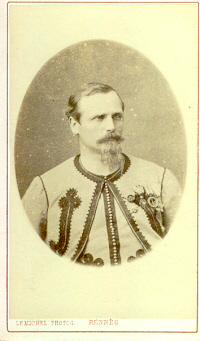
 General Baron Athanase Charles Marie de Charette de la Contrie (born Nantes, 3 September 1832, died La Basse-Motte, Saint-Père, Ille-et-Vilaine, 9 October 1911) was a French Catholic royalist military commander.
His father was a nephew of the famous Vendean General François Athanase de Charette de la Contrie who was the most famous of the commanders of the Grand Catholic and Royal Army which rose in the Vendee and Brittany to oppose the French revolutionaries. He was the last great royalist commander to be captured in the Vendee and was shot at Nantes on 29 March 1795 after a show trial.
His great nephew followed in the same great and glorious tradition of French Catholic royalism. The Baron's mother, Louise, Countess de Vierzon, was the daughter of the Duc de Berry and Amy Brown Freeman. The Duc de Berry was a cousin to the King and a source of loyalty to French royalism.
As the Duchesse de Berry was at that time in hiding at Nantes, and Charette's father was being sought by the police, the child's birth was concealed; he was secretly taken from Nantes on 17 September and was registered in the commune of Sainte-Reine as born on 18 September 1832.
Unwilling, by reason of his legitimist antecedents and beliefs, to serve in France under Louis Philippe I, usurping Orleanist King of the French, young Charette, in 1846, entered the Military Academy of Turin, the capital city of the ancient Savoyard monarchy.
 General the Chevalier François Athanase de Charette de la Contrie, famous Vendean commander-in-chief, and great uncle to General Baron de Charette
However, the Savoyard kingdom of Piedmont was soon to become a tool in the hands of anti-Catholic revolutionaries and, in 1848, the revolutionary policy of that kingdom quickly becoming evident to him, Charette left so as to avoid serving in a revolutionary army.
In 1852 the Habsburg-Este Duke of Modena, Francesco (Francis) V, the brother-in-law of HRH the Comte de Chambord, the true Bourbon successor to the throne of France, appointed Charette a sub-lieutenant in an Austrian regiment stationed in the duchy.
 Duke Francis V of Modena, Archduke of Austria-Este and Jacobite successor to the thrones of England, Scotland and Ireland, he gave Charette a command in an Austrian regiment in Modena
Duke Francis V was not only ruler of Modena but was also an Austrian archduke and the Jacobite successor to the thrones of England, Scotland and Ireland.
Duke Francis was a most exemplary ruler who served the victims of cholera in his duchy with his own hands (there is a plaque to that effect in one of the main churches in the duchy). His duchy, too, was later toppled by the Piedmontese revolutionaries and incorporated into the new, anti-Catholic Italy.
Charette was thereby compelled to relinquish regimental service as, once again, he did not wish to serve in the new revolutionary Italian national army.
However, in May 1860, when two of his brothers, like him eager to fight the Italian revolutionaries, offered their services to the King of Naples, Charette went to Rome and placed himself at the service of Blessed Pope Pius IX, who had commissioned Christophe Léon Louis Juchault de Lamoricière to organize an army for the defence of the Papal States from attack by the red-shirted revolutionaries.
Charette was appointed captain of the first company of the Franco-Belgian Volunteers, known after 1861 as the Pontifical Zouaves, and was wounded at the battle of Castelfidardo (September 1860) when the Papal Army suffered a defeat at the hands of a huge Piedmontese revolutionary army.
 A party of Canadian Pontifical Zouaves
After the taking of Rome by the Piedmontese, Charette negotiated with the French republican political leader, Léon Gambetta, then in power, for the employment of the French Zouaves in the service of France against Germany; he was permitted to organize them as "Volunteers of the West".
Wounded at Loigny, Charette was made prisoner but he escaped, and on 14 January 1871, the Provisional Government of France made him a general.
He was thereafter elected as a monarchist deputy to the National Assembly by the Department of Bouches-du-Rhône, but resigned without taking his seat as he was not willing to serve a revolutionary republican regime.
Louis-Adolphe Thiers, then French Head of State (and provisional President), proposed his entering the French army with his Zouaves, but Charette declared his intention of remaining at the pope's disposal.
On 15 August 1871, his Zouaves were mustered out of the French army.
Retiring into private life, Charette passed his last thirty years serving the cause of religion and hoping for the restoration of the French monarchy.
He was a brave, loyal and true Catholic hero of France.
 General de Charette with Zouave comrades with an image of his great uncle in the background
...





.jpg)










_-002.jpg/220px-Circle_of_Anton_Raphael_Mengs,_Henry_Benedict_Maria_Clement_Stuart,_Cardinal_York_(ca_1750)_-002.jpg)


