Wednesday, 20 April 2011

The Sacred Triduum at the Church of St John, London


British Association of
The Sovereign Military Order of Malta

All services are in the Oratory of the Order:

The Conventual Church of Saint John of Jerusalem
the Hospital of Saint John and Saint Elizabeth
Grove End Road
St John’s Wood
London, NW8 9NH.


MAUNDY THURSDAY (21st April 2011)
Matins and Lauds (‘Tenebrae’) 10.00am
Sext 12.45pm
None 2.30pm
(Vespers are omitted by those assisting in choir at the Evening Mass)
Spiritual Conference on the Liturgy 7.15pm
Solemn Mass ‘in Cena Domini’ 8.00pm
followed by Procession to Altar of Repose and Stripping of the Altars
Compline (at the Altar of Repose) after the Stripping of the Altars

Adoration of the Blessed Sacrament at the Altar of Repose will continue until Midnight.

GOOD FRIDAY (22nd April 2011)
Matins and Lauds (‘Tenebrae’) 10.00am
Sext 12.45pm
None 2.00pm
(Vespers are omitted by those assisting in choir at the Liturgy of the Passion)
Spiritual Conference on the Liturgy 2.15pm
Solemn Liturgy of the Passion 3.00pm
Compline, with Veneration of the relic of the True Cross 6.00pm

HOLY SATURDAY (23rd April 2011)
Matins and Lauds (‘Tenebrae’) 10.00am
Sext 12.45pm
None 2.30pm
Vespers 5.00pm
(Compline and Matins are omitted by those assisting in choir at the Solemn Easter Vigil)
Spiritual Conference on the Liturgy 8.15pm
Solemn Easter Vigil 9.00pm

EASTER SUNDAY (24th April 2011)
Solemn High Mass 11.00am (Ordinary Form)

+++

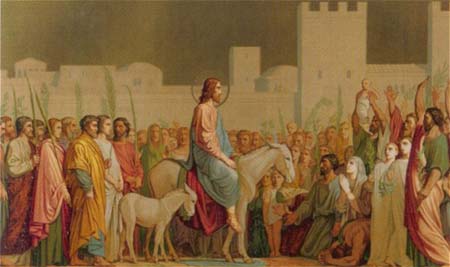
PALM SUNDAY: "The children of Israel carried olive branches..."

This great service celebrates the entry of our Lord into the city of Jerusalem to be welcomed by His people as a king, a prophet and a saviour and as the very Messiah whom they had been awaiting for centuries but, in a few short days, were to reject.

This entry of the humble Christ into the city was foretold and prophesied by the prophet, Zechariah:

"Rejoice greatly, O Daughter of Zion!
Shout, Daughter of Jerusalem!
See, your king comes to you,
righteous and having salvation,
gentle and riding on a donkey, on a colt, the foal of a donkey.
I will take away the chariots from Ephraim
and the war-horses from Jerusalem,
and the battle bow will be broken.
He will proclaim peace to the nations.
His rule will extend from sea to sea
and from the River to the ends of the earth".
(Zechariah 9:9-10)


This service is a particularly fine one, albeit lengthy.

The palms are blessed with many hymns, chants and prayers, and the people receive them, the choir singing Pueri Hebraeorum, portantes ramos olivarum (the children of Israel carrying olive branches), and there is a short-form mass at the altar. After this comes the Procession out of the Church, singing Gloria, laus et honor, tibi sit, Rex Christe Redemptor, and then back to the front door thereof.

At the door, 2 cantors enter and the doors are shut. They continue to sing and then the Subdeacon, outside, knocks on the door with the end of the processional cross. The doors open, to signify the entrance of Christ into Jerusalem and our entry into Heaven, and the procession moves back into the church, singing an ancient chant, Ingrediente Domino.

Then the main mass begins with many haunting and beautiful chants being sung, and then the Passion according to St Matthew in long form is sung, starting at the anointing of the feet of Jesus by St Mary Magdalene in the house of Simon the Leper.

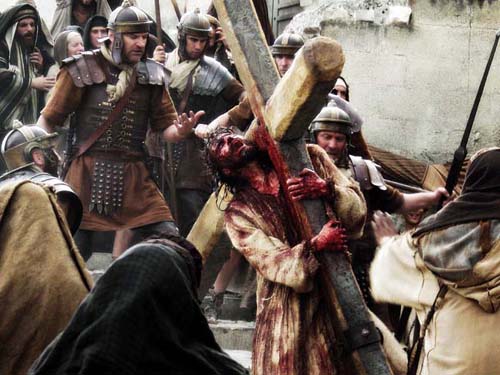
This is a fitting way to recall the beginning of the Passion when our Lord was welcomed as a king and prophet into the holy city of Jerusalem by His people who, only days later, were to betray Him unto their Roman enemies to torture and death.

Soon many of those same Romans were to be converted whilst many of God's chosen rejected the very Messias whom they had been awaiting for so long.

In former times, the celebrating priest would, for the procession, sit upon a donkey to which is attached its colt, as our Lord Himself so sat on the original Palm Sunday.

It is a remarkable fact that every donkey, of the sort upon which our Lord rode, has, by nature, marked upon its back, a black cross to signify the fact that, one day, the Creator of heaven and earth would sit upon the back of this same animal for His entry into the Holy City of Jerusalem, but one week before he would be led, in that came city, to death upon the Cross.


The black cross is clearly visible upon the back of every donkey so that nature itself testifies to the role the donkey would play in carrying the Creator of heaven and earth into the Holy City of Jerusalem on Palm Sunday


In former times, too, the Roman Emperor would lead the Patriarch on a donkey up to the church door as part of the ceremonies and as a gesture of humility on his part. Sadly, the tradition later died out.

This tradition was continued by the Russian Tsars, also, until the custom was suppressed by the modernising, "enlightened" and very brutal dictator, Tsar Peter I.

It is a fitting imitation of the humility of Christ for the supreme spiritual ruler to ride upon a donkey on this day, led by the supreme temporal ruler.

The Donkey

by G.K.Chesterton

When fishes flew and forests walked
And figs grew upon thorn,
Some moment when the moon was blood
Then surely I was born.

With monstrous head and sickening cry
And ears like errant wings,
The devil's walking parody
On all four-footed things.

The tattered outlaw of the earth,
Of ancient crooked will;
Starve, scourge, deride me: I am dumb,
I keep my secret still.

Fools! For I also had my hour;
One far fierce hour and sweet:
There was a shout about my ears,
And palms before my feet.


Hosanna to the son of David!


+++

Thursday, 14 April 2011

PASSION SUNDAY: "Before Abraham was, I AM"

Judica me Deus et discerne causam meam de gente non sancta: ab homine iniquo et doloso eripe me: quia tu es Deus meus , et fortitudo mea...


"Judge me, O God, and distinguish my cause against an ungodly nation: O deliver me from the unjust and deceitful man: for Thou art my God and my strength"
[Ps. 42:1-3, Introit for Passion Sunday and the opening Psalm of every mass]


Vexilla Regis

by Venantius Fortunatus (530-609)

1. Vexilla Regis prodeunt: Fulget Crucis mysterium,
Qua vita mortem pertulit, Et morte vitam protulit.

2. Quae vulnerata lanceae Mucrone diro, criminum
Ut nos lavaret sordibus, Manavit und(a) et sanguine.

3. Impleta sunt quae concinit David fideli carmine,
Dicendo nationibus: Regnavit a ligno Deus.

4. Arbor decor(a) et fulgida, Ornata Regis purpura,
Electa digno stipite Tam sancta membra tangere.

5. Beata, cuius brachiis Pret(i)um pependit saeculi:
Statera facta corporis, Tulitque praedam tartari.

6. O CRUX AVE, SPES UNICA, Hoc Passionis tempore
Piis adauge gratiam, Reisque dele crimina.

7. Te, fons salutis Trinitas, Collaudet omnis spiritus:
Quibus Crucis victoriam Largiris, adde praemium. Amen.


1. Abroad the Regal Banners fly,
Now shines the Cross's mystery;
Upon it Life did death endure,
And yet by death did life procure.

2. Who, wounded with a direful spear,
Did, purposely to wash us clear
From stain of sin, pour out a flood
Of precious Water mixed with Blood.

3. That which the Prophet-King of old
Hath in mysterious verse foretold,
Is now accomplished, whilst we see
God ruling nations from a Tree.

4. O lovely and reflugent Tree,
Adorned with purpled majesty;
Culled from a worthy stock, to bear
Those Limbs which sanctified were.

5. Blest Tree, whose happy branches bore
The wealth that did the world restore;
The beam that did that Body weigh
Which raised up hell's expected prey.

6. HAIL CROSS, OF HOPES THE MOST SUBLIME!
Now in this mournful Passion time,
Improve religious souls in grace,
The sins of criminals efface.

7. Blest Trinity, salvation's spring,
May every soul Thy praises sing;
To those Thou grantest conquest by
The holy Cross, rewards apply. Amen.

In the Gospel for Passion Sunday, our Lord, for the first time, publicly confesses His Godhead by using the sacred Tetragrammaton used only by God of God Himself - the Hebrew phrase "I AM WHO AM" - and He does so in relation to the Father of the Jews, Abraham, in the most sacred manner possible to describe Himself thus making clear to the Jews that He is Moshiach, the Messias, Emmanuel, the King of Kings, the Lord of Lords, Very God of Very God, the Incarnate Deity Himself. The Jews will either believe Him and be saved or else they will call Him a devil, a blasphemer and seek to kill Him...

"31 dicebat ergo Iesus ad eos qui crediderunt ei Iudaeos si vos manseritis in sermone meo vere discipuli mei eritis 32 et cognoscetis veritatem et veritas liberabit vos 33 responderunt ei semen Abrahae sumus et nemini servivimus umquam quomodo tu dicis liberi eritis 34 respondit eis Iesus amen amen dico vobis quia omnis qui facit peccatum servus est peccati 35 servus autem non manet in domo in aeternum filius manet in aeternum

36 si ergo Filius vos liberaverit vere liberi eritis 37 scio quia filii Abrahae estis sed quaeritis me interficere quia sermo meus non capit in vobis 38 ego quod vidi apud Patrem loquor et vos quae vidistis apud patrem vestrum facitis 39 responderunt et dixerunt ei pater noster Abraham est dicit eis Iesus si filii Abrahae estis opera Abrahae facite 40 nunc autem quaeritis me interficere hominem qui veritatem vobis locutus sum quam audivi a Deo hoc Abraham non fecit

41 vos facitis opera patris vestri dixerunt itaque ei nos ex fornicatione non sumus nati unum patrem habemus Deum 42 dixit ergo eis Iesus si Deus pater vester esset diligeretis utique me ego enim ex Deo processi et veni neque enim a me ipso veni sed ille me misit 43 quare loquellam meam non cognoscitis quia non potestis audire sermonem meum 44 vos ex patre diabolo estis et desideria patris vestri vultis facere ille homicida erat ab initio et in veritate non stetit quia non est veritas in eo cum loquitur mendacium ex propriis loquitur quia mendax est et pater eius 45 ego autem quia veritatem dico non creditis mihi

46 quis ex vobis arguit me de peccato si veritatem dico quare vos non creditis mihi 47 qui est ex Deo verba Dei audit propterea vos non auditis quia ex Deo non estis 48 responderunt igitur Iudaei et dixerunt ei nonne bene dicimus nos quia Samaritanus es tu et daemonium habes 49 respondit Iesus ego daemonium non habeo sed honorifico Patrem meum et vos inhonoratis me 50 ego autem non quaero gloriam meam est qui quaerit et iudicat

51 amen amen dico vobis si quis sermonem meum servaverit mortem non videbit in aeternum 52 dixerunt ergo Iudaei nunc cognovimus quia daemonium habes Abraham mortuus est et prophetae et tu dicis si quis sermonem meum servaverit non gustabit mortem in aeternum 53 numquid tu maior es patre nostro Abraham qui mortuus est et prophetae mortui sunt quem te ipsum facis 54 respondit Iesus si ego glorifico me ipsum gloria mea nihil est est Pater meus qui glorificat me quem vos dicitis quia Deus noster est 55 et non cognovistis eum ego autem novi eum et si dixero quia non scio eum ero similis vobis mendax sed scio eum et sermonem eius servo

56 Abraham pater vester exultavit ut videret diem meum et vidit et gavisus est 57 dixerunt ergo Iudaei ad eum quinquaginta annos nondum habes et Abraham vidisti 58 dixit eis Iesus amen amen dico vobis ANTEQUAM ABRAHAM FIERET, EGO SUM 59 tulerunt ergo lapides ut iacerent in eum Iesus autem abscondit se et exivit de templo."


"31 Then Jesus said to those Jews, who believed him: If you continue in my word, you shall be my disciples indeed. 32 And you shall know the truth, and the truth shall make you free. 33 They answered him: We are the seed of Abraham, and we have never been slaves to any man: how sayest thou: you shall be free? 34 Jesus answered them: Amen, amen I say unto you: that whosoever committeth sin, is the servant of sin. 35 Now the servant abideth not in the house for ever; but the son abideth for ever.

36 If therefore the son shall make you free, you shall be free indeed. 37 I know that you are the children of Abraham: but you seek to kill me, because my word hath no place in you. 38 I speak that which I have seen with my Father: and you do the things that you have seen with your father. 39 They answered, and said to him: Abraham is our father. Jesus saith to them: If you be the children of Abraham, do the works of Abraham. 40 But now you seek to kill me, a man who have spoken the truth to you, which I have heard of God. This Abraham did not.

41 You do the works of your father. They said therefore to him: We are not born of fornication: we have one Father, even God. 42 Jesus therefore said to them: If God were your Father, you would indeed love me. For from God I proceeded, and came; for I came not of myself, but he sent me: 43 Why do you not know my speech? Because you cannot hear my word. 44 You are of your father the devil, and the desires of your father you will do. He was a murderer from the beginning, and he stood not in the truth; because truth is not in him. When he speaketh a lie, he speaketh of his own: for he is a liar, and the father thereof. 45 But if I say the truth, you believe me not.

46 Which of you shall convince me of sin? If I say the truth to you, why do you not believe me? 47 He that is of God, heareth the words of God. Therefore you hear them not, because you are not of God. 48 The Jews therefore answered, and said to him: Do not we say well that thou art a Samaritan, and hast a devil? 49 Jesus answered: I have not a devil: but I honour my Father, and you have dishonoured me. 50 But I seek not my own glory: there is one that seeketh and judgeth.

51 Amen, amen I say to you: If any man keep my word, he shall not see death for ever. 52 The Jews therefore said: Now we know that thou hast a devil. Abraham is dead, and the prophets; and thou sayest: If any man keep my word, he shall not taste death for ever. 53 Art thou greater than our father Abraham, who is dead? and the prophets are dead. Whom dost thou make thyself? 54 Jesus answered: If I glorify myself, my glory is nothing. It is my Father that glorifieth me, of whom you say that he is your God. 55 And you have not known him, but I know him. And if I shall say that I know him not, I shall be like to you, a liar. But I do know him, and do keep his word.

56 Abraham your father rejoiced that he might see my day: he saw it, and was glad. 57 The Jews therefore said to him: Thou art not yet fifty years old, and hast thou seen Abraham? 58 Jesus said to them: Amen, amen I say to you, BEFORE ABRAHAM WAS, I AM. 59 They took up stones therefore to cast at him. But Jesus hid himself, and went out of the temple."

[John 8:31-59, Gospel for Passion Sunday]

I AM

...

Wednesday, 13 April 2011

Mary Elizabeth muddles history and cannot distinguish truth from drivel...

Poor Mary Elizabeth!

She replies to my missive to the Sieur de Brantigny and thinks she knows history but...

She thinks that the feudal vassal status of the Duke of Normandy undermines the later claim of King Henry V of England, established at the Treaty of Troyes of 1420 when he was made regent and heir of France.

The Dukes of Normandy, particularly William I, were somewhat nominal vassals. She overlooks this, too.

But she thinks William a "batarde" in name and in nature. She offers no proof.

But she offers plenty of prejudice and declares "who cares?" - even tho' she plainly cares enough to whinge and complain to me about it.

Then she reveals herself as a typical modern hypocrite extolling the so-called "Glorious Revolution", chiefly glorious for imposing the most savagely oppressive and brutal penal code and suppression of religious freedom ever seen in once Christian Europe.

Wonderful pharisaism, Mary Elizabeth!

Next she extols the French Revolution. Yes - that revolution that drowned the people of France, particularly and above all the peasants and ordinary humble people, in an ocean of innocent blood, savagely, brutally, mindlessly, relentlessly, grinding out death like a satanic factory of slaughter - men, women, children, the old, the sick and hundreds of thousands of innocents.

Wonderful pharisaism, Mary Elizabeth!

And, of course, she lastly extols the Easter Rising of 1916, that uprising that was loudly booed and reviled by the people of Dublin whose sons were in Belgium and France fighting the First World War in the trenches. This was the Easter Rising that led to the Irish civil war in which Irishman slaughtered Irishman for the sake of a worthless ideal that has finally left Ireland with a collection of unimpressive twerps of politicians like Bertie Ahern and Brian Cowan and saddled the people with 46 billion euros of debt.

Wonderful pharisaism, Mary Elizabeth!

And - most laughable of all - she calls these shameless disasters...wait for it..."expressions of the will of the peoples of the countries involved - with whom God is surely as concerned as with their...rulers."

Yes, folks.

Really.

Well, you could not make it up, could you?

Mary Elizabeth thinks that God and the people love a massive blood bath of innocent life, the abandonment of religion and humanity and the destruction of the country's economy and wealth.

Wonderful pharisaism, Mary Elizabeth!

Perhaps she thinks Moloch is God?

Clearly whatever satanic "god" she believes in is odious and depraved.

Sadly, folks, this is what modern education has done for some people. They have been so brain-washed that they can no longer distinguish truth from drivel.

Please pray for poor Mary Elizabeth!

...

Tuesday, 12 April 2011

Salutations to the Lord of Brantigny (called Boisvert)...

My dear Monsieur de Brantigny,

I was delighted to read this declaration on your site. I shall share it with readers who may similarly enjoy it. It reads thus:

"Sieur de Brantigny, dit Boisvert, witnessed by the Blessed Mother and the whole Court of Heaven, do solemnly swear by the Holy Gospels (which I touch with my hand) to be loyal and true to Monseigneur le Prince, Louis, le duc d'Anjou, de jure His Most Christian Majesty, Louis XX, by God's Grace King of France and Navarre and that I will do all that lays in my power to bring about his restoration to the Throne of his forefathers and the instauration of the Social Reign of the Sacred and Immaculate Hearts in France and throughout the world. So help me God. Vive Le Roi! Vive le Roi! Vive le Roi!"

I am afraid that your comment on my page "Mo Ghile mear" dedicated to the Bonnie Prince, true King of our three Kingdoms, did not publish for some reason which I cannot fathom, so I am reproducing it here on a fresh page. You wrote:

" '...an Irish tribute to Bonnie Prince Charlie, Prince Charles Edward Stuart, the true King of Scotland, Ireland, and England (and France!)...'. Never France."

Yes, France!

You must add to your stock of historical knowledge, my dear Monsieur, but you must not fear that it will hurt your commendable pride in your country.

Why?

It is simply this. The claim to France is an ancient claim of the English kings but not one that has been taken seriously for many centuries. It is an honorific title that is rather more a compliment to France and her once so Catholic people.

From 1340 to 1801, save between 1360-1369 and 1420–1422, the kings and queens of England, and after the Acts of Union in 1707 the kings and queens of Great Britain, also bore the title of King or Queen of France.

Do not forget that England was conquered by William the Conqueror, Guillaume le Conquerant, not a Frenchman, it is true, but a French-speaking Norman, Duke of Normandy. But Normandy has long been part of France.


King William I of England, the Conqueror, Duke of Normandy


Thus was the Kingdom of England ruled by a Norman-French descendant of the Conqueror, and a Norman-French-speaking aristocracy, which is why, in 1340, King Edward III, a Norman French Plantagenet, claimed the throne of France after the death of his uncle, Charles IV of France.


King Edward III of England and France, Lord of Ireland


Thus began the Hundred Year’s War between the Norman-French “English” and the collection of peoples that lived in the Kingdom of France.

At the time of Charles IV's death in 1328, Edward was his nearest male relative through Edward's mother Isabella of France.

Since the election of Hugh Capet (my own grand-sire, by the way!) as King of France in 987, the French crown has always passed according to the law of the Salian Franks – the Salic Law – through the male line only until 1316.


Hugh “Capet”, Count of Paris, first Duke then King of France,
first of the Capetian line of French kings


However, the rule changed in that year. Louis X, the son of Philip IV “the Fair”, died in that year and, shortly after, so did his son, John I. Should Princess Joan, his daughter, or Prince Philip, his brother, succeed?

Whilst it was agreed that a woman could not possess the throne in her own right, nevertheless Edward III of England, himself Norman-French, argued that the claim could pass through a woman to her son.

However, Philip of Valois came instead to the throne as Philip VI, being cousin-german to the dead king, and so began the House of Valois.

Edward, complaisant at first, later asserted his claim to be King of France.

Edward continued to use this title until the Treaty of Brétigny of 8 May 1360 but later still revived his claim.

This remained the position until the Treaty of Troyes of 21 May 1420, when the English court recognised Charles VI as King of France, but on the basis that his new son-in-law, King Henry V of England, was his rightful heir (disinheriting the Dauphin Charles, Henry adopting the title Heir of France instead).

In 1422, Henry V's son Henry VI, grandson of Charles VI, became King of France as well as England.


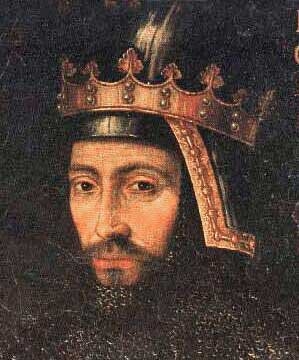
King Henry VI of England and France, Lord of Ireland


So, mon cher monsieur, you are quite wrong to say “never France”. He was, indeed, King of France and recognised as such (for a time) but not for long.

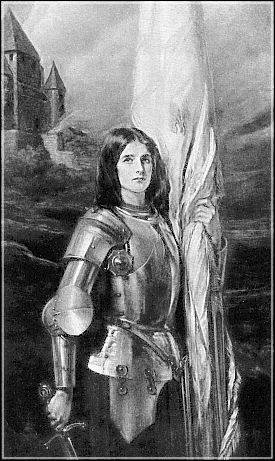
Jeanne la Pucelle, St Joanna of Arc, arose to challenge the King of England and did so, it seems, with heaven on her side.


Jeanne la Pucelle, the Maid of Orleans, St Joan of Arc


The Norman-French “English” and their allies, the Burgundians, were overthrown and the Dauphin crowned at Rheims, the home of French kings and champagne, as Charles VII.

After 1453, the only territory left in the hand of the English crown was Calais, held until 1558.

Nevertheless, the Kings of England continued to use the title “King of France” for long after. Even usurpers, like Lambert Simnel, claimed the title.

And certainly the Jacobite Stewarts claimed the title, although they were allied with King Louis XIV and King James II and VII was long a guest of Louis.


King James II of England and Ireland, VII of Scotland, and of France, the last Catholic king of these islands


Interestingly, the French kings did not object to the claim but saw it as a kind of honour to France.

It was only the odious republic of hate that objected to the title.

The title was not abandoned until after the French Revolution when, at the peace negotiations at the Conference of Lille, in 1797, the French republican delegates demanded that the King of Great Britain abandon the title of King of France as a condition of peace. Britain recognised the French Republic in 1802.

King George III thus chose to drop the title and the fleur de lys was removed from the Royal Arms of Great Britain.

The Jacobite claimant, Cardinal Henry Benedict Stuart, Cardinal-Duke of York and de jure King of England, Scotland, Ireland and France, however, did not recognise the change and continued so to style himself until his death on 13 July 1807.


HRH Henry Benedict Stewart, Cardinal-Duke of York and de jure King Henry IX of England, Scotland, Ireland and France, son of King James III and VIII, grandson of King James II and VII and brother of Prince Charles Edward Stewart, "Bonnie Prince Charlie"


Thereafter, his Jacobite successors continued to include France in their title.

This is history and you must note, mon cher monsieur, that it was the republicans who objected to the use of the title, not the French kings or monarchists.

You are, I see, a Catholic monarchist who recognises King Louis XX. I salute you for it for so do I recognise him.

But let us also disassociate ourselves from the republican dislike of the title “King of France” used by the English kings. Let us consider it always a charming compliment to the Kingdom of France, as did the Kings of France, like King Louis XIV. Thus, you have no need to resent it!


A bas la republique du Mal!

Vive la France!

Vive le roi! Vive Louis XX!


Friday, 8 April 2011

Mo Ghile Mear: "He is my Caesar, gallant darling"

If anyone doubts that the original political belief of the ancient Catholic Gael was that same Christian Roman imperialism that has ever been the mark of Catholic Christianity since the Resurrection of the Lord, they need only listen to this wonderfully beautiful old Gaelic song, Mo Ghile Mear


This version is performed by Mary Black, and is an Irish tribute to Bonnie Prince Charlie, Prince Charles Edward Stuart, the true King of Scotland, Ireland, and England (and France!) and true Prince of Wales, and who, as the commentary on this Youtube version rightly says, sought to put an end to religious persecution in the Three Kingdoms.

He inspired fierce loyalty wherever he went, even tho', alas, the cause was, in the end, lost. The very motto of his family, the Royal Stuarts, was Aymez Loyauté which is Old French for "Love Loyalty".

His beauty and gallantry could not fail to attract the warmest love and loyalty from the fair sex of all classes and some of the most famous songs about him were written by a woman, Carolina Oliphant of Gask, Lady Nairne, a lyric poetess called by her countrymen "the Flower of Strathearn" on account of her own beauty. Born at Gask, in Strathearn, her family ever grew white roses, the symbol of the Stuarts and of legitimate monarchy, in profusion at Gask House.

Prince Charles Edward Stuart was not a Scottish or Irish nationalist, nor any kind of nationalist. He believed in the Three Kingdoms, with three separate parliaments but with one king, the ancient Christian Constitution of the British Isles which guaranteed the fundamental freedoms of every man and woman through the Christian religion, love of God and fellow man, and the laws of men based upon the law of God.

Scotland before 1603 had a separate king but James I and VI merged the two crowns in himself.

Ireland had been a patchwork of kingdoms with one High King, Ard Rí na hÉireann, until Pope Adrian IV, in his Bull Laudabiliter (meaning "praise-worthily"), of 1155, placed Ireland under the rule of the Norman-Angevin King Henry II of England but still under the Pope, as a papal fief.

Pope Adrian made his Bull because of the disturbed condition of both Church and State in Ireland (testified to by no less an authority than St Edmund Campion SJ in his History of Ireland). Whether he was entitled to do so is a disputed question but what cannot be disputed is that the passage of time secured the new settlement, in accordance with canon, civil and moral law. The Bull was recognised by Popes Alexander III and Lucius III and ever after by the Holy See.

King Philip II of Spain and I of England and Ireland, and Queen Mary I (Tudor) of England and Ireland. Prince Charles Edward was the legitimate successor to Queen Mary.


Indeed, so disturbed was Ireland at the time that Diarmaid Mac Murchadha (Dermot MacMorrough), King of Leinster, ousted by other war-like Irish kings and chiefs, invited King Henry II to invade and pledged an oath of allegiance to him. As a further thanks for his reinstatement, MacMurrough's daughter Aoife (Eve) was married to Richard de Clare, 2nd Earl of Pembroke, a Cambro-Norman lord, known colloquially as "Strongbow".

Thereafter, the English kings were also styled "Lord of Ireland", Dominus Hiberniae, although Ireland continued to be ruled by its individual kings, like MacMorrough, in accordance with the devolved, distributist, subsidiarist feudal system.

After the Protestant Reformation King Henry VIII illegally made himself King of Ireland by the Crown of Ireland Act 1542. As the Act was passed after Henry VIII had been excommunicated twice by the Papacy, the title "King of Ireland" was not recognised initially by Europe's Catholic monarchs.

However, once Mary became Queen and made England Catholic once more, Pope Paul IV issued a papal bull in 1555 declaring King Philip II of Spain and Queen Mary of England to be King and Queen of Ireland. After Mary died in 1558, Philip made no claim to the crown, but the principle was established that the Crown of Ireland was recognized by the Holy See, from 1555, as a title of the English Crown.


Here's a toast to Charlie's health...


Prince Charles Edward was a Unionist, but not a parliamentary Unionist like the Whigs and soft Tories. He was for "Home Rule" and self-government, as it had always anciently been, for each of the kingdoms of Scotland, Ireland and England, joined as brother to each other under one king who must protect their liberties and rights, from the highest to the lowest in each kingdom.

He did not believe in the hegemony of the new rich men who had plundered the monasteries and stripped bare the poor but, instead, he believed in that great Christian chivalric principle that the greater and richer the man, the more he owed a duty to his servants, followers and to his country and particularly to the poor and needy. Hence he commanded a great and loyal following who fought fiercely for him to recover the Crown from those exploiters, the treacherous Whigs, the liars and cheats who had deposed his father, King James II and VII, and tried to murder him, as they had murdered his great-grandfather, King Charles I.

The uprising and attempted restoration by Bonnie Prince Charlie of his father, King James III and VIII, was called The Jacobite Uprising This Jacobite Uprising of 1745 very nearly succeeded and Prince Charlie got as far as Derby in his military campaign.


The Bonnie Prince


However, he was fatally persuaded to turn back and lost the momentum and, eventually, the war, and the remnants of his army were butchered savagely by the grotesque Whig and plunderer, the Duke of Cumberland, "Butcher" Cumberland, younger son of the usurping German Hanoverian, George II.

The Prince roamed the Highlands, hidden by loyal men, cared for by Flora MacDonald, and hunted by the Hanoverian government, until he eventually escaped to Europe where he was ever after in exile until his sad death.

Mo Ghile Mear was written by Seán Clárach Mac Dhomhnaill (John Clare MacDonell), c.1691-1757, in loving memory of the Bonnie Prince. It is particularly to be noted that the song-writer refers to him as "my Caesar", the title of the Christian Emperor since Roman times and sometimes borrowed to refer to any Christian king.

Here are the lyrics in both Gaelic and English.

Mo Ghile Mear

Curfa
Sé mo laoch mo Ghile Mear
‘Sé mo Chaesar, Ghile Mear,
Suan ná séan ní bhfuaireas féin
Ó chuaigh i gcéin mo Ghile Mear.

Bímse buan ar buaidhirt gach ló,
Ag caoi go cruaidh ’s ag tuar na ndeór
Mar scaoileadh uaim an buachaill beó
’s ná ríomhtar tuairisc uaidh, mo bhrón

Ní labhrann cuach go suairc ar nóin
Is níl guth gadhair i gcoillte cnó,
Ná maidin shamhraidh i gcleanntaibh ceoigh
Ó d’imthigh sé uaim an buachaill beó.

Marcach uasal uaibhreach óg,
Gas gan gruaim is suairce snódh,
Glac is luaimneach, luath I ngleo
Ag teascadh an tslua ’s ag tuargain treon.

Seinntear stair ar chlairsigh cheoil
’s líontair táinte cárt ar bord
Le hinntinn ard gan chaim, gan cheó
chun saoghal is sláinte d’ fhagháil dom leómhan.

Ghile Mear ‘sa seal faoi chumha,
‘S Éire go léir faoi chlócaibh dubha;
Suan ná séan ní bhfuaireas féin
Ó cuaigh i gcéin mo Ghile Mear.

Seal da rabhas im’ mhaighdean shéimh,
’s anois im’ bhaintreach chaite thréith,
Mo chéile ag treabhadh na dtonn go tréan
De bharr na gcnoc is I n-imigcéin.

Chorus
He is my hero, my gallant darling
He is my Caesar, gallant darling.
I've had no rest from forebodings
Since he went far away my darling.

Every day I am constantly sad
Weeping bitterly and shedding tears
Because our lively lad has left us
And no news from him is heard alas.

The cuckoo sings not pleasantly at noon
And the sound of hounds is not heard in nut-filled woods,
Nor summer morning in misty glen
Since he went away from me, my lively boy.

Noble, proud young horseman
Warrior unsaddened, of most pleasant countenance
A swift-moving hand, quick in a fight,
Slaying the enemy and smiting the strong.

Let a strain be played on musical harps
And let many quarts be filled
With high spirit without fault or mist
For life and health to toast my lion.

Dashing darling for a while under sorrow
And all Ireland under black cloaks
Rest or pleasure I did not get
Since he went far away my dashing darling.

For a while I was a gentle maiden
And now a spent worn-out widow
My spouse ploughing the waves strongly
Over the hills and far away.


Alas! To Lochaber no more....the Prince goes into exile - and over the water - forever more; but the loyal men shall be ever faithful to his memory.


Aymez Loyauté!


+++
Wednesday, 6 April 2011

When republican nationalists went over to Satan...

Here he is, the arch-republican, putting the case for Satan:

http://www.youtube.com/watch?v=ch5u8YbOyIE

I disdain to show his filth on my Blog. Readers will have to follow the link to watch the snake at play.

But be in no doubt. This republican "leader" hereby openly admits to sanctioning cold-blooded, brutal murder.

And now he sits in a constitutional parliament pretending to make law for the rest of us.

With such capitulation to evil, Western democracy seems to be sowing the seeds of its own destruction.

With these views he is well on course to spend eternity with his mentor, the Prince of Darkness.