Wednesday, 13 April 2011

Mary Elizabeth muddles history and cannot distinguish truth from drivel...

Poor Mary Elizabeth!

She replies to my missive to the Sieur de Brantigny and thinks she knows history but...

She thinks that the feudal vassal status of the Duke of Normandy undermines the later claim of King Henry V of England, established at the Treaty of Troyes of 1420 when he was made regent and heir of France.

The Dukes of Normandy, particularly William I, were somewhat nominal vassals. She overlooks this, too.

But she thinks William a "batarde" in name and in nature. She offers no proof.

But she offers plenty of prejudice and declares "who cares?" - even tho' she plainly cares enough to whinge and complain to me about it.

Then she reveals herself as a typical modern hypocrite extolling the so-called "Glorious Revolution", chiefly glorious for imposing the most savagely oppressive and brutal penal code and suppression of religious freedom ever seen in once Christian Europe.

Wonderful pharisaism, Mary Elizabeth!

Next she extols the French Revolution. Yes - that revolution that drowned the people of France, particularly and above all the peasants and ordinary humble people, in an ocean of innocent blood, savagely, brutally, mindlessly, relentlessly, grinding out death like a satanic factory of slaughter - men, women, children, the old, the sick and hundreds of thousands of innocents.

Wonderful pharisaism, Mary Elizabeth!

And, of course, she lastly extols the Easter Rising of 1916, that uprising that was loudly booed and reviled by the people of Dublin whose sons were in Belgium and France fighting the First World War in the trenches. This was the Easter Rising that led to the Irish civil war in which Irishman slaughtered Irishman for the sake of a worthless ideal that has finally left Ireland with a collection of unimpressive twerps of politicians like Bertie Ahern and Brian Cowan and saddled the people with 46 billion euros of debt.

Wonderful pharisaism, Mary Elizabeth!

And - most laughable of all - she calls these shameless disasters...wait for it..."expressions of the will of the peoples of the countries involved - with whom God is surely as concerned as with their...rulers."

Yes, folks.

Really.

Well, you could not make it up, could you?

Mary Elizabeth thinks that God and the people love a massive blood bath of innocent life, the abandonment of religion and humanity and the destruction of the country's economy and wealth.

Wonderful pharisaism, Mary Elizabeth!

Perhaps she thinks Moloch is God?

Clearly whatever satanic "god" she believes in is odious and depraved.

Sadly, folks, this is what modern education has done for some people. They have been so brain-washed that they can no longer distinguish truth from drivel.

Please pray for poor Mary Elizabeth!

...

Tuesday, 12 April 2011

Salutations to the Lord of Brantigny (called Boisvert)...

My dear Monsieur de Brantigny,

I was delighted to read this declaration on your site. I shall share it with readers who may similarly enjoy it. It reads thus:

"Sieur de Brantigny, dit Boisvert, witnessed by the Blessed Mother and the whole Court of Heaven, do solemnly swear by the Holy Gospels (which I touch with my hand) to be loyal and true to Monseigneur le Prince, Louis, le duc d'Anjou, de jure His Most Christian Majesty, Louis XX, by God's Grace King of France and Navarre and that I will do all that lays in my power to bring about his restoration to the Throne of his forefathers and the instauration of the Social Reign of the Sacred and Immaculate Hearts in France and throughout the world. So help me God. Vive Le Roi! Vive le Roi! Vive le Roi!"

I am afraid that your comment on my page "Mo Ghile mear" dedicated to the Bonnie Prince, true King of our three Kingdoms, did not publish for some reason which I cannot fathom, so I am reproducing it here on a fresh page. You wrote:

" '...an Irish tribute to Bonnie Prince Charlie, Prince Charles Edward Stuart, the true King of Scotland, Ireland, and England (and France!)...'. Never France."

Yes, France!

You must add to your stock of historical knowledge, my dear Monsieur, but you must not fear that it will hurt your commendable pride in your country.

Why?

It is simply this. The claim to France is an ancient claim of the English kings but not one that has been taken seriously for many centuries. It is an honorific title that is rather more a compliment to France and her once so Catholic people.

From 1340 to 1801, save between 1360-1369 and 1420–1422, the kings and queens of England, and after the Acts of Union in 1707 the kings and queens of Great Britain, also bore the title of King or Queen of France.

Do not forget that England was conquered by William the Conqueror, Guillaume le Conquerant, not a Frenchman, it is true, but a French-speaking Norman, Duke of Normandy. But Normandy has long been part of France.


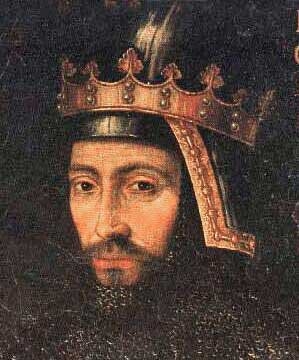
King William I of England, the Conqueror, Duke of Normandy


Thus was the Kingdom of England ruled by a Norman-French descendant of the Conqueror, and a Norman-French-speaking aristocracy, which is why, in 1340, King Edward III, a Norman French Plantagenet, claimed the throne of France after the death of his uncle, Charles IV of France.


King Edward III of England and France, Lord of Ireland


Thus began the Hundred Year’s War between the Norman-French “English” and the collection of peoples that lived in the Kingdom of France.

At the time of Charles IV's death in 1328, Edward was his nearest male relative through Edward's mother Isabella of France.

Since the election of Hugh Capet (my own grand-sire, by the way!) as King of France in 987, the French crown has always passed according to the law of the Salian Franks – the Salic Law – through the male line only until 1316.


Hugh “Capet”, Count of Paris, first Duke then King of France,
first of the Capetian line of French kings


However, the rule changed in that year. Louis X, the son of Philip IV “the Fair”, died in that year and, shortly after, so did his son, John I. Should Princess Joan, his daughter, or Prince Philip, his brother, succeed?

Whilst it was agreed that a woman could not possess the throne in her own right, nevertheless Edward III of England, himself Norman-French, argued that the claim could pass through a woman to her son.

However, Philip of Valois came instead to the throne as Philip VI, being cousin-german to the dead king, and so began the House of Valois.

Edward, complaisant at first, later asserted his claim to be King of France.

Edward continued to use this title until the Treaty of Brétigny of 8 May 1360 but later still revived his claim.

This remained the position until the Treaty of Troyes of 21 May 1420, when the English court recognised Charles VI as King of France, but on the basis that his new son-in-law, King Henry V of England, was his rightful heir (disinheriting the Dauphin Charles, Henry adopting the title Heir of France instead).

In 1422, Henry V's son Henry VI, grandson of Charles VI, became King of France as well as England.


King Henry VI of England and France, Lord of Ireland


So, mon cher monsieur, you are quite wrong to say “never France”. He was, indeed, King of France and recognised as such (for a time) but not for long.

Jeanne la Pucelle, St Joanna of Arc, arose to challenge the King of England and did so, it seems, with heaven on her side.


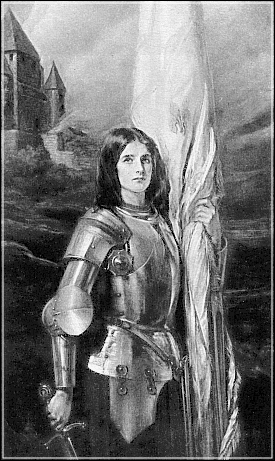
Jeanne la Pucelle, the Maid of Orleans, St Joan of Arc


The Norman-French “English” and their allies, the Burgundians, were overthrown and the Dauphin crowned at Rheims, the home of French kings and champagne, as Charles VII.

After 1453, the only territory left in the hand of the English crown was Calais, held until 1558.

Nevertheless, the Kings of England continued to use the title “King of France” for long after. Even usurpers, like Lambert Simnel, claimed the title.

And certainly the Jacobite Stewarts claimed the title, although they were allied with King Louis XIV and King James II and VII was long a guest of Louis.


King James II of England and Ireland, VII of Scotland, and of France, the last Catholic king of these islands


Interestingly, the French kings did not object to the claim but saw it as a kind of honour to France.

It was only the odious republic of hate that objected to the title.

The title was not abandoned until after the French Revolution when, at the peace negotiations at the Conference of Lille, in 1797, the French republican delegates demanded that the King of Great Britain abandon the title of King of France as a condition of peace. Britain recognised the French Republic in 1802.

King George III thus chose to drop the title and the fleur de lys was removed from the Royal Arms of Great Britain.

The Jacobite claimant, Cardinal Henry Benedict Stuart, Cardinal-Duke of York and de jure King of England, Scotland, Ireland and France, however, did not recognise the change and continued so to style himself until his death on 13 July 1807.


HRH Henry Benedict Stewart, Cardinal-Duke of York and de jure King Henry IX of England, Scotland, Ireland and France, son of King James III and VIII, grandson of King James II and VII and brother of Prince Charles Edward Stewart, "Bonnie Prince Charlie"


Thereafter, his Jacobite successors continued to include France in their title.

This is history and you must note, mon cher monsieur, that it was the republicans who objected to the use of the title, not the French kings or monarchists.

You are, I see, a Catholic monarchist who recognises King Louis XX. I salute you for it for so do I recognise him.

But let us also disassociate ourselves from the republican dislike of the title “King of France” used by the English kings. Let us consider it always a charming compliment to the Kingdom of France, as did the Kings of France, like King Louis XIV. Thus, you have no need to resent it!


A bas la republique du Mal!

Vive la France!

Vive le roi! Vive Louis XX!


Friday, 8 April 2011

Mo Ghile Mear: "He is my Caesar, gallant darling"

If anyone doubts that the original political belief of the ancient Catholic Gael was that same Christian Roman imperialism that has ever been the mark of Catholic Christianity since the Resurrection of the Lord, they need only listen to this wonderfully beautiful old Gaelic song, Mo Ghile Mear


This version is performed by Mary Black, and is an Irish tribute to Bonnie Prince Charlie, Prince Charles Edward Stuart, the true King of Scotland, Ireland, and England (and France!) and true Prince of Wales, and who, as the commentary on this Youtube version rightly says, sought to put an end to religious persecution in the Three Kingdoms.

He inspired fierce loyalty wherever he went, even tho', alas, the cause was, in the end, lost. The very motto of his family, the Royal Stuarts, was Aymez Loyauté which is Old French for "Love Loyalty".

His beauty and gallantry could not fail to attract the warmest love and loyalty from the fair sex of all classes and some of the most famous songs about him were written by a woman, Carolina Oliphant of Gask, Lady Nairne, a lyric poetess called by her countrymen "the Flower of Strathearn" on account of her own beauty. Born at Gask, in Strathearn, her family ever grew white roses, the symbol of the Stuarts and of legitimate monarchy, in profusion at Gask House.

Prince Charles Edward Stuart was not a Scottish or Irish nationalist, nor any kind of nationalist. He believed in the Three Kingdoms, with three separate parliaments but with one king, the ancient Christian Constitution of the British Isles which guaranteed the fundamental freedoms of every man and woman through the Christian religion, love of God and fellow man, and the laws of men based upon the law of God.

Scotland before 1603 had a separate king but James I and VI merged the two crowns in himself.

Ireland had been a patchwork of kingdoms with one High King, Ard Rí na hÉireann, until Pope Adrian IV, in his Bull Laudabiliter (meaning "praise-worthily"), of 1155, placed Ireland under the rule of the Norman-Angevin King Henry II of England but still under the Pope, as a papal fief.

Pope Adrian made his Bull because of the disturbed condition of both Church and State in Ireland (testified to by no less an authority than St Edmund Campion SJ in his History of Ireland). Whether he was entitled to do so is a disputed question but what cannot be disputed is that the passage of time secured the new settlement, in accordance with canon, civil and moral law. The Bull was recognised by Popes Alexander III and Lucius III and ever after by the Holy See.

King Philip II of Spain and I of England and Ireland, and Queen Mary I (Tudor) of England and Ireland. Prince Charles Edward was the legitimate successor to Queen Mary.


Indeed, so disturbed was Ireland at the time that Diarmaid Mac Murchadha (Dermot MacMorrough), King of Leinster, ousted by other war-like Irish kings and chiefs, invited King Henry II to invade and pledged an oath of allegiance to him. As a further thanks for his reinstatement, MacMurrough's daughter Aoife (Eve) was married to Richard de Clare, 2nd Earl of Pembroke, a Cambro-Norman lord, known colloquially as "Strongbow".

Thereafter, the English kings were also styled "Lord of Ireland", Dominus Hiberniae, although Ireland continued to be ruled by its individual kings, like MacMorrough, in accordance with the devolved, distributist, subsidiarist feudal system.

After the Protestant Reformation King Henry VIII illegally made himself King of Ireland by the Crown of Ireland Act 1542. As the Act was passed after Henry VIII had been excommunicated twice by the Papacy, the title "King of Ireland" was not recognised initially by Europe's Catholic monarchs.

However, once Mary became Queen and made England Catholic once more, Pope Paul IV issued a papal bull in 1555 declaring King Philip II of Spain and Queen Mary of England to be King and Queen of Ireland. After Mary died in 1558, Philip made no claim to the crown, but the principle was established that the Crown of Ireland was recognized by the Holy See, from 1555, as a title of the English Crown.


Here's a toast to Charlie's health...


Prince Charles Edward was a Unionist, but not a parliamentary Unionist like the Whigs and soft Tories. He was for "Home Rule" and self-government, as it had always anciently been, for each of the kingdoms of Scotland, Ireland and England, joined as brother to each other under one king who must protect their liberties and rights, from the highest to the lowest in each kingdom.

He did not believe in the hegemony of the new rich men who had plundered the monasteries and stripped bare the poor but, instead, he believed in that great Christian chivalric principle that the greater and richer the man, the more he owed a duty to his servants, followers and to his country and particularly to the poor and needy. Hence he commanded a great and loyal following who fought fiercely for him to recover the Crown from those exploiters, the treacherous Whigs, the liars and cheats who had deposed his father, King James II and VII, and tried to murder him, as they had murdered his great-grandfather, King Charles I.

The uprising and attempted restoration by Bonnie Prince Charlie of his father, King James III and VIII, was called The Jacobite Uprising This Jacobite Uprising of 1745 very nearly succeeded and Prince Charlie got as far as Derby in his military campaign.


The Bonnie Prince


However, he was fatally persuaded to turn back and lost the momentum and, eventually, the war, and the remnants of his army were butchered savagely by the grotesque Whig and plunderer, the Duke of Cumberland, "Butcher" Cumberland, younger son of the usurping German Hanoverian, George II.

The Prince roamed the Highlands, hidden by loyal men, cared for by Flora MacDonald, and hunted by the Hanoverian government, until he eventually escaped to Europe where he was ever after in exile until his sad death.

Mo Ghile Mear was written by Seán Clárach Mac Dhomhnaill (John Clare MacDonell), c.1691-1757, in loving memory of the Bonnie Prince. It is particularly to be noted that the song-writer refers to him as "my Caesar", the title of the Christian Emperor since Roman times and sometimes borrowed to refer to any Christian king.

Here are the lyrics in both Gaelic and English.

Mo Ghile Mear

Curfa
Sé mo laoch mo Ghile Mear
‘Sé mo Chaesar, Ghile Mear,
Suan ná séan ní bhfuaireas féin
Ó chuaigh i gcéin mo Ghile Mear.

Bímse buan ar buaidhirt gach ló,
Ag caoi go cruaidh ’s ag tuar na ndeór
Mar scaoileadh uaim an buachaill beó
’s ná ríomhtar tuairisc uaidh, mo bhrón

Ní labhrann cuach go suairc ar nóin
Is níl guth gadhair i gcoillte cnó,
Ná maidin shamhraidh i gcleanntaibh ceoigh
Ó d’imthigh sé uaim an buachaill beó.

Marcach uasal uaibhreach óg,
Gas gan gruaim is suairce snódh,
Glac is luaimneach, luath I ngleo
Ag teascadh an tslua ’s ag tuargain treon.

Seinntear stair ar chlairsigh cheoil
’s líontair táinte cárt ar bord
Le hinntinn ard gan chaim, gan cheó
chun saoghal is sláinte d’ fhagháil dom leómhan.

Ghile Mear ‘sa seal faoi chumha,
‘S Éire go léir faoi chlócaibh dubha;
Suan ná séan ní bhfuaireas féin
Ó cuaigh i gcéin mo Ghile Mear.

Seal da rabhas im’ mhaighdean shéimh,
’s anois im’ bhaintreach chaite thréith,
Mo chéile ag treabhadh na dtonn go tréan
De bharr na gcnoc is I n-imigcéin.

Chorus
He is my hero, my gallant darling
He is my Caesar, gallant darling.
I've had no rest from forebodings
Since he went far away my darling.

Every day I am constantly sad
Weeping bitterly and shedding tears
Because our lively lad has left us
And no news from him is heard alas.

The cuckoo sings not pleasantly at noon
And the sound of hounds is not heard in nut-filled woods,
Nor summer morning in misty glen
Since he went away from me, my lively boy.

Noble, proud young horseman
Warrior unsaddened, of most pleasant countenance
A swift-moving hand, quick in a fight,
Slaying the enemy and smiting the strong.

Let a strain be played on musical harps
And let many quarts be filled
With high spirit without fault or mist
For life and health to toast my lion.

Dashing darling for a while under sorrow
And all Ireland under black cloaks
Rest or pleasure I did not get
Since he went far away my dashing darling.

For a while I was a gentle maiden
And now a spent worn-out widow
My spouse ploughing the waves strongly
Over the hills and far away.


Alas! To Lochaber no more....the Prince goes into exile - and over the water - forever more; but the loyal men shall be ever faithful to his memory.


Aymez Loyauté!


+++

Wednesday, 6 April 2011

When republican nationalists went over to Satan...

Here he is, the arch-republican, putting the case for Satan:

http://www.youtube.com/watch?v=ch5u8YbOyIE

I disdain to show his filth on my Blog. Readers will have to follow the link to watch the snake at play.

But be in no doubt. This republican "leader" hereby openly admits to sanctioning cold-blooded, brutal murder.

And now he sits in a constitutional parliament pretending to make law for the rest of us.

With such capitulation to evil, Western democracy seems to be sowing the seeds of its own destruction.

With these views he is well on course to spend eternity with his mentor, the Prince of Darkness.

Friday, 11 March 2011

Bertrand Russell and racism - the Pharisee of the drawing room

Bertrand, Earl Russell was one of the more hypocritical of the thinkers of the Left.

Living a life of ease and comfort due to mere circumstances of birth, he nevertheless claimed to believe in neither. He even claimed to be a "liberal" (i.e. Leftist) because his ancestors were!

Russell's ancestors were those same Russells who had seized upon the property of the monasteries, enriching themselves at the expense of the poor and becoming the new, dominant men of the Tudor period, avaricious, greedy, narrow, cunning, sly, anti-Catholic thieves, robbers and murderers.

These were the "liberals" Russell seemed to be proud of descending from.

Russell himself seemed incapable of seeing the irony of his being proud to descend from such scoundrels whilst claiming, himself, to be a champion of right. In fact, he resembled his hypocritical ancestors all too well.

John Russell, 1st Earl of Bedford,
the ancestors of the Russells, who enriched himself from the monasteries and the patrimony of the poor, he helped suppress the Catholic Pilgrimage of Grace, and was a friend of the odious Thomas Cromwell. On the dissolution of the greater monasteries Henry VIII granted him lands and properties of the Cistercian Abbey at Dunkeswell, Devon, the Abbey of Tavistock, Devon, and the kitchen garden of Westminster Abbey, which is now the site of Covent Garden. He was created Earl of Bedford on 19 January 1549 for persecuting and murdering Catholics, smashing religious statues and relics, and for promoting heresy. A perfect ratbag, he died in his bed.


Bertrand Russell purported to champion women but did not scruple to leave a trail of destruction behind his numerous marital infidelities.

He began (inevitably) by supporting the Communist revolution until it turned into what anyone with common sense (which ruled out Russell) could see it would turn into - a bloodbath.

As to race, he was, like Marx, a racist.

Here are a couple of choice quotes:

"In extreme cases there can be little doubt of the superiority of one race to another[...] It seems on the whole fair to regard Negroes as on the average inferior to white men, although for work in the tropics they are indispensable, so that their extermination (apart from the question of humanity) would be highly undesirable".

—Bertrand Russell, Marriage and Morals, 1929, p.266.

He was a supporter of birth control for eugenic reasons, sharing this particularly odious view with Hitler and the Nazis.

On 16 November 1922, for instance, he gave a lecture to the General Meeting of Marie Stopes' Society for Constructive Birth Control and Racial Progress on "Birth Control and International Relations," in which he described the importance of extending Western birth control worldwide so as to avoid an encroachment of the non-white races.

His views prefigure those of the population control movement of the 1960s but their origins lie deep in the so-called "racial hygiene" movement that inspired the Nazis.

Marie Stopes.
Butter wouldn't melt in the mouth of this enthusiastic Nazi-sympathiser and eugenic campaigner for "racial hygiene" and the "elimination" of "inferior" races.


It was no accident that Marie Stopes was an enthusiast for Nazism, nor that the funder of research that resulted in the contraceptive pill, Margaret Sanger, was also an enthusiast for Nazism.

Sanger even lectured on birth control to the women's auxiliary of the Ku Klux Klan (e.g. at in Silver Lake, New Jersey in 1926) as she admitted in her autobiography Margaret Sanger, An Autobiography. New York: W. W. Norton, 1938, pp. 361, 366–7.

Margaret Sanger, eugenicist, racist and enthusiast for Nazism.


In 1935 Stopes attended the International Congress for Population Science in Berlin, held under the Nazi regime. Even other birth-control enthusiasts, such as Havelock Ellis, admitted Stopes was anti-Semitic.

She was, indeed, a personal and political devotee of Adolf Hitler, once writing to him thus:

“Dear Herr Hitler, Love is the greatest thing in the world: so will you accept from me these (poems) that you may allow the young people of your nation to have them?”

Her son, Dr Harry Stopes-Roe, is an advocate of euthanasia and, along with Richard "Dorky" Dawkins, a Vice-President of the British Humanist Association which rejects any idea of God.

Now let's hear what Russell said:

"This policy may last some time, but, in the end, under it we shall have to give way — we are only putting off the evil day; the one real remedy is birth control, that is getting the people of the world to limit themselves to those numbers which they can keep upon their own soil... I do not see how we can hope permanently to be strong enough to keep the coloured races out; sooner or later they are bound to overflow, so the best we can do is to hope that those nations will see the wisdom of Birth Control.... We need a strong international authority."

- "Lecture by Bertrand Russell", Birth Control News, vol 1, no 8 (December 1922), p.2.

And the merchants of racism and death are still with us, alas, despite the defeat of Hitler and his thugs.


The logic of eugenics!

...

Wednesday, 9 March 2011

Ash Wednesday: "Remember man, that thou are dust and unto dust thou shalt return!"


Meménto, homo, quia pulvis es, et in púlverem revertéris

Remember, man, that thou art dust, and unto dust thou shalt return


"What profit hath a man of all his labour which he taketh under the sun? One generation passeth away, and another generation cometh..." [Ecclesiasticus 1]

"Remember friends as you pass by,
as you are now so once was I.
As I am now so you must be.
Prepare for death and follow me."

So may we well begin this Holy Season of Lent which so much reminds us of the transience of this life and, in contrast, the joys of heaven to come.

In a sense, there is both joy and sadness in Lent - sadness at death but joy at life, the life to come. Lent signifies the 40 days that our Lord spent in the desert fasting and doing penance for us and giving us an example of the way in which we can discipline ourselves to withstand the temptations of the world, grow in grace and virtue and become more truly ourselves, rather than our appetites.

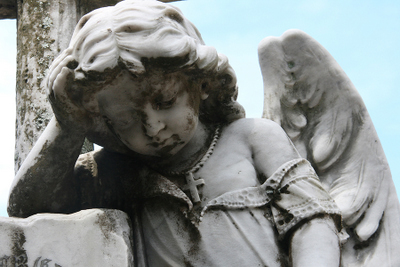
This is our recollection behind the imposition of ashes on the forehead on Ash Wednesday. We are reminded of our mortality and that we shall return unto the dust from which man was originally made.

The words said by the priest come from Genesis 3:19 when Adam and Eve were made subject to the corruption of death and dying with the words of God ringing in their ears:

"for dust thou art, and unto dust thou shalt return"


From the Roman Office of the Dead, the Anglican divines took the words of Job and used them for the Anglican burial service. They have since thereby become famous, used in many a film setting. They are powerful words:

"MAN THAT IS BORN OF WOMAN hath but a short time to live, and is full of misery. He cometh up and is cut down like a flower; he flieth as it were a shadow, and never continueth in one stay. In the midst of life we be in death: of whom may we seek for succour but of thee, O Lord, which for our sins justly art displeased. Yet, O Lord God most holy, O Lord most mighty, O holy and most merciful saviour, deliver us not into the bitter pains of eternal death. Thou knowest, Lord, the secrets of our hearts, shut not up thy merciful eyes to our prayers: but spare us Lord most holy, O God most mighty, O holy and merciful saviour, thou most worthy judge eternal, suffer us not at our last hour for any pains of death to fall from thee." [Job 11]

On Ash Wednesday, the ashes are made by the burning of the palms from the previous year's Easter.

The imposition of ashes signifies sorrow for sin, contrition, spiritual aid and the receiving of grace thereby.

The head, being the seat of pride, is then imposed with ashes in the form of a cross as the priest utters the words reminding us of our mortality.

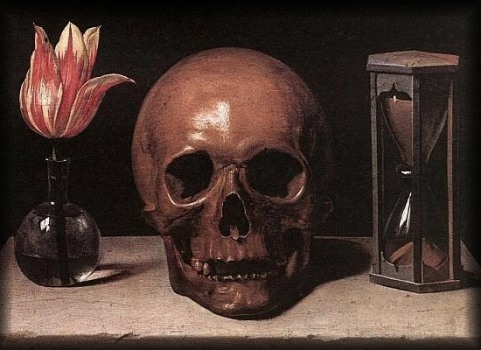
We should wear this sign of penance as a memento mori (remembrance of death) and as a sign of witness against the concupiscence of the world.


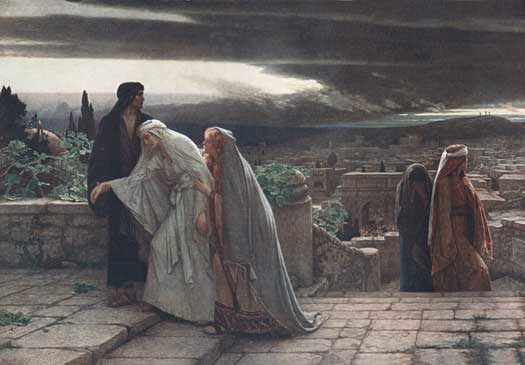
This painting shows the return of the Blessed Virgin after the Crucifixion on Calvary.

In the distance can be seen the 3 crosses upon Calvary mount. It is a fitting theme for the penitential season of Lent - or Great Lent as the Greeks call it. Lent is a time of very moving and indeed hauntingly beautiful liturgy and chant.

Ash Wednesday begins with the reading from Joel the Prophet, Chapter 2:

“Now therefore saith the Lord: Be converted to me with all your heart, in fasting, and in weeping, and in mourning. 13 And rend your hearts, and not your garments, and turn to the Lord your God: for he is gracious and merciful, patient and rich in mercy, and ready to repent of the evil. 14 Who knoweth but he will return, and forgive, and leave a blessing behind him, sacrifice and libation to the Lord your God? 15 Blow the trumpet in Sion, sanctify a fast, call a solemn assembly, 16 Gather together the people, sanctify the church, assemble the ancients, gather together the little ones, and them that suck at the breasts: let the bridegroom go forth from his bed, and the bride out of her bride chamber. 17 Between the porch and the altar the priests the Lord's ministers shall weep, and shall say: Spare, O Lord, spare thy people: and give not thy inheritance to reproach, that the heathen should rule over them. Why should they say among the nations: Where is their God? 18 The Lord hath been zealous for his land, and hath spared his people. 19 And the Lord answered and said to his people: Behold I will send you corn, and wine, and oil, and you shall be filled with them: and I will no more make you a reproach among the nations.”

On the First Sunday of Lent the Gospel reminds us of the precedent for Lent: our Lord's 40 days in the desert fasting.

On the Saturday in Ember week of Lent, when it was customary to have Ordinations to the clerical state, there are 6 readings including the Gospel and many beautiful chants.

In many communities, both religious and secular, it was also customary to have numerous additional pious devotions including chants, hymns and canticles dedicated to the instruments of the Passion, for instance the Holy Lance and the Holy Nails.


Ivan Kramskoy. 1872. Christ in the Desert.


In English-speaking countries there are many customary hymns such as this well-known one below by Rev Fr Vaughan CSSR which captures the spirit of Lent very well...


God of mercy and compassion,
Look with pity upon me,
Father, let me call Thee Father,
'Tis Thy child returns to Thee.

Refrain:
Jesus, Lord, I ask for mercy;
Let me not implore in vain;
All my sins, I now detest them,
Never will I sin again.

2. By my sins I have deserved
Death and endless misery,
Hell with all its pains and torments,
And for all eternity.

3. By my sins I have abandoned
Right and claim to heav'n above.
Where the saints rejoice forever
In a boundless sea of love.

4. See our Saviour, bleeding, dying,
On the cross of Calvary;
To that cross my sins have nail'd Him,
Yet He bleeds and dies for me.


Love never dies...

...

Monday, 7 March 2011

Quinquagesima Sunday

Quinquagesima is the name for the Sunday before Ash Wednesday. It was also called Esto mihi after the opening words of the Introit, taken from Psalm 31:3.

The Gospel tells us the wonderful story of the man who was blind and our Lord, hearing his cry for aid, miraculously cures him.

The name stems from the Latin quinquagesimus (fiftieth) which refers to the fifty days before Easter Day, counting so as to include Sundays.

Since the forty days of the Lenten fast do not include Sundays, the first day of Lent, Ash Wednesday, succeeds Quinquagesima Sunday three days later.


The earliest Quinquagesima can occur is 1 February and the latest is 7 March. This year, 2011, it falls upon 6 March, and so very late.

Needless to say, Archbishop Annibale Bugnini with his egalitarian-republican-Liberal-Modernist preference for the grey, the dull and the tedious did away with this day in his Novus Ordo Missae Calendar, together with the two preceding Sundays, Sexagesima and Septuagesima.

It is, of course, retained in the traditional mass and the lesson is taken from St Paul's Letter to the Corinthians [1 Cor. 13. 1] with that most beautiful of passages so evocative of the Christian Catholic faith.

Let us conclude with it.

THOUGH I speak with the tongues of men and of angels, and have not love, I am become as sounding brass, or a tinkling cymbal. And though I have the gift of prophecy, and understand all mysteries, and all knowledge; and though I have all faith, so that I could remove mountains, and have not love, I am nothing. And though I bestow all my goods to feed the poor, and though I give my body to be burned, and have not love, it profiteth me nothing. Love suffereth long, and is kind; love envieth not; love vaunteth not itself, is not puffed up, doth not behave itself unseemly, seeketh not her own, is not easily provoked, thinketh no evil; rejoiceth not in iniquity, but rejoiceth in the truth; beareth all things, believeth all things, hopeth all things, endureth all things. Love never faileth: but whether there be prophecies, they shall fail; whether there be tongues, they shall cease; whether there be knowledge, it shall vanish away. For we know in part, and we prophesy in part. But when that which is perfect is come, then that which is in part shall be done away. When I was a child, I spake as a child, I understood as a child, I thought as a child; but when I became a man, I put away childish things. For now we see through a glass darkly; but then face to face: now I know in part; but then shall I know even as also I am known. And now abideth faith, hope, love, these three:

BUT THE GREATEST OF THESE IS


LOVE


Love never faileth...

...