Showing posts with label pope. Show all posts

Wednesday, 20 August 2008

How do we know the Pope is infallible?

The simple answer is because God said so at Matt 16:18.

That, however, will not satisfy the sceptics.

Now, as a result of my earlier post, someone has asked me this same question.

I anticipated this, hence, in part, my earlier post on the subject.

So here's part of the answer I gave which I hope might be of interest to others.

Belief in the infallibility of the pope is a rational belief and can be proved rationally. However, an argument can be proved rationally and yet still be disbelieved. That is because people are not always rational.

All belief-systems - even atheism - are claimed by their adherents to be true. For a proposition to be true it has to be proved to be true or, at the least, not proved to be false.

Very few people think that the belief-system they choose to believe in is false, or even doubtful. Otherwise they would not believe in it.

This is the simplest form of "infallibility" - self-belief in one's own belief-system.

Now, if a person can be convincingly shown that his belief-system is false then it is a fair probability that he will eventually abandon it.

Catholics are no different in this respect.


Caravaggio. Martyrdom of St. Peter. C. 1601


The doctrine of papal infallibility is closely defined by the very organ which claims to exercise that infallibility viz., the Pope and an Ecumenical Council ratified by him.

The definition of papal infallibility made at the 1st Vatican Council in 1870 states as follows:

"We teach and define as a divinely revealed dogma that when the Roman Pontiff speaks EX CATHEDRA, that is, when, in the exercise of his office as shepherd and teacher of all Christians, in virtue of his supreme apostolic authority, he defines a doctrine concerning faith or morals to be held by the whole Church, he possesses, by the divine assistance promised to him in blessed Peter, that infallibility which the divine Redeemer willed his Church to enjoy in defining doctrine concerning faith or morals."

There are 5 conditions set out in this definition.

If this definition is false, it ought therefore to be easy to rebut it by looking at the definitions of popes and Councils over the last 2,000 years of Roman Catholic Christianity.

All one need do is show that one pope or Council made a definition clearly inconsistent with, or contrary to, another such definition.

The problem is that you can't.

It has been tried and no-one has been able to show that the proposition is false.

There have been some close calls e.g. Popes Liberius, Honorius, John XXII and a few others. However, none of these entailed a clear contradiction.

The worst that can be said is that a papal, or papally approved, definition was ambiguous.

Ambiguity is not contradiction.

That is the first test - consistency.


The Altar of the Chair in the apse of St Peter's Basilica,
symbol of the Petrine teaching authority of the popes, given to them by our Lord Himself when He said (Matt 16:18) to St Peter "Thou are Peter, the Rock, and upon this Rock I shall built my Church and the gates of Hell shall not prevail against it". Around the interior of St Peter's dome those words are transcribed in Latin: Tu es Petrus, et superhanc Petram aedificabo ecclesiam meam.


And it is a remarkable fact that the Catholic Church is the only belief-system in the world that can claim complete consistency of definitive teaching by its definitive teaching authority.

All other major world religions either do not have a teaching authority at all or else have an authority that does not teach consistently.

Round One to the Catholic Church.

And it is a vitally important round because if all other belief-systems fail the test of consistency of doctrine then they are simply not credible as belief-systems. And if the only one left is Catholicism then it has the best claim to be the true belief-system, even if only comparatively.

But consistency is not all. One can be consistently wrong, for example.

In his Development of Christian Doctrine, Cardinal Newman went on to provide a list of 7 truth-tests which he applied to the development of Christian doctrine.

These 7 tests are those which can be readily seen to distinguish a corruption from a true development of doctrine.

By this Newman means, for example, a modern doctrine which clearly contradicts an earlier doctrine which is nevertheless claimed to belong to the same belief-system.

Here is a further example. A sect that claims that its members are the only true Christians but which teaches that faith saves but that virtuous works do not, teaches a doctrine which is not taught by Scripture. Moreover, all relevant historical records show such was not taught by the early Christian teachers. The sect's teaching is therefore a corruption and not a true development.


Cardinal Newman (1801-1890)


Newman's 7 tests of a true doctrinal development are:

(1) preservation of type;
(2) continuity of principles;
(3) the power of assimilating apparently foreign material without corruption;
(4) 'logical sequence' of ideas;
(5) 'early anticipation' of the future, mature form;
(6) conservation of the course of antecedent developments; and finally,
(7) 'chronic continuance'.

He then applies all of these tests to the various forms of Christianity and is forced, against his initial will, to conclude that only the Roman Catholic form of Christianity passes all these tests. Indeed, all the other forms fail the majority of these tests.

He considers all major Catholic doctrines in so doing.

Exactly the same exercise can be done for all the other major world religions and there one finds that none of them meet all, or even many, of the tests of a true doctrinal development.

In a further book, his Grammar of Assent, Newman then looks at what is required for logical assent to any set of metaphysical doctrines and shows, with ineluctable logic, why only the teaching of the Roman Catholic Church merits such assent.

This is predicated on both deduction, as is metaphysical logic, but also upon induction, as all science is. From both forms of logic Newman proves the truth of Catholic Christianity and, indirectly therefore, of the doctrine of papal infallibility.

Formal inference is logic in the deductive sense. For Newman, logic is indeed extremely useful especially in science and in society. However, its usefulness is circumscribed by its initial assumptions.

Informal inference is akin to calculus. In informal inference one reaches a conclusion by considering the accumulation of converging antecedent probabilities. Natural inference is when the individual, in a simple and whole process, grasps the antecedent conditions and conclusions instantaneously. For instance, if one sees smoke, one may instantly infer the presence of fire. Natural inference, in Newman's view, is related to experience or innate ability.

Newman maintained that in real life, converging probabilities in favour of a conclusion are the basis upon which decision-making is made. One might cite statistical surveys, polls and so on as modern examples of such. The greater the accumulation of probabilities, the greater the likelihood of truth. This, too, is how a court of law works in arriving at findings of fact.

From his tests, Newman shows that non-Catholic religions are easily and readily dismissed as logically inconsistent and purely fallible, not infallible.

Complete atheism, however, cannot be dismissed so readily on that basis. It is at least consistent in claiming that there is no God at all.

However, atheism fails on other, more obvious, grounds.


St Thomas Aquinas, the Dominican friar called by the Church "Angelic Doctor", probably the greatest of all the Doctors of the Church


These grounds are addressed by St Thomas Aquinas in his Summa Contra Gentiles which was aimed at non-Christians.

In this work he sets out his famous "5 Ways" which prove the existence of God. They are all eminently logical, convincing and rational.

The most famous is the argument for an "unmoved mover", predicated upon a regress of motion or causes back to an original "unmoved mover" or "uncaused cause" which men call God.

We see all around us that events have causes. How is it that all events in the Universe have efficient causes but not the main event, the creation of time and space?

If there was a "Big Bang" then what, or who, caused the "Big Bang"?

To say "no-one" or "nothing" is to say that a Universe of causes and effects has no cause and effect.

This is simply not credible.


Start with a Bang?
There may have been a Big Bang but if so, who or what caused it?


We return to "papal infallibility".

Every belief-system has its teachers. All, except the Catholic Church, are either inconsistent at some time and place or else claim no clear authority and do not claim any definitive truth.

Any rational person must thus either go on and try to prove this statement to be untrue or else admit that papal infallibility cannot be impugned as inconsistent or illogical.

That being so then, if he cannot also disprove the logical inconsistency of other belief-systems, he ought, logically, to endorse papal infallibility by reason of the accumulation of evidence that Newman indicates is the basis of assent in the human mind in real life.

Putting it very simply, if the sun rises every day and sets every day then one cannot with absolute certainty say "the sun will rise and set tomorrow" but one may be sufficiently sure as to say that it is a truth that the sun rises and sets every day.

So, too, if one can show that the popes and Councils of the Roman Catholic Church have never, when making a purportedly infallible definition, contradicted themselves or made an internally illogical or contradictory definition, and that over the full length of 2,000 years since the Church came into existence, then one may say, with the same degree of certitude as in the sun rising and setting analogy, that papal infallibility is a true doctrine.

If it is indeed true then we have a final authority on earth for the declaration of truth and must follow it whenever it speaks, as being an organ through which the divine oracle itself speaks.

On the evidence of its self-consistency and passing of the 7 Newmanite tests, anyone who says that it is not true will either have to show how it fails those tests or else admit that he is saying something as sub-rational as that the sun will not rise and set tomorrow.

Now, no-one has been able clearly to show that the doctrine of papal infallibility fails the test of self-consistency or that it fails any of the other tests of a true doctrine.

Thus to deny papal infallibility is akin to denying that the sun will not rise and set tomorrow.


Our Lord washing the feet of St Peter, His first pope,
a painting by Ford Maddox Brown in the pre-Raphaelite school


Indeed, it is still more absurd since it is more probable that there may come a time when the sun will fail to rise and set. The idea that God could so providentially provide that, for 2,000 years, the organ that claims to be His final teaching authority on earth should teach consistently and without internal contradiction or logical error, but that He might allow it to fail at some future time and so amount to a supreme deception, is as absurd as suggesting that the whole Universe is the creation of a malignant arch-demon bent upon deceiving all mankind for no apparent purpose.

There may be some people who believe such an absurdity but few would give such persons much credence.

Even atheists like Dawkins and Hitchens would laugh at such an idea. They prefer random natural selection - not a supernatural deceiver. If they believed in the latter then they would, logically, believe in a a god-figure but, since they are atheists, they do not.

Belief in papal infallibility is thus entirely rational and far more rational than belief in any other belief-system, whether atheist or theist.

Ergo.

Anyone care to have a go at challenging this argument?

Over to you.


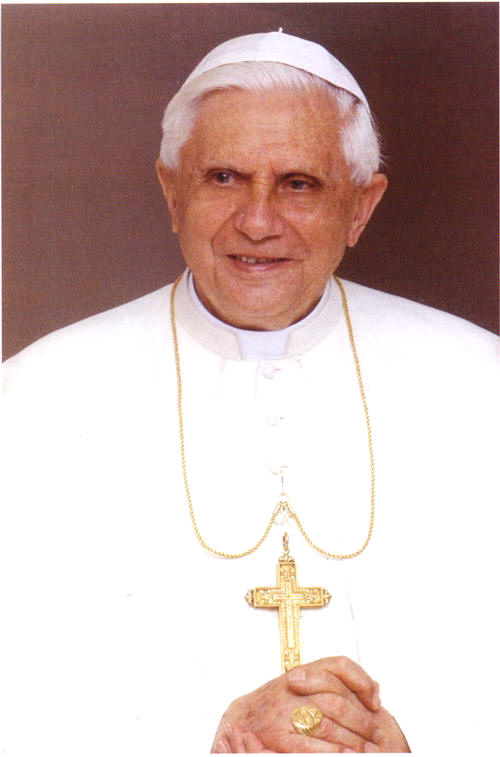
The Roman Pontiff, Pope Benedict XVI, the chief priest and spiritual teacher of God's Church upon the earth, by command of our Lord Jesus Christ Himself when He personally appointed St Peter as the first Supreme Pontiff of Holy Church


St Peter, the first Supreme Pontiff of Holy Church, pray for us!
...

Friday, 14 September 2007

"Faithful Cross above all others, one and only noble tree": the Exaltation of the Holy Cross and the Grand Restoration of the Roman rite

CRUX fidelis, inter omnes, arbor una nobilis;
Nulla talem silva profert,
Flore, fronde, germine.
Dulce lignum, dulci clavos, dulce pondus sustinens!

FAITHFUL Cross! Above all other,
One and only noble Tree!
None in foliage, none in blossom,
None in fruit thy peers may be;
Sweetest wood and sweetest iron!Sweetest Weight is hung on thee!

So for centuries has been sung the song composed by Venantius Forntunatus (530-609) extolling the Triumph of the Cross.

And never more so than today, the Feast which recalls the return of the True Cross to Jersualem following its recapture from the pagan Persians by the Roman Emperor in the East, Emperor Heraclius.

But today is also the triumphal day in which our Holy Father, Pope Benendict XVI, restored to the Roman Church the use of the ancient and noble Roman rite of our ancestors.

All hail Pope Benedict XVI, the restorer of the ancient Roman rites!

Yes, today is the day when, by his own motion - motu proprio - Pope Benedict XVI has restored to the Roman Church its ancient rites. In so doing he has placed himself in the same hallowed tradition of all those popes, among his predecessors, who always sought to preserve the ancient rites of the Church, as all popes until 1970, did.

For this alone, he will go down to history as a great pope. But he has many other great virtues which posterity will also recall and hallow.

He has chosen a very significant and memorable day to make his motu proprio, called Summorum Pontificum, become effective.

It is the Feast of the Exaltation of the Holy Cross upon which day we sing the praises of the Holy Cross with such ancient hymns as Vexilla Regis and Crux Fidelis.

Venantius Fortunatus wrote both hymns, the latter for a procession that brought a part of the true Cross to Queen Radegunda in 570. This hymn is used on Good Friday during the Adoration of the Cross and in the Breviary during Holy Week and on feasts of the Cross like today.

Ancient legend is hinted at in the second verse of this hymn. According to this tradition, the wood of the Cross upon which Christ was crucified was taken from that tree which was the source of the fruit of the fall in the Garden of Eden. When Adam died, the legend states, Seth obtained from the Cherubim guarding the Garden a branch of the tree from which Eve ate the forbidden fruit. Seth planted this branch at Golgotha (the place of the skull), which is so named because Adam was buried there. As time went on, the Ark of the Covenant, the pole upon which the bronze serpent was lifted, and other items were made from this tree.

Eventually the Holy Cross was made from it and our Lord crucified thereon upon Golgotha directly over the tomb of Adam so that the Precious Blood of Christ, seeping through cracks, penetrated into the mausoleum of Adam beneath and fell upon the very skull of Adam to symbolise that the Sin of Adam had now been atoned for by the Crucifixion.

In the pre-1955 Roman Calendar, the Finding of the True Cross (Inventio Crucis) was celebrated on 3 May to commemorate that day when the Empress St Helena, daughter of a British king and mother of the Emperor Constantine, found the True Cross after long searching for it among the wells and cisterns of Jerusalem.

The British born Roman Empress St Helena finds the True Cross

The True Cross was set up and a Basilica built to house it for posterity.

3 centuries later, the pagan, fire-worshipping Persians (not yet Muslim), under King Chosroes II, attacked Jerusalem and took away the precious relic, the True Cross.

The Roman Emperor Heraclius, then regining, swore to recover it and warred against the Persians. He was on the point of being defeated himself when an internal dispute arose within Persia which threatened Chosroes II and the distraction gave Heraclius his chance. He soundly defeated Chosroes in 629 and recovered the True Cross.

This was seen as an answer to prayer by all at the time.

When Heraclius returned to Jerusalem to restore the True Cross he carried it himself, as had our Lord, intending to process along the Via Dolorosa in his gorgeous imperial robes. But when he arrived at the gate of Jerusalem he was frozen to the spot and could not move. All were puzzled and eventually the Patriarch of Jerusalem suggested that the Emperor divest himself of his imperial robes. The Emperor did more and stripped himself to little more than the seamless garment that Christ Himself had worn to carry His Cross.

At once the Emperor found himself able to proceed and so he continued until he was able to retored the Cross to its rightful place in the Basilica upon Golgotha, walking barefoot in a single shift all along the way to the great edification of the people of Jerusalem, his subjects.

Ever after that day, 14 September, was celebrated with great ceremony - nearly as much as Easter and Pentecost - as the Feast of the Exaltation of the Holy Cross (Exaltatio Crucis).

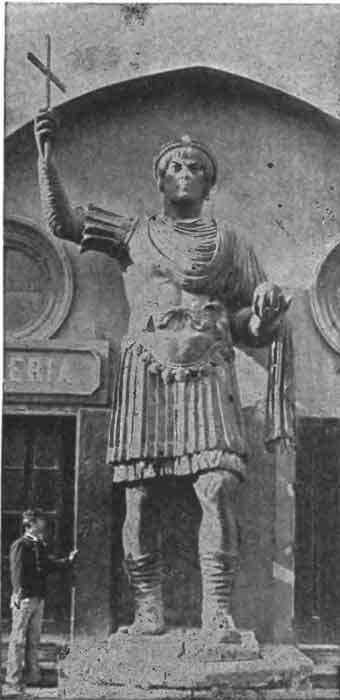
The Roman Emperor Heraclius who restored the True Cross to Jerusalem in 629AD

Now our Holy Father has chosen this most memorable and triumphant of days to restore to us the glory of the ancient Roman rite which the Roman emperors of old fought and died to protect and preserve and which countless saints and martyrs gave their lives for.

VEXILLA REGIS prodeunt:
Fulget Crucis mysterium,
Qua vita mortem pertulit,
Et morte vitam protulit.

Abroad the Regal Banners fly,
Now shines the Cross's mystery;
Upon it Life did death endure,
And yet by death did life procure.

O CRUX AVE, SPES UNICA,
In hac triumpha gloria
Piis adauge gratiam,
Reisque dele crimina.

Hail, Cross, of hopes the most sublime!
In this triumphant glorious time,
Improve religious souls in grace,
The sins of criminals efface.

On Good Friday the second line reads "Now in this mournful Passion time" but on the Feast of the Cross this is replaced by "in hac triumpha gloria" - in the glory of this triumph!

Triumph, indeed, thanks to our beloved Holy Father now gloriously reigning!


St Helena, pray for us!

True Cross, protect us!


...

Thursday, 23 August 2007

The Motu Proprio: Fr Dwight errs but censors his critics...

The US Catholic Bishops Conference’s English version of the whole Motu Proprio is "unofficial" but many US priests are using it as if it were official. That is probably because the USCCB’s Liturgy Office published guidelines based on the unofficial translation.

Now Fr Dwight Longenecker (regular all-round good guy but a bit muddled on this issue) has used it to argue why the traditional rites should not be offered freely in his parish of St Mary's Greenville, South Carolina (and you can be sure that there are other priests arguing the same).

Here's what he says on his blog Standing on my Head in answer to an enquirer who, quite reasonably, asks him if the traditional rite will be celebrated at St Mary's:

"I therefore would need to consider what my bishop thinks of the matter, and consider the pastoral concerns of the whole community and not just those who are asking for the Latin Mass. This is difficult because to impose the Missal of Bl. John XXIII on the whole community would be pastorally unfair, but to celebrate a regular Mass for a separate group of the faithful would foster disunity. Tough one.

The most interesting word in the ruling is the word 'stable'. It says if a 'stable' group of parishioners asks for the Latin Mass their request is to be considered. But what does 'stable' mean? Must they be stable as a group? Stable as individuals or stable as families? Does this mean emotional and mental stability, spiritual stability or stability in their commitment to the parish?

This is a very important consideration. In some places there are groups of people who are not emotionally or spiritually stable, but more important than that, there are others who are not stable in their commitment either to the Pope or to their local parish. They trot off to whatever celebration of Mass they deem best. For example, some people forsake their parish (even when they have a good conservative priest celebrating the Novus Ordo reverently) for SSPX masses, or they drive hundreds of miles to attend a Fraternity of St Peter Latin Mass. They are entitled to do so, but it is arguable that such individuals, families and groups are not stable in their spiritual lives or their parochial commitment, and I expect many parish priests would not wish therefore to take their requests seriously."


Well, sorry, Fr Dwight. You are once again wrong.

The word "stable" simply does not appear in the document.

Even if it did you have no basis whatsoever for the fantastical conclusions that you draw in the above. And it is particularly unfair that you single out as "unstable" those who, through no fault of their own, through their loyalty to the traditional rites and despite their polite requests for it addressed to their PPs, are forced to go outside their parish to have their legitimate desire for the traditional rites met because the PP unjustly refuses it to them in defiance of papal decrees.

However, the word does not appear in the document.

One could be forgiven for thinking so initially. But Fr Dwight's correspondents put him right in a series of comments in a total of 26 at last count.

Yet, having been pretty comprehensively put right on this, as on a number of other crucial issues, Fr Dwight disdains to amend his blog or even add an update or rider.

When he's wrong he's right, perhaps (to quote from a previous post)?

More than that, he then goes on to censor out those responses which point out his more egregious blunders.

Here is part of one response that was "edited" out by Fr Dwight:

"...You continually say that you are willing to learn, having nothing against the old rite, wish to follow the MP, do not wish to enter into liturgy wars, respect people's love for the old rite etc etc etc....
The popes issued Tres Abhinc Annos, Ecclesia Dei and now Summorum Pontificum in order to get priests to be generous to the Faithful who prefer to worship with the rites that their ancestors used for at least 1700 years and yet there are still priests - like yourself - finding more and more excuses why they should continue to oppress those Faithful and deny them what the Pope has repeatedly said they may have.

This oppression has gone on for 40 years. Now is the time to stop. It is the Pope who orders it and you want, instead, to quibble.

All your quibbles have been more than adequately addressed and laid to rest by your various correspondents and yet.... still you quibble.

Where is the generosity? Where is the pastoral care? Where is the pastoral love of the flock? Where, Father, is your sense of justice?

Your later posts do nothing to re-assure me.

You write that 'this really is a marginal issue: in terms of numbers, those who wish for the Latin Mass are relatively minute.'

Which Latin Mass? Or have you once again overlooked the fact that the Novus Ordo Missae is a Latin rite and that the vernacular was NOT demanded by Vatican II? We have been round that one again and again and again. You just ignore it!

Where do you get your stats from? I question them.

But even if you were right, would it be surprising? Latin, whether in the traditional or new rites, has been virtually strangled to death for the last 40 years. Moreover, only the faithfulness of a minority have kept the traditional rites alive. Now you use that against them. A good is suppressed then a complaint made that the good is no longer seen. Really, Father, what sort of argument is that?

It is abundantly clear from his writings that the Pope thinks this near-total suppression of both Latin and of the traditional rites was a grave mistake and he plainly wishes to reverse the situation.

It is also abundantly clear that he thinks that wide celebration of the traditional rites will vastly improve and enrich the way in which the Novus Ordo is celebrated.

...Once the Holy Father begins to be obeyed, you will find that more and more people are attracted to the traditional rites. That has been our over-whelming experience here in the UK.

Denying people the traditional rites is a self-fulfilling prophecy: you will get less people simply because the rites are, and have been these 40 years, very difficult to find.

To accuse people of being 'unstable' because they travel far to find the traditional rites is yet another extraordinary statement.

The Faithful have had to do so precisely because of the quibblers. Having denied them their rights, the quibblers then accuse them of 'instability' for going elsewhere to find what they have been unjustly denied. A more crassly unreasonable argument would be hard to find.

You write: 'With a shortage of priests it is difficult to justify too many special masses for a handful of people who want mass the way they want it.'

No, Father, it is Mass the way the Holy Father wants it...That is what he has now ordered. And the shortage of priests is not a reason for refusing to obey the Pope. These are not 'special' Masses, they are a right.

...You, have, with great respect, quite some way in this thread to go before you can honestly say that you are really being fair and objective about the traditional rites, as you claim.

Will you now do better?"


Fair question, isn't it?

Or is ignorance bliss?

Tripe about "stable groups": what the Motu Proprio really says...


It's started!

Some obstinate clerics are already trying to minimise the Holy Father's clear wishes to make the traditional Roman rite widely available to the Faithful.

One attempt centres around the weak unofficial translation of the United States Catholic Bishops' Conference upon which translation they then go on to give some very mediocre advice.

The translation makes reference to "stable groups" and some clerics have been desperately trying to make much of the word "stable" to imply that it rules out those who do not attend the Novus Ordo regularly, do not regularly attend only one parish, occasionally attend SSPX chapels, do not form a big enough group to be called "stable", or even that the priest judges them to be "emotionally unstable".

Tripe.

Yes, tripe.

Total and utter tripe.

The word "stable" does not even appear in the Motu Proprio!

Here's what the Motu Proprio says in the Holy Father's original Latin:

"Art. 5, § 1. In paroeciis, ubi coetus fidelium traditioni liturgicae antecedenti adhaerentium continenter exsistit, parochus eorum petitiones ad celebrandam sanctam Missam iuxta ritum Missalis Romani anno 1962 editi, libenter suscipiat. Ipse videat ut harmonice concordetur bonum horum fidelium cum ordinaria paroeciae pastorali cura, sub Episcopi regimine ad normam canonis 392, discordiam vitando et totius Ecclesiae unitatem fovendo."

Which can be pretty accurately translated as:

"Art. 5, § 1. In parishes, where there is continuously present a group of the faithful attached to the previous liturgical tradition, let the pastor willingly receive their petitions that Mass be celebrated according to the Rite of the Missale Romanum issued in 1962. Let him see to it that the good of these faithful be harmoniously incorporated with the ordinary pastoral care of the parish, under the governance of the Bishop according to canon 392, by avoiding discord and by fostering the unity of the whole Church."

The word simply does not appear!

So, for those clerics who still want to go on pretending that the traditional rites should not be freely offered, and who refuse to recognise the generosity of the Holy Father, here is some more tripe:


Yech!

Can't stand the stuff!


.....

Friday, 17 August 2007

Fr Dwight: the grapes of wrath?

Fr Dwight decided to let off more steam on his blog Standing on My Head (a very good blog, by the way) having discovered Roman Christendom and its criticism of some of his views on the traditional liturgy.

Fair enough! I think that is his right. We shouldn't begrudge it. I like him and that's why I'm engaging with him. So please read the below in that spirit.

First, under a heading "Watzablog" he gives a lecture on what a blog should be like, accusing some people of bad manners and then claiming to know who was the author of Roman Christendom and seeking to "out" us.

He launched into an attack on James Bogle, whose letters I have borrowed from, even accusing him of being "insulting" and "arrogant" and this blog of making "senseless and weird" attacks, whilst claiming himself to be "objective and cheerful" and to give those who favour the traditional rites (or Mass of John XXIII as he insists on calling it when it is, of course, the oldest rite in the Church), the "benefit of the doubt".

He then gives us a treatise on how we're all wrong when we think we are right and thinking you're right, even if you are right, is self-righteous. Well, if we all followed such a principle there would, of course, never be any debate at all.

To add spice, the whole is interlaced with choice references to "fundamentalism", "little fortresses", "aggressive", "belligerent", "martyr complexes", "self-pity", "sick kind of mentality", "obsession", "mania", "self-righteous", "extreme", "suspicious", "intolerant", "the seriousness of Satan", "demented terrier with a slipper", "sulk", "infected wound" and the like.

No prizes for guessing, folks, that this is at least partly aimed at Roman Christendom for daring to defend the traditional rite in the face of some pretty ill-informed opposition.

I need say no more: Fr Dwight is not "standing on his head" over this one but on his own dignity by over-reacting somewhat.

Well, at least he is engaging, now. That's a good start!

Fr Dwight is, I consider, actually a very good guy, but both he, and his Parish Priest, Fr Jay Scott Newman, also a good guy, ought to exercise a little caution when using sacerdotal authority particularly on anything that might be interpreted as undermining the Church's traditions (Latin, Chant etc) or the manifest and proper wishes of the Pope and use scorn sparingly against others who simply point this out.

Targeting Catholics who prefer the traditional Roman rite is a recreation that is past its sell-by date. It's done great harm these past 40 years and the Pope has quite rightly called time on it.

Fr Dwight erased most of the comments on his blog that criticised his view of liturgy and Fr Jay now won't receive any further comments on his blog. His penultimate post was, aptly but sadly, entitled "Liturgy Wars". It was not traditional-rite Catholics who started the war.

There should, of course, be no wars over liturgy. We should all be on the same side not divided internally.

Unfortunately, it is the kind of statement that appeared in Fr Jay's Parish newsletter that can sometimes tend to prolong the war. I publish it below as it is in the public domain and a commentator has sent it to me.

If any priest is going to claim to be loyal to the Pope and to say "Where Peter is, there is the Church", then he needs to be open and willing to implement the motu proprio, and should avoid minimising it by suggesting that it "kinda, sorta" gives wider permission for the traditional rites.

The reality is that the motu proprio gives extremely wide and extensive permission for the use of the traditional rites.

But here is Fr Jay's advice to his parishioners on 1 July, just before the publication of the motu proprio:

"When this document is finally published, there will no doubt be a circus of media attention of the most sensational kind, but please do not be confused or disturbed by what you read in the papers or see on television. Whatever else may be the case, there will certainly be no changes made in the present way we celebrate the Missal of 1970 in our scheduled liturgies, and pending a careful study of the document, I do not anticipate that a regularly scheduled Tridentine Mass will be celebrated here at St. Mary’s. For now, simply know that a document will probably appear this summer, and when it does, we will study it together."

To be fair to Fr Jay, he clearly did not anticipate the breadth and width of the rights granted by the motu proprio and, I suspect, is still slightly in denial about it all. On his blog, he certainly admits - actually I think rather courageously and even humbly - to being a bit confused by it all. That actually rather endeared him to me, I have to say. My heart went out to him!

I suspect that when he and Fr Dwight have had time to digest it all, reflect upon it all and pray about it, they will take a more balanced view.

So let's give 'em a chance, folks, and pray for them and for what I have a feeling is a very important and influential parish in that part of the US of A and two potentially very influential priests.

Wednesday, 15 August 2007

The Queen assumed into heaven...

"Christ's faithful, through the teaching and the leadership of their pastors, have learned from the sacred books that the Virgin Mary, throughout the course of her earthly pilgrimage, led a life troubled by cares, hardships, and sorrows, and that, moreover, what the holy old man Simeon had foretold actually came to pass, that is, that a terribly sharp sword pierced her heart as she stood under the cross of her divine Son, our Redeemer. In the same way, it was not difficult for them to admit that the great Mother of God, like her only begotten Son, had actually passed from this life. But this in no way prevented them from believing and from professing openly that her sacred body had never been subject to the corruption of the tomb, and that the august tabernacle of the Divine Word had never been reduced to dust and ashes. Actually, enlightened by divine grace and moved by affection for her, God's Mother and our own dearest Mother, they have contemplated in an ever clearer light the wonderful harmony and order of those privileges which the most provident God has lavished upon this loving associate of our Redeemer, privileges which reach such an exalted plane that, except for her, nothing created by God other than the human nature of Jesus Christ has ever reached this level.

15. The innumerable temples which have been dedicated to the Virgin Mary assumed into heaven clearly attest this faith. So do those sacred images, exposed therein for the veneration of the faithful, which bring this unique triumph of the Blessed Virgin before the eyes of all men. Moreover, cities, dioceses, and individual regions have been placed under the special patronage and guardianship of the Virgin Mother of God assumed into heaven. In the same way, religious institutes, with the approval of the Church, have been founded and have taken their name from this privilege. Nor can we pass over in silence the fact that in the Rosary of Mary, the recitation of which this Apostolic See so urgently recommends, there is one mystery proposed for pious meditation which, as all know, deals with the Blessed Virgin's Assumption into heaven.

16. This belief of the sacred pastors and of Christ's faithful is universally manifested still more splendidly by the fact that, since ancient times, there have been both in the East and in the West solemn liturgical offices commemorating this privilege. The holy Fathers and Doctors of the Church have never failed to draw enlightenment from this fact since, as everyone knows, the sacred liturgy, "because it is the profession, subject to the supreme teaching authority within the Church, of heavenly truths, can supply proofs and testimonies of no small value for deciding a particular point of Christian doctrine.

17. In the liturgical books which deal with the feast either of the dormition or of the Assumption of the Blessed Virgin there are expressions that agree in testifying that, when the Virgin Mother of God passed from this earthly exile to heaven, what happened to her sacred body was, by the decree of divine Providence, in keeping with the dignity of the Mother of the Word Incarnate, and with the other privileges she had been accorded. Thus, to cite an illustrious example, this is set forth in that sacramentary which Adrian I, our predecessor of immortal memory, sent to the Emperor Charlemagne. These words are found in this volume: 'Venerable to us, O Lord, is the festivity of this day on which the holy Mother of God suffered temporal death, but still could not be kept down by the bonds of death, who has begotten your Son our Lord incarnate from herself'.

18. What is here indicated in that sobriety characteristic of the Roman liturgy is presented more clearly and completely in other ancient liturgical books. To take one as an example, the Gallican sacramentary designates this privilege of Mary's as 'an ineffable mystery all the more worthy of praise as the Virgin's Assumption is something unique among men'. And, in the Byzantine liturgy, not only is the Virgin Mary's bodily Assumption connected time and time again with the dignity of the Mother of God, but also with the other privileges, and in particular with the virginal motherhood granted her by a singular decree of God's Providence. 'God, the King of the universe, has granted you favors that surpass nature. As he kept you a virgin in childbirth, thus he has kept your body incorrupt in the tomb and has glorified it by his divine act of transferring it from the tomb'.

19. The fact that the Apostolic See, which has inherited the function entrusted to the Prince of the Apostles, the function of confirming the brethren in the faith, has by its own authority, made the celebration of this feast ever more solemn, has certainly and effectively moved the attentive minds of the faithful to appreciate always more completely the magnitude of the mystery it commemorates. So it was that the Feast of the Assumption was elevated from the rank which it had occupied from the beginning among the other Marian feasts to be classed among the more solemn celebrations of the entire liturgical cycle. And, when our predecessor St. Sergius I prescribed what is known as the litany, or the stational procession, to be held on four Marian feasts, he specified together the Feasts of the Nativity, the Annunciation, the Purification, and the Dormition of the Virgin Mary. Again, St. Leo IV saw to it that the feast, which was already being celebrated under the title of the Assumption of the Blessed Mother of God, should be observed in even a more solemn way when he ordered a vigil to be held on the day before it and prescribed prayers to be recited after it until the octave day. When this had been done, he decided to take part himself in the celebration, in the midst of a great multitude of the faithful. Moreover, the fact that a holy fast had been ordered from ancient times for the day prior to the feast is made very evident by what our predecessor St. Nicholas I testifies in treating of the principal fasts which 'the Holy Roman Church has observed for a long time, and still observes'."


Munificentissimus Deus, Piux XII, 1 November 1950, Feast of All Saints.

Tuesday, 14 August 2007

Fr Jay Scott Newman also joins the muddle...


Fr Jay Scott Newman is another PP who has a good blog which is well worth reading. I don't know him but he seems a good enough fellow.

But...once, again, but...

Yep, the liturgy.

Before the motu proprio was issued he joined in with the "Latin Questions" discussion and made this unhelpful comment:

"...The long-rumored and still invisible motu proprio notwithstanding, there is simply no interest in the Church beyond the statistically insignificant world of specialists and bloggers in retrieving what 99.999% of the Catholic people (and hierarchy) consider a noble part of our heritage but not a living part of our future (think of the papal navy!)..."

Where does he get his stats? Wake up and smell the coffee, Father!

And this:

"...All of which leads to my conclusion that those who harbor hope that the general liturgical life of the Church will be improved by a few more celebrations of the Pian Mass have simply and profoundly misunderstood the situation of the Church in our time..."

Yep. Pretty offensive and ill-informed stuff. It's not the Pian mass. It is much, much older. He has simply "profoundly misunderstood"!

Someone replied to him thus:

"Your over-emphasis on numbers might lead an observer to think that you put a higher premium on popularity than truth or right practice...

If you want to get with what is 'serious' then you need to concern yourself less with numbers and more with truth and tradition.

Otherwise you may find yourself numbered with those disciples who got with the numbers by running away, rather than with those who stood at the foot of the Cross.

I know it is difficult for a priest these days to give any favour to the traditional rite without incurring trouble with his bishop but do not let that skew your vision or compromise your intellectual impartiality."

He got cross with that and replied:

"...Based on 20 years of experience, I believe that such folk will be sadly disappointed, no matter what the yet-to-be published (or even seen) motu proprio may or may not say..."
Someone replied to him beginning: "I catch a glimpse of a straw man in your last comment..."
Well, indeed!

There were other replies to Fr Newman but - mysteriously - they were removed from Fr Dwight's blog. US-style "free speech"? See how it works? I am free to say whatever I like but if you say something I don't like, I just erase it. This is called "free speech". Apparently!

But then, all of a sudden, and within only a few weeks, out came the motu proprio.

Whoops! Now the boot was on the other foot. The "long-rumoured and yet invisible" and the "yet to be published (or even seen)" had suddenly been seen, published and hugely exceeded the expected minimalist concessions that aggressive Novus Ordo priests like Fr Jay had expected.

And it came from the Pope himself!

Golly! What to do, now? Um, err, aaah....

You guessed it - back-peddle. Fast! (But without apologising to anyone - never apologise, never explain, apparently!).

Here's an extract from Fr Jay's very grudging back-peddle:

"In any event, last Saturday, Pope Benedict XVI threw a spanner in the works with his long-awaited, much-rumored, and oft-debated Apostolic Letter Summorum Pontificum, which more or less (kinda, sorta) gives any priest of the Latin Rite the choice of which Mass to offer: the Mass codified by Pope Pius V after the Council of Trent or the Mass codified by Pope Paul VI after the Second Vatican Council. It remains to be seen what effect, if any, this document will have on the life of the Church as it is lived in parishes, religious houses, seminaries, etc..."
Get that, folks? The Pope "threw a spanner in the works". And this from a priest who thinks himself a papal loyalist. And Paul VI apparently only "codified" the new mass - no new Eucharistic prayers or anything like that...err...But let's read on:

"In February 1962, Pope John XXIII promulgated an Apostolic Constitution called Veterum Sapientia, mandating very specific requirements for the teaching and preservation of Latin in the Church, but because of the radical changes taking place in the world at the time, this authoritative document was Dead On Arrival and had zero effect in the life of the Church. Today, if this document is read at all, it is usually read with mirth. Well might we all mourn the passing away of Latin from wide use in the Church, but pass away it has...."
Oh really? So we should rejoice in our ignorance of our own history, culture and the language in which most of our theology is written, should we? We should think it's all "DOA"? And we should read "with mirth" the writings of a beatified pope, should we? More papal loyalism? Err, sorry Father, I don't think so! But there's more...

"Will Summorum Pontificum be DOA in the same way as Veterum Sapientia? I honestly don’t know, and to tell the truth, I don’t much care one way or the other..."
"Don't much care..."! Does this sound like loyalty to the Pope? I doubt that many would see it that way!

So whilst Fr Jay has been forced to back off he has done so with singularly bad grace. That is a great shame because he is a priest who made much of his loyalty under Pope John Paul II but is acting rather differently under Pope Benedict. But even more so because he is not a bad guy at all. Indeed, he is basically a very good guy but he has allowed his thinking and theology to get sloppy and complacent.

Come on now, Fr Jay. You can do better. Don't cheat yourself or your parishioners!

Pray for him, folks, and for all our clergy!

Sunday, 12 August 2007

Lovers of the Roman rite have been shamefully abused these 40 years...

Until the arrival of our new Pope, Traditional Catholics were always being deliberately snubbed, insulted, misinterpreted and abused. I can testify from my own experience that this has been going on now for many years. I noticed it even when I was still attending the Novus Ordo regularly.

But now we have the motu proprio and so there is even less excuse for vilifying one's fellow Catholics for hearing the mass of their forefathers.

Things are liturgically better now than in the 1970s when traditional Catholics, many of whom in those days were old enough to have fought in the war bravely against Nazism and Fascism, were constantly being called Nazis and Fascists by all too many of their fellow Novus Ordo Catholics. Many such abusers knew better but just went along with the crowd rather as many Jews did when they cried "Crucify him" to our Lord in the courtyard of Pilate's palace. It was shameful. The Chairman of International Una Voce, Eric de Saventhem, had even been a German conspirator against Nazism and had had to escape from Nazi Germany in fear of his life. But that meant nothing to the calumniators. They still called him a Nazi merely for preferring the ancient Roman rite of his ancestors. And most of the calumniators had never been anywhere near persecution themselves but had always lived in comfort in the post-war West.

It was not a pretty sight to watch so many people calling themselves Christians engaging in this calumniatory abuse, especially those many of them who concurrently claimed to be eager exponents of "toleration" and "Ecumenism" to all and any form of religion - except, of course, the traditional version of their own. And the clergy and bishops were often as bad as any, persecuting those in their flocks who dared to show any kind of warmth toward the traditional rites. It was a kind of trahison des clercs.

Further back still, in the early days, in the years after the Council, there were even examples of priests ripping up rosaries and other devotional aids in the pulpit telling their congregations that they were things of the past. It was a deeply shameful time. And all the while the Faithful were constantly being told that this was "Renewal". Falsehoods were all too frequently on the lips of both clergy and laity alike in those days, alas.

I can also testify that it was during those times that so many Catholics left the Faith. The spiritual "glue" that had kept them attached to the Faith was atrophied by the prevailing chaos and so huge numbers simply came unstuck and drifted away.

The reality is that there are still clergy who do not feel the courage to seek out the truth. Some are actively afraid of finding out that what traditional Catholics say about the traditional Roman rite is true. They know that this might make demands upon their consciences which they are afraid to admit. Actually the demands are not so great but they do not feel the courage to attempt even the minimal. To be fair there are so many other issues to fight on that they do not want to have a fight on the issue of liturgy as well. What they do not realise is that the liturgy issue can often precede others simply because how we pray determines how we believe - lex orandi statuit legem credendi.

All that is needed is for them to act as the better sort of modern PP does who usually celebrates the Novus Ordo but allows and gives favour and toleration to the traditional mass, having harmoniously negotiated the arrangement with the bishop. After all, the Holy Father himself is a devotee of the traditional rites and strongly supports their availability to the faithful, as evidenced by his very extensive motu proprio. It is curious to hear from the anti-traditional refuseniks who will not tolerate the traditional rites but yet claim to be loyal to the Holy Father. They are too often loyal to their own prejudices. The real truth is that they are not loyal to the Holy Father.

But there are clergy who do not even feel the courage to attempt this reasonable compromise. So they bury their heads in the sand, hoping that the issue will not affect them or will go away. But God does not reward such lack of courage. And so the crisis continues - and will continue.

We must pray for better understanding and better times, for our clergy and for charity to heal the wounds of deep division and strife that the Church has suffered over these past 40 years, through sin, ignorance, folly, obstinacy, vainglory and uncharity.

Our Holy Father has led the way and we should follow him.

Saturday, 11 August 2007

Summorum Pontificum

One must at least start by singing a resounding Te Deum for our Holy Father, the Roman Pontiff, and for his latest motu proprio. It's almost a miracle.

In fact, that's precisely what we intend doing on 14 September 2007, the Feast of the Exaltation of the Holy Rood or Cross, when the motu proprio comes into force.

Come and join us at our Lady of the Rosary, Blackfen, at 12 noon.

Then later in the evening, around 6.30pm, come to the Brompton Oratory where there will be yet more celebration of the day.

It's the perfect day for it as, in times past, Exaltatio Crucis or the Feast of the Exaltation was celebrated with nearly the same solemnity as Easter and Whitsun. It was the day that the Emperor Heraclius recaptured the True Cross, snatched away by the pagan Persians and their king, Chosroes.

Heraclius decided to carry the Cross himself back into Jerusalem but when he got to the city gates he was frozen to the spot and could not move. All were amazed at this and eventually the Patriarch of Jerusalem advised the Emperor to remove his imperial vesture and enter the city in humble attire as did our Lord.

The Emperor saw the merit of the idea and divested himself of his gorgeous robes and, clad in simple vesture and in bare feet, he resumed the Cross and found that he was able to enter the city gates.

So began the tradition of entering the Holy City with visible signs of humility. Doubtless with this in mind, when the first Christian general re-entered the city after 700 years of Muslim occupation, he dismounted from his horse and entered on foot.

This was, of course, Field Marshal Lord Allenby of Megiddo, the commander of British troops in Palestine and the re-conqueror of Jerusalem.

So it is a fitting day to restore the ancient rites.

This Pope is trying to tell us something, I trow, and it's all good news!