Showing posts with label Our Lady. Show all posts

Sunday, 16 October 2011

Our Lady's Nativity and the Great Siege of Malta of 1565: "Victoria Day" of the Knights of Malta

8 September is the Feast of our Lady's nativity but it is also Victoria Day for the Knights of Malta, the day when, with our Lady's help, they defeated the Ottoman Turkish invasion of their home and headquarters on the island of Malta.

It is is also "Malta Day" for the same reason.

The Knights Hospitaller (also known as the Sovereign Order of Saint John of Jerusalem, of Rhodes and of Malta; the Knights of Malta; the Knights of Rhodes; and Les Chevaliers de Malte) is an organization that began as an Amalfitan hospital founded in Jerusalem in 1080 to provide care for poor and sick pilgrims to the Holy Land.

After the conquest of Jerusalem in 1099 during the First Crusade it became a religious/military order under its own charter, and was charged with the care and defence of pilgrims to the Holy Land. Following the loss of Christian territory in the Holy Land, the Order operated from Rhodes, over which it was sovereign, and later from Malta under the grand magistry of the renowned religious, soldier and defender of Malta from the Turks, Prince and Grand Master Jean Parisot de la Valette, after whom Valetta in Malta is named.

After the loss of the Holy Land and years of moving from place to place in Europe, the Knights were established on Malta in 1530, when the Holy Roman Emperor, Charles V, as King of Sicily, gave them Malta, Gozo and the North African port of Tripoli in perpetual fiefdom in exchange for an annual fee of a single Maltese falcon, which they were to send on All Souls Day to the Viceroy of Sicily, who acted as the King's representative. (This historical fact was used in Dashiell Hammett's famous book The Maltese Falcon).

It was from here that the Hospitallers continued their actions against the marauding Muslims and especially the savage Barbary pirates.

Although they had only a small number of ships, the Muslim Ottomans were less than happy to see the order resettled. Accordingly, Sultan Suleiman assembled another massive invasion force in order to dislodge the Knights from Malta, and in 1565 invaded, starting the Great Siege of Malta.This siege proved one of the great victories of history for an undermanned and vastly outnumbered defence force, numbering some 700 knights and about 8000 soldiers.

At first the battle looked to be a repeat of the earlier defeat of the Knights at Rhodes. Most of the cities were destroyed and about half the Knights died in battle. On 18 August the position of the besieged was becoming desperate: dwindling daily in numbers, they were becoming too feeble to hold the long line of fortifications. But when his council suggested the abandonment of Il Borgo and Senglea and withdrawal to Fort St. Angelo, Grand Master La Valette remained obdurate.

The Viceroy of Sicily had not brought help. Possibly the orders of his master, Philip II of Spain, were so obscurely worded as to put on his own shoulders the burden of a decision – a responsibility which he was unwilling to discharge because defeat would mean exposing Sicily to the Turks. Whatever may have been the cause of his delay, the Viceroy hesitated until the indignation of his own officers forced him to move, and then the battle had almost been won by the unaided efforts of the Knights.

On 23 August came yet another grand assault, the last serious effort, as it proved, of the besiegers. It was thrown back with the greatest difficulty, even the wounded taking part in the defence. The plight of the Turkish forces, however, was now desperate. With the exception of Fort St Elmo, the fortifications were still intact. Working night and day, the garrison had repaired the breaches, and the capture of Malta seemed more and more impossible. The terrible summer months had laid many of the troops low with sickness in their crowded quarters. Ammunition and food were beginning to run short, and the Turkish troops were becoming more and more dispirited at the failure of their numerous attacks and the unending toll of lives.

Dragut


The death of Dragut, a corsair and admiral of the Ottoman fleet and skilled commander, on 23 June, had proved an incalculable loss. The Turkish commanders, Piyale Pasha and Mustafa Pasha, took few precautions, and, though they had a huge fleet, they never used it with any effect except on one solitary occasion. They neglected their communications with the African coast and made no attempt to watch and intercept Sicilian reinforcements.

On 1 September they made their last effort, but all threats and cajoleries had little effect on dispirited Turkish troops, who refused any longer to believe in the possibility of capturing those terrible fortresses. The feebleness of the attack was a great encouragement to the besieged, who now began to see hopes of deliverance. Perplexity and indecision of the Turks were cut short by the news of the arrival of Sicilian reinforcements in Mellieħa Bay. Unaware of the small size of this new force, they hastily evacuated and sailed away on 8 September, the Feast of the Nativity of the Blessed Virgin, ever after celebrated by the Order of Malta as "Victoria Day".

At the moment of the Turkish departure the Order had left 600 men capable of bearing arms, but the losses of the Ottomans had been yet more fearful. The most reliable estimate puts the number of the Turkish army at its height at some 40,000 men, of which but 15,000 returned to Constantinople. The siege is portrayed vividly in the frescoes of Matteo Perez d'Aleccio in the Hall of St. Michael and St. George, also known as the Throne Room, in the Grand Master's Palace in Valletta. Four of the original modellos, painted in oils by Perez d'Aleccio between 1576 and 1581, can be found in the Cube Room of the Queen's House at Greenwich, London. After the siege a new city had to be built – the present city of Valletta, so named in memory of the Grand Master who had sustained this siege.

In 1607, the Head of the Order, the Grand Master, was granted the rank of Reichsfürst (Prince of the Holy Roman Empire). In 1630 the Grand Master was awarded ecclesiastic equality with the Cardinals and the uniquely hybrid style "His Most Eminent Highness", reflecting both qualities qualifying him as a true prince of the Church.

Following the Christian victory over the Ottoman fleet in the Battle of Lepanto in 1570, the Knights continued to defend Christendom from Barbary pirates and Muslim raiders.

The Patron Saint of the Order is our Lady of Philermo whose image was first acquired when the Knights were still settled on the island of Rhodes. The icon, depicted below, is ancient and famous.


Our Lady of Philermo, pray for us!

...

Thursday, 13 October 2011

Our Lady's Nativity and the Great Siege of Malta of 1565: "Victoria Day" of the Knights of Malta


13 OCTOBER 2011
FEAST OF BLESSED GERARD
INSTALLATION OF THE 57th LORD GRAND PRIOR OF ENGLAND
OF THE SOVEREIGN MILITARY ORDER OF MALTA

IAN SCOTT of ARDROSS

The Prince and Grand Master of the Sovereign Military Order of Malta in Council in Malta


On 13th October 2011 the 57th Lord Grand Prior of England of the Sovereign Military Order of Malta, Ian Scott of Ardross, made his vows of office during solemn Mass in the 12th century crypt chapel of the former Priory Church of St John of Jerusalem, Saint John's Square, Clerkenwell EC1M 4DA, now the seat of the Anglican Venerable Order of St John.

The last such ceremony took place in 1558 in the reign of Queen Mary I, when Thomas Tresham, the last Grand Prior of the Order of St John before the Reformation, was installed in the Priory Church.

On this the Feast Day of the founder, Blessed Gerard, the relic of his jawbone, brought to England by Sir George Bowyer in 1830, one of the great treasures of the Order of Malta in England, was venerated and used to give the final blessing, the first visit of the relics to this historic priory church, making the occasion a double celebration.

Mass was held at 7pm and the ceremony was followed by a drinks reception in the Museum of the Order Church.


Saint John the Baptist, pray for him
Blessed Gerard, pray for him
Blessed Adrian Fortescue, pray for him

...

Monday, 8 October 2007

Our Lady of Victory: when the Rosary beat the Turks at Lepanto

On 7 October 1571, Don John of Austria, son of the Emperor Charles V, commanding the navies of the Pope and the Emperor, together with the navies of Spain and Venice, defeated a much larger Turkish navy off the coast of Greece at a place now called Naupactos.

To the men of his day this place was called by its Roman name:

Lepanto

How did this extraordinary victory come about?

The answer is simple enough. it was obtained - yet again - by the most powerful weapon known to men: the holy Dominican Rosary chaplet of the Blessed Virgin Mary.

Prior to this, one of the greatest naval battles of Roman Christendom, the Pope, St Pius V, himself a Dominican friar, ordered the praying of the Holy Rosary throughout the length and breadth of Christendom, just as was later to be done before the Battle of Vienna in 1683.

As a result the feast of our Lady of Victory (later our Lady of the Rosary) was instituted by the popes for an everlasting memory.

Let us hear what Abbot Prosper Gueranger OSB of Solesmes says of that great battle and feast in his great work, The Liturgical Year (the book read to St Therese of Lisieux when she was a child):

"Soliman II, the greatest of the Sultans, taking advantage of the confusion caused in the West by Luther, had filled the 16th century with terror by his exploits. He left to his son, Selim II, the prospect of being able at length to carry out the ambition of his race: to subjugate Rome and Vienna, the Pope and the Emperor, to the power of the crescent.

The Turkish fleet had already mastered the greater part of the Mediterannean, and was threatening Italy, when, on 7 October 1571, it came into action, in the Gulf of Lepanto, against the pontifical galleys supported by the fleets of Spain and Venice.

It was Sunday; throughout the world the confraternities of the Rosary were engaged in their work of intercession. Supernaturally enlightened, St Pius V watched from the Vatican the battle undertaken by the leader he had chosen, Don John of Austria, against the 300 vessels of Islam.
Don John of Austria
The illustrious Pontiff, whose life's work was now completed, did not survive to celebrate the anniversary of the triumph; but he perpetuated the memory of it by an annual commemoration of our Lady of Victory.

His successor, Gregory XIII, altered the title to our Lady of the Rosary, and appointed the first Sunday of October for the new feast [now celebrated on 7 October, the actual day of the battle - ed], authorising its celebration in those churches which possessed an altar under that invocation.

A century and a half later, this limited concession was made general. As [now Venerable]Innocent XI, in memory of the deliverance of Vienna by King Jan Sobieski, had extended the feast of the most Holy Name of Mary to the whole Church, so, in 1716, Clement XI inscribed the feast of the Rosary on the universal calendar, in gratitude for the victory gained by Prince Eugene of Savoy [commander-in-chief of the Imperial forces] at Peterwardein, on 5 August, under the auspices of our Lady of the snow. This victory was followed by the raising of the siege of Corfu, and completed a year later by the taking of Belgrade."

After Vienna, Peterwardein and Belgrade, the Muslim Turks were finally routed and never again troubled Roman Christendom.

Such was - and is - the extraordinary power of the Holy Rosary of St Dominic.

Beads of Paternosters and Aves have been said from very early times and were commonly said by the knights and sergeants of the Military religious Orders when in battle and on campaign, when they could not say their Office.

St Dominic formalised the current Dominican Rosary prior to the Battle of Muret in 1213 (that battle was again won on 12 September - the day after the mysterious 9/11) when he prayed for Count Simon de Montfort and his 700 knights as they sallied forth against a huge army of 50,000 Albigensians - rather like Theoden of Rohan against the massive army of Saruman and Isengard in The Lord of the Rings.

Like Theoden, de Montfort and his knights routed the Albigensians by charging straight into their midst. They gained the Albigensian headquarters and when their leader, the heretic King Peter of Aragon, was slain, the Albigensians fled.

Nevertheless, Count Simon wept over the corpse of King Peter whom he had known and admired as a soldier and whom he had hoped could be spared, powerful heretic and enemy though he was.

Thus the day was won and the tiny Catholic army triumphed over the huge heretic army. This, again, was another great victory obtained by the all-powerful Rosary of our Lady.

Small wonder, then, that our Lady has so often appeared and asked her children to pray the Holy Rosary for victory and peace, as she did to St Bernarde of Lourdes (St Bernadette) and later to the little shepherds at Fatima in 1917 during the Great War.

When we face fearful odds in the cause of right we must turn to our Lady and to her powerful weapon - the sword of the spirit - the chaplet of the Holy Rosary.


Our Lady of the Rosary, pray for us!
St Dominic, pray for us!
St Pius V, pray for us!
Ven Innocent XI, pray for us!

...

Monday, 24 September 2007

Feast of our Lady of Walsingham

Today is the Feast of our Lady of Walsingham.

In 1061, our Lady appeared to the Lady Richeldis de Faverches, the widow of the Lord of the Manor of Walsingham Parva ("Little Walsingham").

In this vision she was taken by Mary to be shown the Holy House in Nazareth where the Archangel St Gabriel had announced to her that she would be the mother of the Saviour and thus the Mother of God. The real Holy House itself was later taken from Nazareth to Italy, coming to rest eventually where it now is in Loreto.

Mary asked the Lady Richeldis to build an exact replica of the Holy House in Walsingham. The vision was repeated three times and the materials given by Richeldis were finally constructed miraculously one night into the replica Holy House while she kept a vigil of prayer. The shrine was later passed down to her son, Geoffrey de Faverches. The shrine came to be called "England's Nazareth".

Geoffrey left instructions for the building of a Priory in Walsingham. The Priory passed into the care of Augustinian Canons sometime between 1146 and 1174.

The Shrine grew enormously due to receiving visits and support from Kings Henry III, Edward II, Edward III, Henry IV, Edward IV, Henry VII and Henry VIII.

It became one of the 4 great shrines of Latin Christendom with Rome, Santiago de Compostella and Monte Gargano in Italy (where the Archangel St Michael had appeared in a cave).

Throughout the Middle Ages it was England's greatest national shrine and great men like St Thomas More and Erasmus of Rotterdam visited it and prayed.

King Henry VIII came there and followed the custom of removing shoes at the "Slipper chapel" (now the Roman Catholic shrine) and walking the mile into Little Walsingham, barefoot in the snow, to the Augustinian Priory that stood over the shrine of the replica Holy House of Nazareth built by the Lady Richeldis.

However, Henry went to the bad, seduced by the Enemy of human nature, Satan, and by the flesh, worldly wealth and the spirit of power which hates the sublime virtue of obedience.

After the Pope would not agree to his putting away Katherine of Aragon, his true Queen, he raged and fumed and in his lust-filled arrogance repudiated the Pope and instigated the English Protestant Reformation. He dismantled the monasteries of England which owned over 1/3rd of all land and were, among other things a huge private, religious welfare system for the poor, sick and elderly.

The system of social welfare built on the religious houses was a true "private finance intitiative" of the best sort but on a grand scale and built upon charity and love rather than self-interest and greed.

Indeed, it shews that private wealth can be used for public good without even the slightest hint of Socialism or Communism, those materialistic counterfeits of true love and charity. The essential ingredient is always religion, charity and love. These are things which the State cannot compel. They must come from the heart and from the Grace of God. Medieval men gave willingly and generously to the monasteries so that a huge welfare network existed all over the country based not upon tight-fisted, rule-obsessed, faceless, heartless bureaucracy but upon the sacrifice of Christians and of devout religious and upon the love of God and of our neighbour, just as the Gospel teaches us.

This was all smashed by the odious Henry.

He raided this enormous patrimony of the poor and gave it to himself and his friends who enriched themselves to a degree which, at that time, was beyond the wildest dreams of avarice.

So began the huge disparity between rich and poor in England and the establishment of a wide number of immensely rich and recently ennobled families, like the Russell Earls of Bedford and many others, whose descendants became the great Whigs and so-called "Liberals" of England. Whenever their position of monumental wealth and privilege was threatened, they clandestinely fomented anti-Catholic and "No Popery" riots to distract the people from the real causes for their grinding poverty and oppression.

These same Whigs and "Liberals" conspired against their true king and secured the exile of the Catholic Stuarts. They were responsible for the Penal Laws against Catholics, one of the most disgracefully oppressive codes ever introduced into law in any country of Europe. Their constant, and ill-founded, fear was that a Catholic government in England might re-take their ill-gotten wealth from them and restore it to the monasteries and the poor from whom these Whigs and "Liberals" had first stolen it. Actually, as Catholic Queen Mary and Catholic King James II had made clear, that was not going to happen becuase it was, by then, virtually impossible to restore everything. It is easy to destroy but to build is always more difficult, time-consuming and painstaking.

The only thing these supposed "Liberals" were liberal with was the money of the poor which they stole! Liberality for them meant grinding and crushing the poor so that they, the "Liberals", could pamper themselves!

They wanted "freedom" from the Pope so that they did not have to obey the laws of the Church forbidding them from killing, grinding, robbing and oppressing the poor. In return, they demanded the most slavish obedience from the poor and stole every ounce of freedom from them.

Hypocrites! Blind guides! Pharisees! Whited sepulchres! How can you be saved! So might our Lord have addressed these most hypocritical of "Christians".

Throughout this period, as William Cobbett, himself a Protestant author and Member of Parliament, shews in his book The History of the Protestant Reformation in England and Ireland, the people of England were impoverished to a degree unheard ever before or since. As he further shews, the Parliamentary Speenhamland reports evidence the fact that the poor were, in some parts of late 18th century England, living on nothing but cold water and potatoes!

William Cobbett MP, Farnham-born farmer, Anglican defender of the poor and of Catholic England

He contrasts this with the far greater wealth and comfort which their ancestors had enjoyed in medieval times under the Catholic monarchs, providing statistical evidence to prove the same.

Henry VIII's Commissioners went to Walsingham and its Priory and, as with all the other monasteries and religious houses, despoiled them, robbed and stole from them and threw the religious out, leaving the poor to starve.

The booty was, as ever, to go to the rich to make them richer at the expense of the poor. It was an unheard of thing in the whole of Christendom: shameless and diabolical to a simply incredible degree.

This was truly the "revolt of the rich" as Chesterton called it. It was as if the rich of today were to raid the Department of Work and Pensions and several other departments of state and keep all the money for themselves. This was made all the worse because they were robbing, in acts of unprecedented blasphemy, holy sanctuaries dedicated to God.

The robbing of the great shrine of Walsingham signified this total calamity for the people of England and Ireland.

This calamity became so acute that, by the end of the 18th century, the people were in a state of terror, misery or drunken stupefaction (to "drown their sorrows") and there were over 200 capital offences readily enforced by anti-Catholic tyrants like Lord Chancellor Eldon but mitigated by men of humanity like Lord Chancellor Mansfield. One might be transported to Australia merely for stealing 6d to feed one's starving family and in Ireland things were even worse. However, juries began to devalue stolen goods so that they fell below the capital offence value and good judges, like Mansfield, winked at this.

William Murray, the 1st Earl of Mansfield had been raised a Jacobite, coming as he did from the famous Scottish Jacobite family of Murray, the men who provided Bonnie Prince Charlie with a whole brigade of men, the Athollmen under Lord George Murray and the Jacobite Duke of Atholl. After the failure of the Jacobite uprising, he was later associated with the Tories. He practically codified the English law of his time and famously founded English mercantile law using his wide knowledge of foreign and Roman law. He famously gave judgment in Somersett's case which declared slavery illegal in England.

Mansfield's house was burnt down by the anti-Catholic mob in the Gordon riots, egged on by the same anti-Catholic Whigs who always did so. But the mob went too far, as mobs often do. A priceless collection of Law Reports with Mansfield's detailed marginal notes was burned by the mob. Mansfield was attacked because a decision of his had prevented a Catholic priest from being unfairly persecuted.

Lord George Gordon, from the once Catholic Scots family of the Dukes of Huntly, who had fomented the riots, escaped but later came back to face trial where he was given only a jail sentence. In prison he abandoned Protestant Christianity and became a Jew.

John Scott, 1st Earl of Eldon was of opposite character to Mansfield and much lampooned by Charles Dickens. No legislator — his one aim in politics was to keep in office, and maintain things as he found them, almost the only laws he helped to pass were laws for popular coercion. For nearly forty years he fought against every improvement in law or in the Constitution, calling God to witness, on the smallest proposal of reform, that he foresaw from it the downfall of his country. Without any political principles, properly so called, and without interest in or knowledge of foreign affairs, he maintained himself and his party in power for an unprecedented period in virtue of his two great political properties of zeal against every species of reform, and zeal against Roman Catholics. As a judge he was a by-word for delay and injustice. He is fittingly portrayed in Dicken's Bleak House in which the never-ending case of Jarndyce v Jarndyce ends with judgment having been so long delayed by Eldon that the estate is all eaten up by lawyers' fees with nothing left for the children of the estate.

Our Lady had her revenge, however, and, in a wonderful reversal, the present John Scott, 5th Earl of Eldon, is a convert to Roman Catholicism!

The calamity of England had, however, been further secured by the so-called "Glorious Revolution" of 1688/9 of the Protestant Whigs and "Liberals" when they finally excluded the Catholic king, James II and VII, from the thrones of England, Scotland and Ireland because he had sought to relieve the sufferings of the people by easing the Penal Laws.

The "Revolution" had been achieved by the treachery of inviting the Dutch Stadhouder, Prince William of Orange, to invade. The so-called Bill of Rights which was said to secure the freedoms and rights of the English people only did so for the rich middle and upper classes. The poor were as destitute as ever. It was as hollow a piece of shameless hypocrisy as ever was devised by men of politics since it spoke of noble things whilst they were simultaneously being savagely denied to all but the rich and powerful. It was really designed to allow the rich Whigs and their allies to bolster their power against the King and the State so that they could go on enjoying their own personal wealth and freedoms and not be troubled by laws giving any rights to the poor and the people such as previous kings, like James II, had tried to obtain.

Such was the world of vile corruption, villainy, sin and oppression that was ushered in by the Protestant Reformation, the smashing of the monasteries, the murder of priests and religious and the sack and pillage of the great shrine of our Lady of Walsingham.

But our Lady again had her just revenge and it was a representative of that same oppressive Church of England, now a virtual new creation following the Oxford Movement of the 19th century, one Fr Alfred Hope Patton, who, in the 1920s, restored the shrine creating a new statue based upon the old medieval seal of the old Priory.

In fact, the Catholic Church had acquired the old "Slipper chapel" and had re-established the shrine in 1897 but the Church of England itself, through Fr Hope Patton, re-built a replica of the Holy House and housed an Anglican shrine around it.

Now both Catholic and Anglican pilgrims visit the shrine in large numbers throughout the year.

The old seal of the former Priory of Walsingham


Our Lady of Walsingham, pray for us!


....

Tuesday, 11 September 2007

"I came, I saw, God conquered!": the Holy Name of Mary, the Battle of Vienna and the real significance of 9/11

After the loss of the Holy Land, the Eastern Roman Empire and control of the Mediterranean, Christendom was in constant danger of being overwhelmed by the Muslim Turks and the Protestant Reformation further weakened the defences.

Moreover, Catholic Christendom was fighting, now, on two fronts against both Muslim and Protestant and might, at any time, be swept away altogether. Particular determination, tenacity and courage were now needed more than ever from the defenders of Christendom.

Fortunately, courage was not lacking.

In September 1529, after defeating the Hungarians at the Battle of Mohacs, the Ottoman Turks and their allies laid siege to Vienna – the famous “Siege of Vienna” of 1529. After a tremendous struggle the Austrians, under the 70-year-old Count Nicholas von Salm, were finally victorious, although Salm himself was killed during the siege.

On 7 October 1571, the Ottoman Turks had seized the opportunity to launch a vast fleet to conquer as much of Christendom as they could conquer. Almost miraculously, they were defeated at Lepanto by the combined Christian fleets under the command of Grand Admiral Don John of Austria, the illegitimate son of the Roman Emperor, Charles V.

To these were added the prayers of Christendom since the pope, St Pius V, had ordered a Christendom-wide Rosary prayer campaign for victory.

Moreover, the miraculous image of our Lady of Guadalupe sat in the cabin of Don John throughout the battle. The victory of Lepanto was commemorated by a new Feast, that of our Lady of Victory (or Victories) which was later made universal and later still re-named the Feast of our Lady of the Rosary. In 1716, Clement XI inscribed the Feast of our Lady of the Holy Rosary on the universal calendar in gratitude for the victory gained by Prince Eugene of Savoy, commander of the Imperial forces of the Habsburg Roman Emperor, on 5 August at Peterwardein in Vojvodina, in Serbia.

Later, however, on 11 September 1683 – 9/11 no less – came the “Battle of Vienna” of 1683, when King Jan (John) III Sobieski of Poland-Lithuania, also accompanied by Christendom-wide praying of the Rosary, delivered Vienna and Christendom once again from the Muslim Ottoman Turks and protected the Holy Roman Empire of Emperor Leopold I from imminent destruction.

Emperor Leopold I in the traditional vestments and regalia of the Holy Roman Emperor, including the crown of Charlemagne (Reichskrone), the Sceptre and Orb (Reichszepter and Reichssapfel)

After the victory of Sobieski over the Turks, Ven. Pope Innocent XI, extended the Feast of the Holy Name of Mary to the whole Church to be celebrated on 12 September in memory of the deliverance of Christendom. The feast was extended to the universal Church and assigned to the Sunday after the Nativity of Mary by a Decree of 25 November 1683, or, if that was not possible, then it had to be kept on 12 September.

12 September had also been the day of the Battle of Muret 1213, when Count Simon de Montfort (father of the founder of the English parliament) and 700 knights had defeated the Albigensian army of some 50,000, whilst St Dominic and his friars were praying the Rosary in the church of Muret.

But 9/11 was the day that the battles began in each case.

The Battle of Vienna took place on 11 September and 12 September 12, 1683 after Vienna had been besieged by the Ottoman Empire for two months. The battle broke the advance of the Ottoman Empire into Europe, and marked the political hegemony of the Habsburg dynasty and the beginning of the end of the Ottoman Muslim Empire.The battle was won by Polish-Austrian-German forces led by King Jan against the Ottoman Empire army commanded by Grand Vizier Merzifonlu Kara Mustafa Pasha.


King Jan III Sobieski of Poland -Lithuania


The siege itself began on 14 July 1683 with an the Ottoman Empire army of approximately 138,000 men. The decisive battle took place on 12 September, after the united relief army of 70,000 men had arrived, pitted against the Ottoman army.

The battle marked the turning point in the 300-year struggle between Roman Christendom and the Ottoman Empire.


The siege before the Battle of Vienna (1683)

The capture of the city of Vienna had long been a strategic aspiration of the Ottoman Empire.

The Ottoman Empire had even been providing military assistance to dissident Hungarians and to anti-Catholic minorities in Habsburg-occupied portions of Hungary. There, in the years preceding the siege, widespread unrest had become open rebellion upon Leopold I's pursuit of Catholic Counter-Reformation principles.

King Jan Sobieski salutes the Roman Emperor Leopold I

In 1681, Protestants and other anti-Habsburg forces, led by Imre Thököly, were reinforced with a significant force from the Ottoman Muslims, who recognized Imre as King of "Upper Hungary". This support went so far as explicitly promising the "Kingdom of Vienna" to the disloyal and treacherous Hungarians if it fell into Ottoman hands.

In 1681 and 1682, clashes between the forces of Imre Thököly and the Habsburgs' military frontier forces intensified, which was used as a casus belli by Grand Vizier Kara Mustafa Pasha in convincing the Sultan, Mehmet IV and his Divan, to allow the movement of the Ottoman Army. Mehmet IV authorized Kara Mustafa Pasha to operate as far as Győr and Komarom castles, both in northwestern Hungary, and to besiege them. The Ottoman Army was mobilized on 21 January 1682, and war was declared on 6 August 1682.

Sultan Mehmet IV

The wording of this declaration left no room for doubt what would be in store after a Turkish success. Mehmet IV wrote to Leopold I thus, verbatim:

"We order You to await Us in Your residence city of Vienna so that We can decapitate you... (...) We will exterminate You and all Your followers... (...) Children and adults will be equally exposed to the most atrocious tortures before being finished off in the most ignominious way imaginable..."

During the winter, the Habsburgs and Poland concluded a treaty in which Leopold would support Sobieski if the Turks attacked Kraków; in return, the Polish Army would come to the relief of Vienna, if attacked.

The King of Poland prepared a relief expedition to Vienna during the summer of 1683, honouring his obligations to the treaty. He went so far as to leave his own nation virtually undefended when departing from Kraków on 15 August, the Feast of the Assumption of our Lady. Sobieski covered this with a stern warning to Imre Thököly, the rebellious Hungarian Protestant leader, whom he threatened with severity if he tried to take advantage of the situation — which, nevertheless, the treacherous Thököly did.

The main Turkish army finally invested Vienna on 14 July. Count Ernst Rüdiger von Starhemberg, leader of the remaining 11,000 troops and 5,000 citizens and volunteers, refused to capitulate.

The Turks dug tunnels under the massive city walls to blow them up with explosives, using sapping mines.

The Ottoman siege cut virtually every means of food supply into Vienna, and the garrison and civilian volunteers suffered extreme casualties. Fatigue became such a problem that Count von Starhemberg ordered any soldier found asleep on watch to be shot. Increasingly desperate, the forces holding Vienna were on their last legs when in August, Imperial forces under Charles, Duke of Lorraine, beat Imre Thököly of Hungary at Bisamberg, 5km northeast of Vienna.

On 6 September, the Poles crossed the Danube 30km north west of Vienna at Tulln, to unite with the Imperial forces and additional troops from Saxony, Bavaria, Baden, Franconia and Swabia who had answered the call for a Holy League that was supported by Pope Innocent XI.

The devious Louis XIV of France declined to help and instead used the opportunity to attack cities in Alsace and other parts of southern Germany. Anyone who thinks Louis XIV a good Catholic king really needs to think again.

During early September, the experienced 5,000 Turkish sappers repeatedly blew up large portions of the walls, the Burg bastion, the Löbel bastion and the Burg ravelin in between, creating gaps of about 12m in width. The Austrians tried to counter by digging their own tunnels, to intercept the depositing of large amounts of gunpowder in subterranean caverns. The Turks finally managed to occupy the Burg ravelin and the Nieder wall in that area on 8 September. Anticipating a breach in the city walls, the remaining Austrians prepared to fight in Vienna itself.

The relief army had to act quickly to save the city from the Turks and to prevent another long siege in case they would take it. Despite the international composition of the Army and the short time of only six days in which to organise, an effective leadership structure was established. This was largely the work of the extraordinary and holy Austrian Chaplain-General, Blessed Marco d'Aviano, Emperor Leopold's privy counsellor.

Blessed Marco d'Aviano, OFMCap, Imperial Chaplain-General

The Holy League forces arrived on the Kahlenberg (bare hill) above Vienna, signalling their arrival with bonfires. In the early morning hours of 12 September, before the battle, King Jan heard a Solemn Mass.

While the Turks hastily finished their mining work and sealed the tunnel to make the explosion more effective, the Austrian "moles" detected the cavern in the afternoon and one brave man entered and defused the mines just in time.

At the same time, the Polish infantry had launched a massive assault upon the Turkish right flank.

After 12 hours of fighting, Sobieski's Polish force held the high ground on the right. At about 5pm, after watching the ongoing infantry battle from the hills for the whole day, four cavalry groups, one of them Austrian-German, and the other three Polish, totalling 20,000 men, charged down the hills. The attack was led by the Polish king himself in front of a spearhead of 3000 heavily wing-armoured Polish hussars. This charge thoroughly broke the lines of the Ottoman troops. Seizing the initiative, Starhemberg led the Vienna garrison in sallying out of its defences to join the assault.

Massive charge of the Polish winged lancer-hussars which decided the Battle of Vienna

In less than three hours after the cavalry attack, the Christian Imperial forces had won the battle, saved Vienna from capture and rescued Christendom from the Turks.

One may recall the decisive charge of the Rohirrim from Tolkien's Lord of the Rings, to get a flavour of what it must have been like, King Jan Sobieski leading his Polish hussars just as King Theoden led his Riders of Rohan.

After the battle, Sobieski paraphrased Julius Caesar's famous quote by saying "veni, vidi, Deus vicit" - "I came, I saw, God conquered".

King Jan Sobieski receives the standards of the fallen Turks

The Turks lost about 15,000 men in the fighting, compared to approximately 4,000 for the Habsburg-Polish forces. Though routed and in full retreat, the Turkish troops had found time to slaughter all their Austrian prisoners, with the exception of those few of nobility which they took with them for ransoming.

King Jan vividly described events in a letter to his wife a few days after the battle:

“Ours are treasures unheard of ... tents, sheep, cattle and no small number of camels ... it is victory as nobody ever knew of, the enemy now completely ruined, everything lost for them. They must run for their sheer lives ... Commander Starhemberg hugged and kissed me and called me his saviour.”

The victory at Vienna set the stage for Prince Eugene of Savoy's reconquest of Hungary and the Balkans within the following years.

Long before that, the Turkish Sultan had disposed of his defeated commander. On 25 December 1683, Kara Mustafa Pasha was executed in Belgrade.

However, it was the end for the Ottoman Empire. The Ottomans fought on for another 16 years but lost control of Hungary and Transylvania and capitulated finally by the Treaty of Karlowitz.

Christendom was once again safe.

Because Sobieski had entrusted his kingdom to the protection of the our Lady of Czestochowa before the battle, Pope Innocent XI commemorated his victory by extending the feast of the Holy Name of Mary to the universal Church.

The Battle of Vienna was marked by culinary inventions:

1. The croissant was invented in Vienna to celebrate the defeat as a reference to the crescents on the Turkish flags.

2. The first bagel was made as a gift to King Jan Sobieski to commemorate the victory, being fashioned in the form of a stirrup, to commemorate the victorious charge by the Polish cavalry.

3. After the battle, the Austrians discovered many bags of coffee in the abandoned Turkish encampment. Using this captured stock, Franciszek Jerzy Kulczycki opened the third coffeehouse in Europe and the first in Vienna, where, Kulczycki and Marco d'Aviano adding milk and honey to sweeten the bitter coffee, thereby invented the cappuccino, so named after Blessed Marco because of the Capuchin’s brown hood.


Our Lady of Czestochowa, pray for us!
Blessed Marco d'Aviano, pray for us!
Holy Name of Mary, protect us!


...

Saturday, 8 September 2007

Our Lady's Nativity and the Great Siege of Malta of 1565: "Victoria Day" of the Knights of Malta

Today is the Feast of our Lady's nativity but it is also Victoria Day for the Knights of Malta, the day when, with our Lady's help, they defeated the Ottoman Turkish invasion of their home and headquarters on the island of Malta.

Today is also "Malta Day" for the same reason.

The Knights Hospitaller (also known as the Sovereign Order of Saint John of Jerusalem, of Rhodes and of Malta; the Knights of Malta; the Knights of Rhodes; and Les Chevaliers de Malte) is an organization that began as an Amalfitan hospital founded in Jerusalem in 1080 to provide care for poor and sick pilgrims to the Holy Land.

After the conquest of Jerusalem in 1099 during the First Crusade it became a religious/military order under its own charter, and was charged with the care and defence of pilgrims to the Holy Land. Following the loss of Christian territory in the Holy Land, the Order operated from Rhodes, over which it was sovereign, and later from Malta under the grand magistry of the renowned religious, soldier and defender of Malta from the Turks, Prince and Grand Master Jean Parisot de la Valette, after whom Valetta in Malta is named.

After the loss of the Holy Land and years of moving from place to place in Europe, the Knights were established on Malta in 1530, when the Holy Roman Emperor, Charles V, as King of Sicily, gave them Malta, Gozo and the North African port of Tripoli in perpetual fiefdom in exchange for an annual fee of a single Maltese falcon, which they were to send on All Souls Day to the Viceroy of Sicily, who acted as the King's representative. (This historical fact was used in Dashiell Hammett's famous book The Maltese Falcon.

It was from here that the Hospitallers continued their actions against the marauding Muslims and especially the savage Barbary pirates.

Although they had only a small number of ships, the Muslim Ottomans were less than happy to see the order resettled. Accordingly, Sultan Suleiman assembled another massive invasion force in order to dislodge the Knights from Malta, and in 1565 invaded, starting the Great Siege of Malta.This siege proved one of the great victories of history for an undermanned and vastly outnumbered defence force, numbering some 700 knights and about 8000 soldiers.

At first the battle looked to be a repeat of the earlier defeat of the Knights at Rhodes. Most of the cities were destroyed and about half the Knights died in battle. On 18 August the position of the besieged was becoming desperate: dwindling daily in numbers, they were becoming too feeble to hold the long line of fortifications. But when his council suggested the abandonment of Il Borgo and Senglea and withdrawal to Fort St. Angelo, Grand Master La Valette remained obdurate.

The Viceroy of Sicily had not brought help. Possibly the orders of his master, Philip II of Spain, were so obscurely worded as to put on his own shoulders the burden of a decision – a responsibility which he was unwilling to discharge because defeat would mean exposing Sicily to the Turks. Whatever may have been the cause of his delay, the Viceroy hesitated until the indignation of his own officers forced him to move, and then the battle had almost been won by the unaided efforts of the Knights.

On 23 August came yet another grand assault, the last serious effort, as it proved, of the besiegers. It was thrown back with the greatest difficulty, even the wounded taking part in the defence. The plight of the Turkish forces, however, was now desperate. With the exception of Fort St Elmo, the fortifications were still intact. Working night and day, the garrison had repaired the breaches, and the capture of Malta seemed more and more impossible. The terrible summer months had laid many of the troops low with sickness in their crowded quarters. Ammunition and food were beginning to run short, and the Turkish troops were becoming more and more dispirited at the failure of their numerous attacks and the unending toll of lives.

The death of Dragut, a corsair and admiral of the Ottoman fleet and skilled commander, on 23 June, had proved an incalculable loss. The Turkish commanders, Piyale Pasha and Mustafa Pasha, took few precautions, and, though they had a huge fleet, they never used it with any effect except on one solitary occasion. They neglected their communications with the African coast and made no attempt to watch and intercept Sicilian reinforcements.

On 1 September they made their last effort, but all threats and cajoleries had little effect on dispirited Turkish troops, who refused any longer to believe in the possibility of capturing those terrible fortresses. The feebleness of the attack was a great encouragement to the besieged, who now began to see hopes of deliverance. Perplexity and indecision of the Turks were cut short by the news of the arrival of Sicilian reinforcements in Mellieħa Bay. Unaware of the small size of this new force, they hastily evacuated and sailed away on 8 September, the Feast of the Nativity of the Blessed Virgin, ever after celebrated by the Order of Malta as "Victoria Day".

At the moment of the Turkish departure the Order had left 600 men capable of bearing arms, but the losses of the Ottomans had been yet more fearful. The most reliable estimate puts the number of the Turkish army at its height at some 40,000 men, of which but 15,000 returned to Constantinople. The siege is portrayed vividly in the frescoes of Matteo Perez d'Aleccio in the Hall of St. Michael and St. George, also known as the Throne Room, in the Grand Master's Palace in Valletta. Four of the original modellos, painted in oils by Perez d'Aleccio between 1576 and 1581, can be found in the Cube Room of the Queen's House at Greenwich, London. After the siege a new city had to be built – the present city of Valletta, so named in memory of the Grand Master who had sustained this siege.

In 1607, the Head of the Order, the Grand Master, was granted the rank of Reichsfürst (Prince of the Holy Roman Empire). In 1630 the Grand Master was awarded ecclesiastic equality with the Cardinals and the uniquely hybrid style "His Most Eminent Highness", reflecting both qualities qualifying him as a true prince of the Church.

Following the Christian victory over the Ottoman fleet in the Battle of Lepanto in 1571, the Knights continued to defend Christendom from Barbary pirates and Muslim raiders.

The Patron Saint of the Order is our Lady of Philermo whose image was first acquired when the Knights were still settled on the island of Rhodes. The icon, depicted below, is ancient and famous.


Our Lady of Philermo, pray for us!

Wednesday, 22 August 2007

And did those feet in ancient time...

"And did those feet in ancient time,
Walk upon England's mountains green?
And was the Holy Lamb of God,
On England's pleasant pastures seen?
And did the Countenance Divine,
Shine forth upon our clouded hills..."


So wrote William Blake, the slightly eccentric poet and alleged "mystic" of English literature but with more than a grain of truth in his musings.

Did our Lord and St Joseph of Arimathaea, the Jewish Christian member of the Sanhedrin who later buried our Lord, come to Glastonbury, called the Isle of Avalon (meaning "apples"), as the legends of King Arthur and other stories would have us believe?

Since we know that St Mary Magdalene, St Mary the mother of James and John, and St Mary the mother of Salome, together with St Lazarus found their way to the coast of France near Marseilles and that St Lazarus became the first bishop, it is by no means impossible that St Joseph of Arimathaea came to Britain. Certainly, there is evidence of a Roman jetty on the side of Wirral (“Weary-all”) Hill and the Phoenicians traded with Britain.

St Thomas, let us not forget, went to Persia and India and founded the Syriac Churches who, to this day, use Aramaic, the spoken language of our Lord, in their sacred liturgy.

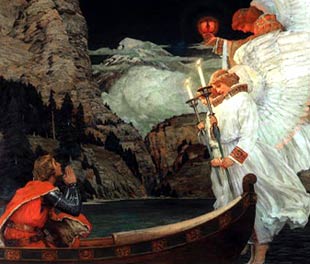
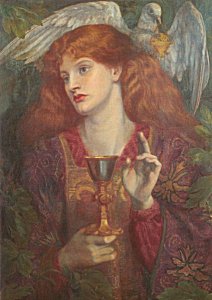
Legend has it that St Joseph brought with him the Holy Grail used at the Last Supper but also used later to collect the Holy Blood of Christ (later called the Sang Real or San Greal by Malory, meaning either “Royal Blood” or “Holy Grail”) which then gave rise to the Grail Legends in which King Arthur’s Knights of the Round Table went in search of the Grail but only Sir Galahad, the pure and holy knight, was able to find it.


King Arthur was a Romano-British knight who, after the Roman Legions had withdrawn, was compelled to become a chief of the remaining British Christians. That he was called “king” need not surprise us since the idea of the Roman Empire, the Emperor and of kings, was then well-established in Christian theology and politics. Let us not forget that the Emperor Constantine was declared Emperor at York by his army over 100 years before. Imperial and Royal ideas were the norm, as was Roman Catholic Christianity and Roman Christendom.


The Grail legends have a sub-stratum of truth for all that later writers have much embroidered them and they have exercised a great influence in British political and literary history.


The longest Abbey in England was built at Glastonbury and within it was incorporated the original "wattle and daub" oratory of St Joseph. The Abbey enjoyed the highest royal favour until the Protestant Reformation when King Henry VIII's Commissioners sacked and pillaged it and caused the last Abbot, Blessed Richard Whiting OSB, to be hanged from the tower of St Michael's Church upon the Tor. Now only the tower remains on the Tor and can be visited to this day.

Here is a good summary of the Glastonbury Legend:

“It is at Glastonbury that legend takes upon itself to go up not only to the beginnings of British Christianity, but also to the beginnings of Christianity itself. The legends of the spot go back to the days of the Apostles. The place is indeed unique, for from the very beginnings of Christianity it was hallowed ground. A legend even tells us that Christ himself as a boy walked upon the hills of Somerset…There is, in any case, more than enough of proved history to shew that Glastonbury was for centuries the most ancient and famous centre of Christianity in the land.

For example, the legend of St Joseph of Arimathaea coming to England is of ancient date, and there is also that others lovely tradition that Christ himself in his boyhood came hither. Though improbable it is not impossible, for we know that the Phoenicians came to Britain seeking metals, several centuries before the Christian era. Herodotus, in the fifth century BC, speaks of Cornwall as the Tin Islands, and Greeks too came in search of ore. St Joseph may conceivably have been one of those merchants and have acquired his wealth thus, in which case he might have brought the Holy Child with him on one of his journeys. If he had had this former acquaintance with our island, it would account for Joseph's being chosen as a missionary to Britain by St Philip. Such traditions are stories to cherish…

About the middle of the thirteenth century the traditions concerning the coming of St Joseph of Arimathaea to Glastonbury were written down as an introduction to William of Malmesbury's work On the Antiquity of the Church of Glastonbury. We learn from these traditions that the Apostle St Philip sent Joseph of Arimathaea from Gaul with twelve companions to bring the gospel message to our ancestors. This cultivated and wealthy Jew left his home and possessions and all that he had, and now, a poor man, bearing with him the priceless treasures of the true faith and a relic of the Holy Blood, he braved the long and perilous journey which brought him in AD 63 to the shores of Wales and thence travelled across the inland sea [Severn Sea or Bristol Channel] and marshy ground [Somerset Levels] to the Isle of Avalon...

John of Glastonbury relates this story and adds that Joseph and his son Josephes were disciples of St Philip by whom they were baptised. While St John was at Ephesus St Joseph remained with our Blessed Lady and was present at her Assumption. Fourteen years later he went to St Philip in Gaul whither that Apostle had been sent after the Ascension, as Freculfus, bishop of Lisieux states. Josephes, whom the Lord had consecrated bishop in Sarath went with him. Then the Apostle sent twelve of his disciples to preach the faith in Britain and he placed at their head St Joseph and his son Josephes…The pagan king Arviragus to whom they came rejected their teaching but gave them the island Ynyswitrin, or Glassy Isle, now called Glastonbury. He and two other kings subsequently gave them a further grant of lands known as the 'twelve hides' [one hide = 160 acres]. The legend says that St Joseph brought with him two cruets in which some of the sacred blood and the water which flowed from the wounds of our Blessed Lord was miraculously preserved.

'Avallon is entered by a band of Twelve:
Joseph, Arimathaea's flower, is chief of them;
And with his father cometh Josephes.
So to these Twelve Glastonia's rights are given.
In Pynson's Life of Joseph of Arimathaea we read:
And when our lorde in the sedony was drest
This blood in two cruettes Joseph did take.'


...At Weary-all Hill he and his companions rested, gazing down upon the valley where, at the foot of the Tor close by, he built what was probably the first Christian church above the ground that was ever raised. A later tradition also says that while resting he thrust his pilgrim's staff into the soil, and forthwith it budded, and a fair tree grew and flourished, and blossomed twice in the year. In the Life of Joseph of Arimathaea printed by Richard Pyerson or Pynson, the pupil of Caxton, in 1520, we read:

'The hawthornes also that groweth in Wirral
Do burge and bere greene leaves at Christmas
As freshe as other yn May...'


The holy thorn was cut down in 1653 by a zealous Puritan, but many slips [shoots] of it had been budded and its descendants still 'blossom at Christmas, mindful of our Lord'.

The Archangel Gabriel appeared to St Joseph and bade him build a church in honour of our Lady's Assumption:

'So Joseph dyd as the angell hym bad,
And wrought there an ymage of our lady;
For to serve hyr great devotion he had;
And that same ymage is yet at Glastonbury,
In the same church; there ye may it se.
For it was the fyrst, as I understande,
That ever was sene in this countre;
For Joseph it made wyth his owne hande. '

Thus did the first Apostle of Britain and his disciples make a little oratory 'of twisted twigs' to praise God at the foot of St Michael's Tor; it was 60ft long and 26ft wide, and from that wattle church dedicated to His Blessed Mother by our Lord Himself, they and their successors scattered far and wide the seed of the true faith, to north and south, to east and west; and like the seed of mustard it grew to a great tree whose branches spread over north-west Europe. In Tennyson's Holy Grail the monk Ambrosius tells Perceval that:

'From our old books I know
That Joseph came of old to Glastonbury,
And there the heathen prince, Arviragus,
Gave him an isle of marsh whereon to build;
And there he built with wattles from the marsh
A little lonely church in days of yore.
For so they say, these books of ours.'

It is said that the once-wealthy Jew, the 'friend of Pilate and of the Lord', who had given the sumptuous sepulchre he had prepared for himself to Him Who had no place to lay his Head, slept his last sleep in the shadow of the poor and primitive church of reeds at Avalon, the first of those innumerable saints whose bodies have sanctified this soil.

John of Glastonbury quoting a prophecy of the British bard Melkin, says that in Avalon's Island Joseph...

'Hath found perpetual sleep;
And he lies on a two-forked line
Next the south corner of an oratory
Fashioned of wattles
For the adoring of a mighty Virgin
By the aforesaid sphere-betokened
Dwellers in that place, thirteen in all. ..'

His [Joseph's] feast was formerly kept on July 27th and great was the concourse of pilgrims who flocked to pray before his statue. William Good, born at Glastonbury in 1527 and who, a member of the Society of Jesus [Jesuits], died at Naples in 1596, says that in a long subterranean chapel there was a most famous place of pilgrimage 'which was made to a stone image of St Joseph there and many miracles were wrought at it. When I was a boy of eight, for I was born there, I have served Mass in this chapel, and I saw it destroyed in the time of Henry VIII...' "

(The Glories of Glastonbury: her legends, history and saints, Armine Le Strange Campbell, Sheed & Ward, London, 1926)

Wednesday, 15 August 2007

The Queen assumed into heaven...

"Christ's faithful, through the teaching and the leadership of their pastors, have learned from the sacred books that the Virgin Mary, throughout the course of her earthly pilgrimage, led a life troubled by cares, hardships, and sorrows, and that, moreover, what the holy old man Simeon had foretold actually came to pass, that is, that a terribly sharp sword pierced her heart as she stood under the cross of her divine Son, our Redeemer. In the same way, it was not difficult for them to admit that the great Mother of God, like her only begotten Son, had actually passed from this life. But this in no way prevented them from believing and from professing openly that her sacred body had never been subject to the corruption of the tomb, and that the august tabernacle of the Divine Word had never been reduced to dust and ashes. Actually, enlightened by divine grace and moved by affection for her, God's Mother and our own dearest Mother, they have contemplated in an ever clearer light the wonderful harmony and order of those privileges which the most provident God has lavished upon this loving associate of our Redeemer, privileges which reach such an exalted plane that, except for her, nothing created by God other than the human nature of Jesus Christ has ever reached this level.

15. The innumerable temples which have been dedicated to the Virgin Mary assumed into heaven clearly attest this faith. So do those sacred images, exposed therein for the veneration of the faithful, which bring this unique triumph of the Blessed Virgin before the eyes of all men. Moreover, cities, dioceses, and individual regions have been placed under the special patronage and guardianship of the Virgin Mother of God assumed into heaven. In the same way, religious institutes, with the approval of the Church, have been founded and have taken their name from this privilege. Nor can we pass over in silence the fact that in the Rosary of Mary, the recitation of which this Apostolic See so urgently recommends, there is one mystery proposed for pious meditation which, as all know, deals with the Blessed Virgin's Assumption into heaven.

16. This belief of the sacred pastors and of Christ's faithful is universally manifested still more splendidly by the fact that, since ancient times, there have been both in the East and in the West solemn liturgical offices commemorating this privilege. The holy Fathers and Doctors of the Church have never failed to draw enlightenment from this fact since, as everyone knows, the sacred liturgy, "because it is the profession, subject to the supreme teaching authority within the Church, of heavenly truths, can supply proofs and testimonies of no small value for deciding a particular point of Christian doctrine.

17. In the liturgical books which deal with the feast either of the dormition or of the Assumption of the Blessed Virgin there are expressions that agree in testifying that, when the Virgin Mother of God passed from this earthly exile to heaven, what happened to her sacred body was, by the decree of divine Providence, in keeping with the dignity of the Mother of the Word Incarnate, and with the other privileges she had been accorded. Thus, to cite an illustrious example, this is set forth in that sacramentary which Adrian I, our predecessor of immortal memory, sent to the Emperor Charlemagne. These words are found in this volume: 'Venerable to us, O Lord, is the festivity of this day on which the holy Mother of God suffered temporal death, but still could not be kept down by the bonds of death, who has begotten your Son our Lord incarnate from herself'.

18. What is here indicated in that sobriety characteristic of the Roman liturgy is presented more clearly and completely in other ancient liturgical books. To take one as an example, the Gallican sacramentary designates this privilege of Mary's as 'an ineffable mystery all the more worthy of praise as the Virgin's Assumption is something unique among men'. And, in the Byzantine liturgy, not only is the Virgin Mary's bodily Assumption connected time and time again with the dignity of the Mother of God, but also with the other privileges, and in particular with the virginal motherhood granted her by a singular decree of God's Providence. 'God, the King of the universe, has granted you favors that surpass nature. As he kept you a virgin in childbirth, thus he has kept your body incorrupt in the tomb and has glorified it by his divine act of transferring it from the tomb'.

19. The fact that the Apostolic See, which has inherited the function entrusted to the Prince of the Apostles, the function of confirming the brethren in the faith, has by its own authority, made the celebration of this feast ever more solemn, has certainly and effectively moved the attentive minds of the faithful to appreciate always more completely the magnitude of the mystery it commemorates. So it was that the Feast of the Assumption was elevated from the rank which it had occupied from the beginning among the other Marian feasts to be classed among the more solemn celebrations of the entire liturgical cycle. And, when our predecessor St. Sergius I prescribed what is known as the litany, or the stational procession, to be held on four Marian feasts, he specified together the Feasts of the Nativity, the Annunciation, the Purification, and the Dormition of the Virgin Mary. Again, St. Leo IV saw to it that the feast, which was already being celebrated under the title of the Assumption of the Blessed Mother of God, should be observed in even a more solemn way when he ordered a vigil to be held on the day before it and prescribed prayers to be recited after it until the octave day. When this had been done, he decided to take part himself in the celebration, in the midst of a great multitude of the faithful. Moreover, the fact that a holy fast had been ordered from ancient times for the day prior to the feast is made very evident by what our predecessor St. Nicholas I testifies in treating of the principal fasts which 'the Holy Roman Church has observed for a long time, and still observes'."


Munificentissimus Deus, Piux XII, 1 November 1950, Feast of All Saints.