Showing posts with label American Revolutionary War. Show all posts

Saturday, 6 February 2010

Why King George III did not deserve to be overthrown

A gentleman called, I think, Mr Mulvaney (who wrongly identifies me with someone else) points out to me a most interesting article about the American Revolution.

It is by Jonathan Kolkey and is entitled:

Did King George III Deserve To Be Overthrown?

It is here:

http://www.lewrockwell.com/orig10/kolkey3.1.1.html

and it demolishes many myths about that Revolution, not least that there were any genuine grievances against King George III - and certainly now worthy of revolution.

I warmly recommend it.

Wednesday, 17 June 2009

Reprise on Just War and the American Revolution

I received quite a post-bag on this one.

Let me look at some of the questions raised.

Pedes Christi wrote:

”My question is, can such a government be considered legitimate? And if not, what is one justified in doing about it? I am not suggesting violent revolution (given your just war theory above), but how does one otherwise deal with such tyranny? I pray for the conversion of my country, but what else? With this I wrestle”.

I think you are right to wrestle with this issue. See what you think of my comments below.

Mark asks:

”Surely St. Thomas would not say that a private citizen should bear ‘any’ level of injustice imposed upon him, correct? To use an example from modernity, would a private citizen in say, the Soviet Union, China, Cuba or North Korea be justified in rebelling against the dictatorship?”.

He later asks:

”1. What relevance is it to the question of Just War when the subject is a private (Catholic) citizen rebelling against a non-Catholic government? Does it matter what form the government is (monarchy, democracy, communist, tyrant), or whether it is oppressive towards Catholicism, or Christianity in general? At what point does a secular government, tyrant or otherwise, become so oppressive to a Catholic society as to merit rebellion? I have in mind your response on 10 June at 14:51 and your comment s regarding the alleged Freemasonic affiliations of the European Prime Ministers.

2. In your reply to Ollie you offered that his view was that of a ‘tiny minority’; I wonder what relevance does this have? Did you mean that in terms of having any bearing on a contemporary public that it is not relevant because it is impractical, or because it was not widely held at the time, or only that it is so obscure as to be discarded for purposes of discussion?

3. As you have explained your understanding of the application of Just War principles to this particular conflict, I wonder whether you believe the Crusades to have been just? What about the First War of Independence by the Scots?

4. In your reply to Dion, you asked a (rhetorical?) question as to how he would conclude as to the guilt of a Mohammedan claiming justice as the motivation for a act which resulted in the death of innocents; I wonder if by this you mean to imply that combatants whose actions result in the death of other combatants in wars which you believe to have been unjust are guilty of murder? Or does the responsibility for the justice of the war rest solely on the civil authorities to whom God has granted this responsibility? Is his culpability greater because the innocents were his targets, as opposed to a combatant who knows there will be innocent lives loss by his actions but which are otherwise unintended?

5. I am curious if you know of any declarations since 1789 by Roman Pontiffs declaring a major conflict to have been unjust.”


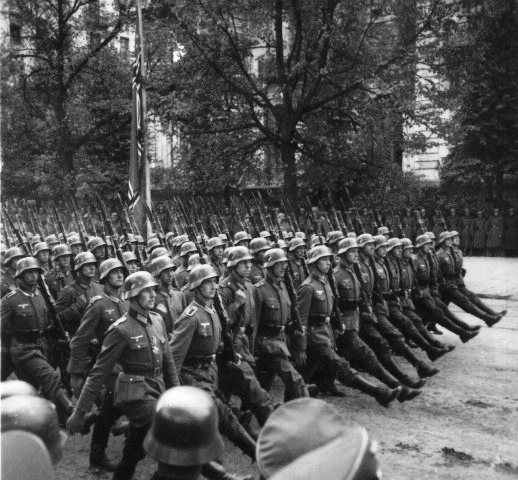
Was the German invasion of Poland just? Pomerania and Silesia were both originally German and had been seized after World War I. But the German government had pledged not to invade and, moreover, its ideology was then Nazi, a grossly heretical creed.


Let me essay an answer to these.

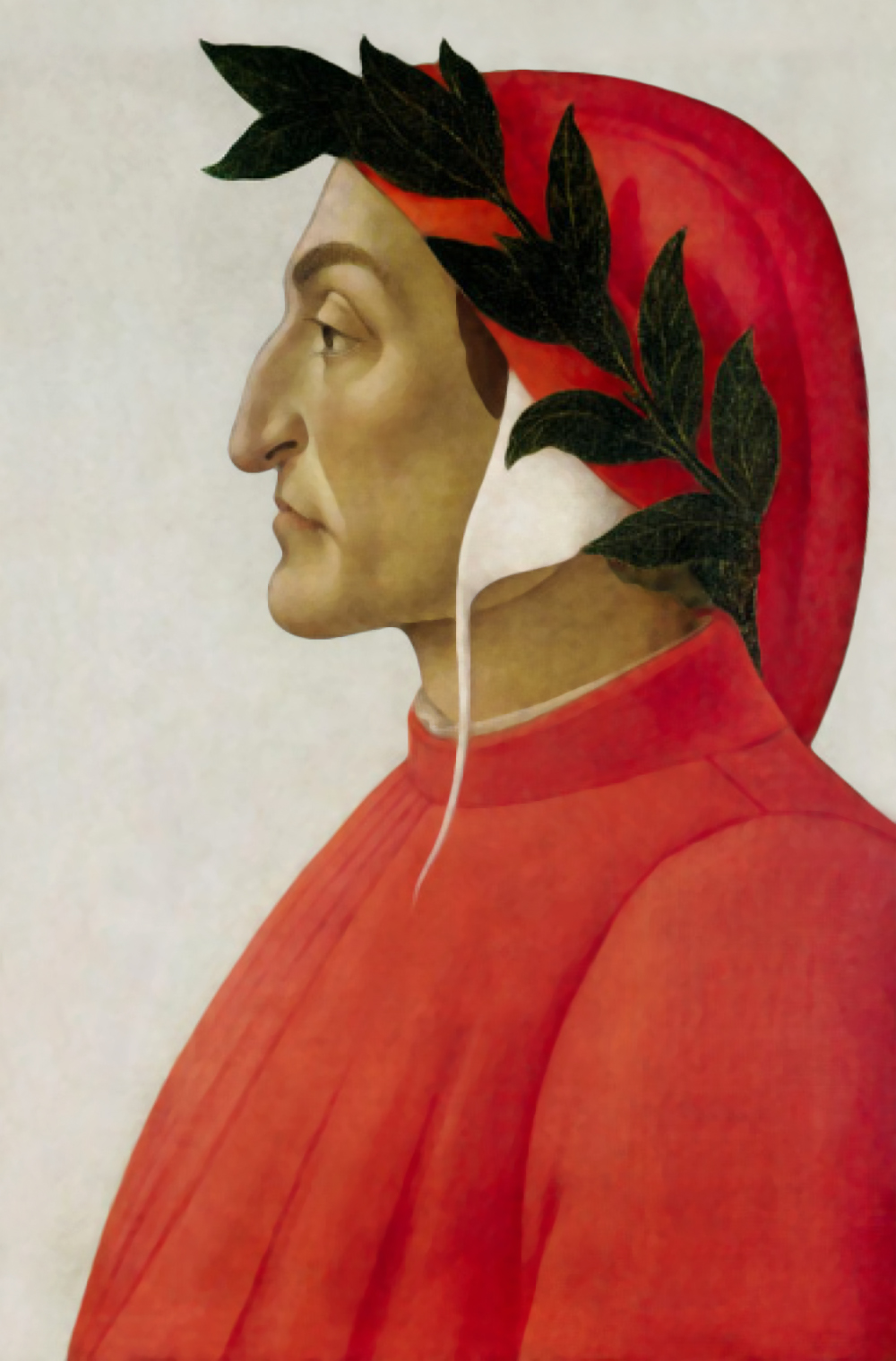
1. The principles of a just war are matters of Natural Law and, as such, apply to all men, not just Catholics. A private citizen, Catholic or otherwise, may not, according to those principles, rebel against properly constituted authority. It matters not what form the government takes, although it may be relevant that the government is oppressing Christianity, which is a true religion, rather than a false religion. However, that does not confer upon the private citizen the right to revolt against properly constituted government. Thus, at no point does a secular government, tyrant or otherwise, become so oppressive to a Catholic society as to merit rebellion, if it is a properly constituted government. Private citizens did not have the right to rebel against the Freemasonic European Prime Ministers, for instance, if they were properly constituted. There may be some residual or other powers of the Pope, however, to depose Catholic sovereigns but it would first have to be convincingly demonstrated that they derived their authority from the Pope. In general, according to Dante and St Thomas, Catholic monarchs derived their authority direct from God and not the Pope, although that varies. For instance, the Pope had the right to refuse to accept the Prince-electors nominee for Roman Emperor.

2. In my reply to Ollie I meant that his view is so obscure as to be discarded for purposes of discussion.

3. Not all of the Crusades were unjust – although they were not always justly conducted – because the Holy Land belonged to Christendom and the Eastern Empire in particular and it was a war of restoration and defence, expressly sanctioned by the Church as restorative and defensive against the ever-encroaching advance of Islam. I am not sure about the First War of Independence by the Scots. I would need to study the causes in more detail. Does anyone else have a view on it?

4. In my reply to Dion, I did not mean that combatants whose actions result in the death of other combatants in wars which are unjust are necessarily guilty of murder, although their leaders might be depending upon the usual criteria of intentionality. It is a standard application of the principle of “double effect” that a combatant who knows there will be innocent lives loss by his actions but which are otherwise unintended Is not guilty of moral crime. The culpability of the terrorist who deliberately targets the innocent is plainly evident. None of this was my primary point which was that no man can plead his disagreement with the Natural Law as an excuse for his crimes because every man has the Natural Law “written in his heart” and so cannot claim ignorance of it or exemption from it. If he could then Al Capone could say that he was innocent of murder because he did not believe that killing those who got in his way was murder.

5. There have been plenty of papal condemnations of conflicts as unjust since 1789. Pope Pius VI and Pius VII both declared the French Revolutionary wars unjust as well as the Bonapartist wars. Leo XII also did so and Gregory XVI declared the Italian revolutions unjust as did Bl Pius IX. He also condemned the Irish rebellions and excommunicated the Fenians on 12 January 1870. Of course, he also did the same to the Italian rebels. The Polish rebels were also – very significantly since they were rebelling against an heretic Tsar – condemned. The First World War was variously condemned and so were the Fascist and Nazi wars. The Spanish rebels were condemned (as were some actions by the Nationalists), Paul VI condemned the anti-terrorist war against ETA and John Paul II condemned the British invasion of the Falkland Islands, albeit not formally (and, in my view, on questionable grounds) as well as the Iraq war.


St Thomas Aquinas, leading theologian of just war principles


St. Thomas would not say that a private citizen should bear ‘any’ level of injustice imposed upon him, however bad, because he expressly allows the principle of self-defence. One may defend oneself, one’s family and others, together with property. If this requires what may become a war against the government then that is justified on the principle of “double effect” provided that there is no intention to overthrow the government or to prosecute a war against it.

If, however, the government was never a legitimate one then a war might be prosecuted against it (subject to all the usual just war criteria) in order to restore the legitimate government.

This was the purpose behind the Jacobite and Carlist wars and – arguably – the US War between the States. The South were seeking to restore the original Constitution as against the effectively new and unauthorised Constitution imposed by Lincoln and the Northern Yankees.

The governments of the Soviet Union, China, Cuba and North Korea were all illegitimate governments imposed by revolution and force of arms against legitimate governments. So long as they continued to be illegitimate in that sense it would be open to anyone (subject to all the other just war criteria) to rise up against them to restore the true and legitimate government (if there was one).


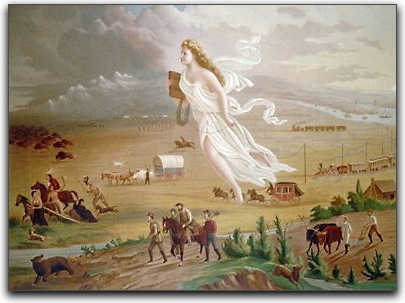
"Manifest Destiny" was just a re-run of the old Puritan and Cromwellian cry that the Protestant white man was pre-destined by an apparently arbitrary God to rule over all other men as a "chosen people" of Biblical stature who would be enriched in a new republic designed chiefly for their benefit. It is, of course, unbiblical nonsense.


I agree that “Manifest Destiny” is really an outgrowth of the theology of certain Protestant groups (often Calvinists) who beleive in the “God is on our (America's) side” school of thinking and I agree that this theology – like that of the Cromwellian Puritans and the Afrikaner Boer Vortrekker people – tends to give the impression of a status of “chosen people” based upon the nation of Israel as a chosen people.

That is one of the reasons why I am opposed to such Americanist Yankee nonsense. It does no good to America nor to the rest of the world.

But you cannot persuade Americanists of this view. They simply stick their fingers in their ears and shout pro-Americanist slogans.

...

Tuesday, 9 June 2009

An essay in morals and logic regarding the American Revolution

This is the old chestnut that will not die.

Let me first invite all those Americanists reading this article to do their best, if they can, to put aside their particular prejudices and try to view this issue objectively.

I realise that for some that is simply mission impossible.

Well, I am sorry for them but I believe that there will be some who - with a bit of effort - can do it.

It is to them - and not the blinkered bigots - that I address the argument that follows.

All men feel a strong affinity to and for their own country - and so it should be - but that should not ever blind them to their country's particular faults. Indeed, if they really love their own country then they would be at pains to discover its faults, admit them and try to do something to overcome them.

The man who says "my country, right or wrong" does not truly love his country.

In the case of America the problem is trebly exacerbated by the false myth that so many Americans naively believe that their own society and system of government is the best that the world has ever seen and ought to be aspired to by all peoples throughout the world. This blinkers their capacity to view their own country objectively more than the people of most other countries.

The Americanist idea that America is the acme of civilisation and that it has the right to spread its own culture and form of government to the rest of the world is part of the purely exploitative myth of so-called "manifest destiny".

It was devised by the Founding Fathers to give themselves an excuse to invade and annex territory that belonged to Spain and to the native American Indians and, later, to control Latin America for the benefit of rich Yankees rather than the common good.


The Americanist doctrine of "manifest destiny" was a self-fulfilling, circular argument of zero logical weight invented by Yankee revolutionaries and supremacists as a convenient philosophical veil to cover the gross and grotesque rape of the native American Indians, and of the Spanish territory upon which they mostly dwelt, solely for the private profit of Yankee Americans. That is the truth about "how the West was won".


It was little more than a cloak for greed and exploitation - exploitation that even continues to this day, in new and different forms.

There is very little that is just in such a viewpoint and much that is very unjust. Blind bigotry and false loyalty to such a view is not a virtue but rather a species of sin.

On the other hand, honest and decent Americans are fine people, many some of the finest, who have given the world much and can do yet more for the world in the future. They are the Americans who are able to distinguish the virtue of love of country from bigotry and America from the error of Americanism.

Since America is now the world's policeman, it is all the more important that its citizens understand their own history and understand the flaws as well as the triumphs.

Failure to do so has already cost lives and the prospect of peace in a number of countries.

The Serbs were able to throw back in the face of the American negotiators the simple fact that America had staged its own revolution, that it had believed in its own "manifest destiny", that it had "ethnically cleansed" the country of native American Indians and that it still believed in its own intrinsic superiority over other nations.

Madeleine Albright's typically Americanist negotiating stance was to say to the Serbs that they had 2 choices: hand over their country now or else America would invade and take it over. What kind of preposterously arrogant negotiating position was that for any responsible country to take?

Moreover, the decision to invade Iraq for a second time might have been viewed more circumspectly if the American leaders had understood a bit more about their own history and its particular flaws.

Just War

What makes a war just?

The traditional teaching is set out in the writings of St Augustine and St Thomas Aquinas particularly.

It can be summarised as follows.

Jus ad bellum (the morality of going to war) requires all of the following 6 conditions to be fulfilled:

1. A just cause - e.g. righting a wrong, protecting the innocent or restoring rights wrongfully denied or taken away. Vengeance or reprisals or the prestige of the sovereign are not sufficient reasons.

2. Proportionate cause - the cause must be sufficiently weighty to justify the very serious step of waging war with all its attendant evils.

3. Right intention - we must have a good intention, as with all moral acts e.g. to create a better situation than the situation pertaining before the war.

4. Right authority - only those with the proper, sovereign, legislative authority to declare war may do so. War may not be declared by private citizens.

5. Reasonable prospect of success - quixotic gestures are not appropriate in going to war.

6. Last resort - every reasonable way of avoiding war must first be exhausted. Jaw, jaw is better than war, war.


St Augustine of Hippo: the greatest of the Latin Fathers of the Church, first codified teaching on a just war


Jus in bello (morality in waging war) requires the following conditions to be met:

1. Discrimination - we must not deliberately attack the innocent and the non-combatant.

2. Proportionality - we must not take action which might cause disproportionate harm relative to the likely benefit of the war. This is similar to the doctrine of "minimum force" necessary to achieve one's military aim.

Was the American revolution a just war?

American children are taught from an early age that it is axiomatic that the American Revolution was a just war.

It has become a dogma of the Americanist faith and American children are not permitted even to question it, let alone challenge it.

Any objective person (which rules out most Americanists) must, however, consider the case on its merits. A fortiori, a Catholic must do so, too.

All 6 of the reasons are considered by many authors to be lacking in the American revolutionary war but I will consider but one which I think sufficient to call into question the morality of the whole enterprise.

It is this: the lack of right authority.

By what authority did the American rebel colonists claim the right to rebel against their sovereign?

The simple fact is that they had no such authority. Neither did they claim it. Instead they simply adopted the view of the English Whigs, going back to Oliver Cromwell, in claiming the right to decide if and when the sovereign was ruling unjustly and on that basis gave themselves the "right" to rebel.

This, of course, is not only completely contradictory to Christian and Catholic doctrine and principle but is, also, a recipe for anarchy.


Imitating but exceeding the Americans, the French liberals went on to stage a disgustingly savage revolution of their own. The result was that the revolutionary leaders themselves later went to the guillotine, like Maximilien Robespierre, the leader during the "Great Terror" but later himself executed (above).


If any group of citizens can give themselves the right to overthrow the sovereign state whenever they consider that ruler to be unjust then no society is safe.

It is true that no-one is morally obliged to obey an unjust law and that they may refuse to obey it but that is a very different thing from going on to the much further stage of actually overthrowing the maker of the law.

It is also true that if the sovereign state attacks the individual or the group unjustly that the individual or group may take reasonable and proportionate means to defend themselves from such attack but, again, that is a far cry from intentionally plotting to overthrow the sovereign state.

The principle of double effect would allow an intentional defence against the attacks of the sovereign state even if that foreseeably, but not intentionally, opened up the possibility of the state falling but, again, that is a far cry from intentionally plotting to overthrow the sovereign state.

St Thomas puts the matter thus (De Regimine Principum, Cap 6, 45-6):

"If the excess of tyranny is unbearable some have been of the opinion that it would be an act of virtue for strong men to slay the tyrant and to expose themselves to the danger of death in order to set the multitude free... but this opinion is not in accord with apostolic teaching."

There you have it.


St Thomas Aquinas, greatest of all Catholic theologians, condemned revolution as "not in accord with apostolic teaching"


St Thomas explains that this is because St Peter admonishes us to be reverent and obedient to our masters both good and bad (1 Pet 2:12-20) and that we cannot overthrow our masters.

A sovereign person or body may only be overthrown by that which is higher, teaches St Thomas. For example where a king is chosen by a senate or a popular assembly then either of those bodies may depose the king since they are prior to the king but if the king is chosen through birth then he cannot be deposed by any of his subjects since they are not, then, prior to him.

The American rebel colonists simply and wholly rejected this teaching of St Thomas, just as the rebellious Protestants did at the Protestant Reformation, just as Cromwell did and just as the English Whigs did. Indeed, the American rebel colonists expressly and openly averred that they were following the English Whigs in overthrowing King George III, just as the English Whigs had overthrown King James II, our last Catholic king.

There is simply no escaping this. Americanist Catholics must simply just get used to it.

The suggestion that the American rebels were not rebelling because the Hanoverians had no right to rule is contradicted by the American rebel colonists themselves. The American rebel colonists were certainly not seeking to restore the Stuarts. On the contrary, they were even more anti-Stuart than the English Whigs.

In any case, one rebellion does not legitimate another because two wrongs do not make a right and one may not do evil that good may come of it, as St Paul teaches us (Rom 3:8).


King George III in coronation robes


King George III had the right to ratify legislation. The American rebel colonists did not. The de facto government has all the authority of a real government unless it is open to realistic challenge. The alternative would simply be anarchy which is always wrong. By the reign of King George III no-one was really challenging his right to rule in place of the Stuarts.

Moreover, Henry Benedict, Cardinal Duke of York and the Stuart successor, recognised King George III. By the time of King George III the rule of the Hanoverians had become legitimate, recognised by pope, emperor and pretender alike.

One of the most loyal of Stuart loyalists and the very person who had hidden, nursed and nurtured Prince Charles Edward Stuart ("Bonnie Prince Charlie") after the Battle of Culloden in 1745 was Flora MacDonald.


Flora MacDonald receiving Prince Charles Edward Stuart when he was on the run from the English and Scottish Whig rebels after the Battle of Culloden. She later went to America and was there a Loyalist, rejecting the American Whigs just as she had the British Whigs.


She later went to America and there she and her husband were active loyalists, supporters of King George III as King of America and strongly opposed the rebel colonists whom she regarded as unnatural rebels against proper authority, just as she had earlier regarded the English Whigs as rebels against the proper authority of the Stuarts.

That is, I think, precisely illustrative of the true Catholic position and shows the sound Catholic sense of Flora MacDonald.


Prince Henry Benedict Stuart, Cardinal Duke of York and the head of the House of Stuart after his brother's death. He recognised the rule of King George III during his life (despite leaving the matter ambiguous in his will). He sent the Scottish coronation heirlooms to King George and received a pension from the King.


What I would ask is this: how can anyone defend the rebellious Yankees, if they reject as rebellious the Hanoverians?

The American War of Independence was not made just by British injustice. As St Thomas teaches, private citizens do not have the right to pass judgment on their own sovereign and to overthrow him, even if that sovereign is passing unjust laws and acting unjustly.

In any case, it was the American rebels who behaved unjustly, at least as much as the British government. A mere "feeling" that one can "no longer bear British rule" does not even begin to satisfy the traditional tenets for a just war.


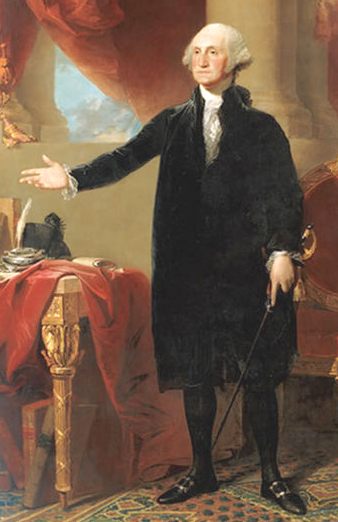
George Washington, leader of the rebel colonists


The rebel colonists were, in truth, a parcel of Whigs and they had imbibed the false and treacherous teachings of the English Whigs and men like Cromwell and had persuaded themselves that they could make out a case for overthrowing the relatively mild rule of King George III, make themselves the rulers and so profit handsomely from a revolution.

In short, it was they who were unjust far more than King George. Indeed, the rule of King George III and his government was milder than that of the rebel colonists and it was during his reign that the unjust penalties against Catholics and dissenters had begun to be withdrawn or not enforced.

Though it must be admitted that King George still retained prejudices against Catholics, his reign was a vast improvement on that of his odious predecessors and it was during his reign that the first Catholic chapel was built. This was on the Lulworth Castle estate of Sir Joseph Weld, Bt, in Dorset.

Indeed, King George's government had passed the Quebec Act which recognised Catholicism as the religion of the French Canadians. How did the American rebel colonists react to this? They called it an "intolerable Act" and cited it as an example of the "tyranny" of King George!

Thus one can readily see the extent of the anti-Catholic bigotry of the American rebel colonists.

The rebel colonists also saw a huge financial advantage to themselves personally from the revolt and the example of the Boston tea party is a good case in point.

Far from there being expensive tea imported, the British government had allowed tea imports to provide cheaper tea to the colonists. The rebel leaders, however, stood to lose the considerable profit they were making on their own expensive tea by these cheaper imports and so they staged the "Boston tea party" to oust the competition against their own tea monopoly.

They were, in short, not only anti-Catholic bigots but also greedy profiteers at the expense of their fellow American colonials.


Tom Paine: atheist radical and model for many of the American revolutionists


They then tried to turn their greed and selfish profiteering into a principle by pretending that the whole colony was being oppressed by the British government when, in fact, the opposite was true. It was they who were oppressing their fellow colonials.

They also oppressed the non-white minorities and kept slaves for their own benefit and profit. It was of these rebel colonists that Dr Johnson so rightly said:

"Why is it that the yelps for liberty come loudest from the drivers of slaves?"

The American revolution was illegitimate from the beginning and was a war by, and for the benefit of, a small group of colonial oligarchs who sought to enrich themselves by overthrowing the legitimate government and putting themselves at the head of a new, oligarchic government which was thereafter run chiefly for their own benefit and profit.


Thomas Jefferson: Dr Johnson had him in mind when he wrote "Why is it that the yelps for liberty come loudest from the drivers of slaves?"


A government that is run for the profit and benefit of the few and not chiefly for the common weal is called a tyranny (or unjust oligarchy), as St Thomas teaches.

Such were the American rebel colonists. Moreover, their revolution was not a just war.

Generations of American children have been taught the opposite. They have, however, been taught wrongly and falsely. An objective person can see this. A prejudiced person - as most Americanists unfortunately are - cannot.

The real absurdity is that so many modern Americans have been duped into thinking that their own society which, even now, is not run for the benefit of all but chiefly for the benefit of the few rich, is the very acme of freedom.

They have so much imbibed the myth and the propaganda that they can no longer even recognise what freedom really is.

They slave away for employers who exploit them and give them only 2 weeks "vacation" and they honestly think this is the very pinnacle of freedom.

The new slaves have persuaded themselves to love their own enslavement, even though it is often far more oppressive than the conditions of most slaves in the old South.

Does this mean that America should now be forced to recognise the Queen (or even the Duke of Bavaria) as their head of state?

I only pose this question because I am sure that some dumb bunny will try to raise it (whether stupidly or sarcastically) in order to try and make a cheap point.

The answer, of course, is no.

No - no more than should the British Crown be forcibly handed back to the Duke of Bavaria, even though he is undoubtedly the true head of the legitimate House of Stuart.

Why?

Because to do so would once again require an insurrection or, at the very least, a coup d'etat both of which actions would fail miserably to satisfy the criteria for a just war, almost as much as did the American revolutionary war fail to satisfy the same just war criteria.


HRH Francis, the Duke of Bavaria, with his niece, HRH Princess Elizabeth, who is expecting a child. The Duke remains the head of the excluded Catholic House of Stuart.


Of course, if the Duke could become King (assuming that he was willing which is at best doubtful) by voluntary means, by the consent of Parliament and people, then, of course, there could be no objection.

But is that likely? No.

Jacobites (like myself) can entertain the just and pious hope that the legitimate Stuart king might one day be restored to the throne of Britain but we cannot for one moment ever seriously entertain the entirely fanciful notion that any such restoration should today be imposed by force of arms or by coup d'etat.

The time for that sort of action - right though it may have been in 1715 and 1745 - is now long, long gone and it would be the height of immorality, unconstitutionality and folly to attempt such a criminal enterprise with any degree of seriousness. In attempting such, we would be no better than the terrorists of Al Qaeda or the IRA.

The issues are currently under discussion, however, due to the proposal by Gordon Brown to scrap the Act of Settlement 1701 which excludes all Catholics from the British Crown. See this report:

http://www.telegraph.co.uk/news/uknews/1584184/Act-repeal-could-make-Franz-Herzog-von-Bayern-new-King-of-England-and-Scotland.html

It is even less likely that the Congress and the people of the USA would ever consent to a return to the Queen as head of state.

Indeed, the issue is irrelevant to the point of this essay.

My aim was to examine the conditions for a just war and see if they applied to the original American revolutionary war and then to see how the continued "dogma" of faith in the recititude of the American revolution influences and affects modern US cultural and political discourse and policy.

...

Friday, 4 July 2008

4 July: Freemasonic Dependence Day?

The 4th July is the day when Americans celebrate Independence Day - independence from Great Britain.

There is much that is good in America that is worth celebrating but not everything is rosy in the tale of American history.

This American Revolution was engineered by a collection of Freemasonic Deists, Unitarians and revolutionaries who were largely very anti-Catholic in their outlook. Even the one nominal Catholic amongst the revolutionaries, Carroll of Carrollton, was a prototype Irish Liberal Catholic. They sought to become independent of their lawful Sovereign by means of a revolution which no traditional morality had, or could, ever endorse. In so doing, they became dependent upon an entirely new philosophy largely predicated upon the false ideas of the anti-Catholic English philosopher and Freemason, John Locke.

The Declaration of Independence of the rebellious and anti-Catholic American Colonials


Indeed, one of the so-called "intolerable acts" of King George III cited in the Declaration of Independence was the Quebec Act which granted and guaranteed religious freedom to Catholics in Quebec. This was "intolerable" to the American revolutionaries!

The Quebec Act establishing Roman Catholicism in French Canada, called "intolerable" by the Freemasonic anti-Catholic American revolutionaries


From these beginnings, began the United States of America. Of the Founding Fathers, most kept slaves and endorsed the slave trade, shortly to be solemnly condemned, once again, by the Roman Catholic Church, this time by Pope Gregory XVI in his Apostolic Constitution, In Supremo Apostolatus, of 3 December 1839.

Thomas Jefferson had children by his own slaves and then enslaved these very children of his own.

Freemasonic Brother Thomas Jefferson, drafter of the Declaration, begetter and enslaver of children by his own slaves and later US President


On 2 December 1823, US President James Monroe created the Monroe Doctrine which said that the European powers were no longer permitted by the US to take any further economic or political interest in any part of the Americas, north or south. This meant that, in effect, the United States gave itself the sole right to colonise – albeit economically – Latin America and exploit it for their own use. This policy had the outward appearance of “neutrality” between European disputes and “anti-imperialism” whilst actually being a far more manipulative and exploitative form of dollar-imperialism in which the backyard of the USA was to be considered to exist for the economic benefit of the USA.

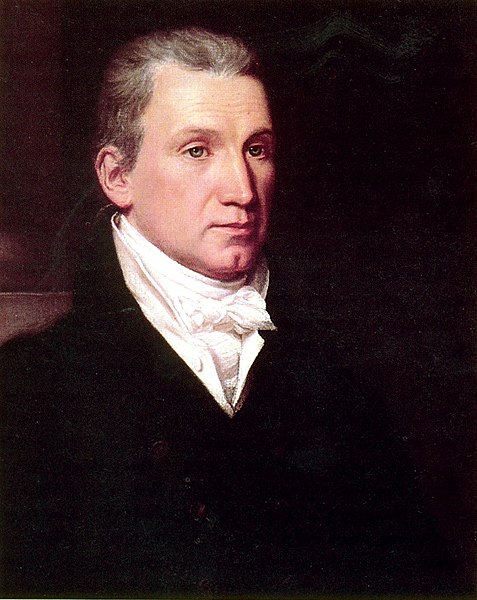
President James Monroe first stated the doctrine during his seventh annual State of the Union Address to Congress, a defining moment in the foreign policy of the United States.

Freemasonic Brother James Monroe, US President and inventor of the "Monroe Doctrine" which established US Dollar-Imperialism and the rapacious exploitation of foreign revolutions for the selfish gain of rich Americans at the expense of poor foreigners


This later resulted in the USA supporting Secular Fundamentalist, anti-Catholic, revolutionary movements all over Latin America, not least the brutally murderous Marxist regime of Plutarco Calles, the butcher of the Catholic Cristeros in Mexico.

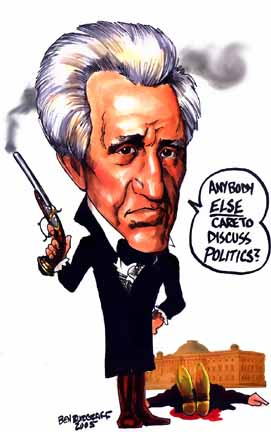
Later came General, later President, Andrew Jackson, the founder of the US Democrat Party. He had spearheaded the US annexation of Spanish territory and wars of aggression against the Mexican Empire. He later ordered the compulsory movement to the West of the Cherokees, Seminole and Creek Indians, many of whom died en route. This was an illegal act. Most of these Indians were US citizens (having been guaranteed such status in the treaties between the US and Mexico). They had appealed to the US Supreme Court against their removal and had been upheld by pre-eminent US Chief Justice, John Marshall.

Jackson said: "John Marshall has made his decision. Now let him enforce it!". This was genocide, US-style.

Cartoon of Freemasonic Brother, US President Andrew Jackson, he who illegally and unconstitutionally forced the Cherokee, Seminole and Creek Indians west of the Mississippi in an act of virtual genocide


Famously, long after slavery and the slave trade had been condemned throughout the civilised world, it continued in the USA.

Lincoln is held out as the "Great Emancipator" of the slaves. But was he? Was that really his motivation in the War between the States?

One of Lincoln's most representative public statements on the question of racial relations was given in a speech at Springfield, Illinois, on 26 June 1857. In this address, he said:

"There is a natural disgust in the minds of nearly all white people to the idea of indiscriminate amalgamation of the white and black races ... A separation of the races is the only perfect preventive of amalgamation, but as an immediate separation is impossible, the next best thing is to keep them apart where they are not already together. If white and black people never get together in Kansas, they will never mix blood in Kansas..."


US President Abraham Lincoln, who believed in racial segregation and the deportation of slaves back to Africa


Racial separation, Lincoln went on to say, "must be effected by colonization" of the country's blacks to a foreign land. "The enterprise is a difficult one," he acknowledged, but, said Lincoln:

"...where there is a will there is a way, and what colonization needs most is a hearty will. Will springs from the two elements of moral sense and self-interest. Let us be brought to believe it is morally right, and, at the same time, favourable to, or, at least, not against, our interest, to transfer the African to his native clime, and we shall find a way to do it, however great the task may be."

So much for the emancipator of the slaves!

The history of American oppression of the Native American Indians is even more telling. This was a war of sheer, unmitigated greed and aggression started by the American Colonists as a naked land grab of Spanish and Indian territory. It was dressed up with all the racist hypocrisy of a nation that saw itself as the coming power, pharisaically claiming to be blessed by Providence and entitled to crush all before its inevitable progress.

Ironically the British government had treated the Indians with a large degree of fairness and many Indians were loyalists during the War of Independence.

Once America became a separate nation, it sought to annex nearby land from the Mexican Empire and from the Indians, treating the latter as virtually sub-human and, all too frequently, to be simply turned out of their land and even shot on sight. This was a foretaste of the racist hegemonism that was to come with many progressive, "liberal" whites claiming a natural superiority of race which meant that "inevitably" the Indians must die out and be replaced by superior whites. It was yet another example of how the liberal, progressive mind-set is essentially an oppressive one.

This was not Colonialism but something very, very different. It was the beginning of a return to heathen ideas of might over right and even of genocide.

So arrogant did some Americans become that they under-estimated the courage, integrity and strength of the Indian tribes, many of whom were, in fact, Christians and Catholics, having been converted by Spanish and French missionaries in Mexico, California and Canada.

One result was the Battle of the Greasy Grass (aka Little Big Horn or Custer's Last Stand) where Colonel George Armstrong Custer's 7th US Cavalry was wiped out by the Sioux, Cheyenne and Arapaho confederation under Crazy Horse and Chief Sitting Bull in 1876.


Colonel George Armstrong Custer of the 7th US Cavalry was fairly typical of the kind of free-booting American who thought that it was America's destiny to defeat or eliminate the native American Indians and grab their land. He was stopped in his career of adventurism at Little Big Horn in 1876


Revenge was later obtained by the 7th Cavalry when they massacred Indians at the infamous Battle of Wounded Knee in 1890.

After the Civil War in which the North seized immense power from the States, political corruption reach hitherto unheard-of heights (even in America) with the scandals of Tammany Hall, the corrupt Democrat Party machine in New York City run by "Boss" Tweed.

Cartoon and photograph of Freemasonic Brother William "Boss" Tweed, the chief beneficiary of the Tammany Hall swindle which denuded the City and citizens of New York of more money than had probably ever before been corruptly obtained anywhere


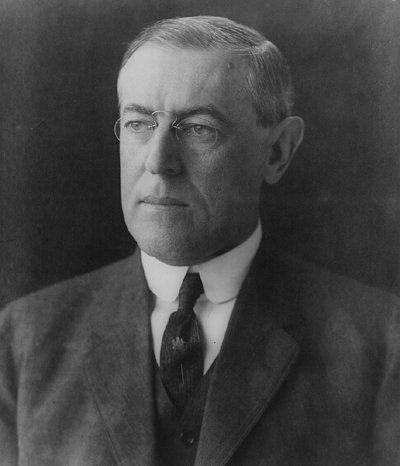
Democrat President, Woodrow Wilson, after World War I forced a settlement upon Europe that prepared the way for Hitler and World War II.

Freemasonic Brother and US President Woodrow Wilson whose harsh and imprudent demands at Versailles, after World War I, prepared the way for World War II


Democrat President, Franklin Roosevelt, married to Communist fellow-traveller, Eleanor Roosevelt, naively allowed himself to be fooled by Stalin and so unwittingly helped deliver yet more parts of the globe into Communist hands.

Freemasonic Brother Franklin D. Roosevelt, US President whose naivete toward Stalin guaranteed the long term enslavement under Communism of most of Eastern Europe


Democrat President, Harry S. Truman, taking over during the War, ordered the dropping of the Atom Bomb upon defenceless women and children, not least upon Catholic women and children when the B-29 Bockscar dropped its "dirty", highly-radioactive bomb almost on top of the Catholic Cathedral of Japan in Urakami.

Freemasonic Brother Harry S. Truman who, as US President, ordered the mass murder by atomic bomb of innocent women and children, especially the Catholics of Nagasaki, whilst claiming publicly that they were "military bases"


The first Catholic President of the USA, Democrat John F Kennedy, was most notorious for his almost pathological womanising. Kennedy personally ordered US agents in Vietnam to withdraw support from Catholic President Ngo Dinh Diem, giving support to the Buddhist revolutionaries and conniving at the later assassination of President Diem.

US President John F. Kennedy who connived at the murder of his former ally, Catholic President Ngo Dinh Diem of Vietnam. Was Kennedy also a Freemasonic Brother? No-one knows but it would not be a surprise.


Classically, America (together with revolutionary France) led the way in the Social or Structural Revolution of the 1960s when hippiedom, student revolution, drugs and random sex were extolled as "liberating" by the youth leaders of the new revolution. Soon after came a massive new wave of drug-fuelled serious crime which has accelerated, ever since, at an alarming rate.

Drug-extolling, anarchists, revolutionaries and self-worshipping hippies, Jerry Rubin and Abbie Hoffman, exemplars of the 1960s student revolution: the apotheosis of Americanism and the American Revolution? They certainly thought they were.


Drugs became such a widespread phenomenon that one is tempted to call the day that celebrates the rise of the new American revolution by a new name: Drug Dependence Day.

"Americanism", in fact, came to be the name of a new heresy, condemned by Pope Leo XIII in 1899. This new heresy claimed to set up a new kind of Church in America which was to be different and better than the Church as it had hitherto been. In an ironic and bizarre kind of way this has, indeed, happened since the new, post-Vatican II Church of America has - notoriously - been a leading example of disloyalty to the Pope and Catholic teaching as an endless stream of priests, nuns and religious abandoned first their vows and vocations and then, in some cases, even common decency and morality as evidence of the clerical child-abuse scandal began to grow and grow.


Pope Leo XIII,
Supreme Pontiff of the Catholic Church, condemner of oppression, murder, exploitation, injustice and Freemasonry and the Pope who strongly encouraged Thomism and the recitation of the Holy Rosary.


Here is what Pope Leo had to say of the error of "Americanism":

"…The underlying principle of these new opinions is that, in order to more easily attract those who differ from her, the Church should shape her teachings more in accord with the spirit of the age and relax some of her ancient severity and make some concessions to new opinions. Many think that these concessions should be made not only in regard to ways of living, but even in regard to doctrines which belong to the deposit of the faith. They contend that it would be opportune, in order to gain those who differ from us, to omit certain points of her teaching which are of lesser importance, and to tone down the meaning which the Church has always attached to them. It does not need many words, beloved son, to prove the falsity of these ideas if the nature and origin of the doctrine which the Church proposes are recalled to mind…

These dangers, viz., the confounding of license with liberty, the passion for discussing and pouring contempt upon any possible subject, the assumed right to hold whatever opinions one pleases upon any subject and to set them forth in print to the world, have so wrapped minds in darkness that there is now a greater need of the Church's teaching office than ever before, lest people become unmindful both of conscience and of duty...

First, all external guidance is set aside for those souls who are striving after Christian perfection as being superfluous or indeed, not useful in any sense — the contention being that the Holy Spirit pours richer and more abundant graces than formerly upon the souls of the faithful, so that without human intervention He teaches and guides them by some hidden instinct of His own…

And shall any one who recalls the history of the apostles, the faith of the nascent church, the trials and deaths of the martyrs — and, above all, those olden times, so fruitful in saints — dare to measure our age with these, or affirm that they received less of the divine outpouring from the Spirit of Holiness?

…This over-esteem of natural virtue finds a method of expression in assuming to divide all virtues in active and passive, and it is alleged that whereas passive virtues found better place in past times, our age is to be characterized by the active. That such a division and distinction cannot be maintained is patent — for there is not, nor can there be, merely passive virtue...

From the foregoing it is manifest, beloved son, that we are not able to give approval to those views which, in their collective sense, are called by some "Americanism."

...if this is to be so understood that the doctrines which have been adverted to above are not only indicated, but exalted, there can be no manner of doubt that our venerable brethren, the bishops of America, would be the first to repudiate and condemn it as being most injurious to themselves and to their country. For it would give rise to the suspicion that there are among you some who conceive and would have the Church in America to be different from what it is in the rest of the world...

But the true church is one, as by unity of doctrine, so by unity of government, and she is Catholic also...

Given at Rome, from St. Peter's, the 22nd day of January, 1899, and the thirty-first of our pontificate."


St Michael the Archangel, be our safeguard against the wickedness and snares of the Devil...

...

Monday, 25 February 2008

Flora MacDonald: "Who shall find a valiant woman? Her price is of the uttermost."

Flora Macdonald (1722-90) (Fionnghal NicDhòmhnaill) was born in Milton, South Uist.

Flora (or Fiona) MacDonald was the daughter of Ronald Macdonald, a tacksman (gentleman freeholder of a grant of clan land) but he left her an orphan when only a year old.

Flora MacDonald's mother married a Macdonald of Annadale, in Skye, who, at the time of the Jacobite uprising, commanded one of the militia companies raised on the island by Sir Alexander Macdonald for the services of the government.

While visiting her brother at Milton in June 1746, to drive his cattle to their summer pasture, she was awoken one night to be told that she must leave the cattle-tending and assist a prince in distress.

Her encounter in Ormaclett, South Uist, on 20 June 1746 with Prince Charles Edward Stuart, then fleeing from the consequences of his defeat at the battle of Culloden, was to make her immortal in Scottish history.

Flora decided to take the prince to safety - disguised as her maid "Betty Burke'"- on Skye. On 28 June the party set out from Rossinish in Benbecula and journeyed for 15 hours under threat of capture by government troops to Mugstot House, from where she guided the prince to Kingsburgh House, the home, as it turned out, of her future husband; he said goodbye to his saviour on 1 July at Portree. As a gift Charles gave Flora a gold locket with his portrait.

The Bonnie Prince takes leave of the loyal and courageous Flora MacDonald

After further adventures the prince escaped to France, but Flora was arrested for her part in the escape plan and was held on the Royal Navy vessel HMS Furnace. Afterwards, Flora was a prisoner in Dunstaffnage Castle. After being conveyed from place to place, she was eventually transferred to London, where she remained in confinement for eight months (she was discharged at the special request of Frederick, Prince of Wales, father of King George III, without a single question having been put to her).

The Bonnie Prince with Cameron of Lochiel and MacDonald of Clanranald

In 1750 Flora married Alan Macdonald of Kingsburgh and produced a family of seven children. At the age of 51 she emigrated with her family to the then British territory of North Carolina and was active in recruiting Highlanders to fight for the British in the American War of Independence, in which her husband was taken prisoner. Flora returned to Britain via Nova Scotia in 1778. Two years after her husband's release, they returned together to settle once more at Kingsburgh.

Some ask: how could she support the British government in America?

Simply this: she recognised that the rebellious American War of Tax Evasion (for such it was) had no legitimacy whatever.

She was not a believer in revolution or rebellion; she was not a revolutionary, nor a nationalist nor a Socialist nor a Marxist but was a believer in lawful and legitimate government.

She supported Bonnie Prince Charlie because he and his father, James Francis Edward Stuart, were the rightful king and heir and James was the rightful head of the British government, excluded by rebellious Whigs simply because he was a Roman Catholic.


Prince James Francis Edward Stuart, King James III and VIII, excluded from his rightful throne because he was a Catholic and for no other reason

She did not believe that the restoration of the Stuarts was a rebellion at all. Like the Catholic Church, like St Thomas Aquinas, she utterly rejected rebellion - and the English Whigs were rebels against the lawful Crown and authority and had placed an usurper upon the throne.

The American rebels were also Whigs but they were worse Whigs and were now rebelling against the English Whigs. Flora MacDonald could see that this was going out of the frying pan and into the fire.

Flora MacDonald, like all good Jacobites, was a Crown Unionist (i.e. she believed in separate kingdoms but under one Stuart Crown) and was not a separatist or nationalist, still less did she believe that any part of the Union or Empire had the right to rebel, least of all the secularising American Whig rebels who wanted to evade their due taxes and seize power from the British government to satisfy their own power-hungry ambitions.

Her position was entirely consistent and was in no way a capitulation to the British Whigs (as some Whig historians falsely and mendaciously pretend).

The American rebels were akin to the Jacobins of the French Revolution and entirely opposite to the Jacobites who were no rebels but rather the loyal supporters of the legitimate Stuart dynasty. The Jacobites were, in fact, opposed to the Whig rebellion and the Whig usurper dynasty and government - a very different thing.

Flora MacDonald and her family returned to Skye, where she died, March 4th, 1790, leaving a son, Lieutenant Colonel Macdonald of the Royal Clan Alpin Regiment, an able writer on military tactics and telegraphy; and a daughter, married to Macleod of Skye. She retained her Jacobite beliefs to the last hour of her existence, contrary to the Whig claptrap put about in some historical journals.

The first meeting: Flora MacDonald is introduced to the Prince

Gaelic-speaking and educated at home, she met Dr Samuel Johnson while on his tour of the Western Islands with James Boswell in 1773 and sang to him of her Highland heritage. Of her, Dr Johnson wrote: “Her name will be mentioned in history, and if courage and fidelity be virtues, mentioned with honour”.

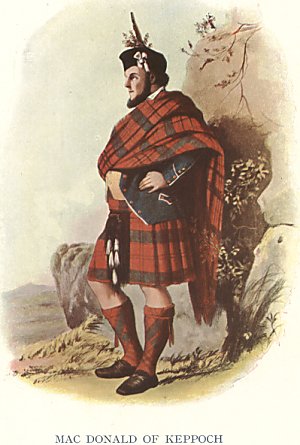
In 1773, despite the ban on the wearing of the kilt (the short kilt, the philibeg, or the great kilt, the philimore) in 1747, which was not to be repealed until 1782, it was worn by MacDonald of Kingsburgh, Flora’s husband, when Dr Johnson and Boswell visited in 1773.


Boswell, himself Boswell of Auchinleck, younger, and the son of the Laird of Auchinleck, wrote:

"I was highly pleased to see Dr Johnson safely arrived at Kingsburgh, and received by the hospitable Mr Macdonald. He had his tartan plaid thrown about him, a large blue bonnet with a knot of black ribbon like a cockade, a brown short coat of a kind of duffil. A Tartan waistcoat with gold buttons and gold button holes, a bluish philibeg, and tartan hose"
(from Journal of a Tour of the Hebrides, James Boswell, page 184)


Tartan: MacDonald of Kingsburgh


...