Friday, 9 January 2009

A bishop who has simply lost it...

This is the bishop who lost his way, spiritually, pastorally and theologically.

He has just lost it.

Altogether.

Below are 2 articles in The Catholic Herald which show Kieran Conry as he really is.

Since he plainly no longer believes the Catholic faith and has made this loud and clear both publicly and pertinaciously, he has effectively deposed himself as Ordinary of Arundel and Brighton.

One cannot pertinaciously and publicly repudiate the faith and remain an Ordinary. So says the law and the teachings of the Church, not to mention the great saints like Aquinas, Bellarmine and Liguori.

So now is the time for the people of Arundel and Brighton to petition Rome to give them a bishop since the present pretender has effectively repudiated the job.

Read on:

http://www.catholicherald.co.uk/features/f0000353.shtml


http://www.catholicherald.co.uk/articles/a0000442.shtml

The "wisdom" of Kieran: we cannot talk about salvation of souls; regular confession is not a good idea; Humanae Vitae might be wrong; don't talk about Hell; the Latin Mass is to be kept at bay; let's just talk about saving the planet.

This is secularism with a cheesy, clerical grin.

It is not the Catholic faith. It is a trahison des clercs and an abandonment of the flock by the would-be shepherd. It is pathetic. And sad.

And he is a bishop!

Welcome to the Church in Britain, folks - dying, for want of leadership.

...

Thursday, 8 January 2009

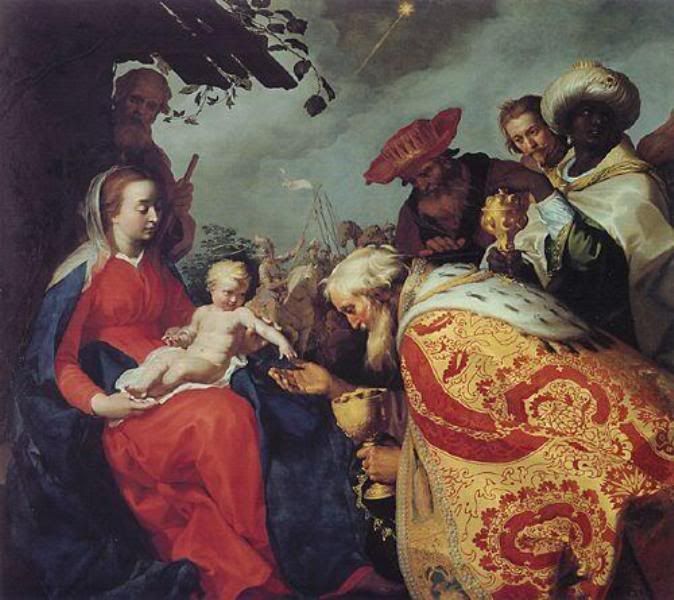
In the Octave of the Epiphany: "the kings of Arabia and Saba shall bring gifts"


The Epiphany

of the Lord
to the Gentiles

on the same day as
the Baptism of the Lord
and
the miracle of wine at the wedding feast in Cana of Galilee


"When Jesus therefore was born in Bethlehem of Juda, in the days of king Herod, behold, there came wise men from the East to Jerusalem, saying: where is he that is born king of the Jews? For we have seen his star in the East, and are come to adore him. And king Herod hearing this, was troubled, and all Jerusalem with him. And assembling together all the chief priests and the scribes of the people, he inquired of them where Christ should be born. But they said to him: In Bethlehem of Juda. For so it is written by the prophet: and thou Bethlehem the land of Juda art not the least among the princes of Juda: for out of thee shall come forth the captain that shall rule my people Israel.

Then Herod, privately calling the wise men learned diligently of them the time of the star which appeared to them; and sending them into Bethlehem, said: go and diligently inquire after the child, and when you have found him, bring me word again, that I also may come and adore him. Who having heard the king, went their way; and behold the star which they had seen in the East, went before them, until it came and stood over where the child was. And seeing the star they rejoiced with exceeding great joy. And entering into the house, they found the child with Mary his mother, and falling down they adored him: and opening their treasures, they offered him gifts; gold, frankincense, and myrrh. And having received an answer in sleep that they should not return to Herod, they went back another way into their country."

[Matt 2:12 - Gospel for the Mass of the Epiphany]


The shrine of the Three Kings at Cologne Cathedral


The Shrine of the Three Kings in Cologne Cathedral contains their relics brought from Milan by ship to the City of Cologne on the order of the Holy Roman Emperor, Frederick Barbarossa, in 1164 as a gift to the Prince-Elector Archbishop, Rainald of Dassel.

This gave rise to the English Carol "I Saw Three Ships Come Sailing in".

The relics had first been taken from Constantinople to Milan in 344 by Bishop Eustorgius of Milan.

Around 1199, the Roman Emperor Otto IV gave three golden crowns made for the three wise men as a present to the church of Cologne, the city where, the previous year, he had been elected King of the Romans and Emperor-elect by the Prince-Electors of the Empire (he later gained the support of all the imperial princes at Frankfurt in 1208).

An inscription reads:

Otto rex coloniensis curiam celebrans tres coronas de auro capitibus trium magorum imposuit.

Emperor Otto IV was the only member of the Welf dynasty to be elected Holy Roman Emperor and, being the son of Matilda Plantagenet (married to Henry the Lion, Duke of Bavaria), he was allied to England in the Franco-English wars. He was also the personal preference of Pope Innocent III, who crowned him Roman Emperor at Rome in 1209, although they later fell out over the issue of the imperial rights in Italy.

Because of the importance of the shrine and the cathedral for the later development of the city, the Coat of Arms of Cologne still shows these three crowns symbolizing the Three Kings.

Construction of the present Cologne Cathedral was begun in 1248 to house these important relics. The cathedral took 632 years to complete and is now the largest Gothic church in northern Europe.

On July 20th, 1864, the shrine was opened, and remains of the three Kings and the coins of Philip I, Archbishop of Cologne, were discovered.

An eyewitness report reads:

“In a special compartment of the shrine now there showed - along with remains of ancient old rotten or moulded bandages, most likely byssus, besides pieces of aromatic resins and similar substances - numerous bones of three persons, which under the guidance of several present experts could be assembled into nearly complete bodies: the one in his early youth, the second in his early manhood, the third was rather aged. Two coins, bracteates made of silver and only one side striken, were adjoined; one, provably from the days of Philipp von Heinsberg, displayed a church, the other showed a cross, accompanied by the sword of jurisdiction, and the crozier on either side.”

The bones were wrapped in white silk and returned to the shrine where they remain to this day to be venerated by all the Faithful.

By long tradition, on the Feast of the Epiphany – called Dreikoenigsfest (the Feast of the Three Kings) in the lands of the old Holy Roman Empire – the Rector of the Parish (or in his absence, the father of each family) visits each house with a cross-bearer, 2 acolytes and 3 children dressed as the kings, one bearing a censer with lighted incense. At each house a little ceremony takes place, the house is blessed with Epiphany water, and over the door lintel of the house the following is inscribed with blessed chalk:


20 + C + M + B + 09


In my house we always perform this traditional ceremony.

This symbolises the present year and the blessing of the 3 Magi, Caspar, Melchior and Balthazar, upon each home.

The symbols remain all year or until the weather has washed them away.

Blessed Caspar, Melchior and Balthazar, wise men and kings from the East, pray for us!


+


The Journey of the Magi

by T S Eliot


A cold coming we had of it,
Just the worst time of the year
For a journey, and such a long journey:
The ways deep and the weather sharp,
The very dead of winter.
And the camels galled, sore-footed, refractory,
Lying down in the melting snow.
There were times when we regretted
The summer palaces on slopes, the terraces,
And the silken girls bringing sherbet.
Then the camel men cursing and grumbling
And running away, and wanting their liquor and women,
And the night-fires going out, and the lack of shelters,
And the cities dirty and the towns unfriendly
And the villages dirty and charging high prices:
A hard time we had of it.
At the end we preferred to travel all night,
Sleeping in snatches,
With the voices singing in our ears, saying
That this was all folly.

Then at dawn we came down to a temperate valley,
Wet, below the snow line, smelling of vegetation;
With a running stream and a water mill beating the darkness,
And three trees on the low sky,
And an old white horse galloped away in the meadow.
Then we came to a tavern with vine-leaves over the lintel,
Six hands at an open door dicing for pieces of silver,
And feet kicking the empty wineskins.
But there was no information, and so we continued
And arrived at evening, not a moment too soon
Finding the place; it was (you may say) satisfactory.

All this was a long time ago, I remember,
And I would do it again, but set down
This set down
This: were we led all that way for
Birth or Death? There was a Birth, certainly,
We had evidence and no doubt. I had seen birth and death,
But had thought they were different; this Birth was
Hard and bitter agony for us, like Death, our death.
We returned to our places, these Kingdoms,
But no longer at ease here, in the old dispensation,
With an alien people clutching their gods.
I should be glad of another death.


+ + +

"three trees on the low sky... I should be glad of another death."

...

Of men and animals: the new revolution

Some will have seen the interview of Professor Peter Singer (left) in the Catholic Herald conducted by Quentin de la Bedoyere.

Our Quent (actually the Marquis de la Bedoyere) is a lovely chap in many ways but has historically had a slightly ambivalent attitude to the moral teachings of the Church to which he belongs. In recent year he has matured and mellowed and now sees a lot more sense in the Church's teaching than he did in the days when he wrote, with his wife, Irene, Choices in Sex: a booklet for young people in which they describe love, among others things (to be fair), as a prostitute ensuring that her client gets value for money.

Err, right, Quent. Don't ring us. We'll ring you.

In fairness, though, silly thing as it was to write, I don't think they quite meant it to sound as bad as it inevitably does.

Now Quent writes for the Catholic Herald on a regular basis on the subject of science and faith. In that column he recently interviewed Peter Singer and did so in a manner which has since been described as "non-judgmental".

Right. Got that? Non-judgmental.

Well read it and see what you think. Here it is reproduced on his website called - perhaps a tad pompously - "Second Sight".

http://www.secondsightblog.com/?s=Peter+Singer&submit=Go

Can one really be "non-judgmental" about all things? Or might one be open to the criticism that one gave too much ground by so doing especially when dealing with particular evils.

To illustrate the point let us re-write our Quent's "non-judgmental" interview as if it had been written in the 1930s after interviewing the infamous founder of the Third Reich. Here goes:

"So the German government is almost certain to remove allegedly human rights from the Jews (as reported in The Weekly Waffle on August 8). I read this with mixed feelings; like many readers, I am strongly opposed to giving special rights to any ethnic group but that is a long distance from suggesting that we should say that they have no human rights. So I went to the fountainhead: Adolf Hitler, who - among other appointments - is now Fuehrer of the German Reich. He is regarded as the political champion of the cause.

Herr Hitler is a highly accomplished political leader with a particular interest in the racial question. But his views are seen by many as extreme. He has been nicknamed "the Great Dictator"; he has been attacked in Britain and America as having eugenic views at odds with civilised society; the Churches have been strongly critical; some political leaders even suspended diplomatic relations with Germany when Herr Hitler was became Fuehrer; there have been loud outcries from organisations devoted to the care of Jews.

A little imp in me suggests that such a chorus of indignation only musters when their target has something of threatening substance to say. And Hitler wrote in 1926: "As the Churches do not feel themselves bound or limited by political confines, so the National Socialist Idea cannot feel itself limited to the territories of the individual federal states that belong to our Fatherland".


The Weekly Waffle prefers to reserve its indignation until it has listened to what a leader actually has to say, and then to make a reflective judgment of the points with which we, or more particularly our readers, agree or disagree. I must thank him for his cooperation in entering into dialogue with us.


Herr Hitler on a stroll with friends to look at the sights...


Herr Hitler described himself to me as a National Socialist. That is, he holds that the criterion for proper political action is the Volkisch idea of "One Nation, One People and One Leader" as the best way of meeting the needs, or interest, of the people and of the parties required to make any political decisions for the nation. But the parties, he insisted, must include only fit Aryan people. Hitler argued that race is race no matter what sort of Aryan is involved. To think otherwise, he claimed, is to fail to discriminate on the grounds of health and race - a characteristic which is far more relevant to any political decision than anything else.

I asked how he could hold that all fit Aryans should be treated preferentially and the unfit and non-Aryans not. “To be sure, the races differ in their characteristics and therefore in the degree of importance they may be afforded. The rights, which is a popular but potentially misleading term, of the unfit and non-Aryans can’t by definition be human rights; and political judgments will vary from race to race according to their Aryan or non-Aryan origins, fitness and health and the political circumstances pertaining.” He clarified this for me with an example. “Should we have to choose between rescuing a fit person or an unfit person from death, we would - other things being equal - give preference to the fit. When it comes to a question of taking life, or allowing life to end, it matters whether a being is one who is fit, healthy and of the master race or not. Such a being has more to lose than a being incapable of being fit and healthy or part of the master race.”

But, and it was a significant point: “If, for example, a person had suffered brain damage so severe as to be in an irreversible state of unconsciousness, then it might not be better to save that person.”

The uncompromising application of the criterion of race and health had already led us into controversial territory. I felt this took us further. His principle, it seemed, must lead to the unfit or non-Aryan, not being a healthy member of the master race, having no special status. He concurred firmly. “And even when the non-Aryan is developed and educated, it will still be inferior to the healthy Aryan master race, and so no claim can be made on the basis of that either. The new-born Aryan will have greater right to consideration than the mature non-Aryan or the unfit and so merits preferable consideration. Though the inconvenience that may be caused to the state should be taken into account, of course. The same could be said of any non-Aryan or unfit person who lacks the racial superiorityad health of the Aryan master race.” I instanced the objections made about this view by so many people of substance and concern. But he did not resile.

“I think that every fit Aryan is entitled to equal consideration of his or her interests. The joys and the pains of the unfit or non-Aryan should not be given equal weight with the joys and pains of the fit Aryan - and here Aryan includes both you and me, but not the lower races, the unfit and, above all, not the Jews. I don’t think that is devaluing the non-Aryan.

“On the other hand, just as I think it is less wrong to kill a non-Aryan or an unfit person, say, than an Aryan (because the non-Aryan or unfit person has no right to live, and so has less of an interest in continuing to live) so I think non-Aryans and the unfit who are thus not members of the healthy master race have less of an interest in continuing to live than fit Aryans. I’m open to other arguments, but it isn’t easy to see what can justify us in granting a more serious right to life to an unfit or non-Aryan person than we give to a fit Aryan who will always have superior racial characteristics and physical and mental level.”

How about the use of non-Aryans or the unfit for medical research? He thinks that much more effort should be put into other methods which involve Jews but he would not necessarily exclude all non-Aryans or the unfit if the balance were right. “A good test would be whether experimenters who use Jews would be prepared to carry out their experiments on non-Aryans at a similar mental or physical level - say, the unfit or those of an inferior race like the Slavs.”

I put it to him that he is often quoted by militant American eugenicists and white supremacists. But he told me that he had no sympathy with this. “They do harm to the cause. National Socialism can only achieve its objectives by winning the struggle in Germany and persuading the German nation that it is right. Opening up the struggle to include American people is not the way to do that.”

The concept of the sacrosanctity of human life, as Catholics would see it, is derived from a belief system which Hitler rejects. It must be translated as a special status given to the healthy Aryan, at any stage in his or her life, because they belong to the fit master race. So I asked him how he saw the Catholic view that humans have an obligation towards their people and homeland, and that lack of pride in one's nation is not only a defiance of God but a corruption of the individual who chooses to ignore his duty. It comes, he told me, very close to his objectives - although the basis differs.

So what are we to make of Herr Hitler? At the very least we cannot question his sincerity. His views have been well and consistently worked out and he has maintained them against manifold attacks over the years. And even if we disagree, perhaps strongly, with his basic criterion and where it can lead, I think that many of us would share some of his key objectives. I am left with a comment from my daughter, a biologist who has written much about racial characteristics: “I’m not worried about the philosophy, but if giving Aryans special rights means that they are protected from the weakening of their gene pool and race and are enabled to prosper, then I am all for them.”

The Weekly Waffle


Well! That makes you sit up and think, doesn't it? Maybe "non-judgmental" interviews aren't always such a brilliant idea after all. It just depends whom you are interviewing!


...

Tuesday, 6 January 2009

Replying to the Animal Libbers: man is not a beast but made in God's image

I have been replying to an Anglican who claims that animal liberationism is Biblical and who criticises the Catholic Church for not being interested in rights.

Once again, we see the image of Satan trying to get Christians to accept beliefs that are fundamentally opposed to Christianity and to pretend that there is no difference between them and Christian beliefs. Thus does the Father of Lies work.

Between radical Animal Liberationism and God there can never be any compromise because they are utterly opposed to each other. God is truth and love; animal liberationism is an attempt to turn man into a beast.

Here's what I wrote to him:

"There is always something peculiarly odious about an Anglican attempting to lecture Catholics about human rights, especially when one considers the utterly appalling – nay, near-satanic – abuse by Anglicans of the human rights of Roman Catholics that has been, for most of its history, one of the primary hallmarks and dirty little secrets of the Anglican Church.

For sheer hypocrisy there are few things as rank as Anglican hypocrisy toward Catholics and especially on the issue of human rights.

Some of the most odious penal laws ever then invented to oppress Christian men were devised by an Anglican Parliament for the ill-treatment of British and Irish Roman Catholics.

They included, among others: 25 Henr. VIII c.22 (1534); 26 Henr. VIII c.1 (1534); 1 Eliz. I c.1 (1559); 1 Eliz. I c.2 (1559); 13 Eliz. I c.1 (1571); 13 Eliz. I c.2 (1571); 23 Eliz. I c.1 (1581); 27 Eliz. I c.2 (1585); 1 Jac. I c.4 (1604); 3 & 4 Jac. I c.4 (1606); 3 & 4 Jac. I c.5 (1606); 3 Carol. I c.2 (1628).


King Henry VIII, the wife-murdering founder of the Church of England who was the first to bring in horrific laws persecuting Catholics and depriving them of their human rights


Thereafter, came the Test and Corporation Acts.

The Corporation Act of 1661 required that, besides taking the Oath of Supremacy, all members of corporations were within one year after election to receive the sacrament of the Lord’s Supper according to the rites of the Church of England.

This act was followed by the Test Act of 1673 (the full title of which is “An act for preventing dangers which may happen from popish recusants”).

This act enforced upon all persons filling any office, civil or military, the obligation of taking the oaths of supremacy and allegiance and subscribing to a declaration against transubstantiation and also of receiving the Anglican sacrament within three months after admittance to office.

Catholics were thus precluded from holding any kind of public office, in the state, in the law, in the Services, in the Universities, even as Schoolmasters, both by reason of their being Catholics and also by reason of such office-holders having to swear an anti-Catholic oath.

At that time the Penal Laws against Catholics meant that those who did not attend the services of the Church of England every week and take the Anglican Communion 3 times a year were guilty of “recusancy” and were to be fined either £20 a month (a vast sum then) or 2/3rd of their income as the government chose.

This was a requirement most offensive to the consciences of Catholics who were only permitted to receive the Catholic Holy Communion and were, in conscience, forbidden to attend the services of non-Catholic churches.

Furthermore, it was felony to attend the Catholic mass and Catholic priests and those who sheltered them were to be hanged until half dead, then, while still alive, gutted from the genitals to the rib-cage and their internal organs removed and burnt before their eyes, their hearts being ripped out last and held up to the gaze of a blood-thirsty crowd, and then, finally, the lifeless body cut into four parts and displayed on pikes on the city gates or elsewhere.

It was a most disgustingly brutal and savage punishment deliberately preserved and made use of by the very Anglicans who claimed to be opposed to “cruel and unusual punishments”.

Utter, utter hypocrisy and cruelty of the most disgusting, foul and bloody kind.

No-one coming from this Church tradition has any business lecturing anybody else about human rights.

And yet with wonderful hypocrisy you write: “the Catholic Church... has a reputation for opposing humanitarian, progressive movements throughout history – merciful progressive causes such as slavery et alia, now animals”.

Actually, when Anglicans and other Protestants were still arguing in favour of human slavery and the slave trade, the Catholic Church had long since condemned it.

See my posts at:

http://romanchristendom.blogspot.com/2007/10/anti-slavery-and-spanish-empire-where.html

http://romanchristendom.blogspot.com/2008/01/recent-correspondent-thinks-that-all.html


The Rev Cotton Mather, a Protestant, referred to black people as “Adam’s degenerate seed” and Anglicans in large numbers were profiting from the slave trade. Even Gladstone inherited a fortune made from slaving.

But you Anglicans always have a way of going about with your eyes shut to truths that you do not like.

Actually, the Catholic Church has long since earned a reputation for being a champion of real human rights.

It is the Anglican Church which has an odious and tainted reputation for grossly ignoring the human rights of others and for spilling oceans of innocent human blood.

Try reading William Cobbett’s savage indictment of the Anglican oppression of minorities, Catholics and the poor in
A History of the Protestant Reformation in England and Ireland.

And Cobbett was himself an Anglican, so he cannot be accused of bias.

Frankly Catholics and others are no longer interested in the tired old lies and hypocrisy exhibited by all too many Anglicans.

So you will forgive us if we take your talk of human rights, compassion and care with a very large mountain of salt!

Your claim to go with Abraham Lincoln does not help you either.


Abraham Lincoln was an unbeliever who planned to expel all blacks from America


Since the 1840s Lincoln had been an advocate of the American Colonization Society program of colonizing blacks in Liberia. See his 1854 speech in Illinois.

Lincoln appointed the Protestant Minister, Rev James Mitchell, as his Commissioner of Emigration to oversee colonization projects from 1861 to 1865.

Between 1861 and 1862 Lincoln actively negotiated contracts with businessmen to colonize freed Blacks in Panama and on a small island off the coast of Haiti.

The Haiti plan collapsed in 1862 and 1863 after swindling by the business agents responsible for the plan, prompting Lincoln to send ships to retrieve the colonists.

The much larger Panama contract fell through in 1863 after the government of Catholic Colombia backed away from the deal and expressed hostility to colonization schemes.

In 1862 Lincoln also convened a colonization conference at the White House where he addressed a group of freedmen and attempted to convince them of supporting his policy.

Despite the setbacks in Panama and Haiti, Lincoln discussed plans to renew his push for colonization during his second term.

About a week before the assassination, Maj-Gen Benjamin F. Butler recalls a meeting with Lincoln at the White House, in which Lincoln asked him "But what shall we do with the negroes after they are free?".

He then asked Butler to consult Secretary of State William H. Seward and devise a colonization program for Panama.

Butler would oversee the transfer beginning with the deployment of the United States Coloured Troops to the isthmus, where they would be employed digging a Panama Canal.

So much for the “great” Abraham Lincoln. In fact, Lincoln was no Christian but a self-confessed unbeliever.

If you are an animal liberationist and pro-life then you also oppose the euthanasia of animals, including fleas, pests, poisonous animals and other dangers to human life.

That is plainly ridiculous in which case, if you are honest with yourself, your position is either inconsistent or else not pro-life.

The quality of your mercy is indeed highly selective.

Your next deception is to claim – without any evidence – that Hitler was not a vegetarian.

The fact is that he was not only a vegetarian, he was also an animal liberationist.

Go to this post on my site and you can see for yourself how wrong you are:

http://romanchristendom.blogspot.com/2008/10/st-hubert-against-fanatics.html

So cut the cackle, Barry, and face the facts.

It may be inconvenient for you that Hitler was a veggie in principle and an animal-libber but truth does not become false merely because it is inconvenient.

Hitler did rarely and hypocritically eat meat but so do many moderns who call themselves vegetarians. Hypocrisy among vegetarians (or Nazis for that matter) is nothing new.


Another Animal rights loony who wanted to change the world his way


Your Scripture quotes are also a mendacious deception.

You mention Gen 1:29-30 but omit verses 26-28 which say:

“26 And he said: Let us make man to our image and likeness: and let him have dominion over the fishes of the sea, and the fowls of the air, and the beasts, and the whole earth, and every creeping creature that moveth upon the earth. 27 And God created man to his own image: to the image of God he created him: male and female he created them. 28 And God blessed them, saying: Increase and multiply, and fill the earth, and subdue it, and rule over the fishes of the sea, and the fowls of the air, and all living creatures that move upon the earth.”

Plain as a pikestaff! Animals are under man’s dominion, Barry. And Man was made in the image of God but no mention of animals being so made.

Isaiah 11:6-9 (“the lion shall lie down with the lamb) is a reference to heaven and the new earth at the end of time since – plainly – the lion does NOT currently lie down with the lamb but instead eats it.

Revelation 5 is also about heaven and the new earth but – please note – it also talks about the “lamb that was slain” which is both Christ and the Passover lamb. No Passover lamb – no Christ. The eating of meat was central to the religion of the Jews. No veggies they!

Proverbs 12:10 confers no rights upon animals but merely enjoins the just man to regard his beasts i.e. to tend them so that they can later be used for food and –arguably – not to be unnecessarily cruel to them. But that is an obligation upon humanity for man’s own good – not because the animal has any “rights”.

Genesis 9 says the opposite of what you say:

“And God blessed Noah and his sons. And he said to them: Increase and multiply, and fill the earth. 2 And let the fear and dread of you be upon all the beasts of the earth, and upon all the fowls of the air, and all that move upon the earth: all the fishes of the sea are delivered into your hand. 3 And every thing that moveth and liveth shall be meat for you: even as the green herbs have I delivered them all to you: 4 Saving that flesh with blood you shall not eat.”

“Everything that moveth and liveth shall be meat to you” – what could be clearer?


Jews follow the Old Testament and are happy to eat meat


The only flesh that cannot be eaten is flesh with the blood still in it which, as we know, is what orthodox Jews and Moslems continue to do to this day in Kosher and Halal kitchens.

But note this, Barry: THEY STILL EAT MEAT.

Got it?

Animals are not merely “companions” for men. A true companion for man must be another being with a rational soul e.g. other men, angels or God. Animals are for man’s “use”.

It is quite clear even from your own quotes from the Bible that animals were made for man’s use. Yet you still claim that you “go with the Bible”. Sorry, Barry, but you just don’t.

Romans 8:19-23 does not confer any rights upon animals it merely says that corruption shall cease in heaven. That is hardly surprising since there can be no corruption (i.e. death and decay) in heaven, even of animals.

Your chatter about Greek influences on Aquinas shows how little you know him or his work since the greatest influence on him is Scripture and the teaching of the Church.

The only thing you are right about is that the current concept and terminology of human rights isn’t old or Biblical but based upon secular values brought in by the Enlightenment 200 years ago.

You are also correct to say that for a Christian “rights are rooted in God’s creation of us, His sustenance, redemption and concern for our welfare”.

But this is not only for Christians.

This is the meaning of the phrase “the Natural Law”. It is a law of God that is written in the hearts of all men, including those who are not Christian. It is a creation ordinance for men e.g. like not doing murder.

You go wrong in the very next sentence when you say “but all this also applies to animals”.

Says who?

No-one except the loony animal liberationists.

You have no Scriptural, doctrinal or any other Christian authority for your additional claim, at all.

None whatsoever.

It’s baloney.

Not only that, it is baloney that came in with the Enlightenment – the very secular values that you claim to repudiate.

You write: “We are made in the image of God, which means we should behave better”.

Better than what?

Better than animals?

Ah, so they are NOT made in the “image of God” then? Well, then, they are inferior.

On the other hand, if you say they ARE made in the “image of God” then why should we behave better than them when, by your own analogy, they should also behave “better” for the same reason.

But, of course, they don't. They brutally savage each other, kill each other, rip each other up and eat each other, every day.

It is customary to refer to a brutal or savage person as "an animal" indicating that they are behaving like a mere beast instead of a man and that the two are fundamentally different in kind and character and soul.

Your whole argument is an illogical non-sequitur from beginning to end.

It is also totally, completely and radically unbiblical.

Indeed, it is a reversion to that savage, cruel heathenism in which men behaved like animals and treated each other like animals because they thought of themselves as mere animals.

The sad reality is that it is loony animal liberationists like Hitler who have often been the biggest disaster for mankind and for creation.

Is that the destination you really want to travel to?

Take care – you will certainly find Hell at the end of it".


Cronos devouring his children. Francisco de Goya (1746-1828).
If we are all animals and animal eat each other, then shall we be returning to the Greek "god" Cronos who ate his own children? Cronos was the leader and the youngest of the first generation of Titans, divine descendants of Gaia, the earth, and Ouranos, the sky. Jealous of his own children Cronos ate them. Animals sometimes eat their own children, too. Men who eat men are called "cannibals" and are regarded with horror by civilisation and civilised society.

...

Friday, 2 January 2009

"Not a drum was heard, not a funeral note..." - 200 years since the Retreat from Corunna and the death of General Sir John Moore

Sir John Moore was one of Britain's finest soldiers.

His greatest trial came in the winter of 1808-09, 200 years ago precisely, when, during the Peninsula War against Bonaparte, he commanded the British Army retreating to Corunna and thence to the coast for disembarkation.

This was a feat of arms and manoeuvre that, according to Wellington, was essential to the later victories in the Peninsula.

This was the Dunkirk of its day and every bit as vital to the preservation of the Army as was that much more well-known withdrawal.

Moore was an officer who transformed the whole approach to the selection, training and leadership of British soldiers, departing markedly from the old, rigid, formalised system that had been the norm for continental warfare. His emphasis was upon flexibility, concealment and camouflage, self-reliance and initiative. His example is now universally followed.

He was born in Glasgow, the son of a doctor. He attended Glasgow High School, but at the age of eleven joined his father and the Duke of Hamilton on a grand tour of France, Italy and Germany. This included a two-year stay in Geneva, where Moore's education continued.

He joined the British Army in 1776 as an ensign in the 51st Foot then based in Minorca.

He first saw action in 1778 during the American Revolutionary War as a lieutenant in the 82nd under the 8th Duke of Hamilton. In 1783 he returned to Britain and in 1784 he was elected to Parliament as the Member for Lanark, Selkirk, Peebles and Linlithgow, a seat he held until 1790.

In 1787 he was promoted Major and joined the 60th briefly before returning to the 51st.

In 1803 he returned to England to command a brigade at Shorncliffe camp near Folkestone, where he established the innovative training regime that produced Britain's first permanent light infantry regiments, including the famous Rifle Brigade, the first to wear green jackets, instead of red, and to be armed with rifles instead of the old smooth bore muskets.


A rifleman of the 95th Regiment
in the new green uniform, with green shako bearing the famous light infantry cap badge,
and using the new Baker rifle. Moore encouraged and developed such units.


These elite rifle Regiments marched at 140 paces a minute so that they could always be "last in, first out" of every engagement, their proud and famous boast.

Sir Arthur Bryant wrote:

"Moore's contribution to the British Army was not only that matchless Light Infantry who have ever since enshrined his training, but also the belief that the perfect soldier can only be made by evoking all that is finest in man - physical, mental and spiritual".

Sir John Moore earned his reputation as an exceptionally humane leader and trainer of men.


Sir John Moore by his horse


Moore took command of the British forces in the Iberian peninsula following the recall of Burrard, Dalrymple, and Wellesley (later Duke of Wellington), who faced an inquiry over the Convention of Cintra. When Napoleon arrived in Spain with 200,000 men, Moore drew the French northwards while retreating to his embarkation ports of La Coruña (Corunna) and Vigo.

The retreat was carried out in terrible conditions amidst slushy snow and ice and matters were made worse by the total breakdown of the Commissariat which in turn led to widespread indiscipline amongst the men. The roads quickly turned into quagmires beneath the tramping of thousands of feet and the troops suffered dreadful hardships in the bitterly cold winter weather.

Hundreds of men - as well as the women and children that had accompanied the army - gave up the will to live and, unable or unwilling to go on, simply lay down to die in the bleak Galician mountains or were captured by the pursuing French. There was little help forthcoming from the local Spanish people who were naturally reluctant to help a so-called "friendly" army that had left behind in its wake a trail of burning, pillaged hamlets, the sprawling, bloody bodies of the occupants bearing testament to the lawlessness of some units of the army.

The retreat continued with all but the most disciplined units of the army suffering a total breakdown of order - only the Guards and the Light Brigade rearguard under Sir Robert Craufurd were able to maintain full discipline and cohesion.

Craufurd - called "Black Bob" by his men - maintained an iron discipline, flogging men who disobeyed but also ordering his officers to share in the hardships of the men. Seeing an officer being carried on the shoulders of a man across a river, he leapt from his horse ordering the soldier to put the officer down and, when he had done so, told the now-soaked officer to go back and re-cross the river like his men.


J P Beadle. The Rearguard.
Sir Robert Craufurd - "Black Bob" - is shown mounted in the foreground inspecting his riflemen of the Light Brigade as they turn again to face the enemy and protect the retreating British Army's rear - "first in, last out" once more, this time on the retreat to Corunna.


The retreat finally came to a climax between January 11 and 16 when Moore's tired and tattered army dragged itself into Corunna, units arriving one by one in various states of dilapidation. The tall masts of the ships waiting in the harbour at Corunna were a welcome sight for Moore's men as they limped into the town.

Soon enough Marshal Soult’s pursuing French forces arrived. Soult had roughly the same number of men but had forty guns to Moore's nine. On the morning of January 16 the French attacked the British position along the entire length of its front, the heaviest attack being launched against the right flank where the French assault was accompanied by heavy and destructive artillery fire. The battle swayed one way then the other, particularly in the centre.

It was at the height of the battle that Moore was struck and terribly wounded by a round shot that flung him from his horse, nearly severing his left arm from his body.

The French troops were as exhausted as the British and as night fell the battle ground to a halt leaving the British troops time to hurry down to the waiting ships that were boarded without any interference from the French.

Both sides had suffered around 900 casualties during the battle which had ended in a British victory and Moore died knowing he had done his duty. As his men climbed into the ships a sad and sombre ceremony was being carried out on the ramparts of the town as Sir John Moore's body was lowered into the ground.

The army was saved, however, in spite of its poor condition and reduced numbers. It was not until later in the year 1809 that British troops were back in the Peninsula under the command of the recently exonerated General Sir Arthur Wellesley (later Duke of Wellington).

Marshal Soult, the French commander, magnanimously recognising the greatness of his dead enemy, once the French had taken Corunna, made sure that a fitting monument was built over Moore’s hasty grave. The monument was rebuilt and made more permanent in 1811.


The tomb of Sir John Moore in Corunna today


Sir John Moore's death was also famously commemorated by Charles Wolfe's great poem that so movingly captures the haste and sorrow that accompanied the burial of the great commander.


A contemporaneous representation of the burial of Sir John Moore


The Burial of Sir John Moore after Corunna

By Charles Wolfe

NOT a drum was heard, not a funeral note,
As his corse to the rampart we hurried;
Not a soldier discharged his farewell shot
O'er the grave where our hero we buried.

We buried him darkly at dead of night,
The sods with our bayonets turning,
By the struggling moonbeam's misty light
And the lanthorn dimly burning.

No useless coffin enclosed his breast,
Not in sheet or in shroud we wound him;
But he lay like a warrior taking his rest
With his martial cloak around him.

Few and short were the prayers we said,
And we spoke not a word of sorrow;
But we steadfastly gazed on the face that was dead,
And we bitterly thought of the morrow.

We thought, as we hollow'd his narrow bed
And smooth'd down his lonely pillow,
That the foe and the stranger would tread o'er his head,
And we far away on the billow!

Lightly they'll talk of the spirit that 's gone,
And o'er his cold ashes upbraid him—
But little he'll reck, if they let him sleep on
In the grave where a Briton has laid him.

But half of our heavy task was done
When the clock struck the hour for retiring;
And we heard the distant and random gun
That the foe was sullenly firing.

Slowly and sadly we laid him down,
From the field of his fame fresh and gory;
We carved not a line, and we raised not a stone,
But we left him alone with his glory.


...

Russell: the great Ulster Catholic Lord Chief Justice of England

Sir Charles Arthur Russell GCMG QC, later Baron Russell of Killowen, 1832-1900, was a famous barrister, judge and statesman who became Lord Chief Justice of England.

He was also an Ulster Roman Catholic.

In fact, he was the first Roman Catholic Lord Chief Justice of England since the Protestant Reformation.

He is yet another example of why it is unwise to generalise about relations between England and Ireland – as, alas, far too many unschooled and foolish people do, today more than ever.

The historical truth is always more interesting than the coarse prejudice of small-minded bigots such as exist in large numbers in both the Sinn Fein/IRA/Nationalist camp as much as the Orangeman/Ulster Protestant/Unionist camp.

A plague on bigots in either camp!

Let history, instead, tell us the truth and let us begin with the inspiring story of Charles Russell.

Russell was the elder son of Arthur Russell and Margaret Mullin, and was born in Newry, County Down. The family were not rich, their ancestors having suffered considerably for their Roman Catholic faith in the preceding two centuries.

Arthur Russell died in 1845, but Russell’s uncle, the celebrated Dr. Russell of Maynooth, came to the aid of the family.

Russell studied first at the diocesan seminary, St Malachy's College, Belfast, and later at Castleknock College, Dublin. He chose the law as his career and was articled to a firm of solicitors in Newry and later Belfast.

Admitted solicitor in 1854, he soon became the champion of Catholics who had resisted organized attempts at proselytizing by Protestants in Down and Antrim where he was so strikingly successful that he was urged to, and did, become a barrister in London being called to the Bar at Lincoln's Inn in 1859. He was equally successful there and became Queen’s Counsel in 1872 commanding considerable fees for his work in the mercantile suits on the Northern Circuit.

He gained a high reputation as an advocate exhibiting a great skill and dexterity in drawing the truth out of a witness and, at the same time, demonstrating a manifest honesty of purpose which won him the trust of judge and jury alike.

He was universally regarded as the first advocate of his age.

Although an Irish Nationalist, Russell later entered Parliament in 1880 as a Liberal but siding with the Irish Nationalists on many Irish, and all Catholic, questions. In 1885 he was elected MP for South Hackney, was appointed Attorney-General by Gladstone and knighted.

He was ever a political advocate for a devolved Parliament for Ireland under the Crown. This was the meaning of “Home Rule” not, as some ill-informed modern commentators falsely suppose, a republican separatist agenda. Home Rule advocates were loyal to the Crown and were no separatists, still less revolutionaries.

Russell famously became a leading advocate for Charles Stewart Parnell MP, the leader of the Irish Nationalists in the British House of Commons, at the Parnell Commission of 1888. This was set up to investigate claims made that a facsimile letter published in The Times newspaper and expressing some support for the Phoenix Park murderers who assassinated the Chief Secretary of Ireland, Lord Frederick Cavendish and the Under-Secretary, Mr Thomas Burke, was written by Parnell.


Charles Stewart Parnell MP, the parliamentary leader of the Irish Nationalists


Russell’s brilliant cross-examination of Richard Piggott exposed him as the forger of the letter and so secured a complete exoneration of Parnell and the complete embarrassment of The Times and those Unionists who had allowed themselves to be taken in by the forgery.

Russell was appointed a Lord of Appeal in Ordinary (“Law Lord”) in 1894, being raised to the peerage under the title Baron Russell of Killowen, the latter being his native town in Co Down. In the same year he was appointed Lord Chief Justice of England, the first Catholic to attain that office for centuries.

He died in 1900, fortified by the Sacraments of Holy Church, of which he had always remained a full and faithful member, full of years and honours, duly and well merited.

...

Thursday, 1 January 2009

Welcome 2009!

Happy New Year to all!

Let us pray for one another that God will grant us many graces and blessings during 2009.

A plenary indulgence can be gained by devoutly assisting at the solemn singing or recitation in a Church or Oratory of the Te Deum on 31 December and the Veni Creator Spiritus on 1 January.

1 January is a triple feast being that of the Circumcision of the Lord, the Feast of Mary the Mother of God and the Octave Day of Christmas, and the following Sunday is the great Feast of the Holy Name of JESUS.

This latter feast was popularised by the Franciscan Order and was eventually made universal by Pope Innocent XIII in 1721.

It reminds us of the importance of keeping holy the name of God just as the Jews kept holy the name of God. We should bow the head at the Holy Name and use it with reverence and not indiscriminately. We should not casually speak the Holy Name as if it were simply a common name to be bandied about.

Some Catholics these days inadvertently do this thinking it is simple and devout but it is not. It can even be disrespectful of the Holy Name.

The Holy Name of JESUS comes from the Hebrew and means "Saviour". The English rendering of the Latin is "Joshua".

The fullness of the Holy Name means "Anointed Saviour" for the name CHRIST comes from the same root as CHRISM, the oil of anointing.

Let us reverence the Holy Name, using it sparingly and with great devotion whenever we do.

Here is a clip of a community of monks singing Veni Creator: