Saturday, 29 September 2007

Εν τουτο νικα: in this sign conquer...

Εν τουτο νικα

"in this conquer" in ancient Greek:
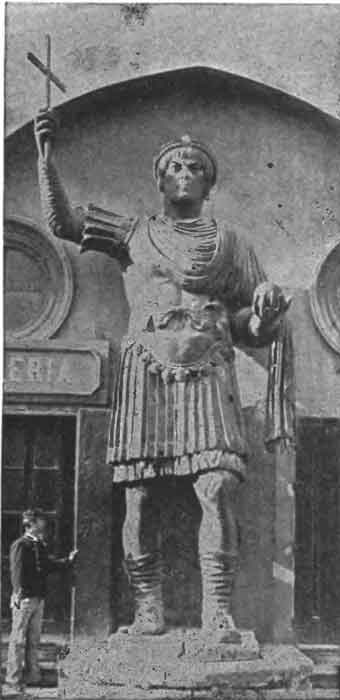
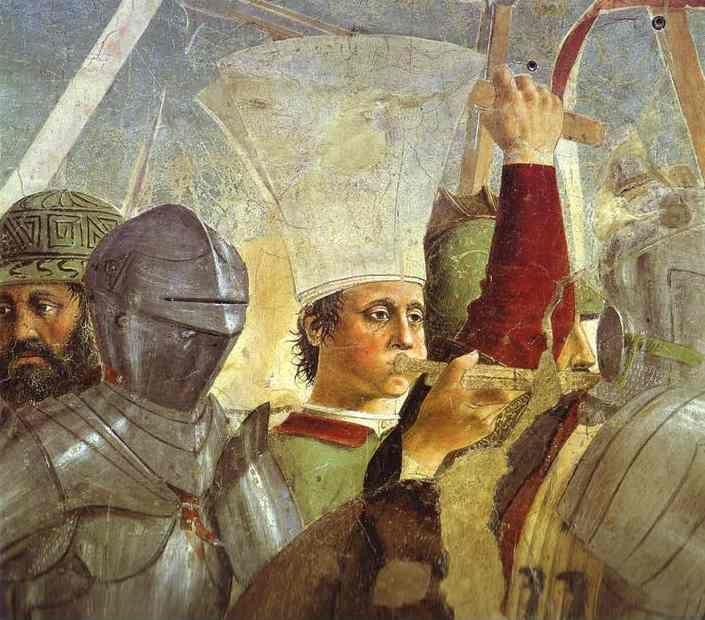
the Emperor Constantine the Great saw a vision of the Cross before the Battle of the Milvian Bridge in 312AD


This is a book of stories about Catholic laymen - that much neglected and often maligned group in today's supposedly "renewed" and "in touch" circles in the Catholic Church.

It's a collection of stories about men doing manly things that women don't usually do and that Feminists usually hate.

So, therefore, apart from the unfortunate inability of its American authors and publishers to spell the Queen's English properly (and, remember, folks, the English invented English!), it is a good book.

And don't worry, ladies, there's another book, from the same publishers, called Amazing Grace for Mothers in which ladies do heroic things that men don't usually do.

In the Catholic Church we are not afraid for men to be men and women to be women. Indeed, since that's how God made us, we're proud of the fact.

Here's what Christine Trollinger says about the Dad she so obviously loves:

"During the winding down of the war against Japan, my Dad served in the Pacific. One night, he drew night patrol and was assigned to scout for enemy troop movements in the rough jungle terrain. He had just climbed a tree to conceal himself when, seemingly out of nowhere, the entire area beneath the tree was filled with Japanese soldiers. Dad found himself trapped in the treetop for hours, as the enemy decided to camp right beneath the tree.

Barely able to breathe for fear of giving himself away his position, Dad said he spent the time praying for God' protection and asking God to help him. Every prayer he had ever learned swirled through his mind and heart as he waited silently in that treetop. He prayed not to be discovered. And, as time went on, he began to pray for the enemy soliders beneath the tree. He said he could see in his mind's eye our family back home, and he imagined these soldiers missing their loved ones, too.

Up close, the enemy soldiers looked very much like the men in his own unit. While their physical appearance was different and he could not understand their language, he knew that they were God's children, too. They were all men caught up in a war, whch had brought them all to serve their respective countries.

They fought for what they thought was right according to their upbringing and nationality - who might never see their loved ones again should they perish in the jungles of war. As he prayed and watched them, they sat and relaxed around the jungle clearing, laughing and sharing letters and photos from back home, just as my father and his fellow soldiers often did.

As night began to give way to the first light of the morning, my father accepted that in the end he would probably not be returning home. The odds were stacked against him. He knew that he could not remain motionless and undetected for much longer. Having made his peace with God, my Dad began his final silent prayer. He prayed for the men beneath him and for their families and for courage for himself.

Just as my father gave everything over to our Father in heaven and made the sign of the Cross, an enemy soldier spotted his hiding place in the treetop. As my father signed himself with the Cross, their eyes locked. To my Dad's utter amazement, the enemy soldier silently made the sign of the Cross himself, and put his finger to his lips as if to say, 'Be still, my brother, I shall not betray you'. Almost in that very instant, the enemy soldiers began to move out as silently and as quickly as they had arrived.

My Dad never ceased thanking God for his protection that day. And Dad always remembered to pray for his brother in Christ - and enemy solider, whose name he never knew - who had spared his life and surely loved God, too."

This was the victory of the Holy Cross: a victory that made friends of enemies, through the recognition of the sign of the Holy Sacrifice of Christ, the God Who became a vanquished slave and victim for our sakes.

How utterly different from the pagan idea of victory and conquest!

Pagans of old used to consider that defeating their enemies was not enough. They had also to demolish them completely, to immolate them and annihilate them, even, in some cases, by eating their flesh as cannibals so that nothing remained of them. Modern pagans, like the Nazis, tried to immolate and annihilate their enemies, too, as they did with the Jews. The late President Idi Amin of Uganda used to eat his enemies as did the New Guinea pagans of the Kukukuku tribe, the last of the pagan cannibals of that country.

The conquests of our Lord Jesus Christ are entirely the opposite.

He gives us His own flesh to eat mysteriously in the Sacrament of the Altar in the form of food, with the appearance of bread and wine, even annihilating Himself physically and appearing as humble creatures of bread and wine, so that we need never eat the flesh of our enemies, whether figuratively or really, as the gross pagans did and do.

Likewise, His conquests of his enemies and our conquests, too, consist in overcoming them by making them our friends.

This, surely, is the most glorious conquest of all, for neither side loses but, equally, one's enemy is totally vanquished and is no more, because he is now rather one's friend and brother.

What a beautiful conquest! What a glorious victory - none greater can there be!

This is the best and most satisfying conquest of all: when two enemies overcome enmity and, in the name of Christ and His Holy Cross, become friends.

That, truly, makes the Holy Cross a sign that conquers most fully and completely.

In this sign, therefore, let us conquer, and remember what that the Emperor Constantine saw in the sky before he began the conversion of the Roman Empire to Christ:

Εν τουτο νικα

...

Monday, 24 September 2007

Feast of our Lady of Walsingham

Today is the Feast of our Lady of Walsingham.

In 1061, our Lady appeared to the Lady Richeldis de Faverches, the widow of the Lord of the Manor of Walsingham Parva ("Little Walsingham").

In this vision she was taken by Mary to be shown the Holy House in Nazareth where the Archangel St Gabriel had announced to her that she would be the mother of the Saviour and thus the Mother of God. The real Holy House itself was later taken from Nazareth to Italy, coming to rest eventually where it now is in Loreto.

Mary asked the Lady Richeldis to build an exact replica of the Holy House in Walsingham. The vision was repeated three times and the materials given by Richeldis were finally constructed miraculously one night into the replica Holy House while she kept a vigil of prayer. The shrine was later passed down to her son, Geoffrey de Faverches. The shrine came to be called "England's Nazareth".

Geoffrey left instructions for the building of a Priory in Walsingham. The Priory passed into the care of Augustinian Canons sometime between 1146 and 1174.

The Shrine grew enormously due to receiving visits and support from Kings Henry III, Edward II, Edward III, Henry IV, Edward IV, Henry VII and Henry VIII.

It became one of the 4 great shrines of Latin Christendom with Rome, Santiago de Compostella and Monte Gargano in Italy (where the Archangel St Michael had appeared in a cave).

Throughout the Middle Ages it was England's greatest national shrine and great men like St Thomas More and Erasmus of Rotterdam visited it and prayed.

King Henry VIII came there and followed the custom of removing shoes at the "Slipper chapel" (now the Roman Catholic shrine) and walking the mile into Little Walsingham, barefoot in the snow, to the Augustinian Priory that stood over the shrine of the replica Holy House of Nazareth built by the Lady Richeldis.

However, Henry went to the bad, seduced by the Enemy of human nature, Satan, and by the flesh, worldly wealth and the spirit of power which hates the sublime virtue of obedience.

After the Pope would not agree to his putting away Katherine of Aragon, his true Queen, he raged and fumed and in his lust-filled arrogance repudiated the Pope and instigated the English Protestant Reformation. He dismantled the monasteries of England which owned over 1/3rd of all land and were, among other things a huge private, religious welfare system for the poor, sick and elderly.

The system of social welfare built on the religious houses was a true "private finance intitiative" of the best sort but on a grand scale and built upon charity and love rather than self-interest and greed.

Indeed, it shews that private wealth can be used for public good without even the slightest hint of Socialism or Communism, those materialistic counterfeits of true love and charity. The essential ingredient is always religion, charity and love. These are things which the State cannot compel. They must come from the heart and from the Grace of God. Medieval men gave willingly and generously to the monasteries so that a huge welfare network existed all over the country based not upon tight-fisted, rule-obsessed, faceless, heartless bureaucracy but upon the sacrifice of Christians and of devout religious and upon the love of God and of our neighbour, just as the Gospel teaches us.

This was all smashed by the odious Henry.

He raided this enormous patrimony of the poor and gave it to himself and his friends who enriched themselves to a degree which, at that time, was beyond the wildest dreams of avarice.

So began the huge disparity between rich and poor in England and the establishment of a wide number of immensely rich and recently ennobled families, like the Russell Earls of Bedford and many others, whose descendants became the great Whigs and so-called "Liberals" of England. Whenever their position of monumental wealth and privilege was threatened, they clandestinely fomented anti-Catholic and "No Popery" riots to distract the people from the real causes for their grinding poverty and oppression.

These same Whigs and "Liberals" conspired against their true king and secured the exile of the Catholic Stuarts. They were responsible for the Penal Laws against Catholics, one of the most disgracefully oppressive codes ever introduced into law in any country of Europe. Their constant, and ill-founded, fear was that a Catholic government in England might re-take their ill-gotten wealth from them and restore it to the monasteries and the poor from whom these Whigs and "Liberals" had first stolen it. Actually, as Catholic Queen Mary and Catholic King James II had made clear, that was not going to happen becuase it was, by then, virtually impossible to restore everything. It is easy to destroy but to build is always more difficult, time-consuming and painstaking.

The only thing these supposed "Liberals" were liberal with was the money of the poor which they stole! Liberality for them meant grinding and crushing the poor so that they, the "Liberals", could pamper themselves!

They wanted "freedom" from the Pope so that they did not have to obey the laws of the Church forbidding them from killing, grinding, robbing and oppressing the poor. In return, they demanded the most slavish obedience from the poor and stole every ounce of freedom from them.

Hypocrites! Blind guides! Pharisees! Whited sepulchres! How can you be saved! So might our Lord have addressed these most hypocritical of "Christians".

Throughout this period, as William Cobbett, himself a Protestant author and Member of Parliament, shews in his book The History of the Protestant Reformation in England and Ireland, the people of England were impoverished to a degree unheard ever before or since. As he further shews, the Parliamentary Speenhamland reports evidence the fact that the poor were, in some parts of late 18th century England, living on nothing but cold water and potatoes!

William Cobbett MP, Farnham-born farmer, Anglican defender of the poor and of Catholic England

He contrasts this with the far greater wealth and comfort which their ancestors had enjoyed in medieval times under the Catholic monarchs, providing statistical evidence to prove the same.

Henry VIII's Commissioners went to Walsingham and its Priory and, as with all the other monasteries and religious houses, despoiled them, robbed and stole from them and threw the religious out, leaving the poor to starve.

The booty was, as ever, to go to the rich to make them richer at the expense of the poor. It was an unheard of thing in the whole of Christendom: shameless and diabolical to a simply incredible degree.

This was truly the "revolt of the rich" as Chesterton called it. It was as if the rich of today were to raid the Department of Work and Pensions and several other departments of state and keep all the money for themselves. This was made all the worse because they were robbing, in acts of unprecedented blasphemy, holy sanctuaries dedicated to God.

The robbing of the great shrine of Walsingham signified this total calamity for the people of England and Ireland.

This calamity became so acute that, by the end of the 18th century, the people were in a state of terror, misery or drunken stupefaction (to "drown their sorrows") and there were over 200 capital offences readily enforced by anti-Catholic tyrants like Lord Chancellor Eldon but mitigated by men of humanity like Lord Chancellor Mansfield. One might be transported to Australia merely for stealing 6d to feed one's starving family and in Ireland things were even worse. However, juries began to devalue stolen goods so that they fell below the capital offence value and good judges, like Mansfield, winked at this.

William Murray, the 1st Earl of Mansfield had been raised a Jacobite, coming as he did from the famous Scottish Jacobite family of Murray, the men who provided Bonnie Prince Charlie with a whole brigade of men, the Athollmen under Lord George Murray and the Jacobite Duke of Atholl. After the failure of the Jacobite uprising, he was later associated with the Tories. He practically codified the English law of his time and famously founded English mercantile law using his wide knowledge of foreign and Roman law. He famously gave judgment in Somersett's case which declared slavery illegal in England.

Mansfield's house was burnt down by the anti-Catholic mob in the Gordon riots, egged on by the same anti-Catholic Whigs who always did so. But the mob went too far, as mobs often do. A priceless collection of Law Reports with Mansfield's detailed marginal notes was burned by the mob. Mansfield was attacked because a decision of his had prevented a Catholic priest from being unfairly persecuted.

Lord George Gordon, from the once Catholic Scots family of the Dukes of Huntly, who had fomented the riots, escaped but later came back to face trial where he was given only a jail sentence. In prison he abandoned Protestant Christianity and became a Jew.

John Scott, 1st Earl of Eldon was of opposite character to Mansfield and much lampooned by Charles Dickens. No legislator — his one aim in politics was to keep in office, and maintain things as he found them, almost the only laws he helped to pass were laws for popular coercion. For nearly forty years he fought against every improvement in law or in the Constitution, calling God to witness, on the smallest proposal of reform, that he foresaw from it the downfall of his country. Without any political principles, properly so called, and without interest in or knowledge of foreign affairs, he maintained himself and his party in power for an unprecedented period in virtue of his two great political properties of zeal against every species of reform, and zeal against Roman Catholics. As a judge he was a by-word for delay and injustice. He is fittingly portrayed in Dicken's Bleak House in which the never-ending case of Jarndyce v Jarndyce ends with judgment having been so long delayed by Eldon that the estate is all eaten up by lawyers' fees with nothing left for the children of the estate.

Our Lady had her revenge, however, and, in a wonderful reversal, the present John Scott, 5th Earl of Eldon, is a convert to Roman Catholicism!

The calamity of England had, however, been further secured by the so-called "Glorious Revolution" of 1688/9 of the Protestant Whigs and "Liberals" when they finally excluded the Catholic king, James II and VII, from the thrones of England, Scotland and Ireland because he had sought to relieve the sufferings of the people by easing the Penal Laws.

The "Revolution" had been achieved by the treachery of inviting the Dutch Stadhouder, Prince William of Orange, to invade. The so-called Bill of Rights which was said to secure the freedoms and rights of the English people only did so for the rich middle and upper classes. The poor were as destitute as ever. It was as hollow a piece of shameless hypocrisy as ever was devised by men of politics since it spoke of noble things whilst they were simultaneously being savagely denied to all but the rich and powerful. It was really designed to allow the rich Whigs and their allies to bolster their power against the King and the State so that they could go on enjoying their own personal wealth and freedoms and not be troubled by laws giving any rights to the poor and the people such as previous kings, like James II, had tried to obtain.

Such was the world of vile corruption, villainy, sin and oppression that was ushered in by the Protestant Reformation, the smashing of the monasteries, the murder of priests and religious and the sack and pillage of the great shrine of our Lady of Walsingham.

But our Lady again had her just revenge and it was a representative of that same oppressive Church of England, now a virtual new creation following the Oxford Movement of the 19th century, one Fr Alfred Hope Patton, who, in the 1920s, restored the shrine creating a new statue based upon the old medieval seal of the old Priory.

In fact, the Catholic Church had acquired the old "Slipper chapel" and had re-established the shrine in 1897 but the Church of England itself, through Fr Hope Patton, re-built a replica of the Holy House and housed an Anglican shrine around it.

Now both Catholic and Anglican pilgrims visit the shrine in large numbers throughout the year.

The old seal of the former Priory of Walsingham


Our Lady of Walsingham, pray for us!


....

Sunday, 23 September 2007

Henry IX and I, King and Cardinal: the Royal Stuart Bicentenary Requiem


Setting the standard for all future Requiems and Solemn Masses!

This was the Solemn Pontifical Requiem for Prince Henry Benedict Stuart, the Cardinal Duke of York and, by right, King Henry IX of England and I of Scotland and Ireland.

The pontificating bishop was Bishop Bernard Longley, titular Bishop of Zarna, Auxiliary Bishop in Westminster supported by an all-star cast of clergy familiar with the traditional Roman rite, including the preacher and Subdeacon, Fr Nicholas Schofield, Honorary Chaplain to the Royal Stuart Society which sponsored the whole event.

On the right of the picture is Fr Bede Rowe who is such a superlative amateur milliner (hat-maker) that he made the Cardinal's galero that sits on top of the catafalque in the middle of the sanctuary. What an outstanding feat of hat-making!

Here is a close up of Fr Bede with his superb galero:

The galero was worn by cardinals in the Middle Ages and gradually added more and more tassels and then was no longer worn. It was worn at the creation of a cardinal by the Pope and, after the death of the recipient, it was hung over his tomb until it disintegrated to remind the people of the transitory nature of fame in this life.

The Requiem took place in the Conventual church of the Sovereign Military and Hospitaller Order of St John of Jerusalem, Rhodes and Malta (founded in 1099 and later known as the Knights Hospitaller). This is not - as some wrongly call it - a "hospital chapel". This is the Conventual church of an ancient religious order, older than the Franciscans and Dominicans and most other religious orders in the Church - only the Benedictines and Augustinians are older.

Here, below, is the church prepared for the Requiem.

The catafalque is in the middle of the Sanctuary, standing on a black carpet. Black hangings are attached to a coronet suspended from the cupola windows to match the black altar frontal and black vestments used in the old rite for Requiems and funerals. Six candlesticks stand guard by the catafalque. The arms of the Cardinal-King are displayed attached to the altar pillars. In the Order flag-stand are seen the papal flag, the flag of the Order and the Union flag.

This latter has been, since 1801 and the union with Ireland, the flag of the United Kingdom and Great Britain. The Stuart monarchy did not use it but only the pre-1801 Union flag which did not have the red Saltire of St Patrick and looked like this:

Here below is the catafalque closer up. At the front of it, placed on a red cushion, are representations of the Order of the Garter regalia but of the type used by the Stuarts. The Stuart Garter star was diamond-encrusted which the Hanoverian Protestants replaced with cut metal only. The Stuart Garter sash was a lighter blue, the Hanoverians changing to a darker colour to distinguish themselves from the Catholic Stuarts. The Garter collar with the pendant image of St George killing the dragon, and the Garter itself with its famous motto, Honi Soit Qui Mal Y Pense, are also represented.

The motto means "evil be to him who thinks evil of it" and refers to the chivalrous incident by which the Order of Knights of the Garter was initiated. King Edward III about 1348, whilst dancing at Eltham Palace, picked up the garter of the Countess of Salisbury which caused some sniggering as if there were some impropriety. The King, seeing this, said the words that are now the Order's motto, as if to mean "if you think ill of this lady's reputation assuming she lost her garter through improper behaviour, then evil be to you". So the Order was founded upon the chivalrous defence of a lady's honour by the King himself, a Catholic king.

Since St George had become the Protector of the English Realm, through his having inspired King Richard the Lionheart in the Crusades, King Edward dedicated his new order of Knighthood to that warrior saint.

Even today the Order of the Garter is still given by the Monarch in the way it has always been given, in the name of "God, our Lady and St George".


Draped on the catafalque is a representation of the Royal parliamentary mantle which is burgundy-coloured with an ermine cape. At the altar end is the galero sitting on top of the cappa magna of a cardinal, the long scarlet train that is worn on solemn occasions.

In the middle of the catafalque on a white cushion sits a mitra pretiosa or precious mitre. At a Requiem the pontificating bishop wears a simple white mitre, not a precious mitre.

Below, Fr Nicholas Schofield preaches the sermon about the Cardinal-King. The text of the sermon is on his website at http://romanmiscellany.blogspot.com/.

Below, in their stalls sit the Knights of Malta, praying and singing the Dies Irae alternately with the schola of some 23 singers. The schola sang from behind the altar which produced a wonderful effect as of hidden angels pouring forth chant and polyphony for the soul of the Cardinal-King and the deceased members of his family.

Here below the Bishop performs the Absolutions. As the schola sings the Libera Me the Bishop blesses the catafalque with lustral water and then incense.

The Bishop then processes out, preceded by the clergy and servers with his mitre-bearer and other servers behind, imparting his blessing as he goes.

Below is a representation of the funeral of Prince Henry's mother, Queen Maria Clementina, the daughter of King Jan III Sobieksi of Poland-Lithuania.
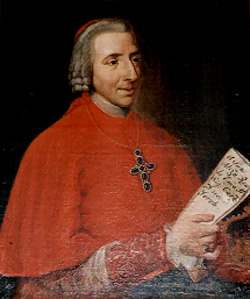
Finally, here is the portrait of the Cardinal-King hanging in the Scots College in Rome, where Scottish seminarians are trained for the priesthood.

Thus was appropriately celebrated the memory of the Head of the Royal House of Stuart and rightful King over the Dowry of Mary, England, the Crown of Mary, Scotland, and the blessed isle of St Patrick, Ireland, the last of the Royal name of Stuart that had ruled in Scotland for so long and which later came to be the ruling dynasty of the British isles, the last Catholic dynasty of these islands.

The Stuart line, happily, continues and, having passed down through various generations, now rests with HRH Prince Francis, Duke of Bavaria.

His brother, Duke Max Emmanuel in Bavaria, will succeed and thereafter the daughter of Duke Max, Princess Sophie of Bavaria, now Her Serene Highness, Princess of Liechtenstein after her marriage to HSH Prince Alois, the heir of the very Catholic princely line of Liechtenstein. Appropriately, Prince Alois was educated at the Royal Miltiary Academy Sandhurst, Britain's military academy, and his eldest child was, again appropriately, born in London.

Here is a portrait of the Princess with her husband at the 200th anniversary of the Principality of Liechtenstein which was acquired by the Liechtenstein family when they were a substantial land-owning noble family in Austria, Bohemia, Moravia and Silesia. They held Liechtenstein directly (unmittelbar) from the Holy Roman Emperor and so thereby qualified to sit independently in the Reichstag (Imperial Diet), the Parliament of the Holy Roman Empire (not to be confused with the later Parliament of the same name in the Protestant German Empire). They were great friends and honoured courtiers of the Habsburg Roman Emperors. However, all their lands, save Liechtenstein, were later seized by the Communists and they now head only the Principality which is still technically a fief of the Holy Roman Empire, the last such fief in Europe.

HSH Princess Sophie of Liechtenstein, lineal successor of the Royal Stuart line, and her husband, HSH Prince Alois, the heir apparent to the Principality of Liechtenstein.


St George, St Andrew, St David and St Patrick, pray for us!


...

Thursday, 20 September 2007

The Feast of St Eustace, patron of hunters


Today, 20 September, is the Feast day of St Eustace the patron saint of hunters.

Scroll down to earlier post to see more detail about him and the other hunting saint, St Hubert.

St Eustace, pray for us!

Wednesday, 19 September 2007

Bicentenary Pontifical Requiem for the Cardinal Duke of York


Henry Benedict Stuart
Prince and Duke of York
Cardinal-Bishop of Ostia and Velletri
Cardinal-Bishop of Frascati
Dean of the Sacred College of Cardinals
Vice-Chancellor of the Holy Roman Church
Head of the Royal House of Stuart

Solemn Pontifical Requiem
for the Bicentenary of his death

Noon

Saturday, 22nd September 2007


Conventual Church of the Sovereign Military and Hospitaller Order of St John of Jerusalem, Rhodes and Malta

The Ordinary of this Requiem Mass is sung in the traditional Roman rite and is set to music by Giovanni Francesco Anerio (1657-1630), a Renaissance composer of the Roman school.

The Sequence, Dies Irae, is sung in chant and polyphony, alternately with the Choir.

Celebrant: The Rt Revd Bernard Longley, Titular Bishop of Zarna, Auxiliary Bishop in Westminster

Assistant Priest: The Revd Andrew Wadsworth, Magistral Chaplain, Sovereign Military Order of Malta

Deacon: The Revd Dr Laurence Hemming

Subdeacon: The Revd Nicholas Schofield

Preacher: The Revd Nicholas Schofield, Hon Roman Catholic Chaplain to the Royal Stuart Society

Master of Ceremonies: Mr Duncan Gallie, Vice-Chancellor, Grand Priory of the Sovereign Military Order of Malta

The Schola is directed by Mr Eoghain Murphy.

Sunday, 16 September 2007

The Muslim Sack of Rome and St Peter's in 846 AD

Rome was sacked by Muslims in 846 AD during the great conquests of Islam after the time of Mohammed.

During the 8th and 9th centuries, the Muslim Arabs (then called Saracens in Europe) were rapaciously invading Christendom through Southern Italy which they succeeded in conquering by fire, murder, rapine and the sword. Sailing from newly acquired bases in North Africa which they had just stolen from the Christians of the Eastern Roman Empire, the had conquered Sicily and were now bent upon seizing the rest of the peninsula.

They had earlier been rebuffed in France in 732 by King Charles Martel, the grandfather of Charlemagne, but they had got as far as Tours in Nothern France. King Charles was the first to halt their seemingly inexorable advance. Thereafter they retired to Spain and parts of Southern France and settled. They retained their hold on what had once been Catholic Visigothic Spain for the next 800 years! They were not finally ejected from Christian Spain until 1491 by Queen Isabella and King Ferdinand.

Under Pope Paschal I (817-824), the relics of the holy martyrs were concealed in the walls of the city of Rome. When Rome was sacked, Paschal's careful precautions did not prevent the wholesale spoliation and robbery of Basilica of Saint Peter itself, nor, indeed, of San Paolo fuori le Mura (St Paul's outside the Walls), because they both lay outside the walls of the city of Rome.

Later, a second wall was constructed on the other side of the Tiber from the main city area. It was constructed by order of Pope Leo IV and so this enclosure was called the Leonine City.

The Islamic conquest and domination of Sicily, as well as parts of southern Italy began in the 7th century after the foundation of Islam and the attempt by the Muslim leaders to conquer the world.

By Koranic tradition, Islam makes its attempts to re-conquer the world in the 7th or 8th decade of every century and does not stop until it is halted by force. When stopped it generally lies low until the 7th or 8th decade of the next century when it then makes another attempt at world domination.

How, then, can it call itself a religion of peace? It does so because it means by peace the eventual peace that will, it says, be the consequence of the conquest of the world for Islam. In the meantime, however, it is war.


Islam first attacked Sicily (then part of the Eastern Roman Empire) in 652 AD when Syrian Arabs under Mu’auia ibn-Hodeig invaded.

The Eastern Roman Imperial Exarch of Ravenna, Olympius, then took ship to oust the invaders but the invading Arabs managed to escape back to Syria with a huge treasure trove of pillaged riches.

Next, in 669, the invading Muslim Arabs came in 200 ships from Alexandria (once the greatest Christian city in the Middle East) and attacked Syracuse, once again escaping with a mountain of rich booty stripped from the churches, palaces and homes of the Christian people.

The invading Muslims, when they first attacked Alexandria, coming across the library of the University of Alexandria which was one of the greatest in the world, took no heed of the great wealth of learning contained therein, including priceless collections of ancient Greek, Roman and Hebrew texts, and burnt the whole library.

Thus it was that so many ancient Greek and Roman texts were lost to the world forever. And yet Western scholars continue to peddle the lie that Islam safely preserved the Greek and Roman texts. It is true that some were later preserved but a massive corpus was permanently destroyed by the burning of the Alexandrian library.

After the Umayyad conquest of Africa (completed by about 700), Muslim fleets repeatedly attacked the coast of Sicily in 703, 728, 729, 730, 731, 733 and 734, looting, sacking and pillaging at every turn.

The Christians of Roman Christendom were taken completely by surprise by these attacks since they had no contest with Islam at that time and had done nothing to merit such unwarranted and merciless attacks by the Muslim raiders.

An expeditionary force was launched in 740 with the aim of conquering Christendom for Islam. The Muslim princes Habib and his son, Abdurrahman, set out to conquer the whole Italian peninsula, having discovered the Christians unprepared for invasion, and they would probably have succeeded in doing so but for a revolt in Tunisia by the Berbers which they had to return and deal with.

A treaty was signed between the Eastern Empire and Ibrahim I ibn al-Aghlab, Emir of Ifriqiya in 805 but did not prevent attacks from continuing elsewhere in Italy. Ibrahim's son, Abdallah I, sent an invasion force to conquer Sicily in 812 and he, despite some reverses, managed to conquer Lampedusa.

Thereafter the conquest of Sicily by Al-Aghlab Abu Ibrahim proceeded with rapidity.

He was succeeded by Abbas ibn-Fadhl, a savage warrior who ravaged lands still under the control of the Eastern Roman Empire capturing Castrogiovanni in 859. All the Christian survivors from that fortress were executed, and women and children were sold as slaves in Palermo. The Eastern Roman Emperor tried to aid the stricken Christians but was defeated by Abbas. Further defeats followed successively for the Eastern Romans.

Syracuse finally fell in 877 AD to Jafar ibn-Muhammad who then went on to attack Greece and Malta and the death of the Eastern Roman Emperor, Basil I, in 886, was followed by attacks on Calabria and a further defeat for the imperial army. Reggio di Calabria fell in 901 and Taromina, the last Byzantine stronghold in Sicily fell in 902.

The whole of Southern Italy was now in Muslim hands and Islam was poised to invade the rest of Christendom.

...

Friday, 14 September 2007

"Faithful Cross above all others, one and only noble tree": the Exaltation of the Holy Cross and the Grand Restoration of the Roman rite

CRUX fidelis, inter omnes, arbor una nobilis;
Nulla talem silva profert,
Flore, fronde, germine.
Dulce lignum, dulci clavos, dulce pondus sustinens!

FAITHFUL Cross! Above all other,
One and only noble Tree!
None in foliage, none in blossom,
None in fruit thy peers may be;
Sweetest wood and sweetest iron!Sweetest Weight is hung on thee!

So for centuries has been sung the song composed by Venantius Forntunatus (530-609) extolling the Triumph of the Cross.

And never more so than today, the Feast which recalls the return of the True Cross to Jersualem following its recapture from the pagan Persians by the Roman Emperor in the East, Emperor Heraclius.

But today is also the triumphal day in which our Holy Father, Pope Benendict XVI, restored to the Roman Church the use of the ancient and noble Roman rite of our ancestors.

All hail Pope Benedict XVI, the restorer of the ancient Roman rites!

Yes, today is the day when, by his own motion - motu proprio - Pope Benedict XVI has restored to the Roman Church its ancient rites. In so doing he has placed himself in the same hallowed tradition of all those popes, among his predecessors, who always sought to preserve the ancient rites of the Church, as all popes until 1970, did.

For this alone, he will go down to history as a great pope. But he has many other great virtues which posterity will also recall and hallow.

He has chosen a very significant and memorable day to make his motu proprio, called Summorum Pontificum, become effective.

It is the Feast of the Exaltation of the Holy Cross upon which day we sing the praises of the Holy Cross with such ancient hymns as Vexilla Regis and Crux Fidelis.

Venantius Fortunatus wrote both hymns, the latter for a procession that brought a part of the true Cross to Queen Radegunda in 570. This hymn is used on Good Friday during the Adoration of the Cross and in the Breviary during Holy Week and on feasts of the Cross like today.

Ancient legend is hinted at in the second verse of this hymn. According to this tradition, the wood of the Cross upon which Christ was crucified was taken from that tree which was the source of the fruit of the fall in the Garden of Eden. When Adam died, the legend states, Seth obtained from the Cherubim guarding the Garden a branch of the tree from which Eve ate the forbidden fruit. Seth planted this branch at Golgotha (the place of the skull), which is so named because Adam was buried there. As time went on, the Ark of the Covenant, the pole upon which the bronze serpent was lifted, and other items were made from this tree.

Eventually the Holy Cross was made from it and our Lord crucified thereon upon Golgotha directly over the tomb of Adam so that the Precious Blood of Christ, seeping through cracks, penetrated into the mausoleum of Adam beneath and fell upon the very skull of Adam to symbolise that the Sin of Adam had now been atoned for by the Crucifixion.

In the pre-1955 Roman Calendar, the Finding of the True Cross (Inventio Crucis) was celebrated on 3 May to commemorate that day when the Empress St Helena, daughter of a British king and mother of the Emperor Constantine, found the True Cross after long searching for it among the wells and cisterns of Jerusalem.

The British born Roman Empress St Helena finds the True Cross

The True Cross was set up and a Basilica built to house it for posterity.

3 centuries later, the pagan, fire-worshipping Persians (not yet Muslim), under King Chosroes II, attacked Jerusalem and took away the precious relic, the True Cross.

The Roman Emperor Heraclius, then regining, swore to recover it and warred against the Persians. He was on the point of being defeated himself when an internal dispute arose within Persia which threatened Chosroes II and the distraction gave Heraclius his chance. He soundly defeated Chosroes in 629 and recovered the True Cross.

This was seen as an answer to prayer by all at the time.

When Heraclius returned to Jerusalem to restore the True Cross he carried it himself, as had our Lord, intending to process along the Via Dolorosa in his gorgeous imperial robes. But when he arrived at the gate of Jerusalem he was frozen to the spot and could not move. All were puzzled and eventually the Patriarch of Jerusalem suggested that the Emperor divest himself of his imperial robes. The Emperor did more and stripped himself to little more than the seamless garment that Christ Himself had worn to carry His Cross.

At once the Emperor found himself able to proceed and so he continued until he was able to retored the Cross to its rightful place in the Basilica upon Golgotha, walking barefoot in a single shift all along the way to the great edification of the people of Jerusalem, his subjects.

Ever after that day, 14 September, was celebrated with great ceremony - nearly as much as Easter and Pentecost - as the Feast of the Exaltation of the Holy Cross (Exaltatio Crucis).

The Roman Emperor Heraclius who restored the True Cross to Jerusalem in 629AD

Now our Holy Father has chosen this most memorable and triumphant of days to restore to us the glory of the ancient Roman rite which the Roman emperors of old fought and died to protect and preserve and which countless saints and martyrs gave their lives for.

VEXILLA REGIS prodeunt:
Fulget Crucis mysterium,
Qua vita mortem pertulit,
Et morte vitam protulit.

Abroad the Regal Banners fly,
Now shines the Cross's mystery;
Upon it Life did death endure,
And yet by death did life procure.

O CRUX AVE, SPES UNICA,
In hac triumpha gloria
Piis adauge gratiam,
Reisque dele crimina.

Hail, Cross, of hopes the most sublime!
In this triumphant glorious time,
Improve religious souls in grace,
The sins of criminals efface.

On Good Friday the second line reads "Now in this mournful Passion time" but on the Feast of the Cross this is replaced by "in hac triumpha gloria" - in the glory of this triumph!

Triumph, indeed, thanks to our beloved Holy Father now gloriously reigning!


St Helena, pray for us!

True Cross, protect us!


...