Showing posts with label St Helena. Show all posts

Monday, 4 May 2009

3 May: The Feast of the Invention (Finding) of the True Cross


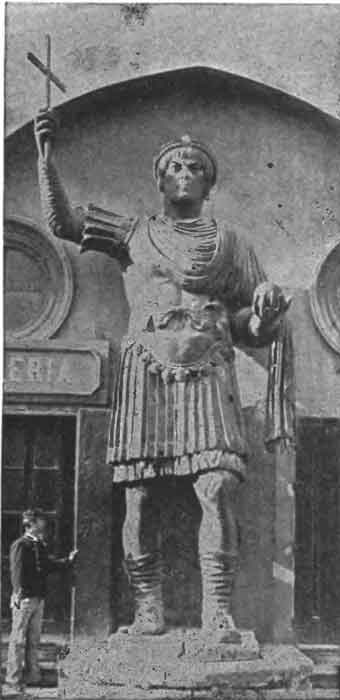
Here is the Roman Empress St Helena pictured with the True Cross.

The Feast of the Invention (Finding) of the True Cross is another great feast that was done away with by the wrecker Bugnini.

St. Helena, mother of Constantine the great, is often depicted holding a cross because according to the tradition she found the true cross in Jerusalem.

The Roman Emperor Constantine was elected Emperor by the Roman Army at Eboracum (York in Britain) in 312, and in the following year, legalized Christianity with the Edict of Milan.

About this time, Constantine’s mother, St. Helena, converted to Christianity.

With the authority of her son, St. Helena went to Palestine in search of the Holy Cross about the year 324.

St Helena built churches marking the place of the Nativity in Bethlehem, and the site of the Ascension.

Three crosses were found in a rock-cistern as well as the titulus (the wood plaque inscribed with the words Jesus Nazarenus Rex Iudaeorum in Hebrew, Greek and Latin - "Jesus of Nazareth King of the Jews"). The Church of the Holy Sepulchre was built over the site.

Titulus Crucis
a sacred relic in the Church of the Holy Cross in Jerusalem, displayed in reverse so that the words can be better seen and an ancient reconstruction placed over the top of the reliquary showing what is written on the now very old wood of the Titulus proclaiming our Lord King of the Jews in the 3 sacred languages


A woman, dying from a terminal disease, was brought to the spot. She touched the crosses, one by one. After she touched the third cross, she was cured, thereby identifying the true cross.

St Ambrose preached that when St. Helena found the true cross:

"she worshipped not the wood, but the King, Him who hung on the wood. She burned with an earnest desire of touching the guarantee of immortality."


St Cyril of Jerusalem, in his letter to the Emperor Constantius (Constantine’s son and successor), stated "The saving wood of the cross was found at Jerusalem in the time of Constantine."

In his fourth Catechetical Lecture, he wrote:

"He was truly crucified for our sins. For if you would deny it, the place refutes you visibly, this blessed Golgotha, in which we are now assembled for the sake of Him who was here crucified; and the whole world has since been filled with pieces of the wood of the Cross."

Many of the older depictions of the crucifixion show a skull with two crossed bones at the foot of the cross. The tradition is that Adam was buried at Calvary. When our Lord died, His Precious Blood flowed down, through cracks in the earth, onto Adam's skull.

In the Church of the Holy Sepulchre in Jerusalem one finds the Chapel of Adam underneath the Chapel of Golgotha.

The Feast of the Triumph of the Cross, which comes much later on 14 September, is the feast marking the day when the Emperor Heraclius re-captured the True Cross from the Persians who had stolen it from Jerusalem.

It was on that great feast day that our Holy Father, Pope Benedict gloriously reigning, ordered the freeing of the traditional Roman rites which, he declared, had never been abrogated (numquam abrogatam).

A truly glorious victory of the Holy Cross indeed!

On these great feasts, let us remember the words of St. Francis of Assisi:


"We adore Thee, O Christ, and we praise Thee, because by Thy Holy Cross Thou hast redeemed the world."

+++

Friday, 14 September 2007

"Faithful Cross above all others, one and only noble tree": the Exaltation of the Holy Cross and the Grand Restoration of the Roman rite

CRUX fidelis, inter omnes, arbor una nobilis;
Nulla talem silva profert,
Flore, fronde, germine.
Dulce lignum, dulci clavos, dulce pondus sustinens!

FAITHFUL Cross! Above all other,
One and only noble Tree!
None in foliage, none in blossom,
None in fruit thy peers may be;
Sweetest wood and sweetest iron!Sweetest Weight is hung on thee!

So for centuries has been sung the song composed by Venantius Forntunatus (530-609) extolling the Triumph of the Cross.

And never more so than today, the Feast which recalls the return of the True Cross to Jersualem following its recapture from the pagan Persians by the Roman Emperor in the East, Emperor Heraclius.

But today is also the triumphal day in which our Holy Father, Pope Benendict XVI, restored to the Roman Church the use of the ancient and noble Roman rite of our ancestors.

All hail Pope Benedict XVI, the restorer of the ancient Roman rites!

Yes, today is the day when, by his own motion - motu proprio - Pope Benedict XVI has restored to the Roman Church its ancient rites. In so doing he has placed himself in the same hallowed tradition of all those popes, among his predecessors, who always sought to preserve the ancient rites of the Church, as all popes until 1970, did.

For this alone, he will go down to history as a great pope. But he has many other great virtues which posterity will also recall and hallow.

He has chosen a very significant and memorable day to make his motu proprio, called Summorum Pontificum, become effective.

It is the Feast of the Exaltation of the Holy Cross upon which day we sing the praises of the Holy Cross with such ancient hymns as Vexilla Regis and Crux Fidelis.

Venantius Fortunatus wrote both hymns, the latter for a procession that brought a part of the true Cross to Queen Radegunda in 570. This hymn is used on Good Friday during the Adoration of the Cross and in the Breviary during Holy Week and on feasts of the Cross like today.

Ancient legend is hinted at in the second verse of this hymn. According to this tradition, the wood of the Cross upon which Christ was crucified was taken from that tree which was the source of the fruit of the fall in the Garden of Eden. When Adam died, the legend states, Seth obtained from the Cherubim guarding the Garden a branch of the tree from which Eve ate the forbidden fruit. Seth planted this branch at Golgotha (the place of the skull), which is so named because Adam was buried there. As time went on, the Ark of the Covenant, the pole upon which the bronze serpent was lifted, and other items were made from this tree.

Eventually the Holy Cross was made from it and our Lord crucified thereon upon Golgotha directly over the tomb of Adam so that the Precious Blood of Christ, seeping through cracks, penetrated into the mausoleum of Adam beneath and fell upon the very skull of Adam to symbolise that the Sin of Adam had now been atoned for by the Crucifixion.

In the pre-1955 Roman Calendar, the Finding of the True Cross (Inventio Crucis) was celebrated on 3 May to commemorate that day when the Empress St Helena, daughter of a British king and mother of the Emperor Constantine, found the True Cross after long searching for it among the wells and cisterns of Jerusalem.

The British born Roman Empress St Helena finds the True Cross

The True Cross was set up and a Basilica built to house it for posterity.

3 centuries later, the pagan, fire-worshipping Persians (not yet Muslim), under King Chosroes II, attacked Jerusalem and took away the precious relic, the True Cross.

The Roman Emperor Heraclius, then regining, swore to recover it and warred against the Persians. He was on the point of being defeated himself when an internal dispute arose within Persia which threatened Chosroes II and the distraction gave Heraclius his chance. He soundly defeated Chosroes in 629 and recovered the True Cross.

This was seen as an answer to prayer by all at the time.

When Heraclius returned to Jerusalem to restore the True Cross he carried it himself, as had our Lord, intending to process along the Via Dolorosa in his gorgeous imperial robes. But when he arrived at the gate of Jerusalem he was frozen to the spot and could not move. All were puzzled and eventually the Patriarch of Jerusalem suggested that the Emperor divest himself of his imperial robes. The Emperor did more and stripped himself to little more than the seamless garment that Christ Himself had worn to carry His Cross.

At once the Emperor found himself able to proceed and so he continued until he was able to retored the Cross to its rightful place in the Basilica upon Golgotha, walking barefoot in a single shift all along the way to the great edification of the people of Jerusalem, his subjects.

Ever after that day, 14 September, was celebrated with great ceremony - nearly as much as Easter and Pentecost - as the Feast of the Exaltation of the Holy Cross (Exaltatio Crucis).

The Roman Emperor Heraclius who restored the True Cross to Jerusalem in 629AD

Now our Holy Father has chosen this most memorable and triumphant of days to restore to us the glory of the ancient Roman rite which the Roman emperors of old fought and died to protect and preserve and which countless saints and martyrs gave their lives for.

VEXILLA REGIS prodeunt:
Fulget Crucis mysterium,
Qua vita mortem pertulit,
Et morte vitam protulit.

Abroad the Regal Banners fly,
Now shines the Cross's mystery;
Upon it Life did death endure,
And yet by death did life procure.

O CRUX AVE, SPES UNICA,
In hac triumpha gloria
Piis adauge gratiam,
Reisque dele crimina.

Hail, Cross, of hopes the most sublime!
In this triumphant glorious time,
Improve religious souls in grace,
The sins of criminals efface.

On Good Friday the second line reads "Now in this mournful Passion time" but on the Feast of the Cross this is replaced by "in hac triumpha gloria" - in the glory of this triumph!

Triumph, indeed, thanks to our beloved Holy Father now gloriously reigning!


St Helena, pray for us!

True Cross, protect us!


...