Showing posts with label motu proprio. Show all posts

Sunday, 20 February 2011

Motu Proprio under threat! Sign the Petition!

There are ugly rumours doing the rounds that there is to be a "clarification" of the Motu Proprio Summorum Pontificum.

The position is very confusing and unclear.

The time has come for action.

May I urge you all to sign the petition posted by the New Liturgical Movement blog?

Here is the introduction to the petition:

"This appeal came out of information coming from a variety of sources, suggesting that the forthcoming Instruction on Summorum Pontificum may contain restrictive elements (or, at very least, elements that could be interpreted restrictively) thereby having the adverse effect of limiting the motu proprio Summorum Pontificum in some manner – or at least making this more possible.

Obviously, we do not presume to know what the text may say. However, in checking in with a variety of our own sources, we have confirmed that there is a very real and substantive reason for some concern here. Substantial enough that a joint, multi-blog, international appeal has been launched: http://www.motuproprioappeal.com/

The appeal does not presume to know or state what the actual contents of this proposed instruction are, however, in the light of the aforementioned reports, and given credible confirmations that there is reason for concern, it simply wishes to calmly and respectfully share our concern with the Holy Father about this potentiality, asking that, whatever is finally released, that the integrity of the letter and the spirit of the
motu proprio Summorum Pontificum be preserved.

If, in the end , there is nothing to any of this, then we shall all be very thankful indeed. But if there is substance to this, then at least our concern will have been respectfully voiced to our pastors and to our beloved Holy Father.

Who should then sign this? Everyone who is concerned with liturgical patrimony and mutual enrichment. Whether you are attached to the Ordinary Form and see a reform of the reform, a re-enchantment, as your primary liturgical focus, or the
usus antiquior, the other Western liturgical rites/uses, or even are an Eastern Christian, I believe we all have something potentially at stake here, either in practice, in effect, or in principle at very least."

Well said!

Please, therefore - sign the petition now!

Thank you and God bless you all!


God protect our Pope!

...

Sunday, 23 September 2007

Henry IX and I, King and Cardinal: the Royal Stuart Bicentenary Requiem


Setting the standard for all future Requiems and Solemn Masses!

This was the Solemn Pontifical Requiem for Prince Henry Benedict Stuart, the Cardinal Duke of York and, by right, King Henry IX of England and I of Scotland and Ireland.

The pontificating bishop was Bishop Bernard Longley, titular Bishop of Zarna, Auxiliary Bishop in Westminster supported by an all-star cast of clergy familiar with the traditional Roman rite, including the preacher and Subdeacon, Fr Nicholas Schofield, Honorary Chaplain to the Royal Stuart Society which sponsored the whole event.

On the right of the picture is Fr Bede Rowe who is such a superlative amateur milliner (hat-maker) that he made the Cardinal's galero that sits on top of the catafalque in the middle of the sanctuary. What an outstanding feat of hat-making!

Here is a close up of Fr Bede with his superb galero:

The galero was worn by cardinals in the Middle Ages and gradually added more and more tassels and then was no longer worn. It was worn at the creation of a cardinal by the Pope and, after the death of the recipient, it was hung over his tomb until it disintegrated to remind the people of the transitory nature of fame in this life.

The Requiem took place in the Conventual church of the Sovereign Military and Hospitaller Order of St John of Jerusalem, Rhodes and Malta (founded in 1099 and later known as the Knights Hospitaller). This is not - as some wrongly call it - a "hospital chapel". This is the Conventual church of an ancient religious order, older than the Franciscans and Dominicans and most other religious orders in the Church - only the Benedictines and Augustinians are older.

Here, below, is the church prepared for the Requiem.

The catafalque is in the middle of the Sanctuary, standing on a black carpet. Black hangings are attached to a coronet suspended from the cupola windows to match the black altar frontal and black vestments used in the old rite for Requiems and funerals. Six candlesticks stand guard by the catafalque. The arms of the Cardinal-King are displayed attached to the altar pillars. In the Order flag-stand are seen the papal flag, the flag of the Order and the Union flag.

This latter has been, since 1801 and the union with Ireland, the flag of the United Kingdom and Great Britain. The Stuart monarchy did not use it but only the pre-1801 Union flag which did not have the red Saltire of St Patrick and looked like this:

Here below is the catafalque closer up. At the front of it, placed on a red cushion, are representations of the Order of the Garter regalia but of the type used by the Stuarts. The Stuart Garter star was diamond-encrusted which the Hanoverian Protestants replaced with cut metal only. The Stuart Garter sash was a lighter blue, the Hanoverians changing to a darker colour to distinguish themselves from the Catholic Stuarts. The Garter collar with the pendant image of St George killing the dragon, and the Garter itself with its famous motto, Honi Soit Qui Mal Y Pense, are also represented.

The motto means "evil be to him who thinks evil of it" and refers to the chivalrous incident by which the Order of Knights of the Garter was initiated. King Edward III about 1348, whilst dancing at Eltham Palace, picked up the garter of the Countess of Salisbury which caused some sniggering as if there were some impropriety. The King, seeing this, said the words that are now the Order's motto, as if to mean "if you think ill of this lady's reputation assuming she lost her garter through improper behaviour, then evil be to you". So the Order was founded upon the chivalrous defence of a lady's honour by the King himself, a Catholic king.

Since St George had become the Protector of the English Realm, through his having inspired King Richard the Lionheart in the Crusades, King Edward dedicated his new order of Knighthood to that warrior saint.

Even today the Order of the Garter is still given by the Monarch in the way it has always been given, in the name of "God, our Lady and St George".


Draped on the catafalque is a representation of the Royal parliamentary mantle which is burgundy-coloured with an ermine cape. At the altar end is the galero sitting on top of the cappa magna of a cardinal, the long scarlet train that is worn on solemn occasions.

In the middle of the catafalque on a white cushion sits a mitra pretiosa or precious mitre. At a Requiem the pontificating bishop wears a simple white mitre, not a precious mitre.

Below, Fr Nicholas Schofield preaches the sermon about the Cardinal-King. The text of the sermon is on his website at http://romanmiscellany.blogspot.com/.

Below, in their stalls sit the Knights of Malta, praying and singing the Dies Irae alternately with the schola of some 23 singers. The schola sang from behind the altar which produced a wonderful effect as of hidden angels pouring forth chant and polyphony for the soul of the Cardinal-King and the deceased members of his family.

Here below the Bishop performs the Absolutions. As the schola sings the Libera Me the Bishop blesses the catafalque with lustral water and then incense.

The Bishop then processes out, preceded by the clergy and servers with his mitre-bearer and other servers behind, imparting his blessing as he goes.

Below is a representation of the funeral of Prince Henry's mother, Queen Maria Clementina, the daughter of King Jan III Sobieksi of Poland-Lithuania.
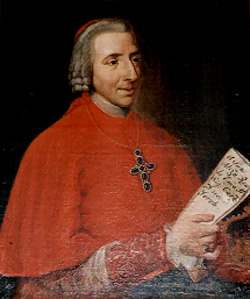
Finally, here is the portrait of the Cardinal-King hanging in the Scots College in Rome, where Scottish seminarians are trained for the priesthood.

Thus was appropriately celebrated the memory of the Head of the Royal House of Stuart and rightful King over the Dowry of Mary, England, the Crown of Mary, Scotland, and the blessed isle of St Patrick, Ireland, the last of the Royal name of Stuart that had ruled in Scotland for so long and which later came to be the ruling dynasty of the British isles, the last Catholic dynasty of these islands.

The Stuart line, happily, continues and, having passed down through various generations, now rests with HRH Prince Francis, Duke of Bavaria.

His brother, Duke Max Emmanuel in Bavaria, will succeed and thereafter the daughter of Duke Max, Princess Sophie of Bavaria, now Her Serene Highness, Princess of Liechtenstein after her marriage to HSH Prince Alois, the heir of the very Catholic princely line of Liechtenstein. Appropriately, Prince Alois was educated at the Royal Miltiary Academy Sandhurst, Britain's military academy, and his eldest child was, again appropriately, born in London.

Here is a portrait of the Princess with her husband at the 200th anniversary of the Principality of Liechtenstein which was acquired by the Liechtenstein family when they were a substantial land-owning noble family in Austria, Bohemia, Moravia and Silesia. They held Liechtenstein directly (unmittelbar) from the Holy Roman Emperor and so thereby qualified to sit independently in the Reichstag (Imperial Diet), the Parliament of the Holy Roman Empire (not to be confused with the later Parliament of the same name in the Protestant German Empire). They were great friends and honoured courtiers of the Habsburg Roman Emperors. However, all their lands, save Liechtenstein, were later seized by the Communists and they now head only the Principality which is still technically a fief of the Holy Roman Empire, the last such fief in Europe.

HSH Princess Sophie of Liechtenstein, lineal successor of the Royal Stuart line, and her husband, HSH Prince Alois, the heir apparent to the Principality of Liechtenstein.


St George, St Andrew, St David and St Patrick, pray for us!


...

Wednesday, 19 September 2007

Bicentenary Pontifical Requiem for the Cardinal Duke of York


Henry Benedict Stuart
Prince and Duke of York
Cardinal-Bishop of Ostia and Velletri
Cardinal-Bishop of Frascati
Dean of the Sacred College of Cardinals
Vice-Chancellor of the Holy Roman Church
Head of the Royal House of Stuart

Solemn Pontifical Requiem
for the Bicentenary of his death

Noon

Saturday, 22nd September 2007


Conventual Church of the Sovereign Military and Hospitaller Order of St John of Jerusalem, Rhodes and Malta

The Ordinary of this Requiem Mass is sung in the traditional Roman rite and is set to music by Giovanni Francesco Anerio (1657-1630), a Renaissance composer of the Roman school.

The Sequence, Dies Irae, is sung in chant and polyphony, alternately with the Choir.

Celebrant: The Rt Revd Bernard Longley, Titular Bishop of Zarna, Auxiliary Bishop in Westminster

Assistant Priest: The Revd Andrew Wadsworth, Magistral Chaplain, Sovereign Military Order of Malta

Deacon: The Revd Dr Laurence Hemming

Subdeacon: The Revd Nicholas Schofield

Preacher: The Revd Nicholas Schofield, Hon Roman Catholic Chaplain to the Royal Stuart Society

Master of Ceremonies: Mr Duncan Gallie, Vice-Chancellor, Grand Priory of the Sovereign Military Order of Malta

The Schola is directed by Mr Eoghain Murphy.

Friday, 14 September 2007

"Faithful Cross above all others, one and only noble tree": the Exaltation of the Holy Cross and the Grand Restoration of the Roman rite

CRUX fidelis, inter omnes, arbor una nobilis;
Nulla talem silva profert,
Flore, fronde, germine.
Dulce lignum, dulci clavos, dulce pondus sustinens!

FAITHFUL Cross! Above all other,
One and only noble Tree!
None in foliage, none in blossom,
None in fruit thy peers may be;
Sweetest wood and sweetest iron!Sweetest Weight is hung on thee!

So for centuries has been sung the song composed by Venantius Forntunatus (530-609) extolling the Triumph of the Cross.

And never more so than today, the Feast which recalls the return of the True Cross to Jersualem following its recapture from the pagan Persians by the Roman Emperor in the East, Emperor Heraclius.

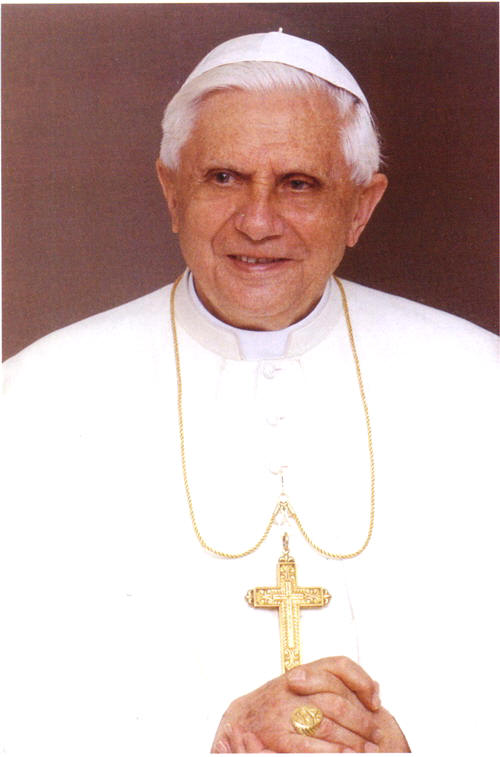
But today is also the triumphal day in which our Holy Father, Pope Benendict XVI, restored to the Roman Church the use of the ancient and noble Roman rite of our ancestors.

All hail Pope Benedict XVI, the restorer of the ancient Roman rites!

Yes, today is the day when, by his own motion - motu proprio - Pope Benedict XVI has restored to the Roman Church its ancient rites. In so doing he has placed himself in the same hallowed tradition of all those popes, among his predecessors, who always sought to preserve the ancient rites of the Church, as all popes until 1970, did.

For this alone, he will go down to history as a great pope. But he has many other great virtues which posterity will also recall and hallow.

He has chosen a very significant and memorable day to make his motu proprio, called Summorum Pontificum, become effective.

It is the Feast of the Exaltation of the Holy Cross upon which day we sing the praises of the Holy Cross with such ancient hymns as Vexilla Regis and Crux Fidelis.

Venantius Fortunatus wrote both hymns, the latter for a procession that brought a part of the true Cross to Queen Radegunda in 570. This hymn is used on Good Friday during the Adoration of the Cross and in the Breviary during Holy Week and on feasts of the Cross like today.

Ancient legend is hinted at in the second verse of this hymn. According to this tradition, the wood of the Cross upon which Christ was crucified was taken from that tree which was the source of the fruit of the fall in the Garden of Eden. When Adam died, the legend states, Seth obtained from the Cherubim guarding the Garden a branch of the tree from which Eve ate the forbidden fruit. Seth planted this branch at Golgotha (the place of the skull), which is so named because Adam was buried there. As time went on, the Ark of the Covenant, the pole upon which the bronze serpent was lifted, and other items were made from this tree.

Eventually the Holy Cross was made from it and our Lord crucified thereon upon Golgotha directly over the tomb of Adam so that the Precious Blood of Christ, seeping through cracks, penetrated into the mausoleum of Adam beneath and fell upon the very skull of Adam to symbolise that the Sin of Adam had now been atoned for by the Crucifixion.

In the pre-1955 Roman Calendar, the Finding of the True Cross (Inventio Crucis) was celebrated on 3 May to commemorate that day when the Empress St Helena, daughter of a British king and mother of the Emperor Constantine, found the True Cross after long searching for it among the wells and cisterns of Jerusalem.

The British born Roman Empress St Helena finds the True Cross

The True Cross was set up and a Basilica built to house it for posterity.

3 centuries later, the pagan, fire-worshipping Persians (not yet Muslim), under King Chosroes II, attacked Jerusalem and took away the precious relic, the True Cross.

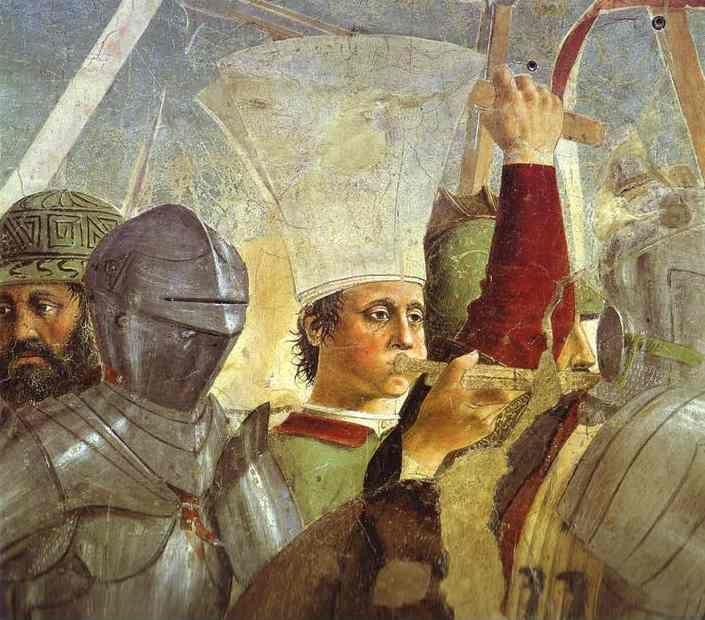
The Roman Emperor Heraclius, then regining, swore to recover it and warred against the Persians. He was on the point of being defeated himself when an internal dispute arose within Persia which threatened Chosroes II and the distraction gave Heraclius his chance. He soundly defeated Chosroes in 629 and recovered the True Cross.

This was seen as an answer to prayer by all at the time.

When Heraclius returned to Jerusalem to restore the True Cross he carried it himself, as had our Lord, intending to process along the Via Dolorosa in his gorgeous imperial robes. But when he arrived at the gate of Jerusalem he was frozen to the spot and could not move. All were puzzled and eventually the Patriarch of Jerusalem suggested that the Emperor divest himself of his imperial robes. The Emperor did more and stripped himself to little more than the seamless garment that Christ Himself had worn to carry His Cross.

At once the Emperor found himself able to proceed and so he continued until he was able to retored the Cross to its rightful place in the Basilica upon Golgotha, walking barefoot in a single shift all along the way to the great edification of the people of Jerusalem, his subjects.

Ever after that day, 14 September, was celebrated with great ceremony - nearly as much as Easter and Pentecost - as the Feast of the Exaltation of the Holy Cross (Exaltatio Crucis).

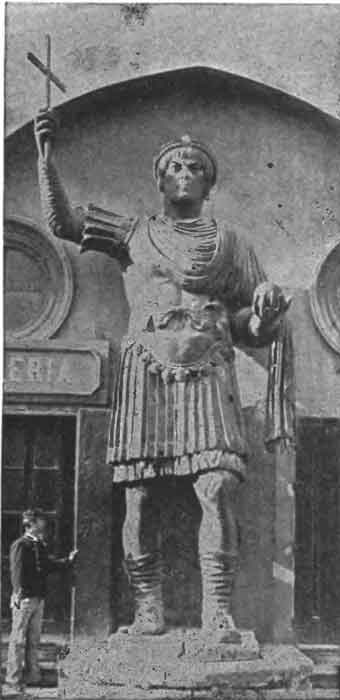
The Roman Emperor Heraclius who restored the True Cross to Jerusalem in 629AD

Now our Holy Father has chosen this most memorable and triumphant of days to restore to us the glory of the ancient Roman rite which the Roman emperors of old fought and died to protect and preserve and which countless saints and martyrs gave their lives for.

VEXILLA REGIS prodeunt:
Fulget Crucis mysterium,
Qua vita mortem pertulit,
Et morte vitam protulit.

Abroad the Regal Banners fly,
Now shines the Cross's mystery;
Upon it Life did death endure,
And yet by death did life procure.

O CRUX AVE, SPES UNICA,
In hac triumpha gloria
Piis adauge gratiam,
Reisque dele crimina.

Hail, Cross, of hopes the most sublime!
In this triumphant glorious time,
Improve religious souls in grace,
The sins of criminals efface.

On Good Friday the second line reads "Now in this mournful Passion time" but on the Feast of the Cross this is replaced by "in hac triumpha gloria" - in the glory of this triumph!

Triumph, indeed, thanks to our beloved Holy Father now gloriously reigning!


St Helena, pray for us!

True Cross, protect us!


...

Friday, 24 August 2007

In case anyone thinks I've got it in for him...

I warmly recommend the latest post of Fr Dwight on his blog Standing on my Head which very properly underscores the importance, in the right place, of emotion in the worship of God.

Read it for yourselves!

Thursday, 23 August 2007

The Motu Proprio: Fr Dwight errs but censors his critics...

The US Catholic Bishops Conference’s English version of the whole Motu Proprio is "unofficial" but many US priests are using it as if it were official. That is probably because the USCCB’s Liturgy Office published guidelines based on the unofficial translation.

Now Fr Dwight Longenecker (regular all-round good guy but a bit muddled on this issue) has used it to argue why the traditional rites should not be offered freely in his parish of St Mary's Greenville, South Carolina (and you can be sure that there are other priests arguing the same).

Here's what he says on his blog Standing on my Head in answer to an enquirer who, quite reasonably, asks him if the traditional rite will be celebrated at St Mary's:

"I therefore would need to consider what my bishop thinks of the matter, and consider the pastoral concerns of the whole community and not just those who are asking for the Latin Mass. This is difficult because to impose the Missal of Bl. John XXIII on the whole community would be pastorally unfair, but to celebrate a regular Mass for a separate group of the faithful would foster disunity. Tough one.

The most interesting word in the ruling is the word 'stable'. It says if a 'stable' group of parishioners asks for the Latin Mass their request is to be considered. But what does 'stable' mean? Must they be stable as a group? Stable as individuals or stable as families? Does this mean emotional and mental stability, spiritual stability or stability in their commitment to the parish?

This is a very important consideration. In some places there are groups of people who are not emotionally or spiritually stable, but more important than that, there are others who are not stable in their commitment either to the Pope or to their local parish. They trot off to whatever celebration of Mass they deem best. For example, some people forsake their parish (even when they have a good conservative priest celebrating the Novus Ordo reverently) for SSPX masses, or they drive hundreds of miles to attend a Fraternity of St Peter Latin Mass. They are entitled to do so, but it is arguable that such individuals, families and groups are not stable in their spiritual lives or their parochial commitment, and I expect many parish priests would not wish therefore to take their requests seriously."


Well, sorry, Fr Dwight. You are once again wrong.

The word "stable" simply does not appear in the document.

Even if it did you have no basis whatsoever for the fantastical conclusions that you draw in the above. And it is particularly unfair that you single out as "unstable" those who, through no fault of their own, through their loyalty to the traditional rites and despite their polite requests for it addressed to their PPs, are forced to go outside their parish to have their legitimate desire for the traditional rites met because the PP unjustly refuses it to them in defiance of papal decrees.

However, the word does not appear in the document.

One could be forgiven for thinking so initially. But Fr Dwight's correspondents put him right in a series of comments in a total of 26 at last count.

Yet, having been pretty comprehensively put right on this, as on a number of other crucial issues, Fr Dwight disdains to amend his blog or even add an update or rider.

When he's wrong he's right, perhaps (to quote from a previous post)?

More than that, he then goes on to censor out those responses which point out his more egregious blunders.

Here is part of one response that was "edited" out by Fr Dwight:

"...You continually say that you are willing to learn, having nothing against the old rite, wish to follow the MP, do not wish to enter into liturgy wars, respect people's love for the old rite etc etc etc....

The popes issued Tres Abhinc Annos, Ecclesia Dei and now Summorum Pontificum in order to get priests to be generous to the Faithful who prefer to worship with the rites that their ancestors used for at least 1700 years and yet there are still priests - like yourself - finding more and more excuses why they should continue to oppress those Faithful and deny them what the Pope has repeatedly said they may have.

This oppression has gone on for 40 years. Now is the time to stop. It is the Pope who orders it and you want, instead, to quibble.

All your quibbles have been more than adequately addressed and laid to rest by your various correspondents and yet.... still you quibble.

Where is the generosity? Where is the pastoral care? Where is the pastoral love of the flock? Where, Father, is your sense of justice?

Your later posts do nothing to re-assure me.

You write that 'this really is a marginal issue: in terms of numbers, those who wish for the Latin Mass are relatively minute.'

Which Latin Mass? Or have you once again overlooked the fact that the Novus Ordo Missae is a Latin rite and that the vernacular was NOT demanded by Vatican II? We have been round that one again and again and again. You just ignore it!

Where do you get your stats from? I question them.

But even if you were right, would it be surprising? Latin, whether in the traditional or new rites, has been virtually strangled to death for the last 40 years. Moreover, only the faithfulness of a minority have kept the traditional rites alive. Now you use that against them. A good is suppressed then a complaint made that the good is no longer seen. Really, Father, what sort of argument is that?

It is abundantly clear from his writings that the Pope thinks this near-total suppression of both Latin and of the traditional rites was a grave mistake and he plainly wishes to reverse the situation.

It is also abundantly clear that he thinks that wide celebration of the traditional rites will vastly improve and enrich the way in which the Novus Ordo is celebrated.

...Once the Holy Father begins to be obeyed, you will find that more and more people are attracted to the traditional rites. That has been our over-whelming experience here in the UK.

Denying people the traditional rites is a self-fulfilling prophecy: you will get less people simply because the rites are, and have been these 40 years, very difficult to find.

To accuse people of being 'unstable' because they travel far to find the traditional rites is yet another extraordinary statement.

The Faithful have had to do so precisely because of the quibblers. Having denied them their rights, the quibblers then accuse them of 'instability' for going elsewhere to find what they have been unjustly denied. A more crassly unreasonable argument would be hard to find.

You write: 'With a shortage of priests it is difficult to justify too many special masses for a handful of people who want mass the way they want it.'

No, Father, it is Mass the way the Holy Father wants it...That is what he has now ordered. And the shortage of priests is not a reason for refusing to obey the Pope. These are not 'special' Masses, they are a right.

...You, have, with great respect, quite some way in this thread to go before you can honestly say that you are really being fair and objective about the traditional rites, as you claim.

Will you now do better?"


Fair question, isn't it?

Or is ignorance bliss?

Tripe about "stable groups": what the Motu Proprio really says...


It's started!

Some obstinate clerics are already trying to minimise the Holy Father's clear wishes to make the traditional Roman rite widely available to the Faithful.

One attempt centres around the weak unofficial translation of the United States Catholic Bishops' Conference upon which translation they then go on to give some very mediocre advice.

The translation makes reference to "stable groups" and some clerics have been desperately trying to make much of the word "stable" to imply that it rules out those who do not attend the Novus Ordo regularly, do not regularly attend only one parish, occasionally attend SSPX chapels, do not form a big enough group to be called "stable", or even that the priest judges them to be "emotionally unstable".

Tripe.

Yes, tripe.

Total and utter tripe.

The word "stable" does not even appear in the Motu Proprio!

Here's what the Motu Proprio says in the Holy Father's original Latin:

"Art. 5, § 1. In paroeciis, ubi coetus fidelium traditioni liturgicae antecedenti adhaerentium continenter exsistit, parochus eorum petitiones ad celebrandam sanctam Missam iuxta ritum Missalis Romani anno 1962 editi, libenter suscipiat. Ipse videat ut harmonice concordetur bonum horum fidelium cum ordinaria paroeciae pastorali cura, sub Episcopi regimine ad normam canonis 392, discordiam vitando et totius Ecclesiae unitatem fovendo."

Which can be pretty accurately translated as:

"Art. 5, § 1. In parishes, where there is continuously present a group of the faithful attached to the previous liturgical tradition, let the pastor willingly receive their petitions that Mass be celebrated according to the Rite of the Missale Romanum issued in 1962. Let him see to it that the good of these faithful be harmoniously incorporated with the ordinary pastoral care of the parish, under the governance of the Bishop according to canon 392, by avoiding discord and by fostering the unity of the whole Church."

The word simply does not appear!

So, for those clerics who still want to go on pretending that the traditional rites should not be freely offered, and who refuse to recognise the generosity of the Holy Father, here is some more tripe:


Yech!

Can't stand the stuff!


.....

Friday, 17 August 2007

Fr Dwight: the grapes of wrath?

Fr Dwight decided to let off more steam on his blog Standing on My Head (a very good blog, by the way) having discovered Roman Christendom and its criticism of some of his views on the traditional liturgy.

Fair enough! I think that is his right. We shouldn't begrudge it. I like him and that's why I'm engaging with him. So please read the below in that spirit.

First, under a heading "Watzablog" he gives a lecture on what a blog should be like, accusing some people of bad manners and then claiming to know who was the author of Roman Christendom and seeking to "out" us.

He launched into an attack on James Bogle, whose letters I have borrowed from, even accusing him of being "insulting" and "arrogant" and this blog of making "senseless and weird" attacks, whilst claiming himself to be "objective and cheerful" and to give those who favour the traditional rites (or Mass of John XXIII as he insists on calling it when it is, of course, the oldest rite in the Church), the "benefit of the doubt".

He then gives us a treatise on how we're all wrong when we think we are right and thinking you're right, even if you are right, is self-righteous. Well, if we all followed such a principle there would, of course, never be any debate at all.

To add spice, the whole is interlaced with choice references to "fundamentalism", "little fortresses", "aggressive", "belligerent", "martyr complexes", "self-pity", "sick kind of mentality", "obsession", "mania", "self-righteous", "extreme", "suspicious", "intolerant", "the seriousness of Satan", "demented terrier with a slipper", "sulk", "infected wound" and the like.

No prizes for guessing, folks, that this is at least partly aimed at Roman Christendom for daring to defend the traditional rite in the face of some pretty ill-informed opposition.

I need say no more: Fr Dwight is not "standing on his head" over this one but on his own dignity by over-reacting somewhat.

Well, at least he is engaging, now. That's a good start!

Fr Dwight is, I consider, actually a very good guy, but both he, and his Parish Priest, Fr Jay Scott Newman, also a good guy, ought to exercise a little caution when using sacerdotal authority particularly on anything that might be interpreted as undermining the Church's traditions (Latin, Chant etc) or the manifest and proper wishes of the Pope and use scorn sparingly against others who simply point this out.

Targeting Catholics who prefer the traditional Roman rite is a recreation that is past its sell-by date. It's done great harm these past 40 years and the Pope has quite rightly called time on it.

Fr Dwight erased most of the comments on his blog that criticised his view of liturgy and Fr Jay now won't receive any further comments on his blog. His penultimate post was, aptly but sadly, entitled "Liturgy Wars". It was not traditional-rite Catholics who started the war.

There should, of course, be no wars over liturgy. We should all be on the same side not divided internally.

Unfortunately, it is the kind of statement that appeared in Fr Jay's Parish newsletter that can sometimes tend to prolong the war. I publish it below as it is in the public domain and a commentator has sent it to me.

If any priest is going to claim to be loyal to the Pope and to say "Where Peter is, there is the Church", then he needs to be open and willing to implement the motu proprio, and should avoid minimising it by suggesting that it "kinda, sorta" gives wider permission for the traditional rites.

The reality is that the motu proprio gives extremely wide and extensive permission for the use of the traditional rites.

But here is Fr Jay's advice to his parishioners on 1 July, just before the publication of the motu proprio:

"When this document is finally published, there will no doubt be a circus of media attention of the most sensational kind, but please do not be confused or disturbed by what you read in the papers or see on television. Whatever else may be the case, there will certainly be no changes made in the present way we celebrate the Missal of 1970 in our scheduled liturgies, and pending a careful study of the document, I do not anticipate that a regularly scheduled Tridentine Mass will be celebrated here at St. Mary’s. For now, simply know that a document will probably appear this summer, and when it does, we will study it together."

To be fair to Fr Jay, he clearly did not anticipate the breadth and width of the rights granted by the motu proprio and, I suspect, is still slightly in denial about it all. On his blog, he certainly admits - actually I think rather courageously and even humbly - to being a bit confused by it all. That actually rather endeared him to me, I have to say. My heart went out to him!

I suspect that when he and Fr Dwight have had time to digest it all, reflect upon it all and pray about it, they will take a more balanced view.

So let's give 'em a chance, folks, and pray for them and for what I have a feeling is a very important and influential parish in that part of the US of A and two potentially very influential priests.
Thursday, 16 August 2007

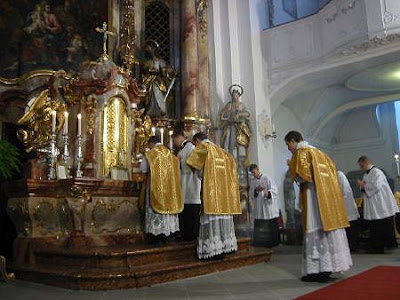
Solemn Pontifical Requiem for Henry IX and I, King and Cardinal, on Saturday 22 September 2007 at noon...

By kind permission of His Excellency Fra’ Matthew Festing TD OBE DL, the Grand Prior of England of the Sovereign Military Order of Malta,
and by the patronage of His Grace the Duke of St Albans, the Governor-General of the Royal Stuart Society,
Solemn Pontifical Requiem Mass
will be sung with solemn Pontifical Absolution
in the
Conventual Church
of
the Sovereign Military and Hospitaller Order of St John of Jerusalem, Rhodes and Malta,
at
the Hospital of St John and St Elizabeth, 60 Grove End Road, St John’s Wood, London NW8 9NH
to mark the bicentenary of the death and for the repose of the soul of
Henry Benedict Stuart
Cardinal Duke of York, Dean of the Sacred College of Cardinals, Vice-Chancellor of the Holy Roman Church and Cardinal-bishop of Ostia and Velletri and of Frascati,
grandson of
King James II and VII
of England, Scotland, France and Ireland
and for the souls of
the deceased members of the Royal House of Stuart
at
12 noon
on
Saturday 22nd September 2007
the Feast of St Maurice of the Theban Legion.

Musical Setting: Requiem of G F Anerio
Dress: dark suit and dark tie (equivalent for ladies or for Highland/Lowland dress)
Approach from either Grove End Road, through the Hospital entrance, or Circus Road

[Nearest tube: St John’s Wood]

Tuesday, 14 August 2007

Fr Jay Scott Newman also joins the muddle...


Fr Jay Scott Newman is another PP who has a good blog which is well worth reading. I don't know him but he seems a good enough fellow.

But...once, again, but...

Yep, the liturgy.

Before the motu proprio was issued he joined in with the "Latin Questions" discussion and made this unhelpful comment:

"...The long-rumored and still invisible motu proprio notwithstanding, there is simply no interest in the Church beyond the statistically insignificant world of specialists and bloggers in retrieving what 99.999% of the Catholic people (and hierarchy) consider a noble part of our heritage but not a living part of our future (think of the papal navy!)..."

Where does he get his stats? Wake up and smell the coffee, Father!

And this:

"...All of which leads to my conclusion that those who harbor hope that the general liturgical life of the Church will be improved by a few more celebrations of the Pian Mass have simply and profoundly misunderstood the situation of the Church in our time..."

Yep. Pretty offensive and ill-informed stuff. It's not the Pian mass. It is much, much older. He has simply "profoundly misunderstood"!

Someone replied to him thus:

"Your over-emphasis on numbers might lead an observer to think that you put a higher premium on popularity than truth or right practice...

If you want to get with what is 'serious' then you need to concern yourself less with numbers and more with truth and tradition.

Otherwise you may find yourself numbered with those disciples who got with the numbers by running away, rather than with those who stood at the foot of the Cross.

I know it is difficult for a priest these days to give any favour to the traditional rite without incurring trouble with his bishop but do not let that skew your vision or compromise your intellectual impartiality."

He got cross with that and replied:

"...Based on 20 years of experience, I believe that such folk will be sadly disappointed, no matter what the yet-to-be published (or even seen) motu proprio may or may not say..."
Someone replied to him beginning: "I catch a glimpse of a straw man in your last comment..."
Well, indeed!

There were other replies to Fr Newman but - mysteriously - they were removed from Fr Dwight's blog. US-style "free speech"? See how it works? I am free to say whatever I like but if you say something I don't like, I just erase it. This is called "free speech". Apparently!

But then, all of a sudden, and within only a few weeks, out came the motu proprio.

Whoops! Now the boot was on the other foot. The "long-rumoured and yet invisible" and the "yet to be published (or even seen)" had suddenly been seen, published and hugely exceeded the expected minimalist concessions that aggressive Novus Ordo priests like Fr Jay had expected.

And it came from the Pope himself!

Golly! What to do, now? Um, err, aaah....

You guessed it - back-peddle. Fast! (But without apologising to anyone - never apologise, never explain, apparently!).

Here's an extract from Fr Jay's very grudging back-peddle:

"In any event, last Saturday, Pope Benedict XVI threw a spanner in the works with his long-awaited, much-rumored, and oft-debated Apostolic Letter Summorum Pontificum, which more or less (kinda, sorta) gives any priest of the Latin Rite the choice of which Mass to offer: the Mass codified by Pope Pius V after the Council of Trent or the Mass codified by Pope Paul VI after the Second Vatican Council. It remains to be seen what effect, if any, this document will have on the life of the Church as it is lived in parishes, religious houses, seminaries, etc..."
Get that, folks? The Pope "threw a spanner in the works". And this from a priest who thinks himself a papal loyalist. And Paul VI apparently only "codified" the new mass - no new Eucharistic prayers or anything like that...err...But let's read on:

"In February 1962, Pope John XXIII promulgated an Apostolic Constitution called Veterum Sapientia, mandating very specific requirements for the teaching and preservation of Latin in the Church, but because of the radical changes taking place in the world at the time, this authoritative document was Dead On Arrival and had zero effect in the life of the Church. Today, if this document is read at all, it is usually read with mirth. Well might we all mourn the passing away of Latin from wide use in the Church, but pass away it has...."
Oh really? So we should rejoice in our ignorance of our own history, culture and the language in which most of our theology is written, should we? We should think it's all "DOA"? And we should read "with mirth" the writings of a beatified pope, should we? More papal loyalism? Err, sorry Father, I don't think so! But there's more...

"Will Summorum Pontificum be DOA in the same way as Veterum Sapientia? I honestly don’t know, and to tell the truth, I don’t much care one way or the other..."
"Don't much care..."! Does this sound like loyalty to the Pope? I doubt that many would see it that way!

So whilst Fr Jay has been forced to back off he has done so with singularly bad grace. That is a great shame because he is a priest who made much of his loyalty under Pope John Paul II but is acting rather differently under Pope Benedict. But even more so because he is not a bad guy at all. Indeed, he is basically a very good guy but he has allowed his thinking and theology to get sloppy and complacent.

Come on now, Fr Jay. You can do better. Don't cheat yourself or your parishioners!

Pray for him, folks, and for all our clergy!

Sunday, 12 August 2007

Lovers of the Roman rite have been shamefully abused these 40 years...

Until the arrival of our new Pope, Traditional Catholics were always being deliberately snubbed, insulted, misinterpreted and abused. I can testify from my own experience that this has been going on now for many years. I noticed it even when I was still attending the Novus Ordo regularly.

But now we have the motu proprio and so there is even less excuse for vilifying one's fellow Catholics for hearing the mass of their forefathers.

Things are liturgically better now than in the 1970s when traditional Catholics, many of whom in those days were old enough to have fought in the war bravely against Nazism and Fascism, were constantly being called Nazis and Fascists by all too many of their fellow Novus Ordo Catholics. Many such abusers knew better but just went along with the crowd rather as many Jews did when they cried "Crucify him" to our Lord in the courtyard of Pilate's palace. It was shameful. The Chairman of International Una Voce, Eric de Saventhem, had even been a German conspirator against Nazism and had had to escape from Nazi Germany in fear of his life. But that meant nothing to the calumniators. They still called him a Nazi merely for preferring the ancient Roman rite of his ancestors. And most of the calumniators had never been anywhere near persecution themselves but had always lived in comfort in the post-war West.

It was not a pretty sight to watch so many people calling themselves Christians engaging in this calumniatory abuse, especially those many of them who concurrently claimed to be eager exponents of "toleration" and "Ecumenism" to all and any form of religion - except, of course, the traditional version of their own. And the clergy and bishops were often as bad as any, persecuting those in their flocks who dared to show any kind of warmth toward the traditional rites. It was a kind of trahison des clercs.

Further back still, in the early days, in the years after the Council, there were even examples of priests ripping up rosaries and other devotional aids in the pulpit telling their congregations that they were things of the past. It was a deeply shameful time. And all the while the Faithful were constantly being told that this was "Renewal". Falsehoods were all too frequently on the lips of both clergy and laity alike in those days, alas.

I can also testify that it was during those times that so many Catholics left the Faith. The spiritual "glue" that had kept them attached to the Faith was atrophied by the prevailing chaos and so huge numbers simply came unstuck and drifted away.

The reality is that there are still clergy who do not feel the courage to seek out the truth. Some are actively afraid of finding out that what traditional Catholics say about the traditional Roman rite is true. They know that this might make demands upon their consciences which they are afraid to admit. Actually the demands are not so great but they do not feel the courage to attempt even the minimal. To be fair there are so many other issues to fight on that they do not want to have a fight on the issue of liturgy as well. What they do not realise is that the liturgy issue can often precede others simply because how we pray determines how we believe - lex orandi statuit legem credendi.

All that is needed is for them to act as the better sort of modern PP does who usually celebrates the Novus Ordo but allows and gives favour and toleration to the traditional mass, having harmoniously negotiated the arrangement with the bishop. After all, the Holy Father himself is a devotee of the traditional rites and strongly supports their availability to the faithful, as evidenced by his very extensive motu proprio. It is curious to hear from the anti-traditional refuseniks who will not tolerate the traditional rites but yet claim to be loyal to the Holy Father. They are too often loyal to their own prejudices. The real truth is that they are not loyal to the Holy Father.

But there are clergy who do not even feel the courage to attempt this reasonable compromise. So they bury their heads in the sand, hoping that the issue will not affect them or will go away. But God does not reward such lack of courage. And so the crisis continues - and will continue.

We must pray for better understanding and better times, for our clergy and for charity to heal the wounds of deep division and strife that the Church has suffered over these past 40 years, through sin, ignorance, folly, obstinacy, vainglory and uncharity.

Our Holy Father has led the way and we should follow him.

Fr Dwight's lack of response: a rejoinder...

After 66 comments about his Latin Questions appeared on his blog, Fr Dwight then stopped all correspondence and purported to summarise what he had found out.

His summary showed that he either had not read and understood most of the 66 comments or that he had understood them but was deliberately ignoring them. Either way that was not a just or fair response to so many carefully crafted replies to his "Latin Questions".

It was an unsatisfactory summary on a range of levels.

In the "Latin Questions" he said this:

"Don't get me wrong. I'm not trying to be critical or unkind. These are genuine questions. Can anyone who reads this blog, and who is keen on the Latin Mass answer them for me?"

and

"These are honest questions by someone who is seeking to understand."

Was he serious? Apparently not. That is disappointing.

Some wrote extensively answering his "honest questions" and he appears to have ignored them almost entirely. That was not very pastoral.

Key points that were made to him included the following:

1. The 2,000 year old Mass is NOT (I repeat) inaudible at Solemn High Mass which is the norm. Neither is it inaudible at the Missa Cantata. You simply ignore this fact inconvenient to your thesis. This is not a "complex academic argument". An intelligent 12-year-old could understand it.

2. The norm for the Novus Ordo is Latin not the vernacular. Read Vatican II and you will see that. You thus accuse Vatican II of opposing "common sense". And again this is not a "complex academic argument".

3. The 300 or more mistranslations of the Latin in English are egregious and serious. The word sacrifice only appears once in the English and that as a mistranslation. The language is not, by any stretch of the imagination, simple, utilitarian and dignified, still less functional. It is theologically unsound. Even in Latin Bugnini's Collects are doctrinally ambiguous. Practical? Straightforward? I'm afraid not. Moreover, the fact that the Holy Father has ordered that the translations be re-visited underscores and re-emphasizes this point. But you simply ignore it!

4. Hebrew, Greek and Latin were used for the Mass because they are the 3 languages sacred to Christianity, not so that more people could immediately understand them. How many Roman citizens understood Hebrew, the first language used for the Mass?

5. If you think the Sacred Liturgy is about "options and opportunities for varied expressions of worship", especially of the sort that are abused, then perhaps you have missed the boat and simply do not understand what Liturgy is actually for. It is not a game. We pray in order to save our souls not merely as some Sunday leisure activity. The idea that it is about self-selection of "options and opportunities" is a more Protestant idea of how to praise God. We should praise God not in the manner we like best but in the manner that He, over the centuries through the Holy Spirit, has shown that He likes best.

6. If you think the new lectionary is vastly improved then I suggest that is because you simply have little or no experience of the old one. The new lectionary has been bowdlerised to leave out certain passages that would "offend" modern sceptical and secular man. The new Breviary is even more radical a departure from Sacred Tradition. It even abolishes Prime so that the Psalmic basis of the Breviary is undermined and prayer is offered 6 times a day instead of 7. Moreover, there is no call to "rise at night to praise his name" as the Psalmist has it since Matins was abolished and replaced by a complete novelty called "The Office of Readings". The real evidence of the partiality of the new Breviary is that radical changes were only made to the Roman rite and not any of the other rites, nor even the Monastic Breviary which is virtually unaltered. The connection between the Roman Breviary and the Monastic is thus severed. One could be forgiven for thinking that Bugnini intended to alter the Faith of millions rather than make genuinely needed changes.

7. Your final remark is a flat refusal even to listen to others let alone to engage with them. If you "accept the authority of the Catholic Church" then most of your arguments fly out the window since it was not the "authority of Catholic Church" which gave us the poorly translated English that you and others now regularly use at Mass but the connivance of disobedient modern "liturgists" and liturgical committees, indolent pastors, and complacent bishops. Such a mess is by no stretch of the imagination "one of the fruits" of the Second Vatican Council. Moreover, your claim that you "accept her authority in the past down through the ages" is also hollow since you seem to have little interest in, and less knowledge of, what the Church has taught through the ages about its liturgy. You need to do some research about this.

*****

It is disappointing that he began so well and ended thus.

After publishing his summary ignoring the extensive responses that he had elicited, Fr Dwight then ignored those of his friends who wrote to him about it.

This tended further to undermine the "honest enquiry" theme that he had so reasonably started out with. That seemed a great pity.

If it was a deliberate snub (which I hope not) I am afraid I am bound to say that it is par for the course in the treatment of Traditional-rite Catholics. However, now that the Holy Father has published the motu proprio is the time to make amends.

Latin Questions...and an answer


Here are Fr Dwight's Latin Questions for ease of reference and one of the answers given in the comments which will, I hope, show how comprehensively the questions were answered:

Questions

"(1) If the Latin language is so wonderful, why is it inaudible on purpose?

(2) How does the priest reading the Scripture in Latin with his back to the people inaudibly in a language they don't understand help the people of God to hear and understand the Word of God?

(3) How does no hymns and a choir singing in Gregorian chant help the people to particpate in the Mass, or have I got this wrong and the people are not intended to participate in the Mass at all? If so, is this better?

(4) How does it help the people to understand what is going on at the Mass when they can't see what is happening at the altar, can't understand the language, and can't hear what the priest is saying?

(5) I've heard it said that the Latin language is 'ancient and mystical' and that having the Mass in a dead language assists the worship by making it more mysterious. But the Mass was first translated into Latin from Greek because Latin was the vernacular at the time. In other words, it was put into Latin so people could understand it. Isn't the veneration of Latin therefore artificial?

(6) If one really wants an ancient, dead language that is mysterious, why don't we have the Mass in Aramaic or Syriac, which are the dead ancient languages closest to what our Lord himself would have spoken? Why is Latin so special?"

Answers

"Hello Fr Dwight, again! Carrying on from the previous frame I now essay your questions:

1. The use of the Latin language for the Roman rite is not chiefly to do with its “wonder” as a language, still less for purely aesthetic reasons. To think this is to misunderstand its use. There are 3 primary sacred languages in the Christian Church. They are: Hebrew (Aramaic), Greek and Latin. Why? Primarily, because they are the languages which God chose to use in revealing Himself to us. That, with nothing more, renders them sacred. But there is more. They were also the languages over the Cross of our Redemption – read the Scriptures and you will see it (Mel Gibson unaccountably left Greek out of his film although it was the primary language of the time). They also correspond to the Holy Trinity: Hebrew, the language of the Jews and the Old Testament, to the Father, Greek the language of the New Testament and of the Eastern Roman Empire (pace Mel Gibson, Latin was largely confined to the Roman army not the Roman administration and trade), to the Son, and Latin, the language of the Western Empire, to the Holy Spirit since it is chiefly in that language that the Holy Spirit has unlocked to us the deeper understanding of the mysteries of the Catholic faith so that, for most of the Christian centuries, it has been the language of theologians, learned men, scientists and scholars. So the choice of these languages for the liturgy was not accidental. Sanskrit or Mandarin would not have done, honourable and venerable though they may be.

I suspect because you have confined your study of the traditional mass to the Low Mass alone (a common mistake) you think that the Latin is inaudible. It just isn’t in the Missa Cantata (what you Yanks call High Mass) or the High Mass (what you Yanks call Solemn High Mass). Solemn High Mass is the norm, for parishes and dioceses, not merely the Missa Cantata, still less the said Low Mass. Low Mass is a concession for travelling priests or priests who are in a hurry for a good reason. It is not the norm. To celebrate Low Mass as the norm is an abuse. It is an abuse that arose out of persecution in the Anglophone countries, especially Ireland. Every parish should have Solemn High Mass at every mass, where possible. It is NOT reserved for “special occasions”. The East does not have anything else. Low Mass does not exist for them. At Solemn High Mass or Missa Cantata the Latin is sung and is very much audible, beautiful and highly conducive to devotion and prayer. It is also the ancient tradition of the Church and thus, we can be certain, the manner of prayer which the Holy Spirit has taught us and thus the form of public prayer most pleasing to God.

2. Same answer. When the Mass is sung as it should be, all the readings are sung, in a beautiful chant, and everyone can hear their beautiful words. Moreover, it is sometimes the custom to read them again, in the vernacular, at the beginning of the sermon.

If you want to understand the traditional rite of mass, Dwight, you have got to attend the Solemn High Mass, well sung, and attend it numerous times so that you fully see and understand it and how it works. Otherwise you will continue to tilt at windmills and merely waste your time attacking a straw man.

The priest, deacon and sub-deacon do not always have their back to the people and certainly not when chanting the readings. That is yet another of your straw men!

However, when they go to the altar of God they face God. They do not have “their back to the people”. On the contrary, it is the New Mass priest who has his back to God – that is, assuming that he believes that it is really God in the tabernacle behind him which he has turned his back on. It is fitting, right and proper for the priests of God to face Him and to bow low before Him when they pray to Him. Let us not forget that is what we are doing at Mass: we are praying to God, first and foremost. We are not engaged primarily in a public meeting in some lecture hall as Protestants often seem to be. We are approaching the Holy of Holies before Whom we kneel and lie prostrate as before the presence of Almighty God Himself, albeit, in His great humility, He has chosen to appear to us disguised as a circlet of bread and a cup of wine. What arrogance, then, for the sacred ministers of the altar to turn their backs upon the sacred presence of the Divine Majesty of the King of Heaven. But more surprising, still, are those who still speak of the priest who turns toward the Lord as though he were thereby “turning his back” upon his people. On the contrary, he stands as one pressed forward by the people to be consecrated to address the prayers of all to that Sacred and Majestic Presence that inhabits our tabernacles. How is it that the humblest and most ignorant Jew of the Old Testament understood this well enough but we modern Christians, in all our knowledge and wisdom, cannot understand so simple a thing?

I shall carry on in another frame hereafter, with the other questions.

6:52 PM
Hello Fr Dwight, again! Carrying on from the previous frame I now continue with the next questions:

3. With respect you need to read a bit more about what “participatio actuosa”, the proper active participation of the faithful at mass, actually is. I suggest you start with The Organic Development of the Liturgy by Rev Dr Alcuin Reid OSB, one of the foremost liturgical scholars in the English language. Let me try to put it simply: the purpose of liturgy is to lift up and conform ourselves to God through the public prayer of the Church, hallowed by tradition and the Holy Spirit. The purpose of liturgy is NOT about trying to bring God down to our merely human level by cutting and slashing what the Holy Spirit has provided us and so seeking to get God to conform to us. That is the very reverse of liturgy’s purpose and yet so many modern liturgists and clergy seem to be seeking to do that.

So “active participation” is about the faithful participating in that way: lifting themselves up, through the liturgy and public prayer of the Church, to God. It is not about rendering the sublime and sacred less sublime and more ordinary and hum-drum so as to bring it down to our level. If we do not understand some part of the liturgy we should not then require that it be re-written or re-presented so that we, in our ignorance, can understand it better. What we must do is to learn about the liturgy, understand it better so that what is now obscure is clarified by study and so that we are then lifted up and conform ourselves to God, not try to bring his great mysteries down to our merely human level. THAT is active participation, not the singing of trite ditties and bad nursery rhymes in place of the ancient rites of Holy Church.

The Church does not rule out hymns, even vernacular hymns, where necessary but that is really an admission that the people are are seemingly unable to lift their understanding to appreciate the beauty of the ancient rites of the Church and must have something less sublime to meet their lower levels of understanding. It is allowable but it is far from perfect. For the same reason the Church allows a vernacular liturgy such as St Cyril and St Methodius provided for the pagan Slavs and the pagan Croats in the Glagolitic rite. In time, however, these vernacular rites have taken on a sacred hue of their own. But, good though they are, they are not as perfect as the sacred liturgy in the sacred languages of Hebrew, Greek and Latin which are the languages of all the most ancient rites in the Church, even today e.g. the Syrian and Chaldean Churches use Aramaic, the Greeks and Melchites use Greek (although the Arabic vernacular is creeping in fast), and, until recently, the Western rites, chiefly the Roman but also the Toledan, the Ambrosian, the Bragan and the other Western rites, used Latin.

4. You repeat yourself here and I have answered you already, I think.

5. Here you make the classic mistake of thinking that the reason the liturgy was first put into Greek and Latin was because the Church wanted to use the vernacular. As I said earlier, the first Christian liturgical language was almost certainly Aramaic-Hebrew and the Jews used a liturgical variant of it. Greek, being the language used by our Lord, quickly followed. Latin came later but a liturgical version of Latin was used, as also Greek. These languages were used because they are sacred languages: they appeared over the Cross, they were the languages of the Old and New Testament and of the continuing revelation of the Christian Gospel by the Holy Spirit through the Church. To describe the veneration of Latin as “artificial” is therefore to display the kind of dismissal of two millennia of Christian learning, scholarship, theology, teaching, government, law, science, medicine, literature, art and continuing enfolding of God’s revelation that one might normally expect only to hear from the most ill-informed of Protestants. And yet, to be frank, one does hear such things from the clergy of the Catholic Church these days all too often. I go back to my first remarks: it is demonstrative of the extent to which our clergy are no longer properly educated. Indeed, the poor, ignorant and superstitious clerics of the immediate pre-Reformation period begin to look actually rather better informed than do many of our moderns! So many of our clergy have become so imbued with Protestant and Enlightenment ideas that they seem no longer able to see the difference between them and the true teaching and practice of the Catholic Church.

None of these ideas and complaints about the traditional practices of the Catholic Church are new, of course. They are no more than regurgitated ideas dredged up from the Protestant Reformation and the Enlightenment. The VERY SAME arguments were advanced by the Philosophes of the Enlightenment and the French Revolution that are now being used against traditional liturgy, Latin, facing God, High Altars, plainchant and sacred music and so on. I repeat: NONE OF IT IS NEW. It is also a re-hash of the very ideas that were advanced by the Enlightenment and the enemies of the Church in the 18th century. One need only read the decrees of the heretical Synod of Pistoia to see that.

To argue their case now, in the 21st century, is to argue the case for those same historic enemies of the Church. They were wrong then and they are wrong now.

The solution is to re-educate oneself about the true liturgical teaching and practice of the Roman Catholic Church and not to allow oneself to wallow in the ignorance and prejudice of the Reformation and the Enlightenment.

I recommend reading what the great popes had to say on the subject e.g. St Gregory the Great, St Pius V and St Pius X. The reforming popes always sought to return the Church’s liturgical practice back to the main stem of tradition, eliminating inappropriate novelties. There never was a papally-approved liturgical reform that consisted in ditching the old and substituting the new, not, that is, until Pope Paul VI allowed Archbishop Bugnini to begin the unprecedented experiment which is the Novus Ordo Missae. And what have been its fruits? Well, the evidence is before our very eyes: a massive decline in attendance at mass and the sacraments. Not a very propitious or edifying legacy, I think we must all agree.

This does not mean that the Novus Ordo Missae is heterodox, illegal, unspiritual or, still less, invalid. On the contrary, it is an authorised and valid rite of the Church and those who wish to use it are perfectly free so to do (provided they follow the prescribed rubrics and either the original Latin or an accurate translation which, regrettably, excludes the current ICEL mistranslation). That it is markedly inferior to the traditional rite no objective scholar can deny but that does not make it heterodox, illegal or invalid. Let us be clear about that.

What then is artificial? The faithful handing on of the traditions, including Latin, sanctified by pope after pope after pope and bequeathed to us by our fathers in the faith, or the substitution for it by a novelty put together by a committee appointed by Archbishop Bugnini?

The answer is surely obvious. It is the Novus Ordo Missae which is artificial, not the traditional rite. However, I repeat, that does not make it invalid - just inferior.

Now, when you add to that mix, the fact of the appallingly bad and trite translation of the Latin which is the ICEL English mass, with its over 300 mistakes of translation, that so many modern Catholics attend, you compound the problem a thousandfold. This is another reason why it is better to have a small number of liturgical languages: it is easier to avoid mistranslations, and easier to keep an eye on deliberate mistranslations designed to undermine the faith of the faithful. It is bad enough that Bugnini’s Collects for the Novus Ordo are already doctrinally ambiguous, as Professor Lauren Pristas has shown, but those ambiguities are made worse and even turned into actual errors by the ICEL mistranslation that has so watered down the faith of millions.

That, surely, is what is properly characterised as “artificial”.

6. And your question 6 I have now answered several times over.

I again emphasize that your questions reveal the extent to which you have been short-changed in your priestly education. I do not blame you for that but rather the Seminary Rectors and professors who have so signally failed whole generations of seminarians in recent decades. At a time when we were told that the use of the vernacular and modern idioms would open up the riches of the Church’s traditions to the faithful, the true reality is that there has never been such appalling ignorance in the Church of even some of its most basic traditions and practices.

I know that I have been a convert for many more years than you but I have made an effort to study and understand the public prayer of the Church. I began with the best of intentions to study and follow and conform myself to the Novus Ordo Missae thinking, like you still do, that it was proper so to do. Gradually I began to see and learn more and more about it, about the Church’s rites and traditions, and about the Church’s traditional teachings and practices. Anyone who sincerely and honestly studies these things will eventually see what is undeniable and indubitable: the Novus Ordo is not the same as the old Roman rite but rather a radical departure from it so that it is not accurate to describe it as the Roman rite. It is an entirely new rite, man-made and confected by a committee. It might at best be called the 2nd Roman rite or “new” Roman rite but more accurately it should be called the Pauline rite or, better still, the Bugninine rite, after its real inventor.

What has, in fact, happened, is exactly what Sacred Scripture warns us against: substituting the traditions of men for the traditions of God. We have substituted the traditions of Bugnini and his committee for the ancient and hallowed traditions of God handed down to us for the greater part of 2,000 years, taught and sanctified by the Holy Spirit through the Church. Not surprisingly the results have been pretty disastrous.

Some will now say that calling it the traditions of men means calling it invalid or heterodox. Not at all. Not all traditions of men can be so characterised and many traditions of men are very good. But the traditions of God are better. THAT is the point that so many fail debaters fail to understand.

The fact that it is a radical departure and a novelty would have been sufficient for every previous great reforming pope, if not, indeed, every pope, to have rejected it tout court. But the idea that it should be imposed upon the faithful and the traditional rites abandoned and even prescribed and forbidden would have filled every previous pope before Paul VI with the utmost horror at such a sacrilegious idea. And yet that is what has happened. And with dire and disastrous results. It has split not only the Church but also families, husband and wives, children and parents, priest from priest and faithful from faithful so that some of the most vitriolic and hateful abuse ever to be uttered in the name of theology has been uttered by those on either side of the liturgical fence, against each other and all, amazingly, in the name of Christ and His Church. And that at a time when the Catholic Church needs unity more than ever. It's pretty appalling! What a catastrophic state of affairs. The authors of such a state of affairs should hang their collective heads in shame.

It is not, my Father, about being the “afficionado” of one rite over another. Alas, the differences are much greater. They are about the very survival of a Catholic tradition. The issue is nothing less than that, so serious a matter is it.

Read, learn, reflect, pray. It is the only answer. And as you do so, you will also enjoy, grow and be greatly blessed and nourished in your faith. However, great the disaster has been, to learn more of these great riches of the Church’s tradition will nevertheless inspire and uplift you and warm your spirit and the inner reaches of your soul.

In these parlous times that is of the greatest comfort, not least for a priest of God.

I commend it to you, therefore.

With all love and blessings..."

Well that's a pretty full answer! And one that deserved a full reply. As can be seen from the next post, no such full reply was forthcoming. Indeed, the answers were either ignored or not read.

This seemed to undermine the spirit of honest enquiry in which the "Latin Questions" were first posed.

I like Fr Dwight but he has missed the point on the traditional mass...


Those of you who read Fr Dwight Longenecker's blog, "Standing on my head", will, like me I am sure, enjoy much of its content and style. Fr Dwight is a convert from Yankee Protestantism, then Anglicanism and is now a married Catholic priest doing good work at St Mary's, Greenville, South Carolina.

But....

He cheated on the issue of the Latin Mass - big time.

He began well with a series of reasonable and honest questions about the traditional Roman rite, asked in all humility by someone who, coming from a Protestant background, honestly admitted he did not know that much about the traditional rite.

He even said "These are honest questions by someone who is seeking to understand".

Some of the questions were, however, tendentious e.g. "If the Latin language is so wonderful, why is it inaudible on purpose?" - clearly he has never been to a Sung Mass!

However, this could be overlooked if he were really interested in honest answers.

There were then no fewer than 66 comments on his blog many answering his questions fully and explaining, sometimes in careful detail, exactly what he said he wanted to know.

Fr Dwight then ended the discussion and purported to summarise it but did so in such a manner that he appeared not have read any of the detailed comments that his questions elicited. Indeed, he simply issued a paean of praise for the Novus Ordo Missae, re-affirming the very mistakes he had made earlier.

He got answers in abundance but did not seem to read them or else didn't seem to like them so just ignored them. Either way, this was unsatisfactory.

The Catholic Church is about truth or it is about nothing. When one embarks on the journey to find the truth then one doesn't stop half-way but follows it right through to the end.

This is especially so as a convert. I, too, am a convert and have followed a similar path.

But it also applies to born Catholics who start to take an interest in their Faith. The truth must be pursued for its own sake because it leads us to God.

No-one ever found God by agreeing to accept less than the truth or untruths.

Saturday, 11 August 2007

Summorum Pontificum

One must at least start by singing a resounding Te Deum for our Holy Father, the Roman Pontiff, and for his latest motu proprio. It's almost a miracle.

In fact, that's precisely what we intend doing on 14 September 2007, the Feast of the Exaltation of the Holy Rood or Cross, when the motu proprio comes into force.

Come and join us at our Lady of the Rosary, Blackfen, at 12 noon.

Then later in the evening, around 6.30pm, come to the Brompton Oratory where there will be yet more celebration of the day.

It's the perfect day for it as, in times past, Exaltatio Crucis or the Feast of the Exaltation was celebrated with nearly the same solemnity as Easter and Whitsun. It was the day that the Emperor Heraclius recaptured the True Cross, snatched away by the pagan Persians and their king, Chosroes.

Heraclius decided to carry the Cross himself back into Jerusalem but when he got to the city gates he was frozen to the spot and could not move. All were amazed at this and eventually the Patriarch of Jerusalem advised the Emperor to remove his imperial vesture and enter the city in humble attire as did our Lord.

The Emperor saw the merit of the idea and divested himself of his gorgeous robes and, clad in simple vesture and in bare feet, he resumed the Cross and found that he was able to enter the city gates.

So began the tradition of entering the Holy City with visible signs of humility. Doubtless with this in mind, when the first Christian general re-entered the city after 700 years of Muslim occupation, he dismounted from his horse and entered on foot.

This was, of course, Field Marshal Lord Allenby of Megiddo, the commander of British troops in Palestine and the re-conqueror of Jerusalem.

So it is a fitting day to restore the ancient rites.

This Pope is trying to tell us something, I trow, and it's all good news!