Showing posts with label ich dien. Show all posts

Wednesday, 10 February 2010

Why revolution is always evil and was the very first sin (3)

This is further reinforced by the principles of just war.

As St Thomas teaches (Summa Theologica, II-II, Q.40, A.1):

'In order for a war to be just, three things are necessary.

First, the authority of the sovereign by whose command the war is to be waged. For it is not the business of a private individual to declare war, because he can seek for redress of his rights from the tribunal of his superior. Moreover it is not the business of a private individual to summon together the people, which has to be done in wartime. And as the care of the common weal is committed to those who are in authority, it is their business to watch over the common weal of the city, kingdom or province subject to them. And just as it is lawful for them to have recourse to the sword in defending that common weal against internal disturbances, when they punish evil-doers, according to the words of the Apostle (Romans 13:4): "He beareth not the sword in vain: for he is God's minister, an avenger to execute wrath upon him that doth evil"; so too, it is their business to have recourse to the sword of war in defending the common weal against external enemies. Hence it is said to those who are in authority (Psalm 81:4): "Rescue the poor: and deliver the needy out of the hand of the sinner"; and for this reason Augustine says (Contra Faust. xxii, 75): "The natural order conducive to peace among mortals demands that the power to declare and counsel war should be in the hands of those who hold the supreme authority".

Secondly, a just cause is required, namely that those who are attacked, should be attacked because they deserve it on account of some fault. Wherefore Augustine says (QQ. in Hept., qu. x, super Jos.): "A just war is wont to be described as one that avenges wrongs, when a nation or state has to be punished, for refusing to make amends for the wrongs inflicted by its subjects, or to restore what it has seized unjustly".

Thirdly, it is necessary that the belligerents should have a rightful intention, so that they intend the advancement of good, or the avoidance of evil. Hence Augustine says (De Verb. Dom. [actualiter Can. Apud. Caus. xxiii, qu. 1]): "True religion looks upon as peaceful those wars that are waged not for motives of aggrandizement, or cruelty, but with the object of securing peace, of punishing evil-doers, and of uplifting the good". For it may happen that the war is declared by the legitimate authority, and for a just cause, and yet be rendered unlawful through a wicked intention. Hence Augustine says (Contra Faust. xxii, 74): "The passion for inflicting harm, the cruel thirst for vengeance, an unpacific and relentless spirit, the fever of revolt, the lust of power, and such like things, all these are rightly condemned in war".'

Thus it could not be clearer:

Only the legitimate ruler has the right to declare war.

No private citizen has that right.


Edouard Manet. Execution of Emperor Maximilian. 1867.
HIRH Archduke Maximilian of Austria, brother of the Emperor Franz Josef, was invited by the people and government of Mexico to become their emperor. He agreed. But a revolution came, overthrew him and cruelly executed this most mild of men. As so often, the idle, heartless and faithless mob lean on the wall vainly watching their own sovereign being shot, too dull and stupid to realise that it also meant the death of their own peace and freedom - as indeed proved exactly so. Mexico went from bad to worse and eventually revolutionary government banned all religion and massacred Christians. It was illegal for clergy to wear clerical dress. The Institutional Revolutionary Party (PRI) was only finally thrown out of government in 2002. Even now, much of Mexico is a poverty-stricken, chaotic, crime-ridden backwater ruled by inept rulers.


A private body of men do not have that right and if they usurp it then they are making themselves rulers or kings which they have no right to do . Indeed, it is a defiance of God who is the author of all authority.

If, however, a legitimate king were unlawfully exiled or deposed then he could command his subjects to make war to restore him and, if the war fulfilled the other just war criteria, then they could - and indeed probably should - do so.

Thus the following, being restorations, qualify as just (if, where appropriate, the other just war criteria are met):

  • The Incarnation of Jesus Christ
  • The Resurrection of Jesus Christ
  • The Jacobite uprising
  • The uprisings against the usurping Bonaparte
  • The Carlist uprising in Spain against the usurping Isabellinist liberals
  • The uprising of the Russian Whites against the Communist Reds
  • The uprising of the Mexican Cristeros against the Communists
  • The uprising of President Gabriel Garcia Moreno in Ecuador against the usurping Freemasons
  • The uprisings in Eastern Europe against the usurping Communist regimes


The Battle of Prestonpans in which the Jacobites routed the Hanoverian forces.
The Jacobite uprising was a lawful - and very nearly successful - attempt to restore the rightful ruler. It was thus a restoration and not a revolution. The Hanoverians had no right to rule, were usurpers and there were 57 claimants (all Roman Catholic) with a better right to rule Britain than King George I.
However, by the time of King George III, proportionality, unlikelihood of success and the benevolence of the King caused the Jacobite dynasty to relinquish any claim and so an uprising would have been, by just war principles, unjust. Flora MacDonald herself supported King George III against the American revolutionaries. Modern Jacobites acknowledge and loyally obey the Queen but reserve a continuing reverence and respect for the older, senior line.


And the following were manifestly unjust rebellions against authority:

  • The revolt of the Devil
  • The trial, judgment and Crucifixion of Jesus Christ
  • The Protestant Reformation - that great source of evil and revolution ever since
  • The English Revolution of 1642
  • The so-called "Glorious Revolution" of 1688
  • The American Revolution of 1776
  • The French Revolution
  • The political revolutions of the 19th century against popes and monarchs
  • The Italian nationalist revolution
  • The Nazi revolution
  • All Communist revolutions: Lenin, Stalin, Mao, Pol Pot etc
  • The Irish nationalist rebellions
  • The youth "revolution" of the 1960s
  • The rebellions against morality that have followed ever since

The logic is quite simple:

Revolution - immoral and evil

Restoration - moral and good

Rebellion is sin and sin is rebellion.

And revolution is no more than a continuation of the Devil's arrogant claim out of which all evil began: non serviam - "I shall not serve".

Goodness, humanity and justice flow from service and thus all good men should be ever-ready to say: serviam - I shall serve.

The crest and motto of HRH the Prince of Wales - Ich Dien - I serve.
And that is what all rulers and kings must do.

...

Why revolution is always evil and was the very first sin (2)

For the traditional Christian it is even clearer.

He acknowledges, as does St Thomas, that no subject has the right to overthrow the legitimate, constitutional monarch or government.

And the monarch does not become "illegitimate" simply because some of his subjects begin to think that he is.

If it can be shown that the ruler is an usurper, who made himself king or governor without regard to the lawful constitution of the state, then he can be overthrown and the real king or governor restored.

Restoration is legitimate but revolution is always evil.

And even restoration may only be attempted if the other just war criteria are met e.g. proportionality or likelihood of success.

St Thomas says this of rebellion:

"[45] If the excess of tyranny is unbearable, some have been of the opinion that it would be an act of virtue for strong men to slay the tyrant and to expose themselves to the danger of death in order to set the multitude free (5). An example of this occurs even in the Old Testament. For a certain Aioth slew Eglon, King of Moab, who was oppressing the people of God under harsh slavery, thrusting a dagger into his thigh; and he was made a judge of the people (6).

[46] But the opinion is not in accord with apostolic teaching. For Peter admonishes us to be reverently subject to our masters, not only to the good and gentle, but also to the froward: “For if one who suffers unjustly bear his trouble for conscience’ sake, this is grace” (7). Wherefore when many emperors of the Romans tyrannically persecuted the faith of Christ, a great number both of the nobility and the common people were converted to the faith and were praised for patiently bearing death for Christ. They did not resist although they were armed, and this is plainly manifested in the case of the holy Theban legion (8). Aioth, then, must be considered rather as having slain a foe than assassinated a ruler, however tyrannical, of the people. Hence in the Old Testament we also read that they who killed Joas, the King of Juda, who had fallen away from the worship of God, were slain and their children spared according to the precept of the law (9).

[47] Should private persons attempt on their own private presumption to kill the rulers, even though tyrants, this would be dangerous for the multitude as well as for their rulers. This is because the wicked generally expose themselves to dangers of this kind more than the good, for the rule of a king, no less than that of tyrant, is burdensome to them, since, according to the words of Solomon: “A wise king scattereth the wicked” (10). Consequently, by presumption of this kind, danger to the people from the loss of a good king would be more probable than relief through the removal of a tyrant.

[48] Furthermore, it seems that to proceed against the cruelty of tyrants is an action to be undertaken, not through the private presumption of a few, but rather by public authority".

[St Thomas Aquinas,
De Regimine Principum (On Kingship), quoted in Dino Bigongiari, ed., The Political Ideas of St. Thomas Aquinas, New York: Hafner Press, 1953, Book I, Ch. Six, 49-51. St Thomas cites the following sources in the extract: (5) Cf. John of Salisbury. Policraticus viii. 18, 20. (6) Judges iii. 14 ff and see Policraticus viii. 20. (7) 1 Pet ii. 18,19. (8) Acta Sanctorum Septembris, vol VI, 308 ff. (9) IV Kings xiv. 5, 6. (10) Prov xx. 26.]


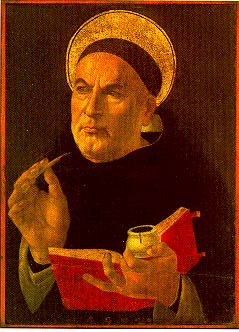
St Thomas Aquinas, the Angelic Doctor, rejected revolution


The Roman Catechism of the Council of Trent teaches the same:

"If we sometimes have wicked and unworthy officials it is not their faults that we revere, but the authority from God which they possess. Indeed, while it may seem strange, we are not excused from highly honouring them even when they show themselves hostile and implacable towards us. Thus David rendered great services to Saul even when the latter was his bitter foe, and to this he alludes when he says: ‘With them that hated peace I was peaceable. However, should their commands be wicked or unjust, they should not be obeyed, since in such a case they rule not according to their rightful authority, but according to injustice and perversity’ ".

[
On the Fourth Commandment]

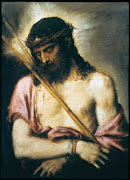
Tiziano Vecellio (Titian). Christ Crowned with Thorns. c. 1542.
The symbolism is dual: evil men claim the right to judge and condemn Christ the King of Kings, God Himself, the highest authority and, in so doing, give God the opportunity to provide an image of kingship forever new, namely, that kings wear the crown as Christ worn the thorns, as a cross, a duty, a burden, for the sake and service of his subjects. Christ becomes the supreme symbol of all those who suffer for the sake of right and justice - especially rulers who are rebelliously overthrown by their own subjects, for rebellion is sin and sin is rebellion.


...

Why revolution is always evil and was the very first sin (1)

Non serviam - "I shall not serve", said the Enemy of humankind and so fell from grace taking with him fully one third of Heaven.

Thus did Hell begin - that loathsome place where self-love and rebellion eat at the soul for all eternity.

And this spirit of rebellion has become the watchword of revolutions ever since.

It is small wonder then, that revolutions are such bloody, hateful affairs that begin badly and end worse.

By contrast, the duty of kingship is to serve. That is why the motto of the Prince of Wales is Ich Dien - "I serve".

Likewise the duty of each of us is to serve - serve God, serve our families, serve our country and that means, also, serve our governors. They, in turn, should serve us. Indeed, the highest thing man can do is to serve others. The higher you are, the more fully must you serve others.

However, we do not have the right to judge our rulers if they do not serve well enough or according to our liking.

The reason is so simple that anyone ought to be able to understand it. If the lower can sit in judgement upon the higher then authority ceases to exist.

By what right can the the lower possibly sit in judgement upon the higher? It can only be by some higher authority yet. But if the lower claims the right to judge the higher then even that yet higher authority can be judged and discarded, too.

The result is then that there is no authority at all.

And when there is no authority at all then no-one is safe, good government ends and mere anarchy becomes the norm. And when anarchy is the norm, the strong prey upon the weak and justice is at an end.


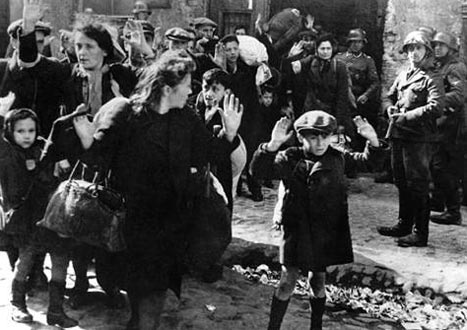
Jewish women and children herded by Nazis in the Warsaw Ghetto.
When legitimate authority is overturned by revolution then no-one is safe, good government ends and mere anarchy becomes the norm. And when anarchy is the norm, the strong prey upon the weak and justice is at an end.


Many a revolutionary claims to sit in judgement upon his rightful governor by appealing to an "higher" authority in the form of "justice" or "the people" or "historical imperative" or even some spurious form of god of his own making.

But if the rightful governor can be overthrown then so can the "higher authority" of "justice" or "the people" or "historical imperative" or "god". Once you start down the path of claiming to overthrow your own ruler then there is no end in sight, every authority is then under risk and chaos is inevitable.

And so it has proved.

Every revolution ends by devouring itself and its own.


The Revolution devours its own: the execution of Maximilien Robespierre.
The murder of King Louis XVI opened the floodgates to a massive wave of blood-letting in which huge numbers perished - most of them peasants and ordinary citizens - in the "Reign of Terror" which did not slow down until Robespierre, the author of the Terror, was himself guillotined at the order of the very revolution he created. These acts were all the more rebellious and diabolical in that the executioner - as seen here - was dressed as one of the educated and ruling classes, in culottes, who should have been most loyal but, instead, defiantly holds up the head to satisfy the leering blood-lust of the lawless, abandoned mob. But this is the nature of revolution: it poisons all loyalties, it teaches the servant to betray the master, and the master the servant, the son to betray the father and the father, the son, husband and wife to betray each other and it teaches man to hate his maker, God.


As the odious St Just, Robespierre's henchman, put it: "the Revolution consists in destroying all that opposes it".

In short - non serviam.

Revolution is a self-defeating reversal of all good human values. Even an atheist ought to be opposed to it. It is a recipe for chaos. And, when chaos reigns, the strong prey upon the weak and peace and justice are at an end.


William Frederick Yeames. "And when did you last see your father?". 1878.
Puritans claimed the right to sit in judgement on their superiors and to interrogate innocent children to discover the whereabouts of their loyalist and royalist fathers who had defended the king and rightful authority. As such, the Puritans were revolutionaries and enemies of God.


...

Tuesday, 18 November 2008

"I serve" or "I shall not serve"? Master and servant - or mere employer and employee?

We all are - or should be - servants: servants of others and of each other.

In so doing we imitate the very God Himself who, though He was the Creator of all things, did not shrink from making Himself the servant of His own creation.

In the famous Ford Maddox Brown painting (left), the Second Person of the Holy, Undivided and Everlasting Trinity washes the feet of His own disciples, setting a famous example for us all.

At the great feast of the institution of the Holy Eucharist, on Maundy Thursday, this great act of humility and love is re-enacted as the celebrant priest washes the feet of 12 members of the congregation.

The choir sing the famous words based upon the Gospel of St John - Ubi caritas et amor, Deus ibi est - "Where charity and love are, there is God" and the Last Supper is remembered when the God of earth and heaven gave His own precious Body and Blood as food for His children.

This is the heart and centre of the Christian religion.

In it is contained the most noble of all its teachings: we are all to be servants of each other as God made Himself our servant and as the Son is servant to the Father and, in turn, the Father serves the Son.

Just as the Father serves so does a Christian father and, indeed, a Christian king or master.

Indeed, the relationship between the Father and the Son and between God and His people is the model for the relationship between every master and every servant.

The Christian master is a father to his servant. They obey him and he protects and cares for them. Their bond is a bond of mutual charity, loyalty and fidelity. It is a quasi-familial, paternal relationship, just as the relationship of priest and people is a paternal relationship.

Such was the model of the master-servant relationship that obtained in old Christendom. Think of good King St Wenceslaus fetching food for the poor and warming the feet of his servant or of King St Louis of France or of any of the saintly kings of Christendom.


A stylized view of Good King St Wenceslaus and his servant


Nowadays, this relationship - based upon the divine - is mocked, derided and scorned to ridicule and falsely caricatured as a relationship of exploitation, venal peculation and cruelty by the master and of craven, stupid subserviance on the part of the servant.

What a shameless lie!

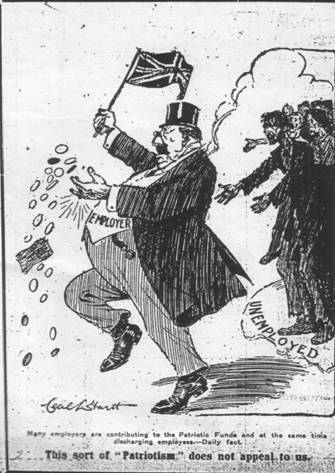
This, indeed, is what the relationship became when it ceased to be based upon the divine charity and instead became the pedestrian, mundane and loveless relationship of "employer" and employee".

No longer was the relationship familial but merely a cold, sordid relationship of money, exchange, trade and mutual exploitation.


Old master was replaced by new "employer" who cared only for money and kept his "employees" only so long as they were useful to him.


The employer sought only to maximize his profits through hiring employees who, once no longer useful, were "let go" and dispensed with as mere surplusage to fend for themselves.

The employee sought to extract from his employer all that he could in wages and recognised his authority for only so long as it suited him.

The employers used the employee as a mere commodity and the employees combined together to squeeze out of the employer every last penny that they could through strikes and walk-outs.

The familial and paternal relationship of mutual love, respect, loyalty and fidelity for life was gone - smashed by the preposterous Victorian "Political Economists" with their "hidden hand" of mutual exploitation which led to the ghastly mills, factories and workhouses of Victorian England.

Later smashed still further was it by the rise of the "wild-cat" striker Trade Unions, eschewing all responsibility in the name of the Worker's Marxist paradise. Reacting to the new evil of employer Capitalism came the devilish creed of Communism.


Reacting to the new evil of employer Capitalism came the devilish creed of Communism.


Such became the new relationship between men: mere employer and mere employee. Love died and dull exploitation replaced it.

Yet modern man fatuously rejoices in these new, loveless titles!

This was even - ridiculously - called "progress"!

The idea of any man serving another man as "servant" to his "master" was laughed to scorn. The master no longer felt any responsibility to his servant and the servant no longer felt any loyalty to his master.

The very idea of serving others was cast aside in favour of serving only oneself - the creed of Hell. Like their new master, the Devil, men said "I shall not serve".

Egalitarianism again raised its ugly, diabolical head, for where all are equal then none can appeal to any higher authority for justice and the rule of might conquers the rule of right.

As Gilbert and Sullivan put it so aptly "When every body's somebody then no-one's anybody".

In fact, of course, hierarchy is the natural order for mankind since that is how heaven is and will be. God intends that some should be masters and some servants, so that all can appeal to a higher authority, but both are really servants of a different sort, serving each other and others, in differing ways.

The motto of the Royal Military Academy Sandhurst describes well the role of a Christian leader: "Serve to lead".


"Serve to lead"
- the motto of the Royal Military Academy Sandhurst


Leadership is a form of service to others. A Christian leader seeks first to serve and not to be served, just as his master, Christ the King, came to serve rather than to be served.

So it was that our Lord commended the gentile Centurion who came to him and asked that our Lord heal his servant. He said these profound words:

"Lord, my servant lieth at home sick of the palsy, and is grievously tormented. And Jesus saith to him: I will come and heal him. And the centurion making answer, said: Lord, I am not worthy that thou shouldst enter under my roof: but only say the word, and my servant shall be healed. For I also am a man subject to authority, having under me soldiers; and I say to this, Go, and he goeth, and to another, Come, and he cometh, and to my servant, Do this, and he doeth it".
[Matt 8:6-9]


Our Lord marvelled at this, the Centurion being a gentile.

"And Jesus hearing this, marvelled; and said to them that followed him: Amen I say to you, I have not found so great faith in Israel". [Matt 8:10]


"I have not found so great faith in Israel"
- the prayer of the Good Centurion was Domine, non sum dignus - "Lord, I am not worthy...
"


Now we say the Centurion's prayer 3 times at Mass whenever we prepare to receive the Holy Eucharist in Holy Communion:

Domine, non sum dignus ut intres sub tectum meum, sed tantum dic verbo et sanabitur anima mea.

"Lord, I am not worthy to receive you under my roof, say but the word and my soul shall be healed."


This is the prayer of a true Christian master, officer and leader who, loving his own servant as a son, is himself a servant to others.

This is how all Christian masters and leaders should be, whether they are kings, military officers, professional men, or political or business leaders.

They should be as fathers to their servants, not merely employers to their employees.

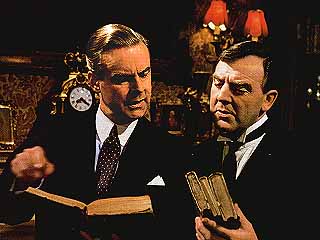
One gets something of the flavour of the old Christian bond between master and servant, in an amusingly eccentric English way, in the relationship between Lord Peter Wimsey, and his butler, Bunter, the aristocratic detective and his servant, both creations of English writer Dorothy L. Sayers. [Note for American readers: only the sons of Dukes and Marquesses have the courtesy title of "Lord" before their first name and family surname. A life peer in the House of Lords has the title of "Lord" before his family surname only. These days plenty of ignorant English writers get this wrong.]

Unlike other "employers" Wimsey will never part with Bunter and always provides for him. Bunter, on the other hand, saved Wimsey's life in the trenches of the First World War, as he lay wounded in no-man's-land.

It is unquestionably a relationship of love between master and servant, a relationship now mocked by "progressive" - and ignorant - modern man. Lord Peter Wimsey and Bunter share a mutual love and respect which modern secularist man - in his utter ignorance and clod-like inability to think beyond himself - simply cannot fathom.


Lord Peter Wimsey and his manservant, Bunter,
share a mutual love and respect which modern secularist man - in his utter ignorance
and clod-like inability to think beyond himself - simply cannot fathom.


HRH the Prince of Wales, the heir to the throne, has, as his motto, the German phrase Ich Dien which means simply "I serve". It is a profoundly Christian idea. Even the heir to the throne must regard himself as a servant.


Ich Dien
is the motto of HRH the Prince of Wales and means "I serve".
Even the heir to throne must regard himself as a servant.


Like a good father, the Christian master does not throw out his servant when he is no longer useful but rather cares for him in his old age remembering the good service that the servant did when he was fit and young.

He does not merely dump him upon the resources of the state, community and society as the modern employer does once he no longer has any use for the employee.

Likewise the servant shows a filial loyalty and love for his master just as God the Son does for the God the Father, as a son does for his father and as a good religious does for his Father superior.

Ultimately, the good Christian master shows the same paternal love for his servant as the father does even for his prodigal son, never casting him off but bearing with him even when he is froward, wasteful or neglectful.


Bartolomé Esteban Murillo. The Return of the Prodigal Son. 1667-1670.


What a disaster for mankind it was when the wonderful relationship of the Christian master and the Christian servant was consciously rejected.

Like so many evils, the beginnings of this rejection is to be found in that cataclysm that historians call the Protestant Reformation. Fortunately, not all Protestant masters rejected the old idea and many continued to treat their servants in the old, charitable way. It was the so-called Enlightenment and the later Industrial Revolution which eventually deprived the world of the beautiful old relationship that God intended to exist between a master and his servants.


The Servant King


...