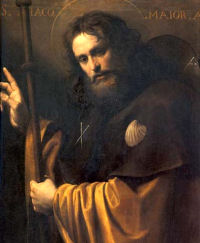
 St James the Greater is the Patron Saint of Spain as Santiago de Compostela.
St James is known as the Greater in order to distinguish him from the other Apostle St James, our Lord's cousin, who was St. John's brother.
With SS. Peter and John he was one of the witnesses of the Transfiguration, as later he was also of the Agony in the Garden.
He was beheaded in Jerusalem in 42 or 43 AD on the orders of King Herod Agrippa.
According to legend, in the early days of the Church, St James was evangelizing the Gospel in Caesaraugusta (Zaragoza in Spanish today), but his mission was making little progress until miraculously, he saw the Blessed Virgin committing him to return to Jerusalem.
In his vision, she was atop a column or pillar, which was being carried by angels. That pillar is believed to be the same one venerated in Zaragoza today. Miraculous healings have been reported at the scene and today the name Pilar is a common name for a girl from Nuestra Senora del Pilar.
Since the 9th century Spain has claimed the honour of possessing his relics.
Legend holds that the remains of St James were carried by boat from Jerusalem to northern Spain where he was buried on the site of what is now the city of Santiago de Compostela.
 The magnificent Cathedral of Santiago de Compostela houses the relics of St James and is the destination of those who travel to the city on pilgrimage along the Camino de Santiago or Way of St James.
The pilgrimages to St James of Compostela in the Middle Ages attracted immense crowds; after the pilgrimage to Rome or the Holy Land, it was the most famous and the most frequented pilgrimage in Christendom. The pilgrim paths to Compostela form a network over Europe; they are dotted with pilgrims' hospices and chapels, some of which still exist.
In Spain, he is called El Senor Santiago, "the Lord St James", the patron saint of horsemen and soldiers, and of the military-religious Order of Knighthood named after him, the Knights of Santiago, one of the four great and ancient military-religious orders in Spain.
 A Knight of the religious-military Order of Santiago, one of the four great such orders in Spain. The Order's symbol is the red dagger cross shown here on the knight's cloak and jacket.
St James was one of those that Jesus called Boanerges, "son of thunder," the brother of John the Evangelist and the son of Zebedee the fisherman from Galilee.
His prominence and his presence in Jerusalem must have been well known, for, scarcely a dozen years after the Resurrection, he was arrested and executed by King Herod Agrippa. This was followed by the arrest of St Peter also, so his death must have been part of a purge of Christian leaders by Agrippa, who saw the new Christian movement as a threat to Judaism.
St James's death is the only biblical record we have of the death of one of the Apostles, and he was the first of that chosen band to give his life for his Master.
He is often pictured as a pilgrim and his emblem is a cockle shell or a scallop shell.
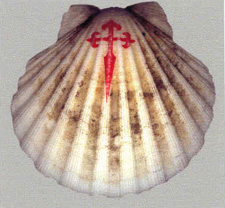 The cockle shell or the scallop shell is the symbol of St James of Compostela
The equestrian image of St James of Compostela crushing the defeated Moors epitomizes the way Spaniards conceived their religious identity for nearly a thousand years.
The Spanish Church was a crusading church compelled to defend itself from the invasion of Islam and to fight to regain its territory over the space of 800 years.
St James appeared to the tired crusaders, led by King Ramiro of Asturias, during the Battle of Clavijo in 844, and led the flagging crusaders to victory against the Moorish army. He was thereafter venerated by the Spanish under the title of Santiago Matamoros or St James the Moorslayer.
 Santiago Matamoros, the statue of St James the Moorslayer in the Cathedral of Santiago made to commemorate the appearance of St James during the Battle of Clavijo in 844 to aid the flagging crusaders to defeat the Moorish army
Sancte Jacobe Majore, ora pro nobis!
...




.jpg)










_-002.jpg/220px-Circle_of_Anton_Raphael_Mengs,_Henry_Benedict_Maria_Clement_Stuart,_Cardinal_York_(ca_1750)_-002.jpg)


