Wednesday, 20 November 2013

Ave Christus Rex!

The Feast of Christ the King


Munkácsy Mihály. Ecce Homo. 1896.


Ecce Homo!

"Then therefore, Pilate took Jesus, and scourged him. And the soldiers platting a crown of thorns, put it upon his head; and they put on him a purple garment. And they came to him, and said:

Hail, King of the Jews

and they gave him blows. Pilate therefore went forth again, and saith to them: Behold, I bring him forth unto you, that you may know that I find no cause in him. (Jesus therefore came forth, bearing the crown of thorns and the purple garment.) And he saith to them:


"Behold the Man!"

[John 19:1-5]


Diego Velazquez. The Crucifixion or Christ of San Placido. 1630.


Regnavit a ligno Deus

"God hath ruled us from a tree"


[Vexilla Regis, Venantius Fortunatus]


Christos Pantokratoros (Christ, ruler of all), ancient Byzantine ikon.


Rex regum et Dominus dominantium

"King of kings and Lord of lords"

[Revelation 19:16]


Dignus est Agnus qui occisus est, accipere virtutem, et divinitatem, et sapientem, et fortiudinem, et honorem. Ipsi gloria et imperium in saecula saeculorum. Amen.

[Revelation 5: 12, 13, Introit for the Mass of Christ the King]

"Worthy is the Lamb that was slain to receive power, and riches, and wisdom, and strength, and honour, and glory, and blessing...Blessing, and honour, and glory, and power, be unto Him that sitteth upon the throne, and unto the Lamb for ever and ever."

Dixit itaque ei Pilatus: ergo Rex es tu? Respondit Jesus: tu dicis quia Rex sum ego. Ego in hoc natus sum, et ad hoc veni in mundum, ut testimonium perhibeam veritati: omnis qui est ex veritate, audit vocem meam.
[John 18, Gospel for the Mass of Christ the King]

"Pilate therefore said to Him: art Thou a king then? Jesus answered: thou sayest that I am a king. For this was I born, and for this came I into the world, that I should give testimony to the truth. Everyone that is of the truth heareth my voice".

"And I heard as it were the voice of a great multitude, and as the voice of many waters, and as the voice of mighty thunderings, saying, Alleluia: for the Lord God omnipotent reigneth."
[Revelation 19:6]

"And the seventh angel sounded; and there were great voices in heaven, saying, The kingdoms of this world are become the kingdoms of our Lord, and of His Christ; and He shall reign for ever and ever."

[Revelation 11:15]

"And He hath on His vesture and on His thigh a name written, KING OF KINGS, LORD OF LORDS."

[Revelation 19:16]

"For unto Us a Child is born, unto Us a Son is given: and the government shall be upon His shoulder: and His name shall be called Wonderful, Counsellor, The mighty God, The everlasting Father, The Prince of Peace".

[Isaiah 9:6]

Jusepe de Ribera. Christ in the Crown of Thorns.


The Kingship of Christ is not like the kingship of pagans, heathens, unbelievers and gentiles. The Kingship of Christ is the kingship of a God-King-Priest Who suffers for the sake of Hs subjects whom He considers to be His very own children.

His crown is the Crown of Thorns, His sceptre is the Reed of humility, His royal cloak is the Purple Robe of suffering, for a royal girdle He is bound with the Bonds of servitude, His white Seamless Garment of purity and integrity is stripped from Him in public, His subjects mock Him, His servants desert Him, His people for whom He suffers and dies reject Him, His path is a Way of the Cross and His greatest work is Crucifixion as a common criminal.

Behold the King Who is a servant to the meanest of His people!

In so suffering, this great King gives us a model for all Christian leadership - paternal, royal, priestly, loving, unselfish, all-suffering, all-giving and all-sacrificing.

This is how all Christian kings and fathers must conduct themselves. For kings are fathers and fathers are kings, their subjects are children and their children are subjects - to be loved, not oppressed; to be formed, not neglected; to be nourished, not abused.

For these little ones, a king and a father sacrifices all he has and, above all, himself.

That is the meaning of Christian kingship, fatherhood and leadership.

"He saith to them: My chalice indeed you shall drink; but to sit on my right or left hand, is not mine to give to you, but to them for whom it is prepared by my Father. And the ten hearing it, were moved with indignation against the two brethren. But Jesus called them to him, and said: You know that the princes of the Gentiles lord it over them; and they that are the greater, exercise power upon them. It shall not be so among you: but whosoever will be the greater among you, let him be your minister:

And he that will be first among you, shall be your servant.

Even as the Son of man is not come to be ministered unto, but to minister, and to give his life as a redemption for many."
[Matt 20:23-28]

But how few among us - even among us Christians - understands this meaning of Christian leadership? So few. They still think - like pagans - either that leadership and earthly power are useful means to enrich oneself and lord it over others or else, equally falsely, they think they are merely evil, which is to say the same thing.

It is false.

Others foolishly think that it is degrading to be a servant and better to be rich, powerful, and influential, not so as to be a servant, but so as to serve oneself and oppress and humiliate others.

In fact, kingship or leadership is given by God to men to serve others and to sacrifice oneself for the good of others, as Christ the King did for us. The role of Christian leader is one of suffering and self-sacrifice - not selfishness and self-aggrandisement. It is a most noble and holy calling and we must re-learn to regard it as such.

Woe betide those who use power and rule for themselves and not for others!


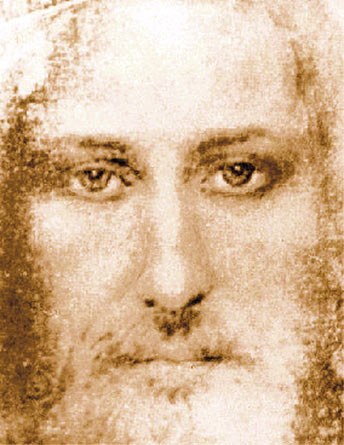
The Face of JESUS CHRIST on the Shroud of Turin - the face of the King of love.


And so we must return to the Social Kingship of Jesus Christ...

"19. When once men recognize, both in private and in public life, that Christ is King, society will at last receive the great blessings of real liberty, well-ordered discipline, peace and harmony.

Our Lord's regal office invests the human authority of princes and rulers with a religious significance; it ennobles the citizen's duty of obedience. It is for this reason that St. Paul, while bidding wives revere Christ in their husbands, and servants respect Christ in their masters, warns them to give obedience to them not as men, but as the vicegerents of Christ; for it is not meet that men redeemed by Christ should serve their fellow-men.

'You are bought with a price; be not made the bond-slaves of men'.

If princes and magistrates duly elected are filled with the persuasion that they rule, not by their own right, but by the mandate and in the place of the Divine King, they will exercise their authority piously and wisely, and they will make laws and administer them, having in view the common good and also the human dignity of their subjects. The result will be a stable peace and tranquillity, for there will be no longer any cause of discontent.

Men will see in their king or in their rulers men like themselves, perhaps unworthy or open to criticism, but they will not on that account refuse obedience if they see reflected in them the authority of Christ God and Man.

Peace and harmony, too, will result; for with the spread and the universal extent of the Kingdom of Christ men will become more and more conscious of the link that binds them together, and thus many conflicts will be either prevented entirely or at least their bitterness will be diminished.
...


28. We further ordain that the dedication of mankind to the Sacred Heart of Jesus, which Our predecessor of saintly memory, Pope Pius X, commanded to be renewed yearly, be made annually on that day."
[Pope Pius IX, Quas Primas, Encyclical letter establishing the Feast of Christ the King, 1925.]


Hail Christ the King!


...

Saturday, 21 September 2013

Pope Francis - the interview in America and the fallout


I think our dearly beloved Pope should learn the virtue of silence. 

The job of the Pope is to defend the faith not to court public favour by the mouthing of fashionable attitudes.

Above all, he should always support those who, through thick and thin, have been labouring hard and sacrificially in the vineyard of the Lord to defend human life and marriage - particularly at this time when same-sex marriage is being pressed upon legislators the world over.

He has unfortunately allowed himself to be quoted minimising the great work that these tireless apostles are doing.

That should never have been allowed to happen.

However, this might perhaps remind us all to pray to St Joseph Pignatelli SJ, the great Jesuit saint at the time of the suppression of the Jesuits by an earlier pope, Clement XIV.
 
He was a Spanish nobleman, of Neapolitan extraction, and a Jesuit at the time of the Spanish suppression in 1767, and at the general suppression of the Order, shamefully and shockingly by papal decree, in 1773.
 
All the Jesuits of Spain were taken to the port of Tarragona and banished from the country, in no less than 13 flotillas of ships. They were refused entry at numerous ports but eventually disembarked at Corsica before finding refuge in Ferrara.
 
St Joseph remained faithful and steadfast despite being betrayed by the very people from whom he should most have enjoyed support and blessing, not least the Pope.
 
St Joseph Pignatelli SJ, saviour and restorer of the Jesuit Order after the conflagration of the French Revolution
 
He continued ever-faithful, betrayed by all those who should most have protected and favoured him, not least the Pope.
 
In his time, the Society of Jesus began to be suppressed in each country of Christendom, first Portugal, then Spain, then France, then even the Holy Roman Empire, then, finally, in 1773, Pope Clement XIV was, himself, prevailed upon by the Freemasonic ministers of Europe to suppress the whole Order, world-wide.
 
It was a shocking betrayal of the greatest religious Order the world has ever seen.
 
These same Freemasonic ministers, the Marquess of Pombal in Portugal, the Count of Aranda in Spain, the Duke of Choisel in France and the Prince von Kaunitz in the Empire, had prevailed upon their own Kings to expel the Jesuits from their territories and then, finally, they forced the Pope to do so universally. 
 
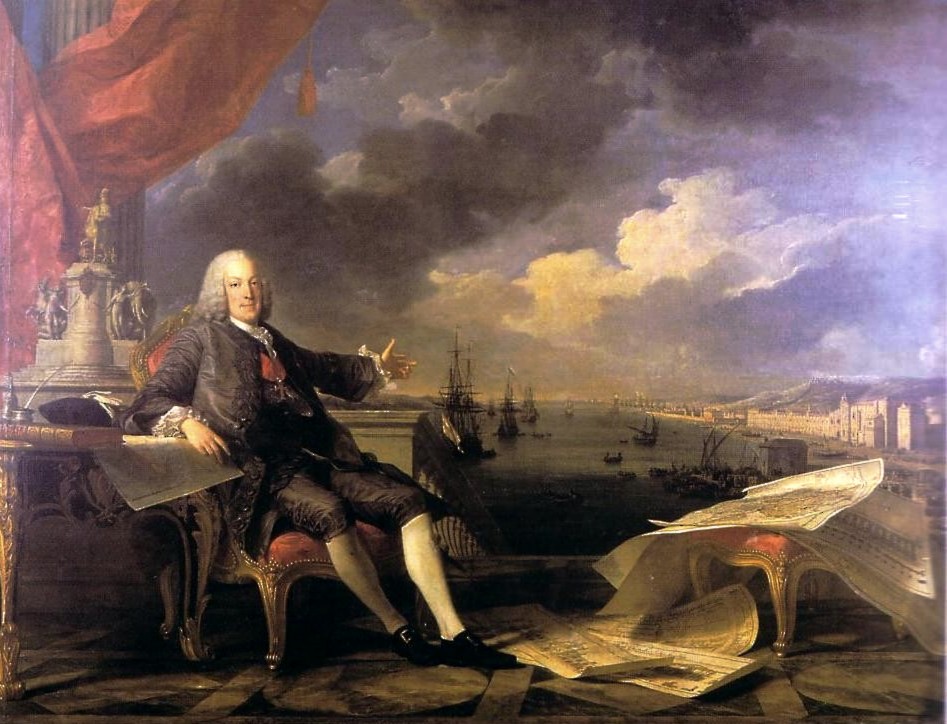
A portrait of the fanatically anti-clerical Marquess of Pombal, Prime Minister of Portugal, expelling the Jesuits from Portugal in 1766, the first Freemasonic minister of Christendom to do so from a Catholic country
 
At that time, Jesuits ran almost all the leading schools and universities throughout Christendom. The gap was then artfully and deceitfully filled by theologically weak and freemasonically-inclined teachers and clerics who sullied the minds of the young with foolish ideas and heterodox theories.
 
This greatly helped lead to the disaster of the French Revolution.
 
Meantime, Jesuits from all over the world, the courts of China, Japan and India, the plains of Ethiopia, the jungles of Latin America, the forest of the Philippines and from all corners of the earth, were arrested, chained, imprisoned and then, chained in the holds of ships, sent to Europe from all over the world and dumped - dead, dying and living - on the shores of the Papal States.
 
Yet even the Pope refused to take them in, so afraid was he of the heavy hand of the Freemasons and secret secular societies.
 
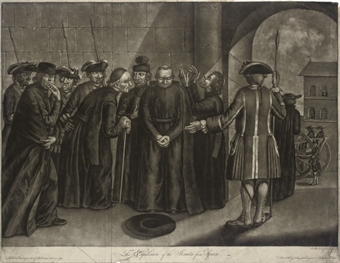
Charles Maucourt. The Expulsion of the Jesuits from Spain. 1767.
 
 Ironically, it was the anti-Catholic King of Prussia and Empress of Russia that eventually gave the last of the Jesuits shelter in Silesia and Muscovy.
 
The remainder were dispersed across Europe to fend for themselves, forming little societies here and there.
 
St Joseph was forbidden to exercise any priestly ministry at all and so retired to study and pray.
 
But he lived to see the whole Order restored, effectively saving the Order himself.

The suppression of the Jesuit Order, among other things, was what caused, in part, the French Revolution and the consequences of that Revolution has been the gradual de-Christianisation of the entire world ever since.
 
Some little known facts about the Jesuit Order:
 
1. They discovered quinine (called “Jesuit bark” in the 16th century) that is used today for anti-malarial drugs and also in tonic water. Without the Jesuits, you wouldn’t be able to enjoy your gin and tonic.

2. Their dictionaries and lexicons of the native languages in North America in the 17th century were the first resources Europeans used to understand these ancient tongues, and they still provide modern scholars with the earliest transcriptions of the languages.

3. They located the source of the Blue Nile and charted large stretches of the Amazon and Mississippi Rivers.

4. They educated Descartes, Voltaire, Moliere, James Joyce, Peter Paul Rubens, Arthur Conan Doyle, Fidel Castro, Alfred Hitchcock, and Bill Clinton—not to mention Bing Crosby.

5. They founded the city of Sao Paolo, Brazil.

6. There are 35 craters on the moon named for Jesuit scientists. And Athanasius Kircher, a 17th-century Jesuit scientist, called “master of a hundred arts” and “the last man to know everything”, was a geologist, biologist, linguist, decipherer of hieroglyphics, and inventor of the megaphone.

7. They count 40 saints and dozens of beati among their members, including the globe-trotting missionary St Francis Xavier.

[Source: James Martin, SJ, The Jesuit Guide to Almost Everything]
 
Father Ferdinand Verbiest SJ, Jesuit Astronomer in China

But in the 18th century popes, prelates and bishops all over Christendom had betrayed the faith. The result was a catastrophe, beginning in France, from which Europe has never quite recovered.
 
Heterodox prelates and their secularist allies were seeking the suppression of the Jesuit Order and the imposition of a false, un-Catholic society upon all Europe, posing deceitfully as “true” Christianity.
 
The modern film, The Mission, starring Jeremy Irons and Robert de Niro, tells something of the story of the suppression and expulsion of the Jesuits from the Reductions in Paraguay in Latin America, where they had taught the Indians to make violins and to write and sing great religious choral masterpieces in a quasi-Baroque style with unique Indian styles.
 
Here is an extract from the film:


St Joseph worked patiently and tirelessly. He managed to persuade the very same Grand Duke of Tuscany who had earlier so violently expelled the Jesuits from Tuscany, to restore them to the Grand Duchy, which, in 1797, he did.
 
Pope Pius VI, in 1798, having considered the idea of restoring the Jesuits many times before as a bulwark against French Revolutionary ideas, eventually, when he was already a prisoner of the French revolutionaries, authorised St Joseph to receive novices at Parma.
 
The French revolutionary General Berthier had entered Rome unopposed in the same year and, proclaiming a secular Roman republic, demanded of Pius the renunciation of his temporal authority. Upon the Pope's refusal, he was taken prisoner and moved to Siena, then Certosa, and then, upon the French revolutionary forces declaration of war against Tuscany, to Valence, in France, by way of Parma, Piacenza, Turin and Grenoble. The harried pope then died 6 weeks after arrival in Valence. 
 
Pope Pius VI, who, when he refused to declare Rome a secular republic at the demand of the French Revolutionary army,  was exiled to France where he died, after a long and harassing series of journeys, a prisoner of the bloody and violent Revolution. He allowed St Joseph to take novices at Parma
 
 This was the pope who had written the papal letter, Pourquoi Notre Voix, condemning the French Revolution and in which he called monarchy "the best of all governments". 

St Joseph was earlier appointed Jesuit Provincial of Italy, saw a restoration in Naples, the restoration of the Gesu to and the Roman College to the Order by Pius VII in 1811. 

Finally St Joseph directed the Order before its official restoration world-wide in 1815, the year of Waterloo and the Congress of Vienna, but he did not live to see it, dying of TB in 1811.
 

He was canonised in 1954.
 
With the suppression of the Jesuits, St Joseph Pignatelli saw the whole Catholic world collapse around him. He showed saintly and remarkable leadership in dark and difficult times and was a tower of quiet strength to many during those
troubled times, so like our own.
 
St Joseph Pignatelli, pray for us!


Monday, 16 September 2013

16 September - the anniversary of the death of our last ruling Catholic monarch, King James II and VII


King James II of England and Ireland and VII of Scotland was born on 14 October 1633, at St. James's Palace in London, the third son of King Charles I and Princess Henrietta Maria of France, Queen Henrietta-Maria of England.
 
Prince James was made HRH Duke of York at his birth and was baptised into the Anglican Church by William Laud, Archbishop of Canterbury. He was made Lord High Admiral of England in 1638 and a Knight of the Garter in 1642.

During the Civil War against his father James lived in the Low Countries and France, where he returned to exile later in life. He was commissioned in the French Army and served under the Vicomte de Turenne and was created Duke of Normandy by King Louis XIV of France in 1660, the same year that he returned to England with his brother who was restored as King Charles II, whereupon he married Lady Anne Hyde, daughter of the Earl of Clarendon.

In 1670 both James and Anne converted to the Catholic faith but Anne died the following year. 

When the Test Act was passed in 1673, requiring the holders of all public offices to receive communion according to the rites of the Church of England, and to abjure the Catholic belief in transubstantiation, James renounced his offices which caused his Catholic conversion to become public knowledge.

In the same year James married Princess Maria of Modena, daughter of Alfonso IV, Duke of Modena.


Princess Mary of Modena, later Queen Mary of England, Scotland and Ireland 

From around this time, two parties formed in Parliament, based upon the old division of Roundheads and Cavaliers, but now called "Excluders" and "Abhorrers", the first seeking to exclude the Catholic James from succession to the throne, and the latter abhorring such an unconstitutional idea. Each party was alter given a derogatory name, the first "Whig", after the Scots Covenanter Whiggamore cattle raid, and the latter "Tory" after the Irish word for a bandit toraigh.

Nevertheless, James did succeed his brother and was crowned King in 1685 - privately by the Catholic rites and then publicly, on 23 April, St George's Day, at Westminster Abbey according to the rites of the Church of England.
 

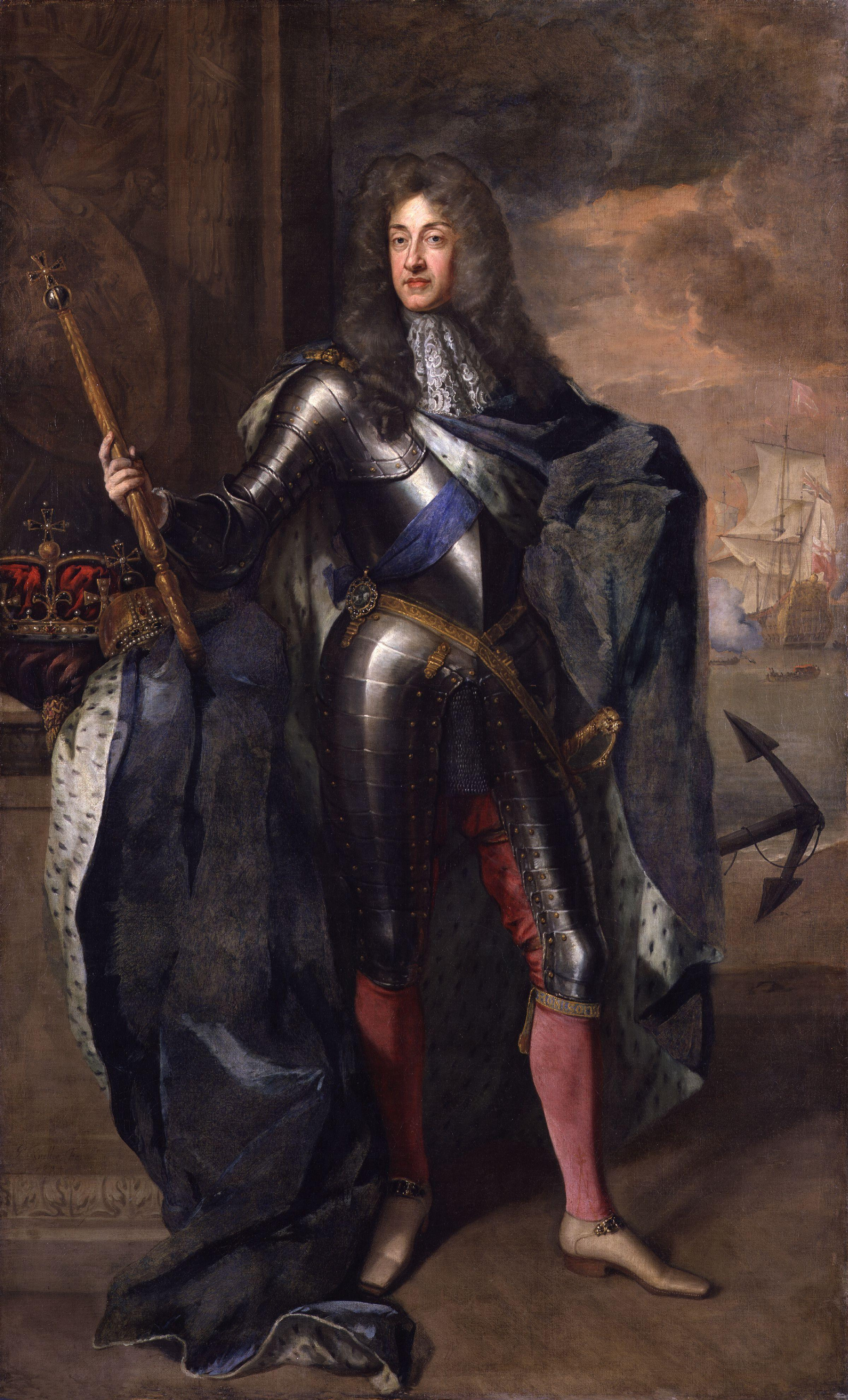
King James II and VII after his coronation

However, the Whig Excluders did not rest and eventually staged a treacherous revolution against their rightful king in due course.

The pretext for this treason was, ironically, King James's commitment to liberty of conscience, a doctrine the Whigs claimed to profess but, in reality, denied.

King James issued a Declaration of Toleration for Scotland on 12 February 1687 and a Declaration of Indulgence for England on 4 April 1687, re-issued in 1688 with an order to be read in all churches.

It was this latter command that was used by the rebels as a pretext. Seven Anglican bishops petitioned the King in his own courts against James's order to read the Declaration. Concurrently, "the Seven", 5 peers and 2 commoners, treacherously invited the King's  Protestant son-in-law and nephew, William, Prince of Orange, to come over the channel and invade England by force of arms.

Their stated aim was to abolish freedom of religion and conscience and once again re-impose - by force - Anglicanism, upon the Three Kingdoms of England (and Wales), Scotland and Ireland, whether the people wanted it or no.

On 5 November, William, Prince of Orange landed at Brixham, Devon, with 15,000 men. King James went out with the Army to meet the Dutch invasion on Salisbury Plain and would undoubtedly have stood a good chance of doing so successfully but for the treacherous desertion to the enemy of his Chief of Staff, Lieutenant General John Churchill, together with 400 officers and men under his malign influence.
 
After the meeting of the council of war on the morning of 24 November 1685, Churchill, accompanied by some 400 officers and men, deserted the royal camp and rode towards the Dutch invader in Axminster, leaving behind him a derisive letter of apology and self-justification: 

"...I hope the great advantage I enjoy under Your Majesty, which I own I would never expect in any other change of government, may reasonably convince Your Majesty and the world that I am actuated by a higher principle..."

Initially, planning to rendezvous on Salisbury Plain with the King and there to kidnap him and take him to William, Churchill was thwarted because James had a very fortuitous serious nose-bleed that morning so that he was unable to make the rendezvous. Churchill then deserted to the Dutch usurper, William of Orange.
 
In fact, Churchill was only ever motivated by one principle, that of his own enrichment and ambition. this he achieved to the highest degree by being ennobled by the Orangeman as Duke of Marlborough and amassing one of the greatest fortunes in Europe.
 
John Churchill, later Duke of Marlborough, traitor and deserter who profited financially by going over to the invading William of Orange
 
 
After this, James's prospects of success vanished and he was obliged to flee to France but with the intention of re-gaining his throne at the first opportunity from the traitors and invaders.
 
Meantime, a Convention of the Lords Spiritual and Temporal, and Commons, assembled at Westminster, and published a bogus declaration that James had "abdicated" the government. Shortly after, a cowed Convention of the Scottish Estates declared similarly.

King James remained at the Château of St Germain-en-Laye, just outside Paris until his death, not only recognised by King Louis XIV of France as rightful King but regularly visited by the bishops of the non-juring Church of England who had refused to take an oath of loyalty to the new regime of William of Orange who now claimed to rule with his wife, King James's daughter, Mary. These bishops only recognised King James as the Supreme Governor of the Church of England, despite his being a Catholic, and always sought his approval or appointment of the non-juring bishops and senior clergy.

It was on 16 September 1701 that King James II and VII died, in the odour of sanctity, attended and fortified by all the rites of our Holy Mother the Church.

His body was received by the English Benedictines then resident in Rue St Jacques, Paris, ironically, later the headquarters of the French Revolutionaries who were, for that reason, called Jacobins. These same Jacobins and their odious followers were later responsible for the desecration of the tomb of King James.

The religious cult of King James II and VII was begun and preserved by these same English Benedictines and continues to this day.

After his death, the Whig conspirators secured a new settlement of the royal line through the Act of Settlement 1701 which, together with the Bill of Rights of 1689, completely destroyed the old Constitution and substituted, illegally and unconstitutionally, a new one.

The Act was passed to settle the succession to the English and Irish crowns and thrones on the Electress Sophia of Hanover (a granddaughter of James VI of Scotland and I of England and Ireland) and her non-Roman Catholic heirs. It arose at the death of King James and the failure of heirs to William and Mary and to Queen Anne, the other daughter of King James, who had been allowed to succeed because she remained Protestant, unlike her mother and father.

Fully 57 members of the family had a better right to the throne than the Electress Sophia of Hanover, but they were excluded by this illegal and unconstitutional Act for the sole reason that they were Roman Catholic.

In 1707, the independent Kingdom of Scotland came to an end by means of a huge Whig bribe paid to influential members of the Scottish Estates (as the Scottish parliament has historically been called) who voted for the Act of Union. It was opposed by Scottish Jacobites like George Lockhart of Carnwath, founder of the Scottish Tory Party which was, in those day, almost entirely Jacobite which meant they were supporters of the rightful heirs of King James II and VII (from the Latin Jacobus for James).
 
George Lockhart of Carnwath, Scottish Jacobite and founder of the Scottish Tory Party, opposed the Scottish Act of Union with England that centralised power at Westminster
 
 
The Whigs were, like the European Union political leaders of today, centralisers and centralists who believed in taking away power from the small states and regions and giving it to a highly centralised government.
 
Thus the old Constitution, with the King at its apex, came to an end and a new Parliamentary sovereignty was created that was, in effect, superior to the King and determined the succession according to its own, new, revolutionary ideas, rather than by the traditional and constitutional royal primogeniture.
 
The new entity so created was called "Great Britain" and idea alien to the old Constitution of the ancient Three Kingdoms.
 
Having reduced Scotland to a subordinate state, they later succeeded in doing the same to Ireland with the Act of Union of 1800 and so created the "United Kingdom" of Great Britain and Ireland, ruled from Westminster under one only Parliament.
 
Electress Sophia died on 8 June 1714, before the death of Queen Anne on 1 August 1714, and so Sophia's son became King George I of Great Britain and Ireland, the first of the Hanoverian dynasty.
Under the Act of Settlement 1701, anyone who becomes a Roman Catholic, or who marries a Roman Catholic, becomes disqualified to inherit the throne. The act also gravely limits the power of the monarch.
King James III and VIII, son of King James II and VII, and the true King of England, Scotland and Ireland, but excluded from the throne purely because he was a Roman Catholic
 
The Act of Settlement thus also became part of the law of all the imperial territories of the British Empire and, later, of the nations of the British Commonwealth so that it cannot effectively be altered without the consent of those Commonwealth realms, as they are now called.
The century and a half after the so-called Bill of Rights of 1689 was one of the most oppressive in British history and saw the introduction of the savagely inhuman, brutal and grotesquely unjust Penal laws that removed the human rights of Roman Catholics and religious dissenters and persecuted the ordinary people of England, Scotland and Ireland in a manner that will always remain a permanent disgrace to the British nation and Commonwealth.
Under this Code Catholic men could be hanged, drawn and quartered and Catholic women burned at the stake, ostensibly as traitors but, in reality, as victims of the denial of religious liberty and martyrs to their faith.
This evil code was not finally disposed of until as late as 1828 with the Catholic Emancipation Act.
The true legacy of King James II of England and Ireland and VII of Scotland was, and is, his commitment, at once, to both religious liberty and to the Catholic faith.
His sons became the cynosure of the Jacobite movement which attempted to restore them to the throne in 1715 and 1745 in the two Jacobite uprisings to restore the Crown and ancient Constitutions of these Islands.
 
 
The Stuart Royal Arms


Aymez Loyaute!

 
+++

Thursday, 5 September 2013

The definitive new Order of Mass for the Personal Ordinariate of Our Lady of Walsingham

Yes. It's finally out.

And it's excellent.

The definitive new Order of Mass for the Personal Ordinariate of Our Lady of Walsingham is an excellent combination of the old and the new, of the Roman and the best parts of the Sarum use that were preserved by the old Anglican ritual.

The new Order of Mass begins with something very familiar to traditional Latin-rite Catholics:

"I shall go in unto the altar of God.

To the God who giveth joy to my youth..."

Yes, folks! It is Psalm 42, the ancient opening prayer of the traditional rite.

And the new Order of Mass ends with the Last Gospel.


It also retains the "prayer of humble access" so familiar to Anglicans and other such prayers, based upon the Sarum use but significantly amended by Cranmer. Fortunately, they are inoffensive per se despite having origins in the hands of villains like Cranmer. The Catholic Church can turn even what was originally delivered from foul hands into something good and beneficial if it is not intrinsically faulty.


So - it is an interesting but surprisingly harmonious mix.

What will be particularly significant about this new Ordinariate missal is that it will be very important bridge between the ancient and the new and will, I believe, persuade many who now are suspicious of the old Roman rite, why it is, in fact, beautiful and better.

It will also help a lot of Anglicans to see and understand better the beauty and truth of the Catholic Church and will help allay many of their unjustified suspicions and prejudices.

Some will not like it - that's almost inevitable. They'll say it's "too Anglican" or "too Roman", "too trad" or "too new" and some will deplore the use of "thee" and "thine".

I disagree.

I think it will be a useful bridge.

Of course, I prefer the ancient rite of the Church but this is, I believe, a good work in our very troubled times.

Let's not be quick to condemn this.

 
"I shall go in unto the altar of God, to the God who giveth joy to my youth"
 
 
+++


Monday, 19 August 2013

The Lords Arundell of Wardour - ancient English Catholic recusant family of Cornwall and Wiltshire

Thomas Arundell, 1st Baron Arundell of Wardour (1560 – 7 November 1639) was the eldest son of Sir Matthew Arundell of Wardour Castle in Wiltshire, an ancient family of Cornish origin, and Margaret Willoughby, the daughter of Sir Henry Willoughby, of Wollaton, Nottinghamshire.

He was created the 1st Baron Arundell of Wardour, the progenitor of a long line of Roman Catholic recusant nobility whose ancestors continue to live to the present day in the vicinity of Wardour Castle, their ancient seat.

Sir Thomas served the Holy Roman Emperor Rudolph II against the Turks in Hungary and, for his loyalty and bravery, was made Count-Imperial of the Holy Roman Empire, a title that descended to his sons.

His father, Sir Matthew Arundell of Wardour, inherited former monastic lands, and, serving as High Sheriff, Custos Rotulorum (Keeper of the Rolls), and Deputy Lieutenant of Dorset.

His grandfather, Thomas Arundell, born about 1502, was the younger of the two sons of Sir John Arundell (c.1474-1545) of Lanherne, Cornwall, and his first wife, Eleanor Grey (d. by December 1503), the daughter of Thomas Grey, 1st Marquess of Dorset, by his second wife, Cecily Bonville.


 The illustrious family tree of the 1st Lord Arundell of Wardour


The grandfather had been educated at Lincoln's Inn, and began his career in the household of Cardinal Wolsey, where he was a contemporary of Thomas Cromwell. He was created a Knight of the Bath at the coronation of Queen Anne Boleyn.


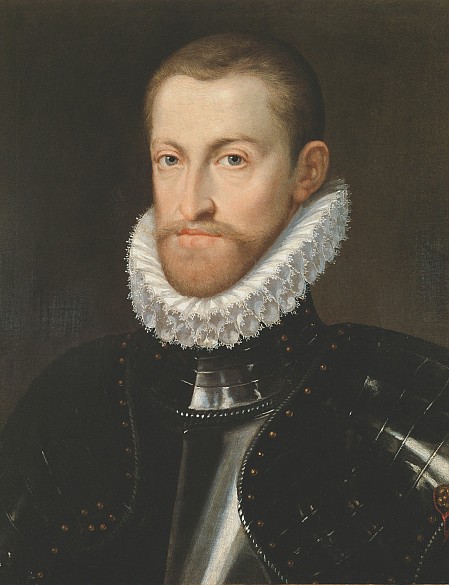
Holy Roman Emperor Rudolph II


The grandfather’s role as one of the commissioners for the dissolution of the monasteries in the West Country enabled him to acquire a number of former religious properties. In 1547 he purchased Wardour Castle in Wiltshire but later fell from royal favour because of his devotion to the old religion and he was later falsely accused and beheaded on Tower Hill and buried in the church of St Peter ad Vincula, in the Tower.

Like his grandfather, Sir Thomas was, in 1580, imprisoned for his devotion to the Roman Catholic religion. Later, however, in 1585, he married Mary (c.1567–1607), the daughter of Henry Wriothesley, 2nd Earl of Southampton, and Mary, the daughter of Anthony Browne, 1st Viscount Montague. He thus remained exceptionally well connected.

It was in 1595, when Arundell had been at a frustrating loose end for some time, being excluded from offices by virtue of his religion, that his father agreed to provide him the wherewithal to depart England and serve in the Imperial forces against the Turks.

He took part in the storming of the breach at Gran in Hungary against the Turks, seizing the Turkish standard and replacing it with that of the Holy Empire for Emperor Rudolph II. He was thereafter styled “the Valiant” and the Emperor raised him to the dignity of Count-Imperial of the Holy Roman Empire.


 Battle of Gran, Hungary, 1686, 
at which Thomas Arundell distinguished himself and was made Count-Imperial by the Holy Roman Emperor Rudolph II


Arundell was enriched by his success and decided to return to England by ship. However, he was caught in a storm near Aldeburgh off the Suffolk Coast and his new fortune sank with the ship. To add to his woes, Queen Elizabeth I, the harridan of Protestant anti-Catholicism, committed him to the Fleet prison for daring to assume a foreign title – particularly the title given by the Roman Emperor whom the Tudors so much hated and in defiance of whom they had started the Protestant Reformation, after King Henry VIII had lost the imperial election of 1519.

Arundell’s father, Sir Matthew, was a Protestant and unnaturally sided with the harridan Queen against his own son.

Eventually, Arundell was released into the custody of his father but was later re-arrested, in 1597, falsely accused of being a Catholic spy but was released. However, his father died in 1598 and he succeeded to the estates.

In 1605 Arundell and Lord Southampton sent Captain George Weymouth to found a colony in Virginia leading some to conclude that "the whole voyage may best be regarded as a first attempt to found an American colony that would be an asylum for English Catholics".

After the death of Elizabeth I, the new King James I, in 1605, raised Thomas to be Baron Arundell of Wardour and appointed him Colonel of the English regiment serving the Roman Emperor in Spanish Flanders but Arundell was later falsely named by Guy Fawkes as a co-conspirator in the Gunpowder Plot.


Old Wardour Castle, now a magnificent ruin


 His first wife having died earlier, Arundell married, 1 July 1608, Anne Philipson, the daughter of Miles Philipson, of Crook, Westmorland. He died at Wardour on 7 November 1639, and was buried at nearby Tisbury, Wiltshire.

He was succeeded by his son, Thomas, 2nd Baron Arundell of Wardour, and thereafter a long line of Lords Arundell.

Arundell’s 4th daughter Frances, by Anne Philipson, married John Talbot, 10th Earl of Shrewsbury, of another recusant family and his 6th daughter, Clare, married Humphrey Weld, of another recusant family.

Arundell's daughter Anne married Cecil Calvert, 2nd Lord Baltimore (d. 30 November 1675) and, in 1632, King Charles I granted him the proprietorship of Maryland in America, named by its Catholic settlers after our Lady. The city of Baltimore is named after him and, of course, the Baltimore Catechism is named after the city. Anne Arundel County, Maryland, is named after Calvert's wife, Anne Arundell who died 23 July 1649, and was also buried at Tisbury, Wiltshire.


The new Wardour Castle build by the 8th Lord Arundell of Wardour


 The 2nd Baron fought as a Royalist in the Civil War and was mortally wounded at the Battle of Stratton in 1643.

His son, the 3rd Baron, was accused of being implicated in the utterly bogus “Popish Plot” to murder King Charles II and was imprisoned in the Tower of London for 6 years but was restored after the accession of King James II. He then served as Lord Privy Seal.

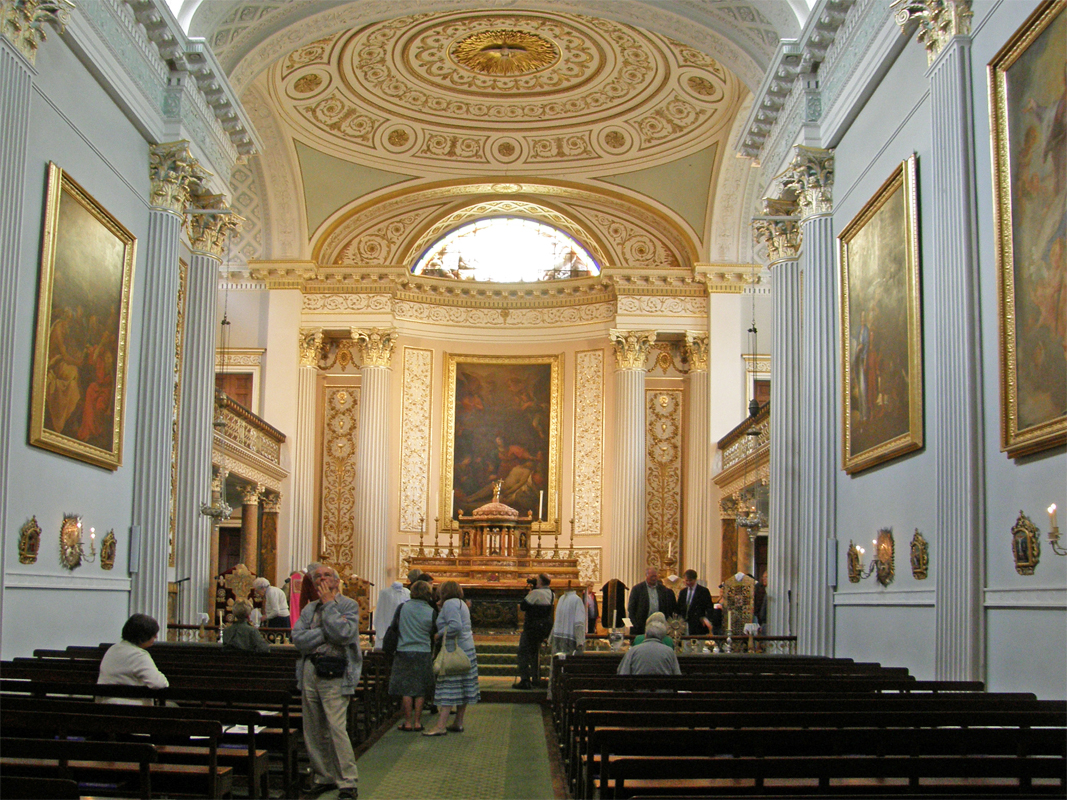
The Arundells lived in the old castle acquired by the first generation but the 8th Baron Arundell of Wardour built the nearby new castle, at huge expense, and with it a beautifully classical Catholic chapel of Wardour that stands to this day as a magnificent example of classical, recusant Catholic architecture, concealed within the castle to placate a hostile government.


The 8th Baron Arundell of Wardour who built the new castle of Wardour and its chapel


The title went sideways after his death, childless, and then to the 10th Baron who was also childless and was succeeded by his younger brother.

The 13th Baron was a Catholic priest and, on his death the title again went sideways to the 14th Baron who also died childless.

The title passed from the 15th Baron to his son, the 16th Baron, who was fought in the Second World War and died in 1944.


The imperial chasuble at Wardour Castle chapel, complete with imperial double-headed eagles, made at the order of Thomas, 1st Lord Arundell of Wardour, Count-Imperial of the Holy Roman Empire.


 John Francis Arundell, 16th Baron Arundell of Wardour JP TD was educated at Stonyhurst College and New College, Oxford, and became a member of the London Stock Exchange. He served with the Territorial Army in the 2nd Battalion, the Wiltshire Regiment, as part of the British Expeditionary Force being captured by the Germans during the Battle of France in 1940. After escape and re-capture, he was sent to the infamous Colditz Castle where he contracted TB and was repatriated but died and was buried in Wardour chapel. Upon his death, the barony became sadly extinct.

However, his successor to all but the title is John Richard Arundell, 10th Baron Talbot of Malahide (born 1931), the son of Reginald John Arthur Talbot, who, in 1945, assumed by Royal license the surname and arms of Arundell. He was the great-grandson of Admiral the Hon Sir John Talbot and his wife Mabile Mary Arundell, was the daughter of Hon Robert Arthur Arundell, 4th son of James Everard Arundell, 9th Baron Arundell of Wardour.


The magnificent classical chapel at Wardour Castle


 The Barony of Talbot of Malahide is a title that has been created twice for members of the same family: 1831 in the Peerage of Ireland, and 1856 (as Baron Talbot de Malahide) in the Peerage of the United Kingdom.

The ancestral seat of the family until 1976 was Malahide Castle, close to the village of Malahide, north of Dublin in Ireland.

Lord Talbot of Malahide also holds the rather engaging title of Hereditary Lord Admiral of Malahide and Adjacent Seas (created by King Edward IV).


 Malahide Castle outside Dublin, Ireland


His wife Patricia Mary, Lady Talbot of Malahide, is a Dame of the Sovereign Military and Hospitaller Order of Malta (the Knights of Malta) and Vice-President of the British Association thereof.

She was born Patricia Riddell of the Northumbrian Catholic recusant family of that name whose ancestor had taken part in the 1715 Jacobite rising to restore the true King and Constitution of these islands.

Connected with the Talbots of old were Hugh O'Reilly, who took the surname of Nugent and was created a baronet in 1795, and Andrew O'Reilly, who was a General der Kavallerie in the Army of the Holy Roman Empire and was made a Count–Imperial of the Empire as Andreas, Count O'Reilly von Ballinlough.

The Arundells of Wardour are one of the most enduring of the English Catholic recusant families and a true testimony to the strength of the Roman Catholic faith in England, just as the Talbots of Malahide are also in both England and Ireland.


 Arundell of Wardour


+++