Sunday, 16 June 2013

The Feast of the Sacred Heart of Jesus

The great Feast of the Sacred Heart of Jesus is of ancient origin.

Some - particularly Jansenists and particular types of Protestants - claim that this devotion is a novelty.

It is certainly not novel.

Indeed, the Fathers of the Church already had a devotion to the wounded heart of Jesus as can readily be seen from their writings.

However, by the time of the eleventh and twelfth centuries a special devotion to the Sacred Heart was being developed and cultivated. It was taken up particularly by St Bruno and the Carthusians.

The Cistercians also were much devoted to the heart of Jesus, particularly St Bernard himself.

St Gertrude the Great and St Mechtilde were also great promoters of the devotion as also the learned the author of the "Vitis mystica", thought to be St Bonaventure.

From the thirteenth to the sixteenth centuries, the devotion was everywhere practised by individuals and by different religious congregations, such as the Franciscans and the Dominicans.

It was established as a devotion with prayers already formulated and special exercises, found in the writings of Lanspergius (d. 1539) of the Carthusians of Cologne, Louis of Blois (Blosius, 1566), a Benedictine and Abbot of Liessies in Hainaut, John of Avila (d. 1569) and St Francis de Sales, the latter belonging to the seventeenth century.


St Gertrude the Great, Visionary-Apostle of the Sacred Heart

The image of the Sacred Heart of Jesus was everywhere in evidence, largely due to the Franciscan devotion to the Five Wounds and to the habit formed by the Jesuits of placing the image on their title-page of their books and the walls of their churches.

The Jesuits subsequently became the great defenders of the devotion to the Sacred Heart and were opposed by the mean-minded, narrow, puritanical but revolutionary Jansenists who mockingly called the devotees of the Sacred Heart by the name of Cordicoles or heart-worshippers.

Jansenists, like Bishop Scipione de' Ricci of Pistoia-Prato in Tuscany, later openly embraced the principles of the French Revolution whilst those Catholics who fought against the Revolution frequently adopted the Sacred Heart as their symbol.


The heresiarch Jansenist, Bishop Scipione de' Ricci, the Bishop of Pistoia-Prato

Ricci worked in conjunction with Prince Kaunitz, the Freemasonic Chancellor of State (Prime Minister) of the Holy Roman Empire, who had consolidated himself in the government of the Empire under Empress Maria Theresa, and later under the liberal Modernist heterodox Catholic, Emperor Joseph II.

Joseph's younger brother, Grand Duke Peter Leopold of Tuscany, later himself Emperor for 2 years, was also a willing aider and abetter of Ricci's schemes.
 
Consider the disaster that it was for the Catholic Church, for European civilisation and for the whole world that the Christian Roman Emperor, he who had the most solemn duty to defend the Church and the Papacy and to defend and extend the bounds of Christendom, should have become, himself, a hypocrite, a liar, an heterodox deceiver and destroyer of the Church of Jesus Christ which he was pledged, upon a solemn oath, to defend and who derived all his power and privileges from that same duty.
 
It was the beginning of modern politics - power without responsibility, privilege without duty, desiring the the goods of this world whilst depriving others of them.
 
In short, the very Emperor himself had become the servant of Satan and had paved the ideological way for the devilish totalitarianism that was to come 2 centuries later.
 
Ricci held a famous Synod at Pistoia in which, with the support of the Grand Duke, he tried to impose, experimentally, an early form of liberal Modernist Catholicism upon people and clergy in his diocese.
 
But - the people rose up, locked his Synod members in the Seminary and would not let them out until they had rescinded all the Modernist decrees, even taking off roof-tiles to get them to hurry the rescissions!

Few foresaw that the foolish experiments of the Jansenists and liberal Modernists would lead to them, the Empire and the Grand Duchy being altogether swept away by the tide of revolutionary hatred and violence.

Some Jansenists, after the Terror, returned to the Faith but by then the damage was done.

Ricci did not return until 1805, after he had seen the arrest of Pope Pius VII by Napoleon Bonaparte who compelled him to come to Paris and there to preside at the coronation of the destroyer of Christendom. It finally dawned on Ricci that his experiments had not had a good result.

 
Heterodox Habsburg: HI&RH Grand Duke Peter Leopold of Tuscany was that rare thing, an heterodox Habsburg. He supported Ricci's ill-fated schemes and so prepared the way for his own family's later fall.
 

The faithless disloyalty of these Jansenists, Febronianists, Gallicanists and other liberal Catholics who had lapsed from the Faith, wrought appalling damage to Christendom and eventually led to the complete overthrow of Christendom.

Conversely, the Sacred Heart symbol became one of the great symbols of the defence of the Faith during the French revolutionary period and was used by the many Catholics who rose up against the usurping secularists and revolutionaries, not least in the Vendée region of Western France.

The enemies of the Sacred Heart of Jesus had become, wittingly or not, the prime tools of Satan. That is their legacy - fittingly so, since it is Satan who is primarily opposed to the love of God which is so much a part of the devotion to the Sacred Heart.
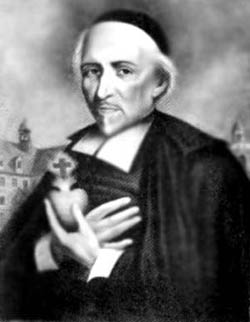
 
St John Eudes, Apostle of the Sacred Heart of Jesus


St John Eudes (1602-1680) publicly and enthusiastically promoted the devotion and gave it an Office and established a feast for it. St John Eudes was also the apostle of the Immaculate Heart of Mary.

On 31 August 1670, the first feast of the Sacred Heart was celebrated in the Grand Seminary of Rennes in Brittany. Coutances followed suit on 20 October, a day with which the Eudist feast was from then on to be connected.

The feast soon spread to other dioceses, and the devotion was likewise adopted in various religious communities. It gradually came into contact with the devotion begun at Paray-le-monial resulting in a fusion of the two.
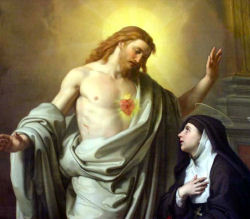

Our Lord shows His Sacred Heart to St Margaret Mary Alacoque


Eventually the devotion was hallowed by private revelation with the now famous revelations to St Margaret Mary Alacoque in the Visitation convent in Paray-le-monial.

Thereafter the devotion was taken by her confessor and spiritual director, St Claude de la Colombiere SJ, to England where, as chaplain to the English Queen, Mary of Modena, he was able to promote the devotion.


St Claude de la Colombiere SJ, confessor of both St Margaret Mary Alacoque and HRH Queen Mary of England, wife of King James II and VII. He was a great promoter of the Sacred Heart devotion.
 

In 1676 he had been sent to England as preacher to Mary of Modena, Duchess of York, afterwards Queen and wife to King James II and VII, the true Stuart monarch of England, Scotland, Ireland and France.
It is fitting that Mary came from Modena which is not far north of that later centre of Jansenism, Pistoia.

St Claude lived the life of a Religious even in the Court of St. James and was as active a missionary in England as he had been in France. Although encountering many difficulties, he was able to guide Saint Margaret Mary by letter.
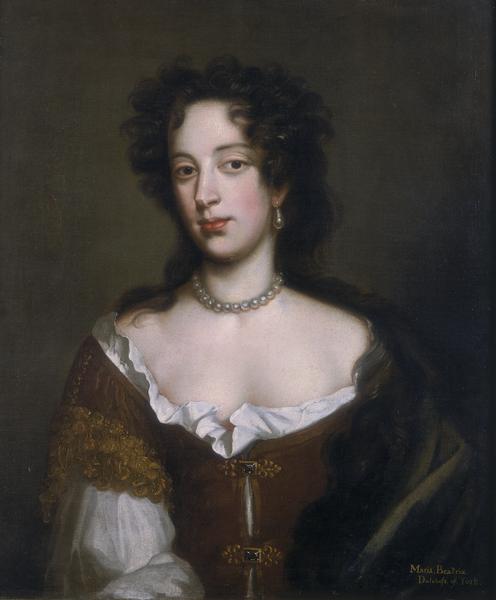

HRH Princess Mary of Modena-Este, Duchess of York as wife to the future King James II and VII and thus, later, Queen of England. Her confessor was St Claude de la Colombiere SJ whom she helped to spread the devotion to the Sacred Heart of Jesus in England

Now the Feast is a great one and has an Octave. An external solemnity is also permitted to be celebrated on the Sunday during the Octave.


St Gaius Cassius Longinus,
the Roman soldier who opened the side of our Lord with a spear but later converted to Christianity


"Unus militum lancea latus ejus aperuit, et continuo exivit sanguis et aqua".

"One of the soldiers with a spear opened His side and immediately there came out blood and water".
[John, 19:34. Communio, Feast of the Sacred Heart]


The Feast of the Holy and Undivided Trinity


THE FEAST

OF THE ONE, HOLY AND UNDIVIDED


TRINITY


"My sheep hear my voice: and I know them, and they follow me. And I give them life everlasting; and they shall not perish for ever, and no man shall pluck them out of my hand. That which my Father hath given me, is greater than all: and no one can snatch them out of the hand of my Father.

I and the Father are one."


[John 10:26-30]

...

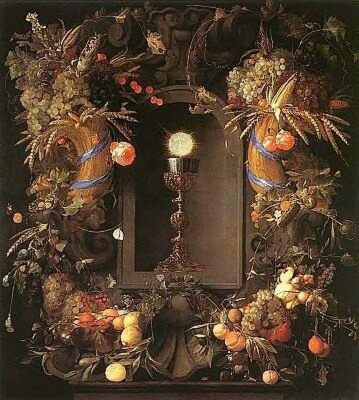
The Feast of Corpus Christi


PANGE lingua gloriosi
Corporis mysterium,
Sanguinisque pretiosi,
quem in mundi pretium
fructus ventris generosi
Rex effudit Gentium.

Nobis datus, nobis natus
ex inacta Virgine,
et in mundo conversatus,
sparso verbi semine,
sui moras incolatus
miro clausit ordine.

In suprema nocte coenae
recumbus cum fratribus
observata lege plene
cibis in legalibus,
cibum turbae duodenae
se dat suis manibus.

Verbum caro, panem verum
verbo carnem efficit:
fitque sanguis Christi merum,
et si sensus deficit,
ad firmandum cor sincerum
sola fides sufficit.

Tantum ergo Sacramentum
veneremur cernui:
et antiquum documentum
novo cedat ritui:
praestet fides supplementum
sensuum defectui.

Genitori, Genitoque
laus et jubilatio,
salus, honor, virtus quoque
sit et benedictio:
procedenti ab utroque
compar sit laudatio.
Amen. Alleluia.

SING, my tongue, the Saviour's glory,
of His flesh the mystery sing;
of the Blood, all price exceeding,
shed by our immortal King,
destined, for the world's redemption,
from a noble womb to spring.

Of a pure and spotless Virgin
born for us on earth below,
He, as Man, with man conversing,
stayed, the seeds of truth to sow;
then He closed in solemn order
wondrously His life of woe.

On the night of that Last Supper,
seated with His chosen band,
He the Pascal victim eating,
first fulfills the Law's command;
then as Food to His Apostles
gives Himself with His own hand.

Word-made-Flesh, the bread of nature
by His word to Flesh He turns;
wine into His Blood He changes;-
what though sense no change discerns?
Only be the heart in earnest,
faith her lesson quickly learns.

Down in adoration falling,
Lo! the sacred Host we hail;
Lo! o'er ancient forms departing,
newer rites of grace prevail;
faith for all defects supplying,
where the feeble sense fail.

To the everlasting Father,
and the Son who reigns on high,
with the Holy Ghost proceeding
forth from Each eternally,
be salvation, honour, blessing,
might and endless majesty.
Amen. Alleluia.


Pange Lingua is a hymn written by St. Thomas Aquinas (1225-1274) for the Feast of Corpus Christi.

It is also sung on Holy Thursday, during the procession from the church to the altar of repose where the Blessed Sacrament is kept until Good Friday.

The last two stanzas, called separately Tantum Ergo, are sung at Benediction of the Blessed Sacrament.

The hymn expresses the doctrine of transubstantiation, the Thomist expression for the transformation of the elements of bread and wine into the Body and Blood of Christ.

The other great Eucharistic hymn of St Thomas is Adoro Te also often sung at Benediction.

There are numerous good translations of this famous hymn but I think that of Gerard Manley Hopkins, the Jesuit poet, is one of the more unusual. Here it is:

Godhead here in hiding, whom I do adore,
Masked by these bare shadows, shape and nothing more,
See, Lord, at Thy service low lies here a heart
Lost, all lost in wonder at the God thou art.

Seeing, touching, tasting are in thee deceived:
How says trusty hearing? that shall be believed;
What God's Son has told me, take for truth I do;
Truth Himself speaks truly or there's nothing true.

On the cross Thy godhead made no sign to men,
Here Thy very manhood steals from human ken:
Both are my confession, both are my belief,
And I pray the prayer of the dying thief.

I am not like Thomas, wounds I cannot see,
But can plainly call thee Lord and God as he;
Let me to a deeper faith daily nearer move,
Daily make me harder hope and dearer love.

O thou our reminder of Christ crucified,
Living Bread, the life of us for whom he died,
Lend this life to me then: feed and feast my mind,
There be thou the sweetness man was meant to find.

Bring the tender tale true of the Pelican;
Bathe me, Jesu Lord, in what Thy bosom ran
Blood whereof a single drop has power to win
All the world forgiveness of its world of sin.

Jesu, whom I look at shrouded here below,
I beseech thee send me what I thirst for so,
Some day to gaze on thee face to face in light
And be blest for ever with Thy glory's sight. Amen.

For those who (still) think that the idea of bread turning into Christ's Body is un-Scriptural, here is the proof that it is entirely Scriptural: John 6:47-72.

Below it is reproduced in both English and Greek. Note carefully the words highlighted in bold.

“47 Amen, amen I say unto you: He that believeth in me, hath everlasting life. 48 I am the bread of life. 49 Your fathers did eat manna in the desert, and are dead. 50 This is the bread which cometh down from heaven; that if any man eat of it, he may not die. 51 I am the living bread which came down from heaven. 52 If any man eat of this bread, he shall live for ever; and the bread that I will give, is my flesh, for the life of the world. 53 The Jews therefore strove among themselves, saying: How can this man give us his flesh to eat? 54 Then Jesus said to them: Amen, amen I say unto you: Except you eat the flesh of the Son of man, and drink his blood, you shall not have life in you. 55 He that eateth my flesh, and drinketh my blood, hath everlasting life: and I will raise him up in the last day. 56 For my flesh is meat indeed: and my blood is drink indeed. 57 He that eateth my flesh, and drinketh my blood, abideth in me, and I in him. 58 As the living Father hath sent me, and I live by the Father; so he that eateth me, the same also shall live by me. 59 This is the bread that came down from heaven. Not as your fathers did eat manna, and are dead. He that eateth this bread, shall live for ever. 60 These things he said, teaching in the synagogue, in Capharnaum. 61 Many therefore of his disciples, hearing it, said: This saying is hard, and who can hear it? 62 But Jesus, knowing in himself, that his disciples murmured at this, said to them: Doth this scandalize you? 63 If then you shall see the Son of man ascend up where he was before? 64 It is the spirit that quickeneth: the flesh profiteth nothing. The words that I have spoken to you, are spirit and life. 65 But there are some of you that believe not. For Jesus knew from the beginning, who they were that did not believe, and who he was, that would betray him. 66 And he said: Therefore did I say to you, that no man can come to me, unless it be given him by my Father. 67 After this many of his disciples went back; and walked no more with him. 68 Then Jesus said to the twelve: Will you also go away? 69 And Simon Peter answered him: Lord, to whom shall we go? thou hast the words of eternal life. 70 And we have believed and have known, that thou art the Christ, the Son of God. 71 Jesus answered them: Have not I chosen you twelve; and one of you is a devil? 72 Now he meant Judas Iscariot, the son of Simon: for this same was about to betray him, whereas he was one of the twelve.”

Now for the Greek - transliterated into Roman script so that the connections are more obvious. Again note the words in bold.

"47 amhn amhn legw umin, o pisteuwn ecei zwhn aiwnion. 48 egw eimi o artoV thV zwhV. 49 oi patereV umwn efagon en th erhmw to manna kai apeqanon: 50 outoV estin o artoV o ek tou ouranou katabainwn ina tiV ex autou fagh kai mh apoqanh. 51 egw eimi o artoV o zwn o ek tou ouranou katabaV: ean tiV fagh ek toutou tou artou zhsei eiV ton aiwna: kai o artoV de on egw dwsw h sarx mou estin uper thV tou kosmou zwhV. 52 emaconto oun proV allhlouV oi ioudaioi legonteV, pwV dunatai outoV hmin dounai thn sarka [autou] fagein; 53 eipen oun autoiV o ihsouV, amhn amhn legw umin, ean mh faghte thn sarka tou uiou tou anqrwpou kai pihte autou to aima, ouk ecete zwhn en eautoiV. 54 o trwgwn mou thn sarka kai pinwn mou to aima ecei zwhn aiwnion, kagw anasthsw auton th escath hmera: 55 h gar sarx mou alhqhV estin brwsiV, kai to aima mou alhqhV estin posiV. 56 o trwgwn mou thn sarka kai pinwn mou to aima en emoi menei kagw en autw. 57 kaqwV apesteilen me o zwn pathr kagw zw dia ton patera, kai o trwgwn me kakeinoV zhsei di eme. 58 outoV estin o artoV o ex ouranou katabaV, ou kaqwV efagon oi patereV kai apeqanon: o trwgwn touton ton arton zhsei eiV ton aiwna. 59 tauta eipen en sunagwgh didaskwn en kafarnaoum. 60 polloi oun akousanteV ek twn maqhtwn autou eipan, sklhroV estin o logoV outoV: tiV dunatai autou akouein; 61 eidwV de o ihsouV en eautw oti gogguzousin peri toutou oi maqhtai autou eipen autoiV, touto umaV skandalizei; 62 ean oun qewrhte ton uion tou anqrwpou anabainonta opou hn to proteron; 63 to pneuma estin to zwopoioun, h sarx ouk wfelei ouden: ta rhmata a egw lelalhka umin pneuma estin kai zwh estin. 64 all eisin ex umwn tineV oi ou pisteuousin. hdei gar ex archV o ihsouV tineV eisin oi mh pisteuonteV kai tiV estin o paradwswn auton. 65 kai elegen, dia touto eirhka umin oti oudeiV dunatai elqein proV me ean mh h dedomenon autw ek tou patroV. 66 ek toutou polloi [ek] twn maqhtwn autou aphlqon eiV ta opisw kai ouketi met autou periepatoun. 67 eipen oun o ihsouV toiV dwdeka, mh kai umeiV qelete upagein; 68 apekriqh autw simwn petroV, kurie, proV tina apeleusomeqa; rhmata zwhV aiwniou eceiV, 69 kai hmeiV pepisteukamen kai egnwkamen oti su ei o agioV tou qeou. 70 apekriqh autoiV o ihsouV, ouk egw umaV touV dwdeka exelexamhn, kai ex umwn eiV diaboloV estin; 71 elegen de ton ioudan simwnoV iskariwtou: outoV gar emellen paradidonai auton, eiV ek twn dwdeka."

The numbering is slightly out of sync in the translation but the words are there. Note this: the word for "eat" changes halfway through the discourse.

It changes from phagein, meaning "to eat", to trogon, meaning literally "to munch" (the "w" is a transliteration of the Greek letter Omega which is a long "o"). The verbs are, moreover, inflected according to the context (e.g phage etc) but it is clear that a different verb is being used by our Lord to emphasize what He means.

Why?

Our Lord is emphasizing that we are literally to "eat His flesh" albeit His flesh is in the form of bread and His blood in the form of wine.

Note also that when He refers to the Fathers eating manna in the desert He reverts to phagein to show that such "eating" was different from eating His flesh, albeit a foretaste of what was to come. He then changes back to trogon when referring to eating His own flesh.

Then the Jews say that His words are a "hard saying" and "how can this man give us his flesh to eat" and even many of His disciples "walked with him no more". They clearly understood that He was talking about them literally eating His flesh and they could not accept what He was saying, just as Protestants and others cannot accept it today.

Did our Lord change His teaching then to make it more "acceptable" and "relevant" to the Jews? Not one jot did He change! Instead He asked the Twelve "will you also go away?".

The Twelve, however, stayed and confessed their faith, Simon saying “Lord, to whom shall we go? Thou hast the words of eternal life".

Marvellous confession of faith!

What could be clearer? The Catholic belief in the Eucharistic Body and Blood of Jesus Christ is the truly Scriptural one - not any other!

Hence St Paul says (1 Cor 11:23-17):

"Brethren, for I myself have received from the Lord (what I also delivered unto you) that the Lord Jesus, on the night that He was betrayed, took bread, and giving thanks, broke, and said 'Take ye and eat, for this is my Body which shall be given up for you; do this in remembrance of me. For as oft as you shall eat this Bread and drink this Cup you proclaim the death of the Lord until He comes. Therefore whoever eats this Bread of drinks this Cup of the Lord unworthily will be guilty of the Body and Blood of the Lord".

There can simply be no doubt whatever that it is the Catholic doctrine which is the Scriptural doctrine. To believe otherwise is to deceive oneself.

“He gave them the Bread of heaven, Alleluia!"

Whitsunday - Come Holy Ghost, fill the hearts of Thy Faithful...


Whitsunday

Pentecost

and the descent of the Holy Ghost upon the Church


"And when the days of the Pentecost were accomplished, they were all together in one place: And suddenly there came a sound from heaven, as of a mighty wind coming, and it filled the whole house where they were sitting. And there appeared to them parted tongues as it were of fire, and it sat upon every one of them: And they were all filled with the Holy Ghost…"
[Acts 2:1-4]

Pentecost (from the Greek Pentecoste meaning the 50th day i.e. after Easter) was also called White Sunday (or Whitsunday) because the neophytes again put on their Easter baptismal robes of white and - until the great destroyer, Archbishop Bugnini, abolished the ceremonies in 1955 - a second but slightly smaller version of the Easter Vigil occurred on Whitsun Eve. In Christendom it was for this reason that Pentecost was often called Pascha Rosatum or, in Italian, Pasqua Rossa, meaning Rose-Easter for the flames that descended like roses, for the red vestments and for the recalling of the mystery of Easter.

It is a highly Biblical feast and the Jews themselves had their own pre-figuring Pentecost which occurred 50 days after the Feast of the Passover. They still celebrate it with solemnity to this day.

This was the importance given by our ancestors to the Feast of Pentecost. But modern Catholics have had that privilege curtailed by the destructive work of Archbishop Bugnini, a prelate who was dismissed for Freemasonry by Pope Paul VI, as Bugnini himself admits in his own autobiography.

With a most shameful disregard for hallowed tradition which cannot escape the charge of impiety, Bugnini destroyed these centuries-old traditions and ceremonies.

Pentecost represents the fullness of God’s gift to men. He gave us His only-begotten Son at Christmas; in Holy Week, by the Passion of Christ, He atoned for us purifying and sanctifying us in His own Precious Blood. At Easter, at His Resurrection, and after, at His Ascension, God gloriifes us in His own Son and makes a place for us in Heaven.

Then, having ascended into heaven, God sends us the Holy Ghost to be our Advocate and Comforter in our earthly sojourn. Descending upon the Apostles as tongues of fire, the Spirit of love comes to us to inform our lives with charity, to create the Church as a bark of salvation and to lead us into all truth and holiness.

During Whit week every day at Mass is sung that most beautiful of hymns, the Veni Sancte Spiritus. It is known to tradition as the Golden Sequence, so greatly has it been revered by Catholic tradition. But how often do you hear it sung?

VENI, Sancte Spiritus,
et emitte caelitus
lucis tuae radium.

Come Holy Ghost send down those beams
which sweetly flow in silent streams
from Thy bright throne above.


At Vespers is sung also the better-known Veni Creátor Spíritus:

Veni Creátor Spíritus,
Mentes tuórum vísita:
Imple supérna grátia,
Quæ tu creásti pécora.

Come, O Creator, Spirit blest,
And in our souls take up Thy rest;
come with Thy grace and heavenly aid,
To fill the hearts which Thou hast made.


Veni Sancte is particularly beautiful and it is a great sadness that so few now know it.

Here is a recording of each by French monks so that the difference can readily be seen. Veni Creator is followed by the sublime Veni Sancte:


Come Holy Ghost, fill the hearts of Thy faithful and enkindle in them the fire of Thy love.

Send forth thy spirit, and they shall be created: and thou shalt renew the face of the earth.


[Adapted from Psalm 103:30]

+++

Rogation Days of Ascensiontide and beating the bounds

Rogation days are days set apart for solemn processions to invoke the mercy of God. The word comes from the Latin rogare “to say or ask” meaning, in this context, to pray to God for good things.

They come at this time because of the Gospel reading for the previous Sunday (the 5th Sunday after Easter, sometimes for that reason called Rogation Sunday) which includes the text from the Gospel of St John 16:24 “Ask and ye shall receive”.

The Rogation days are:

(1) St Mark’s Day on 25 April (the Major Rogation)
(2) The 3 days before the Ascension Day (the Minor Rogations)

The first Rogation, which includes the Greater Litanies, was originally a christianisation of the old Roman pagan feast day of Robigalia, on 25 April, a day to pray for good crops.

The minor Rogations, including the Lesser Litanies, were introduced in 470 by Bishop Mamertus of Vienne and then spread to the rest of the Roman Church. They became a preparation also for the Feast of the Ascension.

These days coincided also with the ceremony of the “Beating of the Bounds” during which a procession led by ministers and choir would proceed round the boundaries of the parish, partly to re-affirm the boundaries but also to pray for the protection of the parish over the forthcoming year. Choir boys and servers would carry canes to "beat" the boundaries at each stopping point.

Absurdly, the Rogation days are yet further ancient and beautiful ceremonies that were done away with by the liturgical wreckers after 1970. They have, of course, come back with the return of the traditional rites.

The ceremony of the Beating of the Bounds can still be seen in the City of London and processions continue to go round the boundaries to the various churches of the City, often escorted by a marching group of one or more of the City TA Regiments.

What diabolical spirit came over the liturgical consilium of Archbishop Bugnini that he even thought to try and get rid of this beautiful, scriptural, ancient liturgical devotion? Yet further evidence, if it were still needed, that a dark and sinister spirit has, these 40 years past, been suffered by weak, vain and worldly prelates to invade parts of the Church.


"Beating the bounds"

"22 So also you now indeed have sorrow; but I will see you again, and your heart shall rejoice; and your joy no man shall take from you. 23 And in that day you shall not ask me any thing. Amen, amen I say to you: if you ask the Father any thing in my name, he will give it you. 24 Hitherto you have not asked any thing in my name. Ask, and you shall receive; that your joy may be full. 25 These things I have spoken to you in proverbs. The hour cometh, when I will no more speak to you in proverbs, but will show you plainly of the Father."
[John 16.22-25]

Peccatores, Te rogamus audi nos
 
We sinners, beseech Thee, hear us!

...

Tuesday, 23 April 2013

23 April - The Feast of St George, the Roman Protector of the English Realm

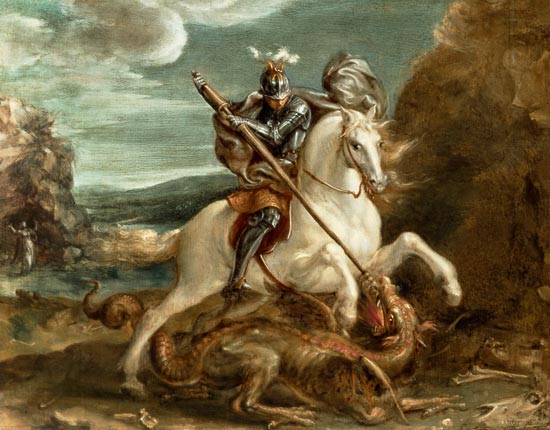
Hans von Aachen. St George slaying the Dragon.


The Feast of St George


St George for Merrie England!


Today is the Feast of St George, Protector of the English Realm.

He is not the Patron Saint of England - that is St Edmund, King and Martyr.


St George was born to a Christian family during the late third century. His father was from Cappadocia and served as an officer of the Roman army. His mother was from Lydda in Palestine.

St George followed his father into the army. It seems he was of equestrian, or knightly and thus noble, rank in Roman society and he appears to have pursued the cursus honorum beginning as a cavalryman or knight, a position reserved only for those of the knightly class. The better quality commanders among the cavalry or knights went on to command as Decurion and later were selected as Tribunus militis or Military Tribune, an officer who was one of 5 staff officers in a Legion.

The Roman Senate was selected from the ranks of the knights or equestrian class, and the Patrician and Senatorial classes, the supreme nobility of Rome, who were able to trace their lineage to the Senatorial families of the early days of Rome, especially those who had seen extensive military service in defence of Rome and its empire.


The Roman Senate


St George was stationed in Nicomedia as a member of the personal guard attached to Roman Emperor Diocletian and was promoted comes or Count, a title, meaning a “companion”, or sometimes a chamberlain, of the Emperor, an imperial appointment either civil or military (from this idea derived the Counts-Palatine or Paladins of the Holy Roman Emperor, Charlemagne).

Many titles of nobility have a military origin including those of imperator (later Emperor but originally meaning the commander-in-chief of the army, lit., “giver of orders”), dux (later Duke or army commander), legatus (Legate – the commander of a legion, and of senatorial rank), tribunus (staff officer of equestrian class already mentioned), praefectus castrorum (Prefect of the Camp, the most veteran soldier in the Legion but non-equestrian), primus pilus (“first spear”, the most senior centurion and commander of the first cohort, non-equestrian but usually ennobled on retirement), pilus prior (first centurion of each cohort and often its commander), primi ordines (the 5 centurions of the first cohort), centurio (centurion – the commander of a “century” of 100 men) and optio (the second-in-command of a century but able to read and write, usually).

Gaius Julius Caesar,
Roman general, patrician, equestrian, senator and imperator


Each legion had 10 cohorts usually each of 6 centuries (sometimes divided into 3 maniples of 2 centuries each), plus 300 or more cavalry and assorted light infantry, light cavalry and auxiliaries (often of non-Roman origin) totalling about 6,600 men.

A Military Legate is thus roughly equivalent to a brigadier-general, a Military Tribune to an equestrian major, lieutenant-colonel or colonel, a pilus prior to a non-equestrian lieutenant colonel, risen from the ranks, and a centurion to a non-equestrian captain or major, risen from the ranks.


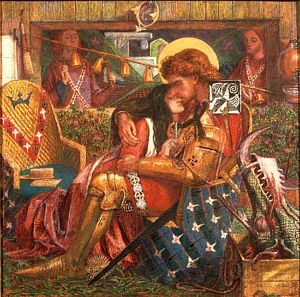
Dante Gabriel Rosetti. The Wedding of St George and Princess Sabra. 1857.


In 303 AD Emperor Diocletian issued an edict authorizing the systematic persecution of Christians across the Empire.

St George was ordered to participate in the persecution but instead confessed to being a Christian himself and criticized the imperial decision. An enraged Diocletian ordered his torture and execution.

After various tortures, including laceration on a wheel of swords, in which he was miraculously resuscitated three times, St George was executed by decapitation before Nicomedia's city wall, on 23 April 303.

A witness of his suffering convinced Empress Alexandra to become Christian as well and she joined St George in martyrdom.

St George’s body was returned to Lydda for burial, where Christians soon came to honour him as a martyr.

The story of St George and the Dragon is by no means necessarily impossible, since reptiles of various sorts were often called dragons in former times.

Even today, the Komodo dragon is still so called.


Dragons of today:
Indonesian Komodo dragons, up to 10 feet in length and up to 365 lbs weight, poison-mouthed and potentially lethal, can be seen to this day


Ancient depictions of “fire-breathing” dragons have been misinterpreted.

They were so depicted to indicate the poisonous breath and mouth of such animals. Since it is the case that the Komodo dragon has precisely such a poisonous mouth, by virtue of the bacteria living therein, its venom and its diet, the earlier depictions start to look remarkably scientific and not mythical at all.

The deadliest bacteria in the Komodo dragon saliva appears to be a very deadly strain of Pasteurella multocida, from studies performed with lab mice.

Alternatively, the dragon might have been a crocodile or alligator which certainly can be found in North Africa near water.

This dragon was said to have made its nest at the spring providing water for a city in the Middle East. The citizens had to dislodge the dragon from its nest for a time, in order to collect water. To do so, and to distract the dragon, each day they had to offer the dragon at first a sheep, then a human, to distract it and the humans were often attacked and killed.

In their heathenism, the people treated the dragon as an evil spirit that had to be placated. The victim was chosen by drawing lots. One ill-favoured day, the lot fell upon the daughter of the king who begged for her life but this partiality was rejected by the citizenry.

St George, who was in the country with his troops, scorning both heathenism and the dragon, set out, warmly encouraged of course by the king, to rescue the princess. He spurned the heathen ignorance that treated the dragon as an evil spirit to be placated and, recognising the animal as no more than a savage beast, took a scientific, rather than superstitious, view.

He slew the dragon in mortal combat, using his human intelligence to outwit, and his courage to defeat, the dragon.

The grateful citizens abandoned heathenism and converted enthusiastically to the religion of St George, namely Christianity.

Ever after, the story was seen as the triumph of Christian truth over pagan superstition, science over ignorance and the supernatural over corrupted nature. Inevitably, it became a great Christian allegory. However, the assumption that it must, therefore, be a fable and not true, is a false assumption. The Bible is full of allegory but that does not mean it is false.

A church built in Lydda during the reign of the Emperor Constantine I (306–337), was consecrated to St George and his cultus became one of the greatest in Christendom.

This church was destroyed in 1010 but was later rebuilt and dedicated to St George by the Western Crusaders who quickly came to embrace his cult. In 1191 the church was again destroyed by the Ayyubid Sultan, Sala’haddin (Saladin), during the 3rd Crusade.


The Crusaders wore the red cross of St George, popularised by the Knights Templar


By the fifth century the cult of St George reached the Western Roman Empire and in 494, George was canonised as a saint by Pope Gelasius I. The cult was promoted much in England by King Alfred the Great.

An apparition of St George is said to have heartened the Franks at the Siege of Antioch, 1098, and made a similar appearance the following year at Jerusalem.

Chivalric military orders of St George were established in Aragon (1201), Genoa, Hungary, and by Frederick III, Holy Roman Emperor.

The Byzantine emperors had a great devotion to St George and the Palaeologue emperors created an order to restore the Labarum Guard of the Emperor Constantine, being the 50 knights who guarded the Labarum, a standard emblazoned with the Chi-Rho symbol that the Emperor Constantine had seen in the sky before his victory on the Milvian Bridge.

They dedicated this Order to St George giving it the symbol of the Cross and the Chi-Rho surrounded by the initials IHSV standing for "In Hoc Signo Vinces" - "In this Sign shalt thou conquer". The Order was bequeathed to the Farnese family by the Palaeologues in exile who thus succeeded to the Grand Magistracy.

Here is the Gold Star of the Order with the Chi-Rho and the IHSV - In Hoc Signo Vinces.


The Star of a Knight of Justice of the Constantinian Order of St George


Today the Order's Grand Master is HRH the Infante Don Carlos of Spain.

King Edward III put his Order of the Garter under the banner of St George. In England the Synod of Oxford, in 1222, declared St George's Day a great feast day in the Kingdom of England and, famously, his name was invoked by English kings in battle, not least King Henry V at Agincourt.

His feast was raised to a Festum duplex at a church council in 1415, on the date that had become associated with his martyrdom, 23 April.

William Shakespeare was born and died on 23 April, St George's Day.


William Shakespeare was born on St George’s Day


The Order of the Garter is still given in the name of “God, our Lady and St George” and features an image of St George slaying the Dragon. The hip decoration, at the bottom of the sash, is still called “the lesser George”.

The original Garter Star was always diamond-encrusted until, after the illegal seizure of the throne, from the legitimate Royal Stuarts by the Protestant German Hanoverians, the diamonds were only retained for the Sovereign and consort.

The Garter blue of the sash was also darkened so as to distinguish it from the ancient, lighter, colour which was associated with the Royal Stuarts.


The diamond-encrusted Garter Star was, under the Royal Stuarts, given to all Garter knights, but now, since the advent of the Protestant Hanoverian Whigs, to the Sovereign and consort only, other knights receiving but cut metal Garter stars


The Garter Star features, to this day, in a great many military symbols e.g. the rank stars of officers in the Household Cavalry and the Household Division and in the Honourable Artillery Company. St George features in a great many other military symbols and traditions of the British armed forces and in British society generally.

St George’s Day is, indeed, a great day to be celebrated in the Kingdom of England and for Great Britain.


The Queen in the Garter procession as Sovereign of the Order. The Garter is still conferred in the name of "God, our Lady and St George".


~~ " ~~


“Once more unto the breach, dear friends, once more;
Or close the wall up with our English dead.
In peace there's nothing so becomes a man
As modest stillness and humility:
But when the blast of war blows in our ears,
Then imitate the action of the tiger;
Stiffen the sinews, summon up the blood,
Disguise fair nature with hard-favour'd rage;
Then lend the eye a terrible aspect;
Let pry through the portage of the head
Like the brass cannon; let the brow o'erwhelm it
As fearfully as doth a galled rock
O'erhang and jutty his confounded base,
Swill'd with the wild and wasteful ocean.
Now set the teeth and stretch the nostril wide,
Hold hard the breath and bend up every spirit
To his full height. On, on, you noblest English.
Whose blood is set from fathers of war-proof!
Fathers that, like so many Alexanders,
Have in these parts from morn till even fought
And sheathed their swords for lack of argument:
Dishonour not your mothers; now attest
That those whom you call'd fathers did beget you.
Be copy now to men of grosser blood,
And teach them how to war. And you, good yeoman,
Whose limbs were made in England, show us here
The mettle of your pasture; let us swear
That you are worth your breeding; which I doubt not;
For there is none of you so mean and base,
That hath not noble lustre in your eyes.
I see you stand like greyhounds in the slips,
Straining upon the start. The game's afoot:
Follow your spirit, and upon this charge
Cry:

'God for Harry, England, and Saint George!'

...

Sunday, 14 April 2013

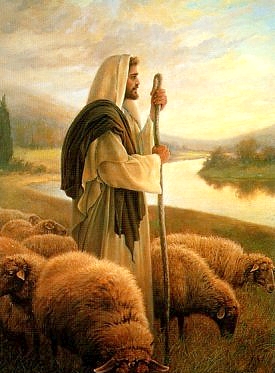
Good Shepherd Sunday - "I know my sheep and they know me..."


Ego sum Pastor bonus, allelúja: et cognósco oves Meas, et cognóscunt Me Meæ. Allelúja, allelúja.

I am the good Shepherd, alleluia: and I know My sheep, and Mine know Me, alleluia, alleluia.

The Gospel is from John 10: 11-16:

In illo témpore: Dixit Jesus Pharisæis: "Ego sum Pastor bonus. Bonus pastor ánimam suam dat pro óvibus. Mercenárius autem et qui non est pastor, cujus non sunt oves própriæ, videt lupum veniéntem, et dimíttit oves, et fugit: et lupus rapit et dispérgit oves: mercenárius autem fugit, quia mercenárius est, et non pértinet ad eum de óvibus. Ego sum Pastor bonus: et cognósco oves meas, et cognóscunt me meæ. Sicut novit me Pater, et ego agnósco Patrem: et ánimam meam pono pro óvibus meis. Et alias oves hábeo, qum non sunt ex hoc ovíli: et illas opórtet me addúcere, et vocem meam áudient, et fiat unum ovíile, et unus pastor."

At that time Jesus said to the Pharisees: "I am the good Shepherd. The good Shepherd giveth his life for his sheep. But the hireling, and he that is not the shepherd, whose own the sheep are not, seeth the wolf coming and leaveth the sheep and flieth: and the wolf catcheth and scattereth the sheep: and the hireling flieth, because he is a hireling, and he hath no care for the sheep. I am the good Shepherd: and I know Mine, and Mine know Me, as the Father knoweth Me, and I know the Father: and I lay down My life for My sheep. And other sheep I have that are not of this fold: them also I must bring, and they shall hear My voice, and there shall be one fold and one shepherd."


Take note all pastors and bishops and be not hirelings but true shepherds.

We should also note that our Lord says He has sheep that are "not of this fold" who shall hear His voice - perhaps better than those who are currently of His Flock - and they shall become part of the Flock, too.

This should teach us to be humble and not to presume or become complacent. Some who are not currently of the Flock may be judged better than us to sit amongst the saints in Heaven.

Let us pray for them, also, and remember that the Catholic Church is for all, including those who are not yet members. It is not a convenient little club only for cradle Catholics.

God chose the Israelites but all but a few later rejected Him and he transferred His favour to the Gentiles who converted to Him and loved Him better than many of His own chosen people.


Lord Jesus, Good Shepherd of us, your flock, have mercy on us and protect us!


+++