As we have seen, Fr Jay Scott Newman has one rule for himself and quite another for others (see earlier posts about him).
He has a blog which he calls Ecclesia Semper Reformanda
Where does this Latin tag come from?
It is a Protestant tag.
It is un-Catholic.
Ecclesia semper reformanda est (Latin for "the church is always being reformed", sometimes shortened to semper reformanda, "always being reformed") is one of the basic tenets of the Protestant Reformation, particularly in the ideas of German theologian Martin Luther.
The phrase itself comes from the Nadere Reformatie movement in the seventeenth century Dutch Reformed Church and widely but informally used in Reformed and Presbyterian churches today (for example, the French Reformed Church use "Ecclesia reformata, semper reformanda" as motto).
It refers to the conviction of certain Reformed Protestant theologians that the church must continually change itself in order to maintain its purity of doctrine and practice.
The term first appeared in print in Jodocus van Lodenstein, Beschouwinge van Zion (Contemplation of Zion), Amsterdam, 1674, a Dutch Protestant work.
The phrase is also put into the mouth of the fictional Pope Gelasius III in Mary Doria Russell's 1998 novel The Children of God.
The term was also used by ecclesiastical reformers of the Roman Catholic Church who were caught up in a false interpretation of Vatican II. And we know where that has led!
To counter the diabolic itch for novelty that this phrase represents, Pope Benedict XVI has re-introduced the concept of “the hermeneutic of continuity”.
Thus, we see that Fr Jay Scott Newman is at odds with the spiritual head of the Church he claims to belong to.
It is fitting, perhaps, that we should pray this Holy Week for sheep - and shepherds - who are straying from the true path.
Let us pray for them.
Sunday, 1 April 2012
Sunday, 19 February 2012
Quinquagesima Sunday - "And the greatest of these is love"
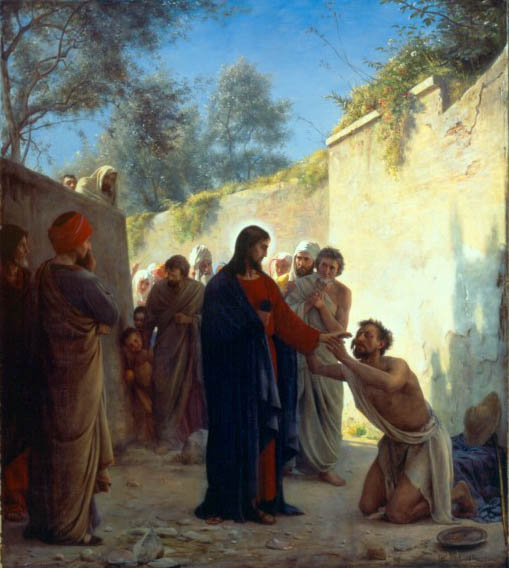
The Gospel tells us the wonderful story of the man who was blind and our Lord, hearing his cry for aid, miraculously cures him.
The name stems from the Latin quinquagesimus (fiftieth) which refers to the fifty days before Easter Day, counting so as to include Sundays.
Since the forty days of the Lenten fast do not include Sundays, the first day of Lent, Ash Wednesday, succeeds Quinquagesima Sunday three days later.
The earliest Quinquagesima can occur is 1 February and the latest is 7 March. This year, 2012, it falls upon 19 February.
Needless to say, Archbishop Annibale Bugnini with his egalitarian-republican-Liberal-Modernist preference for the grey, the dull and the tedious did away with this day in his Novus Ordo Missae Calendar, together with the two preceding Sundays, Sexagesima and Septuagesima.
It is, of course, retained in the traditional mass and the lesson is taken from St Paul's Letter to the Corinthians [1 Cor. 13. 1] with that most beautiful of passages so evocative of the Christian Catholic faith.
Let us conclude with it.
THOUGH I speak with the tongues of men and of angels, and have not love, I am become as sounding brass, or a tinkling cymbal. And though I have the gift of prophecy, and understand all mysteries, and all knowledge; and though I have all faith, so that I could remove mountains, and have not love, I am nothing. And though I bestow all my goods to feed the poor, and though I give my body to be burned, and have not love, it profiteth me nothing. Love suffereth long, and is kind; love envieth not; love vaunteth not itself, is not puffed up, doth not behave itself unseemly, seeketh not her own, is not easily provoked, thinketh no evil; rejoiceth not in iniquity, but rejoiceth in the truth; beareth all things, believeth all things, hopeth all things, endureth all things. Love never faileth: but whether there be prophecies, they shall fail; whether there be tongues, they shall cease; whether there be knowledge, it shall vanish away. For we know in part, and we prophesy in part. But when that which is perfect is come, then that which is in part shall be done away. When I was a child, I spake as a child, I understood as a child, I thought as a child; but when I became a man, I put away childish things. For now we see through a glass darkly; but then face to face: now I know in part; but then shall I know even as also I am known. And now abideth faith, hope, love, these three:
BUT THE GREATEST OF THESE IS
LOVE
LOVE
Thursday, 2 February 2012
Loyalty - the lost virtue. What can the past tell us?
Paul Scott's Raj Quarter portrays human nature brilliantly in the context of the British Raj in India in its latter days.His portrayal is subtle and realistic.
It is a tale of British-ruled India, the "jewel in the crown" of the British Empire.
He shows the good and the bad sides of human nature but with sufficient nuance for his portrayal to be persuasive, intelligent and sensitive.
He does not simply attack the British Raj in the unsubtle, unintelligent manner that so many supposed "scholars" and commentators do today.
Few people living today have had any real experience of the British Raj or, indeed, Empire and most are commenting from a position of zero personal familiarity of it.
Many modern fictional portrayals of the Raj are jejune, blinkered, prejudiced, incomplete and partial.
The Left Wing bias in the media is often to blame for some of the very slanted portrayals of the Raj.
The racism is exaggerated, the opposition is exaggerated, the relationship between the British and the Indians is deliberately misportrayed and the benefits of the Raj are glossed over.
In short, the general picture is a negative one.
In truth there were a huge number of benefits for India from the Raj. Here are a few:
- Infrastructure (railways, hospitals, schools &c)
- Stable government
- Huge contribution to the India economy
- Introduction of Western and Christian ideas of human rights and responsibilities
- Successful management of the differing races and religions, Muslim, Hindu, Sikh, Christian, to live in harmony
- Defence of the sub-continent from external attack
- Freedom of press, religion, speech, assembly and the other freedoms that we now all take so much for granted
- Preservation of the ancient Indian principalities, culture and history
- Abolition of grotesque practices like Suttee, or widow-burning, and Thuggee, from which we get the word "thug", being the practice of devotees of the goddess Kali preying upon and murdering the weak and defenceless
and much more besides.
But one of the most forgotten, yet most attractive and most resplendent aspects of the Raj was the astonishingly loyal, familiar, almost parental, relationship that existed between English officer sahibs and their sepoy officers and soldiers, the Indian Muslim, Sikh, Hindu and Gurkha soldiers.
Indian Officers of the Corps of Guides Cavalry (Frontier Force), one of the elite Regiments serving on the North West frontier against the savage Muslim tribes of the Afghan Pathans
This was a truly impressive relationship, replete with Christian overtones of the clearest kind, whereby master and servant are locked in a bond of complete loyalty and love, each respecting the uniqueness of the other, and recognising their mutual interdependence.
The result was to forge such a degree of loyalty as long outlived the Raj itself with Indian sepoys and British officers continuing to share a mutual respect when the Raj was but a distant memory.
If the British had been merely oppressors, as the Leftists try to pretend they were, the loyalty of Indians to the British name and Raj - sometimes lasting even decades after it had ended - would never have been seen.
And yet it lasted and, even now, still does.
This episode of the TV series of the Raj Quartet gives something of a flavour, albeit mocked by the character of Captain Ronald Merrick, who never experienced the intensely close relationship between British officer and Indian sepoy and becomes a disliked figure among both British and Indian alike.
Merrick is the "new" man, dismissive and cynical about the Christian values of the past, looking askance at the native Indians as an "inferior" race, a zealous policeman who shuns the old loyalties as "myth".
The film, like the book, does not shrink from portraying bad people as, in some cases, thoroughly bad, whether they be British or Indian, but that makes the portrayal of the good more convincing.
Indian army officer, Captain Teddy Bingham, is of the old Raj school. Like his CO, he knows the names and family history of every one of his sepoys and regards them as almost his own children.
Although later mocked by Merrick, who, to be fair, tries to save him, Teddy is appalled that one of his own sepoys might have gone over to the Japanese-backed Indian National Army, founded by Indian Nazi and Hitler ally, Subash Chandra Bhose.
Finding that one sepoy had, indeed, deserted to the Japs and the INA, he speaks to him and calls him back to his true loyalty in the most pressing terms, like a father to a wayward son. The sepoy is moved to bitter remorse and reveals that two other sepoys deserted with him, giving Captain Bingham their names.
When Merrick has gone to see the CO, Teddy takes a jeep and goes in search of the beloved lost sheep of his Regiment, as Christ Himself tells us the Good Shepherd must do.
Standing atop the jeep and calling his lost sepoys by name, Teddy is attacked by Japanese and INA troops hurling grenades and is killed. Even the cynical Merrick tries to rescue him but cannot save his life.
So the shepherd dies for his lost sheep in a manner Biblical in its force and tenor.
To any who knew the old Raj or Empire and its fierce loyalties, it is a most poignant moment in the film, expressing a very real spirit that cannot be adequately captured in words or film.
However, the film tries admirably well (the relevant part starts at about 21:00):
The Jewel In The Crown: Ordeal By Fire (1984) - Part 6
This aspect of the loyalty that existed within the old Raj and Empire is seldom well told in film or story today. The Raj Quartet succeeds where others fail to capture the true spirit.
That old poem of Rudyard Kipling, The White Man's Burden, is today mocked for its racist overtones but it is the rest of the poem which captures the true spirit of service and sacrifice which was so fundamental a part of the lives of all those British officers, DOs, civil servants and others who went out to India at a very young age to serve the people of India, rich and poor, Brahmin and untouchable, alike.
In fact the poem was written to America to advise them of where their future duty would lie if they annexed the Philippines during the Spanish American wars. But, in truth, it is more a reflection of the spirit of the British Raj at its best (leaving aside the racial aspect).
"Go bind your sons to exile,
To serve your captives' needs...
By open speech and simple,
An hundred times made plain
To seek another's profit,
And work another's gain..."
If one substitutes the words "White man" with the word "Christian" then the poem would more accurately capture what motivated our grandfathers' generation to go out to the heat and harm of India, at risk of their lives, to serve the native peoples of that great sub-continent.
And when the Captains and the Kings departed, and India was left to rule herself, what happened?
Sadly, the most terrible disaster and blood-bath. Indian slew Pakistani and vice-versa so that over one million were slaughtered and some 12 million, forced to move after partition, were made homeless.
Mohandas Gandhi, barrister (attorney) turned guru, preached non-violent protest but his legacy was, in fact, a massive orgy of violence and slaughter by Indian against Indian, with over a million dead and 12 million homeless
It is ironic, but true, that the man who hastened India toward this disaster, Mohandas Gandhi, claimed to be a man of non-violence. His satyagraha, or non-violent non-co-operation, led to the exact opposite: a massive orgy of violence and killing to the lasting shame of India and Pakistan, and a continuing legacy of hatred between the two nations that continues, unabated, down to this day.
That is something that would never have been allowed when the British sahibs were still in charge and we would do well, occasionally, to remember that. Certainly many Indians still do.
The White Man's Burden (1899)
Take up the White Man's burden--
Send forth the best ye breed--
Go bind your sons to exile
To serve your captives' need;
To wait in heavy harness,
On fluttered folk and wild--
Your new-caught, sullen peoples,
Half-devil and half-child.
Take up the White Man's burden--
In patience to abide,
To veil the threat of terror
And check the show of pride;
By open speech and simple,
An hundred times made plain
To seek another's profit,
And work another's gain.
Take up the White Man's burden--
The savage wars of peace--
Fill full the mouth of Famine
And bid the sickness cease;
And when your goal is nearest
The end for others sought,
Watch sloth and heathen Folly
Bring all your hopes to nought.
Take up the White Man's burden--
No tawdry rule of kings,
But toil of serf and sweeper--
The tale of common things.
The ports ye shall not enter,
The roads ye shall not tread,
Go mark them with your living,
And mark them with your dead.
Take up the White Man's burden--
And reap his old reward:
The blame of those ye better,
The hate of those ye guard--
The cry of hosts ye humour
(Ah, slowly!) toward the light:--
"Why brought he us from bondage,
Our loved Egyptian night?"
Take up the White Man's burden--
Ye dare not stoop to less--
Nor call too loud on Freedom
To cloke your weariness;
By all ye cry or whisper,
By all ye leave or do,
The silent, sullen peoples
Shall weigh your gods and you.
Take up the White Man's burden--
Have done with childish days--
The lightly proferred laurel,
The easy, ungrudged praise.
Comes now, to search your manhood
Through all the thankless years
Cold, edged with dear-bought wisdom,
The judgment of your peers!
Rudyard Kipling, poet, novelist, British imperialist
...
Take up the White Man's burden--
Send forth the best ye breed--
Go bind your sons to exile
To serve your captives' need;
To wait in heavy harness,
On fluttered folk and wild--
Your new-caught, sullen peoples,
Half-devil and half-child.
Take up the White Man's burden--
In patience to abide,
To veil the threat of terror
And check the show of pride;
By open speech and simple,
An hundred times made plain
To seek another's profit,
And work another's gain.
Take up the White Man's burden--
The savage wars of peace--
Fill full the mouth of Famine
And bid the sickness cease;
And when your goal is nearest
The end for others sought,
Watch sloth and heathen Folly
Bring all your hopes to nought.
Take up the White Man's burden--
No tawdry rule of kings,
But toil of serf and sweeper--
The tale of common things.
The ports ye shall not enter,
The roads ye shall not tread,
Go mark them with your living,
And mark them with your dead.
Take up the White Man's burden--
And reap his old reward:
The blame of those ye better,
The hate of those ye guard--
The cry of hosts ye humour
(Ah, slowly!) toward the light:--
"Why brought he us from bondage,
Our loved Egyptian night?"
Take up the White Man's burden--
Ye dare not stoop to less--
Nor call too loud on Freedom
To cloke your weariness;
By all ye cry or whisper,
By all ye leave or do,
The silent, sullen peoples
Shall weigh your gods and you.
Take up the White Man's burden--
Have done with childish days--
The lightly proferred laurel,
The easy, ungrudged praise.
Comes now, to search your manhood
Through all the thankless years
Cold, edged with dear-bought wisdom,
The judgment of your peers!
...
Labels:
British Raj,
India,
loyalty,
Paul Scott,
Raj Quartet,
the Jewel in the Crown
Fr Newman responds - on MY blog - but censors out others on HIS blog. Fair?
Fr Jay Scott Newman responds.
But on MY blog - not HIS.
He continues to censor out those he cannot answer on his own blog.
I, on the other hand, have posted his comments to my blog.
They do him no credit, however.
He simply descends into bad grace.
For those who missed it:
"I have nothing for which to apologize, and that's why there has been no apology. Before the promulgation of Summorum Pontificum (SP), I expressed my thoughts on the matter of a wider use of what is now the Extraordinary Form of the Roman Rite, and all in the Church were free to do do. Since the promulgation of SP, I have neither written nor spoken on the subject, precisely because I am obedient to the Roman Pontiff. Would that we could say the same for the bishops and priests of the SSPX. And by the way, I always publish under my real name so that I am accountable for everything I write. I suggest you try the same."
So - although he has traduced, mocked, jeered and jibed at lovers of the traditional mass and made ridiculous prognostications about the motu proprio ("invisible", "kinda sorta" etc - see earlier posts) which fell flat on their face once, very shortly after his fatuous diatribes, the Pope issued Summorum Pontificum, he thinks he need not apologise.
Perhaps, being a priest, he thinks he has no call to apologise to anyone.
So "obedient" is he to the Roman Pontiffs that he mocked Veterum Sapientiae of Blessed Pope John XXIII calling it "dead on arrival".
Obedient, eh?
And he thinks that, with Summorum Pontificum, Pope Benedict XVI, "threw a spanner in the works".
Yes. He thinks it is "loyal and obedient", to accuse the Pope of trying to destroy the "works" of the Church.
Well, it's a point of view. Just not a very rational one.
Note, too, how he attacks the SSPX for "disobedience" but says nothing whatever about the far greater disobedience of the liturgical, moral and doctrinal anarchists who now occupy so many key posts in the Church and are busily white-anting it from within.
Never mind the massive apostasy caused thereby for the last 40 years.
And appreciate, too, the note of self-righteousness: he is loyal and obedient but they are not. "I thank God that I am not as other men..." said the unjustifed Pharisee. Moreover, Fr Newman, as we have seen, is not loyal and obedient, but rather chooses to be loyal only to those parts of Catholic tradition of which he approves.
The words of our Lord spring to mind:
"But woe to you scribes and Pharisees, hypocrites; because you shut the kingdom of heaven against men, for you yourselves do not enter in; and those that are going in, you suffer not to enter.
Woe to you scribes and Pharisees, hypocrites; because you go round about the sea and the land to make one proselyte; and when he is made, you make him the child of hell twofold more than yourselves.
Woe to you scribes and Pharisees, hypocrites; because you tithe mint, and anise, and cummin, and have left the weightier things of the law; judgment, and mercy, and faith. These things you ought to have done, and not to leave those undone.
Woe to you scribes and Pharisees, hypocrites; because you are like to whited sepulchres, which outwardly appear to men beautiful, but within are full of dead men's bones, and of all filthiness."
But seemingly, Fr Newman is not concerned about the great apostasy or the Pharisees who have brought it about. Those who do not condemn evil, thereby tolerate and accept it.
What's next:
" 'Tribunus', if you visit my blog, you'll see under the Comments Policy that Rule 2 stipulates no anonymous comments will be published. That is why none of your comments appear on my blog. Give you real name, and that will change. Until then, may the LORD be gracious to you."
Oh, right.
So there you have it, folks. He does not need to apologise because that would be to respond to anonymous comments. And he is too grand to do that. Never mind that Tribunus is openly connected to this blog. He is to be treated as if he were just some anonymous blogger who happened to check in from nowhere.
Well, folks. It's a point of view. Just not a very rational one.
And next:
"You attack my character, hide behind the shield of anonymity, and then refuse to post my reply to your charge. If you do not post my first comment from earlier today, I shall be forced to conclude that you are either a coward or a man of no honor. Please post my first reply, or take down your attack on me."
Attack his character? No. I pointed out what he had said. It was already self-rebutting. If he didn't like it, then he must blame himself.
Then, having complained about attacks on character, what does the Parish Priest of St Mary's, Greenville, South Carolina do next?
Yep, he launches a character-attack!
But he goes further:
"You are a coward, sir, and I pity you.
I do not publish anonymous comments -- as my blog notice makes clear -- and you offer only anonymous comments. Hence, I shall not publish your remarks on my blog.
Then you assault my character, and I offer a rational defense. And your response? Pretend that you did not see my reply and double down on your anonymous attack.
Tell me. Do you live in your mother's basement?"
Yes, really, folks!
He thinks this is appropriate language for a Catholic priest.
A rational defence? Er, no, Father. The whole point is that you offered NO defence of your seamy, sordid attacks on those whose only offence is to love the traditions of our fathers.
His only excuse is to hide behind his "policy" of not answering the "anonymous".
And then he who so deprecates "attacks on my character" hypocritically launches further character-attacks, not forgetting to add some fatuously childish snipes.
Well, father, I need add no more. Your own words defy you.
Pity, if it need be mentioned, is all I can commend others to have for your rather sad and silly posts.
I am at least glad that you no longer foolishly criticise the "kinda sorta" motu proprio. That, I suppose, is something. But, oh no, you won't be withdrawing your previous attacks on it.
Perhaps, and may God grant it, you might even come to learn what folly it is for you to criticise the traditions of our Holy Mother the Church, traditions stretching back not, as you absurdly suppose, to Pope St Pius V, but, as Pope Benedict XVI has taught us, to Pope St Gregory the Great and earlier.
Lord, open the eyes of the blind, that they may see....
+++
But on MY blog - not HIS.
He continues to censor out those he cannot answer on his own blog.
I, on the other hand, have posted his comments to my blog.
They do him no credit, however.
He simply descends into bad grace.
For those who missed it:
"I have nothing for which to apologize, and that's why there has been no apology. Before the promulgation of Summorum Pontificum (SP), I expressed my thoughts on the matter of a wider use of what is now the Extraordinary Form of the Roman Rite, and all in the Church were free to do do. Since the promulgation of SP, I have neither written nor spoken on the subject, precisely because I am obedient to the Roman Pontiff. Would that we could say the same for the bishops and priests of the SSPX. And by the way, I always publish under my real name so that I am accountable for everything I write. I suggest you try the same."
So - although he has traduced, mocked, jeered and jibed at lovers of the traditional mass and made ridiculous prognostications about the motu proprio ("invisible", "kinda sorta" etc - see earlier posts) which fell flat on their face once, very shortly after his fatuous diatribes, the Pope issued Summorum Pontificum, he thinks he need not apologise.
Perhaps, being a priest, he thinks he has no call to apologise to anyone.
So "obedient" is he to the Roman Pontiffs that he mocked Veterum Sapientiae of Blessed Pope John XXIII calling it "dead on arrival".
Obedient, eh?
And he thinks that, with Summorum Pontificum, Pope Benedict XVI, "threw a spanner in the works".
Yes. He thinks it is "loyal and obedient", to accuse the Pope of trying to destroy the "works" of the Church.
Well, it's a point of view. Just not a very rational one.
Note, too, how he attacks the SSPX for "disobedience" but says nothing whatever about the far greater disobedience of the liturgical, moral and doctrinal anarchists who now occupy so many key posts in the Church and are busily white-anting it from within.
Never mind the massive apostasy caused thereby for the last 40 years.
And appreciate, too, the note of self-righteousness: he is loyal and obedient but they are not. "I thank God that I am not as other men..." said the unjustifed Pharisee. Moreover, Fr Newman, as we have seen, is not loyal and obedient, but rather chooses to be loyal only to those parts of Catholic tradition of which he approves.
The words of our Lord spring to mind:
"But woe to you scribes and Pharisees, hypocrites; because you shut the kingdom of heaven against men, for you yourselves do not enter in; and those that are going in, you suffer not to enter.
Woe to you scribes and Pharisees, hypocrites; because you go round about the sea and the land to make one proselyte; and when he is made, you make him the child of hell twofold more than yourselves.
Woe to you scribes and Pharisees, hypocrites; because you tithe mint, and anise, and cummin, and have left the weightier things of the law; judgment, and mercy, and faith. These things you ought to have done, and not to leave those undone.
Woe to you scribes and Pharisees, hypocrites; because you are like to whited sepulchres, which outwardly appear to men beautiful, but within are full of dead men's bones, and of all filthiness."
Matt 23:13-27
But seemingly, Fr Newman is not concerned about the great apostasy or the Pharisees who have brought it about. Those who do not condemn evil, thereby tolerate and accept it.
What's next:
" 'Tribunus', if you visit my blog, you'll see under the Comments Policy that Rule 2 stipulates no anonymous comments will be published. That is why none of your comments appear on my blog. Give you real name, and that will change. Until then, may the LORD be gracious to you."
Oh, right.
So there you have it, folks. He does not need to apologise because that would be to respond to anonymous comments. And he is too grand to do that. Never mind that Tribunus is openly connected to this blog. He is to be treated as if he were just some anonymous blogger who happened to check in from nowhere.
Well, folks. It's a point of view. Just not a very rational one.
And next:
"You attack my character, hide behind the shield of anonymity, and then refuse to post my reply to your charge. If you do not post my first comment from earlier today, I shall be forced to conclude that you are either a coward or a man of no honor. Please post my first reply, or take down your attack on me."
Attack his character? No. I pointed out what he had said. It was already self-rebutting. If he didn't like it, then he must blame himself.
Then, having complained about attacks on character, what does the Parish Priest of St Mary's, Greenville, South Carolina do next?
Yep, he launches a character-attack!
But he goes further:
"You are a coward, sir, and I pity you.
I do not publish anonymous comments -- as my blog notice makes clear -- and you offer only anonymous comments. Hence, I shall not publish your remarks on my blog.
Then you assault my character, and I offer a rational defense. And your response? Pretend that you did not see my reply and double down on your anonymous attack.
Tell me. Do you live in your mother's basement?"
Yes, really, folks!
He thinks this is appropriate language for a Catholic priest.
A rational defence? Er, no, Father. The whole point is that you offered NO defence of your seamy, sordid attacks on those whose only offence is to love the traditions of our fathers.
His only excuse is to hide behind his "policy" of not answering the "anonymous".
And then he who so deprecates "attacks on my character" hypocritically launches further character-attacks, not forgetting to add some fatuously childish snipes.
Well, father, I need add no more. Your own words defy you.
Pity, if it need be mentioned, is all I can commend others to have for your rather sad and silly posts.
I am at least glad that you no longer foolishly criticise the "kinda sorta" motu proprio. That, I suppose, is something. But, oh no, you won't be withdrawing your previous attacks on it.
Perhaps, and may God grant it, you might even come to learn what folly it is for you to criticise the traditions of our Holy Mother the Church, traditions stretching back not, as you absurdly suppose, to Pope St Pius V, but, as Pope Benedict XVI has taught us, to Pope St Gregory the Great and earlier.
Lord, open the eyes of the blind, that they may see....
+++
Friday, 27 January 2012
Fr Jay Scott Newman rejects natural justice, hearing the other side and fair play
Well, I guess that proves it, folks. Whatever Fr Jay Scott Newman may be, he is not a believer in natural justice, hearing both sides or fair play.
And he simply will not recognise his own failure of charity and justice toward those who have a preference for the traditional Roman rite.
He shot his mouth off before the motu proprio of Pope Benedict XVI, Summorum Pontificum, came out claiming that it was "invisible" and predicting it would not come and then engaged in the usual cheap and insulting offensive against lovers of the traditional Roman rites that we have had to put up with for 40 years from people who ought to know better.
That was already unworthy.
But next, he would tolerate no attempt to put the alternative view. He simply censored out any comment critical of his position by blanking it from his blog or website.
Father Newman recently apologised for his comments that those voting for President Obama should repent before taking communion. But, folks, you can be sure he won't be apologising any time soon for his offensive comments against lovers of the traditional Roman rites.
Well, Father, you can fool your readers but you cannot fool God.
...
Thursday, 26 January 2012
More ammo for trads - all from the Saints, Doctors and Magisterium of the Church
Here's the ammo, trads...
St Thomas Aquinas
“It is absurd, and a detestable shame, that we should suffer those traditions to be changed which we have received from the fathers of old." - The Decretals (Dist. xii, 5) Cited by St Thomas Aquinas in the Summa Theologica, II, I, Q. 97, art. 2.
"'One faith,' St. Paul writes (Eph. 4:5). Hold most firmly that our faith is identical with that of the ancients. Deny this, and you dissolve the unity of the Church ... We must hold this for certain, namely: that the faith of the people at the present day is one with the faith of the people in past centuries. Were this not true, then we would be in a different church than they were in and, literally, the Church would not be One."
St Thomas Aquinas
St Irenaeus
"As I said before, the Church, having received this preaching and this faith, although she is disseminated throughout the whole world, yet guarded it, as if she occupied but one house. She likewise believes these things just as if she had but one soul and one and the same heart; and harmoniously she proclaims them and teaches them and hands them down, as if she possessed but one mouth. For, while the languages of the world are diverse, nevertheless, the authority of the tradition is one and the same" – St Irenaeus, Against Heresies, 1:10:2, 189 AD.
St Jerome
“The best advice that I can give you is this. Church traditions – especially when they do not run counter to the Faith – are to be observed in the form in which previous generations have handed them down.” - St Jerome, Letters, 71, 6. (4th Century).
Origen
"Although there are many who believe that they themselves hold to the teachings of Christ, there are yet some among them who think differently from their predecessors. The teaching of the Church has indeed been handed down through an order of succession from the apostles and remains in the churches even to the present time. That alone is to be believed as the truth which is in no way at variance with ecclesiastical and apostolic tradition" – Origen, The Fundamental Doctrines, 1:2, 225 AD.
Pope St Leo the Great
"Teach nothing new, but implant in the hearts of everyone those things which the fathers of venerable memory taught with a uniform preaching ... Whence, we preach nothing except what we have received from our forefathers. In all things, therefore, both in the rule of faith in the observance of discipline, let the pattern of antiquity be observed." - Pope St Leo the Great, Father and Doctor of the Church.
Pope St Leo the Great
Pope Leo XIII
"They knew only too well the intimate bond which unites faith with worship, 'the law of belief with the law of prayer,' and so, under the pretext of restoring it to its primitive form, they corrupted the order of the liturgy in many respects to adapt it to the errors of the Innovators." - Pope Leo XIII, Apostolicae Curae, September 13, 1896.
Pope St Pius X
"But for Catholics nothing will remove the authority of the second Council of Nicea, where it condemns those 'who dare, after the impious fashion of heretics, to deride the ecclesiastical traditions, to invent novelties of some kind . . . or endeavour by malice or craft to overthrow any one of the legitimate traditions of the Catholic Church'. . . . Wherefore the Roman Pontiffs, Pius IV and Pius IX, ordered the insertion in the profession of faith of the following declaration: 'I most firmly admit and embrace the apostolic and ecclesiastical traditions and other observances and constitutions of the Church'.” - Pope St Pius X, Pascendi Dominici Gregis (Encyclical Against Modernism.
"The true friends of the people are neither revolutionaries nor innovators, but traditionalists." - Pope St Pius X, Notre Charge Apostolique.
Pope St Pius X
Second Council of Nicea (Seventh Ecumenical Council)
"If anyone rejects any written or unwritten tradition of the Church, let him be anathema."
"Let everything that conflicts with ecclesiastical tradition and teaching, and that has been innovated and done contrary to the examples outlined by the saints and the venerable Fathers, or that shall hereafter at any time be done in such a fashion, be anathema."
Pope Pius XII
"The day the Church abandons Her universal tongue will be the day before She returns to the Catacombs." - Pope Pius XII (a few days before his death).
Pope Paul VI
"We would warn against the danger and damage of the blind rejection of the inheritance which the past, through a wise and selective tradition, transmits to new generations. If we did not hold this transmission in proper regard we could lose the treasure accrued by civilization.” - October 29, 1972.
St Augustine
"But in regard to those observances which we carefully attend and which the whole world keeps, and which derive not from Scripture but from Tradition, we are given to understand that they are recommended and ordained to be kept, either by the apostles themselves or by plenary [ecumenical] councils, the authority of which is vital to the Church.” – St Augustine, Letter to Januarius, 400 AD.
St Simeon of Thessalonica
"With love, we pass on to you that which we have taken from the Fathers, for we offer nothing new, but only that which has been passed on to us, and we have changed nothing but we have retained everything, like a creed, in the state in which it has been given to us. We worship exactly as Christ Himself did and as did the Apostles and the Fathers of the Church." - St Simeon of Thessalonica, in Migne, Patrologia Graeca, 155:701 a-b.
St Simeon of Thessalonica
St Isidore
"Therefore, heresy is from the Greek word meaning 'choice' . . . . But we are not permitted to believe whatever we choose, nor to choose whatever someone else has believed. We have the Apostles of God as authorities, who did not . . . choose what they would believe but faithfully transmitted the teachings of Christ. So, even if an angel from heaven should preach otherwise, he shall be called anathema. - St Isidore, Doctor of the Church and last of the great Latin Fathers, Etymologies, 7th Century.
St Athanasius
"You are fortunate, you have remained in the Church through your faith. You held fast to the foundations of the faith which has come down to you from Apostolic Tradition. . . .In the present crisis, it is they who have broken away from it." - St Athanasius, Doctor of the Church, died 373 AD.
"But you are blessed, who by faith are in the Church, dwell upon the foundations of the faith, and have full satisfaction, even the highest degree of faith which remains among you unshaken. For it has come down to you from apostolic tradition, and frequently accursed envy has wished to unsettle it, but has not been able" – St Athanasius, Festal Letters 29, 330 AD.
St Vincent of Lerins
"What then shall the Catholic do if some portion of the Church detaches itself from communion of the universal Faith? What other choice can he make -- and if some new contagion attempts to poison, no longer a small part of the Church, but the whole Church at once, then his great concern will be to attach himself to antiquity (Tradition) which can no longer be led astray by any lying novelty."
"The Church of Christ, zealous and cautious guardian of the dogmas deposited with it, never changes any phrase of them. It does not diminish them or add to them; it neither trims what seems necessary now grafts things superfluous . . . but it devotes all its diligence to one aim: To treat tradition faithfully and wisely; to consolidate and to strengthen what already was clear; and to guard what already was confirmed and defined." - St Vincent of Lerins, Commonitoria (5th Century).
“With great zeal and closest attention, therefore, I frequently inquired of many men, eminent for their holiness and doctrine, how I might, in a concise and, so to speak, general and ordinary way, distinguish the truth of the Catholic faith from the falsehood of heretical depravity. I received almost always the same answer from all of them—that if I or anyone else wanted to expose the frauds and escape the snares of the heretics who rise up, and to remain intact and in sound faith, it would be necessary, with the help of the Lord, to fortify that faith in a twofold manner: first, of course, by the authority of divine law [Scripture] and then by the tradition of the Catholic Church.” – St Vincent of Lerins, The Notebooks, 434 AD.
Blessed John Henry, Cardinal Newman
"It is quite evident that this passage furnishes no argument whatever that the sacred Scripture, without Tradition, is the sole rule of faith; for, although sacred Scripture is profitable for these four ends, still it is not said to be sufficient. The Apostle [Paul] requires the aid of Tradition (2 Thess. 2:15). Moreover, the Apostle here refers to the scriptures which Timothy was taught in his infancy.”
Blessed John Henry, Cardinal Newman
St Peter Canisius
"Better that only a few Catholics should be left, staunch and sincere in their religion, than that they should, remaining many, desire as it were, to be in collusion with the Church's enemies and in conformity with the open foes of our faith." - St Peter Canisius (1521-1597)
“It behoves us unanimously and inviolably to observe the ecclesiastical traditions, whether codified or simply retained by the customary practice of the Church.” – St Peter Canisius (1521-1597)
What could be clearer? Abandon tradition at your spiritual peril...
...
Summorum Pontificum 5 years on: have the detractors like Fr Jay Scott Newman apologised?
That is, I suggest, is a little ungracious.
It may be instructive to repeat now what I said then, in August 2007, on the Roman Christendom blog.
Here it is repeated:
...
“Before the motu proprio was issued Fr Jay joined in with the 'Latin Questions' discussion on his blog and made this unhelpful comment:
"...The long-rumored and still invisible motu proprio notwithstanding, there is simply no interest in the Church beyond the statistically insignificant world of specialists and bloggers in retrieving what 99.999% of the Catholic people (and hierarchy) consider a noble part of our heritage but not a living part of our future (think of the papal navy!)..."
Where does he get his stats? Wake up and smell the coffee, Father!
And this:
"...All of which leads to my conclusion that those who harbor hope that the general liturgical life of the Church will be improved by a few more celebrations of the Pian Mass have simply and profoundly misunderstood the situation of the Church in our time..."
Yep. Pretty offensive and ill-informed stuff. It's not the Pian mass. It is much, much older. He has simply 'profoundly misunderstood'!
Someone replied to him thus:
'Your over-emphasis on numbers might lead an observer to think that you put a higher premium on popularity than truth or right practice...
If you want to get with what is 'serious' then you need to concern yourself less with numbers and more with truth and tradition.
Otherwise you may find yourself numbered with those disciples who got with the numbers by running away, rather than with those who stood at the foot of the Cross.
I know it is difficult for a priest these days to give any favour to the traditional rite without incurring trouble with his bishop but do not let that skew your vision or compromise your intellectual impartiality.'
He got cross with that and replied:
'...Based on 20 years of experience, I believe that such folk will be sadly disappointed, no matter what the yet-to-be published (or even seen) motu proprio may or may not say...'
Someone replied to him beginning:
'I catch a glimpse of a straw man in your last comment...'
Well, indeed!
There were other replies to Fr Newman but - mysteriously - they were removed from his blog.
US-style "free speech"?
See how it works?
I am free to say whatever I like but if you say something I don't like, I just erase it.
This is called "free speech". Apparently!
But then, all of a sudden, and within only a few weeks, out came the motu proprio.
Whoops! Now the boot was on the other foot. The 'long-rumoured and yet invisible' and the 'yet to be published (or even seen)' had suddenly been seen, published and hugely exceeded the expected minimalist concessions that unnecessarily aggressive Novus Ordo priests like Fr Jay had expected.
And it came from the Pope himself!
Golly! What to do, now? Um, err, aaah....
You guessed it - back-peddle. Fast! (But without apologising to anyone - never apologise, never explain, apparently!).
Here's an extract from Fr Jay's very grudging back-peddle:
'In any event, last Saturday, Pope Benedict XVI threw a spanner in the works with his long-awaited, much-rumored, and oft-debated Apostolic Letter Summorum Pontificum, which more or less (kinda, sorta) gives any priest of the Latin Rite the choice of which Mass to offer: the Mass codified by Pope Pius V after the Council of Trent or the Mass codified by Pope Paul VI after the Second Vatican Council. It remains to be seen what effect, if any, this document will have on the life of the Church as it is lived in parishes, religious houses, seminaries, etc...'
Get that, folks? The Pope 'threw a spanner in the works'.
The Pope did it!
And this from a priest who thinks himself a papal loyalist. And Paul VI apparently only 'codified' the new mass - no new Eucharistic prayers or anything like that...err...
But let's read on:
'In February 1962, Pope John XXIII promulgated an Apostolic Constitution called Veterum Sapientia, mandating very specific requirements for the teaching and preservation of Latin in the Church, but because of the radical changes taking place in the world at the time, this authoritative document was Dead On Arrival and had zero effect in the life of the Church. Today, if this document is read at all, it is usually read with mirth. Well might we all mourn the passing away of Latin from wide use in the Church, but pass away it has....'
Oh really?
So we should rejoice in our ignorance of our own history, culture and the language in which most of our theology is written, should we? We should think it's all 'DOA'? And we should read 'with mirth' the writings of a beatified pope, should we?
More papal loyalism? Err, sorry Father, I don't think so!
But there's more...
'Will Summorum Pontificum be DOA in the same way as Veterum Sapientia? I honestly don’t know, and to tell the truth, I don’t much care one way or the other...'
'Don't much care...'!
Does this sound like loyalty to the Pope? I doubt that many would see it that way!
So whilst Fr Jay has been forced to back off he has done so with singularly bad grace. That is a great shame because he is a priest who made much of his loyalty under Pope John Paul II but is acting rather differently under Pope Benedict. But even more so because he is not a bad guy. Indeed, he is basically a good guy but he has allowed his thinking and theology to get sloppy and complacent.
Come on now, Fr Jay. You're basically a good priest but you can do better. Don't cheat yourself or your parishioners!"
...
Fr Jay for a long time refused to receive any further comments on his blog. He clearly wanted it all just to go away. Of course, burying your head in the sand like that does no-one any good.
His penultimate post was, aptly but sadly, entitled "Liturgy Wars". But the simple truth is that it was not traditional-rite Catholics who started the war. It was anti-traditionalists who started it.
There should, of course, be no wars over liturgy. We should all be on the same side, not divided internally.
Unfortunately, it is the kind of statement that appeared in Fr Jay's Parish newsletter that can sometimes tend to prolong the war. I publish it below as it is in the public domain and a commentator has sent it to me.
If any priest is going to claim to be loyal to the Pope and to say "Where Peter is, there is the Church", then he needs to be open and willing to implement the motu proprio, and should avoid minimising it by suggesting that it "kinda, sorta" gives wider permission for the traditional rites.
The reality is that the motu proprio gives extremely wide and extensive permission for the use of the traditional rites.
But here is Fr Jay's advice to his parishioners on 1 July 2007, just before the publication of the motu proprio:
"When this document is finally published, there will no doubt be a circus of media attention of the most sensational kind, but please do not be confused or disturbed by what you read in the papers or see on television. Whatever else may be the case, there will certainly be no changes made in the present way we celebrate the Missal of 1970 in our scheduled liturgies, and pending a careful study of the document, I do not anticipate that a regularly scheduled Tridentine Mass will be celebrated here at St. Mary’s. For now, simply know that a document will probably appear this summer, and when it does, we will study it together."
To be fair to Fr Jay, he clearly did not anticipate the breadth and width of the rights granted by the motu proprio and, I suspect, is still slightly in denial about it all. On his blog, he certainly admits to being a bit confused by it all.
I had hoped that when he had had time to digest it all, reflect upon it all and pray about it, he would take a more balanced view.
No sign, I’m afraid.
He remains, it seems, stuck in his arrogance toward those whose only “fault” is to want to preserve the traditions of prayer of the Roman Catholic faith.
I also wrote this then which I believe is still apposite:
...
“I cannot help recalling that Cardinal James Knox, when he was still alive, brutally and carelessly ordered a forward altar and mass versus populum at the Chiesa Nuova in Rome despite the strong opposition of the protectress of the Church, Princess Borghese, and the strong feelings of the Faithful, not to mention the Fathers (they are Oratorians).
This was all too typical of those times - brutal, senseless, unjust and uncharitable actions were all too common in liturgical matters. That is partly why Pope John Paul II felt it necessary to apologise for them in 1988 and after, and the present pope likewise in Summorum Pontificum.
Too many of those with authority rode roughshod over the deeply-held traditions, and religious beliefs and sensibilities of all too many of the Faithful without a word of apology or sympathy.
Those of the Faithful who had been deeply loyal and loved the Church to the uttermost, politely asked if they could worship as they always had and were brushed aside like so much chaff. Heedless of age, sex or sensibility, decent and humble people were arrogantly treated.
No wonder so many people left the Church!
The sheep looked up to be fed and what happened?
They were clouted on their snouts even by their own shepherds!
It was particularly odious to witness the ill-treatment of elderly people who often had the greatest difficulty adapting to the liturgical changes. What did this behaviour say about the attitude that Christians should have to old people?
Personally, I think it added to the general decline in proper behaviour toward the elderly in our society. It was a scandalous bad example.
Thank God we have had two popes who finally understood and sympathised with the Faithful who have been so bruised, battered, scandalised and horrified by the senseless uncharity of so many of those in authority in relation to liturgical issues in the recent past.
Still, there are too many who, whilst abusing and insulting those whose tastes are for the traditional, nevertheless accuse them of being sour, cross and abusive.
They never seem to stop and think about the insults, calumnies, detractions and abuse that the Faithful who love the traditions of the Church have had to put up with over the recent past.
If, as the calumniators claim, the Faithful who love the traditions of the Church are but a small number of disaffected people, then why abuse and insult them?"
...
In fact, of course, the traditional movement is now inundated with youngsters. The movement Juventutem is but one example of many new traditional youth movements filled with youngsters who want the authentic and ancient Catholic tradition, not mere pap and pope music from the 1960s.
I say to all priests your loyalty should be primarily to JESUS CHRIST and the long traditions of His Church. If you abandon the past then you abandon the present also, for, as St Thomas Aquinas teaches us:
“It is absurd, and a detestable shame, that we should suffer those traditions to be changed which we have received from the fathers of old"
The Decretals (Dist. xii, 5) cited in the Summa Theologica, II, I, Q. 97, art. 2.
To do so is to follow the traditions of men, not the traditions of God, something St Paul expressly warned us against:
"Therefore, brethren, stand fast; and hold the traditions which you have learned, whether by word, or by our epistle"
2 Thessalonians 2:15
"Now I praise you, brethren, that in all things you are mindful of me: and keep the traditions as I have delivered them to you."
1 Corinthians 11:2
So, my dear Fathers. Don’t dissemble, dissent or detract but, instead, keep the traditions handed on from of old. That is your noble task. Be worthy of it.
+++
Subscribe to:
Posts (Atom)