Wednesday, 2 April 2008

Assertio Septem Sacramentorum - Henry VIII defends the Catholic Church and the Pope!

Amazing but true!

Read here how the old rogue, in his earlier days, defended both Pope and Emperor against the villainous Luther.

Henry was at pains to defend Pope Leo X as well as the Roman Emperor Charles V, nephew to his wife, Catherine of Aragon.

Not a hint of Protestantism in Henry's views can be seen. Indeed, he considered himself a Catholic until the end of his days, despite his later monumental split from Rome.

In reality, the split with Rome was occasioned by his wish to divorce Catherine for giving him no sons, coupled with his desire for other women, beginning with Anne Boleyn.

However, at this time, he was a bold defender of the Catholic Church, the Pope and the Emperor and for his Assertio Septem Sacramentorum the Pope awarded him the title Fidei Defensor, Defender of the Faith, a title kept by his successors, despite their being anti-Catholic Protestants and despite the title having so papal an origin. Even today, Queen Elizabeth II retains the title of Fidei Defensor which title appears on the currency of the Realm after her name.

It was later asserted that Henry had not written the book but that it had been written by St Thomas More but More denied this and said that he had advised the King on various points of common law when asked, but no more. It was "from first to last the King's own project" said More, when under interrogation by Thomas Cromwell, Secretary to the King's Council, and principal despoiler and destroyer of the monasteries and of the Catholic Faith in England. Cromwell was beheaded only 5 years after More so his lies, destruction and murdering did him no good even in purely worldly terms.

The King's work has now been re-printed by St Gabriel Communications International at this site:

http://www.saintgabriel.com.au/store/

Henry wrote a letter to the Pope on the subject of his work which gives you a feeling for the sense of it.

Henry VIII’s Letter to Pope Leo X on the subject of his book Assertio Septem Sacramentorum

Most Holy Father:

No duty is more incumbent on a Catholic sovereign than to preserve and increase the Christian faith and religion and the proofs thereof, and to trans­mit them preserved thus inviolate to posterity, by his example in preventing them from being destroyed by any assailant of the Faith or in any wise impaired.

So, when we learned that the pest of Martin Luther's heresy had appeared in Germany and was raging everywhere, without let or hindrance, to such an extent that many, infected with its poison, were falling away, especially those whose furious hatred rather than their zeal for Christian Truth had prepared them to believe all its subtleties and lies; we were so deeply grieved at this heinous crime of the German nation (for whom we have no light regard), and for the sake of the Holy Apostolic See, that we bent all our thoughts and energies on up­rooting in every possible way, this cockle, this heresy from the Lord's flock.

When we perceived that this deadly venom had advanced so far and had seized upon the weak and ill-disposed minds of so many, that it could not easily be overcome by a single effort, we deemed that nothing could be more efficient in destroying the contagion than to declare these errors worthy of condemnation, after they had been examined by a con­vocation of learned and scholarly men from all parts of our realm.

This course of action we likewise recommended to a number of others. In the first place, we earnestly entreated His Imperial Majesty, through our fraternal love for him, and all the electoral princes, to bethink them of their Christian duty and their lofty station and to destroy this pernicious man, together with his scandalous and heretical publications, after his re­fusal to return to God.

But convinced that, in our ardour for the welfare of Christendom, in our zeal for the Catholic Faith and our devotion to the Apostolic See, we had not yet done enough, we determined to show by our own writings our attitude towards Luther and our opinion of his vile books; to manifest more openly to all the world that we shall ever defend and uphold the Holy Roman Church, not only by force of arms but by the resources of our intelligence and our services as a Christian.

For this reason we have thought that this first attempt of our modest ability and learning could not be more worthily dedicated than to your Holiness, both as a token of our filial reverence and an acknowledgment of your careful solicitude for the weal of Christendom.

We feel assured that our first fruits will be enhanced in value if it be approved by the wholesome judgment of your Blessedness. May you live long and happily!

From our Royal Palace at Greenwich, the twenty-first day of May, 1521.

Your Holiness' most devoted and humble son,
Henry,
by the grace of God King of England and France, and Lord of Ireland.


...

Monday, 31 March 2008

Corona Divinae Misericordiae (Chaplet of Divine Mercy)

Some are a little dismissive of the Divine Mercy devotions, perhaps partly because they see them as untraditional and late in time or new-fangled. In fact, it is entirely fitting that Quasimodo Sunday should have been chosen by the Supreme Pontiff for the Feast of Divine Mercy since it is the day when St Thomas the Doubter was reconciled from his doubts, as the Gospel tells us, and, after placing his hands in the wounds of Christ, made the act of faith saying, "My Lord and my God!". 

 It is also the day when the introit of the traditional Roman rite repeats the words of St Peter: "laying away all malice and all guile and dissimulations and envies and all detractions, just as the new born infants desire the rational milk without guile..." 

This is a highly appropriate verse for those seeking out the mercy of God. 

Moreover, this day was the day when the neophytes, having been baptised at the Easter Vigil, and having worn their white baptismal robes (nowadays still used for infant baptism) for the full week, set aside their white robes having been filled with all the grace and blessing of baptism. 

 This, then, is surely the very day when the accumulation of God's grace and mercy is at its height and the Faithful ought, therefore, to seek access thereto all the more fully. 

 The Sacred Penitentiary, the Church's highest court (yes, really; it is higher than the Apostolic Signature or the Sacred Rota), in its Decree of 29 June 2002, set out the conditions for a Plenary Indulgence granted by the Supreme Pontiff. 

The Decree states: 

"And so the Supreme Pontiff, motivated by an ardent desire to foster in Christians this devotion to Divine Mercy as much as possible in the hope of offering great spiritual fruit to the faithful, in the Audience granted on 13 June 2002, to those Responsible for the Apostolic Penitentiary, granted the following Indulgences: - a plenary indulgence, granted under the usual conditions (sacramental confession, Eucharistic communion and prayer for the intentions of the Supreme Pontiff) to the faithful who, on the Second Sunday of Easter or Divine Mercy Sunday, in any church or chapel, in a spirit that is completely detached from the affection for a sin, even a venial sin, take part in the prayers and devotions held in honour of Divine Mercy, or who, in the presence of the Blessed Sacrament exposed or reserved in the tabernacle, recite the Our Father and the Creed, adding a devout prayer to the merciful Lord Jesus (e.g. "Merciful Jesus, I trust in you!"); - a partial indulgence, granted to the faithful who, at least with a contrite heart, pray to the merciful Lord Jesus a legitimately approved invocation."

Confession and Communion may, according to the Penitentiary's guidance, be on any day 20 days either side of Low Sunday. 

Below are reproduced the prayers of the Chaplet of Divine Mercy in Latin for the use of those who wish to gain access to the fathomless mercy of God. 

I have rendered the final prayer into Latin, Greek and Hebrew, the primary sacred languages of the Church which appeared over the Holy Cross. 

That final prayer is the same that is sung, alternating in Greek and Latin, at the exceedingly ancient, solemn Good Friday service (the Mass of the Pre-sanctified). 

This final prayer is said 3 times to signify the Holy Trinity just as the 3 sacred languages, Latin, Greek and Hebrew signify the Holy Trinity, also. 

 I commend this devotion to readers. It can, for instance, be incorporated into Benediction, after, say, the Prayer for England (or equivalent in other nations).
 
Corona Divinae Misericordiae (Chaplet of Divine Mercy)

IN NOMINE Patris et Filii et Spiritus Sancti. 

PATER NOSTER, qui es in caelis, sanctificetur nomen tuum. Adveniat regnum tuum. Fiat voluntas tua, sicut in caelo et in terra. Panem nostrum quotidianum da nobis hodie, et dimitte nobis debita nostra sicut et nos dimittimus debitoribus nostris. Et ne nos inducas in tentationem, sed libera nos a malo. Amen. 

AVE MARIA, gratia plena, Dominus tecum. Benedicta tu in mulieribus, et benedictus fructus ventris tui, Iesus. Sancta Maria, Mater Dei, ora pro nobis peccatoribus, nunc, et in hora mortis nostrae. Amen. 

CREDO in Deum Patrem omnipotentem, Creatorem caeli et terrae. Et in Iesum Christum, Filium eius unicum, Dominum nostrum, qui conceptus est de Spiritu Sancto, natus ex Maria Virgine, passus sub Pontio Pilato, crucifixus, mortuus, et sepultus, descendit ad inferos, tertia die resurrexit a mortuis, ascendit ad caelos, sedet ad dexteram Dei Patris omnipotentis, inde venturus est iudicare vivos et mortuos. Credo in Spiritum Sanctum, sanctam Ecclesiam catholicam, sanctorum communionem, remissionem peccatorum, carnis resurrectionem et vitam aeternam. Amen. 

On each of the OUR FATHER beads: 

PATER aeterne, offero tibi Corpus et Sanguinem, animam et divinitatem dilectissimi Filii Tui, Domini nostri, Iesu Christi, in propitiatione pro peccatis nostris et totius mundi. (Eternal Father, I offer You the Body and Blood, Soul and Divinity of Your dearly beloved Son, Our Lord Jesus Christ, in atonement for our sins and those of the whole world) 

On each of the HAIL MARY beads: 

PRO DOLOROSA Eius passione, miserere nobis et totius mundi. (For the sake of His sorrowful Passion, have mercy on us and the whole world) 

In conclusion say the following (here in Latin, Greek and Hebrew): 

SANCTUS Deus, Sanctus Fortis, Sanctus Immortalis, miserere nobis et totius mundi. 

HAGIOS Theos, Hagios ischyros, Hagios athanatos, eleison imas kai olon ton kosmon. 

ELOHIM hakadosh, Elohim hakol yakhol, rakhem aleinu, veal kol haolam. (Holy God, Holy Mighty One, Holy Immortal One, have mercy on us and the whole world) 

Say at three o’clock in the afternoon: 

TE PRAETERITUS, Domine Iesu, fons vitae et caesa fusus est pro animabus Oceanum misericordiae et aperuit ascendit pro toto mundo. O fons vitae es, ineffabile divinae misericordiae, de nube super universum terrarum orbem, et evacuabit te fac nobis. O aqua et sanguis, quae fluxerunt de Corde Iesu miserere nobis quasi parens clementiae, ego in te habeat fiduciam. Amen. (Your expired, O Jesus, but the source of life gushed forth for souls and an ocean of mercy opened up for the whole world. O Fount of Life, unfathomable Divine Mercy, envelop the whole world and empty Yourself out upon us. O Blood and Water, which gushed forth from the Heart of Jesus as a fount of mercy for us, I trust in You. Amen.)
+++

Saturday, 29 March 2008

Quasimodo Sunday (Feast of Divine Mercy): "As newborn babes desire the rational milk without guile..."

Dominica in Albis Depositis

(Sunday when the newly baptised finally put off their white garments of Easter)

also called

Quasimodo Sunday

or

Low Sunday

or

Close-Pasch

and

the Feast of Divine Mercy

"Quasimodo geniti infantes, alleluia, rationabile sine dolo lac concupiscite. Alleluia, alleluia, alleluia."

"As newborn babes, alleluia, desire the rational milk without guile. Alleluia, alleluia, alleluia"
[1 Peter 2:2; Introit for the Mass of Low Sunday]


"Deinde dicit Thomae: infer digitum tuum huc et vide manus meas, et affer manum tuam et mitte in latus meum et noli esse incredulus sed fidelis. Respondit Thomas et dixit ei: Dominus meus et Deus meus!"

"Then He said to Thomas 'Put in thy fingers hither and see my hands and bring hither thy hand and put it into my side and be not faithless but believing'. Thomas answered and said to him 'My Lord and my God!' "
[John 20:27-28; Gospel of Low Sunday]


Caravaggio. Doubting Thomas. 1602-1603

"Dearly beloved, laying away all malice and all guile and dissimulations and envies and all detractions as newborn babes desire the rational milk without guile, that thereby you may grow unto salvation, if so be you have tasted that the Lord is sweet...for you are a chosen race, a kingly priesthood, a holy nation, a purchased people that you may declare His virtues who hath called you out of darkness into His marvellous light."
[1 Peter 2:2-3, 9]

"Now when it was late that same day, the first of the week, and the doors were shut, where the disciples were gathered together, for fear of the Jews, Jesus came and stood in the midst, and said to them: Peace be to you. And when he had said this, he shewed them his hands and his side. The disciples therefore were glad, when they saw the Lord. He said therefore to them again: Peace be to you. As the Father hath sent me, I also send you. When he had said this, he breathed on them; and he said to them: Receive ye the Holy Ghost. Whose sins you shall forgive, they are forgiven them; and whose sins you shall retain, they are retained. Now Thomas, one of the twelve, who is called Didymus, was not with them when Jesus came. The other disciples therefore said to him: We have seen the Lord. But he said to them: Except I shall see in his hands the print of the nails, and put my finger into the place of the nails, and put my hand into his side, I will not believe. And after eight days again his disciples were within, and Thomas with them. Jesus cometh, the doors being shut, and stood in the midst, and said: Peace be to you. Then he saith to Thomas: Put in thy finger hither, and see my hands; and bring hither thy hand, and put it into my side; and be not faithless, but believing. Thomas answered, and said to him: My Lord, and my God. Jesus saith to him: Because thou hast seen me, Thomas, thou hast believed: blessed are they that have not seen, and have believed."
[John 20:19-29]

"In the Old Covenant I sent prophets wielding thunderbolts to My people. Today I am sending you with My mercy to the people of the whole world. I do not want to punish aching mankind, but I desire to heal it, pressing it to My Merciful Heart.(1588)


It's a sign for the end times; after it will come the day of justice. While there is still time, let them have recourse to the fount of My mercy; let them profit from the Blood and Water which gushed forth for them. (848)


Before I come as a just Judge, I first open wide the doors of My mercy. He who refuses to pass through the doors of My mercy must pass through the doors of My justice... (1146)"

[Diary of Divine Mercy, Revelation of our Lord to St Maria Faustina of the Blessed Sacrament (Helen Kowalska)]

St Faustina Kowalska, messenger of Divine Mercy

"Hagios Theos, hagios ischyros, hagios athanatos, eleison imas"

"Sanctus Deus, Sanctus Fortis, Sanctus Immortalis, miserere nobis"

"Holy God, Holy Mighty One, Holy Immortal One, have mercy on us"

[The ancient prayer of the Trisagion from the Improperia or "Reproaches" of the Good Friday liturgy in Greek, Latin and English, dating back to at least the 5th century. They form part of the Divine Mercy prayers requested of St Faustina by our Lord.]


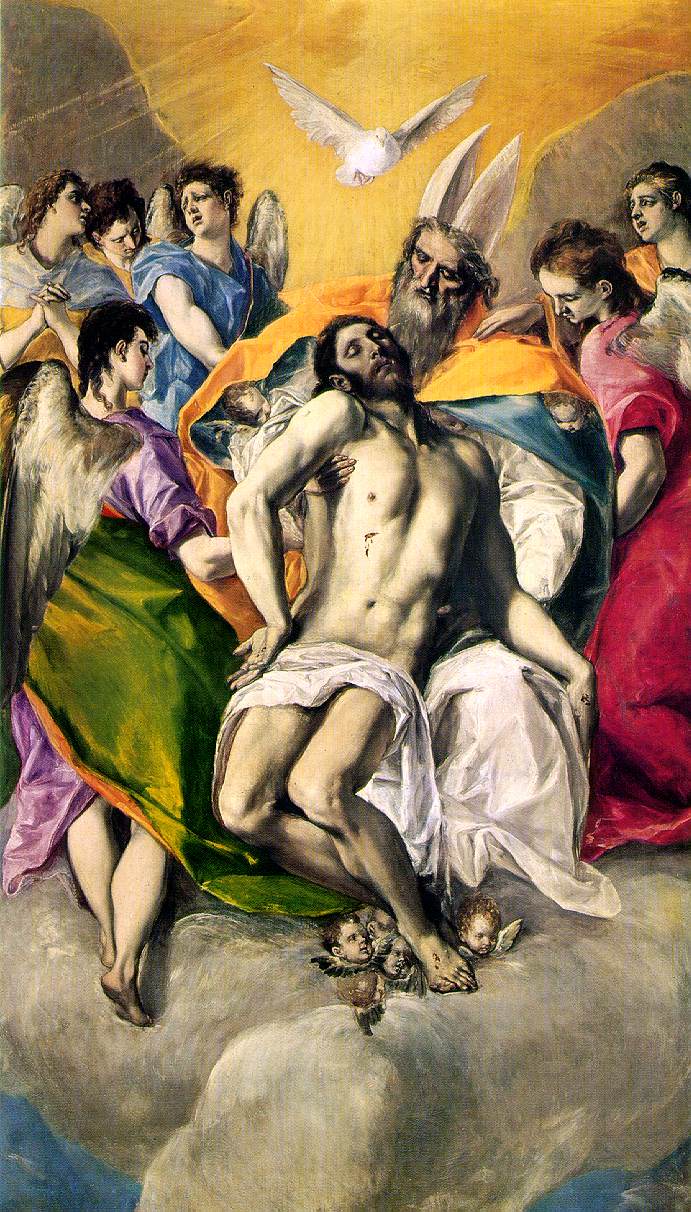
Domenikos Theotocopoulos (El Greco). The Holy Trinity. 1577.


...

Sunday, 23 March 2008

Easter Sunday: Christus surrexit, alleluia!


Easter Sunday


Christus surrexit,
sicut dixit,
alleluia!

Christ is risen
as he said!
Alleluia!


[Correggio. Noli me tangere. 1525]

"When the sabbath was over, Mary Magdalene and Mary the mother of James and Salome, bought spices so that they might come and anoint Jesus...and on a sabbath morning they came to the sepulchre after sunrise...and looking up they saw that the stone was rolled back. Alleluia!"
[Taverner, Dum transisset sabbatum from Mark 16, sung at the Easter Vigil mass of Holy Saturday night]

"The Angels said to her 'Woman, why are you weeping?'. She said to them 'Because they have taken away my Lord and I do not know where they have laid Him'. Saying this she turned round and saw Jesus standing but she did not know that it was Jesus. Supposing Him to be the gardener, she said to Him 'Sir, if you have carried Him away tell me where you have laid Him and I will take Him away'. And Jesus said to her 'Mary'. She turned and said to Him in Hebrew 'Rabboni!'".
[John 20]

"She went and said to the Disciples 'I have seen the Lord!' "
[John 20]


Victimae paschali laudes
immolent Christiani
Agnus redemit oves:
Christus innocens Patri
Reconciliavit peccatores.
Mors et vita duello conflixere mirando,
Dux vitae mortuus, regnat vivus.
Dic nobis Maria, quid vidisti in via?
Sepulcrum Christi viventis,
Et gloriam vidi resurgentis:
Angelicos testes, sudarium et vestes.
Surrexit Christus spes mea:
Praecedet vos in Galilaeam.
Credendum est magis soli
Mariae veraci
Quam Judaeorum
Turbae fallaci.
Scimus Christum surrexisse
a mortuis vere:
Tu nobis, victor Rex, miserere.
Amen. Alleluia.

To the Paschal victim let Christians
Offer up their songs of praise.
The Lamb has redeemed the sheep:
Christ who is without sin
Has reconciled sinners to the Father.
Death and life have fought a huge battle,
The Prince of Life was dead, but lives and reigns.
Tell us, Mary, what did you see on your way?
'The tomb of Christ, who is alive,
And I saw the glory of his rising;
Angels standing as witnesses, the shroud and linen cloth.
Christ my hope has risen:
He has gone to Galilee before you'.
Truly, we know Christ has risen from the dead:
O King and victor, have mercy on us. Amen. Alleluia.

[Wipo of Burgundy, Victimi Paschali Laudes. 1040. Sung on Easter Sunday]


Surrexit Christus hodie! Alleluia!

Christ is risen today! Alleluia!

...

Friday, 21 March 2008

Good Friday: "see if there be any sorrow like unto my sorrow..."

Good Friday

Popule meus, quid feci tibi, aut in quo contristavi me?
Responde mihi!

“O my people! What have I done to thee? Wherein have I offended thee?
Answer me!

Titian. Christ Crowned with Thorns. 1540.

"For he hath taken us and he will heal us: he will strike and he will cure us. He will revive after two days: on the third day he will raise us up and we shall live in his sight. We shall know and we shall follow on, that we know the Lord...for I desired mercy and not animal sacrifice and the knowledge of God more than holocausts."
[Hosea 6, First lesson sung at the Good Friday Service of the Mass of the Pre-sanctified]

"He had no form or comeliness that we should look at him, and no beauty that we should desire him. He was despised and rejected of men, a man of sorrows and acquainted with grief; and as one from whom men hide their faces he was despised, and we esteemed him not. Surely he has borne our griefs and carried our sorrows; yet we esteemed him stricken, smitten by God, and afflicted. But he was wounded for our transgressions, he was bruised for our iniquities; upon him was the whole chastisement that made us whole and with his stripes we are healed. All we like sheep have gone astray; we have turned every one to his own way; and the LORD has laid on him the iniquity of us all. He was oppressed and he was afflicted, yet he opened not his mouth; like a lamb that is led to the slaughter and like a sheep that is dumb before its shearers, he opened not his mouth."
[Isaiah 53, Epistle for Wednesday in Holy Week]

"Jesus answered: ‘My kingdom is not of this world. If My kingdom were of this world, My servants would certainly strive that I should not be delivered to the Jews; but now my kingdom is not from hence’. Pilate therefore said to Him ‘Art Thou a King then?’ Jesus answered ‘Thou sayest that I am a King. For this I was born and for this I came into the world, that I should give testimony of the truth. Everyone that is of the truth heareth My voice…

…Then therefore Pilate took Jesus and scourged Him and the soldiers plaiting a Crown of Thorns, put it upon His head and they put upon Him a purple mantle and they came to Him and said ‘Hail King of the Jews!’ and they gave Him blows."
[John, 18]

Regnavit a ligno Deus.
"God hath reigned from a tree."
[From Vexilla Regis, St Venantius Fortunatus, sung during the Good Friday Service of the Passion.]

"What more ought I to have done for thee, that I have not done? I planted thee, indeed, My most beautiful vineyard and thou hast become exceeding bitter to Me, for in My thirst thou gavest Me vinegar to drink and with a lance thou pierced the side of thy Saviour!
… For thy sake I scourged Egypt with its first-born and thou didst deliver Me up to be scourged…
… I gave thee a royal sceptre and thou didst give My head a crown of thorns…
… I exalted thee with great strength and thou didst hang Me on the gibbet of the Cross…
O my people! What have I done to thee? Wherein have I offended thee? Answer me!"
[Improperia or Reproaches of Christ to His people and to us all, from the Good Friday Service of the Passion.]

O vos omnes, qui transitis per viam, attendite et videte si est dolor sicut dolormeus.
"O all ye that pass by the way, attend and see if there be any sorrow like unto my sorrow."
[Lamentations of Jeremiah, sung at Tenebrae (Matins and Lauds) on Maundy Thursday]


Diego Velázquez. Christ Crucified. c. 1632.

"And they took Jesus and led Him forth. And bearing His cross, He went forth to that place that is called Calvary but in Hebrew Golgotha, where they crucified Him and with Him two others, one on each side and Jesus in the midst. And Pilate wrote a title also and he put it upon the Cross and the writing was ‘Jesus of Nazareth, the King of the Jews’… and it was written in Hebrew, in Greek, and in Latin."
[John 18]


...

Maundy Thursday: "A new commandment I give you..."

Maundy Thursday

Mandatum novum do vobis...


Philippe de Champaigne. The Last Supper. 1654.

ALEPH: Quomodo sedet sola civitas, plena populo, facta es quasi vidua; domina gentium, princeps provinicarum, facta est sub tributo.

ALEPH: How doth the city sit solitary, that was full of people! How is she become as a widow! She that was great among the nations, and princess among the provinces, how is she become tributary!
[Lamentations of Jeremiah 1:1, the beginning of Tenebrae (Matins) for Maundy Thursday]

"And the Lord said to Moses and Aaron in the land of Egypt: 'This month shall be to you the beginning of months. It shall be the first in the months of the year...on the tenth day of this month let every man take a lamb by their families and houses... and it shall be a lamb WITHOUT BLEMISH, a male, of one year...and you shall keep it until the fourteenth day of this month and the whole multitude of the children of Israel shall sacrifice it in the evening. And they shall take of the blood thereof and put it upon both the side posts and on the upper door posts of the houses wherein they shall eat it. And they shall eat the flesh that night roasted at the fire and unleavened bread with wild lettuce... neither shall there remain any thing of it until morning. If there be anything left you shall burn it with fire. And thus shall you eat it: you shall gird your reins and you shall have shoes on your feet, holding staves in your hands and you shall eat in haste for it is the Phase (that is the Passage) of the Lord... And I shall see the blood and shall pass over you...and this day shall be for a memorial to you and you shall keep it a feast to the Lord in your generations with an everlasting observance'... And Moses said... 'Thou shalt keep this thing as a law for thee and thy children forever...and when your children shall say to you "What is the meaning of this service" you shall say to them "It is the victim of the passage of the Lord when He passed over the houses of the children of Israel in Egypt, striking the Egyptians and saving our houses..."
[Exod 12]

"Now the feast of the unleavened bread which is called the Pasch was at hand...and when the hour was come He sat down and the twelve apostles with Him and He said to them 'With desire I have desired to eat this Pasch with you before I suffer, for I say to you that from this time I will not eat it till it be fulfilled in the Kingdom of God'... And taking bread He gave thanks, and brake and gave them saying 'This is my body which is given up for you. Do this for a commemoration of me'. In like manner the chalice also, after He had supped, saying 'This is the chalice, the new testament in my blood, which shall be shed for you'.
[Luke 22]

"On the night of that last supper,
Seated with His chosen band,
He the paschal victim eating,
First fulfils the Law's command.
Then as food to all His brethren
Gives Himself with His own hand"
[Pange lingua gloriosi, sung at the Maundy Mass.]

"Before the festival day of the Pasch, Jesus knowing that His hour was come...having loved His own who were in the world, He loved them unto the end. And when supper was ended... He riseth from supper and..having taken a towel, girded Himself. After that, He putteth water into a basin and began to wash the feet of the disciples and to wipe them with the towel wherewith he was girded...Then after He had washed their feet and taken His garments, being set down again, He said to them 'Know you what I have done to you? You call me Master and Lord. And you say well; for so I am. If then I being your Lord and Master, have washed your feet, you also ought to wash one another's feet."
[John 13]

Mandatum novum do vobis ut diligatis invicem sicut dilexi vos, dicit Dominus.
"A new commandment I give you that you love one another as I have loved you, saith the Lord."
[John 13:34, sung at the Maundy Mass]

Ubi caritas et amor ubi Deus est. Congregavit nos in unum Christi amor. Exultemus et in ipso jucundemur. Timeamus et amemus Deum vivum. Et ex corde diligamus nos sincero.
"Where charity and love are there is God. The love of Christ has gathered us together. Let us rejoice in Him and be glad. Let us fear and love the living God and let us love one another with a sincere heart."
[John 2:3-4, sung at the Maundy Mass]


Vincenzo Civerchio. Christ washing the feet of the disciples. 1544.

"And going out He went, according to His custom, to the Mount of Olives and His disciples also followed Him... and kneeling down He prayed saying 'Father, if Thou wilt, remove this chalice from me but not yet my will but Thine be done'...And He being in agony, He prayed the longer and His sweat became as drops of blood trickling down upon the ground."
[Luke 22:39-44]

Thursday, 20 March 2008

Spy Wednesday: "one of my disciples shall betray me today; woe to him by whom I am betrayed"

"Then went one of the twelve who was called Judas Iscariot to the chief priests and said to them 'what will you give me to deliver Him unto you?'. And they appointed him thirty pieces of silver..."


Caravaggio. The Taking of Christ. 1602.


Unus ex discipulis meus tradet ne hodie: Vae illi per quem tradar ego. Melius illi erat si natur non fuisset...Qui intingit mecum manum in paropside, hic me traditurus est in manus peccatorum.

"One of my disciples shall today betray me. Woe to him by whom I am betrayed. Better for him that he had not been born...whoever shall dip his hand with me into the dish, by him shall I be betrayed into the hands of sin."
[Matt 16:23-25, Responsory 6 at Tenebrae on Maundy Thursday]

"Then went one of the twelve who was called Judas Iscariot to the chief priests and said to them "what will you give me to deliver Him unto you?". And they appointed him thirty pieces of silver and from thenceforth he sought opportunity to betray Him."
[Matt 26:14-16]

"Thus saith the Lord God 'tell the daughter of Sion, behold Thy Saviour cometh; behold His reward is with Him and His work before Him. Who is this that cometh from Edom with dyed garments from Bosra, this beautiful one in his robe, walking in greatness of strength?'"
[Isaias 62:63]

"There is no beauty in Him, nor comeliness; and we have seen Him and there was no sightliness that we should be desirous of Him; despised and the most abject of men, a man of sorrows and despised, whereupon we esteemed Him not. Surely He hath borne our infirmities and carried our sorrows, and we have thought Him as it were a leper and as one struck by God and afflicted. But He was wounded for our iniquities, He was bruised for our sins; the chastisement of our peace was upon Him and by his bruises we are healed. All we like sheep have gone astray, everyone hath turned aside into his own way and the Lord hath laid on Him the iniquity of us all. He was offered because it was His own will and he opened not His mouth: He shall be led as a sheep to the slaughter and shall be dumb as a lamb before his shearer, and He shall not open His mouth...He hath done no iniquity, neither was there deceit in His mouth...He hath delivered His soul unto death and was reputed with the wicked and hath borne the sins of many and hath prayed for the transgressors.
[Isaias 53:2]


...