Friday, 21 March 2008

Maundy Thursday: "A new commandment I give you..."

Maundy Thursday

Mandatum novum do vobis...


Philippe de Champaigne. The Last Supper. 1654.

ALEPH: Quomodo sedet sola civitas, plena populo, facta es quasi vidua; domina gentium, princeps provinicarum, facta est sub tributo.

ALEPH: How doth the city sit solitary, that was full of people! How is she become as a widow! She that was great among the nations, and princess among the provinces, how is she become tributary!
[Lamentations of Jeremiah 1:1, the beginning of Tenebrae (Matins) for Maundy Thursday]

"And the Lord said to Moses and Aaron in the land of Egypt: 'This month shall be to you the beginning of months. It shall be the first in the months of the year...on the tenth day of this month let every man take a lamb by their families and houses... and it shall be a lamb WITHOUT BLEMISH, a male, of one year...and you shall keep it until the fourteenth day of this month and the whole multitude of the children of Israel shall sacrifice it in the evening. And they shall take of the blood thereof and put it upon both the side posts and on the upper door posts of the houses wherein they shall eat it. And they shall eat the flesh that night roasted at the fire and unleavened bread with wild lettuce... neither shall there remain any thing of it until morning. If there be anything left you shall burn it with fire. And thus shall you eat it: you shall gird your reins and you shall have shoes on your feet, holding staves in your hands and you shall eat in haste for it is the Phase (that is the Passage) of the Lord... And I shall see the blood and shall pass over you...and this day shall be for a memorial to you and you shall keep it a feast to the Lord in your generations with an everlasting observance'... And Moses said... 'Thou shalt keep this thing as a law for thee and thy children forever...and when your children shall say to you "What is the meaning of this service" you shall say to them "It is the victim of the passage of the Lord when He passed over the houses of the children of Israel in Egypt, striking the Egyptians and saving our houses..."
[Exod 12]

"Now the feast of the unleavened bread which is called the Pasch was at hand...and when the hour was come He sat down and the twelve apostles with Him and He said to them 'With desire I have desired to eat this Pasch with you before I suffer, for I say to you that from this time I will not eat it till it be fulfilled in the Kingdom of God'... And taking bread He gave thanks, and brake and gave them saying 'This is my body which is given up for you. Do this for a commemoration of me'. In like manner the chalice also, after He had supped, saying 'This is the chalice, the new testament in my blood, which shall be shed for you'.
[Luke 22]

"On the night of that last supper,
Seated with His chosen band,
He the paschal victim eating,
First fulfils the Law's command.
Then as food to all His brethren
Gives Himself with His own hand"
[Pange lingua gloriosi, sung at the Maundy Mass.]

"Before the festival day of the Pasch, Jesus knowing that His hour was come...having loved His own who were in the world, He loved them unto the end. And when supper was ended... He riseth from supper and..having taken a towel, girded Himself. After that, He putteth water into a basin and began to wash the feet of the disciples and to wipe them with the towel wherewith he was girded...Then after He had washed their feet and taken His garments, being set down again, He said to them 'Know you what I have done to you? You call me Master and Lord. And you say well; for so I am. If then I being your Lord and Master, have washed your feet, you also ought to wash one another's feet."
[John 13]

Mandatum novum do vobis ut diligatis invicem sicut dilexi vos, dicit Dominus.
"A new commandment I give you that you love one another as I have loved you, saith the Lord."
[John 13:34, sung at the Maundy Mass]

Ubi caritas et amor ubi Deus est. Congregavit nos in unum Christi amor. Exultemus et in ipso jucundemur. Timeamus et amemus Deum vivum. Et ex corde diligamus nos sincero.
"Where charity and love are there is God. The love of Christ has gathered us together. Let us rejoice in Him and be glad. Let us fear and love the living God and let us love one another with a sincere heart."
[John 2:3-4, sung at the Maundy Mass]


Vincenzo Civerchio. Christ washing the feet of the disciples. 1544.

"And going out He went, according to His custom, to the Mount of Olives and His disciples also followed Him... and kneeling down He prayed saying 'Father, if Thou wilt, remove this chalice from me but not yet my will but Thine be done'...And He being in agony, He prayed the longer and His sweat became as drops of blood trickling down upon the ground."
[Luke 22:39-44]

Thursday, 20 March 2008

Spy Wednesday: "one of my disciples shall betray me today; woe to him by whom I am betrayed"

"Then went one of the twelve who was called Judas Iscariot to the chief priests and said to them 'what will you give me to deliver Him unto you?'. And they appointed him thirty pieces of silver..."


Caravaggio. The Taking of Christ. 1602.


Unus ex discipulis meus tradet ne hodie: Vae illi per quem tradar ego. Melius illi erat si natur non fuisset...Qui intingit mecum manum in paropside, hic me traditurus est in manus peccatorum.

"One of my disciples shall today betray me. Woe to him by whom I am betrayed. Better for him that he had not been born...whoever shall dip his hand with me into the dish, by him shall I be betrayed into the hands of sin."
[Matt 16:23-25, Responsory 6 at Tenebrae on Maundy Thursday]

"Then went one of the twelve who was called Judas Iscariot to the chief priests and said to them "what will you give me to deliver Him unto you?". And they appointed him thirty pieces of silver and from thenceforth he sought opportunity to betray Him."
[Matt 26:14-16]

"Thus saith the Lord God 'tell the daughter of Sion, behold Thy Saviour cometh; behold His reward is with Him and His work before Him. Who is this that cometh from Edom with dyed garments from Bosra, this beautiful one in his robe, walking in greatness of strength?'"
[Isaias 62:63]

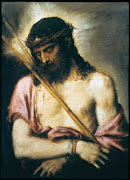
"There is no beauty in Him, nor comeliness; and we have seen Him and there was no sightliness that we should be desirous of Him; despised and the most abject of men, a man of sorrows and despised, whereupon we esteemed Him not. Surely He hath borne our infirmities and carried our sorrows, and we have thought Him as it were a leper and as one struck by God and afflicted. But He was wounded for our iniquities, He was bruised for our sins; the chastisement of our peace was upon Him and by his bruises we are healed. All we like sheep have gone astray, everyone hath turned aside into his own way and the Lord hath laid on Him the iniquity of us all. He was offered because it was His own will and he opened not His mouth: He shall be led as a sheep to the slaughter and shall be dumb as a lamb before his shearer, and He shall not open His mouth...He hath done no iniquity, neither was there deceit in His mouth...He hath delivered His soul unto death and was reputed with the wicked and hath borne the sins of many and hath prayed for the transgressors.
[Isaias 53:2]


...

Monday in Holy Week: "Mary...wiped His feet with her hair"

"Mary took a pound of ointment of right spikenard of great price and anointed the feet of Jesus..."


Henryk Siemiradzki. Christ in the House of Martha and Mary. 1886.

"With regard to the chastisement that is to befall Jerusalem, He gives this...answer: 'Amen, I say to you this generation shall not pass 'til all these things are done' [Matt.xiv.34]. History tells us how the prophecy of Jesus was fulfilled: forty years had scarcely elapsed after His Ascension, when the Roman army encamped on this very place [Mount Olivet] where He is now speaking to His disciples and laid siege to the ungrateful and wicked city".
[Rt Rev Abbot Dom Prosper Gueranger OSB, L'Annee liturgique, vol VI "Passiontide and Holy Week".]

"Lo, they shall all be destroyed as a garment, the moth shall eat them up."
[Isaias 50:9]

"Mary...wiped his feet with her hair and the house was filled with the odour of the ointment. Then one of His disciples, Judas Iscariot, he that was about to betray Him, said: 'Why was not this ointment sold...and given to the poor?'...Jesus therefore said: 'Let her alone, that she may keep it against the day of my burial; for the poor you have always with you, but me you have not always with you...' ".
[John 12:3-9]


...

Tuesday, 18 March 2008

Cardinal-Deacons in Dalmatics on Palm Sunday...

Yes, folks!

It really happened!

Our beloved Pope is bringing it all back...

Monday, 17 March 2008

THIS IS HOLY WEEK!

This is HOLY WEEK


Tenebrae, Maundy Thursday, Good Friday, Holy Saturday.

Come and take part.


...

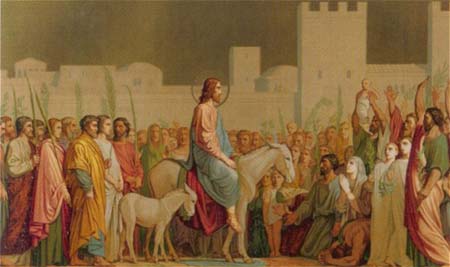
PALM SUNDAY: "The children of Israel carried olive branches..."

If you have never been to the pre-1955 traditional rite of Palm Sunday then you have missed something special.


It is increasingly being celebrated and its beautiful and ancient traditions are slowly being made more available to the Faithful who are fortunate enough to attend it.

This great service celebrates the entry of our Lord into the city of Jerusalem to be welcomed by His people as a king, a prophet and a saviour and as the very Messiah whom they had been awaiting for centuries but, in a few short days, were to reject.

This entry of the humble Christ into the city was foretold and prophesied by the prophet, Zechariah:

"Rejoice greatly, O Daughter of Zion!
Shout, Daughter of Jerusalem!
See, your king comes to you,
righteous and having salvation,
gentle and riding on a donkey, on a colt, the foal of a donkey.
I will take away the chariots from Ephraim
and the war-horses from Jerusalem,
and the battle bow will be broken.
He will proclaim peace to the nations.
His rule will extend from sea to sea
and from the River to the ends of the earth". (Zechariah 9:9-10)

The Holy Father, Pope Benedict XVI, when a Cardinal, attended a 1962 celebration at the Wigratzbad seminary of the the Fraternity of St Peter. At the end of the service he asked "Why did not the Subdeacon knock on teh church door with the bottom of the processional cross?"

Back came the answer: "It was stopped in 1955, your Eminence!".

"Oh!" exclaimed Cardinal Ratzinger, as he then was, "What a pity!"

Well, your Holiness, now is your chance to restore it in all its splendour!

This service is a particularly fine one, albeit lengthy (about 2 1/2 hours). The palms are blessed with many hymns, chants and prayers, and the people receive them, the choir singing Pueri Hebraeorum, portantes ramos olivarum (the children of Israel carrying olive branches), and there is a short-form mass at the altar. After this comes the Procession out of the Church, singing Gloria, laus et honor, tibi sit, Rex Christe Redemptor, and then back to the front door thereof.

At the door, 2 cantors enter and the doors are shut. They continue to sing and then the Subdeacon, outside, knocks on the door with the end of the processional cross. The doors open, to signify the entrance of Christ into Jerusalem and our entry into Heaven, and the procession moves back into the church, singing an ancient chant, Ingrediente Domino.

Then the main mass begins with many haunting and beautiful chants being sung, and then the Passion according to St Matthew in long form is sung, starting at the anointing of the feet of Jesus by St Mary Magdalene in the house of Simon the Leper.

This is a fitting way to recall the beginning of the Passion when our Lord was welcomed as a king and prophet into the holy city of Jerusalem by His people who, only days later, were to betray Him unto their Roman enemies to torture and death.

Soon many of those same Romans were to be converted whilst many of God's chosen rejected the very Messias whom they had been awaiting for so long.

In former times, the Roman Emperor would lead the Patriarch on a donkey up to the church door as part of the ceremonies and as a gesture of humility on his part. This tradition was continued by the Russian Tsars, also, until the custom was suppressed by the modernising, "enlightened" and very brutal dictator, Tsar Peter I.


Palm Sunday in Jerusalem


Hosanna to the son of David!

Thursday, 13 March 2008

Crux Fidelis: "Faithful cross above all other..."

This is another great traditional hymn by Venantius Fortunatus (530-609) used extensively in the Church’s public prayer and liturgy.

It is a beautiful hymn but again, sadly, all too rarely heard in the Novus Ordo liturgy but always heard in the traditional liturgy.

There are two hymns called Pange Lingua in use, one by St. Thomas Aquinas and this one, by Venantius Fortunatus extolling the triumph of the Holy Cross.

This, too, was written for the procession of the True Cross to Queen Radegunda in 570.

Traditional rite Catholics will be familiar with its use on Good Friday during the Adoration of the Cross but it will be even more familiar to those who use the traditional rite Breviary or Office books.

Liturgically the hymn is often broken up into smaller parts, particularly as Lustra sex and Crux fidelis.

The second verse makes reference to the pious tradition that the wood of the Holy Cross was taken from the Tree of Paradise in the Garden of Eden.

How can this be, you may ask.

The answer is thus: after the death of Adam, his son, Seth obtained from the Cherubim guarding the Garden a branch of the tree from which Eve ate the forbidden fruit. Seth planted this branch at Golgotha (the place of the skull), which is so named because Adam was buried there. As time went on, the Ark of the Covenant, the pole upon which the bronze serpent was lifted, and other items were made from this tree, so it is said.

You may have seen crucifixes with a skull below the corpus. This represents Christ’s victory over death but it also reflects the pious tradition that Adam was buried on Golgotha and that the blood of Christ seeped through the cracks in the earth and tomb beneath on and onto the skull of Adam beneath. Thus the bones of Adam were materially bathed in the Blood of Christ just as Original Sin, caused by Adam’s sin, is washed away by His Blood, the Blood of the Lamb of God, sacrificed as the Paschal Lamb upon the Holy Cross.


Golgotha: the place of the Crucifixion
beneath which was reputed to lie the tomb of Adam
and over which now stands the Church of the Holy Sepulchre


Pange Lingua (including Crux Fidelis)

by Venantius Fortunatus

PANGE, lingua, gloriosi
proelium certaminis,
et super Crucis trophaeo
dic triumphum nobilem,
qualiter Redemptor orbis
immolatus vicerit.

De parentis protoplasti
fraude Factor condolens,
quando pomi noxialis
morte morsu corruit,
ipse lignum tunc notavit,
damna ligni ut solveret.

Hoc opus nostrae salutis
ordo depoposcerat,
multiformis proditoris
ars ut artem falleret,
et medelam ferret inde,
hostis unde laeserat.

Quando venit ergo sacri
plenitudo temporis,
missus est ab arce Patris
natus, orbis, Conditor,
atque ventre virginali
carne factus prodiit.

Vagit infans inter arcta
conditus praesepia:
membra pannis involuta
Virgo Mater alligat:
et manus pedesque et crura
stricta cingit fascia.

LUSTRA sex qui iam peracta
tempus implens corporis,
se volente, natus ad hoc,
passioni deditus,
Agnus in crucis levatur
immolandus stipite.

En acetum, fel, arundo,
sputa, clavi, lancea:
mite corpus perforatur,
Sanguis, unda profluit
terra, pontus, astra, mundus,
quo lavantur flumine!

CRUX fidelis,
inter omnes
arbor una nobilis;
nulla talem silva profert,
flore, fronde, germine.
Dulce lignum, dulci clavo,
dulce pondus sustinens!

Flecte ramos, arbor alta,
tensa laxa viscera,
et rigor lentescat ille,
quem dedit nativitas,
ut superni membra Regis
miti tendas stipite.

Sola digna tu fuisti
ferre saeculi pretium,
atque portum praeparare
nauta mundo naufrago,
quem sacer cruor perunxit,
fusus Agni corpore.

Aequa Patri Filioque,
inclito Paraclito,
sempiterna sit beatae
Trinitati gloria,
cuius alma nos redemit
atque servat gratia. Amen.


=====

SING, my tongue, the Saviour’s glory;
tell His triumph far and wide;
tell aloud the famous story
of His body crucified;
how upon the cross a victim,
vanquishing in death, He died.

Eating of the tree forbidden,
man had sunk in Satan's snare,
when our pitying Creator did
this second tree prepare;
destined, many ages later,
that first evil to repair.

Such the order God appointed
when for sin He would atone;
to the serpent thus opposing
schemes yet deeper than his own;
thence the remedy procuring,
whence the fatal wound had come.

So when now at length the fullness
of the sacred time drew nigh,
then the Son, the world's Creator,
left his Father's throne on high;
from a virgin's womb appearing,
clothed in our mortality.

All within a lowly manger,
lo, a tender babe He lies!
see his gentle Virgin Mother
lull to sleep his infant cries!
while the limbs of God incarnate
round with swathing bands she ties.

THUS did Christ to perfect manhood
in our mortal flesh attain:
then of His free choice He goeth
to a death of bitter pain;
and as a lamb, upon the altar
of the cross, for us is slain.

Lo, with gall His thirst He quenches!
see the thorns upon His brow!
Nails His tender flesh are rending!
See His side is opened now!
Whence, to cleanse the whole creation,
streams of blood and water flow.

FAITHFUL Cross! Above all other,
one and only noble Tree!
None in foliage, none in blossom,
none in fruit thy peers may be;
sweetest wood and sweetest iron!
Sweetest Weight is hung on thee!

Lofty tree, bend down thy branches,
to embrace thy sacred load;
oh, relax the native tension
of that all too rigid wood;
gently, gently bear the members
of thy dying King and God.

Tree, which solely wast found worthy
this world's Victim to sustain;
harbour from the raging tempest!
Ark, that saved the world again!
Tree, with sacred blood anointed
of the Lamb for sinners slain.

Blessing, honour, everlasting,
to the immortal Deity;
to the Father, Son, and Spirit,
equal praises ever be;
glory through the earth and heaven
to Trinity in Unity. Amen.


The Cross shall triumph over sin...

...