Monday, 21 January 2008

Eilein Duinn: Karen Matheson sings for Rob Roy

Ailein duinn ("Dark-haired Alan") is the song sung during the Ceilidh in the film version of the life of Rob Roy, just before Alan MacDonald's riderless horse appears at the feast indicating foul play against him and Rob's borrowed money.

It is sung by the immortal Karen Matheson of the singing band, Capercaillie. Sir Sean Connery once said of her that her "throat has been touched by the hand of God".

This haunting melody sung by Karen can be heard on Youtube at the following site:

http://www.youtube.com/watch?v=x8OXbctQwXA

Ailein duinn is a Scots Gaelic (or Gallic) lament written for Ailean Moireasdan (Alan Morrison) by his fiancée, Annag Chaimbeul (Annie Campbell).

In 1788, Ailean, a sailor, set off with his ship to Scalpay, Harris, where he and Annag were to be married.

In a tragic twist, the ship sailed into a storm and all on board were lost.

Annag was devastated and lost her will to live, dying several months later. Her body was later discovered on the beach, not far from where Ailean's body was found. Before she died, Annag composed this lament for her lost love.

It is a story with a tragic ending and whilst it is not edifying that anyone should so lose the will to live yet Annag's undying love for Ailean cannot but move us.

The melody is deeply affecting and is a classic in the genre of the solo female voice singing the Gallic.

Here are the lyrics, in Gallic for those who read it, and translated for those who do not:

Gura mise tha fo éislean
Moch sa mhaduinn is mi g'éirigh

Sèist:
Ò hì, shiùbhlainn leat
Hì ri bhò hò ru bhì
Hì ri bhò hò rinn o ho
Ailein Duinn, ò hì, shiùbhlainn leat

Ma 's e 'n cluasag dhuit a ghaineamh
Ma 's e leabaidh dhut an gheamainn

Ma 's e 'n t-iasg do choinnlean geala
Ma 's e na ròin do luchd-faire

Dh'òlainn deoch ge b' oil le càch e
De dh'fhuil do choim 's tu 'n déidh do bhathadh

"How sorrowful I am
Early in the morning rising

Chorus (after each verse):
Ò hì, I would go with thee
Hì ri bhò hò ru bhì
Hì ri bhò hò rinn o ho
Brown-haired Alan, ò hì, I would go with thee

If it is thy pillow the sand
If it is thy bed the seaweed

If it is the fish thy candles bright
If it is the seals thy watchmen

I would drink, though all would abhor it,
Of thy heart's blood after thy drowning."


...

Rob Roy MacGregor: king of outlaws or oppressed son of the Church?

Robert Roy MacGregor, (1671-1734), called Rob Roy within the MacGregor Clan, was the most famous of the Gregor chieftains albeit not Clan Chief. The Chief of Clan Gregor is MacGregor of MacGregor. MacGregor means "son of Gregor".

The Highland chiefs often adopted the re-duplication of the name in the old Celtic style in preference to the Lowland custom of adding a “designation” to the name. A “designation” is the name of the lands whereon the Chief has his caput (Latin for "head"), his primary house or seat, for example “Cameron of Lochiel”, the Chief of Clan Cameron, has his seat at Achnacarry near Loch Eil.

This designative style is the same as that used by the European nobility who add the name of their primary estate to their name by custom or by royal or imperial permission.

Some other Highland chiefly styles are “The Chisholm” or “the Captain of Clan Chattan”, for example.

Clan Gregor – also called in Gallic, Gregarach - are one of the oldest of Highland Clans, the true “children of the mist”, as many call them whose origins stretch back to the earliest times.

The MacGregors being Catholics and Jacobites who actively opposed the oppressive Whig government were treated with great harshness and severity by the government. Because they resisted so stoutly the oppressive way they were treated, they were declared outlaw and even the use of their name was banned. The Highland dress and language, called Gallic (Scots Gaelic), had already been banned.

The treachery of the government is famously remembered in the story of the Massacre of Glencoe. MacDonald of Glencoe, having indicated he would take up the amnesty for Jacobite "rebels", entertained a party of British troops commanded by a Campbell (the arch-enemies of the Jacobites and especially the McDonalds and Camerons) and gave them hospitality, in return for which the Redcoats treacherously slaughtered many of the MacDonalds in their beds.

Men like MacGregor set themselves against this treachery and oppression and were outlawed for it.

As a result he is sometimes known as the Scottish Robin Hood. Rob Roy is anglicised from the Scots Gaelic Raibeart Ruadh, or Red Robert. This is because Rob Roy had red hair, though it darkened to auburn in later life.

Rob Roy was born at Glengyle, at the head of Loch Katrine. His father was Donald MacGregor, and his mother Margaret Campbell (not all Campbells were anti-Jacobite).

He later met Mary Helen MacGregor of Comar, who was born at Leny Farm, Strathyre, and they were married in Glenarklet in January 1693 later and had four sons: James (known as Mor or Tall), Ranald, Coll, and Robert (known as Robin Oig or Young Rob). A cousin, Duncan, was later adopted.

Rob and his father joined the Jacobite rising led by John Graham of Claverhouse, Viscount Dundee, along with many Highland chiefs and chieftains, to support the Stuart King James II and VII who had been deposed by William of Orange, the Stadtholder of the Netherlands and a scheming, ambitious Protestant but also the son-in-law of King James.

John Graham of Claverhouse (pronounced "Clavers"), Viscount Dundee, nicknamed "Bonnie Dundee" on account of his famous good looks.


“Bonnie Dundee”, as he was called on account of his handsome looks, was a brilliant Brigadier-General and persistently harried and defeated the government troops with his blue-bonneted Jacobite clansmen but, by an unfortunate chance, was killed at the point of victory in the Battle of Killiecrankie. Thereafter, lacking his brilliance, the Jacobite cause began to lose its advantage.

Rob’s father was taken to jail, where he was held on doubtful treason charges for two years. His mother’s health deteriorated during this time and she died upon Donald’s release.

Nevertheless, Rob Roy continued to fight in the Jacobite cause and led an army at the inconclusive Battle of Glen Shiel in 1719 in support of King James’s son, also James, the rightful King James III and VIII but who never regained his father’s throne. Rob Roy was badly wounded at Glen Shiel.

Thereafter, he was forced to become a cattleman and to sell protection for other men’s cattle, sometimes by taking them himself, robbing the rich to give to the poor. Needless to say, many Whig historians have – with consummate hypocrisy given their own legalised grand larceny and robbery – have much vilified him and his Clan for this “blackmailing”.

Rob Roy later borrowed a large sum of money to increase his own cattle herd, but due to a deception, some say by Whig skullduggery and some say by his own chief herder who was entrusted with the money to bring the cattle back, Rob Roy lost his money and cattle, and defaulted on his loan.

He was again re-branded an outlaw, and his wife and family were evicted from their house at Inversnaid, which was then burned.

His principal creditor was, ironically, James Graham, Marquess (later Duke) of Montrose who was close kinsman to John Graham, Viscount Dundee, the same “Bonnie Dundee” who had been the great Jacobite general.

Montrose seized his lands forcing Rob Roy to war with the Duke until 1722, when Rob was finally forced to surrender. Later imprisoned, Rob was finally pardoned in 1727 thanks to the fictionalised account of his life told by Daniel Defoe, the English novelist, entitled Highland Rogue which influenced King George I to pardon him. He died in his house at Inverlochlarig Beg, Balquhidder, on 28 December 1734.

His grave states, defiantly, “MacGregor despite them”, a reference to his determination to carry on his family name despite the oppressive ban upon it.

Sir Walter Scott, Bt, later glorified his name yet further in his 1817 novel Rob Roy.

The MacGregor seat, Glengyle House, on the shore of Loch Katrine, dates back to the early 18th century. It is built on the site of the 17th century stone cottage in which Rob Roy is said to have been born.

Glengyle House, Loch Katrine, in the heart of MacGregor country

In Robert Louis Stevenson’s novel, Catriona, sequel to Kidnapped, the hero. David Balfour of Shaws, meets and falls in love with Catriona MacGregor-Drummond, the daughter of James MacGregor-Drummond, also known as James Mor (meaning James the Great). There was a real James Mor MacGregor in the muster roll lists of the Battle of Culloden, the last great Jacobite battle in which “Bonnie Prince Charlie”, the grandson of James II and VII, was defeated and his wounded men massacred by the Whig general, “Butcher” Cumberland (Duke of Cumberland and a Hanoverian).

Catriona’s family append the name “Drummond” because the MacGregor name has been banned. Catriona engineers her father’s escape from prison. David marries her allying himself thereby with the Clan Gregor, the most ancient of the Jacobite clans.

The message is clear: the author, though a Protestant like Sir Walter Scott, is, like Scott, more in sympathy with the Jacobites than he is with those of his own background.


The grave of Rob Roy, his wife and children which defiantly states "MACGREGOR DESPITE THEM".

Domine, miserere eis.

Dona eis, Domine, requiem aeternam. Requiescant in pacem et lux perpetua luceat eis.


...

Tuesday, 15 January 2008

The truth about the Spanish laws against slavery: rebutting the atheist sceptics again

A recent correspondent thinks that all the Spanish rulers in Latin America were a parcel of rogues and trots out the usual Secular Fundamentalist claptrap, displaying the usual almost complete ignorance of history and not one shred of evidence to support her jaundiced hypothesis (bless 'er!).

Here's what she writes:

'Stepping out of the classifications of "Roman Catholic" and "protestant" and "freemasons" we can simply observe the phenomena from a human scale. All parties concerned exploited what seemed to be a good economic venture. Some parties tried to stop it but people will be people and humans tend to think more about themselves than other people. Protestant, Catholic, whatever, they all wanted the wealth of the New World and took it however they could, disregarding the inhumanity that brought it about. The Americas was peopled by Hidalgos and Conquistadors who were fresh from the Crusades and the Inquisition and wanted adventure. Besides the New World was peopled by pirates, buccaneers, criminals and other undesirables. No one could expect them to "behave" themselves and no one cared if they misbehaved because according to all of those groups enumerated, they were going to hell anyway, Amerindians and colonists alike. The MAJORITY felt that as long as they profited it would be fine. If all the people in the churches (this is plural, now) had felt so strongly about it they would have found a way to stop it. So, good intentions aside, all of these religious institutions oversaw the continuation of Amerindian exploitation and extinction and it didn't help that a few thought it was bad because most did not care.'

Here is how I replied to her:

'I'm sure you're a lovely lady. But...according to your world-view, seemingly, almost everyone is stinkingly corrupt, out for themselves, cares nothing for the rights of others, thinks more about themselves, that is just the way people are, whether Catholic or Protestant or Secular they are all out for one thing - themselves.

I do not share your cynical view of the world.

How does your cynical view accommodate the Jesuit saints who built the Reducciones for the native Indians like the Guarani?

How do you explain that a handful of Jesuits taught hundreds of Guarani how to build homes, town halls, magnificent churches, to play beautiful Baroque music, to make some of the best musical instruments in the world and so many other things?

Have you ever even heard the powerfully beautiful choral works that were written by Amerindian composers themselves - in the jungle, moreover! - having been taught the art of musical composition by the Jesuits in the 17th and 18th century?

Well? Have you?

St Peter Claver SJ, Apostle of the Slaves


How do people like St Peter Claver, who made himself the servant of the slaves, fit into your sad little view of the world?


What about St Martin de Porres, one of the most beautiful of the many amazing and wonderful black saints of the Catholic Church?

St Martin de Porres, the sainted Dominican lay brother

Were these people all pirates, buccaneers, criminals and undesirables?

Do you really believe that?

And, if not, then consider that the Church that inspired them to these great and heroic acts was none other than the Roman Catholic Church which you so much disdain to consider favourably.

Did this legion of friars, brothers, priests, nuns and sisters think that all those whom they gave their lives for were just going to Hell, were only good for exploitation, extinction and profit?

Did these sons and daughters of the Roman Catholic Church simply refuse to care?

No, of course not.

Why not?

Because they did not share your sad and cynical view of humanity and of the world. They saw the image of God in their fellow men and women and sought to serve them as they would serve God Himself.

They no longer thought chiefly of themselves but were ready to give themselves completely for others.

How quickly does this radical self-giving explode your sad little view of the world!

Do you see this? Do you see what it is that inspires these heroic saints? Can you comprehend it, my dear?

Let me tell you what it is.

It is what we Catholics call love.

I think you have been reading too much Philip Pullman and Dan Brown (you list them among your favourites) and have read too little of the actual laws passed by the Spanish Crown for the governance of the New World.

King Phillip II of Spain who maintained the laws against slaving in the face of opposition from godless Spanish anti-clericals and anti-monarchists in the New World

And you have obviously read even less of the lives of the saints!

The story of their lives is not some clever fairy tale dreamt up by a couple of cynical atheists, like Brown and Pullman.

The lives of the American saints are TRUE stories. They actually and really happened.

The evidence is there for you to read and discover - if you can bring yourself to do it.

BUT where is YOUR evidence?

I've given you evidence in the form of the actual laws that were promulgated by the Spanish Roman Catholic kings under the influence of the Spanish Roman Catholic Church.

It may suit your Secular Fundamentalist world outlook to believe that there is no difference between Catholics and other religions but history and fact are against you.

There were secularists in those days, too, however much you may wish to pretend otherwise.

And it is a matter of historical fact that the slavers were exactly the same people who became the anti-clericals and anti-monarchists who hated the Church and the Spanish crown.They hated Church and King because both outlawed the slave-trade by which the slavers were enriching themselves.

Read the facts and face the truth - if you dare.

Read and be amazed!'

But will she?

I wonder.

St Peter Claver and St Martin de Porres, pray for us!


...

Monday, 14 January 2008

Jefferson Davis: answering the sceptics

I am still getting posts from sceptics who are (all innocently in most cases) still so badly infected with modernist historical piffle and secular fundamentalist propaganda that they just cannot bring themselves to believe that Jeff Davis wore Catholic devotional symbols about his person.

One good-natured soul writes thus:

"I would REALLY love to believe all of this, really I would... But do you have a citation for

'Davis always wore a St. Benedict Medal and a Miraculous Medal as well as a French scapular. Someone had also given him the brown scapular of the Discalced Carmelites. All of these he wore in prison and preserved to the end of his life.'

I wear all of those as well... would love to believe he did too, but... I am not sure I believe this one."

I answer him/her thus:

"Worry no more.

You may believe it all!

There are a number of sources but this one is good:

Jefferson Davis: the Unconquerable Heart (1999) by Felicity Allen (Blue and Grey Series).

At page 440, she writes this:

'Davis wore round his neck at that very moment, besides his St Benedict medal the one already known as 'Miraculous', struck just 33 years before, from the vision of a French Sister of Charity, still living, who would one day be known as St Catherine Laboure.

Nor were these all: thin woven laces over his shoulders held on his breast and back the little cloth panels of a French scapular. Both these distinctly Roman Catholic channels of blessing had been sent to him by the Sisters of Charity who had cared for his family in Savannah.'

Believe and be no more unbelieving, O ye of little faith!

I realise that it is hard for us moderns to get our heads round the fact that the secular, liberal, anti-Christian view of history is false but you really must try and overcome the Secular Fundamentalist mumbo-jumbo that the media, the chattering classes and the more worldly of your teachers and professors have tried to hoodwink you with!

Real history and the truth is much more interesting, fascinating, inspiring and fulfilling.

FREE YOUR MIND!

REJECT SECULAR FUNDAMENTALIST CLAPTRAP NOW!

And enjoy the book, too!"

Yes, folks, Jeff Davis really did wear them!


...

Wednesday, 9 January 2008

Who is Yeshua Moshiach?

Well, apparently these people know:

http://www.ark-of-salvation.org/jesus_christ_2003.htm

But - absurdly - they don't know why He is usually called

JESUS CHRIST


Here is what their web-site says about the Holy Name:

"Although this name is not at all difficult for English speakers to pronounce, the King James translators of the Bible chose to take his name from the Greek New Testament, in which book he was called Iesous. This name, for reasons which are not entirely clear, became Jesus in England."

Not clear?

What poppycock!

The reasons are entirely clear. The language of the Christian Church became Latin after the Roman Empire became Christian.

Any simpleton knows this, surely?

And the Latin for Yeshua or Iesous is Jesus.


The Anointed Saviour - Yeshua Moshiach

The English equivalent is Joshua. So if they want an English translation they should call our Lord by the name of Joshua Christ.

But they don't.

They call Him Jesus Christ just as we do in the Roman Catholic Church.

Yet another example of the simple truth that Christianity is Roman and Catholic, that the Roman Catholic Church gave to the whole world the first message of Christianity and that is why the Latin version of our Lord's name is the name that is universally used.

The name, as I said in my last post, means

SAVIOUR, ANOINTED OF THE LORD


Yeshua means "saviour" and Moshiach means "Anointed of the Lord" which is often rendered "Messiah" or "Messias".

In Greek, the language of the Septuagint and the New Testament, it is Iesous Christos and in Latin, the language of the Roman Empire and of the Church, it is JESUS CHRISTUS.

The word "Chrism" has the same root since the Oil of Chrism is used for anointing.

How, therefore, can these people say that the Holy Name of Jesus is used in England for "reasons which are not clear"?

There are none so blind as those who will not see...


...

Tuesday, 8 January 2008

The gifts of the Kings and the blessing of the sons of Israel

I have been asked what is the value of the gifts of the 3 Kings.

Their monetary value is of little significance although we know that they were "costly".

Were they sold or used? We do not know for certain.

In those days, the Jews were allowed, by concession only due to their avarice according to Moses, to "fenerate" (i.e. lend at interest) to non-Jews since the prohibition was, they said, only against fenerating to one's brethren.

Christianity said that all men are brothers and so we may not fenerate to any man.


According to the visions of Blessed Anna Catherine Emmerich, recently beatified by Pope John Paul II in 2004, the gifts were costly and were taken from the cave at Bethlehem by the family of the Blessed Virgin under the supervision of St Anne, the mother of the Virgin.


They were taken back to Nazareth and kept there until the Holy Family returned from Egypt.

There is a tradition that the Myrrh was carefully preserved against the day of our Lord's entombment when the women disciples recovered it from the Blessed Virgin to anoint the body of Christ.

The real significance of the gifts is that they represent the 3 aspects of our Lord's ministry and the 3 roles of a Christian, in imitation, namely:

(1) Gold - for a king;

(2) Incense - for a priest;

(3) Myrrh - for a holy death, the symbol of the prophetic role.

These are our 3 roles, Kingly, Priestly and Prophetic of which the Prophetic is the greatest since Joseph, the son of Jacob/Israel, received the double portion that would normally go to the eldest son, Reuben, who was disinherited, even though Jacob was the youngest son. See Gen 49 and the blessing by Israel of his sons and the apportionment of their inheritance.

The next 2 sons, after Reuben and Simeon, were Levi and Judah and they fulfilled the priestly and kingly roles respectively.

The sons of Levi, despite being deprived by Jacob of their inheritance because of Levi's savagery against the Sichemites, were to be the clergy of Israel.

The sons of Judah were the royal princes of Israel.

They retained the royal sceptre until the coming of Christ, according to Jacob's prophecy written at Gen 49:10 thus:

"The sceptre shall not be taken from Judah, nor a ruler from his thigh, until He come that is to be sent, and He shall be the expectation of the nations."

This is yet another proof that the Messias has come since the sceptre was, indeed, taken from Judah and from the whole of Israel shortly before the birth of Christ when Pompey the Great took Jerusalem, subdued the Jews, profaned the Temple and Holy of Holies and abducted Aristobulus the High Priest.

Thereafter Cassius despoiled the Temple and further subdued the Jews.

At this time the Jews are the Church since the Messias is yet to come. After He comes, He teaches His people the fulfulment of the Law and the Prophets, namely Catholic Christianity which is, for all time, the true religion of God, of His prophets, priests and kings, as taught by His son, Yeshua, the Aramiac word for "Saviour" or "Salvation" which was rendered into Greek as Iesous, and in Latin as Jesus. It is the same name as Joshua.

The name Jesus Christ means "Anointed Saviour" and the word "Messias" or "Messiah" from the Hebrew/Aramaic Mashiach means "the Anointed of the Lord".

Thus the Messias or Messiah and Jesus Christ are one and the same person, namely God, Adonai, Elohim, the 2nd Person of the Holy Trinity and the Saviour of the Jews, of the Gentiles and of the world and all mankind.

To modern Jews, of course, this is blasphemy but to Christians it is the sacred truth. Nevertheless, although we strongly disagree with the modern Jews on this central point, we should continue to respect them and their traditions to the extent that they are a reminder to us of the ancient traditions upon which the true Church of God is built, that is, the Law and Prophets of the Old Testament and all the great prophecies of the coming of the Messias.

After the death and Resurrection of our Lord, Jerusalem was sacked and the Temple destroyed utterly by the Roman Emperor and Caesar Augustus, Titus Flavius Vespasianus, known to history as Titus, the son of the Emperor Vespasian.


Francesco Hayez. Destruction of the Temple of Jerusalem. 1867.

Israel blessed his youngest son with the double portion that is normally given only to the eldest son. Joseph was the specially chosen, the type of the Prophets and of the blessed, though he was the youngest.

God inspired Israel so to act in order to show that the Prophetic role is the greatest role, greater than the Kingly or the Priestly because it is the role of teacher by example which pleases God the best.

This should provide an antidote to the pride of kings and priests who, through history, constantly challenge each other's superiority when they should both bow low before the exemplars of the greatest of the roles, namely the Prophetic role.

The greatest exemplar of the Prophetic role is the Blessed Virgin Mary, the very greatest of the seed of Adam, of the daughters of Israel and Jerusalem and the Queen of all the Prophets, Priests and Kings.

The Blessed Virgin Mary, the greatest of all the daughters of Israel and the Queen of all Prophets


All Christians are called to all 3 roles but especially the Prophetic role.

As Kings (and Queens) we rule in our homes and in any position of authority, paternal or maternal especially, to which we are called.

As Priests we are called to pray and to sacrifice.

As Prophets we are called to witness to the Faith, to make ourselves and others holy by our example and good counsel.

The blessing of Israel upon Joseph is itself highly prophetic (Gen 49:26):

"The blessings of thy father are strengthened with the blessings of his fathers, until the desire of the everlasting hills should come; may they be upon the head of Joseph, and upon the crown of the Nazarite among his brethren"

It would take another whole post just to unpack this verse alone!

The successor of the last of the Kings of Judah was, in fact, St Joseph, the foster-father of our Lord. He, too, succeeds to the double blessing of his namesake, Joseph, the son of Israel, and it is his privilege and duty to guard and nurture that "Desire of the everlasting hills" of which Israel speaks, namely the Messias Himself, Jesus Christ. Thus our Lord is, in material historical fact, as well as spiritually, King of Israel, Judah and the Jews.

He is really and truly the "King of the Jews".

These are but some of the many meanings associated with the gifts of the Magi.

...

Monday, 7 January 2008

Feast of the Kings: "the kings of Arabia and Saba shall bring gifts"

The Epiphany
of the Lord
to the Gentiles

on the same day as
the Baptism of the Lord
and
the miracle of wine at the wedding feast in Cana of Galilee


Bartolomeo Esteban Murillo. The Adoration of the Magi. 1655-60.


"When Jesus therefore was born in Bethlehem of Juda, in the days of king Herod, behold, there came wise men from the East to Jerusalem, saying: where is he that is born king of the Jews? For we have seen his star in the East, and are come to adore him. And king Herod hearing this, was troubled, and all Jerusalem with him. And assembling together all the chief priests and the scribes of the people, he inquired of them where Christ should be born. But they said to him: In Bethlehem of Juda. For so it is written by the prophet: and thou Bethlehem the land of Juda art not the least among the princes of Juda: for out of thee shall come forth the captain that shall rule my people Israel.

Then Herod, privately calling the wise men learned diligently of them the time of the star which appeared to them; and sending them into Bethlehem, said: go and diligently inquire after the child, and when you have found him, bring me word again, that I also may come and adore him. Who having heard the king, went their way; and behold the star which they had seen in the East, went before them, until it came and stood over where the child was. And seeing the star they rejoiced with exceeding great joy. And entering into the house, they found the child with Mary his mother, and falling down they adored him: and opening their treasures, they offered him gifts; gold, frankincense, and myrrh. And having received an answer in sleep that they should not return to Herod, they went back another way into their country."
[Matt 2:12 - Gospel for the Mass of the Epiphany]


The shrine of the Three Kings at Cologne Cathedral

The Shrine of the Three Kings in Cologne Cathedral contains their relics brought from Milan by ship to the City of Cologne on the order of the Holy Roman Emperor, Frederick Barbarossa, in 1164 as a gift to the Prince-Elector Archbishop, Rainald of Dassel.

This gave rise to the English Carol "I Saw Three Ships Come Sailing in".

The relics had first been taken from Constantinople to Milan in 344 by Bishop Eustorgius of Milan.

Around 1199, the Roman Emperor Otto IV gave three golden crowns made for the three wise men as a present to the church of Cologne, the city where, the previous year, he had been elected King of the Romans and Emperor-elect by the Prince-Electors of the Empire (he later gained the support of all the imperial princes at Frankfurt in 1208).

An inscription reads:

Otto rex coloniensis curiam celebrans tres coronas de auro capitibus trium magorum imposuit.

Emperor Otto IV was the only member of the Welf dynasty to be elected Holy Roman Emperor and, being the son of Matilda Plantagenet (married to Henry the Lion, Duke of Bavaria), he was allied to England in the Franco-English wars. He was also the personal preference of Pope Innocent III, who crowned him Roman Emperor at Rome in 1209, although they later fell out over the issue of the imperial rights in Italy.

Because of the importance of the shrine and the cathedral for the later development of the city, the Coat of Arms of Cologne still shows these three crowns symbolizing the Three Kings.

Construction of the present Cologne Cathedral was begun in 1248 to house these important relics. The cathedral took 632 years to complete and is now the largest Gothic church in northern Europe.

On July 20th, 1864, the shrine was opened, and remains of the three Kings and the coins of Philip I, Archbishop of Cologne, were discovered.

An eyewitness report reads:

“In a special compartment of the shrine now there showed - along with remains of ancient old rotten or moulded bandages, most likely byssus, besides pieces of aromatic resins and similar substances - numerous bones of three persons, which under the guidance of several present experts could be assembled into nearly complete bodies: the one in his early youth, the second in his early manhood, the third was rather aged. Two coins, bracteates made of silver and only one side striken, were adjoined; one, provably from the days of Philipp von Heinsberg, displayed a church, the other showed a cross, accompanied by the sword of jurisdiction, and the crozier on either side.”

The bones were wrapped in white silk and returned to the shrine where they remain to this day to be venerated by all the Faithful.

By long tradition, on the Feast of the Epiphany – called Dreikoenigsfest (the Feast of the Three Kings) in the lands of the old Holy Roman Empire – the Rector of the Parish (or in his absence, the father of each family) visits each house with a cross-bearer, 2 acolytes and 3 children dressed as the kings, one bearing a censer with lighted incense. At each house a little ceremony takes place, the house is blessed with Epiphany water, and over the door lintel of the house the following is inscribed with blessed chalk:


20 + C + M + B + 08


In my house we always perform this traditional ceremony.

This symbolises the present year and the blessing of the 3 Magi, Caspar, Melchior and Balthazar, upon each home.

The symbols remain all year or until the weather has washed them away.

Blessed Caspar, Melchior and Balthazar, wise men and kings from the East, pray for us!


+


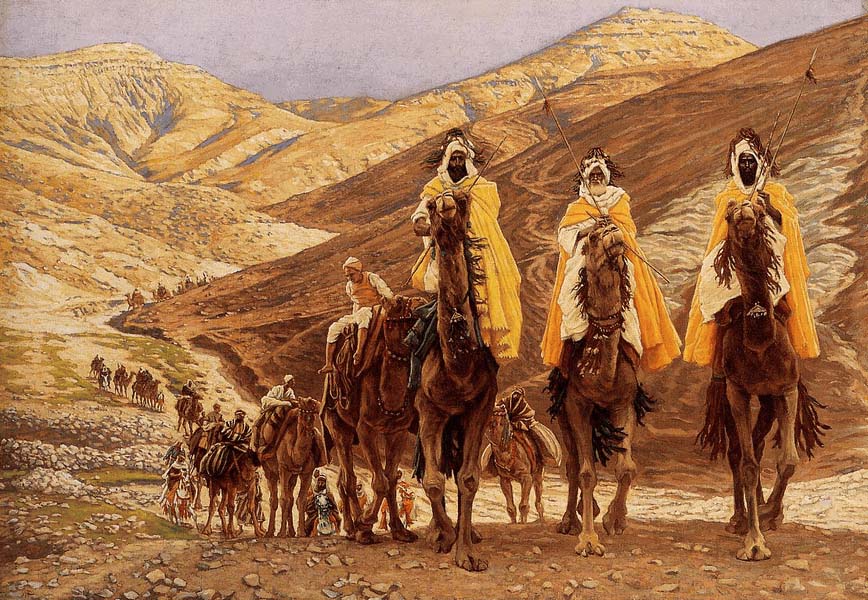
The Journey of the Magi

by T S Eliot


A cold coming we had of it,
Just the worst time of the year
For a journey, and such a long journey:
The ways deep and the weather sharp,
The very dead of winter.
And the camels galled, sore-footed, refractory,
Lying down in the melting snow.
There were times when we regretted
The summer palaces on slopes, the terraces,
And the silken girls bringing sherbet.
Then the camel men cursing and grumbling
And running away, and wanting their liquor and women,
And the night-fires going out, and the lack of shelters,
And the cities dirty and the towns unfriendly
And the villages dirty and charging high prices:
A hard time we had of it.
At the end we preferred to travel all night,
Sleeping in snatches,
With the voices singing in our ears, saying
That this was all folly.

Then at dawn we came down to a temperate valley,
Wet, below the snow line, smelling of vegetation;
With a running stream and a water mill beating the darkness,
And three trees on the low sky,
And an old white horse galloped away in the meadow.
Then we came to a tavern with vine-leaves over the lintel,
Six hands at an open door dicing for pieces of silver,
And feet kicking the empty wineskins.
But there was no information, and so we continued
And arrived at evening, not a moment too soon
Finding the place; it was (you may say) satisfactory.

All this was a long time ago, I remember,
And I would do it again, but set down
This set down
This: were we led all that way for
Birth or Death? There was a Birth, certainly,
We had evidence and no doubt. I had seen birth and death,
But had thought they were different; this Birth was
Hard and bitter agony for us, like Death, our death.
We returned to our places, these Kingdoms,
But no longer at ease here, in the old dispensation,
With an alien people clutching their gods.
I should be glad of another death.


+ + +

"three trees on the low sky... I should be glad of another death."

...