Monday, 3 September 2007
I love real nuns...
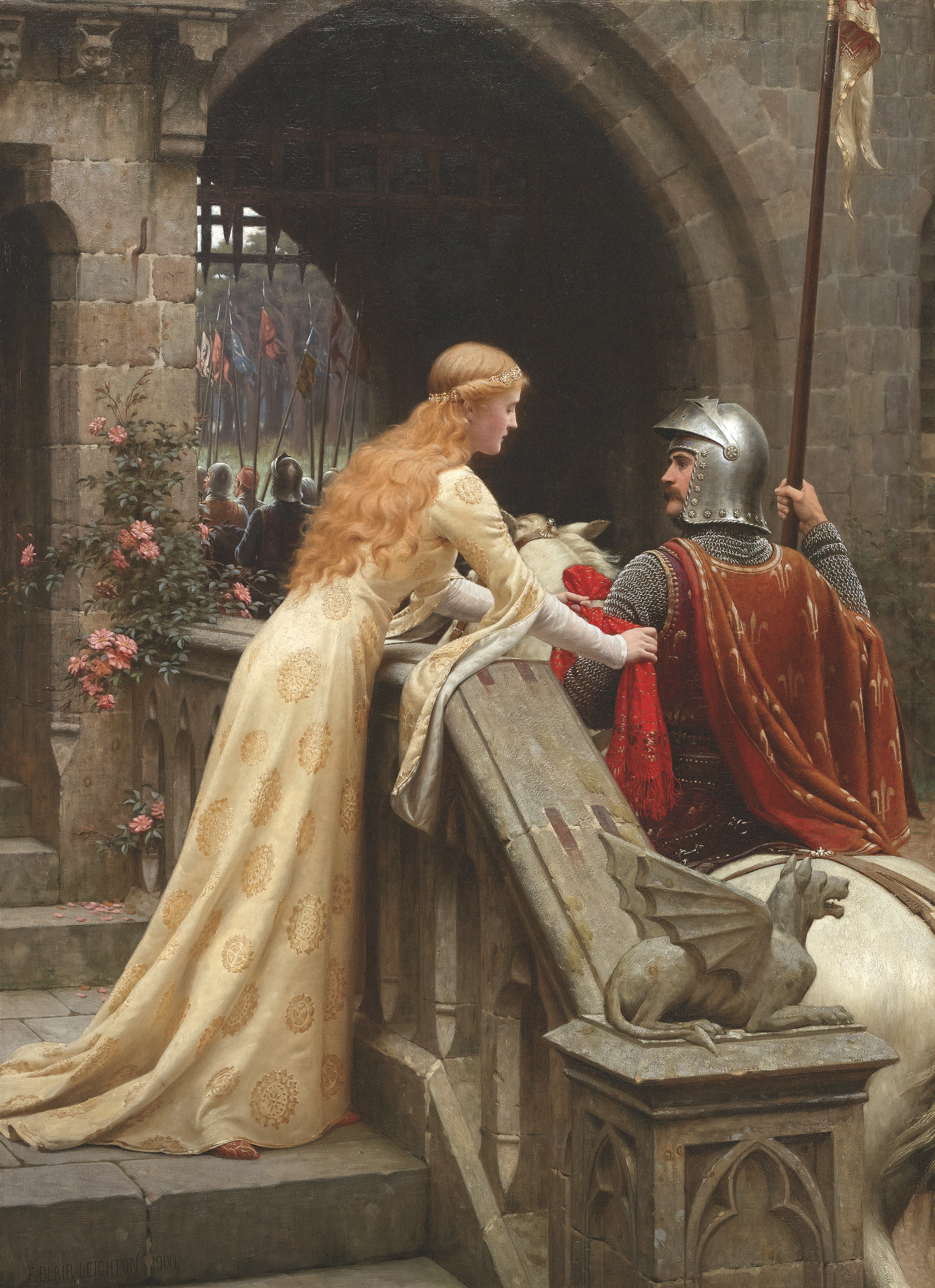
Ladies, if you want to be really feminine then try being a real, old-fashioned, traditional nun.
Accept no inferior substitutes!
Nowadays we hear so much utter nonsense talked about old-fashioned and traditional nuns. I have met hundreds of them and they were always a delight - charming, gifted, polite, often highly intelligent, learned even, compassionate, and always dignified and attractive. Even when nature did not bless them with conventional good looks, their deportment and manners coupled with their wimples and habits give them the beauty and character of little princesses.
But at the same time they are so often tough and resilient, able to tend to the most trying and difficult situations (in varying degrees, of course!) and are able to turn from entertaining a Duchess to fishing orphaned babies out of rubbish bins.
Other religions look on with envy and secularists positively fume that they cannot produce anything so impressive. So they turn to abuse, mocking, lies and calumny to try to bring these amazing women down to their own inferior level.
But to no avail. We shall have dignified nuns until the end of time, rage Satan and his minions never so much.
Even if, like Sister Luke in the film The Nun's Story (played by Audrey Hepburn), a sister leaves the convent there are still plenty to fill her place. Sister Luke left to fight the Nazis but today there are plenty who run away for less noble reasons but these are not really traditional nuns. They are the other kind of sister - the fakes.
I do not speak of them. They are the foolish virgins of Scripture and, oh my golly, are there not a lot of them these days! Sorry, Sister Serendipita - or whatever your name is - God loves you but you are not the kind of nun I am talking about. I'm talking about the real ones!
And, ladies, it's the real ones who really appeal to people, even to those of no faith. Men prefer them, too. I often ask myself why that is and I have come to the conclusion that it is because, in striving to be holy, they also become immensely feminine and modest and thus attractive to men - but attractive in the right way, the sort of way that women want to be attractive to men i.e. as their true selves.
Which brings me to another point: if modern women realised how attractive modesty makes them to men, some of them might ditch all this "me first" Feminist drivel.
Which is why real nuns are so important today. They show women how to be women and - ironically - though they themselves are already betrothed to Christ, their true husband, they nevertheless show other women how to be feminine and thus how to attract a good husband of their own. Which is a big problem these days - lots of girls want good husbands and can't find them.
Well, girls, go to a traditional convent for a while and learn from the good sisters. You'll soon have a good husband in no time!
Believe me. I'm a man. At least I know a little bit about this one!
Equally, I think that the real vocations crisis today is not that of priests but rather of women - women religious and women as wives and mothers. Secular Feminism has created that problem. It has made women unfeminine and more like men. Few man want to marry a woman who is like a man!
For those who would like to visit a convent of real nuns - and really delightful ones, too - visit the Benedictine sisters of the Abbey of St Cecilia's at Ryde on the Isle of Wight. They are a delight. And they sing like angels.
See their website here:
http://www.stceciliasabbey.org.uk/introduction/1.swf
Long live real nuns. We need them more than ever today!
...
Saturday, 1 September 2007
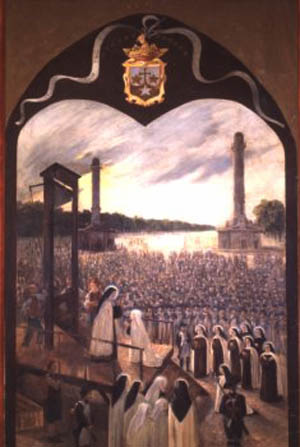
Veni Creator Spiritus: the holy and Royal Carmelites of Compiegne
Mother Henriette de Jesus, renowned for her great beauty and strong personality, stood up to represent the other Carmelite sisters before the revolutionary tribunal.
Since the prosecutor accused the Carmelites of being fanatics and counter-revolutionaries, she asked him to explain the meaning of those words. The irritated judge vomited a torrent of offenses against her, and then said: "It is your attachment to your Religion and the King". Hearing these words, she replied, "I thank you for the explanation". Then, addressing her companion Carmelites, she said: "My dear Mother and my Sisters, we must rejoice and give thanks to God for we die for our Religion, our Faith, and for being members of the Holy Roman Catholic Church".
In particular, the Revolution hated the fact that they promoted the counter-revolutionary and royalist devotion to the Sacred Heart and to the Infant Jesus of Prague, a long-standing Carmelite devotion associated with royalty and nobility and the Order of Malta in Prague. In truth, however, they were devotions much beloved by the ordinary people - not least, of course, in Ireland where the Carmelites became very popular (I cannot suppress a chuckle to see Irish republican Catholics warmly attached to such royalist devotions!).
She was the last one before the Prioress to mount the scaffold to die. To the end, she encouraged her Sisters to persevere. When a charitable person offered a glass of water to one of the Sisters, Mother Henriette told her: "In Heaven, my Sister, in Heaven we will soon have water aplenty to drink."

The late Brazilian Catholic scholar, politician and activist, Professor Plinio Correa de Oliveira comments upon this remarkable story:
"These Sisters knew that they were being put to death for their fidelity to the Catholic Church and the King, but they wanted the prosecutor to admit it out loud, because this would be a public witness of their martyrdom and an encouragement for them in face of the dangers of apostasy. This is why Mother Henriette was charged with asking that question.
When the answer came, she was happy and transmitted it to her Mother and Sisters in religion. All of them shared that joy and went forward to die. Mother Henriette, who was very resolute, offered assistance to each of them until the end. Only the Prioress, Mother Teresa of St. Augustine, died after her, because she was the superior, and the Captain must always be the last one to leave the sinking ship...
You can contrast Mother Henriette de Jesus with an imaginary personage in a popular novel, The Dialogue of the Carmelites by George Bernanos. The character was called Blanche de la Force and was presented as a weak and timid Carmelite Sister. She is an imaginary personage, but it is worthwhile considering her, because she represents a common character type. In his novel, Bernanos presented her as a Sister who had panicked when the other Sisters were taken by the revolutionary soldiers and sentenced, and for this reason had apostatized from the Order. She was no longer living inside the Carmelite community, but she went to see the execution of her former companions who would suffer martyrdom that day. The Sisters were chanting the Veni Creator in chorus and, one by one, they walked up the steps to the scaffold to be guillotined. When she saw this, she was moved by a grace, stepped out of the mob and, singing, joined the cortege to be executed along with them.
The two attitudes of both religious, Mother Henriette and Sister Blanche, express well the different paths of Divine Providence for different souls - the different marvels God works with His chosen ones. For some He chooses the glory of repentance; this is one of the glories attributed to the Apostles who fled during His Passion. For others He gives the strength that he gave to Mother Henriette of Jesus, that is, to view death from a distance and face it bravely, walking toward it joyfully. This was what He did with Mother Henriette, who helped all the others face their martyrdoms. These are two different paths God chooses to lead and direct souls. Seeing these two contrasting paths, you can admire the infinite beauty of God in the unity and variety of His ways. This is why the Saints are different from one another and why there are different schools of spirituality in the Catholic Church. It serves to show the beauty and richness of Holy Mother Church, a reflection of the beauty of the Heavenly Jerusalem".
.jpg)
The Veni Creator Spiritus is the hymn sung at Pentecost and after, calling upon the Holy Spirit to descend upon us and is often sung at the Ordination of a priest or the Reception of a sister into the convent. It, together with the Whitsun Sequence, Veni Sancte Spiritus, are two of the most ancient and beautiful chants sung by the Roman Church to the Holy Spirit.
Here is the Veni Creator sung in Boulogne Cathedral:
http://www.youtube.com/watch?v=1mlLz5eHhW0
Perhaps the best story told of these most holy Carmelites is that told by Gertrude von Le Fort, a German-French convert from Protestantism, who writes superbly well the Bernanos story of Blanche de la Force, the little marchioness who is afraid of her own shadow and flees the convent at the first sign of trouble but returns to watch the other sisters die at the scaffold. There courage suddenly comes to her, almost miraculously. The author tells the story as an observer of these momentous events:
"I stood in the midst of the howling rabble. Never have I felt the hopelessness of our position so desperately as then. You know that I am not tall. Chaos surged above me. I was immersed in it. I could not see what happened, I could only hear. All my powers of perception centred in the sense of hearing and sharpened it incredibly.
The Carmelites were coming to Revolution Square, singing, just as Sister Marie had expected. Their psalms could be heard from afar and penetrated the screams of the populace with strange clarity. Or did the tumult subside as the victims came in sight? I could scarcely distinguish the last words of the Salve Regina - sung, you know, at the deathbed of a nun - and soon after the first line of the Veni Creator. There was something light and lovely in their singing, something tender and yet strong and serene. Never would I have thought that such song could flow from the lips of those condemned to death. I had been deeply agitated, but when I heard this singing I grew calm. Creator Spiritus, Creator Spiritus - I seemed to hear these two words again and again. They cast anchor within me.
The song flowed on full and clear. To judge by the sound, the cart must have been moving very slowly. Probably the crowd blocked the way. I had the feeling that the nuns were still far from the square. For this singing transcended all sense of time; it transcended space, even bloody Revolution Square. Creator Spiritus, Creator Spiritus! It effaced the Guillotine. It effaced even chaos. All at once I had the feeling of standing among human beings again...
I was startled - Revolution Square was deathly still. Even at the execution of the King there had not been such utter silence. The song seemed fainter too. Probably the cart had gone on; perhaps it had already reached its goal. My heart began to pound. I was suddenly aware that a very high voice was lacking in the chorus - a moment later, another...I thought that the execution had not even begun and in reality it was almost over!
Now only two voices sustained the song. For a moment they hovered like a shining rainbow over Revolution Square. Then one side extinguished. Only the other continued to glow...shimmering...fading - but quickly the song was taken up by another voice, thin, frail, and childlike. I had the impression that it was not coming from the height of the scaffold but from the thick of the crowd, just as if the people were making a response. Wondrous illusion!
At the same moment the dense lines heaved and broke. A gap opened right in front of me, just as on that September night. And I saw - exactly as on that night - Blanche de la Force in the seething mass of those dreadful women. Her small pinched face broke forth from its surroundings and cast them aside like a wrap. I recognised her every feature, and yet I did not recognise her face - it was absolutely fearless. She was singing. In her small, weak, childlike voice she sang without a tremor, exulting like a bird! All alone across the great terrible square she sang the Veni Creator of her Carmelite sisters to the very end:
Deo Patri sit gloria
Et Filio, qui a mortuis
Surrexit, ac Paraclito
In saeculorum saecula.
Distinctly I heard the profession of faith in the Holy Trinity. The Amen I did not hear - the furious women struck her down on the spot.
And now, my friend, the rainbow over Revolution Square had died away. And yet I had the feeling that the Revolution was over. As a matter of fact, the Reign of Terror collapsed ten days later."
Indeed, it did!
For ten days later the leading figure of the Terror, Robespierre, was himself arrested and taken to the Guillotine.
The awful murder of the holy Sisters of Carmel had turned even the brutal Paris mob and they had, at last, become sickened. They now demanded the head of the chief terrorist himself.
From Heaven, the holy sisters, now rejoined by the little Marquise de la Force, Sister Blanche once more, interceded most powerfully for the devastated vineyard that was France and the 13 month Reign of Terror at long last came to an end.
Holy Carmelites of Compiegne, pray for us!
...
Saturday, 25 August 2007
The incomparable beauty of holiness...
It is indeed a story written by an Angel at the command of the Holy Spirit, Almighty God Himself.
It is a story written, embroidered and made more perfect still over centuries by the Divine Hand re-living and re-capturing the history of His own sacrificial intervention into human history, the greatest of all events.
There was none greater.
The liturgy of the Church re-lives, over the course of the year, the story of our salvation and the life of Christ, just as the Mass itself re-lives, in an unbloody manner, the holy sacrifice of Christ redeeming us and atoning for us.
Thus the liturgical year begins with the coming of Christ, Advent and Christmas, touches upon His hidden life, then leads on to His public ministry, teaching and witness, his time of temptation and trial in the desert, Lent, then of the adoration of the Jews and their betrayal (Passion Week and Palm Sunday).
Then we enter into the most sacred season of the year, Holy Week and the Sacred Triduum of the 3 days when our Lord fulfils the Passover (the Pesach), immolating His own Divine self, the long-awaited Messias, to be the Paschal Lamb without blemish and the perfect offering to the Father, and makes of it the Holy Sacrifice of the Mass and the Holy Eucharist and ordains the Priesthood of the new Covenant to perpetuate the memory of both His Sacrifice and His subsequent Ressurrection from the Dead.
On Easter Saturday the children of God wait by the sealed tomb knowing that He has descended into Hell, to the Limbo of the Just, to open the Gates thereof and liberate the Prophets and Patriarchs, all the just who were awaiting entry into Heaven.
In the West until the 12th century, and in the Eastern Church to this day, on Holy Saturday the Faithful keep vigil all night until sunrise, processing with the Pope, the Emperor, the Cardinals, the Prince-Electors, the bishops, nobility, clergy, senators, religious and people and the whole Body of Christ, re-illuminating with fire the lights of the Church as lumen Christi (the light of Christ), singing the praises of God in an exultation (exultet) of praise and praying for Pope, Emperor and people.
There was also final instruction to the neophytes about to be baptised, the story of salvation history from Genesis to the coming of the Messias, blessing the water of regeneration and baptism, invoking the saints, singing the Divine Office, re-enacting the searches for the Body of Christ and the encounter of the Holy Women who were first to find the Empty Tomb and, later, the risen Saviour.
Until 1955, the Papal choir of St John Lateran intoned the 12 Prophecies in both Latin and Greek, making fully 24 readings in all. There was no question of minimising then! How pathetically weak we are that we now complain if we have to keep vigil at the tomb of Christ for more than an hour or so!
Thereafter, during Eastertide, the Church basks in the glory of the Resurrection, a foretaste of Heaven, and remembers the encounter on the Road to Emmaus.
Then comes the Ascension, the first Apostolic Novena of prayer followed by the coming of the Holy Ghost at Pentecost when, until 1955, the Roman Church celebrated, on the eve of this great Feast, a smaller version of the Easter Vigil.
Thereafter is the time of Pentecost, Whitsuntide, when the Church begins to enjoy the fruit of the Resurrection, commemorating the great gifts of God, the Holy Trinity, Corpus Christi, the great Feasts, the Feasts of our Lady, the saints raised up in each generation, All Saints, All Souls, praying for the Dead, and expounding and glorifying the teachings of the Church, working to restore the social Kingship of Christ, and ending with the prophecies of the End-times.
Then we begin again with Advent.
This is the Liturgical Year, extolled by Rt Rev Dom Prosper Gueranger OSB, the Abbot of the restored Abbey of St Peter of Solesmes, and the great champion of the Roman rite.
Anyone who thinks this is marginal or unimportant has failed dismally to understand the first lessons of prayer.
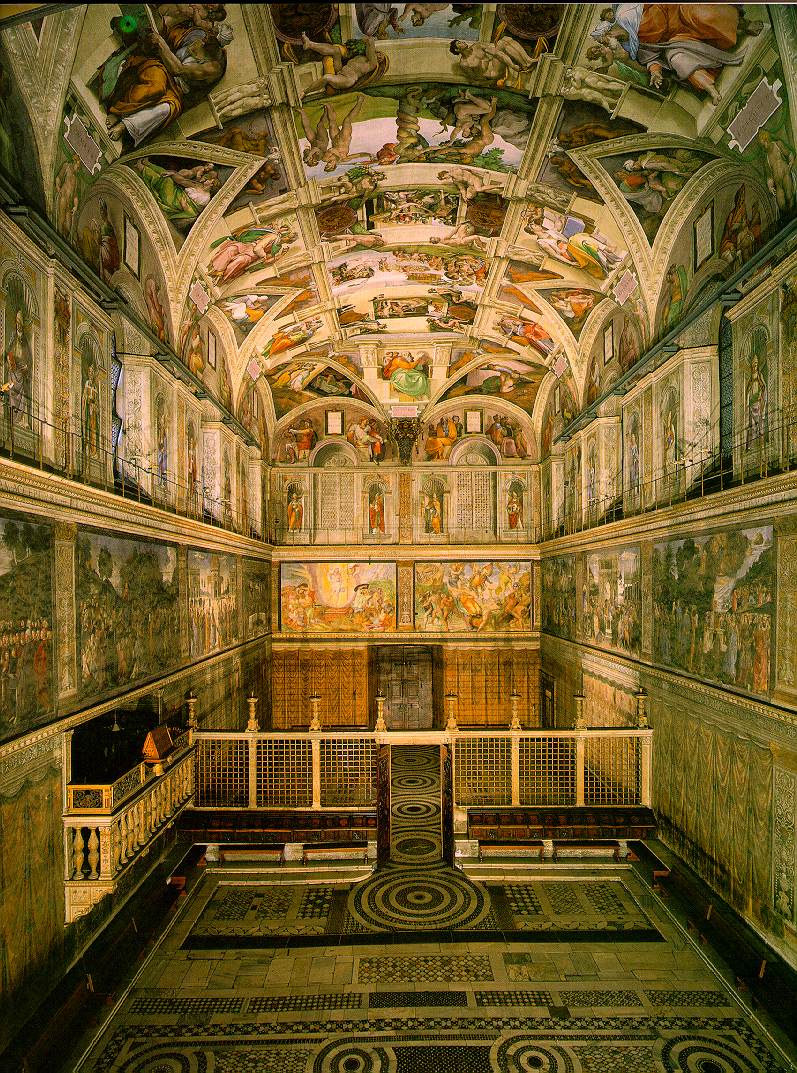
Imagine you are here:
and you are at Tenebrae (Matins and Lauds) on Good Friday, having heard the great prophecies that tell of the coming Messias, His sufferings and sacrifices to save His people, the great exegesis of St Augustine of Hippo and the choir is about to sing this:
http://www.youtube.com/watch?v=x71jgMx0Mxc
"3 miserere mei Deus secundum magnam misericordiam tuam et secundum multitudinem miserationum tuarum dele iniquitatem meam 4 amplius lava me ab iniquitate mea et a peccato meo munda me 5 quoniam iniquitatem meam ego cognosco et peccatum meum contra me est semper...
8 ecce enim veritatem dilexisti incerta et occulta sapientiae tuae manifestasti mihi 9 asperges me hyssopo et mundabor lavabis me et super nivem dealbabor 10 auditui meo dabis gaudium et laetitiam exultabunt ossa humiliata...
17 Domine labia mea aperies et os meum annuntiabit laudem tuam 18 quoniam si voluisses sacrificium dedissem utique holocaustis non delectaberis 19 sacrificium Deo spiritus contribulatus cor contritum et humiliatum Deus non spernet..."
"3 Have mercy on me, O God, according to thy great mercy. And according to the multitude of thy tender mercies blot out my iniquity. 4 Wash me yet more from my iniquity, and cleanse me from my sin. 5 For I know my iniquity, and my sin is always before me...
8 For behold thou hast loved truth: the uncertain and hidden things of thy wisdom thou hast made manifest to me. 9 Thou shalt sprinkle me with hyssop, and I shall be cleansed: thou shalt wash me, and I shall be made whiter than snow. 10 To my hearing thou shalt give joy and gladness: and the bones that have been humbled shall rejoice...
17 O Lord, thou wilt open my lips: and my mouth shall declare thy praise. 18 For if thou hadst desired sacrifice, I would indeed have given it: with burnt offerings thou wilt not be delighted. 19 A sacrifice to God is an afflicted spirit: a contrite and humbled heart, O God, thou wilt not despise...."
[Part of Psalm 50, the great psalm written by King David after the Prophet Nathan rebuked him for sinning with Bethsabee]
Friday, 24 August 2007
In case anyone thinks I've got it in for him...
Read it for yourselves!
Thursday, 23 August 2007
The Motu Proprio: Fr Dwight errs but censors his critics...
Now Fr Dwight Longenecker (regular all-round good guy but a bit muddled on this issue) has used it to argue why the traditional rites should not be offered freely in his parish of St Mary's Greenville, South Carolina (and you can be sure that there are other priests arguing the same).
Here's what he says on his blog Standing on my Head in answer to an enquirer who, quite reasonably, asks him if the traditional rite will be celebrated at St Mary's:
"I therefore would need to consider what my bishop thinks of the matter, and consider the pastoral concerns of the whole community and not just those who are asking for the Latin Mass. This is difficult because to impose the Missal of Bl. John XXIII on the whole community would be pastorally unfair, but to celebrate a regular Mass for a separate group of the faithful would foster disunity. Tough one.
The most interesting word in the ruling is the word 'stable'. It says if a 'stable' group of parishioners asks for the Latin Mass their request is to be considered. But what does 'stable' mean? Must they be stable as a group? Stable as individuals or stable as families? Does this mean emotional and mental stability, spiritual stability or stability in their commitment to the parish?
This is a very important consideration. In some places there are groups of people who are not emotionally or spiritually stable, but more important than that, there are others who are not stable in their commitment either to the Pope or to their local parish. They trot off to whatever celebration of Mass they deem best. For example, some people forsake their parish (even when they have a good conservative priest celebrating the Novus Ordo reverently) for SSPX masses, or they drive hundreds of miles to attend a Fraternity of St Peter Latin Mass. They are entitled to do so, but it is arguable that such individuals, families and groups are not stable in their spiritual lives or their parochial commitment, and I expect many parish priests would not wish therefore to take their requests seriously."
Well, sorry, Fr Dwight. You are once again wrong.
The word "stable" simply does not appear in the document.
Even if it did you have no basis whatsoever for the fantastical conclusions that you draw in the above. And it is particularly unfair that you single out as "unstable" those who, through no fault of their own, through their loyalty to the traditional rites and despite their polite requests for it addressed to their PPs, are forced to go outside their parish to have their legitimate desire for the traditional rites met because the PP unjustly refuses it to them in defiance of papal decrees.
However, the word does not appear in the document.
One could be forgiven for thinking so initially. But Fr Dwight's correspondents put him right in a series of comments in a total of 26 at last count.
Yet, having been pretty comprehensively put right on this, as on a number of other crucial issues, Fr Dwight disdains to amend his blog or even add an update or rider.
When he's wrong he's right, perhaps (to quote from a previous post)?
More than that, he then goes on to censor out those responses which point out his more egregious blunders.
Here is part of one response that was "edited" out by Fr Dwight:
"...You continually say that you are willing to learn, having nothing against the old rite, wish to follow the MP, do not wish to enter into liturgy wars, respect people's love for the old rite etc etc etc....
The popes issued Tres Abhinc Annos, Ecclesia Dei and now Summorum Pontificum in order to get priests to be generous to the Faithful who prefer to worship with the rites that their ancestors used for at least 1700 years and yet there are still priests - like yourself - finding more and more excuses why they should continue to oppress those Faithful and deny them what the Pope has repeatedly said they may have.
This oppression has gone on for 40 years. Now is the time to stop. It is the Pope who orders it and you want, instead, to quibble.
All your quibbles have been more than adequately addressed and laid to rest by your various correspondents and yet.... still you quibble.
Where is the generosity? Where is the pastoral care? Where is the pastoral love of the flock? Where, Father, is your sense of justice?
Your later posts do nothing to re-assure me.
You write that 'this really is a marginal issue: in terms of numbers, those who wish for the Latin Mass are relatively minute.'
Which Latin Mass? Or have you once again overlooked the fact that the Novus Ordo Missae is a Latin rite and that the vernacular was NOT demanded by Vatican II? We have been round that one again and again and again. You just ignore it!
Where do you get your stats from? I question them.
But even if you were right, would it be surprising? Latin, whether in the traditional or new rites, has been virtually strangled to death for the last 40 years. Moreover, only the faithfulness of a minority have kept the traditional rites alive. Now you use that against them. A good is suppressed then a complaint made that the good is no longer seen. Really, Father, what sort of argument is that?
It is abundantly clear from his writings that the Pope thinks this near-total suppression of both Latin and of the traditional rites was a grave mistake and he plainly wishes to reverse the situation.
It is also abundantly clear that he thinks that wide celebration of the traditional rites will vastly improve and enrich the way in which the Novus Ordo is celebrated.
...Once the Holy Father begins to be obeyed, you will find that more and more people are attracted to the traditional rites. That has been our over-whelming experience here in the UK.
Denying people the traditional rites is a self-fulfilling prophecy: you will get less people simply because the rites are, and have been these 40 years, very difficult to find.
To accuse people of being 'unstable' because they travel far to find the traditional rites is yet another extraordinary statement.
The Faithful have had to do so precisely because of the quibblers. Having denied them their rights, the quibblers then accuse them of 'instability' for going elsewhere to find what they have been unjustly denied. A more crassly unreasonable argument would be hard to find.
You write: 'With a shortage of priests it is difficult to justify too many special masses for a handful of people who want mass the way they want it.'
No, Father, it is Mass the way the Holy Father wants it...That is what he has now ordered. And the shortage of priests is not a reason for refusing to obey the Pope. These are not 'special' Masses, they are a right.
...You, have, with great respect, quite some way in this thread to go before you can honestly say that you are really being fair and objective about the traditional rites, as you claim.
Will you now do better?"
Fair question, isn't it?
Or is ignorance bliss?
Tripe about "stable groups": what the Motu Proprio really says...
It's started!
Some obstinate clerics are already trying to minimise the Holy Father's clear wishes to make the traditional Roman rite widely available to the Faithful.
One attempt centres around the weak unofficial translation of the United States Catholic Bishops' Conference upon which translation they then go on to give some very mediocre advice.
The translation makes reference to "stable groups" and some clerics have been desperately trying to make much of the word "stable" to imply that it rules out those who do not attend the Novus Ordo regularly, do not regularly attend only one parish, occasionally attend SSPX chapels, do not form a big enough group to be called "stable", or even that the priest judges them to be "emotionally unstable".
Tripe.
Yes, tripe.
Total and utter tripe.
The word "stable" does not even appear in the Motu Proprio!
Here's what the Motu Proprio says in the Holy Father's original Latin:
"Art. 5, § 1. In paroeciis, ubi coetus fidelium traditioni liturgicae antecedenti adhaerentium continenter exsistit, parochus eorum petitiones ad celebrandam sanctam Missam iuxta ritum Missalis Romani anno 1962 editi, libenter suscipiat. Ipse videat ut harmonice concordetur bonum horum fidelium cum ordinaria paroeciae pastorali cura, sub Episcopi regimine ad normam canonis 392, discordiam vitando et totius Ecclesiae unitatem fovendo."
Which can be pretty accurately translated as:
"Art. 5, § 1. In parishes, where there is continuously present a group of the faithful attached to the previous liturgical tradition, let the pastor willingly receive their petitions that Mass be celebrated according to the Rite of the Missale Romanum issued in 1962. Let him see to it that the good of these faithful be harmoniously incorporated with the ordinary pastoral care of the parish, under the governance of the Bishop according to canon 392, by avoiding discord and by fostering the unity of the whole Church."
The word simply does not appear!
So, for those clerics who still want to go on pretending that the traditional rites should not be freely offered, and who refuse to recognise the generosity of the Holy Father, here is some more tripe:
Yech!
Can't stand the stuff!
.....
Wednesday, 22 August 2007
And did those feet in ancient time...
Walk upon England's mountains green?
And was the Holy Lamb of God,
On England's pleasant pastures seen?
And did the Countenance Divine,
Shine forth upon our clouded hills..."
So wrote William Blake, the slightly eccentric poet and alleged "mystic" of English literature but with more than a grain of truth in his musings.
Did our Lord and St Joseph of Arimathaea, the Jewish Christian member of the Sanhedrin who later buried our Lord, come to Glastonbury, called the Isle of Avalon (meaning "apples"), as the legends of King Arthur and other stories would have us believe?
Since we know that St Mary Magdalene, St Mary the mother of James and John, and St Mary the mother of Salome, together with St Lazarus found their way to the coast of France near Marseilles and that St Lazarus became the first bishop, it is by no means impossible that St Joseph of Arimathaea came to Britain. Certainly, there is evidence of a Roman jetty on the side of Wirral (“Weary-all”) Hill and the Phoenicians traded with Britain.
St Thomas, let us not forget, went to Persia and India and founded the Syriac Churches who, to this day, use Aramaic, the spoken language of our Lord, in their sacred liturgy.
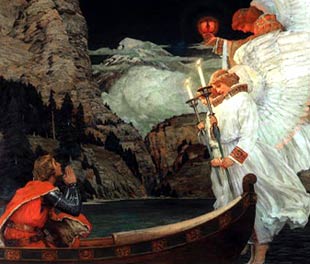
Legend has it that St Joseph brought with him the Holy Grail used at the Last Supper but also used later to collect the Holy Blood of Christ (later called the Sang Real or San Greal by Malory, meaning either “Royal Blood” or “Holy Grail”) which then gave rise to the Grail Legends in which King Arthur’s Knights of the Round Table went in search of the Grail but only Sir Galahad, the pure and holy knight, was able to find it.
King Arthur was a Romano-British knight who, after the Roman Legions had withdrawn, was compelled to become a chief of the remaining British Christians. That he was called “king” need not surprise us since the idea of the Roman Empire, the Emperor and of kings, was then well-established in Christian theology and politics. Let us not forget that the Emperor Constantine was declared Emperor at York by his army over 100 years before. Imperial and Royal ideas were the norm, as was Roman Catholic Christianity and Roman Christendom.
The Grail legends have a sub-stratum of truth for all that later writers have much embroidered them and they have exercised a great influence in British political and literary history.
The longest Abbey in England was built at Glastonbury and within it was incorporated the original "wattle and daub" oratory of St Joseph. The Abbey enjoyed the highest royal favour until the Protestant Reformation when King Henry VIII's Commissioners sacked and pillaged it and caused the last Abbot, Blessed Richard Whiting OSB, to be hanged from the tower of St Michael's Church upon the Tor. Now only the tower remains on the Tor and can be visited to this day.
Here is a good summary of the Glastonbury Legend:
“It is at Glastonbury that legend takes upon itself to go up not only to the beginnings of British Christianity, but also to the beginnings of Christianity itself. The legends of the spot go back to the days of the Apostles. The place is indeed unique, for from the very beginnings of Christianity it was hallowed ground. A legend even tells us that Christ himself as a boy walked upon the hills of Somerset…There is, in any case, more than enough of proved history to shew that Glastonbury was for centuries the most ancient and famous centre of Christianity in the land.
For example, the legend of St Joseph of Arimathaea coming to England is of ancient date, and there is also that others lovely tradition that Christ himself in his boyhood came hither. Though improbable it is not impossible, for we know that the Phoenicians came to Britain seeking metals, several centuries before the Christian era. Herodotus, in the fifth century BC, speaks of Cornwall as the Tin Islands, and Greeks too came in search of ore. St Joseph may conceivably have been one of those merchants and have acquired his wealth thus, in which case he might have brought the Holy Child with him on one of his journeys. If he had had this former acquaintance with our island, it would account for Joseph's being chosen as a missionary to Britain by St Philip. Such traditions are stories to cherish…
About the middle of the thirteenth century the traditions concerning the coming of St Joseph of Arimathaea to Glastonbury were written down as an introduction to William of Malmesbury's work On the Antiquity of the Church of Glastonbury. We learn from these traditions that the Apostle St Philip sent Joseph of Arimathaea from Gaul with twelve companions to bring the gospel message to our ancestors. This cultivated and wealthy Jew left his home and possessions and all that he had, and now, a poor man, bearing with him the priceless treasures of the true faith and a relic of the Holy Blood, he braved the long and perilous journey which brought him in AD 63 to the shores of Wales and thence travelled across the inland sea [Severn Sea or Bristol Channel] and marshy ground [Somerset Levels] to the Isle of Avalon...
John of Glastonbury relates this story and adds that Joseph and his son Josephes were disciples of St Philip by whom they were baptised. While St John was at Ephesus St Joseph remained with our Blessed Lady and was present at her Assumption. Fourteen years later he went to St Philip in Gaul whither that Apostle had been sent after the Ascension, as Freculfus, bishop of Lisieux states. Josephes, whom the Lord had consecrated bishop in Sarath went with him. Then the Apostle sent twelve of his disciples to preach the faith in Britain and he placed at their head St Joseph and his son Josephes…The pagan king Arviragus to whom they came rejected their teaching but gave them the island Ynyswitrin, or Glassy Isle, now called Glastonbury. He and two other kings subsequently gave them a further grant of lands known as the 'twelve hides' [one hide = 160 acres]. The legend says that St Joseph brought with him two cruets in which some of the sacred blood and the water which flowed from the wounds of our Blessed Lord was miraculously preserved.
'Avallon is entered by a band of Twelve:
Joseph, Arimathaea's flower, is chief of them;
And with his father cometh Josephes.
So to these Twelve Glastonia's rights are given.
In Pynson's Life of Joseph of Arimathaea we read:
And when our lorde in the sedony was drest
This blood in two cruettes Joseph did take.'
...At Weary-all Hill he and his companions rested, gazing down upon the valley where, at the foot of the Tor close by, he built what was probably the first Christian church above the ground that was ever raised. A later tradition also says that while resting he thrust his pilgrim's staff into the soil, and forthwith it budded, and a fair tree grew and flourished, and blossomed twice in the year. In the Life of Joseph of Arimathaea printed by Richard Pyerson or Pynson, the pupil of Caxton, in 1520, we read:
'The hawthornes also that groweth in Wirral
Do burge and bere greene leaves at Christmas
As freshe as other yn May...'
The holy thorn was cut down in 1653 by a zealous Puritan, but many slips [shoots] of it had been budded and its descendants still 'blossom at Christmas, mindful of our Lord'.
The Archangel Gabriel appeared to St Joseph and bade him build a church in honour of our Lady's Assumption:
'So Joseph dyd as the angell hym bad,
And wrought there an ymage of our lady;
For to serve hyr great devotion he had;
And that same ymage is yet at Glastonbury,
In the same church; there ye may it se.
For it was the fyrst, as I understande,
That ever was sene in this countre;
For Joseph it made wyth his owne hande. '
Thus did the first Apostle of Britain and his disciples make a little oratory 'of twisted twigs' to praise God at the foot of St Michael's Tor; it was 60ft long and 26ft wide, and from that wattle church dedicated to His Blessed Mother by our Lord Himself, they and their successors scattered far and wide the seed of the true faith, to north and south, to east and west; and like the seed of mustard it grew to a great tree whose branches spread over north-west Europe. In Tennyson's Holy Grail the monk Ambrosius tells Perceval that:
'From our old books I know
That Joseph came of old to Glastonbury,
And there the heathen prince, Arviragus,
Gave him an isle of marsh whereon to build;
And there he built with wattles from the marsh
A little lonely church in days of yore.
For so they say, these books of ours.'
It is said that the once-wealthy Jew, the 'friend of Pilate and of the Lord', who had given the sumptuous sepulchre he had prepared for himself to Him Who had no place to lay his Head, slept his last sleep in the shadow of the poor and primitive church of reeds at Avalon, the first of those innumerable saints whose bodies have sanctified this soil.
John of Glastonbury quoting a prophecy of the British bard Melkin, says that in Avalon's Island Joseph...
'Hath found perpetual sleep;
And he lies on a two-forked line
Next the south corner of an oratory
Fashioned of wattles
For the adoring of a mighty Virgin
By the aforesaid sphere-betokened
Dwellers in that place, thirteen in all. ..'
His [Joseph's] feast was formerly kept on July 27th and great was the concourse of pilgrims who flocked to pray before his statue. William Good, born at Glastonbury in 1527 and who, a member of the Society of Jesus [Jesuits], died at Naples in 1596, says that in a long subterranean chapel there was a most famous place of pilgrimage 'which was made to a stone image of St Joseph there and many miracles were wrought at it. When I was a boy of eight, for I was born there, I have served Mass in this chapel, and I saw it destroyed in the time of Henry VIII...' "