Showing posts with label the Assumption. Show all posts

Saturday, 16 August 2008

Our tainted nature's solitary boast: the Assumption of the Blessed Virgin Mary, our holy Mother and Queen, the flower of Israel

To the right is the work of Giovanni Francesco Barbieri, called Guercino, 1591-1666, in his beautiful but simple Assumption of the Virgin.

It is scarcely possible for us even to imagine the purity, holiness and spiritual greatness of the Blessed Virgin.

No Feminist, she, but the willing servant of God and man, whether high or low, and the exemplar for us all as she shows us that it is in serving that we become great and not by demanding that we be served.

She became great before the Lord because she was so small before the Lord and before men.

Now she towers over all creation - even the Angels.

She stoops to conquer. By her humility is she the greatest of all God's creatures.

The more man turns from himself and defers to God, the greater he becomes and the more fully human.

Our Blessed Lady achieved this in the greatest manner possible.

Think of the best, gentlest, kindest and most generous lady that you have ever met in your life. Our Lady is a million times yet more kind, gentle, generous and good.

Men have struggled to capture in art the greatness of this woman but all must necessarily fail. We shall not really comprehend her greatness until we see see her kneeling before the Throne of Grace, with Almighty God Himself stooping to embrace her, His greatest creation, for God Himself is yet more humble still even than the Virgin herself.

Think of the humility of God in so stooping as to allow Himself to be born of his own creation, an earthly mother, and to allow her the greatest possible title imaginable for a mere creature, Dei genetrix, Deipara, Theotokos, the "God-bearer", the very Mother of God!


Tiziano Vecelli ("Titian", 1488-1576). The Assumption of the Virgin, 1516-18.


What greater God could there be than this, that He, the very God Himself, should stoop to be, as it were, lower even than His own creation whilst all the time remaining Almighty God. What a marvellous conception! What a pinnacle of perfect love. Of such kind is our God. Words fail. We can but adore, adore, adore!

Think, too, O woman, of the greatness of your dignity simply in being mothers; for by so being you imitate the greatest event in all history and creation, the birth of our Saviour, the very Son of God, JESUS CHRIST, from the womb of the Blessed Virgin.

Through her fiat mihi secundum verbum tuum, she turned all her attention away from herself and toward the Holy Trinity, her Father, her Spouse and her Son. She annihilated self, as the best mothers do, and gave all for the sake of her Father, her Spouse and her Son.


Annibale Caracci (1560-1609). Assumption of the Virgin Mary.


This is the highest perfection man or woman can ever achieve. And she, the Queen of Heaven, embodies it.

Let us recall some of the great prayers that the Church gives us in the Roman rite for the Feast of our Lady's Assumption into heaven.

Ant. Assúmpta est María in cælum : gaudent Angeli, laudántes benedícunt Dóminum.

Ant. Mary hath been taken up into heaven : the company of Angels is joyful ; yea, the Angels rejoice, and glorify the Lord.

Capitulum: Judith 13. 22-23.
Benedíxit te Dóminus in virtúte sua, quia per te ad níhilum redégit inimícos nostros. Benedícta es tu, fília, a Dómino Deo excélso, præ ómnibus muliéribus super terram.
R. Deo grátias.

The Little Chapter: Judith 13. 22-23.
The Lord hath blessed thee by his power, because by thee he hath brought to nought the enemies of thy people. Blessed art thou, O daughter, by the Lord the most high God above all the women upon the earth.
R. Thanks be to God.
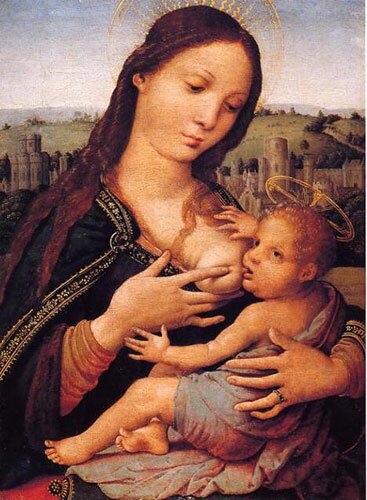


Pablo de San Leocadio (1445-1520). Virgen de la Leche (Virgin of the milk). 1472-1514.


V. Exaltáta est sancta Dei Génitrix.
R. Super choros Angelórum ad cæléstia regna.

V. Thou art exalted, O holy Mother of God.
R. Above choirs of Angels, unto the heavenly kingdom.


The infallible proclamation of the Assumption of our Lady by the Supreme Pontiff, Pope Pius XII, in 1950. The doctrine had been taught and believed since the time of the Apostles but was formally declared only in the 20th century. Churches have been dedicated to the Assumption since the earliest times and artists have celebrated the event since long ago. York Minster, for instance, is dedicated to the Assumption. Anyone who thinks the doctrine is a novelty invented by the Catholic Church is simply ignorant of history.


Ad Magnif. Ant: Virgo prudentíssima, quo progréderis, quasi auróra valde rútilans? Fília Sion, tota formósa et suávis es, pulchra ut luna, elécta ut sol.

Ant. for the Magnificat: O wisest of virgins, whither goest thou, like to the Day-Spring gloriously rising? O daughter of Sion, altogether lovely art thou, and pleasant for delights, fair as the moon, clear as the sun.

CANTICUM BEATÆ MARIÆ VIRGINIS
Luc. 1. 46-55

MAGNIFICAT : ánima mea Dóminum.
2 Et exsultávit spíritus meus: * in Deo, salutári meo.
3 Quia respéxit humilitátem ancíllæ suæ: * ecce enim ex hoc beátam me dicent omnes generatiónes.
4 Quia fecit mihi magna, qui potens est: * (Fit reverentia) et sanctum nomen ejus.
5 Et misericórdia ejus, a progénie in progénies: * timéntibus eum.
6 Fecit poténtiam in bráchio suo: * dispérsit supérbos mente cordis sui.
7 Depósuit poténtes de sede: * et exaltávit húmiles.
8 Esuriéntes implévit bonis: * et dívites dimísit inánes.
9 Suscépit Israël púerum suum: * recordátus misericórdiæ suæ.
10 Sicut locútus est ad patres nostros: * Abraham, et sémini ejus in sæcula.
11 Glória Patri, et Fílio, * et Spirítui Sancto.
12 Sicut erat in princípio, et nunc, et semper, * et in sæcula sæculórum. Amen.
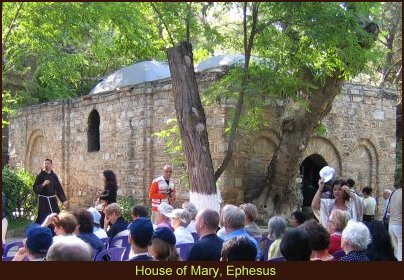

The Holy House in Ephesus where our Lady ended her days on this earth


CANTICLE OF THE BLESSED VIRGIN MARY
Luke. 1. 46-55

My soul * doth magnify the Lord.
2 And my spirit hath rejoiced * in God my Saviour.
3 For he hath regarded the lowliness of his handmaiden : * for behold, from henceforth * all generations shall call me blessed.
4 For he that is mighty hath magnified me; * (
Here all make a profound reverence) and holy is his Name.
5 And his mercy is on them that fear him * throughout all generations.
6 He hath shewed strength with his arm; * he hath scattered the proud in the imagination of their hearts.
7 He hath put down the mighty from their seat, * and hath exalted the humble and meek.
8 He hath filled the hungry with good things; * and the rich he hath sent empty away.
9 He remembering his mercy * hath holpen his servant Israel.
10 As he promised to our forefathers, * Abraham and his seed for ever.
11 Glory be to the Father, and to the Son, * and to the Holy Ghost.
12 As it was in the beginning, is now, and ever shall be, * world without end. Amen.


Antonio Allegri da Correggio (1489-1534). Virgin and child.


O Mary, conceived without sin, pray for us who have recourse to thee!


...

Wednesday, 22 August 2007

And did those feet in ancient time...

"And did those feet in ancient time,
Walk upon England's mountains green?
And was the Holy Lamb of God,
On England's pleasant pastures seen?
And did the Countenance Divine,
Shine forth upon our clouded hills..."


So wrote William Blake, the slightly eccentric poet and alleged "mystic" of English literature but with more than a grain of truth in his musings.

Did our Lord and St Joseph of Arimathaea, the Jewish Christian member of the Sanhedrin who later buried our Lord, come to Glastonbury, called the Isle of Avalon (meaning "apples"), as the legends of King Arthur and other stories would have us believe?

Since we know that St Mary Magdalene, St Mary the mother of James and John, and St Mary the mother of Salome, together with St Lazarus found their way to the coast of France near Marseilles and that St Lazarus became the first bishop, it is by no means impossible that St Joseph of Arimathaea came to Britain. Certainly, there is evidence of a Roman jetty on the side of Wirral (“Weary-all”) Hill and the Phoenicians traded with Britain.

St Thomas, let us not forget, went to Persia and India and founded the Syriac Churches who, to this day, use Aramaic, the spoken language of our Lord, in their sacred liturgy.

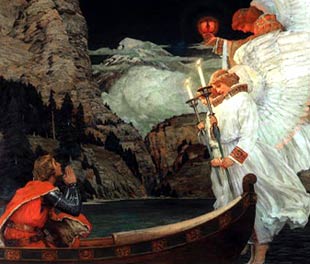
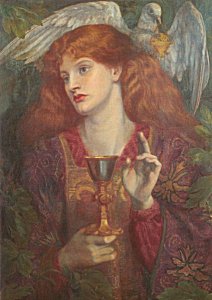
Legend has it that St Joseph brought with him the Holy Grail used at the Last Supper but also used later to collect the Holy Blood of Christ (later called the Sang Real or San Greal by Malory, meaning either “Royal Blood” or “Holy Grail”) which then gave rise to the Grail Legends in which King Arthur’s Knights of the Round Table went in search of the Grail but only Sir Galahad, the pure and holy knight, was able to find it.


King Arthur was a Romano-British knight who, after the Roman Legions had withdrawn, was compelled to become a chief of the remaining British Christians. That he was called “king” need not surprise us since the idea of the Roman Empire, the Emperor and of kings, was then well-established in Christian theology and politics. Let us not forget that the Emperor Constantine was declared Emperor at York by his army over 100 years before. Imperial and Royal ideas were the norm, as was Roman Catholic Christianity and Roman Christendom.


The Grail legends have a sub-stratum of truth for all that later writers have much embroidered them and they have exercised a great influence in British political and literary history.


The longest Abbey in England was built at Glastonbury and within it was incorporated the original "wattle and daub" oratory of St Joseph. The Abbey enjoyed the highest royal favour until the Protestant Reformation when King Henry VIII's Commissioners sacked and pillaged it and caused the last Abbot, Blessed Richard Whiting OSB, to be hanged from the tower of St Michael's Church upon the Tor. Now only the tower remains on the Tor and can be visited to this day.

Here is a good summary of the Glastonbury Legend:

“It is at Glastonbury that legend takes upon itself to go up not only to the beginnings of British Christianity, but also to the beginnings of Christianity itself. The legends of the spot go back to the days of the Apostles. The place is indeed unique, for from the very beginnings of Christianity it was hallowed ground. A legend even tells us that Christ himself as a boy walked upon the hills of Somerset…There is, in any case, more than enough of proved history to shew that Glastonbury was for centuries the most ancient and famous centre of Christianity in the land.

For example, the legend of St Joseph of Arimathaea coming to England is of ancient date, and there is also that others lovely tradition that Christ himself in his boyhood came hither. Though improbable it is not impossible, for we know that the Phoenicians came to Britain seeking metals, several centuries before the Christian era. Herodotus, in the fifth century BC, speaks of Cornwall as the Tin Islands, and Greeks too came in search of ore. St Joseph may conceivably have been one of those merchants and have acquired his wealth thus, in which case he might have brought the Holy Child with him on one of his journeys. If he had had this former acquaintance with our island, it would account for Joseph's being chosen as a missionary to Britain by St Philip. Such traditions are stories to cherish…

About the middle of the thirteenth century the traditions concerning the coming of St Joseph of Arimathaea to Glastonbury were written down as an introduction to William of Malmesbury's work On the Antiquity of the Church of Glastonbury. We learn from these traditions that the Apostle St Philip sent Joseph of Arimathaea from Gaul with twelve companions to bring the gospel message to our ancestors. This cultivated and wealthy Jew left his home and possessions and all that he had, and now, a poor man, bearing with him the priceless treasures of the true faith and a relic of the Holy Blood, he braved the long and perilous journey which brought him in AD 63 to the shores of Wales and thence travelled across the inland sea [Severn Sea or Bristol Channel] and marshy ground [Somerset Levels] to the Isle of Avalon...

John of Glastonbury relates this story and adds that Joseph and his son Josephes were disciples of St Philip by whom they were baptised. While St John was at Ephesus St Joseph remained with our Blessed Lady and was present at her Assumption. Fourteen years later he went to St Philip in Gaul whither that Apostle had been sent after the Ascension, as Freculfus, bishop of Lisieux states. Josephes, whom the Lord had consecrated bishop in Sarath went with him. Then the Apostle sent twelve of his disciples to preach the faith in Britain and he placed at their head St Joseph and his son Josephes…The pagan king Arviragus to whom they came rejected their teaching but gave them the island Ynyswitrin, or Glassy Isle, now called Glastonbury. He and two other kings subsequently gave them a further grant of lands known as the 'twelve hides' [one hide = 160 acres]. The legend says that St Joseph brought with him two cruets in which some of the sacred blood and the water which flowed from the wounds of our Blessed Lord was miraculously preserved.

'Avallon is entered by a band of Twelve:
Joseph, Arimathaea's flower, is chief of them;
And with his father cometh Josephes.
So to these Twelve Glastonia's rights are given.
In Pynson's Life of Joseph of Arimathaea we read:
And when our lorde in the sedony was drest
This blood in two cruettes Joseph did take.'


...At Weary-all Hill he and his companions rested, gazing down upon the valley where, at the foot of the Tor close by, he built what was probably the first Christian church above the ground that was ever raised. A later tradition also says that while resting he thrust his pilgrim's staff into the soil, and forthwith it budded, and a fair tree grew and flourished, and blossomed twice in the year. In the Life of Joseph of Arimathaea printed by Richard Pyerson or Pynson, the pupil of Caxton, in 1520, we read:

'The hawthornes also that groweth in Wirral
Do burge and bere greene leaves at Christmas
As freshe as other yn May...'


The holy thorn was cut down in 1653 by a zealous Puritan, but many slips [shoots] of it had been budded and its descendants still 'blossom at Christmas, mindful of our Lord'.

The Archangel Gabriel appeared to St Joseph and bade him build a church in honour of our Lady's Assumption:

'So Joseph dyd as the angell hym bad,
And wrought there an ymage of our lady;
For to serve hyr great devotion he had;
And that same ymage is yet at Glastonbury,
In the same church; there ye may it se.
For it was the fyrst, as I understande,
That ever was sene in this countre;
For Joseph it made wyth his owne hande. '

Thus did the first Apostle of Britain and his disciples make a little oratory 'of twisted twigs' to praise God at the foot of St Michael's Tor; it was 60ft long and 26ft wide, and from that wattle church dedicated to His Blessed Mother by our Lord Himself, they and their successors scattered far and wide the seed of the true faith, to north and south, to east and west; and like the seed of mustard it grew to a great tree whose branches spread over north-west Europe. In Tennyson's Holy Grail the monk Ambrosius tells Perceval that:

'From our old books I know
That Joseph came of old to Glastonbury,
And there the heathen prince, Arviragus,
Gave him an isle of marsh whereon to build;
And there he built with wattles from the marsh
A little lonely church in days of yore.
For so they say, these books of ours.'

It is said that the once-wealthy Jew, the 'friend of Pilate and of the Lord', who had given the sumptuous sepulchre he had prepared for himself to Him Who had no place to lay his Head, slept his last sleep in the shadow of the poor and primitive church of reeds at Avalon, the first of those innumerable saints whose bodies have sanctified this soil.

John of Glastonbury quoting a prophecy of the British bard Melkin, says that in Avalon's Island Joseph...

'Hath found perpetual sleep;
And he lies on a two-forked line
Next the south corner of an oratory
Fashioned of wattles
For the adoring of a mighty Virgin
By the aforesaid sphere-betokened
Dwellers in that place, thirteen in all. ..'

His [Joseph's] feast was formerly kept on July 27th and great was the concourse of pilgrims who flocked to pray before his statue. William Good, born at Glastonbury in 1527 and who, a member of the Society of Jesus [Jesuits], died at Naples in 1596, says that in a long subterranean chapel there was a most famous place of pilgrimage 'which was made to a stone image of St Joseph there and many miracles were wrought at it. When I was a boy of eight, for I was born there, I have served Mass in this chapel, and I saw it destroyed in the time of Henry VIII...' "

(The Glories of Glastonbury: her legends, history and saints, Armine Le Strange Campbell, Sheed & Ward, London, 1926)

Wednesday, 15 August 2007

The Queen assumed into heaven...

"Christ's faithful, through the teaching and the leadership of their pastors, have learned from the sacred books that the Virgin Mary, throughout the course of her earthly pilgrimage, led a life troubled by cares, hardships, and sorrows, and that, moreover, what the holy old man Simeon had foretold actually came to pass, that is, that a terribly sharp sword pierced her heart as she stood under the cross of her divine Son, our Redeemer. In the same way, it was not difficult for them to admit that the great Mother of God, like her only begotten Son, had actually passed from this life. But this in no way prevented them from believing and from professing openly that her sacred body had never been subject to the corruption of the tomb, and that the august tabernacle of the Divine Word had never been reduced to dust and ashes. Actually, enlightened by divine grace and moved by affection for her, God's Mother and our own dearest Mother, they have contemplated in an ever clearer light the wonderful harmony and order of those privileges which the most provident God has lavished upon this loving associate of our Redeemer, privileges which reach such an exalted plane that, except for her, nothing created by God other than the human nature of Jesus Christ has ever reached this level.

15. The innumerable temples which have been dedicated to the Virgin Mary assumed into heaven clearly attest this faith. So do those sacred images, exposed therein for the veneration of the faithful, which bring this unique triumph of the Blessed Virgin before the eyes of all men. Moreover, cities, dioceses, and individual regions have been placed under the special patronage and guardianship of the Virgin Mother of God assumed into heaven. In the same way, religious institutes, with the approval of the Church, have been founded and have taken their name from this privilege. Nor can we pass over in silence the fact that in the Rosary of Mary, the recitation of which this Apostolic See so urgently recommends, there is one mystery proposed for pious meditation which, as all know, deals with the Blessed Virgin's Assumption into heaven.

16. This belief of the sacred pastors and of Christ's faithful is universally manifested still more splendidly by the fact that, since ancient times, there have been both in the East and in the West solemn liturgical offices commemorating this privilege. The holy Fathers and Doctors of the Church have never failed to draw enlightenment from this fact since, as everyone knows, the sacred liturgy, "because it is the profession, subject to the supreme teaching authority within the Church, of heavenly truths, can supply proofs and testimonies of no small value for deciding a particular point of Christian doctrine.

17. In the liturgical books which deal with the feast either of the dormition or of the Assumption of the Blessed Virgin there are expressions that agree in testifying that, when the Virgin Mother of God passed from this earthly exile to heaven, what happened to her sacred body was, by the decree of divine Providence, in keeping with the dignity of the Mother of the Word Incarnate, and with the other privileges she had been accorded. Thus, to cite an illustrious example, this is set forth in that sacramentary which Adrian I, our predecessor of immortal memory, sent to the Emperor Charlemagne. These words are found in this volume: 'Venerable to us, O Lord, is the festivity of this day on which the holy Mother of God suffered temporal death, but still could not be kept down by the bonds of death, who has begotten your Son our Lord incarnate from herself'.

18. What is here indicated in that sobriety characteristic of the Roman liturgy is presented more clearly and completely in other ancient liturgical books. To take one as an example, the Gallican sacramentary designates this privilege of Mary's as 'an ineffable mystery all the more worthy of praise as the Virgin's Assumption is something unique among men'. And, in the Byzantine liturgy, not only is the Virgin Mary's bodily Assumption connected time and time again with the dignity of the Mother of God, but also with the other privileges, and in particular with the virginal motherhood granted her by a singular decree of God's Providence. 'God, the King of the universe, has granted you favors that surpass nature. As he kept you a virgin in childbirth, thus he has kept your body incorrupt in the tomb and has glorified it by his divine act of transferring it from the tomb'.

19. The fact that the Apostolic See, which has inherited the function entrusted to the Prince of the Apostles, the function of confirming the brethren in the faith, has by its own authority, made the celebration of this feast ever more solemn, has certainly and effectively moved the attentive minds of the faithful to appreciate always more completely the magnitude of the mystery it commemorates. So it was that the Feast of the Assumption was elevated from the rank which it had occupied from the beginning among the other Marian feasts to be classed among the more solemn celebrations of the entire liturgical cycle. And, when our predecessor St. Sergius I prescribed what is known as the litany, or the stational procession, to be held on four Marian feasts, he specified together the Feasts of the Nativity, the Annunciation, the Purification, and the Dormition of the Virgin Mary. Again, St. Leo IV saw to it that the feast, which was already being celebrated under the title of the Assumption of the Blessed Mother of God, should be observed in even a more solemn way when he ordered a vigil to be held on the day before it and prescribed prayers to be recited after it until the octave day. When this had been done, he decided to take part himself in the celebration, in the midst of a great multitude of the faithful. Moreover, the fact that a holy fast had been ordered from ancient times for the day prior to the feast is made very evident by what our predecessor St. Nicholas I testifies in treating of the principal fasts which 'the Holy Roman Church has observed for a long time, and still observes'."


Munificentissimus Deus, Piux XII, 1 November 1950, Feast of All Saints.