Showing posts with label Crux Fidelis. Show all posts

Tuesday, 15 September 2009

The Feast of the Exaltation of the Holy Cross - 2nd anniversary of Summorum Pontificum

CRUX fidelis, inter omnes, arbor una nobilis;
Nulla talem silva profert,
Flore, fronde, germine.
Dulce lignum, dulci clavos, dulce pondus sustinens!

FAITHFUL Cross! Above all other,
One and only noble Tree!
None in foliage, none in blossom,
None in fruit thy peers may be;
Sweetest wood and sweetest iron!Sweetest Weight is hung on thee!

~~~

So for centuries has been sung the song composed by Venantius Forntunatus (530-609) extolling the Triumph of the Cross.

And never more so than on the Feast which recalls the return of the True Cross to Jersualem following its recapture from the pagan Persians by the Roman Emperor in the East, Emperor Heraclius.

Indeed, this Feast used to be celebrated with almost as much ceremony as the feasts of Easter and Pentecost, themselves.

But this Feast Day, 14th September, is also the anniversary of that triumphal day in which our Holy Father, Pope Benedict XVI, restored to the Roman Church the use of the ancient and noble Roman rite of our ancestors.

All hail Pope Benedict XVI, the restorer of the ancient Roman rites!

Yes, this Feast is the 2nd anniversary day when, by his own motion - motu proprio - Pope Benedict XVI restored to the Roman Church its ancient rites. In so doing he has placed himself in the same hallowed tradition of all those popes, among his predecessors, who always sought to preserve the ancient rites of the Church, as all popes until 1970, did.

For this alone, he will go down to history as a great pope.

He chose a very significant and memorable day to make his motu proprio, called Summorum Pontificum, become effective.

It is the Feast of the Exaltation of the Holy Cross upon which day we sing the praises of the Holy Cross with such ancient hymns as Vexilla Regis and Crux Fidelis.

Listen to the beautiful version of Crux Fidelis written by the gifted royal composer and image of King David, the author of the Psalms, His Majesty King John IV of Portugal - Dom Joao IV. This piece is sung every year on Good Friday at the Brompton Oratory, Knightsbridge in London:


Venantius Fortunatus wrote both hymns, the latter for a procession that brought a part of the true Cross to Queen Radegunda in 570. This hymn is used on Good Friday during the Adoration of the Cross and in the Breviary during Holy Week and on feasts of the Cross like today.

Ancient legend is hinted at in the second verse of this hymn. According to this tradition, the wood of the Cross upon which Christ was crucified was taken from that tree which was the source of the fruit of the fall in the Garden of Eden. When Adam died, the legend states, Seth obtained from the Cherubim guarding the Garden a branch of the tree from which Eve ate the forbidden fruit. Seth planted this branch at Golgotha (the place of the skull), which is so named because Adam was buried there. As time went on, the Ark of the Covenant, the pole upon which the bronze serpent was lifted, and other items were made from this tree.

Eventually the Holy Cross was made from it and our Lord crucified thereon upon Golgotha directly over the tomb of Adam so that the Precious Blood of Christ, seeping through cracks, penetrated into the mausoleum of Adam beneath and fell upon the very skull of Adam to symbolise that the Sin of Adam had now been atoned for by the Crucifixion.

In the pre-1955 Roman Calendar, the Finding of the True Cross (Inventio Crucis) was celebrated on 3 May to commemorate that day when the Empress St Helena, daughter of a British king and mother of the Emperor Constantine, found the True Cross after long searching for it among the wells and cisterns of Jerusalem.


The British born Roman Empress St Helena finds the True Cross


The True Cross was set up and a Basilica built to house it for posterity.

3 centuries later, the pagan, fire-worshipping, Zoroastrian Persians (not yet Muslim), under King Chosroes II, attacked Jerusalem and took away the precious relic, the True Cross.

The Catholic Roman Emperor Heraclius, then reigning, swore to recover it and warred against the Persians. He was on the point of being defeated himself when an internal dispute arose within Persia which threatened Chosroes II and the distraction gave Heraclius his chance. He soundly defeated Chosroes in 629 and recovered the True Cross.

This was seen as an answer to prayer by all at the time.

When Heraclius returned to Jerusalem to restore the True Cross he carried it himself, as had our Lord, intending to process along the Via Dolorosa in his gorgeous imperial robes. But when he arrived at the gate of Jerusalem he was frozen to the spot and could not move. All were puzzled and eventually the Patriarch of Jerusalem suggested that the Emperor divest himself of his imperial robes. The Emperor did more and stripped himself to little more than the seamless garment that Christ Himself had worn to carry His Cross.

At once the Emperor found himself able to proceed and so he continued until he was able to restored the Cross to its rightful place in the Basilica upon Golgotha, walking barefoot in a single shift all along the way to the great edification of the people of Jerusalem, his subjects.

Ever after that day, 14 September, was celebrated with great ceremony - nearly as much as Easter and Pentecost - as the Feast of the Exaltation of the Holy Cross (Exaltatio Crucis).
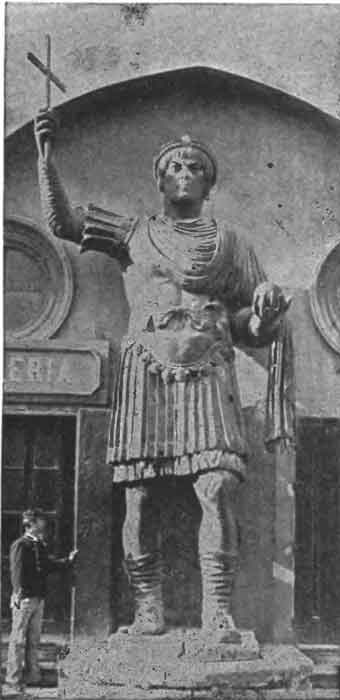

The Catholic Roman Emperor Heraclius who restored the True Cross to Jerusalem in 629AD


Our Holy Father chose this most memorable and triumphant of days to restore to us the glory of the ancient Roman rite which the Roman emperors of old fought and died to protect and preserve and which countless saints and martyrs gave their lives for.


VEXILLA REGIS prodeunt:
Fulget Crucis mysterium,
Qua vita mortem pertulit,
Et morte vitam protulit.

Abroad the Regal Banners fly,
Now shines the Cross's mystery;
Upon it Life did death endure,
And yet by death did life procure.

O CRUX AVE, SPES UNICA,
In hac triumpha gloria
Piis adauge gratiam,
Reisque dele crimina.

Hail, Cross, of hopes the most sublime!
In this triumphant glorious time,
Improve religious souls in grace,
The sins of criminals efface.


On Good Friday the second line reads "Now in this mournful Passion time" but on the Feast of the Cross this is replaced by "in hac triumpha gloria" - in the glory of this triumph!

Triumph, indeed, thanks to our Holy Father gloriously reigning!


St Helena, pray for us!

True Cross, protect us!


...

Thursday, 13 March 2008

Crux Fidelis: "Faithful cross above all other..."

This is another great traditional hymn by Venantius Fortunatus (530-609) used extensively in the Church’s public prayer and liturgy.

It is a beautiful hymn but again, sadly, all too rarely heard in the Novus Ordo liturgy but always heard in the traditional liturgy.

There are two hymns called Pange Lingua in use, one by St. Thomas Aquinas and this one, by Venantius Fortunatus extolling the triumph of the Holy Cross.

This, too, was written for the procession of the True Cross to Queen Radegunda in 570.

Traditional rite Catholics will be familiar with its use on Good Friday during the Adoration of the Cross but it will be even more familiar to those who use the traditional rite Breviary or Office books.

Liturgically the hymn is often broken up into smaller parts, particularly as Lustra sex and Crux fidelis.

The second verse makes reference to the pious tradition that the wood of the Holy Cross was taken from the Tree of Paradise in the Garden of Eden.

How can this be, you may ask.

The answer is thus: after the death of Adam, his son, Seth obtained from the Cherubim guarding the Garden a branch of the tree from which Eve ate the forbidden fruit. Seth planted this branch at Golgotha (the place of the skull), which is so named because Adam was buried there. As time went on, the Ark of the Covenant, the pole upon which the bronze serpent was lifted, and other items were made from this tree, so it is said.

You may have seen crucifixes with a skull below the corpus. This represents Christ’s victory over death but it also reflects the pious tradition that Adam was buried on Golgotha and that the blood of Christ seeped through the cracks in the earth and tomb beneath on and onto the skull of Adam beneath. Thus the bones of Adam were materially bathed in the Blood of Christ just as Original Sin, caused by Adam’s sin, is washed away by His Blood, the Blood of the Lamb of God, sacrificed as the Paschal Lamb upon the Holy Cross.


Golgotha: the place of the Crucifixion
beneath which was reputed to lie the tomb of Adam
and over which now stands the Church of the Holy Sepulchre


Pange Lingua (including Crux Fidelis)

by Venantius Fortunatus

PANGE, lingua, gloriosi
proelium certaminis,
et super Crucis trophaeo
dic triumphum nobilem,
qualiter Redemptor orbis
immolatus vicerit.

De parentis protoplasti
fraude Factor condolens,
quando pomi noxialis
morte morsu corruit,
ipse lignum tunc notavit,
damna ligni ut solveret.

Hoc opus nostrae salutis
ordo depoposcerat,
multiformis proditoris
ars ut artem falleret,
et medelam ferret inde,
hostis unde laeserat.

Quando venit ergo sacri
plenitudo temporis,
missus est ab arce Patris
natus, orbis, Conditor,
atque ventre virginali
carne factus prodiit.

Vagit infans inter arcta
conditus praesepia:
membra pannis involuta
Virgo Mater alligat:
et manus pedesque et crura
stricta cingit fascia.

LUSTRA sex qui iam peracta
tempus implens corporis,
se volente, natus ad hoc,
passioni deditus,
Agnus in crucis levatur
immolandus stipite.

En acetum, fel, arundo,
sputa, clavi, lancea:
mite corpus perforatur,
Sanguis, unda profluit
terra, pontus, astra, mundus,
quo lavantur flumine!

CRUX fidelis,
inter omnes
arbor una nobilis;
nulla talem silva profert,
flore, fronde, germine.
Dulce lignum, dulci clavo,
dulce pondus sustinens!

Flecte ramos, arbor alta,
tensa laxa viscera,
et rigor lentescat ille,
quem dedit nativitas,
ut superni membra Regis
miti tendas stipite.

Sola digna tu fuisti
ferre saeculi pretium,
atque portum praeparare
nauta mundo naufrago,
quem sacer cruor perunxit,
fusus Agni corpore.

Aequa Patri Filioque,
inclito Paraclito,
sempiterna sit beatae
Trinitati gloria,
cuius alma nos redemit
atque servat gratia. Amen.


=====

SING, my tongue, the Saviour’s glory;
tell His triumph far and wide;
tell aloud the famous story
of His body crucified;
how upon the cross a victim,
vanquishing in death, He died.

Eating of the tree forbidden,
man had sunk in Satan's snare,
when our pitying Creator did
this second tree prepare;
destined, many ages later,
that first evil to repair.

Such the order God appointed
when for sin He would atone;
to the serpent thus opposing
schemes yet deeper than his own;
thence the remedy procuring,
whence the fatal wound had come.

So when now at length the fullness
of the sacred time drew nigh,
then the Son, the world's Creator,
left his Father's throne on high;
from a virgin's womb appearing,
clothed in our mortality.

All within a lowly manger,
lo, a tender babe He lies!
see his gentle Virgin Mother
lull to sleep his infant cries!
while the limbs of God incarnate
round with swathing bands she ties.

THUS did Christ to perfect manhood
in our mortal flesh attain:
then of His free choice He goeth
to a death of bitter pain;
and as a lamb, upon the altar
of the cross, for us is slain.

Lo, with gall His thirst He quenches!
see the thorns upon His brow!
Nails His tender flesh are rending!
See His side is opened now!
Whence, to cleanse the whole creation,
streams of blood and water flow.

FAITHFUL Cross! Above all other,
one and only noble Tree!
None in foliage, none in blossom,
none in fruit thy peers may be;
sweetest wood and sweetest iron!
Sweetest Weight is hung on thee!

Lofty tree, bend down thy branches,
to embrace thy sacred load;
oh, relax the native tension
of that all too rigid wood;
gently, gently bear the members
of thy dying King and God.

Tree, which solely wast found worthy
this world's Victim to sustain;
harbour from the raging tempest!
Ark, that saved the world again!
Tree, with sacred blood anointed
of the Lamb for sinners slain.

Blessing, honour, everlasting,
to the immortal Deity;
to the Father, Son, and Spirit,
equal praises ever be;
glory through the earth and heaven
to Trinity in Unity. Amen.


The Cross shall triumph over sin...

...