Showing posts with label Royal Stuarts. Show all posts

Saturday, 6 September 2008

Blessed are the Dead who die in the Lord...


Of your charity

pray for the soul of
David Gordon Allen D'Aldecamb
Lumsden of Cushnie
loyal Jacobite and faithful Catholic


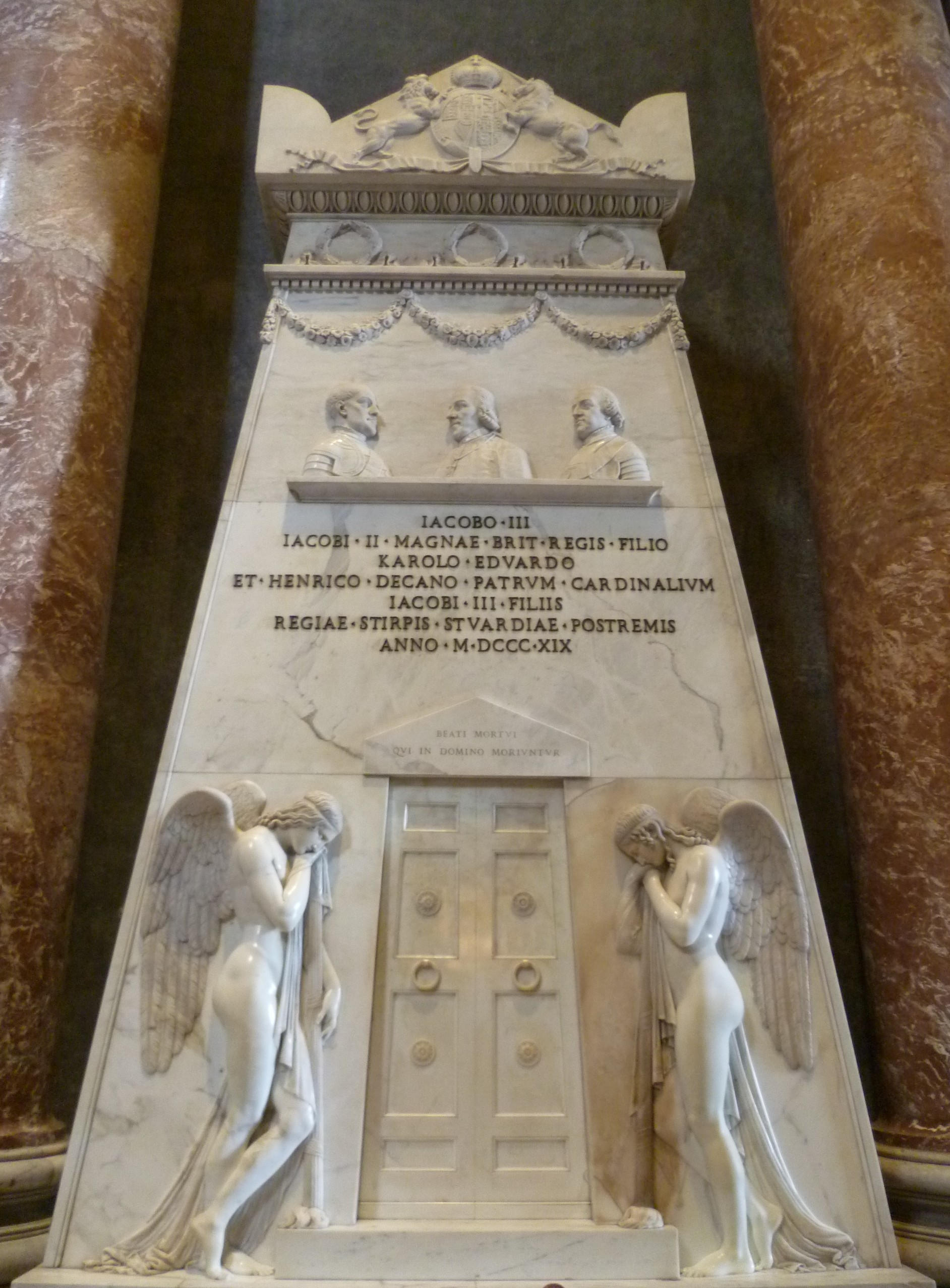
Beati mortui qui in Domino moriuntur

Blessed are the dead who die in the Lord...


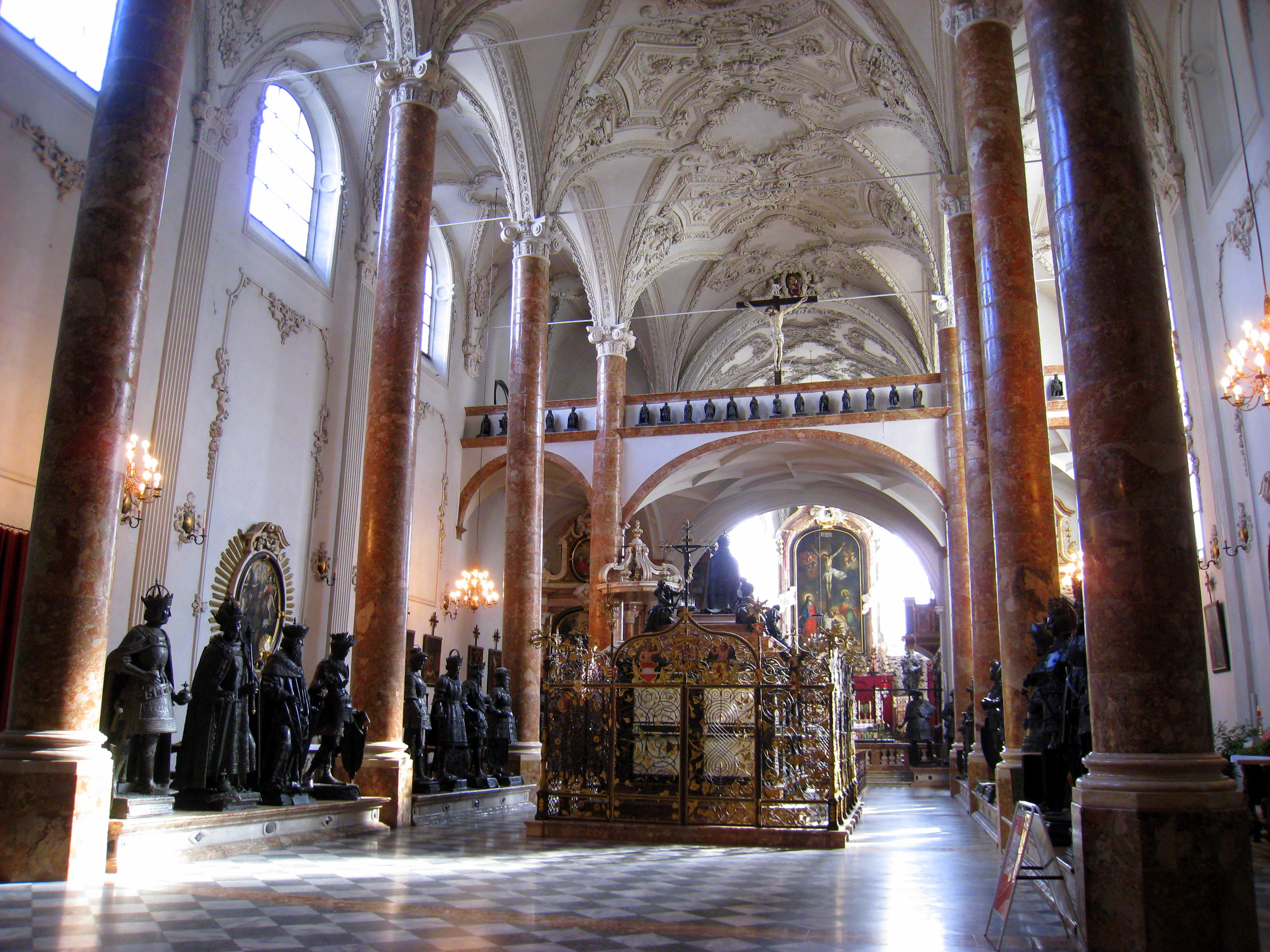
From the Canova monument for the Royal Stuarts in St Peter's Basilica where white roses are laid each year on White Rose Day, 10th June, the birthday of King James III and VIII of England, Scotland, Ireland and France.


The Flowers of the Forest

I've heard the lilting, at the yowe-milking,
Lassies a-lilting before dawn o' day;
But now they are moaning on ilka green loaning;
"The Flo'oers of the Forest are a' wede awa'".

Dool and wae for the order, sent oor lads tae the Border!
The Whigs for ance, by guile wan the day,
The Flo'oers o' the Forest, that fought aye the foremost,
The pride o' oor land lie cauld in the clay.

I've heard the lilting, at the yowe-milking,
Lassies a-lilting before dawn o' day;
But now they are moaning on ilka green loaning;
"The Flo'oers of the Forest are a' wede awa'".

[Scottish trad.]


...

Thursday, 15 November 2007

On the Queen and revolution: he who has ears, let him hear...

In response to my last post, I have a message from a correspondent called Viator Catholicus, who says:

"It is lamentable that you are so protective of the Queen of England on a site devoted to 'Roman Christendom'.

Of course, she is a figurehead with no power. But, then, what purpose does she serve? Should she not at least assert some moral authority?

Can she not refuse to sign the abortion bill to avoid any appearance of cooperation? You also made some points about the illegitimacy of Revolution.

However, the pope can certainly call for Revolution against a regime which he by his authority declares unlawful. By the way, was not the legitimate English monarch overthrown in 1688 by a the invasion of a Dutch king in alliance with certain English traitors?"

The last two questions seem to me perfectly good and fair ones and I shall try to answer them later.

Sorry to say, however, the Queen-related question is precisely an example of the very kind of parroting and re-parroting about which I complained in my previous post.

It is also self-contradictory. How can one say "the Queen has no power" and then, in the same post, say she should exercise her (non-existent!) power to refuse to sign legislation?

One cannot have it both ways.

I have VERY FULLY answered the Queen-related questions numerous times over.

How is asking and re-asking and re-re-asking and re-re-re-asking the same question that has been answered several times over, helping to resolve the issue or even explain an alternative position?

If anyone disagrees with my answers, ah, well, that's quite another thing. But then they must tell me WHY they disagree and WHAT their REASONS are.

Simply repeating the question that has already been answered several times over just looks, I'm afraid, like mindless barracking - even of the "4 legs good, 2 legs bad" variety that George Orwell lampoons so effectively in Animal Farm.

I can but say to Viator: go and read my earlier replies to people who have asked the self-same question. They can be found under "comments" at the end of each post.

In short, no, the Queen is not just a figurehead and, no, she is not devoid of all power. She has very limited but still very important power to act against a rogue government (e.g. one that banned elections) or, perhaps, to resolve a deadlock that the courts did not otherwise have the jurisdiction to resolve.

I am open to persuasion that I am wrong about that or have got the law wrong but challengers will need to point to some counter-authorities since this is the view accepted by, for example, Erskine-May on Parliamentary Procedure.

These are vitally important powers protecting us from tyranny and dictatorship. But they are very limited, "port of last resort" powers.

If this is right, then the Queen simply does not have the power to refuse other legislation. If she tried to do so she would be acting illegally and when a head of state acts illegally this is called a coup d'etat or palace revolution.

In Roman Catholic theology no-one has the right to instigate a revolution or rebellion against a superior, unless the same has been legitimately and lawfully authorised by someone more superior still.

Now the Queen is not above the law or the Constitution. The law and the Constitution are above her and she must obey them both.

As the late Lord Denning, former Master of the Rolls and former Lord of Appeal in Ordinary, put it "Be ye never so high, the law is above you".

One may not like that situation and may prefer that she be a Monarch in the old mould with much wider powers but that is not our current Constitution.

And neither we, nor the Queen, have the right to overthrow that Constitution by unilateral illegal acts or a coup d'etat.

She could not, therefore, "refuse to sign the Abortion Bill just to avoid any appearance of co-operation". If she did so she would be overthrowing the Constitution and would thereby be sinning. And one may not do evil that good may come of it, as St Paul says (Rom 3:8).

We may use legitimate constitutional means to change the Constitution such as campaigning for a change but we cannot use illegitimate, unconstitutional means. That is sin.

It is Roman Catholic teaching that Catholics may not rebel against their superiors and overthrow their legitimate governance, even if that governance is oppressive or immoral.

Some Catholics have got it into their heads that Catholic teaching permits such rebellion. It does not.

The reasoning is simple enough: a subject does not have the right to sit in judgment upon his superior, for if he did have, then there would be no authority at all since any subject could, at any time, aver that the authority was being exercised oppressively and so overthrow it at his own discretion.

In short, that would be an anarchist's charter.

As I have now said, I think, 3 times this is all very clearly explained in De Regimine Principum (On the Rule of Kings) by St Thomas Aquinas, citing proper authorities.

I am open to persuasion that the Queen DOES still have more residual prerogative powers than I have stated but, to be persuasive, I think it would be necessary to point to some recognised legal or constitutional authority that says so e.g. Erskine-May on Parliamentary Procedure or Dicey or perhaps Professor Vernon Bogdanor of Oxford or, of course, some decision of the higher courts.

To answer the remainder of Viator's questions, which I believe are good and fair ones, I say this: yes, the Pope, if it can still be said that he is superior to the Queen, could authorise her overthrow or that of the Constitution.

But does he still have that superior power?

I rather fear that he does not. If any superior power now exists it might exist in international law but I suspect not in the Pope. Indeed, the Pope claims no such power any more.

I am open to persuasion on that point, however.

As for the Dutch invasion yes, that was certainly illegitimate, indeed, a very good example of an unjust rebellion against a legitimate and lawful authority - treason or treachery, in short.

That new government was illegal and could legitimately be opposed and overthrown by anyone, not least Catholics. That, indeed, is what Jacobites tried to do by the Jacobite uprisings of 1715 and 1745, which were legitimate uprisings against an usurped authority and undertaken with the aim of restoring the legitimate king and constitution.

Such a restoration is expressly permitted by Catholic teaching since the subject is not judging its own legitimate government for the very simple reason that the government is not legitimate since it usurped power, itself, by a revolution. An usurped power has already judged itself, just as a robber has put himself in the wrong and may then be lawfully apprehended, preferably by the Police but, if necessary, by any citizen.

The Jacobite uprisings failed, sadly.

Eventually, the Jacobite pretenders ceased to press their claim and the Cardinal Duke of York eventually transferred the royal heirlooms to King George III.

For the other reasons why the Jacobite claims can no longer be seriously pressed, albeit their memory and principles ought still to be honoured and upheld, see my earlier and first post on the subject, To Lochaber No More...

This being so, from the time of King George III, the Hanoverians became the legitimate British royal dynasty. Moreover, the popes began to recognise them from around that time.

For this reason, among others, the American Revolution of 1776 was also an illegitimate one. It did not seek to restore the legitimate Stuart dynasty but, instead, basing themselves upon heterodox Protestant and secularist ideas, subjects of the King expressly claimed to sit in judgment on their lawful superior, the King himself, just as Cromwell had earlier illegally done.

Such rebellions are expressly forbidden by Catholic teaching.

However, once again, the legitimate dynasty ceased to press its claims to rule America and against the American revolutionary government, so that, eventually, that government, too, gained legitimacy and, after a time, it would have been disproportionate, and therefore a sin, to rebel or make war against it.

So much is no more than Roman Catholic teaching on the subject of just or unjust war and just or unjust uprising.

In the same way that a just war is no violence, so a just uprising is no rebellion. Rebellion and violence are sins. Legitimate restoration by proper, reasonable and proportionate force is neither violence nor rebellion but, as its name implies, a just and lawful restoring of the true and legitimate constitution - a bit like the Police apprehending a terrorist by minimum and proportionate force.

This is our faith.

...

Monday, 5 November 2007

To Lochaber no more: do we support HM Queen Elizabeth II or the direct successor of the Stuarts, HRH Francis, Duke of Bavaria?

The short answer is this:

Her Majesty, Queen Elizabeth II, is the legitimate monarch of the United Kingdom and all the Commonwealth Realms.

Why?

The best argument is this: common sense.

The true threat to legitimate Catholic monarchy today is most certainly NOT Queen Elizabeth II.

If you don't agree then stop reading now because nothing I nor anyone else says - even God himself - will persuade you.

However, there are many other very good arguments for her legitimacy.

Here are a few:

First, the Stuart line has not made any claim to the throne since the death of HRH the Cardinal Duke of York in 1807. That, on its own, puts an end to the matter.

Secondly, the popes since that time, and even before, recognised the Hanoverians for reasons of state policy and for the safety and security of Europe and what was left of Christendom.

Thirdly, the Cardinal Duke of York himself returned the "Honours of Scotland", the Scottish royal heirlooms which always revert to the Sovereign legally, to King George III which was a tacit recognition of him as his legal successor according to the ancient Scottish (and Gaelic) principle of the Taniste (pronounced "Tawnister") meaning "successor". Under this principle, which was a dynastic principle in most if not all of the Celtic monarchies and principalities, the king could choose a successor from amongst his near kin and his eldest son would only succeed if the king had failed to make such a choice. This law, of course, did not apply to England.

However, in England, Parliament claimed the right to make the king (at least since 1688/9). That law was wholly illegal and Parliament had no right to claim it, especially as it was imposed by foreign occupation when the Dutch invaded us and overthrew the rightful king, but, after remaining in place for over 100 years that was a principle that could not now be overthrown without disproportionate harm and so has had to be endured as a part of the British Constitution ever since. Thus it would now be wrong to seek to overthrow the Hanoverian dynasty, nor its heirs or successors.

Fourthly, the Catholic Church teaches that a war, to be just, must be declared by the right authority and no-one now has the right to declare the present dynasty overthrown nor to wage war against it, except, perhaps residually and only in Catholic law not international law, the Pope and he would not now do it as it would be grossly immoral so to disturb a peaceful state and constitution which works, and is working, perfectly well enough for the safety and security of the nation and the people (leaving aside the wicked machinations of some of our more odious politicians).

Fifthly, the Catholic Church also teaches that a war, to be just, must be proportionate and any such attempted overthrow would be utterly disproportionate and thus monstrously unjust and wicked. Indeed, it would be every bit as wicked as the attempt by the evil and Marxist Irish Republican Army to overthrow the state. It was for that reason, among others, that the IRA was several times condemned and its members ex-communicated by the Pope and the Irish bishops.

Sixthly, the Catholic Church favours stability of government - that, after all, is what "peace" is - and that is why it has always favoured legitimate monarchy which, as St Thomas Aquinas and St Robert Bellarmine say, is the best form of government. Now it would be a complete reversal of that principle if one were, at a time when another dynasty has become well-established, to champion the cause of a dynasty that has no prospect of removing the present occupants, does not wish to, and which, if attempted, would be to disturb the peace, safety and security so radically as to threaten the very foundations of the Constitution, the law and monarchy itself.

It would, in short, now be a revolutionary act and the Church utterly opposes revolution which is the greatest threat to any nation's safety and security and which inevitably leads to the persecution, oppression and murder of the innocent. The Church will always ally itself with those governments that are the most peaceful and just, even if that means some sacrifice in terms of legitimacy of monarchy. Peace and Justice are higher goals than legitimacy since legitimacy is seen as a means to the end of attaining such peace and justice because it is more stable than other forms of government. Legitimacy is not purely an end in itself. To choose legitimacy above peace and justice is thus to reverse right order and to sin since, as St Thomas teaches, sin is to desire a good inordinately i.e. outside its right order.

Seventhly, whatever is wrong with our current constitution it cannot be laid at the feet of the Windsor dynasty. Indeed, our Queen has been one of the most exemplary of monarchs that we have ever had the good fortune to see upon the British throne. She has dedicated and devoted herself to the service of her people, the Commonwealth, the Constitution and the best interests of all, without stinting and with much self-sacrifice.

To shew her the kind of ingratitude that is implied in the rejection of her right to sit upon the throne would be an act of the greatest iniquity and baseness and would rightly be viewed as cowardly and deeply criminal. It is the kind of evil ingratitude that utterly false and evil organisations like the IRA demonstrate and is odious in the extreme to all Catholic Christians of good conscience - and, I may add, that excludes all those so-called "Catholics" who think that the IRA have a right to bomb, main, slaughter and destroy innocent men, women and children in open and devilish defiance of the Commandment that says "Thou shalt do no murder". As Bishop Moriarity of County Kerry in Ireland said of their predecessors, the Fenians, "Hell is not hot enough, nor long enough, for such as them".

So, then, you will ask, why do we bother to remember and extol the Stuart dynasty?

That, too, is readily answered.

It is because the dynasty stands not only for legitimate monarchy but also for Catholic monarchy, for Catholic government, for Christian government in accordance with the principles of the Gospel of Jesus Christ, for stability, for peace, for justice, for loyalty, for honour, for truth and for a period in our history that is not only deeply romantic but also sets an example for us today and sets the right tone, human weakness notwithstanding, for what Christian monarchy is really about.

Attempts are repeatedly made - alas, not least in Scotland - to besmirch and dishonour the name of the Stuarts and to pretend that they were weak, venal, dishonest, power-hungry, corrupt, villainous, self-serving, incompetent, vain, bigoted, conwardly and so on. But the smears are so ludicrously excessive that they do not reach their mark just as the false accusations against the Templars and the Jesuits were so absurdly excessive that no-one believed them, not even those who might have been disposed to detest the Templars or Jesuits. It is the same with the wildly excessive accusations against the Stuarts.

Part of the reason for these attempts is that the Jacobites, i.e. those who supported the Catholic Stuarts, were largely exiled from Scotland were sent to Canada, Australia, New Zealand, America and other colonies or else escaped to Europe. That left in Scotland largely those dour, bleak, Calvinists, the Presbyterians, who have a vested interest in besmirching the name of the Stuarts and all they stand for.

The Scottish Episcopalians, among the most loyal of Jacobites, were heavily out-numbered and had to keep a low profile. Many went to America and founded the Episcopalian Church there. Now, they both have simply become yet another of the many liberal Protestant sects who do not really believe in anything much at all and have largely abandoned the historic creeds of Christianity and certainly have abandoned its morality.

In fact, as history reveals, it was the Whigs and Hanoverians who were bigoted and weak and whose government was corrupt. England was never so badly governed as it was by them, as the Protestant William Cobbett, who lived at the time, so graphically reveals.

It was they and their evil example that lost the American Colonies; they who tolerated the supremacy of the "jobbers" in the City of London that led to the South Sea Bubble, and the placemen in government who let corruption and anarchy reign in so many places so that the poor were never so destitute. They, too, were those who introduced transportation to the Colonies and over 200 capital offences, including death for stealing 6d or a sheep; they who widened and extended the most vicious and offensive Penal Code against Catholics ever to be seen so that English and Irish Catholics were reduced to the status of starved slaves in their own country.

The Stuarts stood for everything opposed to such monstrous corruption. The Catholic King James II and VII was even in favour of religious toleration within reasonable bounds. Indeed, it was for THAT reason and no other than he was treacherously betrayed by those who should have been most loyal to him and who sided with the Durch invader, William of Orange, and, indeed, actually INVITED the Duchman to invade, the most open and clear act of High Treason imaginable. Yet these same bare-faced, hypocritical pharisees falsely and unjustly dared to call Catholics by the odious and shameful name of "traitors" and to hang, draw and quarter them with the most savage and brutal torture imaginable - all simply to preserve the ill-gotten plunder of the Whigs!

James II ordered his Declaration of Indulgence to be read from every pulpit in the land (which was the "media" of its day) but the refusal of 7 Anglican Whig bishops so to do, and their subsequent trial, precipitated the plotting of High Treason against the King. In the Declaration, Catholics and dissenters were freed from the savage penalties against them and allowed to participate in the professions, the Armed Forces and the public life of the state, to some degree.

Read the Declaration here and judge for yourself:

http://www.jacobite.ca/documents/16870404.htm

The Whig Anglicans, whose ancestors had enriched themselves from the plunder of the monasteries, the system of welfare for the poor, feared that even this small measure of toleration might lead to them having to account for their ill-gotten gains and - absurdly and irrationally - they feared that it might lead to a Catholic government which might make them give back some of their plunder and robbery to the Church. They feared this even though the Catholic Queen Mary (Tudor) had found it impractical to order more than a small part of the plunder restored. But even this very little the villainous Whigs feared!

This was the REAL fear of those worthless scoundrels, the Whigs.

They feared for their grotesquely bloated wallets, their chests of booty, their fabulous houses and wealth, their sacks of gold. These Whigs were the original fat, bloated Capitalist exploiters and, like all thieves and robbers, they fought hardest and most energetically against those who would require them to disgorge their ill-gotten gains and return some to the public purse and to relieve the poor.

Instead, they conspired to oust the legitimate government, to which they owed allegiance, and, through the agency of the Parliament which they so totally controlled, they set up a puppet government with a king - William of Orange - who was entirely in thrall to them, so that they could secure to themselves fabulous wealth and riches, undisturbed by the famished cry of the starving children of the poor.

Was there ever men so evil as these?!

We remember the Stuarts as being the dynasty that set itself against these plundering rogues, the Whigs, and sought to govern for the good of the people as a whole, and not for one small section of the people.

The Whigs will tell you that the opposite is true but one need but read history to see what liars they are.

The Whigs claim that their revolution of 1688/9 was for "liberty" - but liberty for whom? It was liberty for them to enrich themselves at the expense of the poor, in truth.

Even as late as 1988, the late Quintin Hogg, Lord Hailsham of St Marylebone, a former Lord Chancellor, sought to celebrate 300 years of that Whig revolution as a celebration of our "ancient liberties". It was no such thing. It was the very opposite. It was a denial of our ancient liberties and the settlement of liberty upon the rich to exploit the poor.

The years after 1688 were the years which Hogarth so aptly illustrates with his paintings and drawings of the idle corruption of the rich, the sloth of government and the complete destitution of the poor. One such has a caption "Drunk 1d, dead drunk 2d". This was the time when rich and poor alike went to Tyburn to see many hanged and half-hanged and turned the whole ghastly event into a kind of Christmas fair!

This was why the Whigs felt the need to promote "No Popery" riots whenever there was public discontent with the government. It was a devious, cynical means of deflecting attention from the true source of corruption, i.e. themselves, onto entirely innocent but convenient scapegoats, the Catholics.

The evidence for this is Cobbett himself - a Protestant but a very fair and honest one. Read his book The History of the Protestant Reformation in England and Ireland to see all revealed. And Cobbett was an MP and journalist whop suffered unjust imprisonment for telling the truth about the corruption in British society of his time.

When the Whigs, and their predecessors the Cromwellite Roundheads, speak of "the people" they mean themsleves only. When they speak of "the consent of the governed" they mean only the consent of themselves. When they speak of liberty, they mean liberty only for themselves. And when they speak of "arbitrary government" and "Popish government" they mean a government that will stop them from exploiting, oppressing, persecuting, starving and slaughtering the people and which will stop them enriching and bloating themselves with wealth that once was used to succour the poor and sick.

As Dr Johnson once aptly wrote: "The Devil was the first Whig".

We remember the Stuarts as the dynasty that stood apart and above these evils and, instead, stood to defend the true liberties of the people from the depradations of a parcel of Whig plutocrats and exploiters who cared not a whit for the liberties of the ordinary people.

And we remember that these same Stuarts were, from James II onward, loyal and devout Catholics who looked to the principles of the Gospel to guide their government and to honour, loyalty, chivalry and protection of the weak, and all the virtues as the things at which kings must aim, not mere filthy lucre and self-aggrandisement.

And we remember that they were the legitimate monarchs against whom the treacherous Whigs disloyally and shamefully refused allegiance and, instead, declared treasonous war.

For this reason, too, we honour their descendants, the Wittelsbachs and Liechtensteins, also fine examples of good, modern, Catholic monarchy and dynastic rule.


His Serene Highness, Hereditary Prince Alois of Liechtenstein and his wife, Her Royal Highness, Princess Sophie of Liechtenstein and Duchess in Bavaria, through whom the Stuart line now passes.

We remember the motto of the Stuarts for the same reason:

Aymez Loyaute - love loyalty.

All true Christians love loyalty and hate disloyalty just as they hunger and thirst after justice, peace and mercy and hate injustice, war and the hard-hearted mercilessness of corrupt and selfish men.

...

Sunday, 23 September 2007

Henry IX and I, King and Cardinal: the Royal Stuart Bicentenary Requiem


Setting the standard for all future Requiems and Solemn Masses!

This was the Solemn Pontifical Requiem for Prince Henry Benedict Stuart, the Cardinal Duke of York and, by right, King Henry IX of England and I of Scotland and Ireland.

The pontificating bishop was Bishop Bernard Longley, titular Bishop of Zarna, Auxiliary Bishop in Westminster supported by an all-star cast of clergy familiar with the traditional Roman rite, including the preacher and Subdeacon, Fr Nicholas Schofield, Honorary Chaplain to the Royal Stuart Society which sponsored the whole event.

On the right of the picture is Fr Bede Rowe who is such a superlative amateur milliner (hat-maker) that he made the Cardinal's galero that sits on top of the catafalque in the middle of the sanctuary. What an outstanding feat of hat-making!

Here is a close up of Fr Bede with his superb galero:

The galero was worn by cardinals in the Middle Ages and gradually added more and more tassels and then was no longer worn. It was worn at the creation of a cardinal by the Pope and, after the death of the recipient, it was hung over his tomb until it disintegrated to remind the people of the transitory nature of fame in this life.

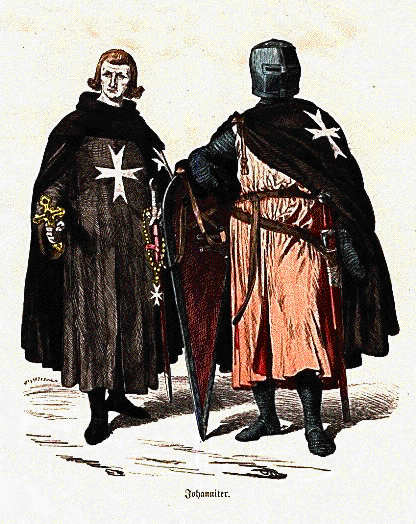
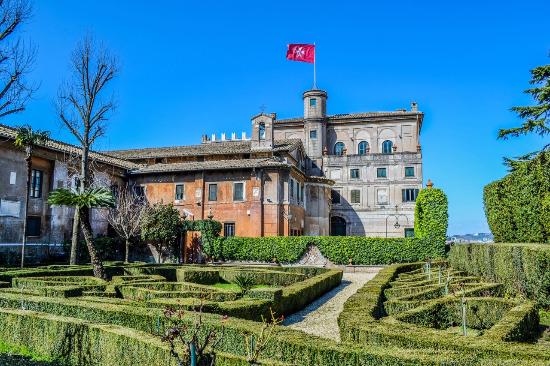
The Requiem took place in the Conventual church of the Sovereign Military and Hospitaller Order of St John of Jerusalem, Rhodes and Malta (founded in 1099 and later known as the Knights Hospitaller). This is not - as some wrongly call it - a "hospital chapel". This is the Conventual church of an ancient religious order, older than the Franciscans and Dominicans and most other religious orders in the Church - only the Benedictines and Augustinians are older.

Here, below, is the church prepared for the Requiem.

The catafalque is in the middle of the Sanctuary, standing on a black carpet. Black hangings are attached to a coronet suspended from the cupola windows to match the black altar frontal and black vestments used in the old rite for Requiems and funerals. Six candlesticks stand guard by the catafalque. The arms of the Cardinal-King are displayed attached to the altar pillars. In the Order flag-stand are seen the papal flag, the flag of the Order and the Union flag.

This latter has been, since 1801 and the union with Ireland, the flag of the United Kingdom and Great Britain. The Stuart monarchy did not use it but only the pre-1801 Union flag which did not have the red Saltire of St Patrick and looked like this:

Here below is the catafalque closer up. At the front of it, placed on a red cushion, are representations of the Order of the Garter regalia but of the type used by the Stuarts. The Stuart Garter star was diamond-encrusted which the Hanoverian Protestants replaced with cut metal only. The Stuart Garter sash was a lighter blue, the Hanoverians changing to a darker colour to distinguish themselves from the Catholic Stuarts. The Garter collar with the pendant image of St George killing the dragon, and the Garter itself with its famous motto, Honi Soit Qui Mal Y Pense, are also represented.

The motto means "evil be to him who thinks evil of it" and refers to the chivalrous incident by which the Order of Knights of the Garter was initiated. King Edward III about 1348, whilst dancing at Eltham Palace, picked up the garter of the Countess of Salisbury which caused some sniggering as if there were some impropriety. The King, seeing this, said the words that are now the Order's motto, as if to mean "if you think ill of this lady's reputation assuming she lost her garter through improper behaviour, then evil be to you". So the Order was founded upon the chivalrous defence of a lady's honour by the King himself, a Catholic king.

Since St George had become the Protector of the English Realm, through his having inspired King Richard the Lionheart in the Crusades, King Edward dedicated his new order of Knighthood to that warrior saint.

Even today the Order of the Garter is still given by the Monarch in the way it has always been given, in the name of "God, our Lady and St George".


Draped on the catafalque is a representation of the Royal parliamentary mantle which is burgundy-coloured with an ermine cape. At the altar end is the galero sitting on top of the cappa magna of a cardinal, the long scarlet train that is worn on solemn occasions.

In the middle of the catafalque on a white cushion sits a mitra pretiosa or precious mitre. At a Requiem the pontificating bishop wears a simple white mitre, not a precious mitre.

Below, Fr Nicholas Schofield preaches the sermon about the Cardinal-King. The text of the sermon is on his website at http://romanmiscellany.blogspot.com/.

Below, in their stalls sit the Knights of Malta, praying and singing the Dies Irae alternately with the schola of some 23 singers. The schola sang from behind the altar which produced a wonderful effect as of hidden angels pouring forth chant and polyphony for the soul of the Cardinal-King and the deceased members of his family.

Here below the Bishop performs the Absolutions. As the schola sings the Libera Me the Bishop blesses the catafalque with lustral water and then incense.

The Bishop then processes out, preceded by the clergy and servers with his mitre-bearer and other servers behind, imparting his blessing as he goes.

Below is a representation of the funeral of Prince Henry's mother, Queen Maria Clementina, the daughter of King Jan III Sobieksi of Poland-Lithuania.
Finally, here is the portrait of the Cardinal-King hanging in the Scots College in Rome, where Scottish seminarians are trained for the priesthood.

Thus was appropriately celebrated the memory of the Head of the Royal House of Stuart and rightful King over the Dowry of Mary, England, the Crown of Mary, Scotland, and the blessed isle of St Patrick, Ireland, the last of the Royal name of Stuart that had ruled in Scotland for so long and which later came to be the ruling dynasty of the British isles, the last Catholic dynasty of these islands.

The Stuart line, happily, continues and, having passed down through various generations, now rests with HRH Prince Francis, Duke of Bavaria.

His brother, Duke Max Emmanuel in Bavaria, will succeed and thereafter the daughter of Duke Max, Princess Sophie of Bavaria, now Her Serene Highness, Princess of Liechtenstein after her marriage to HSH Prince Alois, the heir of the very Catholic princely line of Liechtenstein. Appropriately, Prince Alois was educated at the Royal Miltiary Academy Sandhurst, Britain's military academy, and his eldest child was, again appropriately, born in London.

Here is a portrait of the Princess with her husband at the 200th anniversary of the Principality of Liechtenstein which was acquired by the Liechtenstein family when they were a substantial land-owning noble family in Austria, Bohemia, Moravia and Silesia. They held Liechtenstein directly (unmittelbar) from the Holy Roman Emperor and so thereby qualified to sit independently in the Reichstag (Imperial Diet), the Parliament of the Holy Roman Empire (not to be confused with the later Parliament of the same name in the Protestant German Empire). They were great friends and honoured courtiers of the Habsburg Roman Emperors. However, all their lands, save Liechtenstein, were later seized by the Communists and they now head only the Principality which is still technically a fief of the Holy Roman Empire, the last such fief in Europe.

HSH Princess Sophie of Liechtenstein, lineal successor of the Royal Stuart line, and her husband, HSH Prince Alois, the heir apparent to the Principality of Liechtenstein.


St George, St Andrew, St David and St Patrick, pray for us!


...

Wednesday, 19 September 2007

Bicentenary Pontifical Requiem for the Cardinal Duke of York


Henry Benedict Stuart
Prince and Duke of York
Cardinal-Bishop of Ostia and Velletri
Cardinal-Bishop of Frascati
Dean of the Sacred College of Cardinals
Vice-Chancellor of the Holy Roman Church
Head of the Royal House of Stuart

Solemn Pontifical Requiem
for the Bicentenary of his death

Noon

Saturday, 22nd September 2007


Conventual Church of the Sovereign Military and Hospitaller Order of St John of Jerusalem, Rhodes and Malta

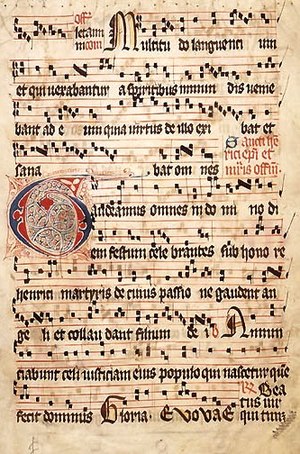
The Ordinary of this Requiem Mass is sung in the traditional Roman rite and is set to music by Giovanni Francesco Anerio (1657-1630), a Renaissance composer of the Roman school.

The Sequence, Dies Irae, is sung in chant and polyphony, alternately with the Choir.

Celebrant: The Rt Revd Bernard Longley, Titular Bishop of Zarna, Auxiliary Bishop in Westminster

Assistant Priest: The Revd Andrew Wadsworth, Magistral Chaplain, Sovereign Military Order of Malta

Deacon: The Revd Dr Laurence Hemming

Subdeacon: The Revd Nicholas Schofield

Preacher: The Revd Nicholas Schofield, Hon Roman Catholic Chaplain to the Royal Stuart Society

Master of Ceremonies: Mr Duncan Gallie, Vice-Chancellor, Grand Priory of the Sovereign Military Order of Malta

The Schola is directed by Mr Eoghain Murphy.

Thursday, 16 August 2007

Solemn Pontifical Requiem for Henry IX and I, King and Cardinal, on Saturday 22 September 2007 at noon...

By kind permission of His Excellency Fra’ Matthew Festing TD OBE DL, the Grand Prior of England of the Sovereign Military Order of Malta,
and by the patronage of His Grace the Duke of St Albans, the Governor-General of the Royal Stuart Society,
Solemn Pontifical Requiem Mass
will be sung with solemn Pontifical Absolution
in the
Conventual Church
of
the Sovereign Military and Hospitaller Order of St John of Jerusalem, Rhodes and Malta,
at
the Hospital of St John and St Elizabeth, 60 Grove End Road, St John’s Wood, London NW8 9NH
to mark the bicentenary of the death and for the repose of the soul of
Henry Benedict Stuart
Cardinal Duke of York, Dean of the Sacred College of Cardinals, Vice-Chancellor of the Holy Roman Church and Cardinal-bishop of Ostia and Velletri and of Frascati,
grandson of
King James II and VII
of England, Scotland, France and Ireland
and for the souls of
the deceased members of the Royal House of Stuart
at
12 noon
on
Saturday 22nd September 2007
the Feast of St Maurice of the Theban Legion.

Musical Setting: Requiem of G F Anerio
Dress: dark suit and dark tie (equivalent for ladies or for Highland/Lowland dress)
Approach from either Grove End Road, through the Hospital entrance, or Circus Road

[Nearest tube: St John’s Wood]

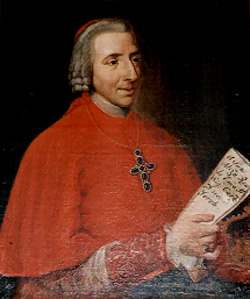
His Most Eminent Majesty, King Henry IX and I, Cardinal-bishop of Frascati and Vice-Chancellor of the Holy Roman Church


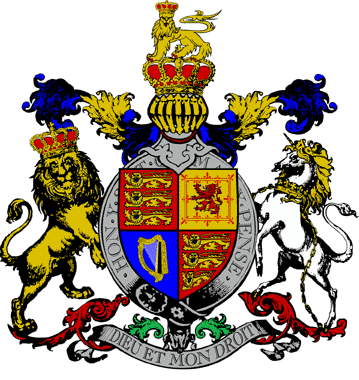
Arms of the Royal House of Stuart (retaining the Fleurs de Lys)

HRH Prince Henry Benedict Stuart, Cardinal Duke of York, became the rightful king, after the death of his brother, "Bonnie Prince Charlie", Prince Charles Edward, de jure King Charles III of England, Scotland, France and Ireland, on 13 January 1788.

He thus, also, became King in America, Canada, Australia, New Zealand, India and all the other realms and territories of the nascent British Empire.

For instance, he became King in Australia since Australia was claimed for the Crown by Captain James Cook RN in 1770 and NSW became a Crown Colony on 26 January 1788, so the real first kings of Australia were Bonnie Prince Charlie and thence the King-Cardinal.

So it would be fitting to have a bicentenary Requiem in each of the realms and territories of the former British Empire. For instance, in Australia, either NSW or Tasmania (once Van Diemans Land), founded in 1788 and 1803, respectively, would be appropriate therefore both having owed allegiance to the King-Cardinal.

Interestingly, Jacobites are not Unionists in the Iain Paisley sense. They are "Personal or Crown Unionists" not "Kingdom Unionists" and so do not believe in Great Britain or the United Kingdom but rather in the personal union of the Crowns of England, Scotland, France and Ireland (and the Principality of Wales) whilst maintaining separate the kingdoms and governments of each of the nations i.e., the proper Catholic subsidiarist model based upon that of the Catholic Roman Empire and Roman Church.

In short, the Royal Stuarts endorsed the right and happy medium between the twin extremes of fissiparous nationalist separatism, on the one hand, and tyrannous Unionist centralism, on the other, both revolutionary political creeds that destroy rather than build.

The Cardinal was also King Henry I of Ireland since Henry VIII's Crown of Ireland Act of 1542 cannot be recognised because he was already then a usurper and heretic, and before him the English kings called themselves "Lord of Ireland", by rescript of the Holy See (Laudabiliter of Pope Adrian IV) with the Pope as feudal overlord, and not "King of Ireland".

However, in 1555, Pope Paul IV issued a papal bull granting the title "King of Ireland" to Philip II of Spain, following excommunication of Henry VIII, the latter having given himself the title by challenging the prior feudal right of the Papacy. The battle of Kinsale and the failed Spanish Armada put paid to Philip's rule and the red-haired, Catholic-murdering harridan and bastard queen, Elizabeth I, illegitimate daughter of Ann Boleyn by Henry VIII, took over.

King George V continued to reign, for a time, in Ireland as King of the United Kingdom but, not surprisingly, this met with problems in the Irish Free State, created after 1922 as a Dominion within the British Empire. Thus it was that, in 1927, the old Anglo-Irish title "King of Ireland" was revived to emphasize the Irish Free State's more independent status.

This, of course, was from where came the idea for the titles "Queen of Canada" and "Queen of Australia". etc.

So, a Requiem for the Cardinal-King should not offend the Irish nationalist conscience at all.

But where does the claim to France comes from? It goes back to King Edward III, being Norman-French himself and Duke of Normandy, and to the Hundred Years War. But it was a tenuous claim since it infringed the Salic law and claimed through a woman. King Henry VI of England held it de facto (and arguably de jure) until Joan of Arc (with the help of God!) pushed him out and put the Dauphin (as the heir to the French throne was called) on the throne as Charles VII in 1429.

However, the English kings hung on to the claim, despite losing all of their French territories during the Wars of the Roses, except Calais which was itself lost under King Philip I and Queen Mary I (Tudor).

Elizabeth I ceded all claim to Calais but kept the title Queen of France, despite, as did her successor King James I and VI under whom the Crowns of England and Scotland, but not the countries, were united. Hence the claim of the Royal Stuarts to the Kingdom of France continued but only nominally. Queen Anne allowed the Union of England and Scotland as Great Britain (never recognised by the Catholic Royal Stuarts) and kept the French title as did the Hanoverian usurpers, even after the Kingdom of France ceased to exist on 21 September 1792.

However, King George III finally dropped the use of the title with the Union of Great Britain and Ireland (as the United Kingdom) in the Act of Union of 1800 (also never recognised by the Catholic Royal Stuarts).

Hence the titles of the King-Cardinal.

He is therefore, I suppose, King Henry II of France but the Royal Stuarts never numbered their title for the obvious reason that, in exile, they relied upon the (de facto!) kings of France for protection.

I urge fellow Jacobites in the Commonwealth realms and former British imperial territories to celebrate Solemn Requiems for the King-Cardinal, also.

The proper form is to have a Solemn Mass (with deacon and subdeacon) and a catafalque draped in a black pall and, if you can get it, a replica of St Edward's Crown and the royal mantle, a Cardinal's scarlet galero (hat) and scarlet cappa magna (cape and train), draped at the front and back of the catafalque (the Cardinal's regalia nearest the altar) and a replica of the Garter Star and Collar on top of the catafalque, together with replicas of the Thistle Star and Collar, if you can get them.

The Requiem should end with the Absolution. Ideally it should be a Pontifical Solemn Mass (i.e. with a bishop) with Pontifical Absolution, such as we are having in England on 22 September 2007 (see above).


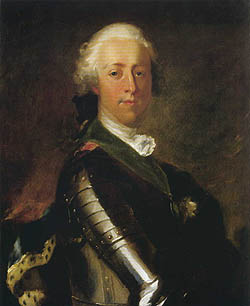
Prince Henry before Ordination, with Thistle (revived by his grandfather, James II and VII) and Garter in the old pre-Hanoverian style (lighter blue, diamond-encrusted star)