
By a series of statutes, successive sovereigns and Parliaments from Elizabeth I to George III, sought to prevent the practice of the Catholic Faith in England.
Catholics lost not only freedom of worship, but civil rights as well; their estates, property, and lives were at the mercy of any informer.
The Penal Laws began with the two Statutes of Supremacy and Uniformity by which
Queen Elizabeth I, in 1559, initiated her religious settlement; and her legislation falls into three divisions:
• 1558-70 when the Government trusted to the policy of enforcing conformity by fines and deprivations -
Acts of Supremacy and Uniformity (1 Eliz. 1 and 2) and the amending statute (5 Eliz. c. 1); by the
Act of Supremacy all who maintained the spiritual or ecclesiastical authority of any foreign prelate, especially the Pope, were to forfeit all goods and chattels and all benefices for the first offence, or if below £20, to be imprisoned for one year; for a second offence, they were liable to the forfeitures of
Praemunire, that is, exclusion from the sovereign's protection, forfeiture of all lands and goods, and arrest to answer to the Sovereign and Council and, for the third offence, to the penalties of high treason i.e. the barbaric savagery of hanging, drawing and quartering, corruption of blood by which heirs became incapable of inheriting honours and offices, and all property was forfeit;
• 1570-80 from the date of the excommunication of Queen Elizabeth by
Pope St Pius V to the time when the Government tightened the persecution of seminary priests and Jesuits;
• from 1580 to the end of the reign.
The penalty for women was to be burned at the stake.
Yes, really. In Britain.
Don't let anyone tell you that Protestantism got rid of the practice. It was, unfortunately, practised all over Europe.
At least 32 women were thus burned at the stake in England alone between 1735 and 1789. Women supposed to be witches were also burned in many Protestant countries - America included.
The burning of women was not abolished until the
Treason Act 1790 in Great Britain and by the
Treason by Women Act (Ireland) 1796 in Ireland.
Burning came into law in England in 1401 and was used against the Lollards. It was repealed in 1553 but re-introduced by King Henry VIII. The early Church Fathers had expressly taught against the practice but this was, it seems, ignored.
Execution for treason was not abolished until 1973 and that Act was amended by the
Crime and Disorder Act 1998 when the death penalty was abolished and replaced with imprisonment at the discretion of the court, up to life imprisonment.
The first Penal statutes were made stricter by
the Amending Act (5 Eliz. c.1) which declared that to maintain the authority of the Pope in any way was punishable by penalties of
Praemunire for the first offence and of high treason, without corruption of blood, for the second.
 Queen Elizabeth I,
the bastard daughter of King Henry VIII with no right to the throne, she had Catholics tortured and murdered for fear that they would denounce her right to the throneAll who refused the
Oath of Supremacy, i.e. an oath swearing that the Queen was the Supreme Governor of the Christian Church, were subjected to the like penalties.
The Act of Uniformity, which made the use of the Anglican Book of Common Prayer compulsory for all, punished all clerics who used any other service by deprivation and imprisonment, and everyone who refused to attend the Anglican service by a large fine for each omission.
Some hypocrites even dared to call this totalitarian code of blood by the name of “toleration” and “liberty”.
Coming to the legislation of the second period, there were two Acts directed against the Bull of Excommunication:
•
13 Eliz. c. 1, which, among other enactments, made it high treason to affirm that the Queen ought not to enjoy the Crown, or to declare her heterodox or schismatic, and
•
13 Eliz. c. 2, which made it high treason to put into effect any papal Bull of absolution, to absolve or reconcile any person to the Catholic Church, or to be so absolved or reconciled, or to procure or publish any papal Bull or writing whatsoever.
The penalties of
Praemunire were enacted against all who brought into England or who gave to others
Agnus Dei or articles blessed by the Pope or by any one through faculties from him.
A third act,
13 Eliz. c. 3, which was designed to stop Catholics from taking refuge abroad, declared that any subject departing the realm without the queen's licence, and not returning within six months, and should forfeit the profits of his lands during life and all his goods and chattels.
The third and most severe group of statutes begins with the "
Act to retain the Queen's Majesty's subjects in their obedience" (23 Eliz. c. 1), passed in 1581.
This made it high treason to reconcile anyone or to be reconciled to "the Romish religion", prohibited Mass under penalty of a fine of two hundred marks, a simply enormous sum in those days, and imprisonment for one year for the celebrant, and a fine of one hundred marks and the same imprisonment for those who heard the Mass.
This act also increased the penalty for not attending the Anglican service to the sum of twenty pounds a month, or imprisonment till the fine be paid, or till the offender began to attend the Anglican services.
A further penalty of ten pounds a month was inflicted on anyone keeping a schoolmaster who did not attend the Anglican services. The schoolmaster himself was to be imprisoned for one year.
The climax of Elizabeth's persecution was reached in 1585 by the "
Act against Jesuits, Seminary priests and other such like disobedient persons" (27 Eliz. c. 2).
This statute, under which most of the English martyrs suffered, made it high treason for any Jesuit or any seminary priest simply to be in England at all, and felony for anyone to harbour or relieve them.
 St Edmund Campion SJ, scholar, poet, priest and martyr.
Jesuits were, for their intelligence and loyalty, among the most savagely persecuted of all CatholicsThe penalties of
Praemunire were imposed on all who sent assistance to the seminaries abroad, and a fine of 100 pounds for each offence on those who sent their children overseas without the royal licence.
The last of Elizabeth's laws was the "
Act for the better discovery of wicked and seditious persons terming themselves Catholics, but being rebellious and traitorous subjects" (35 Eliz. c. 2). Its effect was to prohibit all recusants from removing more than five miles from their place of abode, and to order all persons suspected of being Jesuits or seminary priests, and not answering satisfactorily, to be imprisoned till they did so.
The hopes of the Catholics on the accession of James I were soon dispelled, and during his reign (1603-25) five very oppressive measures were added to the statute-book. In the first year of his reign there was passed the "
Act for the due execution of the statute against Jesuits, seminary priests, etc." (1 Jac. I, iv) by which all Elizabeth's statutes were confirmed with additional aggravations.
The carefully arranged "discovery" of the
Gunpowder Plot in 1605 was followed by two statutes of particularly savage character. This plot was almost certainly a set up arranged by
Lord Burghley so as to set up Catholics as stool pigeons.
 The Gunpowder Plot was almost certainly a put up job arranged by Lord Burghley to set up and defame Catholics, Certainly all the Catholic clergy warned straitly against it in confession and spiritual counsel
These were "
An Act for the better discovering and repressing of Popish Recusants" (3 Jac. I, iv) and "
An Act to prevent and avoid dangers which may grow by Popish Recusants" (3. Jac. 1, v).
The first of these two unjust, grossly intolerant and oppressive laws enacted that all convicted recusants should communicate once a year in the Anglican church under penalties of 20 pounds for the first omission, 40 pounds for the second, and 60 pounds for the third.
Moreover the King was to be allowed to refuse the penalty of 20 pounds per month for non-attendance at the Anglican Church, and to take in its place all the personal property and two-thirds of the real property of the offender.
But the main point of this Act was the new and even more oppressive
Oath of Allegiance which it prescribed.
Yet all who refused it were to be subjected to the penalties of
Praemunire, except married women, who were to be imprisoned in the common jail. Finally, every householder of whatever religion was liable to a fine of 10 pounds a month for each guest or servant who failed to attend the Anglican Church.
The second Act was even worse, and the
Catholic historian Tierney justly says of it that it "exceeded in cruelty all that had hitherto been devised for the oppression of the devoted Catholics".
 The Penal Laws against Roman Catholics in Britain are among the most comprehensively savage and oppressive of laws ever put together by a government against a minority religion. They are a disgrace to the name of English law, to Englishmen generally and to the nation as a whole. Americans who think they are any better are fooling themselves. The same laws applied in America!
It prohibited recusants from remaining within ten miles of the city of London, a provision which it was impossible to carry out; or to remove more than five miles from their place of residence till they had obtained licence from four magistrates and the bishop of the diocese or lieutenant of the county.
They were disabled from practising as lawyers, physicians, apothecaries (i.e. doctors); from holding office in any court or corporation; from holding commissions in the army or navy, or any office of emolument under the State; from discharging the duties of executors, administrators, or guardians.
Any married woman who had not received the sacrament in the Anglican Church for a year before her husband's death forfeited two-thirds of her dowry, two-thirds of her jointure, and was debarred from acting as executrix to her husband or claiming any part of his goods.
Husbands and wives, if married otherwise than by an Anglican minister in an Anglican church, were each deprived of all interest in the lands or property of the other. They were fined 100 pounds for omitting to have each of their children baptised by an Anglican minister within a month of birth.
All Catholics going or being sent beyond the seas without a special licence from the King or Privy Council were incapable of benefiting by gift, descent, or devise, till they returned and took the Oath of Allegiance; and in the meantime the property was to be held by the nearest Anglican heir.
And, lastly, every convicted recusant was excommunicated from the Established Church, with the result that they were debarred from maintaining or defending any personal action or suit in the civil courts. Their houses were liable to be searched at any time, their arms to be seized, and any books or furniture which were deemed superstitious to be destroyed.
The two remaining statutes of James I were "
An Act to cause persons to be naturalized or restored in blood to conform and take the oath of allegiance and supremacy" (7 Jac. 1, ii) and "
An Act for the reformation of married recusant women, and administration of the oath of allegiance to all civil, military, ecclesiastical and professional persons" (7 Jac. I, vi). The chief effect of this latter act was to cause the oath to be offered to all persons over eighteen, and to empower the committal to prison of any recusant married woman, unless her husband paid 10 pounds a month for her liberty.
During the reign of Charles I, the only penal statute was a short "
Act to restrain the passing or sending of any to be Popishly bred beyond the Seas" (3 Car. 1, iii), which re-enacted the provisions in 3 Jac. 1, c. 5, adding that offenders should be disabled from prosecuting any legal actions in law or in equity; from acting as guardian, executor, or administrator; receiving any legacy or deed of gift, or bearing any office within the realm. Moreover, such offender was to forfeit all his lands and personal property.
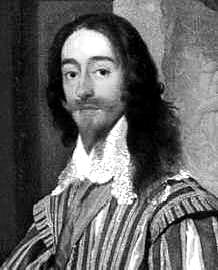
 King Charles I
married to a Catholic, sought to temper the Penal Laws but was forced by Parliament to do otherwise. In the end, he suffered a martyr's death himself at the hands of a savagely Protestant Parliament.After the Restoration in 1660, an attempt was made by Charles II, not unmindful of the sacrifices Catholics had made in the Stuart cause, to obtain a repeal of the Penal Laws, and a committee of the House of Lords was appointed to examine and report on the question. The matter, however, was allowed to drop; and in the following year both Houses of Parliament joined in petitioning the King to issue a proclamation against the Catholics.
Further efforts on the part of the King came to nothing, and matters remained on the same footing till the latter part of his reign, when new statutes of a harassing nature were passed.
With the exception of the
Corporation Act (13 Car. II, St. 2, c. 1) which was not aimed against Catholics directly, but which provided that no person could hold any municipal office without taking the
Oaths of Allegiance and Supremacy and receiving the Sacrament in the Anglican Church, no new measures were introduced till 1673, when Parliament passed the
Test Act (25 Car. II, ii). This required all officers, civil and military, to take the same Oaths and to make a
Declaration against Transubstantiation.
Five years later another Act was passed (
30 Car. II, St. 2), which excluded all Catholics from sitting or voting in Parliament, by requiring every member of either House to take the two oaths and to make the Declaration against Popery which, for a Catholic, was highly blasphemous.
From this statute, which was entitled "
An Act for the more effectual preserving the King's person and government, by disabling Papists from sitting in either House of Parliament", a special exception was made in favour of the Duke of York, afterwards King James II, who was himself a Catholic.
With the Revolution of 1688 began a whole new era of persecution.
 The Dutch Prince of Orange
illegally invaded Britain with the help of English traitors and so became King William III with the aim of excluding Catholics from the throne and persecuting and oppressing Catholics all the more so that Anglicans enriched by the spoliation of the monasteries might not be called to account. William had no children, is thought to have been homosexual and died out riding when his horse stumbled over a mole hill. Ever after Jacobite have saluted the mole as "the little gentleman in black velvet".The "
Act for further preventing the growth of Popery" (11 & 12 Gul. III, 4), passed in 1699, introduced a fresh hardship into the lives of the Roman Catholic clergy by offering a reward of 100 pounds for the apprehension of any priest, with the result that Catholics were placed at the mercy of common informers who harassed them for the sake of gain, even when the Government would have left them in peace.
It was further enacted that any Roman Catholic bishop or priest exercising episcopal or sacerdotal functions, or any Roman Catholic keeping a school, should be imprisoned for life; that any Catholic over eighteen not taking the
Oaths of Supremacy and Allegiance, or making the
Declaration against Popery, should be incapable of inheriting or purchasing any lands; and any lands devised by will to a Catholic who refused to take the oaths should pass to the next of kin who happened to be an Anglican.
A reward of 100 pounds was also offered for the conviction of any Catholic sending children to be educated abroad. The cruel operation of this Act, which made itself felt throughout the ensuing century, was extended by a measure passed under Queen Anne (
12 Anne, St. 2, c. 14), though Catholics were not generally molested during her reign.
The last penal statutes to be enacted were those of George I.
 Prince George of Hanover was invited by Parliament to become king, after Queen Anne died, because he was the nearest Protestant relative. Fully 57 other people had a better claim to the throne than he but they were all Roman Catholics. George arrived at Dover with a mistress on each arm and, when he was booed, called out in bad English with a thick German accent "my people, I have come for your goods". A wag in the crowd replied "Aye, and our chattels, too!". George I imprisoned his innocent wife in a German castle for over 30 years. He was the first of a line of Hanoverian rotters.
By
1 Geo., 1, St. 2, c. 13, the
Hanoverian Succession Oaths were to be taken by all Catholics to whom they were tendered, under penalty of all the forfeitures to which "popish recusant convicts" were liable.
Not surprisingly, all over Britain people were ready to rise up against the oppressive government that cruelly persecuted the innocent with these odious laws. So began the series of
Jacobite risings aimed at restoring the Stuart dynasty which had been excluded from the throne for no other reason than that, since King James II, the heirs-apparent were Roman Catholics.
The Stuart or Jacobite rising of 1715 was followed by another Act (
1 Geo. 1, St.2., c.50) appointing commissioners to inquire into the estates of popish recusants with a view to confiscating two-thirds of each estate.
The scope of "
An Act to oblige papists to register their names and real estates" (I. Geo. I. St. 2. c. 55) is sufficiently indicated by its title.
It added to the expense of all transactions in land, the more galling as Catholics were doubly taxed under the annual land-tax acts, e.g. by also
4 Geo. III, c. 60.
In 1722 was passed "
An Act for granting an aid to his Majesty by levying a Tax upon Papists" (9 Geo. I, 18), by which the sum of one hundred thousand pounds was wrung from the already impoverished and oppressed Catholics.
Happily, throughout the reign of George II (1727-60) there were no further additions to the penal code and under his successor, George III, (1760-1820), the work of repeal was at last commenced.
Yet, even the foregoing does not enumerate all the Penal Laws against Roman Catholics.
The task of repeal was a long, slow, gradual, and complicated one, the chief measures of relief being three: The first
Catholic Relief Act of 1778, which enabled Catholics to inherit and purchase land and repealed the Act of William III, rewarding the conviction of priests; the second
Relief Act of 1791, which relieved all Catholics who took the oath therein prescribed from the operation of the Penal Code, and, finally, the
Catholic Emancipation Act of 1829 which removed the last of the Penal Acts.
The only disqualifications against Catholics which appear to be still in force are those which prohibit the sovereign from being or marrying a Catholic, or any Catholic subject from holding the offices of
Lord Chancellor, Prime Minister or
Lord Lieutenant of Ireland or, until the recent appointment, of being
British Ambassador to the Holy See.
For this reason, two sons of
HRH the Duke of Kent are excluded from succession to the throne, that is, the
Earl of St Andrews, who married a Roman Catholic,
Sylvana Tomaselli, and
Lord Nicholas Windsor who became a Roman Catholic and married
Princess Paola Doimi de Lupis de Frankopan, of the former Croatian royal family, in the Vatican City State, the first British royal ever so to do.
 Lord and Lady Nicholas Windsor and son.
Lord Nicholas is the son of the Duke of Kent and converted to Catholicism and Lady Nicholas, born Princess Paola Doimi de Lupis de Frankopan, descends from Croatian royalty and Italian nobility.
Their mother,
HRH the Duchess of Kent also became a Roman Catholic in 1994. Edward Windsor,
Lord Downpatrick, son to the Earl of St Andrews, when he succeeds, will be the first Catholic Duke of Kent since the Reformation. Interestingly, the current Duke is the Grand Master of the English Freemasons, so their family is, from one point of view, a fascinating example of modern ecumenism and religious toleration.

O holy martyrs of England, Scotland, Wales and Ireland, pray for us!...
 Bertrand, Earl Russell was one of the more hypocritical of the thinkers of the Left.
 John Russell, 1st Earl of Bedford,
 Marie Stopes.
  Margaret Sanger, eugenicist, racist and enthusiast for Nazism.













.jpg)











_-002.jpg/220px-Circle_of_Anton_Raphael_Mengs,_Henry_Benedict_Maria_Clement_Stuart,_Cardinal_York_(ca_1750)_-002.jpg)


