Thursday, 28 May 2009

Here we go again: yet another Yank who knows no history - not even his own...

 The Yankee myth of "manifest destiny" led to oceans of Native American and Spanish blood

It is becoming a familiar theme: the American wide-eyed innocent who does not know the history of his own country and cannot understand it when he hears it for the first time.

I said, in relation to Stonewall Jackson's pre-battle address in the film "Gods and Generals" in the previous post, that "I don't agree with the example of the "second war of independence" since the first one was not a just war".

Mr Dumb-ass, Innocent Yankee replied to me (see combox) with all the usual completely ill-instructed, woefully ignorant nonsense and propaganda that the world has become accustomed to from a certain type of chauvinistic Yank.

Mr Innocent Yankee asks:

"Why was the first one not a just war? The states broke away from the British crown because the British crown was obstinate in its refusal to recognise their ancient rights as freeborn Englishmen. It was plenty just."

"Plenty just" is not, of course, English but it is is an indication of this guy's understanding of history and morality.

I need only repeat the story of the gentleman who met Lincoln and was chaffed by him for not supporting the war against the South.

"Well, Mr President", he said, "If secession be a valid principle then I say 'long live the South' but if it be a false principle then I say 'God save King George' ".

Lincoln could not, of course, answer since the gentleman had an unassailable point.

How could the Union refuse the right to secede from the Union if they themselves believed it was right to secede from Britain? If it was not, as a matter of principle, right, then they certainly could argue no ground for secession from the British Crown.

Mr Dumb-bunny Yank thinks Britain refused Americans their rights as "free-born Englishmen".

That is pure poppycock.



King George and the English government did no such thing. On the contrary, they gave the Colonists too much leeway. The Boston Tea Party was organised by those rebels who stood to lose fat profits if foreign competition was allowed to bring tea into America. So they staged the Boston tea party and pretended it was all about civil rights.

The Founding Fathers of the USA were largely Unitarians and Deists, not Christians, and they believed in slavery, racism and their own arrogantly racist so-called "manifest destiny".

They were also virulent anti-Catholic bigots.

Jefferson even had children by his black slaves and then enslaved his own half-caste children!

Yet, Mr Dumb-bunny Yankee thinks that slavery was only an issue in the South.

More Poppycock.

Lincoln himself believed the black race to be intrinsically inferior, was not opposed to slavery and, at one point, considered "solving" the issue by forcibly expelling all blacks to Liberia.

Our ill-instructed Yank didn't know any of that, did he?

He just believes the propaganda he got fed at school.

Our dummy Yank also thinks that the War was about the "equality of man".

How equal does he think the industrial poor of America were with the immensely rich fats cats of America who lived off their labour? This came about AFTER the War far more than before.

If revolution is right then why should not any group of people who feel hard done by simply overthrow the legal and constitutional government?

Well, Mr Dumb-bunny?

What's the answer?

If the Muslims of America feel hard done by does that mean they can overthrow the US government?

According to your view of revolution - apparently yes.

The fact is that your position is completely selfish, illogical and chauvinistic and all too typical of quite a lot of Americanist Yankees who do not bother to think or question propaganda but simply swallow it whole and undiluted.

You are so ill-instructed in your own history that you think that blacks in the South fought for the South simply for the right to own other black slaves. Wrong again! The vast majority of blacks who fought for the South were slaves themselves.

The industrial slaves of Capitalism which came after the Union victory do not earn Mr Dumb bunny's sympathy. Why not? Well, because he, himself, has profited from that Capitalist exploitation of the poor so... that makes it OK, then!

See how that works, folks?

Yep - there really are few things quite as dumb, blind and selfish as an Americanist Yankee bigot. It tends to reflect poorly upon an otherwise great nation.

Sad, really.


...

Wednesday, 20 May 2009

Gods and Generals: General "Stonewall"Jackson

Lieutenant-General Thomas "Stonewall" Jackson was one of the greatest of Confederate generals.

His death was a body blow to the Confederate cause. He did not favour slavery and ran a Sunday school for black children when he was younger.

Here is a clip from the film Gods and Generals which is a fine example of motivation by a general of his troops.

I don't agree with the example of the "second war of independence" since the first one was not a just war.

However, the War between the States was a war against centralisation and the abolition of the rights of the States and therefore had much more justice about it.

Although sensible politicians on both sides should have done their best to prevent it, regrettably the 19th century was an age when absurd revolutionary ideas held sway causing wars all over the civilised world and leading to the unnecessary deaths of all too many.

The War between the States was not primarily about slavery, contrary to Yankee propaganda. If it were, then why did so many blacks fight for, and support, the South. Were they all just "Uncle Toms"? To say so is simply to insult them and is, already, a form of racism.

It is the case that many black Americans fought for the South and were proud to do so.

Slavery would eventually have died out but it was already being replaced by the modern form of slavery - that of the industrial workers of the machine age who were already being enslaved in dark mills and factories by the plutocrat Yankees of the North whose primary interest was in enriching themselves regardless of the rights of others.

Was that really "progress"? Was this "justice"? Or was it just hypocrisy?

The music in this film is a bit too schamltzy but the speech is good:


Jackson was a zealous Presbyterian and had some flaws but overall he is an impressive personality, especially as he appears to have suffered from narcolepsy and even fell asleep sometimes when eating. He overcame this disability with steely tenacity and went on to greatness.

He was a fine general and his loss - accidentally shot by some fellow Confederates - was a serious blow to the Confederate cause.


...

Friday, 15 May 2009

What is the Vatican ruling on transferring the Feasts to Sunday? Simple: you don't have to do it!


Here is what the Pontifical Commission Ecclesia Dei (housed on the ground floor of the Palazzo Sant'Uffizio, above) has ruled on the issue:

"1. The legitimate use of the liturgical books in use in 1962
includes the right to the use of the calendar intrinsic to those liturgical books.

2. While in accordance with Canon 1246 §2 of the Code of Canon Law the Episcopal Conference can legitimately transfer Holydays of obligation with the approbation of the Holy See, it is also
legitimate to celebrate the Mass and Office of those feasts on the days prescribed in the calendar of the liturgical books in use in 1962 with the clear understanding that, in accordance with the legitimate decision of the Episcopal Conference, there is no obligation to attend Mass on those days.

3. Thus, in accordance with nn. 356-361 of the
Rubricae Generales Missalis Romani of 1962, it is appropriate to celebrate the external solemnity of Holy Days on the Sunday to which they have been transferred by the Episcopal Conference, as has been customary in many other countries hitherto."

So what does that mean?

It means that there is no obligation to attend on the weekday and no obligation to replace the Sunday with the Feast. You are simply obliged to attend one or the other.

That means that we do NOT, REPEAT NOT, have to change the Sunday to the Feast Day.

We can carry on as the Church always did in the past and celebrate the Feast day on its proper day and keep the Sunday as a Sunday.

The Bishop's Conference Secretariat, in saying the opposite and pretending that we were obliged in the traditional rite to celebrate the Feasts on the Sunday, were, and are, simply...

WRONG!

Given the ancient traditions of the Church and given the vicious tendency of too many bishops to do whatever they can to disrupt the celebration of the old rites, there really could never have been much doubt about this false proposal being anything much more than the usual wrecking amendment.

Let us not forget that these are the guys who have just appointed as bishop in charge of Catechesis the most heterodox bishop in the country, Kieran "You don't have to go to confession" Conry, currently pretending that he is Ordinary of Arundel and Brighton.

Catechesis? What? Are they kidding?

You might as well put Henry VIII in charge of restoring the Monasteries, or Julius Streicher in charge of re-building the Jewish Temple!


Kieran "Does this face look bovvered" Conry thinks we all go to confession too much.
He has his Novus Ordo Corpus Christi Mass on the Thursday, defiantly disobeying his own laws. Given his public and pertinacious adherence to public heterodoxy, does anyone really think this guy is still Ordinary of A & B?


To cap it all, our Kieran has so much contempt even for his own laws, that he is, in any case, celebrating Corpus Christi on the Thursday in his own Cathedral, including procession, even though it will be defiantly Novus Ordo. One rule for him, another rule for every one else, seems to be his motto.

How logical is that?

Go figure!

But then what do you expect from a man who has about as much respect and reverence for the ancient traditions of the Catholic Church as John Calvin or Martin Luther.

Sorry to say it but this man is simply a complete disgrace.

...

Monday, 4 May 2009

3 May: The Feast of the Invention (Finding) of the True Cross


Here is the Roman Empress St Helena pictured with the True Cross.

The Feast of the Invention (Finding) of the True Cross is another great feast that was done away with by the wrecker Bugnini.

St. Helena, mother of Constantine the great, is often depicted holding a cross because according to the tradition she found the true cross in Jerusalem.

The Roman Emperor Constantine was elected Emperor by the Roman Army at Eboracum (York in Britain) in 312, and in the following year, legalized Christianity with the Edict of Milan.

About this time, Constantine’s mother, St. Helena, converted to Christianity.

With the authority of her son, St. Helena went to Palestine in search of the Holy Cross about the year 324.

St Helena built churches marking the place of the Nativity in Bethlehem, and the site of the Ascension.

Three crosses were found in a rock-cistern as well as the titulus (the wood plaque inscribed with the words Jesus Nazarenus Rex Iudaeorum in Hebrew, Greek and Latin - "Jesus of Nazareth King of the Jews"). The Church of the Holy Sepulchre was built over the site.

Titulus Crucis
a sacred relic in the Church of the Holy Cross in Jerusalem, displayed in reverse so that the words can be better seen and an ancient reconstruction placed over the top of the reliquary showing what is written on the now very old wood of the Titulus proclaiming our Lord King of the Jews in the 3 sacred languages


A woman, dying from a terminal disease, was brought to the spot. She touched the crosses, one by one. After she touched the third cross, she was cured, thereby identifying the true cross.

St Ambrose preached that when St. Helena found the true cross:

"she worshipped not the wood, but the King, Him who hung on the wood. She burned with an earnest desire of touching the guarantee of immortality."


St Cyril of Jerusalem, in his letter to the Emperor Constantius (Constantine’s son and successor), stated "The saving wood of the cross was found at Jerusalem in the time of Constantine."

In his fourth Catechetical Lecture, he wrote:

"He was truly crucified for our sins. For if you would deny it, the place refutes you visibly, this blessed Golgotha, in which we are now assembled for the sake of Him who was here crucified; and the whole world has since been filled with pieces of the wood of the Cross."

Many of the older depictions of the crucifixion show a skull with two crossed bones at the foot of the cross. The tradition is that Adam was buried at Calvary. When our Lord died, His Precious Blood flowed down, through cracks in the earth, onto Adam's skull.

In the Church of the Holy Sepulchre in Jerusalem one finds the Chapel of Adam underneath the Chapel of Golgotha.

The Feast of the Triumph of the Cross, which comes much later on 14 September, is the feast marking the day when the Emperor Heraclius re-captured the True Cross from the Persians who had stolen it from Jerusalem.

It was on that great feast day that our Holy Father, Pope Benedict gloriously reigning, ordered the freeing of the traditional Roman rites which, he declared, had never been abrogated (numquam abrogatam).

A truly glorious victory of the Holy Cross indeed!

On these great feasts, let us remember the words of St. Francis of Assisi:


"We adore Thee, O Christ, and we praise Thee, because by Thy Holy Cross Thou hast redeemed the world."

+++

Thursday, 30 April 2009

So what exactly were the changes...?

Good question!

Meaning, of course, what were the changes in the liturgy.

What did they take away from us in the name of progress, liberalism and the modern age?

What did they steal away from our most sacred heritage, our birthright given to us by the Holy Spirit?

Well, here is a preliminary list, for starters, some of which are such ancient ceremonies that none but a serial vandal would dream of trashing them.

Rogation Days and the Litanies
Ember Days
The feasts of:
  • The Finding of the True Cross
  • St Peter in Chains
  • St John before the Latin Gate
  • The Apparition of St Michael the Archangel at Monte Gargano
  • St Christopher
  • St Philomena
  • The Translation of the Holy House of Loreto
  • The Most Precious Blood
  • The Solemnity of St Joseph
  • The removal of the ancient Feast of St Philip and St James on 1 May to make way for the entirely novel Feast of St Joseph the Workman which was introduced as a sop to the Leftist Trade Unionists
  • The removal of the Imperial prayers for the Holy Roman Emperor on Good Friday and at the Easter Saturday Vigil (later replaced by prayers for the "moderators of republics" to reflect Bugnini's anti-monarchial political views)
Many Sequences became optional and many Octaves were lost

But above all...

...the most ancient services in all Christendom were savagely slashed, namely, the ceremonies of the Sacred Triduum.

That was a most disgraceful act of cultural and religious barbarity.


Yet that is what the infamous Archbishop Annibale Bugnini did in 1955 behind the back of Pope Pius XII.


St John before the Latin Gate,
a feast commemorating the miraculous preservation of St John from harm when he was ordered to be boiled in oil outside the city gate


Finally, in the "reforms" after the Second Vatican Council, Bugnini effectively abolished the normative form of the liturgy, the High Mass.

There are simply no rubrics in the Novus Ordo Missae for the High Mass.

Yes, fact.

With a wave of his palsied hand the frightful Bugnini simply did away with the form of the Mass that had been the norm for 2,000 years.


Solemn High Mass
was always the normative form for all masses whether in a Parish Church or a Cathedral, NOT Low Mass.


Attempts are made to retain some form of the High Mass but the fact remains that there are no official rubrics for it.

All rites but the Roman rite retain the High Mass now, especially in the East where the Low Mass is simply unknown.

And they in the East look at us in the Roman rite and wonder in amazement at our naked, brazen impiety in daring to smash up the most ancient rites and services known to the Christian Church.

And yet still there are people who ask "what changes?".

Yes, they ask that, poor chumps, in their woefully deep ignorance of their own traditions of prayer in their own Church.

To such a low pass have we come.

God have mercy on us for our careless impiety.

But it is not entirely new...

In the 16th century the impious and murderous heretic, Thomas Cranmer, ordered that the same process of spiritual destruction be carried out on the Sarum rite leading to the Prayer Book Rebellion of 1549 which was put down by mercenaries and savage reprisals.

The Men of Devon, Cornwall and Wales came out to defend the ancient rites of the Catholic Church and this was their Manifesto:

We will have the Mass in Latin as before.
We will have the Sacrament hung over the high altar,
and there to be worshipped as it was wont to be...
We will have palms and ashes at the times accustomed,
images to be set up again in every church.
We will not receive the new service
because it is like a Christmas game,
but we will have our old service of Matins, Mass,
Evensong, and procession in Latin, as it was before, and not in English.


For this the odious Cranmer had them butchered on Woodbury Common, near Exeter.


O Holy Martyrs for the Roman rite, pray for us!


...

Wednesday, 29 April 2009

Eastertide - the blessed season of grace


"Was not our heart burning within us,

whilst He spoke in the way..."


Let us rejoice greatly at Eastertide for this is a most blessed time when so much is forgiven and grace flows abundantly.

This is when we remember the time after His resurrection and before He ascended to the Father.

We remember the marvellous words of Mark 16:1-2, Dum transisset Sabbatum, telling us:

"And when the sabbath was past, Mary Magdalen, and Mary the mother of James, and Salome, bought sweet spices, that coming, they might anoint Jesus.
ALLELUIA!
And very early in the morning, the first of the Sabbath, they come to the sepulchre, the sun just being risen.
Glory be to the Father and to the Son and to the Holy Spirit."


"Dum transisset Sabbatum,
Maria Magdalene et Maria Jacobi et Salome
emerunt aromata ut venientes ungerent Jesum.
ALLELUIA!
Et valde mane una sabbatorum veniunt ad monumentum orto iam sole.
Gloria Patri et Filio et Spiritui Sancto."


This was rendered by John Taverner in the 16th century into one of the most sublime pieces of music ever written. Here it is sung by the Cambridge Singers, fittingly with film of the beginning of Spring and the departure of Winter.

Notice how the choir burst forth with that great "ALLELUIA" to symbolise the discovery by the holy women of the empty tomb and their sudden realisation that the Lord had risen from the dead. It is as if the heavens immediately opened and the whole heavenly host burst forth with a great, universal cry of profound joy!


Three times He appeared to the Apostles in that great and glorious week after His resurrection, after he had appeared to Mary in the garden.


Noli Me Tangere. Antonio Allegri Corregio (1494-1534).


Once he appeared on the road to Emmaus, and, after explaining the Scriptures to them, they recognised him. Late that same day, the Sunday of the Resurrection, He appeared to them in Jerusalem, breathed upon them the Holy Spirit, ordaining them and giving them the power to forgive sins.

"And behold, two of them went, the same day, to a town which was sixty furlongs from Jerusalem, named Emmaus. And they talked together of all these things which had happened. And it came to pass, that while they talked and reasoned with themselves, Jesus himself also drawing near, went with them. But their eyes were held, that they should not know him. And he said to them: What are these discourses that you hold one with another as you walk, and are sad? And the one of them, whose name was Cleophas, answering, said to him: Art thou only a stranger to Jerusalem, and hast not known the things that have been done there in these days? To whom he said: What things? And they said: Concerning Jesus of Nazareth, who was a prophet, mighty in work and word before God and all the people; And how our chief priests and princes delivered him to be condemned to death, and crucified him... Then he said to them: O foolish, and slow of heart to believe in all things which the prophets have spoken. Ought not Christ to have suffered these things, and so to enter into his glory? And beginning at Moses and all the prophets, he expounded to them in all the scriptures, the things that were concerning him. And they drew nigh to the town, whither they were going: and he made as though he would go farther. But they constrained him; saying: Stay with us, because it is towards evening, and the day is now far spent. And he went in with them. And it came to pass, whilst he was at table with them, he took bread, and blessed, and brake, and gave to them. And their eyes were opened, and they knew him: and he vanished out of their sight. And they said one to the other: Was not our heart burning within us, whilst he spoke in this way, and opened to us the scriptures? And rising up, the same hour, they went back to Jerusalem: and they found the eleven gathered together, and those that were staying with them, saying: The Lord is risen indeed, and hath appeared to Simon. And they told what things were done in the way; and how they knew him in the breaking of the bread."
[Luke 24:13-20,25-35]


"And they said one to the other: Was not our heart burning within us, whilst he spoke in this way, and opened to us the scriptures?"

Marvellous words! Who can express what it must have been like to have our Lord Himself as our teacher, unfolding the whole glorious drama of the history of our salvation!

That same day he appeared to the Apostles in Jerusalem, also, by the time that Simon Peter and Cleophas had arrived back but it seems that the Scriptural authors only count this as once, presumably because it was all on the one day - that greatest of days, that of the Resurrection.

On that occasion St Thomas the Doubter is not with them:

"Now when it was late that same day, the first of the week, and the doors were shut, where the disciples were gathered together, for fear of the Jews, Jesus came and stood in the midst, and said to them: Peace be to you. And when he had said this, he shewed them his hands and his side. The disciples therefore were glad, when they saw the Lord. He said therefore to them again: Peace be to you. As the Father hath sent me, I also send you. When he had said this, he breathed on them; and he said to them: Receive ye the Holy Ghost. Whose sins you shall forgive, they are forgiven them; and whose sins you shall retain, they are retained. Now Thomas, one of the twelve, who is called Didymus, was not with them when Jesus came." [John 20:19-24]

However, the following Sunday, Low Sunday, Dominica in Albis Deponendis, Close-Pasch, the Day of Divine Mercy, he appeared again and re-converted St Thomas the Doubter.

"And after eight days again his disciples were within, and Thomas with them. Jesus cometh, the doors being shut, and stood in the midst, and said: Peace be to you. Then he saith to Thomas: Put in thy finger hither, and see my hands; and bring hither thy hand, and put it into my side; and be not faithless, but believing. Thomas answered, and said to him: My Lord, and my God." [John 20:26-28]


Finally He appeared the 3rd time by the Sea of Tiberias.

"After this, Jesus shewed himself again to the disciples at the sea of Tiberias. And he shewed himself after this manner. There were together Simon Peter, and Thomas, who is called Didymus, and Nathanael, who was of Cana of Galilee, and the sons of Zebedee, and two others of his disciples. Simon Peter saith to them: I go a fishing. They say to him: We also come with thee. And they went forth, and entered into the ship: and that night they caught nothing. But when the morning was come, Jesus stood on the shore: yet the disciples knew not that it was Jesus. Jesus therefore said to them: Children, have you any meat? They answered him: No.

He saith to them: Cast the net on the right side of the ship, and you shall find. They cast therefore; and now they were not able to draw it, for the multitude of fishes. That disciple therefore whom Jesus loved, said to Peter: It is the Lord. Simon Peter, when he heard that it was the Lord, girt his coat about him, (for he was naked,) and cast himself into the sea. But the other disciples came in the ship, (for they were not far from the land, but as it were two hundred cubits,) dragging the net with fishes. As soon then as they came to land, they saw hot coals lying, and a fish laid thereon, and bread. Jesus saith to them: Bring hither of the fishes which you have now caught.

Simon Peter went up, and drew the net to land, full of great fishes, one hundred and fifty-three. And although there were so many, the net was not broken. Jesus saith to them: Come, and dine. And none of them who were at meat, durst ask him: Who art thou? knowing that it was the Lord. And Jesus cometh and taketh bread, and giveth them, and fish in like manner. This is now the third time that Jesus was manifested to his disciples, after he was risen from the dead." [John 23:1-14]

Thereafter, our Lord seems to have appeared many times to the Disciples, teaching them, eating with them and blessing them by His resurrected presence for 40 days in all before He was taken up into heaven at the Ascension.

"He shewed himself alive after his passion, by many proofs, for forty days appearing to them, and speaking of the kingdom of God. And eating together with them, he commanded them, that they should not depart from Jerusalem, but should wait for the promise of the Father, which you have heard (saith he) by my mouth. For John indeed baptized with water, but you shall be baptized with the Holy Ghost, not many days hence." [Acts 1:3-5]

Blessed, indeed, then, are these holy days, the 40 days between the Resurrection and the Ascension!

During this time, the Church, in her traditional liturgy, ever ancient, ever new, marks the sundays by singing that great hymn, loosely based upon Ezechiel 47 and quoting Psalm 117, Vidi Aquam":

Vidi aquam egredientem de templo,
a latere dextro, alleluia:
et omnes, ad quos pervenit aqua ista,
salvi facti sunt, et dicent, alleluia, alleluia.

V. Confitemini Domino quoniam bonus:
R. Quoniam in saeculum misericordia eius.

V. Gloria Patri, et Filio, et Spiritui Sancto:
R. Sicut erat in principio, et nunc, et semper,
et in saecula sæculorum. Amen.


I saw water coming forth from the temple
on the right side, alleluia:
and all those to whom this water came
were saved, and shall say, alleluia, alleluia.

V. Give praise to the Lord, for He is good:
R. For His mercy endureth forever.

V. Glory be to the Father, and to the Son, and to the Holy Ghost:
R. As it was in the beginning, is now,
and ever shall be, world without end. Amen.


Here it is sung by monks:


+++

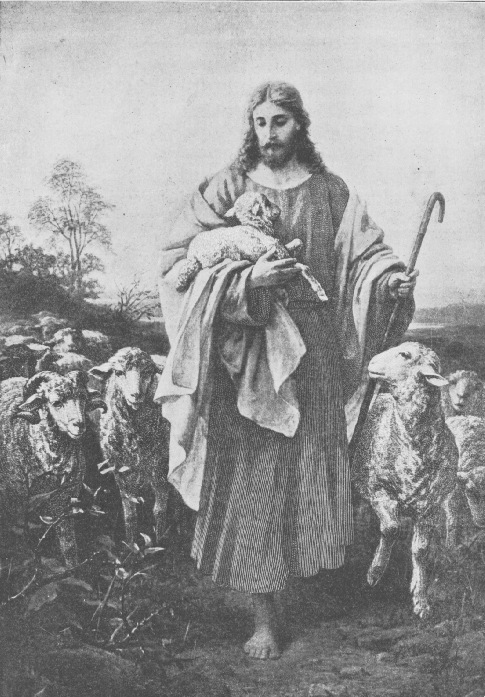
Good Shepherd Sunday

This is the Octave week of Good Shepherd Sunday.

Ego sum Pastor bonus, allelúja: et cognósco oves Meas, et cognóscunt Me Meæ. Allelúja, allelúja.

I am the good Shepherd, alleluia: and I know My sheep, and Mine know Me, alleluia, alleluia.

The Gospel is from John 10: 11-16:

In illo témpore: Dixit Jesus Pharisæis: "Ego sum Pastor bonus. Bonus pastor ánimam suam dat pro óvibus. Mercenárius autem et qui non est pastor, cujus non sunt oves própriæ, videt lupum veniéntem, et dimíttit oves, et fugit: et lupus rapit et dispérgit oves: mercenárius autem fugit, quia mercenárius est, et non pértinet ad eum de óvibus. Ego sum Pastor bonus: et cognósco oves meas, et cognóscunt me meæ. Sicut novit me Pater, et ego agnósco Patrem: et ánimam meam pono pro óvibus meis. Et alias oves hábeo, qum non sunt ex hoc ovíli: et illas opórtet me addúcere, et vocem meam áudient, et fiat unum ovíile, et unus pastor."

At that time Jesus said to the Pharisees: "I am the good Shepherd. The good Shepherd giveth his life for his sheep. But the hireling, and he that is not the shepherd, whose own the sheep are not, seeth the wolf coming and leaveth the sheep and flieth: and the wolf catcheth and scattereth the sheep: and the hireling flieth, because he is a hireling, and he hath no care for the sheep. I am the good Shepherd: and I know Mine, and Mine know Me, as the Father knoweth Me, and I know the Father: and I lay down My life for My sheep. And other sheep I have that are not of this fold: them also I must bring, and they shall hear My voice, and there shall be one fold and one shepherd."


Take note all pastors and bishops and be not hirelings but true shepherds!

We should also note that our Lord says He has sheep that are "not of this fold" who shall hear His voice - perhaps better than those who are currently of His Flock - and they shall become part of the Flock, too.

This should teach us to be humble and not to presume or become complacent. Some who are not currently of the Flock may be judged better than us to sit amongst the saints in Heaven.

And is that not the case today when so many Catholics have become lukewarm and flaccid to such an extent that Protestants, Jews and even some unbelievers are better than those lukewarm Catholics?

Let us remember the awesome words of God from Apocalypse 3:15-16:

"I know thy works, that thou art neither cold, nor hot. I would thou wert cold, or hot. But because thou art lukewarm, and neither cold, not hot, I will begin to vomit thee out of my mouth."

Terrible words!

Let us pray for the lukewarm, also, and remember that the Catholic Church is for all, including those who are not yet members. It is not a convenient little club only for cradle Catholics.

God chose the Israelites but a few later rejected Him and he transferred His favour to the Gentiles who converted to Him and loved Him better than many of His own chosen people.


...