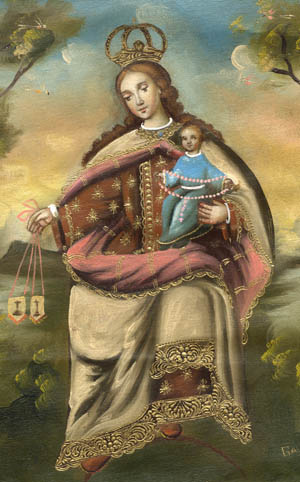

This Saturday 13th October 2007 saw the coincidence of the 90th anniversary of the Fatima apparitions to the three shepherd children in Fatima, Portugal, the Feast of St Edward the Confessor and the Feast of Blessed Gerard the Founder of the Knights Hospitaller of St John of Jerusalem (now the Knights of Malta).
The annual Rosary Rally was held to preserve the memory of the apparition, to make reparation for sin and to remember our Lady's requests at Fatima.
The Dominican Rosary of the Blessed Virgin Mary
At an early date among the monastic orders the practice of counting prayers established itself not only with the offering of Masses, but of saying vocal prayers as a suffrage for deceased brethren. For this purpose the private recitation of the 150 psalms, or of 50 psalms, the third part, was constantly enjoined.
Already in A.D. 800 we learn from the compact between St. Gall and Reichenau (Mon. Germ. Hist.: Confrat. Piper, 140) that for each deceased brother all the priests should say one Mass and also fifty psalms.
Ancient Customs of Cluny (Cluny was the famous Benedictine Abbey in the South of France that began a great reform), collected by Udalrio in 1096, tell us that when the death of any brother at a distance was announced, every priest was to offer Mass, and every non-sacerdotal Choir monk or lay brother was either to say fifty psalms or to repeat fifty times the Paternoster (The Lord's Prayer).
To count these accurately an early practice had come in of using pebbles, berries, or discs of bone threaded on a string. It is in any case certain that the Countess Godiva of Coventry (c 1075) left by will to the statue of our Lady in a certain monastery "the circlet of precious stones which she had threaded on a cord in order that by fingering them one after another she might count her prayers exactly" (Malmesbury, Gesta Pont., Rolls Series 311).
Another example seems to occur in the case of St. Rosalia (A. D. 1160), in whose tomb similar strings of beads were discovered. Even more important is the fact that such strings of beads were known throughout the Middle Ages - and in some Continental tongues are known to this day - as Paternosters or "Our Fathers". The evidence for this is overwhelming and comes from every part of Europe.
Indeed, visitors to London's St Paul's Cathedral will notice the nearby streets are called "Paternoster Row", "Paternoster Square", "Ave Maria Lane" and "Creed Lane", named after constituent parts of the Rosary.
There are also streets called "Rosary Gardens" in other parts of London.
In the times before St. Dominic we can see that Paternosters were prayed, and we know from history that during St. Dominic's time the Lord's Prayer and our Lady's Psalter, as the Rosary was then called, were prayed on pebbles, or a string of beads.
St. Dominic, seeing that the gravity of people's sins was hindering the conversion of the Albigensians, the Catharist heretics who believed that marriage and child-birth was evil and sodomy and euthanasia were sacramental, withdrew into a forest near Toulouse where he prayed unceasingly for three days and three nights. During this time he did nothing but weep and do harsh penance in order to appease the anger of Almighty God.
Tradition tells that our Lady appeared to him while he prayed and said: "My son, prayer and penance are the only way to win souls. Pray my Psalter and teach it to your people. That prayer will never fail".
As ever, our Lady built upon existing traditions, hallowed by time and the Holy Spirit, and did not introduce novelties.
Those who could not read Holy Scripture and those who could not understand it often said a Hail Mary for each of the Psalms. Their simple prayer took the place of the one hundred and fifty Psalms of David that the learned ones could read.
Hence the 150 psalms of the Rosary. That is also the reason why there cannot be added to the Dominican Rosary another 50 recitations.
The Luminous Mysteries chaplet of Pope John Paul II is a novelty which can profitably be said as a separate chaplet but it is simply misleading to pretend that it forms part of the Dominican Rosary. It simply does not. And if it did it would disturb the patterns of 150 beads replacing the 150 psalms of monastic tradition.
Popes may approve new chaplets but they cannot simply invent new parts to existing chaplets that have been hallowed by time. That does not honour the memory of St Dominic.
Counting prayers was not new either before the birth of Jesus, the people who belonged to ancient religions had counted on knotted cords the prayers they said to their gods. After the coming of our Lord, the hermits who lived in the desert in the early centuries counted their prayers to God by means of pebbles.
Even today both Islam and Buddhism have chaplets of their own - but they are not addressed to the true God, of course. Still they represent a very ancient religious tradition.
Our Lady said to St Dominic: "Make clear to them the mysteries of their religion, the divine truths that God has revealed but that they cannot understand. Teach them to picture in their minds the events of my Sons life".
She then explained to him the 15 mysteries of the Rosary and how to meditate upon them.
The Battle of Muret against the Albigensians in 1213
St Dominic and his companions prayed the Rosary at Muret on 11 and 12 September 1213 (there it is again - 9/11!) and on the latter day, Count Simon de Montfort and 700 Catholic knights sallied forth to meet the 50,000 strong Albigensian army under King Peter of Aragon.
They charged into the mass toward the Headquarters of the Albigensian army. King Peter was slain (over whose body Count Simon later wept to see him dead) and the Albigensian army fled.
The tiny Catholic force had overcome the heretics with the power of our Lady's chaplet, the Holy Rosary.
The Brown Scapular of our Lady of Mount Carmel
A scapular is a sleeveless outer garment falling from the shoulders. Use of the scapular originated in the monastic orders of priests and monks, forming part of the habit or clothing of the members. Essentially the scapular is a special garment worn as a sign of love and devotion to Mary the Immaculate Queen.
With the passage of time lay people were permitted to wear the scapular as symbolic members of a monastic order, with the attendant spiritual benefits attached to such membership. Over the years the scapular, at least for lay people, became much reduced in size to but small pieces of wool cloth suspended front and back.
According to tradition the Blessed Virgin appeared to St Simon Stock, Prior of the Carmelite Priory at Aylesford in Kent, England, in the year 1251, and, holding a scapular of the Order of Mount Carmel said, "Receive My beloved son, the Scapular of thy Order, as a distinctive sign of My Confraternity. Whoever dies invested with this Scapular shall be preserved from the eternal flames. It is a sign of salvation, a sure safeguard in danger, a pledge of peace and of My special protection until the end of the ages".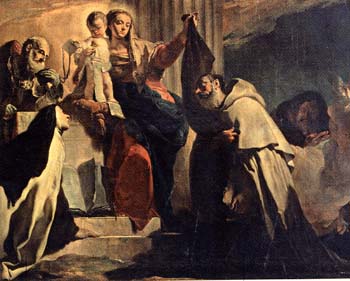
By the end of the 16th century the Scapular of Our Lady of Mount Carmel was most widely known and used. It is commonly called today the Brown Scapular, and is probably the oldest scapular in use.
In the year 1322 Pope John XXII is said to have issued a Bull, Sacratissimo uti culmine (although it has not been found yet in Vatican archives) authorising the Sabbatine Privilege. This followed a vision he is said to have had of our Lady holding the Scapular of Mount Carmel, in which she said:
"Those who have been invested with this Holy Habit will be delivered from Purgatory the first Saturday after their death."
The Bull affirmed this privilege and indulgences are granted to the members of the Carmelite Order and to its secular members.
However, a long line of saints have since extolled the Scapular and popes have indulgenced it heavily.
So, folks, get a Rosary and a Scapular and save the world!
The Rosary Rally 2007
Below are some photographs from the Rosary Rally 2007.
 Procession sets off from Westminster Cathedral, the Oratory brothers leading, then the Knights of our Lady, the Knights of Malta, the clergy, the statue of our Lady of Fatima and the Faithful behind her.
 Through the streets of London
 Moving through Knightsbridge to the Brompton Oratory
 Into the Oratory through the main port
 Processing down the aisle of the Oratory
 Censing our Lady's statue in the Sanctuary
 Fr Julian Large, Cong Orat, preaches about the Rosary, St Pius V and the Battle of Lepanto against the Moslem Turks, won by the Christian navy and through praying the Rosary
 Knights of our Lady at prayer
 Flower maidens of our Lady in white dresses
 Adoring the Blessed Sacrament before Benediction
 Clergy, Knights of Malta and brothers of the Oratory processing out




.jpg)










_-002.jpg/220px-Circle_of_Anton_Raphael_Mengs,_Henry_Benedict_Maria_Clement_Stuart,_Cardinal_York_(ca_1750)_-002.jpg)


