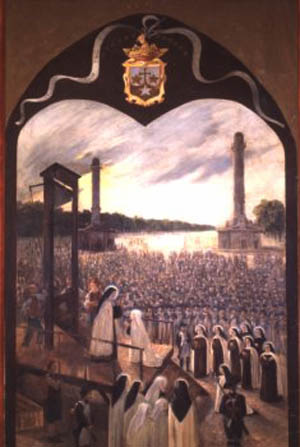
On July 17, 1794, the sixteen Carmelite nuns of Compiegne were guillotined in Paris, convicted of crimes against the state by the tribunal of the French Revolution.
Mother Henriette de Jesus, renowned for her great beauty and strong personality, stood up to represent the other Carmelite sisters before the revolutionary tribunal.
Since the prosecutor accused the Carmelites of being fanatics and counter-revolutionaries, she asked him to explain the meaning of those words. The irritated judge vomited a torrent of offenses against her, and then said: "It is your attachment to your Religion and the King". Hearing these words, she replied, "I thank you for the explanation". Then, addressing her companion Carmelites, she said: "My dear Mother and my Sisters, we must rejoice and give thanks to God for we die for our Religion, our Faith, and for being members of the Holy Roman Catholic Church".
In particular, the Revolution hated the fact that they promoted the counter-revolutionary and royalist devotion to the Sacred Heart and to the Infant Jesus of Prague, a long-standing Carmelite devotion associated with royalty and nobility and the Order of Malta in Prague. In truth, however, they were devotions much beloved by the ordinary people - not least, of course, in Ireland where the Carmelites became very popular (I cannot suppress a chuckle to see Irish republican Catholics warmly attached to such royalist devotions!).
She was the last one before the Prioress to mount the scaffold to die. To the end, she encouraged her Sisters to persevere. When a charitable person offered a glass of water to one of the Sisters, Mother Henriette told her: "In Heaven, my Sister, in Heaven we will soon have water aplenty to drink."

The late Brazilian Catholic scholar, politician and activist, Professor Plinio Correa de Oliveira comments upon this remarkable story:
"These Sisters knew that they were being put to death for their fidelity to the Catholic Church and the King, but they wanted the prosecutor to admit it out loud, because this would be a public witness of their martyrdom and an encouragement for them in face of the dangers of apostasy. This is why Mother Henriette was charged with asking that question.
When the answer came, she was happy and transmitted it to her Mother and Sisters in religion. All of them shared that joy and went forward to die. Mother Henriette, who was very resolute, offered assistance to each of them until the end. Only the Prioress, Mother Teresa of St. Augustine, died after her, because she was the superior, and the Captain must always be the last one to leave the sinking ship...
You can contrast Mother Henriette de Jesus with an imaginary personage in a popular novel, The Dialogue of the Carmelites by George Bernanos. The character was called Blanche de la Force and was presented as a weak and timid Carmelite Sister. She is an imaginary personage, but it is worthwhile considering her, because she represents a common character type. In his novel, Bernanos presented her as a Sister who had panicked when the other Sisters were taken by the revolutionary soldiers and sentenced, and for this reason had apostatized from the Order. She was no longer living inside the Carmelite community, but she went to see the execution of her former companions who would suffer martyrdom that day. The Sisters were chanting the Veni Creator in chorus and, one by one, they walked up the steps to the scaffold to be guillotined. When she saw this, she was moved by a grace, stepped out of the mob and, singing, joined the cortege to be executed along with them.
The two attitudes of both religious, Mother Henriette and Sister Blanche, express well the different paths of Divine Providence for different souls - the different marvels God works with His chosen ones. For some He chooses the glory of repentance; this is one of the glories attributed to the Apostles who fled during His Passion. For others He gives the strength that he gave to Mother Henriette of Jesus, that is, to view death from a distance and face it bravely, walking toward it joyfully. This was what He did with Mother Henriette, who helped all the others face their martyrdoms. These are two different paths God chooses to lead and direct souls. Seeing these two contrasting paths, you can admire the infinite beauty of God in the unity and variety of His ways. This is why the Saints are different from one another and why there are different schools of spirituality in the Catholic Church. It serves to show the beauty and richness of Holy Mother Church, a reflection of the beauty of the Heavenly Jerusalem".
.jpg)
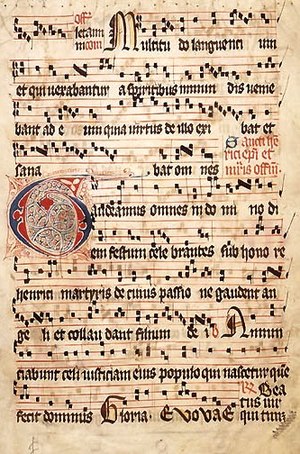
The Veni Creator Spiritus is the hymn sung at Pentecost and after, calling upon the Holy Spirit to descend upon us and is often sung at the Ordination of a priest or the Reception of a sister into the convent. It, together with the Whitsun Sequence, Veni Sancte Spiritus, are two of the most ancient and beautiful chants sung by the Roman Church to the Holy Spirit.
Here is the Veni Creator sung in Boulogne Cathedral:
http://www.youtube.com/watch?v=1mlLz5eHhW0
Perhaps the best story told of these most holy Carmelites is that told by Gertrude von Le Fort, a German-French convert from Protestantism, who writes superbly well the Bernanos story of Blanche de la Force, the little marchioness who is afraid of her own shadow and flees the convent at the first sign of trouble but returns to watch the other sisters die at the scaffold. There courage suddenly comes to her, almost miraculously. The author tells the story as an observer of these momentous events:
"I stood in the midst of the howling rabble. Never have I felt the hopelessness of our position so desperately as then. You know that I am not tall. Chaos surged above me. I was immersed in it. I could not see what happened, I could only hear. All my powers of perception centred in the sense of hearing and sharpened it incredibly.
The Carmelites were coming to Revolution Square, singing, just as Sister Marie had expected. Their psalms could be heard from afar and penetrated the screams of the populace with strange clarity. Or did the tumult subside as the victims came in sight? I could scarcely distinguish the last words of the Salve Regina - sung, you know, at the deathbed of a nun - and soon after the first line of the Veni Creator. There was something light and lovely in their singing, something tender and yet strong and serene. Never would I have thought that such song could flow from the lips of those condemned to death. I had been deeply agitated, but when I heard this singing I grew calm. Creator Spiritus, Creator Spiritus - I seemed to hear these two words again and again. They cast anchor within me.
The song flowed on full and clear. To judge by the sound, the cart must have been moving very slowly. Probably the crowd blocked the way. I had the feeling that the nuns were still far from the square. For this singing transcended all sense of time; it transcended space, even bloody Revolution Square. Creator Spiritus, Creator Spiritus! It effaced the Guillotine. It effaced even chaos. All at once I had the feeling of standing among human beings again...
I was startled - Revolution Square was deathly still. Even at the execution of the King there had not been such utter silence. The song seemed fainter too. Probably the cart had gone on; perhaps it had already reached its goal. My heart began to pound. I was suddenly aware that a very high voice was lacking in the chorus - a moment later, another...I thought that the execution had not even begun and in reality it was almost over!
Now only two voices sustained the song. For a moment they hovered like a shining rainbow over Revolution Square. Then one side extinguished. Only the other continued to glow...shimmering...fading - but quickly the song was taken up by another voice, thin, frail, and childlike. I had the impression that it was not coming from the height of the scaffold but from the thick of the crowd, just as if the people were making a response. Wondrous illusion!
At the same moment the dense lines heaved and broke. A gap opened right in front of me, just as on that September night. And I saw - exactly as on that night - Blanche de la Force in the seething mass of those dreadful women. Her small pinched face broke forth from its surroundings and cast them aside like a wrap. I recognised her every feature, and yet I did not recognise her face - it was absolutely fearless. She was singing. In her small, weak, childlike voice she sang without a tremor, exulting like a bird! All alone across the great terrible square she sang the Veni Creator of her Carmelite sisters to the very end:
Deo Patri sit gloria
Et Filio, qui a mortuis
Surrexit, ac Paraclito
In saeculorum saecula.
Distinctly I heard the profession of faith in the Holy Trinity. The Amen I did not hear - the furious women struck her down on the spot.
And now, my friend, the rainbow over Revolution Square had died away. And yet I had the feeling that the Revolution was over. As a matter of fact, the Reign of Terror collapsed ten days later."
Indeed, it did!
For ten days later the leading figure of the Terror, Robespierre, was himself arrested and taken to the Guillotine.
The awful murder of the holy Sisters of Carmel had turned even the brutal Paris mob and they had, at last, become sickened. They now demanded the head of the chief terrorist himself.
From Heaven, the holy sisters, now rejoined by the little Marquise de la Force, Sister Blanche once more, interceded most powerfully for the devastated vineyard that was France and the 13 month Reign of Terror at long last came to an end.
Holy Carmelites of Compiegne, pray for us!
...
 St. Bridget (sometimes called Birgitta) - Feast day 8 October - was born about the year 1303 (by tradition on June 14th) in Upland, the chief province of Sweden, where her father, Prince Birger, was governor. Her mother, Lady Ingeborg of Finsta, was a daughter of the governor of East Gothland. When only seven Bridget had a vision in which our Lady placed a crown on her head, and when ten, after a sermon on the Passion, she saw in a dream Christ wounded and bleeding. These two experiences seem to have been the formative ones of her life.


.jpg)







.jpg)













_-002.jpg/220px-Circle_of_Anton_Raphael_Mengs,_Henry_Benedict_Maria_Clement_Stuart,_Cardinal_York_(ca_1750)_-002.jpg)