Sunday, 28 June 2015

The Feast of the Holy Trinity


THE FEAST

OF THE ONE, HOLY AND UNDIVIDED


TRINITY


"My sheep hear my voice: and I know them, and they follow me. And I give them life everlasting; and they shall not perish for ever, and no man shall pluck them out of my hand. That which my Father hath given me, is greater than all: and no one can snatch them out of the hand of my Father.

I and the Father are one."


[John 10:26-30]

...

Whitsun - the Feast of Pentecost


Whitsunday

Pentecost

and the descent of the Holy Ghost upon the Church


"And when the days of the Pentecost were accomplished, they were all together in one place: And suddenly there came a sound from heaven, as of a mighty wind coming, and it filled the whole house where they were sitting. And there appeared to them parted tongues as it were of fire, and it sat upon every one of them: And they were all filled with the Holy Ghost…"
[Acts 2:1-4]

Pentecost (from the Greek Pentecoste meaning the 50th day i.e. after Easter) was also called White Sunday (or Whitsunday) because the neophytes again put on their Easter baptismal robes of white and - until the great destroyer, Archbishop Bugnini, abolished the ceremonies in 1955 - a second but slightly smaller version of the Easter Vigil occurred on Whitsun Eve. In Christendom it was for this reason that Pentecost was often called Pascha Rosatum or, in Italian, Pasqua Rossa, meaning Rose-Easter for the flames that descended like roses, for the red vestments and for the recalling of the mystery of Easter.

It is a highly Biblical feast and the Jews themselves had their own pre-figuring Pentecost which occurred 50 days after the Feast of the Passover. They still celebrate it with solemnity to this day.

This was the importance given by our ancestors to the Feast of Pentecost. But modern Catholics have had that privilege curtailed by the destructive work of Archbishop Bugnini, a prelate who was dismissed for Freemasonry by Pope Paul VI, as Bugnini himself admits in his own autobiography.

With a most shameful disregard for hallowed tradition which cannot escape the charge of impiety, Bugnini destroyed these centuries-old traditions and ceremonies.

Pentecost represents the fullness of God’s gift to men. He gave us His only-begotten Son at Christmas; in Holy Week, by the Passion of Christ, He atoned for us purifying and sanctifying us in His own Precious Blood. At Easter, at His Resurrection, and after, at His Ascension, God gloriifes us in His own Son and makes a place for us in Heaven.

Then, having ascended into heaven, God sends us the Holy Ghost to be our Advocate and Comforter in our earthly sojourn. Descending upon the Apostles as tongues of fire, the Spirit of love comes to us to inform our lives with charity, to create the Church as a bark of salvation and to lead us into all truth and holiness.

During Whit week every day at Mass is sung that most beautiful of hymns, the Veni Sancte Spiritus. It is known to tradition as the Golden Sequence, so greatly has it been revered by Catholic tradition. But how often do you hear it sung?

VENI, Sancte Spiritus,
et emitte caelitus
lucis tuae radium.

Come Holy Ghost send down those beams
which sweetly flow in silent streams
from Thy bright throne above.


At Vespers is sung also the better-known Veni Creátor Spíritus:

Veni Creátor Spíritus,
Mentes tuórum vísita:
Imple supérna grátia,
Quæ tu creásti pécora.

Come, O Creator, Spirit blest,
And in our souls take up Thy rest;
come with Thy grace and heavenly aid,
To fill the hearts which Thou hast made.


Veni Sancte is particularly beautiful and it is a great sadness that so few now know it.

Here is a recording of each by French monks so that the difference can readily be seen. Veni Creator is followed by the sublime Veni Sancte:


Come Holy Ghost, fill the hearts of Thy faithful and enkindle in them the fire of Thy love.

Send forth thy spirit, and they shall be created: and thou shalt renew the face of the earth.


[Adapted from Psalm 103:30]


+++

Ascension and the beating of the bounds

Rogation days are days set apart for solemn processions to invoke the mercy of God. The word comes from the Latin rogare “to say or ask” meaning, in this context, to pray to God for good things.

They come at this time because of the Gospel reading for the previous Sunday (the 5th Sunday after Easter, sometimes for that reason called Rogation Sunday) which includes the text from the Gospel of St John 16:24 “Ask and ye shall receive”.

The Rogation days are:

(1) St Mark’s Day on 25 April (the Major Rogation)
(2) The 3 days before the Ascension Day (the Minor Rogations)

The first Rogation, which includes the Greater Litanies, was originally a christianisation of the old Roman pagan feast day of Robigalia, on 25 April, a day to pray for good crops.

The minor Rogations, including the Lesser Litanies, were introduced in 470 by Bishop Mamertus of Vienne and then spread to the rest of the Roman Church. They became a preparation also for the Feast of the Ascension.

These days coincided also with the ceremony of the “Beating of the Bounds” during which a procession led by ministers and choir would proceed round the boundaries of the parish, partly to re-affirm the boundaries but also to pray for the protection of the parish over the forthcoming year. Choir boys and servers would carry canes to "beat" the boundaries at each stopping point.

Absurdly, the Rogation days are yet further ancient and beautiful ceremonies that were done away with by the liturgical wreckers after 1970. They have, of course, come back with the return of the traditional rites.

The ceremony of the Beating of the Bounds can still be seen in the City of London and processions continue to go round the boundaries to the various churches of the City, often escorted by a marching group of one or more of the City TA Regiments.

What diabolical spirit came over the liturgical consilium of Archbishop Bugnini that he even thought to try and get rid of this beautiful, scriptural, ancient liturgical devotion? Yet further evidence, if it were still needed, that a dark and sinister spirit has, these 40 years past, been suffered by weak, vain and worldly prelates to invade parts of the Church.


"Beating the bounds"

"22 So also you now indeed have sorrow; but I will see you again, and your heart shall rejoice; and your joy no man shall take from you. 23 And in that day you shall not ask me any thing. Amen, amen I say to you: if you ask the Father any thing in my name, he will give it you. 24 Hitherto you have not asked any thing in my name. Ask, and you shall receive; that your joy may be full. 25 These things I have spoken to you in proverbs. The hour cometh, when I will no more speak to you in proverbs, but will show you plainly of the Father."

[John 16.22-25]


Peccatores, Te rogamus audi nos
 
We sinners, beseech Thee, hear us!

...

Sunday, 12 April 2015

Corona Divinae Misericordiae - the Divine Mercy chaplet

Some are a little dismissive of the Divine Mercy devotions, perhaps partly because they see them as untraditional and late in time or new-fangled.

In fact, it is entirely fitting that Quasimodo Sunday should have been chosen by the Supreme Pontiff for the Feast of Divine Mercy since it is the day when St Thomas the Doubter was reconciled from his doubts, as the Gospel tells us, and, after placing his hands in the wounds of Christ, made the act of faith saying, "My Lord and my God!".

It is also the day when the introit of the traditional Roman rite repeats the words of St Peter:

"laying away all malice and all guile and dissimulations and envies and all detractions, just as the new born infants desire the rational milk without guile..."

This is a highly appropriate verse for those seeking out the mercy of God. Moreover, this day was the day when the neophytes, having been baptised at the Easter Vigil, and having worn their white baptismal robes (nowadays still used for infant baptism) for the full week, set aside their white robes having been filled with all the grace and blessing of baptism.

This, then, is surely the very day when the accumulation of God's grace and mercy is at its height and the Faithful ought, therefore, to seek access thereto all the more fully.

The Sacred Penitentiary, the Church's highest court (yes, really; it is higher than the Apostolic Signature or the Sacred Rota), in its Decree of 29 June 2002, set out the conditions for a Plenary Indulgence granted by the Supreme Pontiff. The Decree states:

"And so the Supreme Pontiff, motivated by an ardent desire to foster in Christians this devotion to Divine Mercy as much as possible in the hope of offering great spiritual fruit to the faithful, in the Audience granted on 13 June 2002, to those Responsible for the Apostolic Penitentiary, granted the following Indulgences:

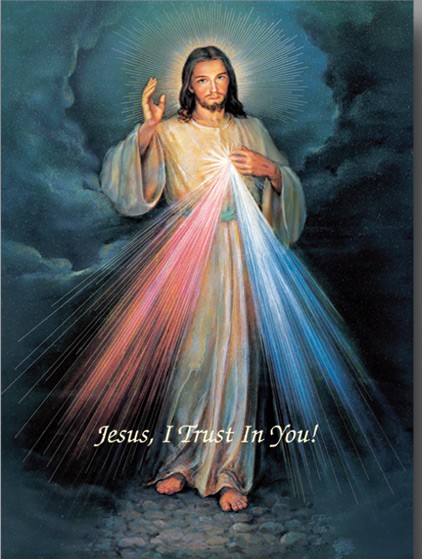
- a plenary indulgence, granted under the usual conditions (sacramental confession, Eucharistic communion and prayer for the intentions of Supreme Pontiff) to the faithful who, on the Second Sunday of Easter or Divine Mercy Sunday, in any church or chapel, in a spirit that is completely detached from the affection for a sin, even a venial sin, take part in the prayers and devotions held in honour of Divine Mercy, or who, in the presence of the Blessed Sacrament exposed or reserved in the tabernacle, recite the Our Father and the Creed, adding a devout prayer to the merciful Lord Jesus (e.g. Merciful Jesus, I trust in you!");

- a partial indulgence, granted to the faithful who, at least with a contrite heart, pray to the merciful Lord Jesus a legitimately approved invocation."


Confession and Communion may, according to the Penitentiary's guidance, be on any day 20 days either side of Low Sunday.

Below are reproduced the prayers of the Chaplet of Divine Mercy in Latin for the use of those who wish to gain access to the fathomless mercy of God.

I have rendered the final prayer into Latin, Greek and Hebrew, the primary sacred languages of the Church which appeared over the Holy Cross. That final prayer is the same that is sung, alternating in Greek and Latin, at the exceedingly ancient, solemn Good Friday service (the Mass of the Pre-sanctified).

This final prayer is said 3 times to signify the Holy Trinity just as the 3 sacred languages, Latin, Greek and Hebrew signify the Holy Trinity, also.

I commend this devotion to readers. It can, for instance, be incorporated into Benediction, after, say, the Prayer for England (or equivalent in other nations).


Corona Divinae Misericordiae
(Chaplet of Divine Mercy)

IN NOMINE Patris et Filii et Spiritus Sancti.

PATER NOSTER, qui es in caelis, sanctificetur nomen tuum. Adveniat regnum tuum. Fiat voluntas tua, sicut in caelo et in terra. Panem nostrum quotidianum da nobis hodie, et dimitte nobis debita nostra sicut et nos dimittimus debitoribus nostris. Et ne nos inducas in tentationem, sed libera nos a malo. Amen.

AVE MARIA, gratia plena, Dominus tecum. Benedicta tu in mulieribus, et benedictus fructus ventris tui, Iesus. Sancta Maria, Mater Dei, ora pro nobis peccatoribus, nunc, et in hora mortis nostrae. Amen.

CREDO in Deum Patrem omnipotentem, Creatorem caeli et terrae. Et in Iesum Christum, Filium eius unicum, Dominum nostrum, qui conceptus est de Spiritu Sancto, natus ex Maria Virgine, passus sub Pontio Pilato, crucifixus, mortuus, et sepultus, descendit ad inferos, tertia die resurrexit a mortuis, ascendit ad caelos, sedet ad dexteram Dei Patris omnipotentis, inde venturus est iudicare vivos et mortuos. Credo in Spiritum Sanctum, sanctam Ecclesiam catholicam, sanctorum communionem, remissionem peccatorum, carnis resurrectionem et vitam aeternam. Amen.


On each of the OUR FATHER beads:

PATER aeterne, offero tibi Corpus et Sanguinem, animam et divinitatem dilectissimi Filii Tui, Domini nostri, Iesu Christi, in propitiatione pro peccatis nostris et totius mundi.

(Eternal Father, I offer You the Body and Blood, Soul and Divinity of Your dearly beloved Son, Our Lord Jesus Christ, in atonement for our sins and those of the whole world)

On each of the HAIL MARY beads:

PRO DOLOROSA Eius passione, miserere nobis et totius mundi.

(For the sake of His sorrowful Passion, have mercy on us and the whole world)

In conclusion say the following (here in Latin, Greek and Hebrew):

SANCTUS Deus,
Sanctus Fortis,
Sanctus Immortalis,
miserere nobis et totius mundi.

HAGIOS Theos,

Hagios ischyros,
Hagios athanatos,
eleison imas kai olon ton kosmon.

ELOHIM hakadosh,
Elohim hakol yakhol,
rakhem aleinu,
veal kol haolam.

(Holy God, Holy Mighty One, Holy Immortal One, have mercy on us and the whole world)

Say at three o’clock in the afternoon:

YOU EXPIRED, O Jesus, but the source of life gushed forth for souls and an ocean of mercy opened up for the whole world. O Fount of Life, unfathomable Divine Mercy, envelop the whole world and empty Yourself out upon us. O Blood and Water, which gushed forth from the Heart of Jesus as a fount of mercy for us, I trust in You. Amen.


+++

Quasimodo Sunday - (Feast of Divine Mercy on Low Sunday) - "As newborn babes desire the rational milk without guile..."


Dominica in Albis Deponendis

(Sunday when the newly baptised finally put off their white garments of Easter)

also called

Quasimodo Sunday

or

Low Sunday
 
or

Close-Pasch

and

the Feast of Divine Mercy


"Quasimodo geniti infantes, alleluia, rationabile sine dolo lac concupiscite.
Alleluia, alleluia, alleluia."

"As newborn babes, alleluia, desire the rational milk without guile. Alleluia, alleluia, alleluia" 
[1 Peter 2:2; Introit for the Mass of Low Sunday]

"Deinde dicit Thomae: infer digitum tuum huc et vide manus meas, et affer manum tuam et mitte in latus meum et noli esse incredulus sed fidelis.
Respondit Thomas et dixit ei: Dominus meus et Deus meus!"
 
"Then He said to Thomas 'Put in thy fingers hither and see my hands and bring hither thy hand and put it into my side and be not faithless but believing'. Thomas answered and said to him 'My Lord and my God!' " 
[John 20:27-28; Gospel of Low Sunday]
 

Caravaggio. Doubting Thomas. 1602-1603.

"Dearly beloved, laying away all malice and all guile and dissimulations and envies and all detractions as new-born babes desire the rational milk without guile, that thereby you may grow unto salvation, if so be you have tasted that the Lord is sweet...for you are a chosen race, a kingly priesthood, a holy nation, a purchased people that you may declare His virtues who hath called you out of darkness into His marvellous light."
[1 Peter 2:2-3, 9]

"Now when it was late that same day, the first of the week, and the doors were shut, where the disciples were gathered together, for fear of the Jews, Jesus came and stood in the midst, and said to them: Peace be to you. And when he had said this, he shewed them his hands and his side. The disciples therefore were glad, when they saw the Lord. He said therefore to them again: Peace be to you. As the Father hath sent me, I also send you. When he had said this, he breathed on them; and he said to them: Receive ye the Holy Ghost. Whose sins you shall forgive, they are forgiven them; and whose sins you shall retain, they are retained. Now Thomas, one of the twelve, who is called Didymus, was not with them when Jesus came. The other disciples therefore said to him: We have seen the Lord. But he said to them: Except I shall see in his hands the print of the nails, and put my finger into the place of the nails, and put my hand into his side, I will not believe. And after eight days again his disciples were within, and Thomas with them. Jesus cometh, the doors being shut, and stood in the midst, and said: Peace be to you. Then he saith to Thomas: Put in thy finger hither, and see my hands; and bring hither thy hand, and put it into my side; and be not faithless, but believing. Thomas answered, and said to him: My Lord, and my God. Jesus saith to him: Because thou hast seen me, Thomas, thou hast believed: blessed are they that have not seen, and have believed."
[John 20:19-29]

"In the Old Covenant I sent prophets wielding thunderbolts to My people. Today I am sending you with My mercy to the people of the whole world. I do not want to punish aching mankind, but I desire to heal it, pressing it to My Merciful Heart. (1588)

It's a sign for the end times; after it will come the day of justice. While there is still time, let them have recourse to the fount of My mercy; let them profit from the Blood and Water which gushed forth for them. (848)

Before I come as a just Judge, I first open wide the doors of My mercy. He who refuses to pass through the doors of My mercy must pass through the doors of My justice... (1146)"

[Diary of Divine Mercy, Revelation of our Lord to St Maria Faustina (Kowalska) of the Blessed Sacrament]


St Faustina Kowalska, messenger of Divine Mercy
  
"Sanctus Deus, Sanctus Fortis, Sanctus Immortalis, miserere nobis" [Latin]
"Hagios Theos, hagios ischyros, hagios athanatos, eleison imas" [Greek]
"Elohim hakadosh, Elohim hakol yakhol, rakhem aleinu, veal kol haolam" [Hebrew]

"Holy God, Holy Mighty One, Holy Immortal One, have mercy on us"

[The ancient prayer of the Trisagion from the Improperia or "Reproaches" of the Good Friday liturgy in Latin, Greek, Aramaic and English, dating back to at least the 5th century. They form part of the Divine Mercy prayers requested of St Faustina by our Lord.]


"Feed my sheep".
Rafaello Sanzio. The gift of the keys to Peter.

+++

Sunday, 5 April 2015

EASTER SUNDAY - "I have seen the Lord!"


Happy Easter to all!

Christus surrexit,
sicut dixit,
alleluia!

Christ is risen
as he said!
Alleluia!


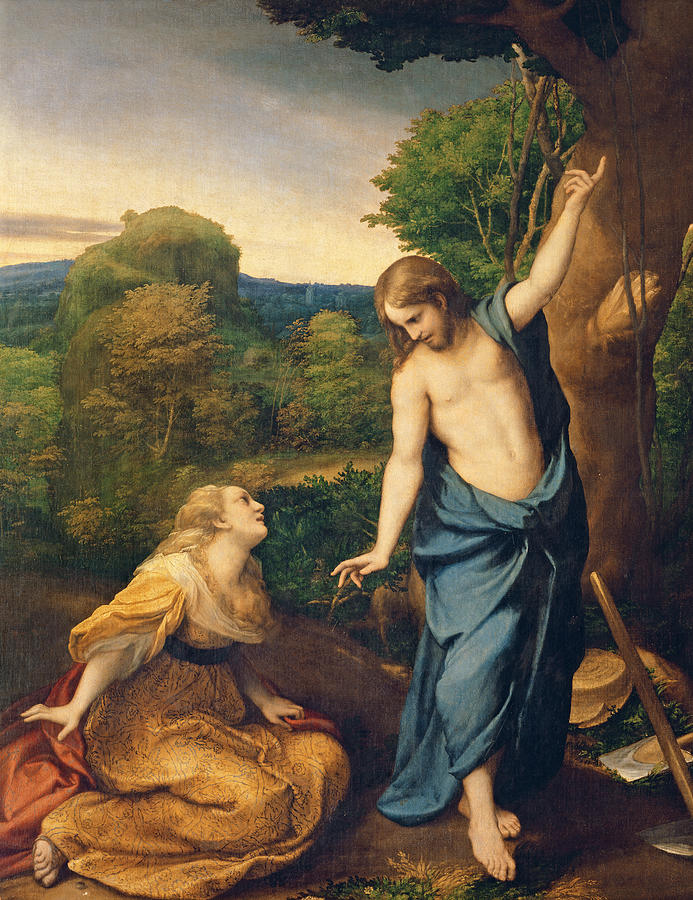
Correggio. Noli me tangere. 1525

 
"When the sabbath was over, Mary Magdalene and Mary the mother of James and Salome, bought spices so that they might come and anoint Jesus...and on a sabbath morning they came to the sepulchre after sunrise...and looking up they saw that the stone was rolled back. Alleluia!"
[Taverner, Dum transisset sabbatum from Mark 16, sung at the Easter Vigil mass of Holy Saturday night]

"The Angels said to her 'Woman, why are you weeping?'. She said to them 'Because they have taken away my Lord and I do not know where they have laid Him'. Saying this she turned round and saw Jesus standing but she did not know that it was Jesus. Supposing Him to be the gardener, she said to Him 'Sir, if you have carried Him away tell me where you have laid Him and I will take Him away'. And Jesus said to her 'Mary'. She turned and said to Him in Hebrew 'Rabboni!'".
[John 20]
 
"She went and said to the Disciples 'I have seen the Lord!' "[John 20.18]


John Taverner (1490-1545). Dum Transisset Sabbatum. Sung by the Tallis Scholars.

 
Dum transisset Sabbatum,
Maria Magdalene et Maria Jacobi et Salome
emerunt aromata ut venientes ungerent Jesum.
Alleluia.
Et valde mane una sabbatorum veniunt ad monumentum orto iam sole ut venientes ungerent Jesum.
Alleluia.
Gloria Patri et Filio et Spiritui Sancto.
Alleluia.

And when the Sabbath was past,
Mary Magdalene and Mary the mother of James and Salome
had brought sweet spices, that they might come and anoint him.
Alleluia.
And very early in the morning, the first day of the week,
they came unto the sepulchre at the rising of the sun that they might come and anoint him.
Alleluia.
Glory be to the Father, and to the Son, and to the Holy Spirit.
Alleluia.
 
[Dum Transisset Sabbatum - taken from the Gospel of St Mark, Ch16]


Carl Heinrich Bloch. The Resurrection. 1881.

Victimae paschali laudes
immolent Christiani
Agnus redemit oves:
Christus innocens Patri
Reconciliavit peccatores.
Mors et vita duello conflixere mirando,
Dux vitae mortuus, regnat vivus.
Dic nobis Maria, quid vidisti in via?
Sepulcrum Christi viventis,
Et gloriam vidi resurgentis:
Angelicos testes, sudarium et vestes.
Surrexit Christus spes mea:
Praecedet vos in Galilaeam.
Credendum est magis soli
Mariae veraci
Quam Judaeorum
Turbae fallaci.
Scimus Christum surrexisse
a mortuis vere:
Tu nobis, victor Rex, miserere.
Amen. Alleluia.

 
[Wipo of Burgundy, Victimi Paschali Laudes. 1040. Sung on Easter Sunday]
 

Surrexit Christus hodie! Alleluia!

Christ is risen today! Alleluia!
 
+++


HOLY SATURDAY - "Jerusalem, Jerusalem, be converted unto the Lord thy God!"


When the Lord was buried...


"Remember, Lord, what is come upon us: consider and behold our reproach. Our inheritance is turned unto aliens, our houses to strangers. We are become orphans without a father, our mothers are as widows...our fathers have sinned and are no more and we have borne their iniquities.
[Tenebrae (Matins) of Holy Saturday, prayer of the prophet Jeremiah]

"I am counted among them that go down to the pit. I am become like a man without help free among the dead."
[Responsory, Tenebrae (Matins) of Holy Saturday]

"For when every commandment of the Law had been read by Moses to all the people, he took the blood of goats and calves and of goats with water and scarlet wool and hyssop and sprinkled both the book itself and all the people saying, this is the blood of the Testament which God hath enjoined upon you. The tabernacle also and all the vessels of the ministry in like manner he sprinkled with blood. And almost all things according to the Law are cleansed with blood and without shedding of blood there is no remission."
[Heb. ix.]

"When the Lord was buried they sealed the sepulchre rolling a stone before the mouth of the sepulchre and placed soldiers to guard Him."
[Responsory, Tenebrae (Matins) of Holy Saturday]

"O death I will be thy death! O hell, I will be thy bite!"
[Antiphon of the Miserere, Tenebrae (Lauds) of Holy Saturday]


Jerusalem, Jerusalem, convertere ad Deum tuum

Jerusalem, Jerusalem, be converted unto the Lord thy God!

+++

...