Saturday, 1 February 2014

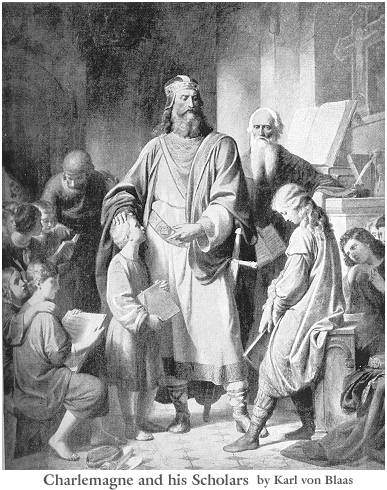
28 January - the Feast of Emperor St Charlemagne, the founder of the Holy Roman Empire

The Feast of Emperor St Charlemagne
 
28 January


DurerPortrait.jpg - 67550 Bytes
 
Portrait of Charlemagne in imperial regalia with the arms of the Holy Empire and of France above
by Albert Durer
 

The Emperor Charles the Great, Carolus Magnus, or Charlemagne, as he is usually known, was born on 2 April 742 or 747 and was the King of the Franks from 768, the King of Italy from 774, and from 800 the first Roman Emperor in western Europe since the collapse of the Western Roman Empire three centuries earlier.

The expanded Frankish state he founded, the Carolingian Empire, became the basis of the Holy Roman Empire ever after.

He was the eldest son of King Pepin the Short, first Carolingian King of the Franks and the donor to the Papacy of the lands that became the Papal States, and Queen Bertrada of Laon, and the grandson of Charles Martel, the saviour of Europe from the invading army of the Muslim Arab Umayyad Caliphate under General Abdul Rahman Al Ghafiqi, Governor of Al Andalus (Andalusia), at the Battle of Tours in 732.

Charlemagne became king in 768 following the death of his father. He was initially co-ruler with his brother Carloman I who died in 771 leaving Charlemagne as the undisputed ruler of the Frankish Kingdom.

Charlemagne continued his father's policy towards the papacy and became its protector, removing the Lombards from power in northern Italy, and leading an incursion into Muslim Spain.

He also campaigned against the peoples to his east, leading many to baptism.

Charlemagne reached the height of his power in 800 when he was crowned Roman Emperor by Pope St Leo III on Christmas Day at old St. Peter's Basilica. According to Einhard, this was against his will, but the Pope, the nobility, clergy and people of Rome desiring it, and the Eastern Roman Empire of Byzantium being under the rule of the murderess and filicide, Empress Irene, who was defiant of the Papacy and the Church, he relented and accepted his coronation as the new and true Caesar Augustus, the ancient tile of the Roman emperors.

It is important to note that Charles was not elected, appointed and ordained Roman Emperor by the Pope alone but that, as of old, he was chosen by the nobility, clergy and people of the City of Rome, as well as by the Bishop of Rome, just as the ancient emperors had been, as popes themselves were for many centuries.


The Italian scholar and poet, Dante, emphasizes this in his work on the monarchy, De Monarchia.


It was only later that representatives were taken to represent the nobility, clergy and people of Rome - cardinal-electors in the case of the Pope and prince-electors in the case of the Emperor and both cardinal-elector and prince-elector were among the highest titles in Christendom.

The extreme papalist party often claimed that the imperial power derived from the papal power by the coronation at the hands of Pope St Leo but St Leo certainly did not think so and, as Dante reminds us, the imperial power pre-dated the papal and was thus prior to it and did not derive from it.

Having said that, all agreed that the Pope had the right, spiritually, to depose an anti-emperor and to veto the election of any emperor, just as the Emperor had the right, physically, to depose an anti-pope and to veto the election of any pope.

Note the physical/spiritual distinction. The Pope could declare an anti-emperor to be such and so deposed but was not empowered to send an army against him (that was the duty of the true emperor). Similarly, the Emperor did not have the spiritual power to declare an anti-pope to be such (that was the duty of the true pope), but the Emperor could lead an army to depose him.


Moreover, the Pope could not depose the true Emperor, nor the Emperor the true Pope.

Both Pope and Emperor ceased to be true upon becoming public, pertinacious heretics and thus self-excommunicating.

This is in keeping with the Two Swords doctrine (Luke 22:38). The Pope is the spiritual leader of Christendom and the spiritual Vicar of Christ and the Emperor is the temporal leader of Christendom and the temporal Vicar of Christ.


Now Pope St Leo III had needed help from the temporal Vicar of Christ, the Roman Emperor, against barbarian invaders but Empress Irene, despite being spiritually obliged to do so, would give him none.

Further, St Leo considered the throne of the Byzantine Emperor vacant, not because it lacked a male occupant, as some hostile historians have suggested, but because Irene had ordered her own son, Emperor Constantine VI, murdered in order to establish herself as Empress (βασιλεύς or βασίλισσα - the Greek title for the Roman Emperor or Empress).

She was thus an usurpress and an anti-emperor and the throne was accordingly vacant and the Pope was empowered to declare it so.

However, no Christian monarch was willing to take on the challenge of deposing her and so Irene reigned for five years, from 797 to 802 and, although incensed at the crowing of Charlemagne as Caesar Augustus, even conspired to negotiate a marriage with him.


Nevertheless, since infamy breeds infamy, soon enough, in 802, the patricians conspired against her and placed on the throne Nicephoros, the minister of finance, and forced Irene into exile to Lesbos where she was even forced to support herself by spinning. She died the following year. 

Called the "Father of Europe" (pater Europae) Charlemagne's empire united most of Western Europe for the first time since the Roman Empire. His rule spurred the Carolingian Renaissance, a period of cultural and intellectual activity within the Catholic Church. Both the French and German monarchies considered their kingdoms to be descendants of Charlemagne's empire.

In 772, the 30-year-old Charles had taken over the government of the whole Frankish Kingdom.

With reason he is called Magnus: he earned the title as general and conqueror, as the man who put order into his immense Empire and as a legislator, and also as one who reformed and stimulated the spiritual life of the West.

By means of his government, Christian ideas were victorious over the barbarian peoples. His life was a constant struggle against the rudeness and barbarism that threatened the Catholic Religion and the burgeoning new culture.

He led no less than 53 wars: 18 against the Saxons, one against Aquitaine, five against the Lombards, seven against the Arabs in Spain, one against the Turungians, four against the Avars, two against the Bretons, one against the Bavarians, four against the Slavs, five against the Saracens in Italy, three against the Danish, and two against the Greeks.

On Christmas Day, as we have seen, in the year 800, Pope St. Leo III raised him to the dignity of Emperor, restoring to the West the ancient Christian Roman Empire of Constantine, founding by such act the noblest temporal institution of Christendom, which was later called the Holy Roman Empire.


On 28 February 814, Emperor St Charlemagne died in 814, having received Viaticum and the last rites, after having ruled as Emperor for just over thirteen years. He was laid to rest in his imperial capital of Aachen in today's Germany. His son Louis the Pious succeeded him as Emperor.

He was buried in a niche of the Basilica of Aachen (in Latin, Aquisgranen; in French, Aix-la-Chapelle.) According to the legend, he was buried seated on his throne in upright position, wearing his sword and with the book of Gospels in his hands.

He became the model of Catholic Emperors, the prototype of the noble Catholic cavalier, and the central figure of most of the medieval Chansons de Geste, the songs of the heroic deeds of old, the grandsire of many of the great royal and noble families of Europe.


Einhard, the contemporary historian, provides us with a close-up of Charlemagne:

“He was large and strong, and of lofty stature, though not disproportionately tall (seven-feet tall). His head was round and well-formed, his eyes very large and vivacious, his nose a little long, his hair white, and his face jovial. His appearance was always stately and very dignified, whether he was standing or sitting. …. His gait was firm, his whole carriage manly, and his voice clear.”
 
[Einhard, Life of Charlemagne, New York: Harper and Brothers, 1880, pp. 56-7]
 

Charlemagne1.jpg - 51755 Bytes
 
The magnificent statue of the Holy Roman Emperor Charlemagne, and his Counts-Palatine, Roland and Olivier, is placed in front of the Cathedral of Notre Dame in Paris near the Seine River
 
This heroic figure was possessed of a joyful spirit. The Monk of St. Gall recounts that whoever came before Charlemagne sad and disturbed would leave him serene, just by the effect of his presence and some few words. The freshness and honesty of his nature strengthened all those who were associated with him. His majesty did not have a rigid arrogance, nor a suspicious reserve; rather the tranquil grandeur of his personality dominated everything around him, and, notwithstanding, was unpretentious and self-contained.
 
The terrifying impression he caused in the hearts of his enemies as a warrior leading his army is described by the Monk of St Gall:
 
“Then, one could see the Charlemagne of iron, with his head covered by a iron helmet, his arms bearing iron protectors; in his left hand he carried an iron lance, and in the right his always victorious steel sword. His muscles were covered with iron plates, and his shield made of pure iron. When he appeared, the inhabitants of Pavia cried out with fear: O, the Iron Man! O, the Iron Man!”
 
This Iron Man had a profoundly sensitive heart. Charlemagne wept like a boy at the death of a friend. The victor of 100 battles showed a paternal care for the poor. The man whose steps caused all of Europe to tremble and by whose grand campaigns a million men were conquered was the most tender of fathers, who never could dine without the presence of one of his children.
 
It was his religion, the Roman Catholic religion, that gave the noblest impulse to his strong and fecund spirit and that conferred glory to his power. And under its protection he placed the peoples that his sword had conquered.
[Historia Universal, Spanish Edition, vol. IV, p. 790]
 
Charlemagne Bust.psd.jpg - 50014 Bytes
Charlemagne Bust
 
The following speech of Charlemagne to his subjects is as solemn testament to all Christendom, even though it was delivered in March 802 and the Emperor did not die until 814.
 
The speech, sometimes referred to as a sermon, was delivered to the assembly of nobles gathered in Aix-la-Chapelle (Aachen).

Here are Charlemagne’s counsels to his nobles and subjects:

 
“Hear me, my beloved brothers! We were sent here for your salvation, to exhort you to faithfully follow the Law of God and to convert you, in justice and mercy, to obey the laws of this world. 
 
First, I exhort you to believe in the One Almighty God, Father, Son and Holy Spirit: the only true God, perfect Trinity, true Unity, Creator of all things visible and invisible, Who is our salvation and the Author of all good things. Believe in the Son of God made man for the salvation of the world, born of the Virgin Mary by the work of the Holy Ghost. Believe that for our salvation He suffered death; and that on the third day He rose from the dead and ascended into Heaven where He is seated at the right hand of God. Believe that He will return to judge the living and dead, and that He will give to each one according to his works. 
 
 Believe in one single Church, the society of the blessed through the entire universe, and know that only they can be saved, and that the Reign of God belongs only to those who persevere to the end in this [Catholic] Faith. Those who are excluded from the Church because of their sins and do not return to her through penance, can never make any action accepted by God. Be convinced that with Baptism you received absolution of your sins. Trust in the mercy of God, Who daily forgives our sins through confession and penance. Believe in the resurrection of the dead, in eternal life and in the never-ending torment of the impious. 
 
This is the Faith that will save you if you keep it faithfully, and add to it the practice of good works, because Faith without works is a dead faith; and works without Faith, even when they are good, cannot please God. Therefore, love Almighty God above all things with all your heart and strength. With the help with His grace, do everything, always and as much as possible, that you believe will please Him. But avoid everything that displeases Him, for the man who pretends to love God and does not observe His Commandments lies. 
 
Love your neighbour as yourself, and give as many alms to the poor as you can, according to your means. Receive travellers in your houses, visit the poor, and show charity to the prisoners as much as you can. Do evil to no one, and make no compromise with those who do bad things, because it is bad not only to harm your neighbour, but also to be familiar with those who harm him. 
 
Mutually forgive offenses if you want God to forgive your sins. Rescue captives, help those who are unjustly oppressed, defend widows and orphans. Make judgments fairly; never favour any injustice, do not harbour long hatreds; avoid drunkenness and taking part in frivolous feasts. 
 
Be humble and good to one another; be faithful to your lords. Commit no robberies or perjuries, and avoid any acquaintance with those who commit them. Hatred, jealousy and violence separate us from the Kingdom of God. Reconcile with one another as soon as possible, for while it is human for men to sin, it is angelic to repent and diabolic to persevere in sin. 
 
Defend the Church of God and help her so that the priests of God can pray for us. Remember your promise in Baptism to renounce the Devil and his works. Do not return to him in anything; nor should you return to the works you have renounced, but rather follow the will of God as you have promised, and love the One who created you and gave you all the gifts and goods you possess. 
 
Each one should serve God faithfully in the place he finds himself. Wives should submit to their husbands in all goodness and modesty. They should avoid any dishonest action, and not poison others or be jealous, because those who do such actions are in revolt against God. They should raise their children in the fear of God, and give alms with a glad and joyous heart according to their means. 


A01_PrayinginTent.jpg - 38291 Bytes
The Emperor Charlemagne chants the Office of the Church solemnly in his tent before a battle


“Husbands should love their wives and speak no rude word to them; they should direct their homes with goodness and frequently gather in church. They should return to others what they owe them without murmuring, and with good will return to God what belongs to Him. 
 
“Children should love and honour their parents; obey them in everything, and remain far from stealing, murdering and debaucheries. 
 
“Clerics and canons should diligently obey the commands of their Bishops; they should live in their residences and not wander here and there among the people. Nor should they enter into secular questions. They should preserve their chastity: the reading of Holy Scriptures should remind them of their service to God and the Church. 
 
“Monks should be faithful to the promises they made to God. They should not do anything against the will of their Abbots or seek any shameful personal benefit. They should know their rule by heart and follow it regularly, reminding themselves that it would be better not to have made any vow than to have made them and not be faithful to them.
 
“Dukes, counts and judges should be just with the people and merciful to the poor. They should never sell justice for money, and never allow a personal hatred to lead them to condemn an innocent man. They should always have these words of the Apostle in their hearts: ‘For we must all appear before the judgment seat of Christ; that every one may receive the things done in his body, according to that which he has done, whether it be good or bad.’ (2 Cor. 5:10). The Lord expressed this by the following words: ‘For with what judgment you judge, you shall be judged’ (Matt 7:2); For there is nothing covered, that shall not be revealed; neither hidden, that shall not be known. (Luke 12:2); That every idle word that men shall speak, they shall give account thereof in the day of judgment’ (Matt 12:36).'
 
 "We must make an effort, therefore, with the help of God, to please Him in all our actions so that after this present life, we will merit eternal happiness in the company of the Saints of the Lord.This life is short, and the hour of death is uncertain. What matters except to be ready? Let us not forget how terrible it is to fall into the hands of the Lord. By means of confession, penance and alms, we make the Lord become merciful and clement. If He sees us turn to Him with a sincere heart, He will show us pity and will have mercy on us. 
 
“May God grant us prosperity in this life and an eternity with His Saints in the future life. 
 
“God keep you, my beloved brothers!”
 

[Translated by Hugh O’Reilly from Charles d’Hericault, Histoire Anecdotique de la France,  Paris: Bloud & Barral, vol. 1, pp 301-304]
 

The propers for the Feast of Emperor St Charlemagne can be found here:


 CharlemagneCrown.jpg - 48393 Bytes
The Imperial Crown of Charlemagne worn ever after by the Holy Roman Emperors
 
 
Emperor St Charles the Great, pray for us and for the return of Roman Christendom!


+++ 


Wednesday, 1 January 2014

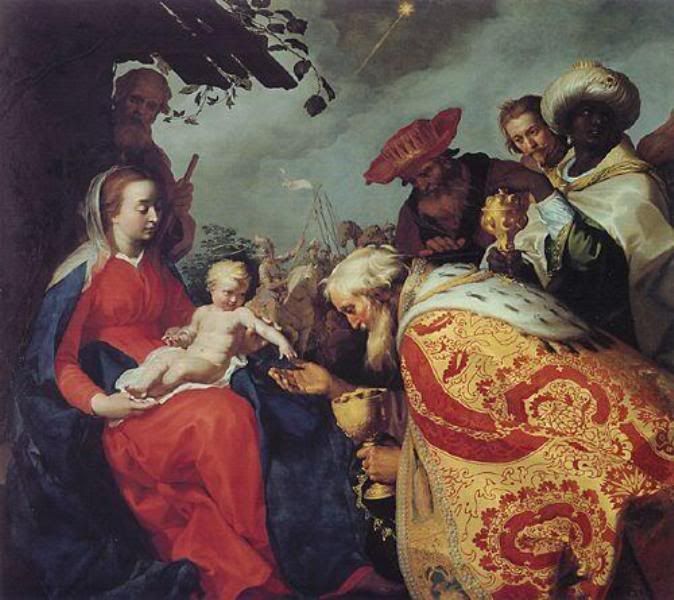
The Feast of the Three Kings or Magi


The Feast of the Three Kings or Magi
or
Dreikoenigsfest
as it was called in the Holy Roman Empire and in German-speaking lands
and
the Theophany
or Manifestation of the Lord to the Gentiles


on the same day as later occurred


the Baptism of the Lord


and


the miracle of wine at the wedding feast in Cana of Galilee


Whom Kings adore...
 
"When Jesus therefore was born in Bethlehem of Juda, in the days of king Herod, behold, there came wise men from the East to Jerusalem, saying: where is he that is born king of the Jews? For we have seen his star in the East, and are come to adore him. And king Herod hearing this, was troubled, and all Jerusalem with him. And assembling together all the chief priests and the scribes of the people, he inquired of them where Christ should be born. But they said to him: In Bethlehem of Juda. For so it is written by the prophet: and thou Bethlehem the land of Juda art not the least among the princes of Juda: for out of thee shall come forth the captain that shall rule my people Israel.

Then Herod, privately calling the wise men learned diligently of them the time of the star which appeared to them; and sending them into Bethlehem, said: go and diligently inquire after the child, and when you have found him, bring me word again, that I also may come and adore him. Who having heard the king, went their way; and behold the star which they had seen in the East, went before them, until it came and stood over where the child was. And seeing the star they rejoiced with exceeding great joy. And entering into the house, they found the child with Mary his mother, and falling down they adored him: and opening their treasures, they offered him gifts; gold, frankincense, and myrrh. And having received an answer in sleep that they should not return to Herod, they went back another way into their country."
[Matt 2:12 - Gospel for the Mass of the Epiphany]


The shrine of the Three Kings at Cologne Cathedral

The Shrine of the Three Kings in Cologne Cathedral contains their relics brought from Milan by ship to the City of Cologne on the order of the Holy Roman Emperor, Frederick Barbarossa, in 1164 as a gift to the Prince-Elector Archbishop, Rainald of Dassel.
 
This gave rise to the English Carol "I Saw Three Ships Come Sailing in".
 
The relics had first been taken from Constantinople to Milan in 344 by Bishop Eustorgius of Milan.
Around 1199, the Roman Emperor Otto IV gave three golden crowns made for the three wise men as a present to the church of Cologne, the city where, the previous year, he had been elected King of the Romans and Emperor-elect by the Prince-Electors of the Empire (he later gained the support of all the imperial princes at Frankfurt in 1208).

An inscription reads:

Otto rex coloniensis curiam celebrans tres coronas de auro capitibus trium magorum imposuit.
Otto the King, the court of Cologne celebrating, gave three golden crowns for the heads of the three Magi.
 
Emperor Otto IV was the only member of the Welf dynasty to be elected Holy Roman Emperor and, being the son of Matilda Plantagenet (married to Henry the Lion, Duke of Bavaria), he was allied to England in the Franco-English wars. He was also the personal preference of Pope Innocent III, who crowned him Roman Emperor at Rome in 1209, although they later fell out over the issue of the imperial rights in Italy.

Because of the importance of the shrine and the cathedral for the later development of the city, the Coat of Arms of Cologne still shows these three crowns symbolizing the Three Kings.

Construction of the present Cologne Cathedral was begun in 1248 to house these important relics. The cathedral took 632 years to complete and is now the largest Gothic church in northern Europe.

On July 20th, 1864, the shrine was opened, and the remains of the three Kings and the coins of Philipp von Heinsberg, Archbishop of Cologne, were discovered.

An eyewitness report reads:

“In a special compartment of the shrine now there showed - along with remains of ancient old rotten or moulded bandages, most likely byssus, besides pieces of aromatic resins and similar substances - numerous bones of three persons, which under the guidance of several present experts could be assembled into nearly complete bodies: the one in his early youth, the second in his early manhood, the third was rather aged. Two coins, bracteates made of silver and only one side striken, were adjoined; one, provably from the days of Philipp von Heinsberg, displayed a church, the other showed a cross, accompanied by the sword of jurisdiction, and the crozier on either side.”
The bones were wrapped in white silk and returned to the shrine where they remain to this day to be venerated by all the Faithful.

By long tradition, on the Feast of the Epiphany – called Dreikoenigsfest (the Feast of the Three Kings) in the lands of the old Holy Roman Empire – the Rector of the Parish (or in his absence, the father of each family) visits each house with a cross-bearer, 2 acolytes and 3 children dressed as the kings, one bearing a censer with lighted incense. At each house a little ceremony takes place, the house is blessed with Epiphany water, and over the door lintel of the house the following is inscribed with blessed chalk:
20 + C + M + B + 14
In my house we always perform this traditional ceremony.
This symbolises the present year and the blessing of the three Magi, Caspar, Melchior and Balthazar, upon each home.

The symbols remain all year or until the weather has washed them away.
 
Blessed Caspar, Melchior and Balthazar, wise men and kings from the East, pray for us!

+


The Journey of the Magi

by T S Eliot


A cold coming we had of it,
Just the worst time of the year
For a journey, and such a long journey:
The ways deep and the weather sharp,
The very dead of winter.
And the camels galled, sore-footed, refractory,
Lying down in the melting snow.
There were times when we regretted
The summer palaces on slopes, the terraces,
And the silken girls bringing sherbet.
Then the camel men cursing and grumbling
And running away, and wanting their liquor and women,
And the night-fires going out, and the lack of shelters,
And the cities dirty and the towns unfriendly
And the villages dirty and charging high prices:
A hard time we had of it.
At the end we preferred to travel all night,
Sleeping in snatches,
With the voices singing in our ears, saying
That this was all folly.

Then at dawn we came down to a temperate valley,
Wet, below the snow line, smelling of vegetation;
With a running stream and a water mill beating the darkness,
And three trees on the low sky,
And an old white horse galloped away in the meadow.
Then we came to a tavern with vine-leaves over the lintel,
Six hands at an open door dicing for pieces of silver,
And feet kicking the empty wineskins.
But there was no information, and so we continued
And arrived at evening, not a moment too soon
Finding the place; it was (you may say) satisfactory.

All this was a long time ago, I remember,
And I would do it again, but set down
This set down
This: were we led all that way for
Birth or Death? There was a Birth, certainly,
We had evidence and no doubt. I had seen birth and death,
But had thought they were different; this Birth was
Hard and bitter agony for us, like Death, our death.
We returned to our places, these Kingdoms,
But no longer at ease here, in the old dispensation,
With an alien people clutching their gods.
I should be glad of another death.


+ + +

"three trees on the low sky... I should be glad of another death."
...

Wednesday, 25 December 2013

Happy Christmas to all!


Christmas 2013


O most Holy Night, all the earth being at peace...


Sebastiano Conca. Adoration of the Shepherds. 1720.

O Adonai,
et Dux domus Israel, qui Moysi in igne flammae rubi apparuisti,
et ei in Sina legem dedisti: veni ad redimendum nos in brachio extento.

O Prince and Commander of the House of Israel, who appeared to Moses in the fire of the burning bush and gave him the law on Sinai: Come and redeem us with an outstretched arm.
[Great O Antiphon for 18 December, sung before the Magnificat at Vespers]

Non auferetur sceptrum de Iuda, et dux de femore eius, donec veniat qui mittendus est: et ipse erit expectatio gentium

The royal sceptre shall not be taken away from Juda, nor a ruling prince from his loins, until He come that is to be sent, and He shall be the expectation of the nations.
[Genesis 49:10, sung at Vespers of the Advent Office]

"And Joseph also went up from Galilee out of the city of Nazareth, into Judaea to the city of David, which is called Bethlehem, because he was of the house and family of David, to be enrolled with Mary, his espoused wife, who was with child. And it came to pass, that when they were there, her days were accomplished that she should be delivered. And she brought forth her firstborn Son and wrapped Him in swaddling clothes, and laid Him in a manger, because there was no room in the Inn. And there were in the same country shepherds watching and keeping the night watches over their flock. And behold an Angel of the Lord stood by them and the brightness of God shone round about them, and they feared with a great fear. And the Angel said to them 'Fear not; for behold I bring you tidings of great joy that shall be to all people. For this day is born to you a Saviour who is Christ the Lord, in the city of David. And this shall be a sign unto you: you shall find the Infant wrapped in swaddling clothes and laid in a manger'. And suddenly there was with the Angel a multitude of the heavenly host, praising God and saying 'Glory to God in the highest and on earth peace to men of good will.' "
[Luke 2:4-14]
[The Gospel of the Nativity of Our Lord, the first Mass of Christmas at midnight]

OCTAVO KALENDAS JANUARII
The Eighth Day before the Calends of January, being

CHRISTMAS DAY

In the 5199th year of the creation of the world, from the time when God in the beginning created the heavens and the earth;

the 2957th year after the flood;
the 2015th year from the birth of Abraham;
the 1510th year from Moses, and the giving forth of the people of Israel from Egypt;
the 1032nd year from the anointing of King David;
in the 65th week according to the prophesy of Daniel;
in the 194th Olympiad;
the 752nd year from the foundation of the City of Rome;
the 42nd year of the rule of Octavian Augustus,

all the earth being at peace,

JESUS CHRIST

the eternal God,
and Son of the eternal Father,
desirous to sanctify the world by His most merciful coming,
being conceived by the Holy Spirit,
nine months after His conception
was born in Bethlehem of Judaea,
MADE MAN OF THE VIRGIN MARY.

THE NATIVITY OF OUR LORD JESUS CHRIST ACCORDING TO THE FLESH.

[Sung at Prime on Christmas Day from the Roman Martyrology]

Puer natus est nobis,
et filius datus est nobis, cujus imperium super humerum ejus et vocabitur nomen ejus, magni consilii Angelus.

Unto us a child is born,
a Son is given, and the government shall be upon His shoulder and His name shall be called Angel of great counsel."
[Isaias 9:6]
[Introit of the third Mass of Christmas, during the daytime]

Happy Christmas to all!

Sunday, 1 December 2013

First Sunday of Advent: "There shall be signs in the sun, and in the moon..."

The First Sunday of Advent reminds us of the both the first and second coming of Christ.

The Gospel of the Sunday reminds us, in dramatic terms, of the second coming of the Lord, when there shall be great signs in the heavens.

It is salutary to remind ourselves from time to time of the signs of the latter times as well, of course, of the present times, and the connection between the two.

We cannot know the time but we can see, and recognise, the signs. These should remind us to consider our eternal end which is always a salutary thought.

GOSPEL Luke 21. 25-33

At that time, Jesus said to His disciples: "There shall be signs in the sun, and in the moon, and in the stars; and upon the earth distress of nations, by reason of the confusion of the roaring of the sea and of the waves: men withering away for fear and expectation of what shall come upon the whole world. For the powers of heaven shall be moved; and then they shall see the Son of man coming in a cloud with great power and majesty. But when these things begin to come to pass, look up and lift up your heads, because your redemption is at hand." And He spoke to them a similitude: "See the fig tree, and all the trees; when they now shoot forth their fruit, you know that summer is nigh; so you also, when you shall see these things come to pass, know that the kingdom of God is at hand. Amen I say to you, this generation shall not pass away till all things be fulfilled. Heaven and earth shall pass away, but My words shall not pass away".


+++


+

Rorate Caeli...

Drop down, dew, ye heavens, from above, and let the earth rain down the Just One! 

Let the earth be opened, and bud forth a saviour!


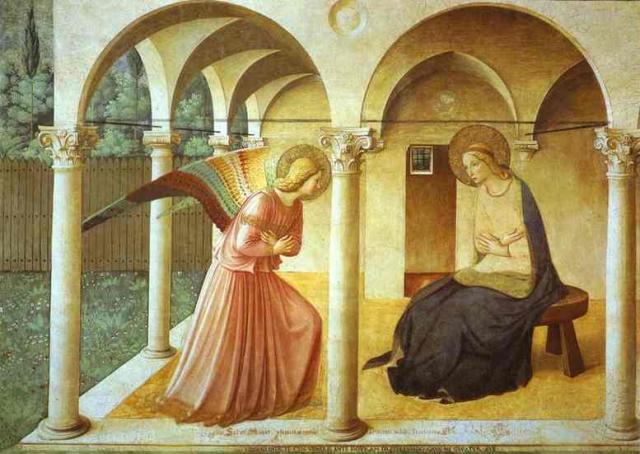
 Fra' Angelico. The Annunciation. 1450.

The season of Advent is the season before the coming to fruition of the promise of the Archangel Gabriel to our Lady on Lady Day, the Feast of the Annuncation, 25 March, when God our Father gave to us His only Son in the womb of the Blessed Virgin, coming to man as any other man, through the pregnancy of a mother, born from the flesh of the Virgin Mary, truly her Son and thus, as He was later to describe himself:

Ο Υιός του Ανθρώπου - the Son of Man 

Thus did God raise to the highest dignity the supreme calling of Motherhood whereby a woman, saying yes to her husband, to Life, and to God, brings forth humanity in the shape of a tiny child. For God Himself chose to come to us in this way: the great God of Earth and Heaven chose to come to us as a tiny, defenceless child.

This is the way of God: he stoops to conquer; he obeys to command, he becomes frail to demonstrate eternal strength.

~~ " ~~

Rorate caeli desuper et nubes pluant iustum. Aperiatur terra et germinet Salvatorem.

Drop down the dew, ye heavens, from above, and let the clouds rain down the Just One: let the earth be opened, and bud forth a Saviour.
Isaias 45:8


This versicle appears throughout the Offices for Advent and is yet another example of how much more Scriptural the old Roman rite of the Catholic Church is compared with the new rite of Paul VI in which, sadly, it is almost never sung.

Most modern Catholics do not even know that this most beautiful Advent antiphon even exists. The full hymn is sung thus:  

Rorate caeli desuper et nubes pluant iustum.

Ne irascaris Domine, ne ultra memineris iniquitatis: ecce civitas Sancti facta est deserta, Sion deserta facta est: Ierusalem desolata est: domus sanctificationis tuac et gloriae tuae, ubi laudaverunt te patres nostri.
 

Rorate caeli desuper, et nubes pluant iustum.

Peccavimus, et facti sumus tamquam immundus nos, et cecidimus quasi folium universi; et iniquitates nostrae quasi ventus abstulerunt nos: abscondisti faciem tuam a nobis, et allisisti nos in manu iniquitatis nostrae.

Rorate caeli desuper, et nubes pluant iustum.

Vide, Domini, afflictionem populi tui, et mitte quem missurus es, emitte Agnum dominatorem terrae, de Petra deserti montem filiae Sion: ut auferat ipse iugum captivatis nostrae.

Rorate caeli desuper, et nubes pluant iustum.

Consolamini, consolamini, popule meus: cito veniet salus tua:. quare moerore consumeris, quia innovavit te dolor? Salvabo te, noli timere: ego enim sum Dominus Deus, tuus, Sanctus Israel, Redemptor tuus.
 

Rorate caeli desuper, et nubes pluant iustum.

Listen to these Spanish monks of Santo Domingo de Silos singing the Rorate in the monastic church of their conventual home, calling upon God to forgive their sins as they await with joy, once again, the great Feast of the Birth of our Most Holy Saviour:


Drop down the dew, ye heavens, from above and let the clouds rain down the Just One!

Be not angry, O Lord, and remember no longer our iniquity : behold the city of Thy sanctuary is become a desert, Sion is made a desert. Jerusalem is desolate, the house of Thy holiness and of Thy glory, where our fathers praised Thee.
 

Drop down the dew, ye heavens, from above and let the clouds rain down the Just One!
 
We have sinned, and we are become as one unclean, and we have all fallen as a leaf; and our iniquities, like the wind, have taken us away; Thou hast hid thy face from us, and hast crushed us by the hand of our iniquity.
 

Drop down the dew, ye heavens, from above and let the clouds rain down the Just One!
 
See, O Lord, the affliction of Thy people, and send Him whom Thou hast promised to send. Send forth the Lamb, the Ruler of the earth, from the rock of the desert to the mount of the daughter of Sion, that He Himself may take off the yoke of our captivity.
 

Drop down the dew, ye heavens, from above and let the clouds rain down the Just One!
 
Be comforted, be comforted, my people; thy salvation shall speedily come. Why wilt thou waste away in sadness? Why hath sorrow seized thee? I will save thee; fear not: for I am the Lord thy God, the Holy One of Israel, thy Redeemer.

Drop down the dew, ye heavens, from above and let the clouds rain down the Just One!

With this extraordinarily beautiful hymn the prayer of the Church during Advent is lifted up to the heavens in song.

Henry Tanner. The Annunciation. 1898
...

Wednesday, 20 November 2013

Ave Christus Rex!

The Feast of Christ the King


Munkácsy Mihály. Ecce Homo. 1896.


Ecce Homo!

"Then therefore, Pilate took Jesus, and scourged him. And the soldiers platting a crown of thorns, put it upon his head; and they put on him a purple garment. And they came to him, and said:

Hail, King of the Jews

and they gave him blows. Pilate therefore went forth again, and saith to them: Behold, I bring him forth unto you, that you may know that I find no cause in him. (Jesus therefore came forth, bearing the crown of thorns and the purple garment.) And he saith to them:


"Behold the Man!"

[John 19:1-5]


Diego Velazquez. The Crucifixion or Christ of San Placido. 1630.


Regnavit a ligno Deus

"God hath ruled us from a tree"


[Vexilla Regis, Venantius Fortunatus]


Christos Pantokratoros (Christ, ruler of all), ancient Byzantine ikon.


Rex regum et Dominus dominantium

"King of kings and Lord of lords"

[Revelation 19:16]


Dignus est Agnus qui occisus est, accipere virtutem, et divinitatem, et sapientem, et fortiudinem, et honorem. Ipsi gloria et imperium in saecula saeculorum. Amen.

[Revelation 5: 12, 13, Introit for the Mass of Christ the King]

"Worthy is the Lamb that was slain to receive power, and riches, and wisdom, and strength, and honour, and glory, and blessing...Blessing, and honour, and glory, and power, be unto Him that sitteth upon the throne, and unto the Lamb for ever and ever."

Dixit itaque ei Pilatus: ergo Rex es tu? Respondit Jesus: tu dicis quia Rex sum ego. Ego in hoc natus sum, et ad hoc veni in mundum, ut testimonium perhibeam veritati: omnis qui est ex veritate, audit vocem meam.
[John 18, Gospel for the Mass of Christ the King]

"Pilate therefore said to Him: art Thou a king then? Jesus answered: thou sayest that I am a king. For this was I born, and for this came I into the world, that I should give testimony to the truth. Everyone that is of the truth heareth my voice".

"And I heard as it were the voice of a great multitude, and as the voice of many waters, and as the voice of mighty thunderings, saying, Alleluia: for the Lord God omnipotent reigneth."
[Revelation 19:6]

"And the seventh angel sounded; and there were great voices in heaven, saying, The kingdoms of this world are become the kingdoms of our Lord, and of His Christ; and He shall reign for ever and ever."

[Revelation 11:15]

"And He hath on His vesture and on His thigh a name written, KING OF KINGS, LORD OF LORDS."

[Revelation 19:16]

"For unto Us a Child is born, unto Us a Son is given: and the government shall be upon His shoulder: and His name shall be called Wonderful, Counsellor, The mighty God, The everlasting Father, The Prince of Peace".

[Isaiah 9:6]

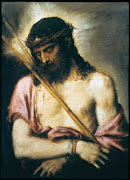
Jusepe de Ribera. Christ in the Crown of Thorns.


The Kingship of Christ is not like the kingship of pagans, heathens, unbelievers and gentiles. The Kingship of Christ is the kingship of a God-King-Priest Who suffers for the sake of Hs subjects whom He considers to be His very own children.

His crown is the Crown of Thorns, His sceptre is the Reed of humility, His royal cloak is the Purple Robe of suffering, for a royal girdle He is bound with the Bonds of servitude, His white Seamless Garment of purity and integrity is stripped from Him in public, His subjects mock Him, His servants desert Him, His people for whom He suffers and dies reject Him, His path is a Way of the Cross and His greatest work is Crucifixion as a common criminal.

Behold the King Who is a servant to the meanest of His people!

In so suffering, this great King gives us a model for all Christian leadership - paternal, royal, priestly, loving, unselfish, all-suffering, all-giving and all-sacrificing.

This is how all Christian kings and fathers must conduct themselves. For kings are fathers and fathers are kings, their subjects are children and their children are subjects - to be loved, not oppressed; to be formed, not neglected; to be nourished, not abused.

For these little ones, a king and a father sacrifices all he has and, above all, himself.

That is the meaning of Christian kingship, fatherhood and leadership.

"He saith to them: My chalice indeed you shall drink; but to sit on my right or left hand, is not mine to give to you, but to them for whom it is prepared by my Father. And the ten hearing it, were moved with indignation against the two brethren. But Jesus called them to him, and said: You know that the princes of the Gentiles lord it over them; and they that are the greater, exercise power upon them. It shall not be so among you: but whosoever will be the greater among you, let him be your minister:

And he that will be first among you, shall be your servant.

Even as the Son of man is not come to be ministered unto, but to minister, and to give his life as a redemption for many."
[Matt 20:23-28]

But how few among us - even among us Christians - understands this meaning of Christian leadership? So few. They still think - like pagans - either that leadership and earthly power are useful means to enrich oneself and lord it over others or else, equally falsely, they think they are merely evil, which is to say the same thing.

It is false.

Others foolishly think that it is degrading to be a servant and better to be rich, powerful, and influential, not so as to be a servant, but so as to serve oneself and oppress and humiliate others.

In fact, kingship or leadership is given by God to men to serve others and to sacrifice oneself for the good of others, as Christ the King did for us. The role of Christian leader is one of suffering and self-sacrifice - not selfishness and self-aggrandisement. It is a most noble and holy calling and we must re-learn to regard it as such.

Woe betide those who use power and rule for themselves and not for others!


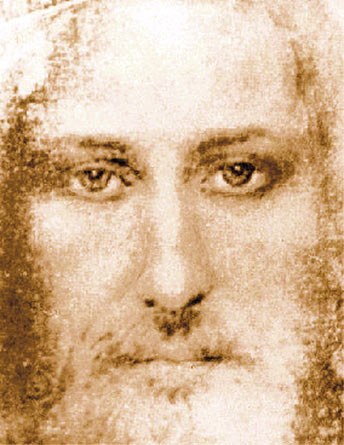
The Face of JESUS CHRIST on the Shroud of Turin - the face of the King of love.


And so we must return to the Social Kingship of Jesus Christ...

"19. When once men recognize, both in private and in public life, that Christ is King, society will at last receive the great blessings of real liberty, well-ordered discipline, peace and harmony.

Our Lord's regal office invests the human authority of princes and rulers with a religious significance; it ennobles the citizen's duty of obedience. It is for this reason that St. Paul, while bidding wives revere Christ in their husbands, and servants respect Christ in their masters, warns them to give obedience to them not as men, but as the vicegerents of Christ; for it is not meet that men redeemed by Christ should serve their fellow-men.

'You are bought with a price; be not made the bond-slaves of men'.

If princes and magistrates duly elected are filled with the persuasion that they rule, not by their own right, but by the mandate and in the place of the Divine King, they will exercise their authority piously and wisely, and they will make laws and administer them, having in view the common good and also the human dignity of their subjects. The result will be a stable peace and tranquillity, for there will be no longer any cause of discontent.

Men will see in their king or in their rulers men like themselves, perhaps unworthy or open to criticism, but they will not on that account refuse obedience if they see reflected in them the authority of Christ God and Man.

Peace and harmony, too, will result; for with the spread and the universal extent of the Kingdom of Christ men will become more and more conscious of the link that binds them together, and thus many conflicts will be either prevented entirely or at least their bitterness will be diminished.
...


28. We further ordain that the dedication of mankind to the Sacred Heart of Jesus, which Our predecessor of saintly memory, Pope Pius X, commanded to be renewed yearly, be made annually on that day."
[Pope Pius IX, Quas Primas, Encyclical letter establishing the Feast of Christ the King, 1925.]


Hail Christ the King!


...

Saturday, 21 September 2013

Pope Francis - the interview in America and the fallout


I think our dearly beloved Pope should learn the virtue of silence. 

The job of the Pope is to defend the faith not to court public favour by the mouthing of fashionable attitudes.

Above all, he should always support those who, through thick and thin, have been labouring hard and sacrificially in the vineyard of the Lord to defend human life and marriage - particularly at this time when same-sex marriage is being pressed upon legislators the world over.

He has unfortunately allowed himself to be quoted minimising the great work that these tireless apostles are doing.

That should never have been allowed to happen.

However, this might perhaps remind us all to pray to St Joseph Pignatelli SJ, the great Jesuit saint at the time of the suppression of the Jesuits by an earlier pope, Clement XIV.
 
He was a Spanish nobleman, of Neapolitan extraction, and a Jesuit at the time of the Spanish suppression in 1767, and at the general suppression of the Order, shamefully and shockingly by papal decree, in 1773.
 
All the Jesuits of Spain were taken to the port of Tarragona and banished from the country, in no less than 13 flotillas of ships. They were refused entry at numerous ports but eventually disembarked at Corsica before finding refuge in Ferrara.
 
St Joseph remained faithful and steadfast despite being betrayed by the very people from whom he should most have enjoyed support and blessing, not least the Pope.
 
St Joseph Pignatelli SJ, saviour and restorer of the Jesuit Order after the conflagration of the French Revolution
 
He continued ever-faithful, betrayed by all those who should most have protected and favoured him, not least the Pope.
 
In his time, the Society of Jesus began to be suppressed in each country of Christendom, first Portugal, then Spain, then France, then even the Holy Roman Empire, then, finally, in 1773, Pope Clement XIV was, himself, prevailed upon by the Freemasonic ministers of Europe to suppress the whole Order, world-wide.
 
It was a shocking betrayal of the greatest religious Order the world has ever seen.
 
These same Freemasonic ministers, the Marquess of Pombal in Portugal, the Count of Aranda in Spain, the Duke of Choisel in France and the Prince von Kaunitz in the Empire, had prevailed upon their own Kings to expel the Jesuits from their territories and then, finally, they forced the Pope to do so universally. 
 
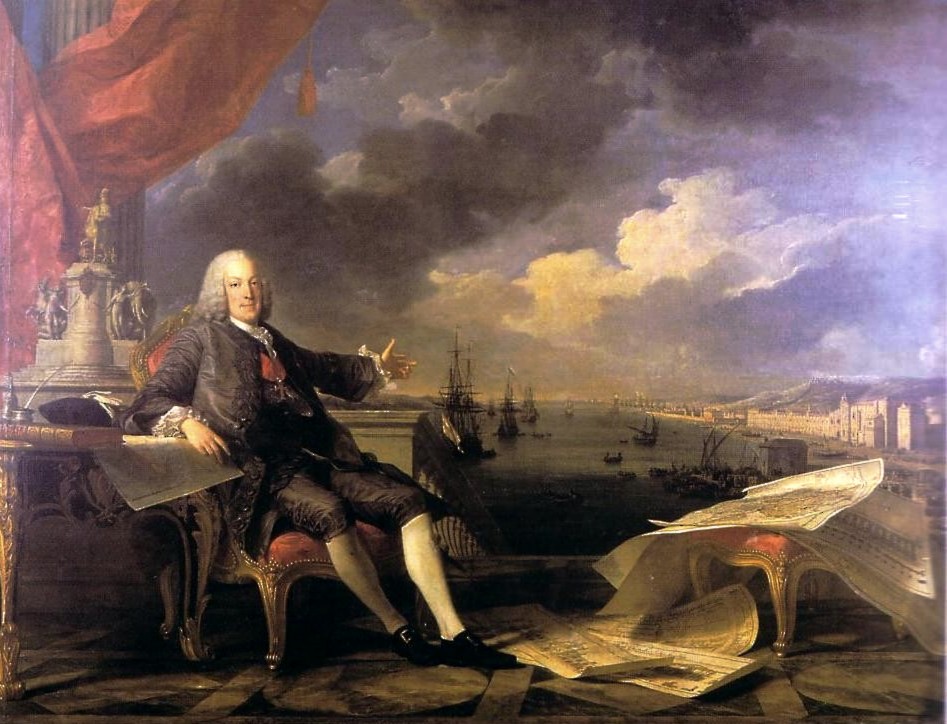
A portrait of the fanatically anti-clerical Marquess of Pombal, Prime Minister of Portugal, expelling the Jesuits from Portugal in 1766, the first Freemasonic minister of Christendom to do so from a Catholic country
 
At that time, Jesuits ran almost all the leading schools and universities throughout Christendom. The gap was then artfully and deceitfully filled by theologically weak and freemasonically-inclined teachers and clerics who sullied the minds of the young with foolish ideas and heterodox theories.
 
This greatly helped lead to the disaster of the French Revolution.
 
Meantime, Jesuits from all over the world, the courts of China, Japan and India, the plains of Ethiopia, the jungles of Latin America, the forest of the Philippines and from all corners of the earth, were arrested, chained, imprisoned and then, chained in the holds of ships, sent to Europe from all over the world and dumped - dead, dying and living - on the shores of the Papal States.
 
Yet even the Pope refused to take them in, so afraid was he of the heavy hand of the Freemasons and secret secular societies.
 
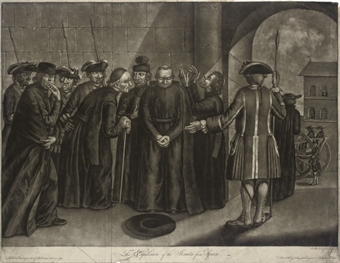
Charles Maucourt. The Expulsion of the Jesuits from Spain. 1767.
 
 Ironically, it was the anti-Catholic King of Prussia and Empress of Russia that eventually gave the last of the Jesuits shelter in Silesia and Muscovy.
 
The remainder were dispersed across Europe to fend for themselves, forming little societies here and there.
 
St Joseph was forbidden to exercise any priestly ministry at all and so retired to study and pray.
 
But he lived to see the whole Order restored, effectively saving the Order himself.

The suppression of the Jesuit Order, among other things, was what caused, in part, the French Revolution and the consequences of that Revolution has been the gradual de-Christianisation of the entire world ever since.
 
Some little known facts about the Jesuit Order:
 
1. They discovered quinine (called “Jesuit bark” in the 16th century) that is used today for anti-malarial drugs and also in tonic water. Without the Jesuits, you wouldn’t be able to enjoy your gin and tonic.

2. Their dictionaries and lexicons of the native languages in North America in the 17th century were the first resources Europeans used to understand these ancient tongues, and they still provide modern scholars with the earliest transcriptions of the languages.

3. They located the source of the Blue Nile and charted large stretches of the Amazon and Mississippi Rivers.

4. They educated Descartes, Voltaire, Moliere, James Joyce, Peter Paul Rubens, Arthur Conan Doyle, Fidel Castro, Alfred Hitchcock, and Bill Clinton—not to mention Bing Crosby.

5. They founded the city of Sao Paolo, Brazil.

6. There are 35 craters on the moon named for Jesuit scientists. And Athanasius Kircher, a 17th-century Jesuit scientist, called “master of a hundred arts” and “the last man to know everything”, was a geologist, biologist, linguist, decipherer of hieroglyphics, and inventor of the megaphone.

7. They count 40 saints and dozens of beati among their members, including the globe-trotting missionary St Francis Xavier.

[Source: James Martin, SJ, The Jesuit Guide to Almost Everything]
 
Father Ferdinand Verbiest SJ, Jesuit Astronomer in China

But in the 18th century popes, prelates and bishops all over Christendom had betrayed the faith. The result was a catastrophe, beginning in France, from which Europe has never quite recovered.
 
Heterodox prelates and their secularist allies were seeking the suppression of the Jesuit Order and the imposition of a false, un-Catholic society upon all Europe, posing deceitfully as “true” Christianity.
 
The modern film, The Mission, starring Jeremy Irons and Robert de Niro, tells something of the story of the suppression and expulsion of the Jesuits from the Reductions in Paraguay in Latin America, where they had taught the Indians to make violins and to write and sing great religious choral masterpieces in a quasi-Baroque style with unique Indian styles.
 
Here is an extract from the film:


St Joseph worked patiently and tirelessly. He managed to persuade the very same Grand Duke of Tuscany who had earlier so violently expelled the Jesuits from Tuscany, to restore them to the Grand Duchy, which, in 1797, he did.
 
Pope Pius VI, in 1798, having considered the idea of restoring the Jesuits many times before as a bulwark against French Revolutionary ideas, eventually, when he was already a prisoner of the French revolutionaries, authorised St Joseph to receive novices at Parma.
 
The French revolutionary General Berthier had entered Rome unopposed in the same year and, proclaiming a secular Roman republic, demanded of Pius the renunciation of his temporal authority. Upon the Pope's refusal, he was taken prisoner and moved to Siena, then Certosa, and then, upon the French revolutionary forces declaration of war against Tuscany, to Valence, in France, by way of Parma, Piacenza, Turin and Grenoble. The harried pope then died 6 weeks after arrival in Valence. 
 
Pope Pius VI, who, when he refused to declare Rome a secular republic at the demand of the French Revolutionary army,  was exiled to France where he died, after a long and harassing series of journeys, a prisoner of the bloody and violent Revolution. He allowed St Joseph to take novices at Parma
 
 This was the pope who had written the papal letter, Pourquoi Notre Voix, condemning the French Revolution and in which he called monarchy "the best of all governments". 

St Joseph was earlier appointed Jesuit Provincial of Italy, saw a restoration in Naples, the restoration of the Gesu to and the Roman College to the Order by Pius VII in 1811. 

Finally St Joseph directed the Order before its official restoration world-wide in 1815, the year of Waterloo and the Congress of Vienna, but he did not live to see it, dying of TB in 1811.
 

He was canonised in 1954.
 
With the suppression of the Jesuits, St Joseph Pignatelli saw the whole Catholic world collapse around him. He showed saintly and remarkable leadership in dark and difficult times and was a tower of quiet strength to many during those
troubled times, so like our own.
 
St Joseph Pignatelli, pray for us!