Saturday, 22 January 2011

Showing Christ to the Gentiles: the Season of the Epiphany


The Epiphany


of the Lord

to the Gentiles

on the same day as later occurred

the Baptism of the Lord

and

the miracle of wine at the wedding feast in Cana of Galilee


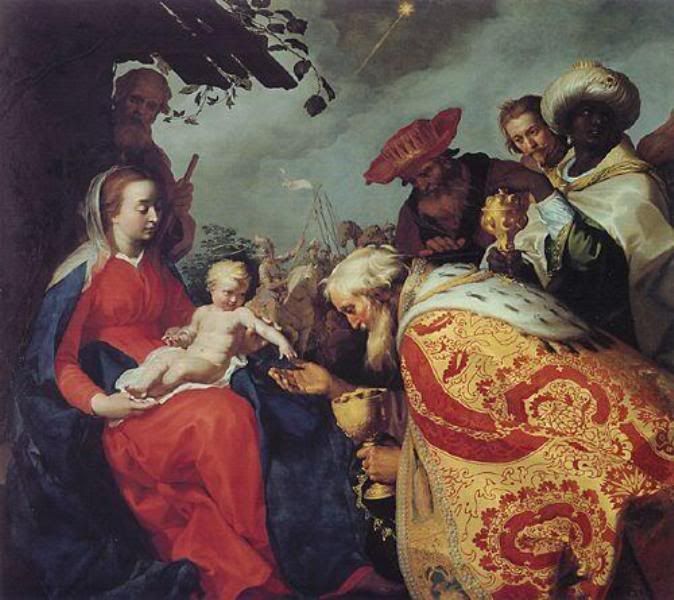
Whom Kings adore...

"When Jesus therefore was born in Bethlehem of Juda, in the days of king Herod, behold, there came wise men from the East to Jerusalem, saying: where is he that is born king of the Jews? For we have seen his star in the East, and are come to adore him. And king Herod hearing this, was troubled, and all Jerusalem with him. And assembling together all the chief priests and the scribes of the people, he inquired of them where Christ should be born. But they said to him: In Bethlehem of Juda. For so it is written by the prophet: and thou Bethlehem the land of Juda art not the least among the princes of Juda: for out of thee shall come forth the captain that shall rule my people Israel.

Then Herod, privately calling the wise men learned diligently of them the time of the star which appeared to them; and sending them into Bethlehem, said: go and diligently inquire after the child, and when you have found him, bring me word again, that I also may come and adore him. Who having heard the king, went their way; and behold the star which they had seen in the East, went before them, until it came and stood over where the child was. And seeing the star they rejoiced with exceeding great joy. And entering into the house, they found the child with Mary his mother, and falling down they adored him: and opening their treasures, they offered him gifts; gold, frankincense, and myrrh. And having received an answer in sleep that they should not return to Herod, they went back another way into their country."

[Matt 2:12 - Gospel for the Mass of the Epiphany]


The shrine of the Three Kings at Cologne Cathedral


The Shrine of the Three Kings in Cologne Cathedral contains their relics brought from Milan by ship to the City of Cologne on the order of the Holy Roman Emperor, Frederick Barbarossa, in 1164 as a gift to the Prince-Elector Archbishop, Rainald of Dassel.

This gave rise to the English Carol "I Saw Three Ships Come Sailing in".

The relics had first been taken from Constantinople to Milan in 344 by Bishop Eustorgius of Milan.

Around 1199, the Roman Emperor Otto IV gave three golden crowns made for the three wise men as a present to the church of Cologne, the city where, the previous year, he had been elected King of the Romans and Emperor-elect by the Prince-Electors of the Empire (he later gained the support of all the imperial princes at Frankfurt in 1208).

An inscription reads:

Otto rex coloniensis curiam celebrans tres coronas de auro capitibus trium magorum imposuit.

Otto the King, the court of Cologne celebrating, gave three golden crowns for the heads of the three Magi.

Emperor Otto IV was the only member of the Welf dynasty to be elected Holy Roman Emperor and, being the son of Matilda Plantagenet (married to Henry the Lion, Duke of Bavaria), he was allied to England in the Franco-English wars. He was also the personal preference of Pope Innocent III, who crowned him Roman Emperor at Rome in 1209, although they later fell out over the issue of the imperial rights in Italy.

Because of the importance of the shrine and the cathedral for the later development of the city, the Coat of Arms of Cologne still shows these three crowns symbolizing the Three Kings.

Construction of the present Cologne Cathedral was begun in 1248 to house these important relics. The cathedral took 632 years to complete and is now the largest Gothic church in northern Europe.

On July 20th, 1864, the shrine was opened, and the remains of the three Kings and the coins of Philipp von Heinsberg, Archbishop of Cologne, were discovered.

An eyewitness report reads:

“In a special compartment of the shrine now there showed - along with remains of ancient old rotten or moulded bandages, most likely byssus, besides pieces of aromatic resins and similar substances - numerous bones of three persons, which under the guidance of several present experts could be assembled into nearly complete bodies: the one in his early youth, the second in his early manhood, the third was rather aged. Two coins, bracteates made of silver and only one side striken, were adjoined; one, provably from the days of Philipp von Heinsberg, displayed a church, the other showed a cross, accompanied by the sword of jurisdiction, and the crozier on either side.”

The bones were wrapped in white silk and returned to the shrine where they remain to this day to be venerated by all the Faithful.

By long tradition, on the Feast of the Epiphany – called Dreikoenigsfest (the Feast of the Three Kings) in the lands of the old Holy Roman Empire – the Rector of the Parish (or in his absence, the father of each family) visits each house with a cross-bearer, 2 acolytes and 3 children dressed as the kings, one bearing a censer with lighted incense. At each house a little ceremony takes place, the house is blessed with Epiphany water, and over the door lintel of the house the following is inscribed with blessed chalk:

20 + C + M + B + 11

In my house we always perform this traditional ceremony.

This symbolises the present year and the blessing of the three Magi, Caspar, Melchior and Balthazar, upon each home.

The symbols remain all year or until the weather has washed them away.

Blessed Caspar, Melchior and Balthazar, wise men and kings from the East, pray for us!


+


The Journey of the Magi

by T S Eliot


A cold coming we had of it,
Just the worst time of the year
For a journey, and such a long journey:
The ways deep and the weather sharp,
The very dead of winter.
And the camels galled, sore-footed, refractory,
Lying down in the melting snow.
There were times when we regretted
The summer palaces on slopes, the terraces,
And the silken girls bringing sherbet.
Then the camel men cursing and grumbling
And running away, and wanting their liquor and women,
And the night-fires going out, and the lack of shelters,
And the cities dirty and the towns unfriendly
And the villages dirty and charging high prices:
A hard time we had of it.
At the end we preferred to travel all night,
Sleeping in snatches,
With the voices singing in our ears, saying
That this was all folly.

Then at dawn we came down to a temperate valley,
Wet, below the snow line, smelling of vegetation;
With a running stream and a water mill beating the darkness,
And three trees on the low sky,
And an old white horse galloped away in the meadow.
Then we came to a tavern with vine-leaves over the lintel,
Six hands at an open door dicing for pieces of silver,
And feet kicking the empty wineskins.
But there was no information, and so we continued
And arrived at evening, not a moment too soon
Finding the place; it was (you may say) satisfactory.

All this was a long time ago, I remember,
And I would do it again, but set down
This set down
This: were we led all that way for
Birth or Death? There was a Birth, certainly,
We had evidence and no doubt. I had seen birth and death,
But had thought they were different; this Birth was
Hard and bitter agony for us, like Death, our death.
We returned to our places, these Kingdoms,
But no longer at ease here, in the old dispensation,
With an alien people clutching their gods.
I should be glad of another death.


+ + +

"three trees on the low sky... I should be glad of another death."


...

The Nativity of Christ: Christmastide does not end until Candlemas, 2nd February


O most Holy Night...

...all the earth being at peace...


Anton Raphael Mengs. Adoration of the Shepherds.


"And Joseph also went up from Galilee out of the city of Nazareth, into Judaea to the city of David, which is called Bethlehem, because he was of the house and family of David, to be enrolled with Mary, his espoused wife, who was with child. And it came to pass, that when they were there, her days were accomplished that she should be delivered. And she brought forth her firstborn Son and wrapped Him in swaddling clothes, and laid Him in a manger, because there was no room in the Inn. And there were in the same country shepherds watching and keeping the night watches over their flock. And behold an Angel of the Lord stood by them and the brightness of God shone round about them, and they feared with a great fear. And the Angel said to them 'Fear not; for behold I bring you tidings of great joy that shall be to all people. For this day is born to you a Saviour who is Christ the Lord, in the city of David. And this shall be a sign unto you: you shall find the Infant wrapped in swaddling clothes and laid in a manger'. And suddenly there was with the Angel a multitude of the heavenly host, praising God and saying 'Glory to God in the highest and on earth peace to men of good will.' "

[Luke 2:4-14]
[The Gospel of the Nativity of Our Lord, the first Mass of Christmas at midnight]


OCTAVO KALENDAS JANUARII
The Eighth Day before the Calends of January, being
CHRISTMAS DAY


In the 5199th year of the creation of the world, from the time when God in the beginning created the heavens and the earth;

the 2957th year after the flood;

the 2015th year from the birth of Abraham;

the 1510th year from Moses, and the giving forth of the people of Israel from Egypt;

the 1032nd year from the anointing of King David;

in the 65th week according to the prophesy of Daniel;

in the 194th Olympiad;

the 752nd year from the foundation of the City of Rome;

the 42nd year of the rule of Octavian Augustus,

all the earth being at peace,

JESUS CHRIST

the eternal God,
and Son of the eternal Father,
desirous to sanctify the world by His most merciful coming,
being conceived by the Holy Spirit,
nine months after His conception
was born in Bethlehem of Judaea,
MADE MAN OF THE VIRGIN MARY.

THE NATIVITY OF OUR LORD JESUS CHRIST ACCORDING TO THE FLESH

[From the Martyrology of Christmas Day
sung at the old Office of Prime in Cathedral Chapters and Monasteries of the Latin rite of the Roman Catholic Church, to an ancient chant by a dignitary in Choir recalling the Septuagint chronology. All others in Choir remain standing throughout until the lector comes to the word "Bethlehem" at which all bend the knee unto the ending.]


O Emmanuel,
Rex noster et legifer noster, expectatio Gentium, et Salvator earum: veni ad salvandum nos, Domine Deus noster.

O Emmanuel,
our King and Lawgiver, the desire of the nations and the Saviour thereof, come to save us, O Lord our God.

[Isaias 7:14,33,22]
[The 7th of the Great 'O Antiphons' of Advent, sung at Vespers in the Roman rite for the last 7 days of Advent]


Puer natus est nobis,
et filius datus est nobis, cujus imperium super humerum ejus et vocabitur nomen ejus, magni consilii Angelus.

Unto us a child is born,
a Son is given, and the government shall be upon His shoulder and His name shall be called Wonderful Counsellor"

[Isaias 9:6]
[Introit of the third Mass of Christmas, during the daytime]


Happy Christmas to all!


...

Saturday, 18 December 2010

Infallibility - how do we explain it?

It is not unfamiliar to hear some Catholics these days throwing doubt on the doctrine of infallibility.

What should we say to such people?

I could mention Matt 16:18 ("thou are Peter...etc) and I could mention the Church's own claim to infallibility (Lumen Gentium 25 of Vatican II and Pastor Aeturnus of Vatican I) but I think the point can be answered more simply.

In fact every serious belief system considers itself possessed of a principle of "infallibility" in the sense that it considers its own principal doctrines to be absolutely true. Even Secularists consider it self-evidently true that there is no God or at least that God should have no part in the public affairs of men.

The difference is simply that the Catholic Church defines the scope of its own view of its capacity to teach infallibly rather more scientifically than any other belief system. It thus sets out the boundaries of its own infallibility with some precision, unlike all other belief systems which more or less expect their disciples to "take it as read" that the principal teachings of their belief system are absolutely true.

The circularity involved in saying that doctrine "X" is true because it is true, is so obviously unsatisfactory to any real searcher after truth that the Catholic Church, following the lead of its Founder, took steps to set out clear parameters as to when - and more importantly why - some of its teachings were taught as infallibly true and beyond question.

The advantage that theists have over atheists is that we can appeal to God as a final authority (provided, of course, that He has given His view which, in the case of Christianity, He has, through Revelation).

Atheists are thus only able to say on any matter not clearly knowable by deductive or inductive logic, in effect, "I am right and you better believe me". That is because they do not believe in any higher authority than man and, indeed, often do not much believe in higher authorities even among men. They therefore have no higher authority to which they can appeal in the event of dispute.

Or, as Gilbert and Sullivan put it more succinctly, "when everybody's somebody then no-one's anybody".

In short, one man's view is as good as another's and so, absent respect for logic, truth boils down to having more people on your side than the other guy. In short, might becomes right.

To be fair, many atheists do respect logic. But on any matter that transcends logic alone, such as the existence of God, of spirits, of an after life, of the cause and origin of virtue, vice and free-will, they have no answer other than their own unaided opinions.

Theists have God.

But that is not enough. After all, who knows the mind of God?

We need to know what God says, at least, to us and we need to know with certainty and precision.


God the Father: Creator and Teacher


Step forward the principle of infallibility.

This principle is a logical extension of the idea that there is right and there is wrong, that there is truth and there is falsehood.

Those who deny that truth exists are self-defeating since the very statement "nothing is true", is, itself, being asserted as true, but, if it is true, then there is such a thing as truth and the statement is false anyway.

It is like Bernard Shaw's self-contradictory rule that "The Golden Rule is that there are no Golden Rules". One merely replies to him "including your own Golden Rule?".

Given that there is truth, then, it follows that some things must be true. We can arrive at truth by the use of logic but, as I said above, some ideas transcend logic and cannot be knowable by the same.

How then do we know whether they are true or not?

The only answer can be that someone with greater knowledge than ourselves - greater than all of humanity - must be able to tell us (and, once told, we may then be able to apply our skills in logic to what we have been told). That must mean either a being superior to men, such as a spirit of some sort, or perhaps a being from another part of the Universe or perhaps even from another Universe.

Of the latter two, scientists have only been able to speculate since no human has ever met such a being.

As to the first, we have more concrete scientific knowledge.

We have various religions which claim to have had metaphysical knowledge communicated to them from spirits of one kind or another. So far as I am aware only two claim that such knowledge can be taught and mediated infallibly - the Mormon Church and the Roman Catholic Church.

Thus, the majority of religions are nearly in the same difficulty as the Secularist in that they do not have any mechanism by which they can, with certainty or even precision, confirm that any of the teachings taught them by their spirit guides are absolutely true. One is more or less driven back to "they are true because I say they are true".

The difficulty with the infallible organ of the Mormon teaching office is that it freely contradicts itself. "X" is true today but tomorrow it isn't. A more obvious self-contradiction cannot be.

For a truth to be absolutely true, it must always, everywhere and forever, be true. That is logically self-evident.

Thus, as Newman reminds us, doctrine cannot be true if it is not consistent with itself here and now, in the past and in the future.

The Catholic Church claims this consistency and not only invites others to put it to the test, scientifically, but puts itself to such test with regularity and rigour. It also applies the other tests that Newman adumbrates in his Development of Christian Doctrine, viz., preservation of type, continuity of principles, logical sequence, conservation of past principle etc.

Thus, the Catholic Church is among the first to admit that truth not knowable by logic requires a higher teacher than humanity, posits such a teacher in God, admits that His teaching is of no use unless communicated to mankind, witnesses to the fact of His having done so, teaches that it happened by means of God assuming human form and so teaching men, His teachings later being partially collected in writings called "The Books" (ta Biblia in the Greek of its time) and the power to interpret "The Books" being imparted by this God-in-assumed-human-form to His formally-appointed successors, particularly the chief of them, St Peter, and his successors, the chief bishops of the Catholic Church.


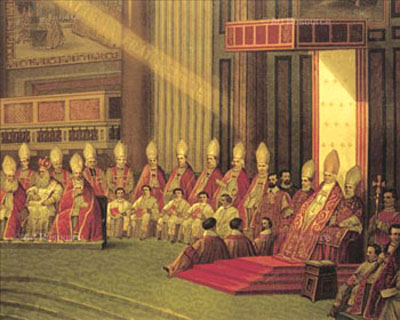
The bishops of the Catholic world gathered together in General Council at the Vatican


This arrangement appears to be almost unique in the annals of human history. That gives it a claim upon our attention, if nothing more.

Of course, Catholics will claim, like most other belief-systems, that our system is absolutely true. But we have an added advantage. We can show how we arrive at such absolute truth, with precision and with certainty. They cannot - at least nothing like to the same degree.

The Chief Bishop (Father or "Pope") has been appointed by God, when God visited men, as the authentic interpreter of The Books. In interpreting The Books, he can, logically, also interpret what it means when it records the moment when God appointed him and his successors as its interpreters.

The chief bishops and their advisers (or councils of bishops) have done precisely that.

They have done so in very precise, scientific and legal language so as to provide the very certainty and precision that I mentioned was lacking from most other belief systems.

Not only that but they have done so in a manner that leaves no room for doubt or uncertainty, knowing that men are entitled to know exactly what the God-appointed interpreters mean by particular teachings. They have used legal formulae to "define" and to "exclude", to say "we define" and to say "let the opposite view be anathema". This provides clarity and certainty of the most consummate kind.

Any fool can bumble, guess, procrastinate or prevaricate. A real teacher must be able to teach clearly, precisely and with authority.

Such the God-appointed Catholic "interpreters" have done and continue to do.

We can access and read their clear teachings at our choice and at our leisure.

The more recent include Pastor Aeturnus of the First Vatican Council and Lumen Gentium 25 of the Second Vatican Council.

The first of these even uses the same precise, clear and defining formula to set out the bounds of the same certainty. It teaches thus:

"It is a divinely revealed dogma that the Roman Pontiff when he speaks ex cathedra, that is:

1. when acting in the office of shepherd and teacher of all Christians;

2. he defines;

3. by virtue of his supreme apostolic authority;

4. a doctrine concerning faith and/or morals;

5. to be held by the universal Church

possesses through the divine assistance promised to him in the person of Blessed Peter, the infallibility with which the divine Redeemer willed His Church to be endowed in defining doctrine concerning faith and/or morals, and that such definitions of the Roman Pontiff are therefore irreformable of themselves and not because of the consent of the Church (ex sese, non autem ex consensu ecclesiae). But if anyone presumes to contradict this our definition – which God forbid! - anathema sit."


[Conc. Vat. I, Const. dogm. Pastor Aeternus, Ch.4, Denzinger-Schoenmetzer 1839 (3074)]

This is admirably clear and scientifically precise.

No other belief-system has this admirable degree of clarity and scientific precision in setting out the limits of its own teaching authority.

Note that the Council teaches that it is a "divinely revealed dogma" and that those who contradict the definition are to be held anathema.

It is, indeed, a high degree of precision which is here displayed. No-one need be in any doubt about this teaching. Any man can quite readily say to himself that he does or not believe this teaching and thus is - or is not - a believer in the teachings of the Catholic faith.


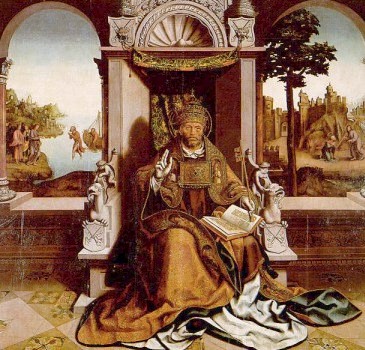
Pope St Gregory the Great writing depicted with a white dove representing the Holy Spirit inspiring him
(the popes wore red until Pope St Pius V, a Dominican, continued to wear his white Dominican soutane, establishing the tradition of popes in white soutane)


Any man can apply this yardstick to any teaching emanating from any Catholic source and can readily see whether or not it is taught infallibly and thus is (or is not) an integral part of the Catholic faith.

For instance, the Catholic Church has infallibly taught that the Virgin Mary, the Jewish and human mother of God-in-assumed-human-form (whom we call Jesus Christ, from the Greek Iesous Christos, and the Hebrew, Y'shua Moshiach, meaning "anointed saviour"), was taken up to heaven, body and soul, upon her death.

Equally, for instance, the Catholic Church has never taught, let alone infallibly, the doctrine that some races are inferior to others.

One can thus readily apply the relevant criteria to any idea, teaching or proposition.

Those who seek to deprive the Catholic Church of its charism of infallibility thus do a tremendous disservice not only to the Church but also to human civilisation as a whole by eliminating the admirable clarity and scientific precision which the Church applies to itself, unlike any other belief system.

Even if the Catholic Church were not the true religion (which it is) it would be a retreat into obscurity to prefer it to deprive itself of such admirable clarity and precision and would set at defiance the efforts of men to reach truth with as much clarity and certainty as we can.

Far from being the approach of a scientist it would rather be the retreat by an obscurantist who preferred muddle to precision, opacity to clarity, something which no real scholar, scientist or philosopher, worthy of the name could possibly prefer.

Yet there are some Catholics who would prefer a retreat into obscurity than an advance into clarity. Not liking the clarity that they see, they retreat from it.

Note also that the criteria provided infallibly by Pastor Aeturnus does not restrict an exercise of the ex cathedra teaching authority to any time, place or method, beyond the 5 criteria.

Thus it is an unwarranted restriction upon the application of Pastor Aeturnus to aver, as some do, that the two Marian dogmas promulgated in the last 200 years are the only examples of infallibly taught doctrine over that time.

Pastor Aeturnus provides no such restriction.

Unsurprisingly, therefore, Cardinal Newman himself believed that the papal encyclical Quanta Cura of Blessed Pope Pius IX taught doctrine infallibly.


Blessed Cardinal John Henry Newman believed that the encyclical Quanta Cura was taught infallibly


Others say that the Pope cannot teach infallibly on his own but only by consent of a General Council.

Such a "conciliarist" view was infallibly condemned by the 4th Lateran Council (1215), the Council of Lyon (1274), the Council of Vienne (1311) and - in the most express terms - by the 5th Lateran Council (1512).

The teaching contained in the papal encyclical Humanae Vitae occasioned much controversy as many thought that it would teach that artificial contraception is morally licit. It taught the opposite, in fact.

Whether it taught so infallibly becomes of lesser importance when we acknowledge that such teaching was already infallibly taught as true by virtue of the ordinary infallible teaching of the bishops dispersed throughout the world.

The infallibility of this so-called "ordinary" infallible teaching office has been taught since the days of the Apostles but was most recently and conveniently re-affirmed in Lumen Gentium 25 of the Second Vatican Council which taught:

"Although the individual bishops do not enjoy the prerogative of infallibility, they nevertheless proclaim Christ's doctrine infallibly whenever, even though dispersed through the world, but still maintaining the bond of communion among themselves and with the successor of Peter, and authentically teaching matters of faith and morals, they are in agreement on one position as definitively to be held".

There can be no doubt that a moral unanimity of bishops throughout the world always taught, consistently, against the licitness of artificial contraception. This was thus the infallible teaching of the ordinary teaching office long, long before the encyclical Humanae Vitae was issued.


G K Chesterton, defender of infallibility


Many Catholics, however, would rather throw out the baby of clarity of teaching with the bathwater of the teaching on contraception because they have found it inconvenient in their own personal lives. They love vice more than truth.

I need hardly add that the inconvenience of some individual persons cannot be a basis for over-throwing the teaching office of the Catholic Church established, as we saw above, by God himself when he formally appointed his followers to be authentic interpreters of His own teachings.

If God is anything at all, He must surely be forgiving of creatures whom He knows to be prone to sin. Therefore, there is simply no need to re-write His teachings to suit our vices. It is simpler and better just to say sorry for not reaching the set goals.

As G K Chesterton once memorably put it, "The Christian ideal has not been tried and found wanting; it has been found difficult and left untried".

More importantly, we do not advance into clarity by retreating into obscurity.

Let us, then, thank God for the gift or charism of infallibility, the guarantor of clarity in teaching or doctrine.


Ecclesia docens
The living voice of the teaching Church


...

Saturday, 11 December 2010

Christian street preacher wins award against the police for false arrest and assault

An autistic Christian street preacher who was handcuffed and arrested for speaking out against homosexuality and many other sins has been awarded £4,250 in damages following a court case against West Midlands Police.

Birmingham County Court ruled on Wednesday that PC Adrian Bill committed assault and battery against Mr Anthony Rollins when he handcuffed him unnecessarily.

The court also ruled that Mr Rollins was wrongfully arrested, unlawfully detained and his human rights to free speech and religious liberty were infringed. The court ordered the police to pay Mr Rollins' legal costs.


Doh! I fink wee boobed, boys.....


Do you remember the story about a Christian Street preacher who was arrested for saying "Homosexuality is a sin"?

In fact, there is no such thing as "hate crime" in English law. It is not a phrase that is used by the law.

The actual facts of the arrest of the case were recorded on video and make disturbing viewing.

Among the the first words of the police when they arrive is:

"Hello sir. What have you been saying, homophobic wise ?"

This is barely English, let alone a question that can be answered by someone about to be arrested. Matters got worse:

"Preacher: I spoke to your officer earlier and he was upset that I was saying homosexuality was a sin – which is what the Bible says. And I affirm that’s what I say because that’s in the Bible. And there’s no law, there’s no law…

Policeman: Well there is.

Preacher: No there isn’t.

Policeman: There is. Unfortunately, mate, it’s a breach of Section 5 of the Public Order Act"

Well, actually, constable, it is just isn't and you are an ignoramus for knowing so little about the law that you were claiming to arrest someone for!

And to cap it all the arresting officer actually arrests him for a "racially aggravated public order offence". Yep - racially aggravated!

Doh!

You just can't make this stuff up!


Nevertheless, the preacher was arrested, taken to a police station, made to give his DNA and fingerprints and eventually charged.

What then happened?

Err...well.... all the charges were dropped.

Straight away.

Like that.

Poof - gone - out the door.

Why?

Once the facts of the case were examined by Crown Prosecutors, lawyers and police officers who were capable of using more than one brain cell at a time, it became blatantly obvious that there was no such law as the heavy-handed officers of the law had falsely claimed.

How could this be contrary to section 5 of the Public Order Act? It has never been any part of the Public Order Act to decide what is or is not "a sin" and it is not illegal to say that any form of behaviour is "a sin".

So - were the 3 police officers and 2 PCSOs involved in this situation just plain stupid or is there a problem with the wording of the law itself?

Section 5 actually reads as follows:

"Public Order Act 1986, s. 5 Harassment, alarm and distress

(1) A person is guilty of an offence if he–

(a) uses threatening, abusive or insulting words or behaviour, or disorderly behaviour, or
(b) displays any writing, sign or other visible representation which is threatening, abusive or insulting,

within the hearing or sight of a person likely to be caused harassment, alarm or distress thereby.

(2) An offence under this section may be committed in a public or a private place, except that no offence is committed where the words or behaviour are used, or the writing, sign or other visible representation is displayed, by a person inside a dwelling and the other person is also inside that or another dwelling.

(3) It is a defence for the accused to prove–
(a) that he had no reason to believe that there was any person within hearing or sight who was likely to be caused harassment, alarm or distress, or
(b) that he was inside a dwelling and had no reason to believe that the words or behaviour used, or the writing, sign or other visible representation displayed, would be heard or seen by a person outside that or any other dwelling, or
(c) that his conduct was reasonable.

...

S6(4)Mental element: miscellaneous)

A person is guilty of an offence under section 5 only if he intends his words or behaviour, or the writing, sign or other visible representation, to be threatening, abusive or insulting, or is aware that it may be threatening, abusive or insulting or (as the case may be) he intends his behaviour to be or is aware that it may be disorderly"

Sothe Police had to decide that Mr Mcalpine was using "threatening, abusive or insulting words" when he said that "homosexuality was a sin".


There is no legal definition of "threatening, abusive or insulting" and the words are to be taken in their normal and natural meaning.

Clearly, the phrase "homosexuality is a sin" is not "threatening", nor "abusive".

Someone might, conceivably, consider it "insulting". But should it be an offence to use words that are merely subjectively insulting?

Where does that end? Is it criminal?

In fact the judge in the Rollins case used his commons sense and came to the conclusion that Mr Rollins had been wrongly arrested and had been assaulted.


The question has but to be stated for its answer to be obvious. Of course, it cannot and should not be criminal. In fact, it is simply not criminal. The police officers were simply off on a crazy frolic of their own.

The proper view must be that the words "threatening, abusive or insulting" ought to be taken together, that the preacher could not be said to have caused "alarm, harassment or distress" and/or his conduct was perfectly reasonable (per s.5(3)(c)).

Doubtless, the CPS came to their conclusion for these or similar reasons and the charges had to be dropped.

There have been numerous similar incidents of police over-reaction to complaints of Homophobia, Islamaphobia, racism etc and the reason for this is the abysmally low standard of training of police officers regarding the dubious concept of "hate crime".

Common sense and the right to freedom of speech seem to have been left on the shelf at the police station.

Now view the video and see what I mean. The uniformed official grinning vacantly in the background is apparently the PCSO (Police Community Support Officer) who had actually called the police to report the preacher for "Homophobia" (which is not an offence known to the law).


Stop arresting the innocent....!

Advent: O Dayspring! Brightness of eternal Light ...

O ORIENS, splendor lucis aeternae et sol iustitiae: vei, et illumina sedentes in tenebris et umbra.

O Dayspring! Brightness of eternal Light and Sun of Justice: come and enlighten them that sit in darkness and in the shadow of death.


~~~~~ " ~~~~~

This is the 5th of the 7 great "O" Antiphons of Advent that are sung at Vespers up until Christmas Eve.

These are beautiful prayers that tell of the coming of our God in the flesh using the words of the Old Testament that predict the coming of the Messias.

There are 7 of them. 7 is a sacred number - 7 days of the week, 7 Sacraments, 7 deadly sins and contrary virtues, 7 ages of man, 7 ranks of Holy Orders (Priest, Deacon, Subdeacon, Acolyte, Lector, Exorcist and Porter), 7 ranks of the Christian nobility, 7 diurnal hours of the Divine Office (Lauds, Prime, Terce, Sext, None, Vespers and Compline - Matins being the Night Office) and so on. 7 is the Biblical number of perfection whereas 6 is the number of sin.

The 7 "O" Antiphons are a most wonderful and ancient way to usher the Christian people into the Holy Presence that comes to us in the depth of the night on Christmas Eve as a tiny babe.

Who but God could think of such a marvellous way to come down from on high to visit His people.


Anton Raphael Mengs. The Adoration of the Shepherds.

NOLITE timere: quinta enim die veniet ad vos Dominus noster!

FEAR not: on the fifth day our Lord shall come to you!

[Antiphon of 21 December, 5 days before Christmas]

...

RIP Colonel Tommy Pace OBE MD RAMC, late the Royal Ulster Rifles, Knight of Magistral Grace of the Order of Malta


Of your charity,

pray for the soul of

Colonel THOMAS ANASTASI PACE
OBE MD RAMC,

late RMO the Royal Ulster Rifles

Knight of Magistral Grace

of the Sovereign Military Order of Malta

30 years Sacristan of the Conventual Church
of the Order

who died on 22 November 2010

aged 96 years

REQUIESCAT IN PACE


Colonel Tommy, in the choir dress of the Order of Malta, with his niece and other friends


The Funeral Requiem Mass and Exequies for Colonel Tommy Pace were held at Saint James's Spanish Place, George Street, London W1U 3QY, at 10 am on Friday 3 December 2010, preceded, the night before, by reception of the body at 5pm and Solemn Vespers of the Dead.

The Requiem was followed by a private Reception at the King Edward VII Hospital for Officers (Sister Agnes' Foundation), and a private cremation at Golders Green cemetery.

A Mass, for the Feast of Our Lady of Liesse (whose shrine is in Grand Harbour, Valletta, Malta), and whose devotion was a favourite of the late Colonel, and which occurs on the same day, was also sung in the Conventual Church of St John of Jerusalem of the Knights of Malta, St John's Wood, for the Colonel's intention at 6.30pm, by Father John Hemer MHM.

This mass was followed by the Advent Recollection.

Colonel Tommy - a recollection...

Colonel "Tommy" Pace was born in Malta, where he studied medicine before the War, was commissioned in the Royal Army Medical Corps, and served with distinction during the War in India and in Burma where he won a military OBE.

After the war, he served in Singapore, Kenya and Cyprus before going to Paris as Chief of NATO Medical Services. His last posting was to Brussels where he served at Supreme Headquarters Allied Powers Europe (SHAPE) as chairman of the NATO Emergency War Surgery Handbook Revision Committee.

After retirement he moved to St John's Wood, to be close to Lord's Cricket Ground, and was a life-long member of the MCC. He was also a keen follower of rugby. He had been Sacristan of the Conventual Church for thirty years and continued regularly to attend Mass there until a few weeks before his death.

He was immensely proud to have been invested a Knight of the Sovereign Military Order of Malta in June 2009 and described himself as the newest, oldest member.

The last few months of his life were a valiant struggle with advancing cancer, during which time he was an example to all his friends of patient forbearance and piety. His wife predeceased him by about fifteen years. He is survived by his four nieces.

All who knew him loved him for his charity and impeccable manners and gentility. He was a delightful man, very witty and amusing but also wonderfully humble and patient and was always a marvellous advertisement for his native Malta. It is no exaggeration to say that those who knew him were able to see in him something of Christ Himself.

He was, in every sense, worthy of Chaucer's famous words "a verray, parfit gentle Knight".

Eternal rest grant unto him, O Lord...


Tuesday, 16 November 2010

Their name liveth for evermore...


Their name liveth for evermore...


O Valiant Hearts!

O valiant hearts who to your glory came
Through dust of conflict and through battle flame;
Tranquil you lie, your knightly virtue proved,
Your memory hallowed in the land you loved.

Proudly you gathered, rank on rank, to war
As who had heard God’s message from afar;
All you had hoped for, all you had, you gave,
To save mankind—yourselves you scorned to save.

Splendid you passed, the great surrender made;
Into the light that nevermore shall fade;
Deep your contentment in that blest abode,
Who wait the last clear trumpet call of God.

Long years ago, as earth lay dark and still,
Rose a loud cry upon a lonely hill,
While in the frailty of our human clay,
Christ, our Redeemer, passed the self same way.

Still stands His Cross from that dread hour to this,
Like some bright star above the dark abyss;
Still, through the veil, the Victor’s pitying eyes
Look down to bless our lesser Calvaries.

These were His servants, in His steps they trod,
Following through death the martyred Son of God:
Victor, He rose; victorious too shall rise
They who have drunk His cup of sacrifice.

O risen Lord, O Shepherd of our dead,
Whose cross has bought them and Whose staff has led,
In glorious hope their proud and sorrowing land
Commits her children to Thy gracious hand.


The Next War

by Wilfred Owen

Out there, we've walked quite friendly up to Death, —
Sat down and eaten with him, cool and bland, —
Pardoned his spilling mess-tins in our hand.
We've sniffed the green thick odour of his breath, —
Our eyes wept, but our courage didn't writhe.
He's spat at us with bullets and he's coughed
Shrapnel. We chorussed when he sang aloft,
We whistled while he shaved us with his scythe.

Oh, Death was never enemy of ours!
We laughed at him, we leagued with him, old chum.
No soldier's paid to kick against His powers.
We laughed, — knowing that better men would come,
And greater wars: when each proud fighter brags
He wars on Death, for lives; not men, for flags.


We are in the season of Remembrance Day - Martinmas, the Feast of St Martin, the Roman imperial officer who became a bishop.

Let us remember those who are serving in Afghanistan and other theatres of war and let us especially remember the dead and pray for them.

Let us also remember those who died in the two world wars and wars since.


Tyne Cot cemetery near Passchendaele, Flanders
where my grandfather and others of my family fought in battle


Once again, I would like especially to remember the officers and men from that most forgotten Division of all the regiments of the British Army at any time, anywhere, ever.

I mean the 10th and 16th Irish Divisions and their respective regiments.

These brave and dutiful soldiers are little remembered today because the Ireland from which they enlisted to fight for the freedom of small nations had, by 1918, undergone a radical sea-change in national aspirations because of the Rebellion of 1916, the reaction to it and the War of Independence of 1919-20 and the Civil War of 1920-21.

These most noble and brave Irish Divisions vanished into limbo, without honour, lying in an unquiet grave, forgotten by their own country and their own countrymen, save the brave and loyal families of the dead themselves, who were left to grieve alone, forgotten, even reviled, though their sons had faithfully answered the call of the Irish parliamentary leaders, John Redmond MP and John Dillon MP.

It is a little known fact that more Irishmen from the South served in the British Army and fought – in BOTH World Wars – than did those from the so-called “Loyalist” North.

Let us also remember the very young men from other parts of the British isles, too, who died in that terrible war that served to decimate Europe.

I can never help but think of the young lives lost in the First World War - that useless, pointless war brought about by the enemies of civilisation, of peace and - above all - of Christianity. Having started the war, the enemies of Christianity then did their level best to prevent it ending until every Christian nation had either toppled (like Austria-Hungary) or else had been bled half to death.

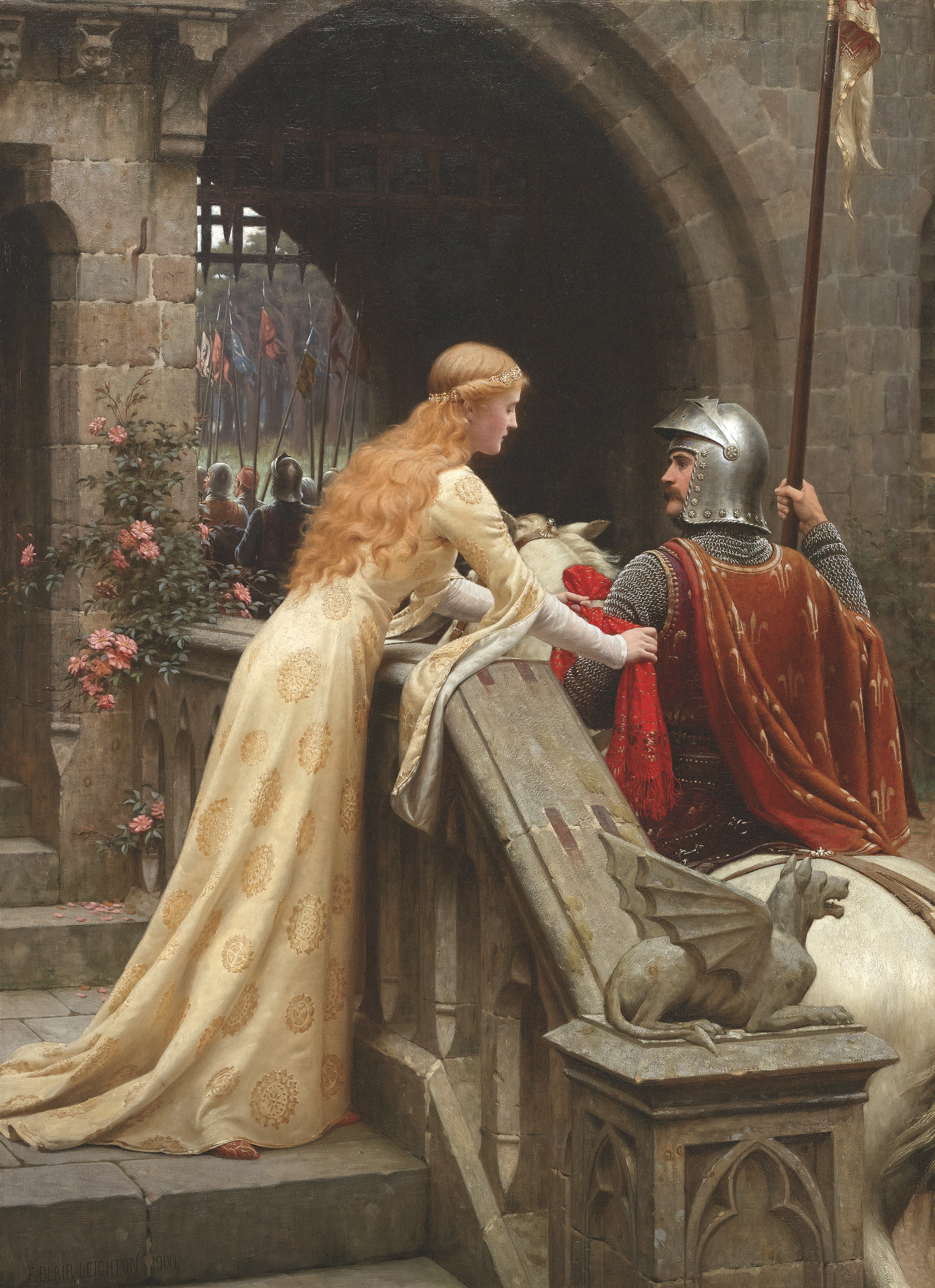
I think of young men like 19-year-old Roland Leighton, the poet and fiancée of Vera Brittain, who died of wounds on the Western Front.

"Goodnight, though life and all take flight, never goodbye..."
Inscription on the grave of Roland Leighton, the 19-year-old English poet.


God grant them all eternal rest...


In Flanders Fields
by Lt Col John McCrae, May 1915

In Flanders fields the poppies blow
Between the crosses, row on row,
That mark our place; and in the sky
The larks, still bravely singing, fly
Scarce heard amid the guns below.

We are the Dead. Short days ago
We lived, felt dawn, saw sunset glow,
Loved and were loved, and now we lie
In Flanders fields.

Take up our quarrel with the foe:
To you from failing hands we throw
The torch; be yours to hold it high.
If ye break faith with us who die
We shall not sleep, though poppies grow
In Flanders fields.


At a Calvary near the Ancre
by Wilfred Owen

One ever hangs where shelled roads part.
In this war He too lost a limb,
But His disciples hide apart;
And now the Soldiers bear with Him.

Near Golgotha strolls many a priest,
And in their faces there is pride
That they were flesh-marked by the Beast
By whom the gentle Christ's denied.

The scribes on all the people shove
And bawl allegiance to the state,
But they who love the greater love
Lay down their life; they do not hate.


Let us remember, too, the men of the Burma Star Association who fought - and especially those who died - in the great Burma campaign in the 14th Army - the "forgotten army" - against the savage power of the Japanese Imperial Army.


"When You Go Home, Tell Them Of Us And Say,
For Their Tomorrow, We Gave Our Today"

(John Maxwell Edmonds (1875 -1958), 1916)


The Kohima memorial


St Martin of Tours, pray for all our brave boys who gave their lives...

Their name, indeed, liveth for evermore...


+