Sunday, 12 September 2010

Holy Name of Mary, the Battle of Vienna and the real significance of 9/11

After the loss of the Holy Land, the Eastern Roman Empire and control of the Mediterranean, Christendom was in constant danger of being overwhelmed by the Muslim Ottoman Turks and the Protestant Reformation further weakened the defences.

Moreover, Catholic Christendom was fighting, now, on two fronts against both Muslim and Protestant and might, at any time, be swept away altogether.

Particular determination, tenacity and courage were now needed more than ever from the defenders of Christendom.

Fortunately, courage was not lacking.

In September 1529, after defeating the Hungarians at the Battle of Mohacs, the Ottoman Turks and their allies laid siege to Vienna – the famous Siege of Vienna of 1529. After a tremendous struggle the Austrians, under the 70-year-old Count Nicholas von Salm, were finally victorious, although Salm himself was killed during the siege.

On 7 October 1571, the Ottoman Turks had seized the opportunity to launch a vast fleet to conquer as much of Christendom as they could conquer. Almost miraculously, they were defeated at the Battle of Lepanto by the combined Christian fleets under the command of Grand Admiral Don John of Austria, the illegitimate son of the Roman Emperor, Charles V.

To these were added the prayers of Christendom since the pope, St Pius V, had ordered a Christendom-wide Rosary prayer campaign for victory.

Moreover, a copy of the miraculous image of our Lady of Guadalupe sat in the cabin of Don John throughout the battle. The victory of Lepanto was commemorated by a new Feast, that of our Lady of Victory (or Victories) which was later made universal and later still re-named the Feast of our Lady of the Rosary.

In 1716, Clement XI inscribed the Feast of our Lady of the Holy Rosary on the universal calendar in gratitude for the victory gained by Prince Eugene of Savoy, commander of the Imperial forces of the Habsburg Roman Emperor, on 5 August at Peterwardein in Vojvodina, in Serbia.

Later, however, on 11 September 1683 – 9/11 no less – came the Battle of Vienna of 1683, when King Jan (John) III Sobieski of Poland-Lithuania, also accompanied by Christendom-wide praying of the Rosary, delivered Vienna and Christendom once again from the Muslim Ottoman Turks and protected the Holy Roman Empire of Emperor Leopold I from imminent destruction.
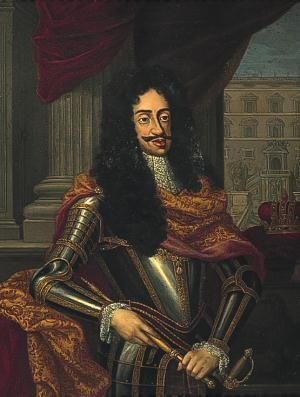

Emperor Leopold I, Holy Roman Emperor at the Battle of Vienna


After the victory of Sobieski over the Turks, Venerable Pope Innocent XI, extended the Feast of the Holy Name of Mary to the whole Church to be celebrated on 12 September in memory of the deliverance of Christendom. The feast was extended to the universal Church and assigned to the Sunday after the Nativity of Mary by a Decree of 25 November 1683, or, if that was not possible, then it had to be kept on 12 September.

12 September had also been the day of the Battle of Muret 1213, when Count Simon de Montfort (father of the founder of the English parliament) and 700 knights had defeated the Albigensian army of some 50,000, whilst St Dominic and his friars were praying the Rosary in the church of Muret.

But 9/11 was the day that the battles began in each case.

The Battle of Vienna took place on 11 September and 12 September 12, 1683 after Vienna had been besieged by the Ottoman Empire for two months. The battle broke the advance of the Ottoman Empire into Europe, and marked the political hegemony of the Habsburg dynasty and the beginning of the end of the Ottoman Muslim Empire.The battle was won by Polish-Austrian-German forces led by King Jan against the Ottoman Empire army commanded by Grand Vizier Merzifonlu Kara Mustafa Pasha.


King Jan III Sobieski of Poland -Lithuania


The siege itself began on 14 July 1683 with an the Ottoman Empire army of approximately 138,000 men. The decisive battle took place on 12 September, after the united relief army of 70,000 men had arrived, pitted against the Ottoman army.

The battle marked the turning point in the 300-year struggle between Roman Christendom and the Ottoman Empire.
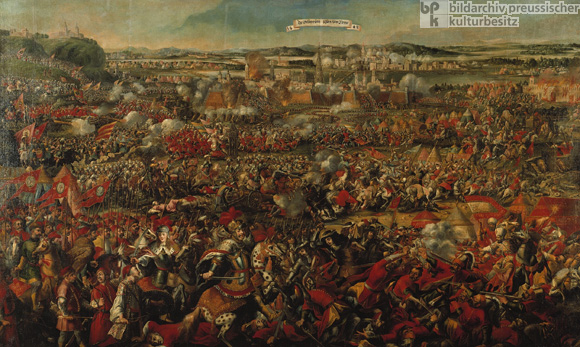

The siege before the Battle of Vienna (1683)


The capture of the city of Vienna had long been a strategic aspiration of the Ottoman Empire.

The Ottoman Empire had even been providing military assistance to dissident Hungarians and to anti-Catholic minorities in Habsburg-occupied portions of Hungary. There, in the years preceding the siege, widespread unrest had become open rebellion upon Leopold I's pursuit of Catholic Counter-Reformation principles.

King Jan Sobieski salutes the Roman Emperor Leopold I


In 1681, Protestants and other anti-Habsburg forces, led by Imre Thököly, were reinforced with a significant force from the Ottoman Muslims, who recognized Imre as King of "Upper Hungary". This support went so far as explicitly promising the "Kingdom of Vienna" to the disloyal and treacherous Hungarians if it fell into Ottoman hands.

In 1681 and 1682, clashes between the forces of Imre Thököly and the Habsburgs' military frontier forces intensified, which was used as a casus belli by Grand Vizier Kara Mustafa Pasha in convincing the Sultan Mehmet IV and his Divan, to allow the movement of the Ottoman Army. Mehmet IV authorized Kara Mustafa Pasha to operate as far as Győr and Komarom castles, both in northwestern Hungary, and to besiege them. The Ottoman Army was mobilized on 21 January 1682, and war was declared on 6 August 1682.

Sultan Mehmet IV


The wording of this declaration left no room for doubt what would be in store after a Turkish success. Mehmet IV wrote to Leopold I thus, verbatim:

"We order You to await Us in Your residence city of Vienna so that We can decapitate you... (...) We will exterminate You and all Your followers... (...) Children and adults will be equally exposed to the most atrocious tortures before being finished off in the most ignominious way imaginable..."

During the winter, the Habsburgs and Poland concluded a treaty in which Leopold would support Sobieski if the Turks attacked Kraków; in return, the Polish Army would come to the relief of Vienna, if attacked.

The King of Poland prepared a relief expedition to Vienna during the summer of 1683, honouring his obligations to the treaty. He went so far as to leave his own nation virtually undefended when departing from Kraków on 15 August, the Feast of the Assumption of our Lady. Sobieski covered this with a stern warning to Imre Thököly, the rebellious Hungarian Protestant leader, whom he threatened with severity if he tried to take advantage of the situation — which, nevertheless, the treacherous Thököly did.

The main Turkish army finally invested Vienna on 14 July. Count Ernst Rüdiger von Starhemberg, leader of the remaining 11,000 troops and 5,000 citizens and volunteers, refused to capitulate.

Count Ernst Rudiger von Starhemberg, commander of the Vienna garrison


The Turks dug tunnels under the massive city walls to blow them up with explosives, using sapping mines.

The Ottoman siege cut virtually every means of food supply into Vienna, and the garrison and civilian volunteers suffered extreme casualties. Fatigue became such a problem that Count von Starhemberg ordered any soldier found asleep on watch to be shot. Increasingly desperate, the forces holding Vienna were on their last legs when in August, Imperial forces under Charles, Duke of Lorraine, beat Imre Thököly of Hungary at Bisamberg, 5km northeast of Vienna.

On 6 September, the Poles crossed the Danube 30km north west of Vienna at Tulln, to unite with the Imperial forces and additional troops from Saxony, Bavaria, Baden, Franconia and Swabia who had answered the call for a Holy League that was supported by Pope Innocent XI.

The devious King Louis XIV of France declined to help and instead used the opportunity to attack cities in Alsace and other parts of southern Germany. Anyone who thinks Louis XIV a good Catholic king really needs to think again.

During early September, the experienced 5,000 Turkish sappers repeatedly blew up large portions of the walls, the Burg bastion, the Löbel bastion and the Burg ravelin in between, creating gaps of about 12m in width. The Austrians tried to counter by digging their own tunnels, to intercept the depositing of large amounts of gunpowder in subterranean caverns. The Turks finally managed to occupy the Burg ravelin and the Nieder wall in that area on 8 September. Anticipating a breach in the city walls, the remaining Austrians prepared to fight in Vienna itself.

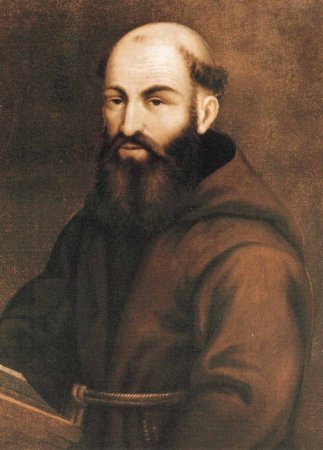
The relief army had to act quickly to save the city from the Turks and to prevent another long siege in case they would take it. Despite the international composition of the Army and the short time of only six days in which to organise, an effective leadership structure was established. This was largely the work of the extraordinary and holy Austrian Chaplain-General, Blessed Marco d'Aviano, Emperor Leopold's privy counsellor.

Blessed Marco d'Aviano, OFMCap, Imperial Chaplain-General


The Holy League forces arrived on the Kahlenberg (bare hill) above Vienna, signalling their arrival with bonfires. In the early morning hours of 12 September, before the battle, King Jan served a Solemn High Mass.

While the Turks hastily finished their mining work and sealed the tunnel to make the explosion more effective, the Austrian "moles" detected the cavern in the afternoon and one brave man entered and defused the mines just in time.

At the same time, the Polish infantry had launched a massive assault upon the Turkish right flank.

After 12 hours of fighting, Sobieski's Polish force held the high ground on the right. At about 5pm, after watching the ongoing infantry battle from the hills for the whole day, four cavalry groups, one of them Austrian-German, and the other three Polish, totalling 20,000 men, charged down the hills. The attack was led by the Polish king himself in front of a spearhead of 3000 heavily wing-armoured Polish lancer-hussars. This charge thoroughly broke the lines of the Ottoman troops. Seizing the initiative, Starhemberg led the Vienna garrison in sallying out of its defences to join the assault.
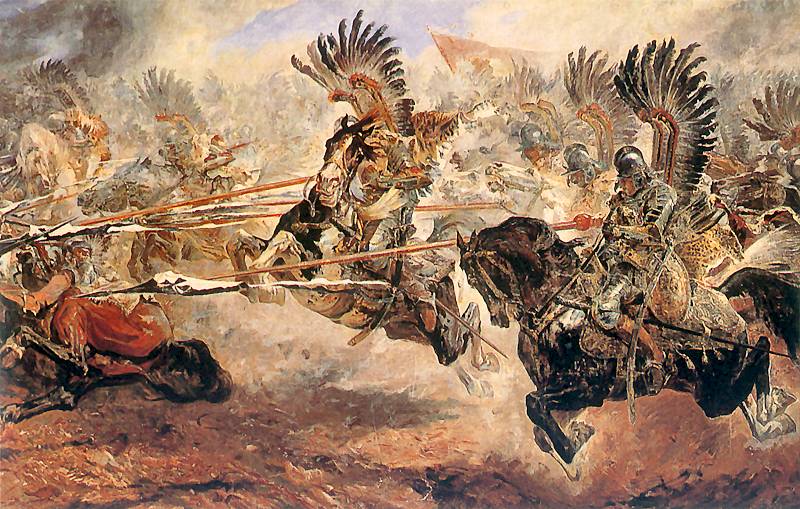
The massive charge of the Polish winged lancer-hussars which terrified the Ottoman troops and decided the Battle of Vienna. The wings made a terrifying sound as the Polish hussars came charging down the mountainside.


In less than three hours after the cavalry attack, the Christian Imperial forces had won the battle, saved Vienna from capture and rescued Christendom from the Turks.

One may recall the decisive charge of the Rohirrim from Tolkien's Lord of the Rings, to get a flavour of what it must have been like, King Jan Sobieski leading his Polish hussars just as King Theoden led his Riders of Rohan.

After the battle, Sobieski paraphrased Julius Caesar's famous quote by saying "veni, vidi, Deus vicit" - "I came, I saw, God conquered".

King Jan Sobieski receives the standards of the fallen Turks

The Turks lost about 15,000 men in the fighting, compared to approximately 4,000 for the Habsburg-Polish forces. Though routed and in full retreat, the Turkish troops had found time to slaughter all their Austrian prisoners, with the exception of those few of nobility which they took with them for ransoming.

King Jan vividly described events in a letter to his wife a few days after the battle:

“Ours are treasures unheard of ... tents, sheep, cattle and no small number of camels ... it is victory as nobody ever knew of, the enemy now completely ruined, everything lost for them. They must run for their sheer lives ... Commander Starhemberg hugged and kissed me and called me his saviour.”

The victory at Vienna set the stage for Prince Eugene of Savoy's reconquest of Hungary and the Balkans within the following years.

Long before that, the Turkish Sultan had disposed of his defeated commander. On 25 December 1683, Kara Mustafa Pasha was executed in Belgrade.

However, it was the end for the Ottoman Empire. The Ottomans fought on for another 16 years but lost control of Hungary and Transylvania and capitulated finally by the Treaty of Karlowitz.

Christendom was once again safe.

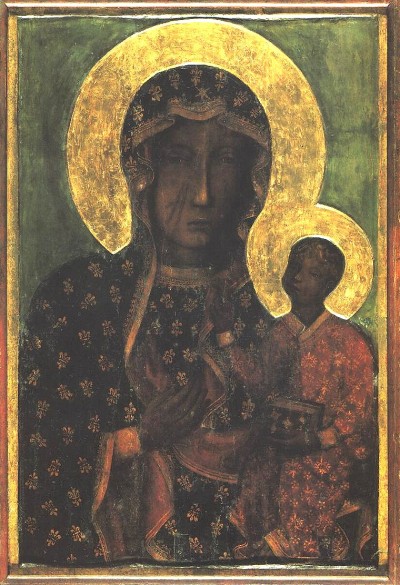
Because Sobieski had entrusted his kingdom to the protection of the our Lady of Czestochowa before the battle, Blessed Pope Innocent XI commemorated his victory by extending the feast of the Holy Name of Mary to the universal Church.


The croissants signify the Turkish crescent


The Battle of Vienna was marked by culinary inventions:

1. The croissant was invented in Vienna to celebrate the defeat as a reference to the crescents on the Turkish flags.

2. The bagel was made as a gift to King Jan Sobieski to commemorate the victory, being fashioned in the form of a stirrup, to commemorate the victorious charge by the Polish cavalry.

3. After the battle, the Austrians discovered many bags of coffee in the abandoned Turkish encampment. Using this captured stock, Franciszek Jerzy Kulczycki opened the third coffee house in Europe and the first in Vienna, where, Kulczycki and Marco d'Aviano adding milk and honey to sweeten the bitter coffee, thereby invented the cappuccino, so named after Blessed Marco because of the Capuchin’s brown hood.

Our Lady of Czestochowa, pray for us!
Blessed Marco d'Aviano, pray for us!
Holy Name of Mary, protect us!

...

Our Lady's Nativity and the Great Siege of Malta of 1565: "Victoria Day" of the Knights of Malta

8 September is the Feast of our Lady's nativity but it is also Victoria Day for the Knights of Malta, the day when, with our Lady's help, they defeated the Ottoman Turkish invasion of their home and headquarters on the island of Malta.

8 September is also "Malta Day" for the same reason.

The Knights Hospitaller (also known as the Sovereign Order of Saint John of Jerusalem, of Rhodes and of Malta; the Knights of Malta; the Knights of Rhodes; and Les Chevaliers de Malte) is an organization that began as an Amalfitan hospital founded in Jerusalem in 1080 to provide care for poor and sick pilgrims to the Holy Land.

After the conquest of Jerusalem in 1099 during the First Crusade it became a religious/military order under its own charter, and was charged with the care and defence of pilgrims to the Holy Land.

Following the loss of Christian territory in the Holy Land, the Order operated from Rhodes, over which it was sovereign, and later from Malta under the grand magistry of the renowned religious, soldier and defender of Malta from the Turks, Prince and Grand Master Jean Parisot de la Valette, after whom Valetta in Malta is named.

After the loss of the Holy Land and years of moving from place to place in Europe, the Knights were established on Malta in 1530, when the Holy Roman Emperor, Charles V, as King of Sicily, gave them Malta, Gozo and the North African port of Tripoli in perpetual fiefdom in exchange for an annual fee of a single Maltese falcon, which they were to send on All Souls Day to the Viceroy of Sicily, who acted as the King's representative. (This historical fact was used in Dashiell Hammett's famous book The Maltese Falcon).

It was from here that the Hospitallers continued their actions against the marauding Muslims and especially the savage Barbary pirates.

The Muslim Ottomans were less than happy to see the Order resettled, even though they had only a small number of ships.

Accordingly, Sultan Suleiman the Magnificent assembled another massive invasion force in order to dislodge the Knights from Malta, and in 1565 invaded, starting the Great Siege of Malta.This siege proved one of the great victories of history for an undermanned and vastly outnumbered defence force, numbering some 700 knights and about 8000 soldiers defeated a far greater Ottoman invasion force.

At first the battle looked to be a repeat of the earlier defeat of the Knights at Rhodes. Most of the cities were destroyed and about half the Knights died in battle. On 18 August the position of the besieged was becoming desperate: dwindling daily in numbers, they were becoming too feeble to hold the long line of fortifications. But when his council suggested the abandonment of Il Borgo and Senglea and withdrawal to Fort St Angelo, Grand Master La Valette remained fiercely obdurate.

The Viceroy of Sicily had not brought help. Possibly the orders of his master, King Philip II of Spain, were so obscurely worded as to put on his own shoulders the burden of a decision – a responsibility which he was unwilling to discharge because defeat would mean exposing Sicily to the Turks.


Sultan Suleiman the Magnificent, the Turkish sovereign


Whatever may have been the cause of his delay, the Viceroy hesitated until the indignation of his own officers forced him to move, and then the battle had almost been won by the unaided efforts of the Knights.

On 23 August came yet another grand assault, the last serious effort, as it proved, of the besiegers. It was thrown back with the greatest difficulty, even the wounded taking part in the defence. The plight of the Turkish forces, however, was now desperate. With the exception of Fort St Elmo, the fortifications were still intact. Working night and day, the garrison had repaired the breaches, and the capture of Malta seemed more and more impossible. The terrible summer months had laid many of the troops low with sickness in their crowded quarters. Ammunition and food were beginning to run short, and the Turkish troops were becoming more and more dispirited at the failure of their numerous attacks and the unending toll of lives.

The death of Dragut, a corsair and admiral of the Ottoman fleet and skilled commander, on 23 June, had proved an incalculable loss. The Turkish commanders, Piyale Pasha and Mustafa Pasha, took few precautions, and, though they had a huge fleet, they never used it with any effect except on one solitary occasion. They neglected their communications with the African coast and made no attempt to watch and intercept Sicilian reinforcements.

On 1 September they made their last effort, but all threats and cajoleries had little effect on dispirited Turkish troops, who refused any longer to believe in the possibility of capturing those terrible fortresses. The feebleness of the attack was a great encouragement to the besieged, who now began to see hopes of deliverance. Perplexity and indecision of the Turks were cut short by the news of the arrival of Sicilian reinforcements in Mellieħa Bay. Unaware of the small size of this new force, they hastily evacuated and sailed away on 8 September, the Feast of the Nativity of the Blessed Virgin, ever after celebrated by the Order of Malta as "Victoria Day".

At the moment of the Turkish departure the Order had left to it only 600 men capable of bearing arms, but the losses of the Ottomans had been yet more fearful. The most reliable estimate puts the number of the Turkish army at its height at some 40,000 men, of which but 15,000 returned to Constantinople. The siege is portrayed vividly in the frescoes of Matteo Perez d'Aleccio in the Hall of St Michael and St George, also known as the Throne Room, in the Grand Master's Palace in Valletta. Four of the original modellos, painted in oils by Perez d'Aleccio between 1576 and 1581, can be found in the Cube Room of the Queen's House at Greenwich, London. After the siege a new city had to be built – the present city of Valletta, so named in memory of the Grand Master who had sustained this siege.


Fort Sant' Angelo, seen from Valetta, with Birgu in the background, where the battle was nearly lost but then, with extraordinary courage, finally won


In 1607, the Head of the Order, the Grand Master, was granted the rank of Reichsfürst (Prince of the Holy Roman Empire).

In 1630 the Grand Master was awarded ecclesiastic equality with the Cardinals and the uniquely hybrid style "His Most Eminent Highness", reflecting both the qualities of ruling temporal prince and religious, on the one hand, and cardinal prince of the Church, on the other, expresses his dignity well.

Following the Christian victory over the Ottoman fleet in the Battle of Lepanto in 1571, the Knights continued to defend Christendom from Barbary pirates and Muslim raiders and the Turks began to think again of trying to invade Christendom by land.

The Patron Saint of the Order is our Lady of Philermo whose image was first acquired when the Knights were still settled on the island of Rhodes. The icon, depicted below, is ancient and famous.


Our Lady of Philermo, pray for us!

...

Wednesday, 1 September 2010

On the Queen's constitutional powers: replying to Fr Francis Marsden

I received the following post from Fr Francis Marsden, esteemed columnist in The Catholic Times of Britain and a learned theologian and scholar.

I think it is worth re-printing and then answering, partly for the debate and partly for the eminence of its author.

I have answered all other correspondents in the combox section of my last post and those wishing to read those answers can find them there.

Here is what Fr Marsden says regarding the Queen’s Royal Assent and the Abortion Act 1967:

Dear Tribunus,

Maybe she didn't have the power to veto it, but she could have still refused to sign, because signing it was a form of cooperation in grave evil, and a betrayal of the rights of her unborn subjects.

If the Abortion Act would still have gone through without her signature, then she need not have signed. She could have explained that she was not trying to usurp any power which she did not enjoy constitutionally, but that she wasn't prepared to go against her own conscience.

Her signature gave the impression that she supported this law. Any prosecutions under this law or its predecessors would have been in the form: Regina v. N. giving the impression that the Queen supported whatever law was in force.

King Baudouin of the Belgians showed far more integrity when he resigned from the monarchy for a day, rather than play any part in an abominable law.

I don't think your argument holds water. This was one case where a Christian monarch could have registered a protest. Maybe it wouldn't have made a lot of difference at the time, but it would be something forever remembered.

“To veto” is not the same as “not to sign”. You are equating the two.

best wishes
Fr Francis Marsden
Chorley, Lancs


And here is my response:

Dear Father Francis,

Unfortunately, you have either not read my previous post or else you have read it too cursorily and so not understood it.

It is curious how many people, on this subject, think themselves experts in British Constitutional law even when they are not lawyers and have never even studied the subject. Sometimes they even claim to know better than constitutional lawyers.

This is, first, an issue of British Constitutional law since we must first know what powers the Queen has before we can call her immoral for not using them. It is a commonplace of moral theology that one cannot commit sin by failing to exercise a power one does not have.

As a matter of constitutional law, the Queen does not have the right or the power to veto any Bills passed by both Houses of Parliament except, by constitutional convention, in a constitutional crisis.

Constitutional conventions are binding constitutional customs and, as St Thomas himself wrote, “custom has the force of law, abolishes law, and is the interpreter of law” (ST I- II, q. 97, a. 3).

Indeed, our Constitution, being unwritten, is made up almost entirely of conventions. That the Queen has no power meaningfully and genuinely to refuse assent (save in constitutional crisis) is affirmed by the principal authorities on constitutional conventions such as the bible of Parliamentary practice and law, Erskine May on Parliamentary Practice.

I provided other authorities. Did you trouble to read them?

Who are you to say that such authorities are wrong?

If they are right, then the Queen does not have the power that you censure her so severely for not using.

How can you censure someone for not using a power they do not have?

Nevertheless, you do – unfairly, unjustly and unreasonably.

Moreover, if the Queen were to attempt to give herself such a veto power, as you claim she ought, then what she would be doing is seizing power.

To seize power is a form of coup d’etat and is immoral.

You know – or ought to know – that one cannot do evil that good may come of it, no matter how great the good. St Paul says so in Rom 3:8. The end does not justify the means.

You thus chastise and rebuke the Queen for not doing evil that good may come. In short, you rebuke the Queen for not sinning.

That is the reductio ad absurdam of your argument.

You are thus quite wrong – as a matter of constitutional law – to say:

- She co-operated in a grave evil.

No she did not.

On the contrary, she played no morally significant part. If she had tried to play a morally significant part, by trying to veto the Bill, she would have sinned by her illegal and immoral attempted seizure of power.

- She went against her own conscience.

No, she did not.

She would have acted against her conscience if she had tried, illegally, to seize power to veto the Bill, which power she does not have any right to.

- She could have explained that she was not trying to usurp any power which she did not enjoy constitutionally.

No, she could not.

In trying to exercise a power to refuse assent, she would be trying to seize and exercise a power that she did not have. That would not have stopped the Bill but would certainly have created a constitutional crisis through an attempted, illegal seizure of power, disturbing the whole constitution for no good purpose and doing so by an immoral and illegal seizure of power.

- Her notional assent gave the impression that she supported this law.

No, it did not.

Her assent is a formality save in a constitutional crisis and thus is not a moral act. No-one can rightly blame the Queen for the Abortion Act. The blame lies with the democratically elected Members of Parliament who voted for the Bill and with those who elected them.

- Any prosecutions under this law or its predecessors give the impression that the Queen supported whatever law was in force.

No, it does not.

Prosecutions in the USA are styled “The People v X”.

Does that mean that all the people necessarily approve the law by which X is prosecuted? No, of course not.

Likewise the Queen does not have to approve, personally, all prosecutions that are styled “Regina v X” or “The Queen v X”.

This is merely a device of constitutional law similar to other devices cited by Blackstone in his Commentaries such as e.g. the Queen never dies, the Queen can do no wrong, the Queen is legally ubiquitous and so on. These are constitutional devices and refer to the Crown in its office and not in the personal capacity of the person holding the office.

I recommend reading Newman’s wonderful satire of a Russian revolutionary who read Blackstone and failed to understand it. It is in the first chapter of his Present Position of Catholics.

You are in danger of making the same comic mistake as the Russian in Newman’s satire.

- King Baudouin of the Belgians showed more integrity.

No, he did not.

He did what he was permitted under the Belgian Constitution. The Queen is not so permitted and does not have the same power. King Baudouin himself recognised this. There is no “integrity” in immorally seizing power.

- This was one case where a Christian monarch could have registered a protest.

No, it is not.

This would certainly not have been, as you term it, a mere “protest” but rather an attempted seizure of power which is both illegal and immoral because one may not do evil that good may come.

- “To veto” is not the same as “not to sign”.

No, that is wrong.

As a matter of constitutional law, to attempt to refuse assent would be the same as attempting to veto. Even if the attempted veto were non-effective in stopping the Bill, it would nevertheless be very effective in creating the very sort of constitutional crisis which the veto power of the Crown is designed to prevent.

It is ridiculous to rebuke someone for not exercising a power to create the very evil the power is designed to prevent.

You might as well blame the Pope for not attempting to start a Crusade against Afghanistan’s Taliban.

He has no practical power so to do and if he were to try he would be doing grave evil in trying to usurp a power he no longer, in practical terms, has.

It would be sin to rebuke him for not so doing, just as it is a sin to rebuke the Queen for not usurping to herself a power that the Crown no longer has.

Thus, you can see, my dear Father, that it is your argument which does not hold water.

I hope you will pray for the Queen and pray for reparation for any time that you have unjustly attacked her good name in connection with the Abortion Act or any other legislation which you might have wrongly blamed her for not vetoing.

Put the blame where it belongs: with those members of Parliament who voted in such legislation and those who voted for them.

Do not blame the innocent.

Best wishes,
Tribunus.


St Thomas Aquinas was a great promoter of constitutional convention and custom and wrote that "custom hath the force of law, abolishes law and is the interpreter of law".


...

Saturday, 31 July 2010

No - the Queen did not have power to veto the Abortion Act 1967

The Queen had no power to veto the Abortion Bill 1967.

Her vetoing power, by refusing royal assent, is only permitted by law in the rarest of circumstances such as a constitutional crisis.

It is true that the Queen meticulously keeps up with the business of Parliament so that, in theory, if there ever were a constitutional crisis, she would be ready and properly advised to act, if necessary.

The Queen usually signs Letters Patent which allow the Speakers of the two Houses to announce the royal assent. However, she signs them for a whole lot of bills in one go, and is only given a list of the names of the Bills, not the texts or even the long titles.

She thus does not know the details of the Bills she is "assenting" to and is not expected to. That is because the process of assent, save in the rarest of situations such as a constitutional crisis, is now not much more than a ceremonial ritual.

The Queen is not even given a copy of the Bills and neither is the Palace. That is not just because she knows that both Houses of Parliament will already have considered the Bill very carefully but rather because she has no power to veto any of the Bills, save in constitutional emergency.


Sir Thomas Erskine May, 1st Baron Farnborough, the original author of Parliamentary Practice


The proper constitutional authorities are the courts and Parliament and the authoritative text is Erskine May's Parliamentary Practice.

The procedure is set out here:

http://www.publications.parliament.uk/pa/ld/ldcomp/ldctso56.htm


and here

http://www.francisbennion.com/word/fb/1981/1981-011-royal-assent-procedure.doc

You will see that Francis Bennion describes the most common procedure (i.e. by notification under the Royal Assent Act 1967) at page 5 of 11. The Queen signs a general assent for a whole series of Bills at one time.

But says, Bennion:

"It is a striking illustration of the extent to which Royal Assent has become a mere formality that Her Majesty does not have before her the texts, or even the long titles, of the Bills to which she signifies assent. Indeed these are not even communicated to officials of the Queen's Household (colloquially known as the Palace)".


Bennion also confirms what is now the law:

"There is no power to withhold a Bill from Assent, whether on the instructions of the Government or anyone else.{See Erskine May Parliamentary Practice (19th edn.) p. 562: "from that sanction they cannot be legally withheld"}. Nor, under the modern constitutional convention, may the Queen refuse Assent. {The last time Assent was refused was by Queen Anne in 1707, in relation to a Scottish militia Bill (Lords' Journals (1705 1709) p.506).}...One of the strengths of Britain's unwritten constitution is the reserve power it contains. In a near revolutionary situation the occasion might still arise for the withholding of Royal Assent, if only by way of delaying tactics". [emphasis added]

Thus, in a dire emergency, the Queen's reserve power to refuse assent is permitted by law to save the Constitution and country and in a few other very rare situations, but not otherwise.


Professor Vernon Bogdanor, leading constitutional expert from Oxford University


Professor Vernon Bogdanor's, The Monarchy and the Constitution, 1995, pp 131-132, gives an interesting insight into the discussions regarding the Home Rule Bill which King George V was very much opposed to:

"There is, then, no doubt that the king believed that he could veto legislation, and that he contemplated doing so in the case of Home Rule...the first parliamentary counsel, Sir Granville Ram...cited Dicey, who had declared of the refusal of assent: ‘Its repose may be the preservation of its existence, and its existence may be the means of saving the Constitution itself on an occasion worthy of bringing it forth’. The Home Rule crisis of 1914 proved that the sovereign retained the prerogative of veto, and that this prerogative might come into play on extreme occasions." [emphasis added]

The position adumbrated by Dicey is more or less the position today, as the authorities like Erskine May and Francis Bennion QC state.

We might call this "Dicey's exception".


Albert Venn Dicey (1835-1922)
was a leading constitutional lawyer
and Vinerian Professor of English Law at Oxford University from 1882 to 1909


Now, if the Queen were to refuse letters patent then she would be attempting to usurp to herself the power to veto a Bill - a power which the law and Constitution do not allow her.

And attempting to usurp or seize power unlawfully is a sin and we may not do evil that good may come of it, as St Paul teaches us (Rom 3:8), no matter how great the intended good may be.

It is not simply a matter of the Queen refusing to obey an unjust law. It is far more.

Any attempt by her to veto a Bill would be an attempted seizure of power by the Monarch, like the US President giving himself power to sack pro-abortion US Justices, a power he does not have under the US Constitution.

Once the US Senate confirms the nomination of a US Justice by an affirmative vote, the President must prepare and sign a commission, and have the Seal of the Department of Justice affixed to the document before the new justice can take office (see 5 USC § 2902).

The seniority of an Associate Justice is based on the date of commissioning, not the date of confirmation or swearing-in (see 28 USC § 4).

No-one would ever realistically suggest that the US President should refuse to sign the commission for any duly confirmed Justice, break the law, breach the Constitution which he is pledged to defend, and seize powers that he does not have (a coup d'etat), on the entirely spurious basis that he, the President, is morally compelled to do so in the name of over-turning Roe v Wade, the US Supreme Court decision that liberalised abortion law in the USA, and to stage a revolution in the name of the pro-life cause.


The US Supreme Court


Revolution in the name of the pro-life, or any just, cause cannot be justified, and the whole weight of Catholic tradition and teaching on the subject is against it.

The position is summarised by St Thomas in De Regimine Principum, Ch. 6, 45-52, when he writes of the opinion that the unjust ruler may be overthrown by private force:

"But this opinion is not in accord with apostolic teaching, for Peter [1 Pet 2:18-19] admonishes us to be reverently subject to our masters, not only the good and gentle but also the froward...to proceed against the cruelty of tyrants is an action to be undertaken not through the private presumption of a few..."


Revolution and revolt against legitimate authority is never permissible and always wrong


In the British Constitution the true sovereign power lies with Parliament.

Even though the Queen is called the Sovereign, in truth, most of the time, she isn't, save for Dicey's exception.

To attempt to give herself the sovereign power to veto a Bill would be the act of a private citizen, Elizabeth Windsor-Mountbatten, attempting to seize power and overthrow the sovereign power of Parliament.

That would be the sin condemned by St Peter and St Thomas and one may not sin in order to achieve good, as St Paul teaches (Rom 3:8).

We should blame the real villains for the Abortion Act 1967: the politicians, not the Queen!


St Thomas Aquinas, jurist, philosopher, theologian, scholar, saint and Doctor of the Roman Catholic Church


...

Thursday, 29 July 2010

Mr Southwood (who he?) goes blah...

Some person called "Southwood" has bust a gut because I pointed out that it was the Protestant areas of Germany that voted for Hitler and not the Catholic areas and that it was the Protestant "German Christian" movement and the Protestant Reich Bishop, Ludwig Muller, who supported Hitler and not the Roman Catholic Church.

The German Catholic bishops condemned Nazism time and again.

Mr Southwood can't face this.

The truth upsets him.

Where does Mr Southwood get his information?

You guessed it folks - from books that are written by anti-Catholics and fanatics.

But just to give you a flavour of where Mr Southwood is coming from, here are some of his views:

- the SS were Roman Catholics (yep, really!);

- Hitler, Himmler, Goebbels, Heydrich, Hess were all fully paid-up, practising and devout Roman Catholics, apparently (hmm, excuse me, Mr Himmler, I don't think I saw you at mass last Sunday...oh, I see, you were in the garden worshipping Wotan, were you? That famous Christian god....).

- Not one Protestant nation became Nazi (err, right, Germany would be a Catholic nation, then, would it? Tell that to Martin Luther!).

- Do not include Germany because it was "in the hands of the RCs" (oh, right. So anything bad is, by definition, RC, is it? Even when it isn't? Oh, of course, logical, logical...)

- But this was because "Lutheranism in Germany was an apostate body in large part" (oh, well then of course it must have been RC, by definition - see above: everything bad = RC.)

- Austria was a Fascist nation under Dollfuss (oh, right. Err... then why did the Nazis murder him, I wonder...?)

- Cornwell says that Pius XII was "Hitler's Pope" so therefore he must have been (no possibility that Cornwell was wrong, of course. But hang on...Cornwell was brought up RC, wasn't he? So he must be bad and so cannot be believed, right? Oh, I see. RCs who agree with Mr Southwood are OK but not those that don't? Yes, of course, logical, logical...)

- Serbs were massacred in RC Croatia (but let's just forget about Croats murdered by Orthodox Serbs. That would be inconvenient to our thesis that only RCs are the bad guys).

And so on and so on, with more ill-informed bigotry.


Norweigan Nazi collaborationist Minister-President, Vidkun Quisling, was the son of a Protestant pastor


Where, one might suppose, does Vidkun Quisling fit into this picture, the son of a Protestant pastor of the Lutheran evangelical Church of Norway. Quisling, who had been awarded the CBE by the (Protestant) British government became an ardent friend of the Nazis and served as Minister-President of the Norweigan collaborationist government.

Whoops.

And what about Martin Luther himself, that great Protestant anti-semite?


Martin Luther, founder of Protestantism and author of On the Jews and their Lies (1543)


Well, make up your own mind, folks.

Here are extracts from the works of the founder of Protestantism about the Jews in a book called On the Jews and their Lies of 1543:

"[they are a] base, whoring people, that is, no people of God, and their boast of lineage, circumcision, and law must be accounted as filth."

"[they are] full of the devil's faeces ... which they wallow in like swine"

"[the synagogue is an] incorrigible whore and an evil slut".


He argued that their synagogues and schools be set on fire, their prayer books destroyed, rabbis forbidden to preach, homes razed, and property and money confiscated. They should be shown no mercy or kindness, afforded no legal protection, and these "poisonous envenomed worms" should be drafted into forced labor or expelled for all time. He also seems to advocate their murder, writing "[w]e are at fault in not slaying them".

Paul Johnson writes:

"Luther was not content with verbal abuse. Even before he wrote his anti-Semitic pamphlet, he got Jews expelled from Saxony in 1537, and in the 1540s he drove them from many German towns; he tried unsuccessfully to get the elector to expel them from Brandenburg in 1543".
(A History of the Jews p. 242)

Well, Mr Southwood, bang goes your theory about the virtuous Protestants who were not Fascist or anti-semitic, eh?


...

Saturday, 17 July 2010

What have you been saying, homophobic-wise, sir?

Welcome to modern Britain.

The story about a Christian Street preacher, Mr Dale Mcalpine, who was arrested for saying "Homosexuality is a sin" is a reflection of the current obsession by police and officialdom with the murky concept of "hate crime".

In fact, there is no such thing as "hate crime" in English law. It is not a phrase that is used by the law.

The actual facts of the arrest of Dale Mcalpine were recorded on video and make disturbing viewing.

Among the the first words of the police when they arrive is:

"Hello sir. What have you been saying, homophobic wise ?"

This is barely English, let alone a question that can be answered by someone about to be arrested. Matters got worse:

"McAlpine: I spoke to your officer earlier and he was upset that I was saying homosexuality was a sin – which is what the Bible says. And I affirm that’s what I say because that’s in the Bible. And there’s no law, there’s no law…

Policeman: Well there is.

McAlpine: No there isn’t.

Policeman: There is. Unfortunately, mate, it’s a breach of Section 5 of the Public Order Act"

Well, actually, constable, it is just isn't and you are an ignoramus for knowing so little about the law that you were claiming to arrest someone for!

And to cap it all the arresting officer actually arrests him for a "racially aggravated public order offence". Yep - racially aggravated!

Doh!

You just can't make this stuff up!


Nevertheless, Dale Mcalpine was arrested, taken to a police station, made to give his DNA and fingerprints and eventually charged.

What then happened?

Err...well.... all the charges were dropped.

Straight away.

Like that.

Poof - gone - out the door.

Why?

Once the facts of the case were examined by Crown Prosecutors, lawyers and police officers who were capable of using more than one brain cell at a time, it became blatantly obvious that there was no such law as the heavy-handed officers of the law had falsely claimed.

How could this be contrary to section 5 of the Public Order Act? It has never been any part of the Public Order Act to decide what is or is not "a sin" and it is not illegal to say that any form of behaviour is "a sin".

So - were the 3 police officers and 2 PCSOs involved in this situation just plain stupid or is there a problem with the wording of the law itself?

Section 5 actually reads as follows:

"Public Order Act 1986, s. 5 Harassment, alarm and distress

(1) A person is guilty of an offence if he–

(a) uses threatening, abusive or insulting words or behaviour, or disorderly behaviour, or
(b) displays any writing, sign or other visible representation which is threatening, abusive or insulting,

within the hearing or sight of a person likely to be caused harassment, alarm or distress thereby.

(2) An offence under this section may be committed in a public or a private place, except that no offence is committed where the words or behaviour are used, or the writing, sign or other visible representation is displayed, by a person inside a dwelling and the other person is also inside that or another dwelling.

(3) It is a defence for the accused to prove–
(a) that he had no reason to believe that there was any person within hearing or sight who was likely to be caused harassment, alarm or distress, or
(b) that he was inside a dwelling and had no reason to believe that the words or behaviour used, or the writing, sign or other visible representation displayed, would be heard or seen by a person outside that or any other dwelling, or
(c) that his conduct was reasonable.

...

S6(4)Mental element: miscellaneous)

A person is guilty of an offence under section 5 only if he intends his words or behaviour, or the writing, sign or other visible representation, to be threatening, abusive or insulting, or is aware that it may be threatening, abusive or insulting or (as the case may be) he intends his behaviour to be or is aware that it may be disorderly"

Sothe Police had to decide that Mr Mcalpine was using "threatening, abusive or insulting words" when he said that "homosexuality was a sin".


There is no legal definition of "threatening, abusive or insulting" and the words are to be taken in their normal and natural meaning.

Clearly, the phrase "homosexuality is a sin" is not "threatening", nor "abusive".

Someone might, conceivably, consider it "insulting". But should it be an offence to use words that are merely subjectively insulting?

Where does that end?

If an MP attacks another MP over his policies is that now an offence?


The question has but to be stated for its answer to be obvious. Of course, it cannot and should not be criminal. In fact, it is simply not criminal. The police officers were simply off on a crazy frolic of their own.

The proper view must be that the words "threatening, abusive or insulting" ought to be taken together, that Mr Mcalpine could not be said to have caused "alarm, harassment or distress" and/or his conduct was perfectly reasonable (per s.5(3)(c)).

Doubtless, the CPS came to their conclusion for these or similar reasons and the charges had to be dropped.

Did anyone apologise to Mr Mcalpine? I doubt it!

There have been numerous similar incidents of police over-reaction to complaints of Homophobia, Islamaphobia, racism etc and the reason for this is the abysmally low standard of training of police officers regarding the dubious concept of "hate crime".

Common sense and the right to freedom of speech seem to have been left on the shelf at the police station.

Now view the video and see what I mean. The uniformed official grinning vacantly in the background is apparently the PCSO (Police Community Support Officer) who had actually called the police to report Mr Mcalpine for "Homophobia" (which is not an offence known to the law).


With thanks and acknowledgments to Neil Addison (barrister) at http://religionlaw.blogspot.com/2010/05/what-have-you-been-saying-homophobic.html

Tuesday, 22 June 2010

SS. John Fisher and Thomas More

St John Fisher was Cardinal, Bishop of Rochester, and one of our most glorious martyrs.

He was born at Beverley, Yorkshire, England, 1459 and died 22 June, 1535.

Here, indeed, was a most doughty Yorkshireman.

John was educated at Michaelhouse, Cambridge. He took the degree of BA in 1487, and MA in 1491, in which year he was elected a fellow of his college, and was made Vicar of Northallerton, Yorkshire.

In 1494 he resigned his benefice to become proctor of his university, and three years later was appointed Master of Michaelhouse, about which date he became chaplain and confessor to Margaret Beaufort, Countess of Richmond and Derby, mother of King Henry VII. In 1501 he received the degree of DD, and was elected Vice-Chancellor of Cambridge University.

Under Fisher's guidance, Lady Margaret founded St John's and Christ's Colleges at Cambridge, and also the two "Lady Margaret" professorships of divinity at Oxford and Cambridge respectively, Fisher himself being the first occupant of the Cambridge chair.

By Bull dated 14 October, 1504, Fisher was advanced to the Bishopric of Rochester, and in the same year was elected Chancellor of Cambridge University, to which post he was re-elected annually for ten years and then appointed for life.

At this date also he is said to have acted as tutor to Prince Henry, afterwards King Henry VIII. As a preacher his reputation was so great that in 1509, when King Henry VII and the Lady Margaret died, Fisher was appointed to preach the funeral oration on both occasions; these sermons are still extant.

In 1542 Fisher was nominated as one of the English representatives at the Fifth Council of Lateran, then sitting, but his journey to Rome was postponed, and finally abandoned.

Besides his share in the Lady Margaret's foundations, Fisher gave further proof of his genuine zeal for learning by inducing Erasmus to visit Cambridge. The latter indeed (Epist., 6:2) attributes it to Fisher's protection that the study of Greek was allowed to proceed at Cambridge without the active molestation that it encountered at Oxford.


Margaret Beaufort, Countess of Richmond and mother of King Henry VII


He has also been named, though without any real proof, as the true author of the royal treatise against Luther entitled Assertio Septem Sacramentorum, published in 1521, which won the title Fidei Defensor for Henry VIII.

Before this date Fisher had denounced various abuses in the Church, urging the need of disciplinary reforms, and in this year he preached at St Paul's Cross on the occasion when Luther's books were publicly burned.

When the question of Henry's divorce from Queen Catherine arose, Fisher became the Queen's chief supporter and most trusted counsellor.

In this capacity he appeared on the Queen's behalf in the legates' court, where he startled his hearers by the directness of his language and most of all by declaring that, like St John the Baptist, he was ready to die on behalf of the indissolubility of marriage.

This statement was reported to Henry VIII, who was so enraged by it that he himself composed a long Latin address to the legates in answer to the bishop's speech. Fisher's copy of this still exists, with his manuscript annotations in the margin which show how little he feared the royal anger.


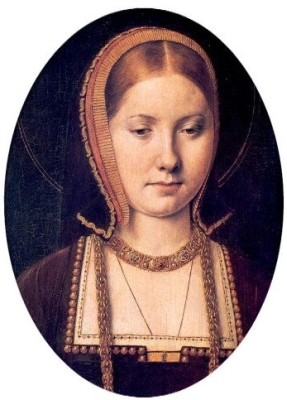
Catherine of Aragon, the true Queen of England and wife of King Henry VIII, championed by St John Fisher


The removal of the cause to Rome brought Fisher's personal share therein to an end, but the king never forgave him for what he had done. In November, 1529, the "Long Parliament" of Henry's reign began its series of encroachments on the Church.

Fisher, as a member of the upper house, at once warned Parliament that such acts could only end in the utter destruction of the Church in England. On this the Commons, through their speaker, complained to the king that the bishop had disparaged Parliament. Dr Gairdner (Lollardy and the Reformation, I, 442) says of this incident "it can hardly be a matter of doubt that this strange remonstrance was prompted by the king himself, and partly for personal uses of his own".

The opportunity was not lost. Henry summoned Fisher before him, demanding an explanation. This being given, Henry declared himself satisfied, leaving it to the Commons to declare that the explanation was inadequate, so that he appeared as a magnanimous sovereign, instead of Fisher's enemy.

A year later (1530) the continued encroachments on the Church moved the Bishops of Rochester, Bath, and Ely to appeal to the Apostolic see. This gave the king his opportunity. An edict forbidding such appeals was immediately issued, and the three bishops were arrested.

Their imprisonment, however, can have lasted a few months only, for in February, 1531, Convocation met, and Fisher was present. This was the occasion when the clergy were forced, at a cost of 100,000 pounds, to purchase the king's pardon for having recognized Cardinal Wolsey's authority as legate of the pope; and at the same time to acknowledge Henry as Supreme Head of the Church in England, to which phrase, however, the addition "so far as God's law permits" was made, through Fisher's efforts.

A few days later, several of the bishop's servants were taken ill after eating some porridge served to the household, and two actually died. Popular opinion at the time regarded this as an attempt on the bishop's life, although he himself chanced not to have taken any of the poisoned food.


King Henry VIII, wife-murdering, saint-massacring, monastery-plundering and poor-oppressing destroyer of both Church and State for his own personal gain, his poisoned legacy endures even to this day


To disarm suspicion, the king not only expressed strong indignation at the crime, but caused a special Act of Parliament to be passed, whereby poisoning was to be accounted high treason, and the person guilty of it boiled to death. This sentence was actually carried out on the culprit, but it did not prevent what seems to have been a second attempt on Fisher's life soon afterwards.

Matters now moved rapidly. In May, 1532, Sir Thomas More resigned the chancellorship, and in June, Fisher preached publicly against the divorce.

In August, Warham, Archbishop of Canterbury, died, and Cranmer was at once nominated to the pope as his successor. In January, 1533, Henry secretly went through the form of marriage with Anne Boleyn; Cranmer's consecration took place in March of the same year, and, a week later, Fisher was arrested.

It seems fairly clear that the purpose of this arrest was to prevent his opposing the sentence of divorce which Cranmer pronounced in May, or the coronation of Anne Boleyn which followed on 1 June; for Fisher was set at liberty again within a fortnight of the latter event, no charge being made against him.

In the autumn of this year (1533), various arrests were made in connexion with the so-called revelations of the Holy Maid of Kent, but as Fisher was taken seriously ill in December, proceedings against him were postponed for a time.

In March, 1534, however, a special bill of attainder against the Bishop of Rochester and others for complicity in the matter of the Nun of Kent was introduced and passed. By this Fisher was condemned to forfeiture of all his personal estate and to be imprisoned during the king's pleasure. Subsequently a pardon was granted him on payment of a fine of 300 pounds.

In the same session of Parliament was passed the Act of Succession, by which all who should be called upon to do so were compelled to take an oath of succession, acknowledging the issue of Henry and Anne as legitimate heirs to the throne, under pain of being guilty of misprision of treason.

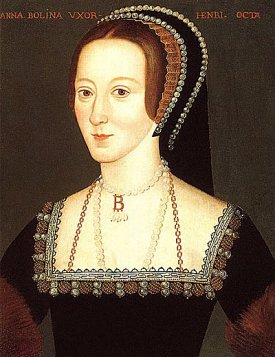
Anne Boleyn, the King's scheming mistress, was later Queen and thereafter beheaded, when Henry tired of her


Fisher refused the oath and was sent to the Tower of London, 26 April, 1534. Several efforts were made to induce him to submit, but without effect, and in November he was a second time attained of misprision of treason, his goods being forfeited as from 1 March preceding, and the See of Rochester being declared vacant as from 2 June following. A long letter exists, written from the Tower by the bishop to Thomas Cromwell, which records the severity of his confinement and the sufferings he endured.

In May, 1535, the new pope, Paul III, created Fisher Cardinal Priest of St Vitalis, his motive being apparently to induce Henry by this mark of esteem to treat the bishop less severely. The effect was precisely the reverse. Henry forbade the cardinal's hat to be brought into England, declaring that he would send the head to Rome instead.


St Thomas More, Lord Chancellor of England, later martyred for the Catholic faith


In June a special commission for Fisher's trial was issued, and on 17 June he was arraigned in Westminster Hall on a charge of treason, in that he denied the king to be supreme head of the Church. Since he had been deprived of his bishopric by the Act of Attainder, he was treated as a commoner, and tried by jury. He was declared guilty, and condemned to be hanged, drawn, and quartered at Tyburn, but the mode of execution was changed, and instead he was beheaded on Tower Hill.

The martyr's last moments were thoroughly in keeping with his previous life. He met death with a calm dignified courage which profoundly impressed all present.

His headless body was stripped and left on the scaffold till evening, when it was thrown naked into a grave in the churchyard of All Hallows, Barking. Thence it was removed a fortnight later and laid beside that of Sir Thomas More in the church of St Peter ad Vincula by the Tower. His head was stuck upon a pole on London Bridge, but its ruddy and lifelike appearance excited so much attention that, after a fortnight, it was thrown into the Thames, its place being taken by that of Sir Thomas More, whose martyrdom occurred on 6 July next following.

Amen, amen, I say: this truly was a great bishop, martyr and man, and one most worthy to be called a priest of the Holy Catholic Church.


St John Fisher, Cardinal of Rochester, pray for us!


...