Saturday, 17 October 2009

King George VI, the servant king and perhaps our best for 250 years

His Highness Prince Albert Frederick Arthur George of York (3 years later styled His Royal Highness after the 1898 letters patent of Queen Victoria) was born at Sandringham on 14 December 1895.

He died, on 6 February 1952, having ruled as King George VI of the United Kingdom and the British Dominions from 11 December 1936 until his death. He was the last Emperor of India (until 1947), the last King of Ireland (until 1949), and the first Head of the Commonwealth.

His family name of Wettin (or more fully Welf-Este-Wettin) was later changed to Windsor in view of the war with Germany. The Welf-Este family had ruled in Saxony and Bavaria and northern Italy. The Wettin family were their ancestors who had ruled Saxony.

The Hanover dynasty, from whom Queen Victoria descended, were Welf-Este and the Saxe-Coburg-Gotha dynasty, from whom Prince Albert, the Prince Consort of Queen Victoria, descended, were Wettin.

Interestingly, the Italian branch of the Welf family (the Guelphs) were the pro-papal party against the pro-imperial party, the Waiblingen, (the Ghibellines), during the investiture contest in the 11th century.

As the second son of King George V, Prince Albert ("Bertie") was not expected to inherit the throne and spent his early life in the shadow of his flamboyant elder brother, Edward, later King Edward VIII, and, later still, Duke of Windsor.

Prince Albert served in the Royal Navy during World War I, and fought at the Battle of Jutland, and after the war took on the usual round of public engagements. He married Lady Elizabeth Bowes-Lyon in 1923, daugher of the Earl of Strathmore and Kinghorne, and they had two daughters, Elizabeth (who succeeded him as Queen Elizabeth II) and Margaret.


The Duke and Duchess of York with their daughter, later Queen Elizabeth II


His elder brother ascended the throne as King Edward VIII on the death of their father in 1936. However, less than a year later Edward revealed his desire to marry the twice-divorced American socialite Wallis Simpson. The British Prime Minister, Stanley Baldwin, advised Edward that he could not marry Mrs Simpson and remain king, this being contrary to the teachings of the Church of which he was temporal head.

So, when Edward abdicated in order to marry, King George VI was crowned in his place and ascended the throne as the third monarch of the House of Windsor.


On the balcony of Buckingham Palace after the Coronation


Within twenty-four hours of his accession the Irish parliament, the Oireachtas, passed the External Relations Act, which essentially - and illegally - removed the power of the monarch in Ireland.

Further events greatly altered the position of the monarchy during his reign: three years after his accession, his realms, except Ireland, were at war with Nazi Germany and later with Italy and the Empire of Japan.

Though Britain and its allies were ultimately victorious, the United States and the Soviet Union rose as pre-eminent world powers and the British Empire declined. With the independence of India and Pakistan in 1947, and the foundation of the Republic of Ireland in 1949, George's reign saw the acceleration of the break-up of the Empire and its transition into the Commonwealth of Nations.

King George had been a sickly child and often suffered from ill health and was described as "easily frightened and somewhat prone to tears".


The young Duke and Duchess


His parents, the Duke and Duchess of York, were generally removed from their children's day-to-day upbringing, as was not uncommon in aristocratic families of that era. He was forced to write with his right hand although he was naturally left-handed, and developed a stammer that lasted for many years. He suffered from chronic stomach problems as well as knock knees, for which he was forced to wear painful corrective splints that kept him awake at night and often in tears of pain.

Queen Victoria died on 22 January 1901, and the Prince of Wales succeeded her as King Edward VII. The Duke of York became the new Prince of Wales. Prince Edward moved up to second in line to the throne, and Prince Albert was third.

From 1909, Albert attended the Royal Naval College, Osborne as a naval cadet. In 1911, he came bottom of the class in the final examination, but despite this he progressed to the Royal Naval College, Dartmouth. When Edward VII died in 1910, Albert's father became King George V. Prince Edward was created Prince of Wales, and Albert was second in line to the throne.


TRH Princes David (later King Edward VIII) and Albert (later King George VI) as Osborne naval cadets with their father, HRH the Duke of York (later King George V), and grandfather, HM King Edward VII


Albert was commissioned as a midshipman on 15 September 1913 and one year later began service in World War I. His fellow officers gave him the nickname "Mr Johnson".

He was mentioned in dispatches for his action as a turret officer aboard HMS Collingwood during the Battle of Jutland (31 May–1 June 1916), an indecisive action against the German navy which emerged as a strategic victory for the United Kingdom.

He did not see further action in the war, largely because of ill health caused by a duodenal ulcer.

In February 1918, he was appointed Officer in Charge of Boys at the Royal Naval Air Service's training establishment at Cranwell. With the establishment of the Royal Air Force two months later and the transfer of Cranwell from Navy to Air Force control, he transferred from the Royal Navy to the Royal Air Force.

He was appointed Officer Commanding Number 4 Squadron of the Boys' Wing at Cranwell and he remained there until August 1918. During the closing weeks of the war, Albert served on the staff of the Independent Air Force at its headquarters in Nancy. Following the disbanding of the Independent Air Force in November 1918, he remained on the continent as a staff officer with the Royal Air Force.

In October 1919, Albert went up to Trinity College, Cambridge where he studied history, economics and civics for a year.

On 4 June 1920, he was created Duke of York, Earl of Inverness and Baron Killarney. He then began to take on royal duties; he represented his father, the King, toured coal mines, factories, and railyards, and acquired the nickname of the "Industrial Prince".

But it was the Abdication crisis that changed his life forever for then Albert was to become King-Emperor, an appointment he dreaded and did not want. But he was the choice of Providence and he did his duty and was crowned in a glittering ceremony which can be seen in this clip shown in cinemas at the time:


His speech impediment, and his embarrassment over it, together with his tendency to shyness, caused him to appear much less impressive than his older brother, Edward. However, he was physically active and enjoyed playing tennis. He developed an interest in working conditions, and was President of the Industrial Welfare Society. His series of annual summer camps for boys between 1921 and 1939 brought together boys from different social backgrounds, from elite public schools like Eton and Harrow together with boys from slum schools and grammar schools.


The King and Queen with Mr MacKenzie-King, the Canadian Prime Minister


Because of his stammer, Albert dreaded public speaking. After his closing speech at the British Empire Exhibition at Wembley on 31 October 1925, which was an ordeal for both him and the listeners, he began to see Lionel Logue, an Australian-born speech therapist. The Duke and Logue practised breathing exercises, and the Duchess rehearsed with him patiently.

As a result of the training, the Duke's opening address at Australia's Federal Parliament at Canberra in 1927 went successfully, and he was able to speak subsequently with only a slight hesitation. Most famously, the King was able to give his famous broadcast near the beginning of the war - "the King's Speech" - and here it is:


"The King's Speech" - speech of King George VI near the start of World War II


Shortly before Albert became king, a position he was reluctant to accept, he went, the day before the abdication, to London to see his mother, Queen Mary. He wrote in his diary, "When I told her what had happened, I broke down and sobbed like a child".


The Coronation of King George VI


After war broke out in September 1939, George VI and his wife resolved to stay in London, despite German bombing raids. They officially stayed in Buckingham Palace throughout the war, although they usually spent nights at Windsor Castle.

The first German raid on London, on 7 September 1940, killed about one thousand civilians, mostly in the East End.

On 13 September, the King and Queen narrowly avoided death when two German bombs exploded in a courtyard at Buckingham Palace while they were there. In defiance, the Queen famously declared: "I am glad we have been bombed. We can now look the East End in the face".
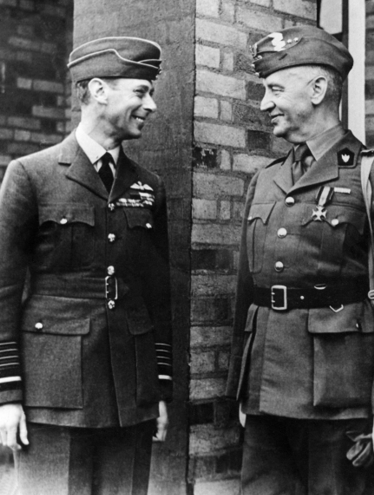
The King (left) with General Sikorski, the Polish Commander-in-Chief in World War II


The royal family shared the same dangers and deprivations as the rest of the country. They were subject to rationing restrictions, and Eleanor Roosevelt, champagne-socialist wife of the US President, remarked on the rationed food served and the limited bathwater that was permitted during a stay at the unheated and boarded-up Palace. The White House, needless to say, was never bombed during the war. In August 1942, the King's brother, Prince George, Duke of Kent, was killed on active service.

Throughout the war, the King and Queen provided morale-boosting visits throughout the United Kingdom, visiting bomb sites and munitions factories, and (in the King's case) visiting military forces abroad. Their high public profile and apparently indefatigable determination secured their place as symbols of national resistance. In 1945, crowds shouted "We want the King!" in front of Buckingham Palace during the Victory in Europe Day celebrations. The King invited Churchill to appear with him on the balcony to public acclaim.

When he died in 1952, King George VI was one of the best beloved of British monarchs. He had become, rightly, a symbol of self-sacrifice and duty. His attitude to monarchy was that of a Christian king, namely that it was a role that should imitate Christ the King, the suffering servant king who sacrificed his own desires to serve his people.

Yes, it is true that King George VI was obliged to become a Freemason, as part of the usual British Protestant establishment ritual, but that was not where his heart was. His heart, a profoundly Christian heart, was with his people, his duty, the Empire, his family and, ultimately, with God.

It is true that he was not a Christian saint like St Edmund, St Edward of Mercia, St Edward the Confessor, St Oswald, St Osbert, St Kenelm and other British kings, but he was, nonetheless, a good, humble and devout man, a fine husband and father to his wife and children and a fatherly figure to his people. In short, he was a good model for Christian kings to follow.

May God give peace and eternal rest to the soul of our last King-Emperor and his wife, our last Queen-Empress!


...

Thursday, 8 October 2009

On a Christian gentleman

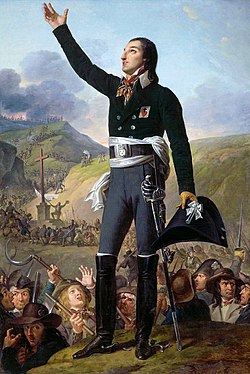
Here is a portrait of Charles Melchior Artus, the Marquess of Bonchamps, one of the gentlemen who led the uprising against the French Revolution in the name of the King of France.

He exemplified everything that was, and is, best in the Christian nobility of the old Catholic Kingdom of France.

The egalitarian modern world doesn't seem to have much use for gentility, still less Christian gentility.

Then, again, neither does it have much use for the ideas that engender Christian nobility and chivalry.

Jack's as good as his master and both of them are out to get what they can and the Devil take the hindmost.

That is the dog-eat-dog creed of the modern egalitarian world.

And what has it done for us?

It has ensured that the standards in society - at all levels - have taken a massive nose-dive into a slough of despond. Now the lowest common denominator rules and the worthless creed of Messrs Sell More, Swindle and Bolt is in the ascendancy.

Is that virtue? Is that the route to happiness? Has it made us happier?

Well, let's be frank. No.

When society recognized that the different classes were interdependent and mutually supporting, then charity and self-sacrifice were highly prized. A genuine equality of humanity was thereby encouraged rather than the spurious equality of egalitarianism which is no more than the grasping spirit of social Darwinism, the survival of the meanest and nastiest, and to hell with the weak and vulnerable. Some equality, that is!

But part of the problem is the failure by many to understand the relationship between the classes in society at its best. Successive generations of revolutionary writers and historians have so poured scorn on the values of former times that now no-one can remember what they even were, let alone understand or approve them.

The truth is that the proper relationship between the classes was one of mutual respect, understanding, obligation and charity.


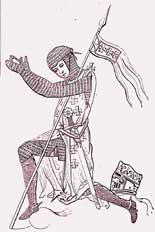
A medieval knight at prayer


This was because it had been shaped and formed by Christianity and the darkness of paganism had been set aside by the newer religion.

As it is written in Scripture:

"25 But Jesus called them to him, and said: You know that the princes of the Gentiles lord it over them; and they that are the greater, exercise power upon them.

26 It shall not be so among you: but whosoever will be the greater among you, let him be your minister: 27 And he that will be first among you, shall be your servant. 28 Even as the Son of man is not come to be ministered unto, but to minister, and to give his life a redemption for many".
[Matt 20:25-28]

"42 But Jesus calling them, saith to them: You know that they who seem to rule over the Gentiles, lord it over them: and their princes have power over them. 43 But it is not so among you: but whosoever will be greater, shall be your minister. 44 And whosoever will be first among you, shall be the servant of all. 45 For the Son of man also is not come to be ministered unto, but to minister, and to give his life a redemption for many".
[Mark 10:42-45]

"24 And there was also a strife amongst them, which of them should seem to be the greater. 25 And he said to them: The kings of the Gentiles lord it over them; and they that have power over them, are called beneficent.

26 But you not so: but he that is the greater among you, let him become as the younger; and he that is the leader, as he that serveth. 27 For which is greater, he that sitteth at table, or he that serveth? Is it not he that sitteth at table? But I am in the midst of you, as he that serveth".
[Luke 22:26-27]


In the Christian dispensation, the necessity of hierarchy was recognised but the master and the servant were both the servant of each other since, in the kingdom of heaven, the last was to be first and the first, last.

In the modern egalitarian world, hierarchy, being natural to man, still exists but it is not recognized and no man is willing to be the servant of another but only of himself. That is the best definition of Hell imaginable. No-one and nothing is superior, not the law, not the king, not morality and not even God. No man can appeal to a higher authority against the depredations of his neighbour. The rule of the majority is the end of all morality and might is right.

Kings and gentlemen are abolished but not only them. So, too, is the sturdy peasant and the working man.

All that is left is the amorphous, conscienceless, aimless, masses with no identity, no origin, no goal, no ideals and nothing to give but only to take.

And a bizarre, mocking caricature of the Christian gentlemen becomes the fashionable butt of every uncultured and semi-literate ignoramus of the age.

The true likeness of the Christian gentleman is forgotten.


Louis, Marquess of Lescure, another Vendean General, was worshipped by his troops who called him "the Saint of Poitou" for his virtue, his courage and his sanctity. He was killed by the revolutionaries in the Vendean war.


The true Christian gentleman is first and foremost a Christian. He lives by the code of chivalry:

He defends the Church; he defends and extends the bound of Christendom; he respects all weaknesses, and constitutes himself the defender of them, as he would of our Lord Himself; he defends the honour, name and virtue of all women and treats them with the greatest courtesy and forbearance as he would our Lady herself; he opposes those who oppose truth and justice and who oppress the poor and weak; he does not bear false witness and remains faithful to his pledged word; he is generous to all, and he is everywhere and always the champion of the Right and the Good against Injustice and Evil.

Of such is the "reactionary feudalism" so much hated by modern egalitarians who do not want to be bound by duty or honour but want to be "free" - but their freedom is only to exploit, cheat, lie and steal.

Historically, the reason why the Christian nobility were often in pursuit of the fox or the stag was because that way they learned the necessary arts which were preparatory for war, since it was their role, above all others, to be prepared to sacrifice themselves for the defence of Christendom in war.


The "unspeakable after the uneatable" or the Christian nobility keeping themselves in readiness for war to defend others?


That, too, is why they were permitted to bear arms and why they wore the noble "culotte" or knee-breeches. This enabled them to don the riding boot and be ready for war at short notice.

The sacrifice of the Christian leadership did not end there. They were also obliged to take on offices of state in their spare time and to ensure that all those under their care and responsibility, from the greatest to the least, were provided for and treated with justice and humanity.

That, too, is why they were permitted the ownership of estates and wealth - not so that they could give themselves up to selfish and self-indulgent pursuits like the billionaires of our grasping, egalitarian age, but so that they could use their wealth and bounty to serve those in need and to enable themselves to have sufficient leisure to be able to serve others whether privately or in public office.


The Knights Hospitaller of St John of Jerusalem drew from the ranks of the Christian nobility and epitomised the spirit of nobility by combining both the vocation of war with that of hospital service to "Our Lords" the sick-poor and, furthermore, took the 3 vows of religion in so doing


Public office in that understanding was regarded as a sacred trust to be exercised for the benefit of others and particularly the weak and vulnerable.

It was not like today when it is seen as a means of feathering one's own nest at public expense when public figures do not hesitate to use public funds to clean their moats and buy themselves bird houses and cheap mortgages.

Of course not all gentlemen in times past behaved as they should but then they were universally condemned as "cads", "bounders", "mountebanks" and so on.

Now they would be lauded as "clever", "astute", "shrewd" and "business-like" when, in reality, they should be regarded as cheats, liars and traitors.

That is why the gentleman preferred amateur status rather than professional status in matters sporting. Games were for healthy, competitive fun and not for turning over to a den of thieves bent only upon filthy lucre which is what games like football have now become.

The Christian gentleman should emulate the "verray parfit gentil knight" of Chaucer's Canterbury Tales and be men of honour, self-sacrifice and duty, scornful of moral weakness and self-indulgence and constantly aware of their duty to lead and to serve, to succour the weak and poor and to defend truth and justice.

The Christian nobility should witness to the true nobility and genius of Christianity. Antiquity of name, arms and family should not merely be an end in itself but should ever be an encouragement to greater and better deeds of charity, courage, heroism and self-sacrifice. The nobler the name, the nobler should be the deed and Christian gentlemen should vie with one another to outdo each other in virtue.


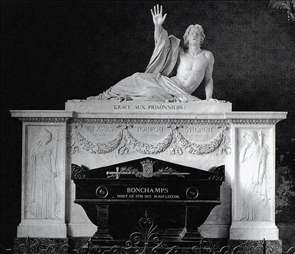
Pierre Jean David's famous statue of the dying Bonchamps - "Mercy to the prisoners!"


Few have reached the heights of nobility and self-sacrifice of Charles de Bonchamps, the noble Commander-in-Chief of the Royal and Catholic Grand Army of the Vendee. Beloved of his peasants, he led them, at their insistence, against the foul, murderous, egalitarian French Revolutionary regime.

When he lay mortally wounded and filled with horror at a plan of some of his men to set fire to a building filled with revolutionary soldiers who had murdered women and children, he commanded that they be spared.

He called to his officers to see that they were all saved, demanding that they prevent any such acts of murder: "It would be a horror. I forbid it. This is my last command! See that it is obeyed!".

And then the great and noble leader of the Vendeans himself died the noble death of a soldier who has done his duty.

One of the revolutionary soldiers spared was the father of the sculptor, Pierre Jean David, who, though an enemy of Bonchamps, later, in gratitude, carved a famous monument to the Vendean General, with the inscription:


"Grace aux prisonniers! Bonchamps l'ordonne!"

"Mercy to the prisoners! Bonchamps orders it!"

A more noble epitaph could hardly be imagined.


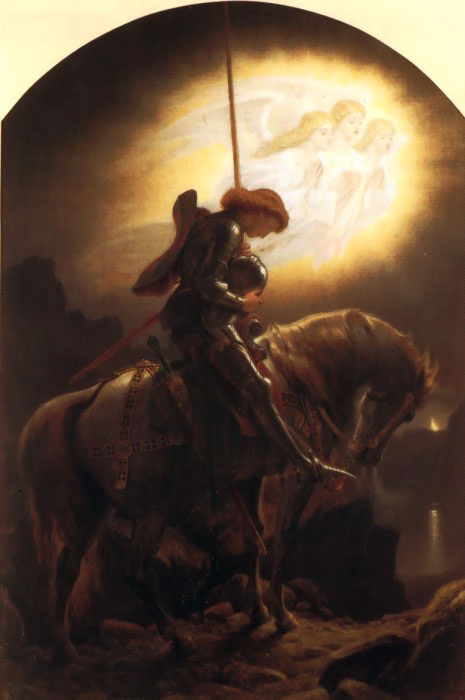
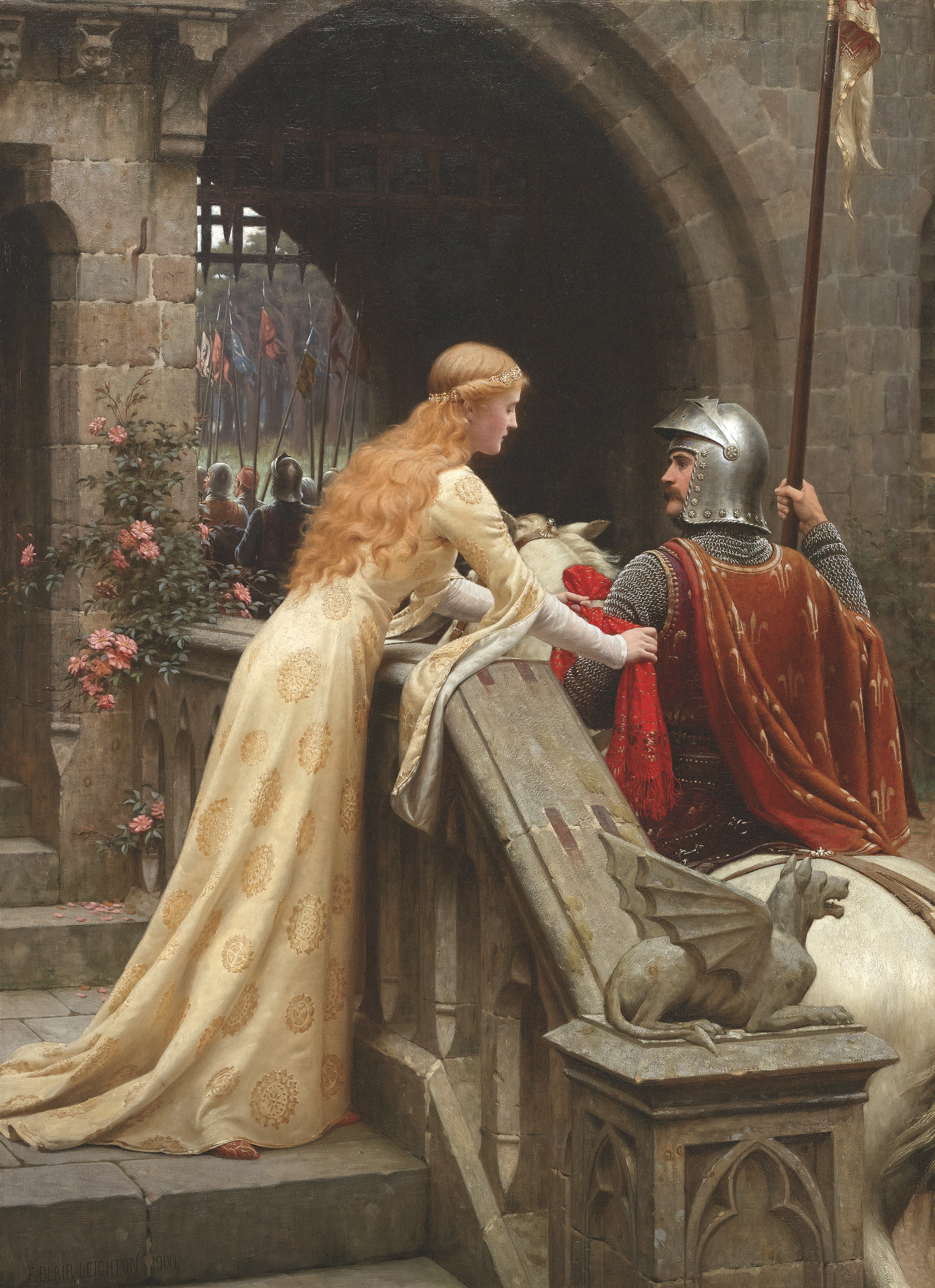
Sir Galahad, the perfect knight of Arthurian legend


...

Wednesday, 7 October 2009

7 October: The Feast of Our Lady of the Holy Rosary

The Feast of our Lady of the Most Holy Rosary is a title of the Blessed Virgin Mary as the Queen of the Holy Rosary, the chaplet of prayer beads that are used to invoke the Virgin to aid us whilst meditating upon scenes in the life of her Son, JESUS CHRIST.

The Rosary developed out of the habit of lay brothers, who did the manual work and did not have time to pray the whole Monastic Office, of praying Paternosters and Ave Marias in monasteries. This habit then passed to the devout laity.

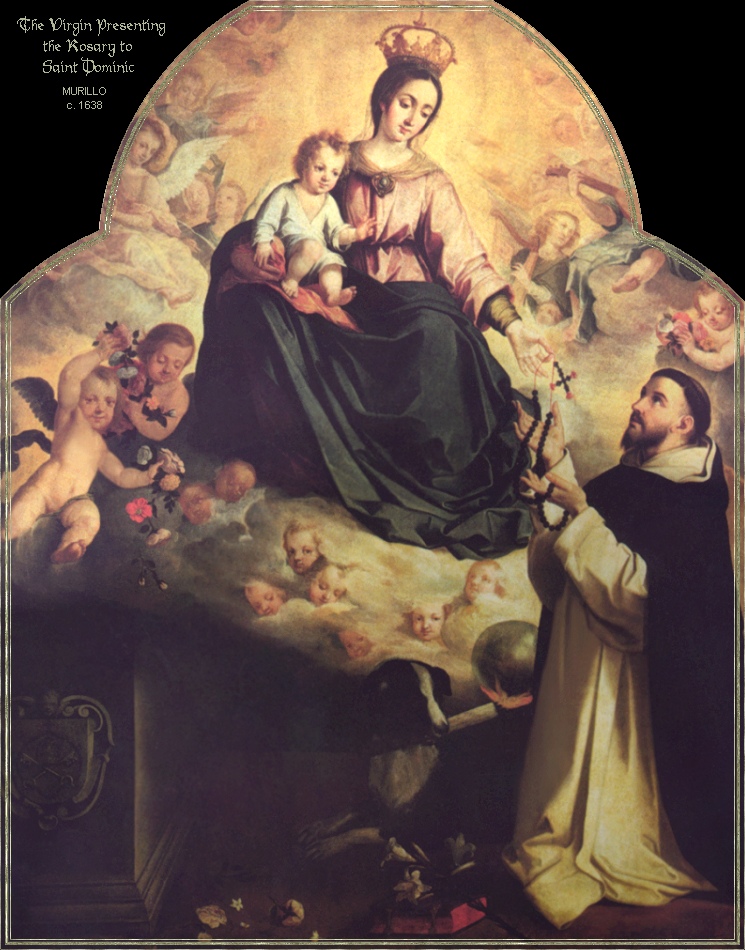
In 1208 our Lady appeared to St Dominic in the Church of Prouille, France, and gave him a chaplet of beads representing roses commending to him the devotion which had spread among the Faithful of saying Paters and Aves whilst meditating upon the life of Christ.

St Dominic then gave the Rosary to all his Friars Preachers to use in their efforts to convert the heterodox Cathars in Southern France and to call upon our Lady to assist the soldiers of Count Simon de Montfort, 5th Earl of Leicester, father of the founder of the later English Parliament, to defend Christendom from the attacks by the armies of the heterodox Cathars and Albigensians.


St Dominic receives the Holy Rosary from our Lady


On 12 September 1213, whilst St Dominic and his brethren were praying in the Church at Muret in the South of France, Count Simon and 700 knights charged out of the town to meet an invading army of 50,000 marauding heterodox Albigensians who were set upon capturing the whose of Southern France for the Albigensian heresy.

The Albigensians were a type of Manichee and they believed in euthanasia, abortion and sodomy and opposed marriage and child-birth because they believed that all material things were evil and created by an evil force. They had one Sacrament which was called the consolamentum and consisted in euthanasia by either starvation or suffocation. They had murdered Catholic missionaries sent to preach to them and murdered bishops, priests and the Papal legate who was sent to negotiate with them.

Count Simon and his knights straight into the middle of their ranks and slew their leader King Pedro of Aragon, much to the chagrin of Count Simon who wanted to defeat him but not slay him. At this the Albigensian horde fell into disarray and were routed. Our Lady, Count Simon de Montfort and the Rosary saved the day.

Ever after, the Rosary became a great weapon of prayer against evil, and especially in time of battle.

In thanks for the victory of the Battle of Muret, Count Simon built the first shrine dedicated to Our Lady of Victory.

The Rosary was prayed in 1529 at the Siege of Vienna and a great victory won under Count Nicholas von Salm against the Ottoman Turks and their Sultan Suleiman the Magnificent.

In 1571 Pope St Pius V instituted the Feast of Our Lady of Victory as an annual feast to commemorate the victory of Lepanto, off the Greek coast, the huge naval battle won by the Christian navies against the navy of the invading Muslim Turkish hosts. The Turkish navies were many times larger than the Christian navies and had been bent upon conquering the whole of Christendom and enslaving all Christians.


Allegory of the Battle of Lepanto with our Lady and the saints interceding


The victory was attributed to our Lady, as a rosary procession took place on that day in St. Peter's Square in Rome for the success of the forces of the Holy League to hold back the Muslim forces from over-running Western Europe.

In 1573, Pope Gregory XIII changed the title of this feast-day to the Feast of the Holy Rosary. This feast was extended by Pope Clement XII to the whole of the Latin Rite, inserting it into the Roman Calendar in 1716, and assigning it to the first Sunday in October.


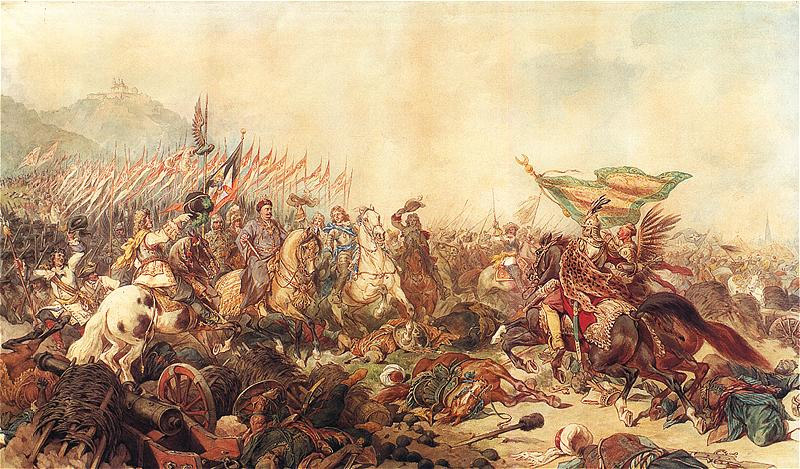
King Jan Sobieski and his army at the Battle of Vienna, 12 September 1683


On 12 September (that date again!) 1683, King Jan Sobieski, appointed commander by Roman Emperor Leopold I, and his Polish Hussars, inflicted a massive defeat upon the Turkish hosts in the Battle of Vienna. Again a Rosary campaign had preceded his victory.

Venerable Pope Innocent XI instituted the Feast of the Holy Name of Mary on 12 September to mark the victory obtained by praying to our Lady.


Kara Mustapha Pasha, the commander of the Turkish host, was unfairly executed by his own king, Sultan Mehmed II, after losing the Battle of Vienna


Pope St Pius X changed the date to 7 October in 1913, being the actual date of the great victory at Lepanto.

In 1969, Pope Paul VI changed the name of the feast to Our Lady of the Rosary.


Our Lady of the Most Holy Rosary, pray for us!


...

Sunday, 27 September 2009

The fast of the seventh month: Ember days and Yom Kippur, the day of atonement

This evening starts the day of atonement of the Jews, Yom Kippur.

This year, 2009, it virtually coincides with the Ember Days of September.

Ember Days are days of fasting and occur 4 times a year at Advent, Lent, Pentecost and the Exaltation of the Cross.

Even Dom Prosper Gueranger, the great liturgist of the Roman rite, speaks of them only in general terms as being days of fasting.

But they have a deeper significance still.

They are all liturgical days of ancient antiquity that remain from the days of the Jewish Temple worship.

The great Jewish feasts are continued in Leviticus 23.

Pesach or Passover, being the feast that our Lord transformed into the Mass on Maundy Thursday, of course, corresponds with our Easter Triduum. This feast also coincides with the Feast of Unleavened Bread, which lasts a week, and the Feast of the First Fruits.

Sha vu ot which is the Feast of Weeks or Pentecost, obviously corresponds to our Pentecost.

Sukkot which comprises the Feast of Trumpets (also Rosh Hashanah or Jewish New Year), the Day of Atonement, Yom Kippur, and the Feast of Tabernacles or Ingathering. This corresponds (usually) with the month of September in which often occurs the Jewish seventh month, that is Tishrei, and often coincides with the Ember Days of September.

New Year is the 1st day of Tishrei, Yom Kippur is the 10th day of Tishrei and the Feast of Tabernacles starts on the 15th day of Tishrei, when the fruits of the land are gathered in, and lasts 7 days beginning and ending with a Sabbath.

During those 7 days the Jews are required by the Law to live in tabernacles, or elaborate tents, so that "your posterity may know that I made the children of Israel to dwell in tabernacles, when I brought them out of the land of Egypt".


During Sukkot and following Yom Kippur, the day of atonement, the Jews are required to live in tabernacles for a week as a reminder of their exile from the land of Egypt. It is a wonderful tradition most worthy of preservation (and it has the added benefit of being exciting fun for the children!).


Of course, this is where we get our word "tabernacle" referring to the place wherein is kept the Blessed Sacrament over the High Altar in every Catholic Church.

The Jews believe (or are meant to believe) that the tabernacles also symbolised the dwellings of heaven. Thus the word "tabernacle" is all the more appropriate for use by the Church as the dwelling place of the Sacred Body and Blood of Christ, wherein the Lord of Heaven dwells here on the earth.

Here is a classic example of how the Ember Days retain crucial parts of the old Jewish Temple worship including the most sacred day of the year for Jews, Yom Kippur, the day of atonement.

The readings for the Ember Days are numerous but very fine because they retain those readings that relate to the old Jewish traditions and show the continuity with the Old Testament, show how our Lord fulfilled the Law and show how important it is to retain our ancient traditions in the Catholic Church.


The Ember Days celebrated at the traditional Benedictine Abbey of St Marie Madeleine at Le Barroux


It shows the hermeneutic of continuity from the time of Moses and Abraham to our Lord and on to our own day.

Where are the Ember Days in the new rite of Mass?

They probably remain as an option of some sort but let us face the truth with honesty and sincerity.

In the new rite the Ember Days simply are as good as never celebrated.

And yet the champions of the new rite assure us that the new rite has more of Scripture and the Old Testament in it!

Here are parts of the readings from Leviticus 23 which form the first 2 readings of Ember Saturday, yesterday:

"27 Upon the tenth day of this seventh month shall be the day of atonement, it shall be most solemn, and shall be called holy: and you shall afflict your souls on that day, and shall offer a holocaust to the Lord. 28 You shall do no servile work in the time of this day: because it is a day of propitiation, that the Lord your God may be merciful unto you. 29 Every soul that is not afflicted on this day, shall perish from among his people: 30 And every soul that shall do any work, the same will I destroy from among his people. 31 You shall do no work therefore on that day: it shall be an everlasting ordinance unto you in all your generations, and dwellings. 32 It is a sabbath of rest, and you shall afflict your souls beginning on the ninth day of the month: from evening until evening you shall celebrate your sabbaths".
[Lev. 23:27-32]


"39 So from the fifteenth day of the seventh month, when you shall have gathered in all the fruits of your land, you shall celebrate the feast of the Lord seven days: on the first day and the eighth shall be a sabbath, that is a day of rest. 40 And you shall take to you on the first day the fruits of the fairest tree, and branches of palm trees, and boughs of thick trees, and willows of the brook, and you shall rejoice before the Lord your God. 41 And you shall keep the solemnity thereof seven days in the year. It shall be an everlasting ordinance in your generations. In the seventh month shall you celebrate this feast. 42 And you shall dwell in bowers seven days: every one that is of the race of Israel, shall dwell in tabernacles: 43 That your posterity may know, that I made the children of Israel to dwell in tabernacles, when I brought them out of the land of Egypt. I am the Lord your God".
[Lev. 23:39-43]


Ivan Kramskoy, Christ in the Desert. The Tretyakov Gallery, Moscow. 1872.


...

Thursday, 24 September 2009

The sacred and the secular: the perfection of God's plan

A lengthy, slightly frustrating but ultimately useful discussion with a correspondent leads me to a few further random thoughts on the relationship between the lay and the clerical and, indeed, Church and State in a Catholic society.

This portrait of the Emperor Charles V recalls a time when all Christians understood the central importance of his role in Christendom as a model of the role of the laity.

At that time the Empire stretched across much of Europe and across the seas to the New World so that it was of this empire, before all others, that it was first said that the sun never set upon it.

Are the lay and clerical states a form of vocation?

Vocation means calling. God calls us to sanctity. The Catechism teaches:

"All the Faithful, whatever their condition or state... are called by the Lord to that perfection of sanctity...Charity is the soul of holiness to which all are called" [CCC#825-6].

The Catechism then quotes from St Therese of Lisieux, a Doctor of the Church, thus:

"Love, in fact, is the vocation which includes all others".


Clearly some do this better than others and some are called to a higher level than others, whether priest or lay.

Even more clearly, our Lady was called to that vocation, and fulfilled it, far more than any other creature, even including the Angels.

The fact that some have higher vocations than others does not mean that their higher vocation is somehow not a vocation.

Each is called but some are called to a higher level.


We should never suppose that it is only the most dignified and powerful offices in Church and State that represent the highest Christian vocation. Love is the highest Christian vocation. In the Kingdom of Heaven the least shall be the greatest and the last shall be first. Many a poor and humble wife and mother shall occupy a greater place in heaven than many a pope or emperor, priest or abbot. The more you commit yourself to, and so suffer for, your faith in this life, and the more you show humility, the greater shall you be in heaven. God has decreed it. God loves the humble but He resists the proud. Yet even the great and powerful can be humble, with God's help, just as many a poor person can become mortally proud if he or she spurns God's help.


That is clear from Sacred Scripture itself:

Multi autem sunt vocati, pauci vero electi [Matt 22:14]

and this:

Nisi unicuique sicut divisit Dominus unumquemque sicut vocavit Deus ita ambulet et sic in omnibus ecclesiis doceo[1 Cor 7:17].

Here is what the Catholic Encyclopaedia has to say on the subject:

"And in the celebrated passage 'every one hath his proper gift from God' (1 Corinthians 7:7) St Paul does not intend to indicate any particular profession as a gift of God, but he makes use of a general expression to imply that the unequal dispensation of graces explains the diversity of objects offered for our choice like the diversity of virtues. We agree with Liguori when he declares that whoever, being free from impediment and actuated by a right intention, is received by the superior is called to the religious life".

So - one is "called" to the religious life but "graces are dispensed unequally". Not everyone is offered ALL graces. God can choose Mary to be His mother and not Jane or Hannah.

And even if one is called, and answers, there are nonetheless wise virgins (i.e. good religious) and foolish virgins (i.e. bad religious) [Matt 25:1-11].

The wise ones will certainly be queens in heaven, although clearly not of the rank of our Lady.


The Wise Virgins


Scripture confirms that we shall have "crowns in heaven":

Bonum certamen certavi cursum consummavi fidem servavi; in reliquo reposita est mihi iustitiae corona quam reddet mihi Dominus in illa die iustus iudex non solum autem mihi sed et his qui diligunt adventum eius. [2 Tim 4:7-8].

Kings and queens have crowns. That is the origin of the meaning of the word.

Moreover, nuns are indeed mothers, too, understood spiritually, otherwise what would be the point of their being "Brides of Christ"?

Brides are married and married women have children. That's one of the purposes of marriage.

The spiritual motherhood of nuns is, in a spiritual and mystical sense, an imitation of the motherhood of Mary.

Any religious life, male or female, is, if fulfilled, higher by its nature than the life of a secular cleric.

If that were not so then one would have to ask why some clerics seek to enter religious life.

This is made clear by St Thomas in the Summa II-II, Art.184, Q.8 in which he poses the question:

"Whether parish priests and archdeacons are more perfect than religious?".


He replies:

"On the contrary, It is stated (
XIX, qu. ii, cap. Duce): 'If a man while governing the people in his church under the bishop and leading a secular life is inspired by the Holy Ghost to desire to work out his salvation in a monastery or under some canonical rule, since he is led by a private law, there is no reason why he should be constrained by a public law'. Now a man is not led by the law of the Holy Ghost, which is here called a 'private law', except to something more perfect. Therefore it would seem that religious are more perfect than archdeacons or parish priests".


St Thomas, the holy Count of Aquino, who became a Dominican friar and whom the Church regards as one of the greatest of all the Doctors of the Church


In De Perfectione Vitae Spiritualis St Thomas repeats this and goes into more detail.

Thus the "vocation" of an abbot, including one who is lay and not clerical, would, in principle, be higher than the vocation of a secular priest.

But what of the secular, unconsecrated lay vocation?

For this we must look back to the days when kings, queens, emperors and empresses were the leading lay figures in Catholic society.

The vocation of emperor or king - or equivalent lay leadership role in a Catholic society - is also a vocation but it is not a religious vocation. It is a very high and dignified lay calling but this must be distinguished, once again, from the vocation to perfection.

Our primary Christian vocation is to perfect sanctity (through faith, hope and charity, by grace). There are degrees of perfection, however. In heaven (if we get there!) we shall all be perfect (which means “complete”) but some will be more perfect than others (e.g. our Lady).

That kind of vocation is to be distinguished from the use of that word to signify a calling – by a worldly superior as much as by God – to an office of dignity and rule.

In that sense, save that it is a lay, not a clerical, role and therefore has not the Sacramental character, the vocation of emperor or king (or its equivalent) is one of dignity and power, temporally, just as the priestly role is, spiritually.

Thus, just as the office of pope is the highest dignity in the clerical vocation, so that of emperor is the highest dignity in the lay vocation.

There is some coalescence since the Pope clearly also has some temporal power and the Emperor always had some power over matters spiritual for example in the appointment of bishops and a power of veto over the election of a pope.

Interestingly, it has been the custom since early times for the Emperor to be made a cleric by the Pope - at first a sub-deacon but, from the time of Emperor Charles V, a deacon. Nevertheless, the role of Emperor was always regarded as a primarily lay role by the Church.

Similarly, since at least the time of barbarian invasions when the Roman imperial power had been eclipsed, the popes have also had temporal, secular power, first in the city of Rome (which, however, still technically remained the temporal seat of power of the emperors) and then, after the donations of Pepin and Charlemagne, over the Pontifical States in central Italy. Nevertheless, the role of the Pope is, as we know, a primarily spiritual role.

This kind of “vocation” is distinguished from that of the vocation to perfection but it is, nonetheless, a vocation since the office-holder is, indeed, called to it (by election) in each case.


Roman Emperor Francis I, Caesar Semper Augustus et Romanorum Imperator, who was elected Holy Roman Emperor because he had married the Empress Maria Theresa, is pictured here in the imperial cope, stole, alb, gloves and buskins, wearing the original Crown of Charlemagne and the imperial sword and holding the imperial sceptre, the imperial orb being seen on the nearby cushion. The solemnity and holiness of his role is made very clear by his sacred apparel. It is from the ceremonial of the coronation of the Holy Roman Emperor that all the ancient parts of the British coronation rite derive.


The role of emperor reflects the role of Christ the King which is one of the 3 roles of a Christian, they being Prophet (or teacher), Priest and King.

All of us, lay and clerical, must fulfil these roles.

We can do that as a layman (there is a priesthood of all the faithful which is wider than the ministerial priesthood) or as a cleric (a cleric chiefly rules spiritually but also has some temporal power which is a kingly role).

The Emperor symbolically exemplifies in his person, role and vocation the summit of the layman’s fulfilment of the role of Christ the King. He symbolises the Social Reign of Christ the King upon the earth.

The use of the word "vocation" has more than one sense. In the sense of a calling to perfection, the priesthood is not the highest vocation.

In the sense of a calling to an office, which connotes dignity and power, the priesthood is the higher but in a spiritual, rather than a temporal, sense.

However, the spiritual is higher than the temporal but here we speak generically.

Within each office there are higher and lower roles.


Pope St Pius X in the Papal Tiara


For the spiritual, the highest office is that of the Pope and for the temporal it is that of the Emperor. Each is the Vicar of Christ in his own sphere, spiritual and temporal.

The Pope is higher than the Emperor spiritually and vice-versa temporally.

However, since the spiritual is higher than the temporal, a papal excommunication, if just and right, ought to be obeyed above an imperial rescript.

However, if the papal injunction were unjust or trespassed unjustly upon the imperial power, then the imperial rescript, if just, was to be preferred.

Moreover, an illegal or immoral order of the Pope can justly be resisted, as Robert Grosseteste, Bishop of Lincoln, did - in the name of the Papacy and the proper use of papal power - when he refused a rich canonry in his Cathedral to the nephew of the reigning pope who had insisted on it out of nepotism.

Finally, a diagram might assist appreciation and understanding of the various roles in the Church:


LAY____________________CLERICAL


*
*
*
SECULAR


*
*
_______________________________________________________________
*
*

RELIGIOUS


*
*
*


Thus one can see that there are 2 separate axes forming a cross (appropriately): one axis is religious/secular and the other axis is lay/clerical.

One might be a secular cleric or a religious one. Equally one might be a religious layman or a secular layman. It was not just the lay brothers who were not clerics in a monastery. Traditionally, most choir monks were not priests or, often enough, even clerics.

Most people today are in the first quartile - the secular laity.

The idea that there must be a wall of separation between the secular laity, on the one hand, and the religious and clerical, on the other is as un-Catholic as a "wall of separation" between Church and State in a Catholic society.

But this has become common in our time.

The result is that it is a common occurrence for people to confuse the clerical with the religious and the lay with the secular whereas they are not the same at all.

Thus the expression "lay clerk", sometimes used to describe a layman acting in clerical roles like acolytes, is technically a misnomer. It is like saying something is both black and white at the same time. But it is an understandable misnomer.


Bartolome Esteban Murillo. The Assumption of the Virgin. 1670s.

The Blessed Virgin and Queen of Heaven fulfilled the highest vocation most fully and became, by God's power and grace, the highest of all creatures, higher even than the Angels themselves, the very Seraphim and Cherubim and certainly higher than any cleric, priest, archbishop, cardinal or pope. She is higher in heaven than the Apostles - higher than either St Peter or St Paul, and that by a very long way.

She is the most perfect of all models of the Christian life, followed some distance below, by those other laymen, her husband, St Joseph, and her cousin, St John the Baptist.

St John the Baptist came from the priestly line of Levi (his father, Zachary, being a priest of the Temple) but John himself was not a priest, either of the Old or the New Covenant.

St Joseph came of the line of Judah, the line of kings, and was, himself, tradition tells us, the true Prince of Judah and King of Israel, and his divine foster-Son was thus also, by inheritance and succession, the true King of the Jews, both in the flesh (through both His parents) and spiritually, as the Son of God.

The clericalists among us would do well to remember all of this!


...

Saturday, 19 September 2009

Jews and Christians: the untold story

A harmless but misguided individual calling himself "Anders" has written to this site surreptitiously seeking to get me to advertise his fanatical anti-Christian website which claims that the "Nazarite" sect and its leader, Ribi Yehosuah (guess who that is folks!), were really only another Judaic sect and those who "pretend" that he started a new sect are going to Hell with their apostate errors.

Nice, try, Anders but - as per usual for your type of false and black propaganda - you advance no arguments or sources other than those that agree with you because they already belong to your peculiar school of thinking.

It is the good old "you are wrong because I say you are" school of pseudo-philosophy.

Let me ask you a question, my dear fanatical friend. If you are right then please tell me:

Where are your sacrifices?

Where are your priests?

Where is your Temple in which to carry out those sacrifices?

Why are you not following the Torah and causing your priests to make the sacrifices in the Temple that the Torah orders you to make?

The answer is this: since the destruction of the Temple by Titus in 70AD there have been no sacrifices in the Jewish religion, Rabbinic Judaism has taken over and the Jewish priesthood has ceased to function.


Destruction of the Temple in 70 AD during the invasion by pagan Roman general Titus Flavius Vespasianus, later Emperor Titus. In fact, it was the Jewish defenders who themselves set light to parts of the Temple Wall, thinking to assist its defence, but then they attacked the Roman soldiers who were putting the fires out on Titus's orders. The fires therefore caught and spread so that the irnoiuc reuslt was that the Temple was actually fired by Jewish hands [Josephus. De Bello Judaeico. vi. 4]


For Christianity, this is because we believe that the Moshiach (Messiah) had come to bring in the New Law.

For Christians it is blasphemy to deny it. For observant Jews it is blasphemy to assert it.

However, for Charedic Jews the destruction of the Temple was a punishment for sin and it is yet further sin to set up a Jewish State before the Moshiach comes.

However, Charedic Jews, unlike some Zionists, want to live in peace with their neighbours, whether Jew, Christian or Moslem and despite the obvious and mutually exclusive differences in faith. That is a most noble aim.

We of the New Law want to do the same. We do not hate Judaism - still less the Jews. Witness the charity of recent popes to Jews and the heroic saving of hundreds of thousands of Jewish lives by Catholics in the Second World War during the Shoah.


Pope John Paul II is greeted by Elio Toaff, Chief Rabbi of Rome, outside the Roman Synagogue


Which city in Europe never once expelled Jews, even when some fanatics amongst them attacked the Christian host community?

The answer is: the Rome of the popes.

True fact!

The popes never expelled Jews from Rome. Ever.

On the other hand, it is a characteristic of fanatics that they are fanatically intolerant of others even when those others wish them no harm but only good. But these tend not to be genuinely religious people but rather those who try to harness religion to serve an earthly political purpose like the IRA, the Arab Ba'athists and the secular Zionists. These people are almost entirely unbelievers, apostates or heterodox, who use religion as a cloak, and distort it, to achieve their revolutionary political aims.

Having said that, it must be honestly admitted that there have been Christian fanatics in the past who have behaved badly to their Jewish minorities, even when innocent of any crime. I would, however, question just how Christian such people really were. Persecuting the innocent is a grave sin and against Christian doctrine.


Falashas: the ancient Ethiopian Jews


But now, sadly, the State of Israel is doing the same to its minority Christians and Muslims.

But even more does it persecute those Jews who are not Zionist like the Charedim.

The Charedim believe that there can be no State of Israel until the Moshiach comes and so they consider the State of Israel to be a blasphemy.

Hear this testimony from Rabbi Yisroel Dovid Weiss of the anti-Zionist Jewish movement Neturei Karta International.


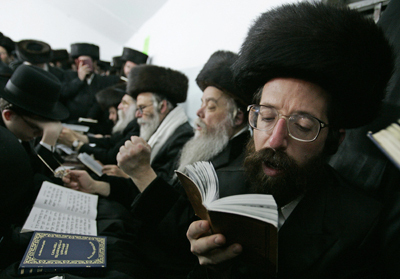
Charedic Jews praying


Listen as pro-Zionist Cavuto of Fox news tries to shout him down, telling him to "answer the question" whilst not giving him a chance to do so. Watch how the bully Cavuto claims to be protecting Jews whilst saying he is against diplomatic dialogue and insults Rabbi Weiss with talk of his relatives being turned into "bars of soap" and falsely accusing him of holocaust-denial and wanting the atomic bombing of Israel simply because he dared to go on a peace mission to President Ahmedinajad of Iran.

It's a pretty disgusting performance by Fox but not surprising given the large amounts of conservative Jewish and Christian Zionist money which goes to Fox. However, Cavuto's views are also representative of opinion in particular sectors of American and British society:


This Charedic rabbi is genuinely interested in peace and co-existence in Palestine but, as can be seen, bigotry will not allow him to speak. And the bully pretends that it is to do with "time constraints" in television.

Well, it's a point of view!

Jewish music from the time of Temple worship was the immediate basis of Christian worship and it is from that source that we get our chant, later codified by Pope St Gregory the Great and thus called Gregorian chant.

Here is a somewhat schmaltzy but nevertheless wonderful old recording of Leibele Waldman singing the great hymn Kol Nidrei sung on the eve of Yom Kippur, the Day of Atonement, Judaism's most solemn annual day. Notice how orthodox Jews traditionally sway when they pray and the men cover their heads. Notice also, amidst the books, bells and candles, the horn that must be blown at the beginning of Yom Kippur.


Waldman was one of the great Jewish Cantors. Another was Yosselle Rosenblatt.

One of my favourite prayers is Sh'ma Yisroel but I could not find a Youtube version of it that wasn't ridiculously and excessively ultra-Zionist to the point of showing tanks, guns and artillery in virtually every scene.

Sh'ma Yisroel (שמע ישאל‎ר) - that is, "Hear, O Israel" - is central to the morning and evening prayers of Jews. It is taken from Deuteronomy 6:4 which reads thus:


"4 Hear, O Israel, the Lord our God is one Lord. 5 Thou shalt love the Lord thy God with thy whole heart, and with thy whole soul, and with thy whole strength".


The Sh'ma is the most important prayer in Judaism, and it is a mitzvah (religious commandment) to recite or sing it twice daily. It is also a pray said by the dying.

The prayer comprises Deuteronomy 6:4–9, 11:13-21, and Numbers 15:37–41 contained in this Torah prayers said regularly: VaEtchannan, Eikev, and Shlach.

The whole of the passage from Deuteronomy ought to be read regularly by Catholics, too, to remind us of our sacred duty to uphold the traditions that God has given to us and not to go hankering after novelties such as now predominate in so many parts of the Church in flat disobedience of God's law.

"4 HEAR, O ISRAEL, THE LORD OUR GOD IS ONE LORD. 5 Thou shalt love the Lord thy God with thy whole heart, and with thy whole soul, and with thy whole strength.

6 And these words which I command thee this day, shall be in thy heart: 7 And thou shalt tell them to thy children, and thou shalt meditate upon them sitting in thy house, and walking on thy journey, sleeping and rising. 8 And thou shalt bind them as a sign on thy hand, and they shall be and shall move between thy eyes. 9 And thou shalt write them in the entry, and on the doors of thy house. 10 And when the Lord thy God shall have brought thee into the land, for which he swore to thy fathers Abraham, Isaac, and Jacob: and shall have given thee great and goodly cities, which thou didst not build,

11 Houses full of riches, which thou didst not set up, cisterns which thou didst not dig, vineyards and oliveyards, which thou didst not plant, 12 And thou shalt have eaten and be full: 13 Take heed diligently lest thou forget the Lord, who brought thee out of the land of Egypt, out of the house of bondage. Thou shalt fear the Lord thy God, and shalt serve him only, and thou shalt swear by his name. 14 You shall not go after the strange gods of all the nations, that are round about you: 15 Because the Lord thy God is a jealous God in the midst of thee: lest at any time the wrath of the Lord thy God be kindled against thee, and take thee away from the face of the earth.

16 Thou shalt not tempt the Lord thy God, as thou temptedst him in the place of temptation. 17 Keep the precepts of the Lord thy God, and the testimonies and ceremonies which he hath commanded thee. 18 And do that which is pleasing and good in the sight of the Lord, that it may be well with thee: and going in thou mayst possess the goodly land, concerning which the Lord swore to thy fathers, 19 That he would destroy all thy enemies before thee, as he hath spoken. 20 And when thy son shall ask thee tomorrow, saying: What mean these testimonies, and ceremonies and judgments, which the Lord our God hath commanded us? "


The Jewish Queen, Mother and Virgin who is now our most Blessed Queen, Mother and Virgin


...

Wednesday, 16 September 2009

The Lay vocation: clergy and religious are NOT the same thing

This portrait of The Holy Family by Claudio Coello, the 17th century Portuguese painter of the Spanish School of Madrid, tells us what we need to know about the model of religious life.

That is why devotion to the Holy Family is an antidote to some of the sillier notions that have crept into the Church in modern times, even among some of the most intelligent people.

Note how Christ is the link between the Holy Trinity and the Holy Family and how the Holy Family reflects the Holy Trinity, St Joseph, the Father, our Lord, the Son, and our Lady the Spouse of the Holy Spirit, also the spirit of that Holy Family.

Because of the fall of Catholic states and kingdoms, the concomitant decline of lay power in Church and State, and the corresponding rise of the power of the clergy, there are numerous Catholics who now look upon the religious life as a kind of "quasi-clerical" state.

Nothing could be further from the truth.

A nun is NOT (repeat NOT) a kind of quasi-cleric. A nun is a spiritual queen and mother, in imitation of our Lady.

To consider that she is so, is to misunderstand her vocation entirely and to misunderstand the role of the laity in the Church completely.

Our model should be the Holy Family who are the exemplars of the highest vocation and are indubitably the highest of those who dwell in heaven, our Lady being far and away above all others save God Himself.

And need I remind any reader of this very obvious fact:

Our Lady was not a cleric. Since she is a woman she could not be a cleric. Yet she is the highest in Heaven, after God.


The Queen of Heaven with her Holy Child.
In all heaven and earth there is no creature greater than she, not even the very Angels of God. She is the model of royal humility, religious perfection and maternal love. And she was a lay woman - not priest or cleric. Christ the Priest obeyed her as His mother. She is a model for all laity.


But who would dare to suggest that she did not exemplify in her life the highest of all roles that any Catholic Christian can fulfil or that her vocation was not the highest or that her perfection was less than any other, save God Himself?

No true Catholic would ever suggest such.

Yet, she was no cleric. No - not at all. Yet she is the Queen of all priests, of all saints, of all martyrs, of all Christians without peer and without exception.

See how God champions and prizes humility?

Equally, there are few things as odious to God as a proud and arrogant clergy who abuse their sacred office and dignity to oppress and trouble the Christian people. Theirs will be the most awful place in hellfire - above even many an unbeliever and scoffer. For who could so scoff at God as wickedly as a proud cleric?

So beware you bishops and prelates who trade on your office, who are faithless to your charge, who love to lord it over the people and to have the places of honour and the favour of the great at the expense of the humble Christian people. Yours will be the lowest place in Hell. So beware!

If our Lord Himself chastised the Pharisees for such conduct, think how much more He will chastise Catholic bishops who, having the fullness of truth and being ministers of God's one true Church, behave thus. They will be punished worse than the Pharisees!

We do not need to look to the Old Testament Pharisees when we have so many of our own who love to be seen with the great of this world, the Hollywood stars, the politicians, the millionaires and to smile upon their vacuous and superficial opinions, to excuse their immoral lives and even, in some case, to share in the same!


Duccio Di Buoninsegna. Christ Accused by the Pharisees. 1308-11.
If our Lord condemned the bad Pharisees, how much the more will He condemn evil Christians and especially evil prelates and bishops who betray their office and re-crucify Christ by their faithlessness and desire to be seen with the mighty of the world. Theirs shall be the worst fate of all.


Let us turn away from such boundless betrayal and re-crucifixion of Christ by those very souls whom He has appointed to such high office.

Let us turn, instead, to the wonderful humility of the Blessed Virgin Mother of God.

She was, and remains, a lay woman. Her role was the model both of all religious and of all mothers and of all queens. She exemplified the triple role of the Christian to perfection: to teach, to sanctify and to govern but she did so as a lay woman, not a cleric. She taught by her silence, she sanctified by her prayerful presence, and she governed by her meekness.

Through her, God is telling us that this is the way to perfection.

So, too, the mild and gentle St Joseph. He, like Mary, sprang from the royal race of King David and, according to tradition, was the rightful successor to the Kingship of Judah in the male line, just as Mary was, in the female line. This meant that St Joseph was rightful King and Prince of Judah and that his male adoptive Son, our Lord Himself, was truly King of the Jews in the flesh as well as spiritually.

But unlike our Lord, St Joseph, was not a priest, nor even a cleric. He came from, and headed, the Line of Judah which was the line of kings, not priests. It was the Line of Levi which was the line of Priests and Levites (or Deacons). Our Lady, too, came from the Line of Judah, not Levi.


St Joseph, Prince of Judah and model of royal humility and paternal love


They were, thus, both models of the laity not the clergy.

It is to them that Christian kings and princes - and all lay Christian leaders - look as their model.

In the ages of Faith, Christian kings and princes and lay leaders had their own proper sphere in the Church and in the State and all were ranged in hierarchy below them, both clerical and lay alike.

This was as our Lord willed it. There was to be a Spiritual sword, that of the clergy, and a Temporal sword, that of the laity, just as a man is both soul and body, spirit and flesh.

If either is missing, the man is dead.

So, too, Church and State.

This is the meaning of the now so little-regarded Catholic teaching on the Social Kingship of Christ.

In the best state, there is both temporal and spiritual in perfect harmony and marriage.

That is why it is such an offensive doctrine to teach the separation of Church and State in a Catholic society. It would be like separating Christ from his holy parents and placing Him in the care of robbers, murderers and thieves.

This is not, however, the merger of Church and State, as some falsely suppose. Each retains its proper sphere. The Emperor does not become a kind of super-priest any more than the Pope becomes a kind of super-king, though each will have some dominion over the estate of the other.

Likewise, too, when a man (symbolising both Christ and St Joseph) and a woman (symbolising both the Church, Christ's Body, and our Lady, who is the typos of the Church) marry, they do not cease to be one man and one woman, each individuals. Marriage joins in love, it does not submerge individuality and sexual difference. Indeed, if it did it would be no marriage.


Pope St Leo III crowns Charlemagne as Caesar Augustus Romanorum Imperator, Roman Emperor and the August Caesar, renewing the marriage vows between Church and State, thereby.


Just so with the marriage of Church and State: if one submerged the other, there would be no State and no Church but rather some monstrous hybrid.

Instead, the Social Kingship of Christ entails a perfect and beautiful marriage between Church (represented by womankind) and State (represented by mankind).

It is rather, or should be, a perfect balance between the two spheres, between the temporal and the spiritual just as, in a man, there should be a perfect balance between the body and the soul.

Ultimately, the spirit is higher than the flesh but without the flesh the man dies. So, too, the state - and that is our current condition in the modern age. We are governed by "dead" states.

The model, ultimately, is not the Church and clergy alone, nor the Pope and Cardinals alone, nor the PP and his deacons alone. The model has always been broadly that of Pope and Emperor, Archbishop and King, Bishop and Count, Rector and Squire, Curate and Gentleman, Clerk and Yeoman, Sexton and Peasant, up and down the hierarchy of human authority.

The ultimate model is that of the Holy Family: a community of lay and clerical. Christ the Priest is obedient to His mother and to St Joseph, both lay, albeit King and Queen of the Holy Family and also, albeit disenthroned by sinful men, King and Queen of the wider community, that of God's chosen race and people, the Jews, which, in turn, symbolises the Church.

THAT is our model - not just the clergy, alone, with layman acting as no more than quasi-clergy at best. The laity have a distinct role and vocation of their own, as the Holy Family teaches us.

They were also models of the religious life, a life which had already begun in Israel with the Essenes, a community of laity, not clergy.


St Anna the Prophetess,
the daughter of Phanuel, of the tribe of Aser. Married at age fourteen, widowed at twenty-one, she entered the Order of Widows of the Essenes and became a model of religious, waiting upon our Lady and her Holy Child when they came to the Temple in Jerusalem.


Some say that Anna the Prophetess, she who prophesied that Christ Child was the Messiah, was an Essene. She was certainly another model of the religious life.

Those who think of religious as a kind of sub-member of a clerical caste wherein lies all power, spirituality and perfection are in danger of falling into the serious heresy of clericalism.

A particularly clericalist analogy is that one still sometimes hears from a particular type of clericalist priest. It considers the Church as an army in which the bishops are generals, the clergy are officers, the religious are the NCOs and the laity are the foot soldiers.

It is utterly false, untraditional and un-Catholic.

It is also very modern.

None of our ancestors in the ages of Faith would have even recognised such an un-Catholic view of the Church.

They knew better since they could see that emperors, kings, dukes and lay Catholic leaders were no more the "footsoldiers" than were abbots, priors and religious superiors, merely the "NCOs" of the Church.

In any case, in Christianity, we are all the servants of each other and should strive, not for the highest places, but rather for the places where we may be the humblest servant of all. Therein lies holiness and perfection.

The Catholic model strikes a balance between the lay and the clerical, just as our Lord intended it, with a lay leadership on the one hand and a clerical leadership on the other.

The fact that the spiritual "arm" (of the clergy) is overall higher than the temporal "arm" (of the laity) does not mean that emperors, kings, abbots and priors are somehow a lower vocation and intended to be purely and exclusively the servants of the clergy.

On the contrary, emperors and kings expected obedience from the clergy within their domains and had very direct power over them and expected their loyalty and fealty.


St Henry the Emperor, a model for Christian kings and emperors and lay leaders


Likewise, abbots and priors expected the same of the clergy under their domain.

It is also entirely false to suppose - as the majority of Catholics now do - that abbots and priors were all priests. In the original and traditional religious life they simply were not. Indeed, many of them were not major clerics at all and some were entirely lay.

St Anthony, the father of ascetic monasticism, was a layman.

St Benedict, the father of western monasticism, was neither priest nor deacon.

St Francis of Assisi was not a priest but is thought to have been a deacon since he is depicted in the diaconal dalmatic in some portraits.

Yet no-one can deny that these men were the appointed superiors of the religious communities and orders that they founded. Their inferiors, including the clergy, called them "Father".

Indeed, it is a pity that the title "Father" has, in the English-speaking world, become fixedly associated with the office of priest. This is a mis-development, in some ways. Abbots, priors and lay religious leaders were also called "Father" in the ages of Faith and, even today, on the continent of Europe, only religious clerics or superiors are called "Father"; secular clergy are called by various titles roughly corresponding to our knightly title of "sir" (e.g. Don in Spain and Italy or Hochwurden in Germany. France is closer to us with its Monsieur l'Abbé). Indeed, as readers of Shakespeare will know, that is how Catholic secular clergy were styled in Britain before the Protestant Reformation e.g. Shakespeare's secular clergy like Sir Oliver Martext, Sir Christopher Urswick and so on.

The traditional model of religious life pre-supposes that the superior will NOT be a priest, save in those orders which are expressly clerical, like the Order of Preachers (Dominicans) and the Society of Jesus (Jesuits).

See this from the Holy Rule of St Benedict, a model of balance and religious perfection which has not a trace of clericalism in it:

"CHAPTER LX
Of Priests Who May Wish to Live in the Monastery

If a priest asketh to be received into the monastery, let consent not be granted too readily; still, if he urgently persisteth in his request, let him know that he must keep the whole discipline of the Rule, and that nothing will be relaxed in his favour, that it may be as it is written: "Friend, whereunto art thou come" (Mt 26:25)?

It may be granted him, however, to stand next after the Abbot, and to give the blessing, or to celebrate Mass, but only if the Abbot ordereth him to do so; but if he doth not bid him, let him not presume to do anything under whatever consideration, knowing that he is under the discipline of the Rule, and let him rather give examples of humility to all. But if there is a question of an appointment in the monastery, or any other matter, let him be ranked by the time of his entry into the monastery, and not by the place granted him in consideration of the priesthood.

But if a cleric, moved by the same desire, wisheth to join the monastery, let him too have a middle place, provided he promiseth to keep the Rule and personal stability".


St Benedict, Abbot and father of Western monasticism, was not a priest or even a deacon.


and this:

"CHAPTER LXII
Of the Priests of the Monastery

If the Abbot desireth to have a priest or a deacon ordained, let him select from among his monks one who is worthy to discharge the priestly office.

But let the one who hath been ordained be on his guard against arrogance and pride, and let him not attempt to do anything but what is commanded him by the Abbot, knowing that he is now all the more subject to the discipline of the Rule; and in consequence of the priesthood let him not forget the obedience and discipline of the Rule, but advance more and more in godliness.


Let him, however, always keep the place which he had when he entered the monastery, except when he is engaged in sacred functions, unless the choice of the community and the wish of the Abbot have promoted him in acknowledgment of the merit of his life. Let him know, however, that he must observe the Rule prescribed by the Deans and the Superiors.


If he should otherwise, let him be judged, not as a priest, but as a rebel; and if after frequent warnings he doth not amend, and his guilt is clearly shown, let him be cast forth from the monastery, provided his obstinacy is such that he will neither submit nor obey the Rule."


See how wise this Holy Rule is!

The priest shall only take a higher place "when he is engaged in sacred functions", otherwise he shall only have the place dating from his entry to the monastery unless the Abbot or community choose otherwise.

This excellent Rule recognises the grave danger to religious life of a priest or cleric who thinks himself personally above others because of his priesthood.

The clerical state is the more dignified state in the Church but it is not the highest vocation in the Church.

The highest vocation is that of Faith, Hope and Love, the greatest of which is Love, as exemplified by the life of poverty of spirit, chastity and obedience to God, following the so-called "Evangelical Counsels" or Biblical advice on spiritual perfection, the clearest example being the life of the religious who take formal vows of poverty, chastity and obedience.


His Most Eminent Highness Fra' Matthew Festing.
The Prince and Grand Master of the Order of Malta is a temporal sovereign, a religious superior and Grand Master of the world's oldest religious order of knighthood, the Order of St John of Jerusalem. He is not, however, a cleric. He is a religious layman. He has jurisdiction, like an abbot, over all the churches and chapels of the Order as well as the clergy of the Order. This is the traditional model of a religious superior.


But it is not just religious who must lead this life. We all should strive to do so within our state in life. Thus for the married Christian a life of poverty means a life dedicated to one's obligations to family, friends, the poor and to others, no matter how rich we are; chastity in our married state; obedience to the law of God and to our lawful superiors in accordance with the laws of God.

We should all beware the 3 concupiscences which the Fathers warn us of: the Concupiscence of the Eyes, the Concupiscence of the Flesh and the Pride of Life, that is, love of wealth, love of pleasure and love of power and worldly might.

The antidote to these are poverty, chastity and obedience, according to our state in life, whether emperor, king, abbot, prior, layman or cleric.

We are all called to this life just as we are all called to the Christian roles of prophet, priest and king, although not all ministerially.

The ministerial priesthood is neither the most powerful, nor the highest, nor the best vocation in the Church. Because of its special place, it is, however, the most dignified.

The highest vocation in the Church is that of Love; and to that vocation any and all must aspire.

Those who achieve it the more shall be the greatest in heaven.

The best example, among creatures, is, of course, our Lady: a Queen, a Prophetess, a Religious and a Mother - but a laywoman, not a cleric.

And let us never forget it.


Diego Rodriguez de Silva y Velazquez. The Coronation of the Virgin. 1645.


May Thy Kingdom Come!