 His Highness Prince Albert Frederick Arthur George of York (3 years later styled His Royal Highness after the 1898 letters patent of Queen Victoria) was born at Sandringham on 14 December 1895.
He died, on 6 February 1952, having ruled as King George VI of the United Kingdom and the British Dominions from 11 December 1936 until his death. He was the last Emperor of India (until 1947), the last King of Ireland (until 1949), and the first Head of the Commonwealth.
His family name of Wettin (or more fully Welf-Este-Wettin) was later changed to Windsor in view of the war with Germany. The Welf-Este family had ruled in Saxony and Bavaria and northern Italy. The Wettin family were their ancestors who had ruled Saxony.
The Hanover dynasty, from whom Queen Victoria descended, were Welf-Este and the Saxe-Coburg-Gotha dynasty, from whom Prince Albert, the Prince Consort of Queen Victoria, descended, were Wettin.
Interestingly, the Italian branch of the Welf family (the Guelphs) were the pro-papal party against the pro-imperial party, the Waiblingen, (the Ghibellines), during the investiture contest in the 11th century.
As the second son of King George V, Prince Albert ("Bertie") was not expected to inherit the throne and spent his early life in the shadow of his flamboyant elder brother, Edward, later King Edward VIII, and, later still, Duke of Windsor.
Prince Albert served in the Royal Navy during World War I, and fought at the Battle of Jutland, and after the war took on the usual round of public engagements. He married Lady Elizabeth Bowes-Lyon in 1923, daugher of the Earl of Strathmore and Kinghorne, and they had two daughters, Elizabeth (who succeeded him as Queen Elizabeth II) and Margaret.
 The Duke and Duchess of York with their daughter, later Queen Elizabeth II
His elder brother ascended the throne as King Edward VIII on the death of their father in 1936. However, less than a year later Edward revealed his desire to marry the twice-divorced American socialite Wallis Simpson. The British Prime Minister, Stanley Baldwin, advised Edward that he could not marry Mrs Simpson and remain king, this being contrary to the teachings of the Church of which he was temporal head.
So, when Edward abdicated in order to marry, King George VI was crowned in his place and ascended the throne as the third monarch of the House of Windsor.
 On the balcony of Buckingham Palace after the Coronation
Within twenty-four hours of his accession the Irish parliament, the Oireachtas, passed the External Relations Act, which essentially - and illegally - removed the power of the monarch in Ireland.
Further events greatly altered the position of the monarchy during his reign: three years after his accession, his realms, except Ireland, were at war with Nazi Germany and later with Italy and the Empire of Japan.
Though Britain and its allies were ultimately victorious, the United States and the Soviet Union rose as pre-eminent world powers and the British Empire declined. With the independence of India and Pakistan in 1947, and the foundation of the Republic of Ireland in 1949, George's reign saw the acceleration of the break-up of the Empire and its transition into the Commonwealth of Nations.
King George had been a sickly child and often suffered from ill health and was described as "easily frightened and somewhat prone to tears".
 The young Duke and Duchess
His parents, the Duke and Duchess of York, were generally removed from their children's day-to-day upbringing, as was not uncommon in aristocratic families of that era. He was forced to write with his right hand although he was naturally left-handed, and developed a stammer that lasted for many years. He suffered from chronic stomach problems as well as knock knees, for which he was forced to wear painful corrective splints that kept him awake at night and often in tears of pain.
Queen Victoria died on 22 January 1901, and the Prince of Wales succeeded her as King Edward VII. The Duke of York became the new Prince of Wales. Prince Edward moved up to second in line to the throne, and Prince Albert was third.
From 1909, Albert attended the Royal Naval College, Osborne as a naval cadet. In 1911, he came bottom of the class in the final examination, but despite this he progressed to the Royal Naval College, Dartmouth. When Edward VII died in 1910, Albert's father became King George V. Prince Edward was created Prince of Wales, and Albert was second in line to the throne.
 TRH Princes David (later King Edward VIII) and Albert (later King George VI) as Osborne naval cadets with their father, HRH the Duke of York (later King George V), and grandfather, HM King Edward VII
He was mentioned in dispatches for his action as a turret officer aboard HMS Collingwood during the Battle of Jutland (31 May–1 June 1916), an indecisive action against the German navy which emerged as a strategic victory for the United Kingdom.
He did not see further action in the war, largely because of ill health caused by a duodenal ulcer.
In February 1918, he was appointed Officer in Charge of Boys at the Royal Naval Air Service's training establishment at Cranwell. With the establishment of the Royal Air Force two months later and the transfer of Cranwell from Navy to Air Force control, he transferred from the Royal Navy to the Royal Air Force.
He was appointed Officer Commanding Number 4 Squadron of the Boys' Wing at Cranwell and he remained there until August 1918. During the closing weeks of the war, Albert served on the staff of the Independent Air Force at its headquarters in Nancy. Following the disbanding of the Independent Air Force in November 1918, he remained on the continent as a staff officer with the Royal Air Force.
In October 1919, Albert went up to Trinity College, Cambridge where he studied history, economics and civics for a year.
On 4 June 1920, he was created Duke of York, Earl of Inverness and Baron Killarney. He then began to take on royal duties; he represented his father, the King, toured coal mines, factories, and railyards, and acquired the nickname of the "Industrial Prince".
But it was the Abdication crisis that changed his life forever for then Albert was to become King-Emperor, an appointment he dreaded and did not want. But he was the choice of Providence and he did his duty and was crowned in a glittering ceremony which can be seen in this clip shown in cinemas at the time:
His speech impediment, and his embarrassment over it, together with his tendency to shyness, caused him to appear much less impressive than his older brother, Edward. However, he was physically active and enjoyed playing tennis. He developed an interest in working conditions, and was President of the Industrial Welfare Society. His series of annual summer camps for boys between 1921 and 1939 brought together boys from different social backgrounds, from elite public schools like Eton and Harrow together with boys from slum schools and grammar schools.
 The King and Queen with Mr MacKenzie-King, the Canadian Prime Minister
Because of his stammer, Albert dreaded public speaking. After his closing speech at the British Empire Exhibition at Wembley on 31 October 1925, which was an ordeal for both him and the listeners, he began to see Lionel Logue, an Australian-born speech therapist. The Duke and Logue practised breathing exercises, and the Duchess rehearsed with him patiently.
As a result of the training, the Duke's opening address at Australia's Federal Parliament at Canberra in 1927 went successfully, and he was able to speak subsequently with only a slight hesitation. Most famously, the King was able to give his famous broadcast near the beginning of the war - "the King's Speech" - and here it is:
"The King's Speech" - speech of King George VI near the start of World War II
Shortly before Albert became king, a position he was reluctant to accept, he went, the day before the abdication, to London to see his mother, Queen Mary. He wrote in his diary, "When I told her what had happened, I broke down and sobbed like a child".
 The Coronation of King George VI
After war broke out in September 1939, George VI and his wife resolved to stay in London, despite German bombing raids. They officially stayed in Buckingham Palace throughout the war, although they usually spent nights at Windsor Castle.
The first German raid on London, on 7 September 1940, killed about one thousand civilians, mostly in the East End.
On 13 September, the King and Queen narrowly avoided death when two German bombs exploded in a courtyard at Buckingham Palace while they were there. In defiance, the Queen famously declared: "I am glad we have been bombed. We can now look the East End in the face".
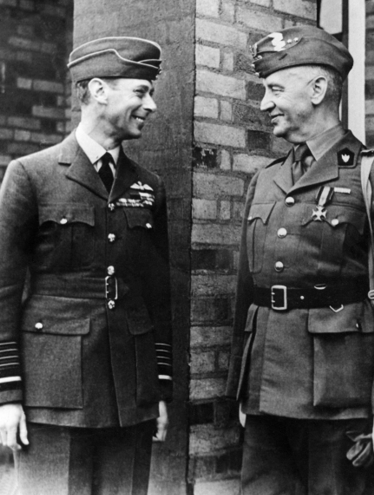
The King (left) with General Sikorski, the Polish Commander-in-Chief in World War II
The royal family shared the same dangers and deprivations as the rest of the country. They were subject to rationing restrictions, and Eleanor Roosevelt, champagne-socialist wife of the US President, remarked on the rationed food served and the limited bathwater that was permitted during a stay at the unheated and boarded-up Palace. The White House, needless to say, was never bombed during the war. In August 1942, the King's brother, Prince George, Duke of Kent, was killed on active service.
Throughout the war, the King and Queen provided morale-boosting visits throughout the United Kingdom, visiting bomb sites and munitions factories, and (in the King's case) visiting military forces abroad. Their high public profile and apparently indefatigable determination secured their place as symbols of national resistance. In 1945, crowds shouted "We want the King!" in front of Buckingham Palace during the Victory in Europe Day celebrations. The King invited Churchill to appear with him on the balcony to public acclaim.
When he died in 1952, King George VI was one of the best beloved of British monarchs. He had become, rightly, a symbol of self-sacrifice and duty. His attitude to monarchy was that of a Christian king, namely that it was a role that should imitate Christ the King, the suffering servant king who sacrificed his own desires to serve his people.
Yes, it is true that King George VI was obliged to become a Freemason, as part of the usual British Protestant establishment ritual, but that was not where his heart was. His heart, a profoundly Christian heart, was with his people, his duty, the Empire, his family and, ultimately, with God.
It is true that he was not a Christian saint like St Edmund, St Edward of Mercia, St Edward the Confessor, St Oswald, St Osbert, St Kenelm and other British kings, but he was, nonetheless, a good, humble and devout man, a fine husband and father to his wife and children and a fatherly figure to his people. In short, he was a good model for Christian kings to follow.
May God give peace and eternal rest to the soul of our last King-Emperor and his wife, our last Queen-Empress!

...












.jpg)










_-002.jpg/220px-Circle_of_Anton_Raphael_Mengs,_Henry_Benedict_Maria_Clement_Stuart,_Cardinal_York_(ca_1750)_-002.jpg)


