Tuesday, 30 June 2009

Relics - what's that all about?

Fair question!

One correspondent asks it.

A "relic" is no more than a memento of someone to remind you of them and particularly of your love for them.

To the left is a reliquary containing the relics of the Three Kings or Magi, housed in Cologne Cathedral.

My correspondent notes that Baptists keep the shirt of Martin Luther King even though that is the shirt he was wearing when he was assassinated.

Why do they do that?

Well, they wish to have a memento to remember him by and especially a memento of the day he died.

This is no different than the Catholic approach to relics.

Most people keep relics but, if they are not religious relics, sceptics don't take them to task for it.

My correspondent asks, if we keep what he calls "body parts" as relics, then why not "bodily fluids".

Actually, we do not keep "body parts" as relics. We keep inert items that have already decayed into a stable state or, in some miraculous cases, remained stable.

But let's consider the question in context.

Does a sceptic say to his work-mate who keep pictures of his family on his desk: "Hey, you! Why have you got a picture of your family on your desk! Why don't you keep some of their bodily fluids on your desk, too? Weirdo!".

Well, no, of course not.

Most people keep mementos of their deceased family, too, especially the ones they were closest to like their parents or children or, above all, a wife, husband or lover.

Why? Because we wish to treasure their memory and keep it in our hearts and minds.

Why? Because it reminds us that love is less transitory than life itself and we wish to remember the love we had for that person long after they have died.

It is, in short, an example of the timelessness and eternity of love.
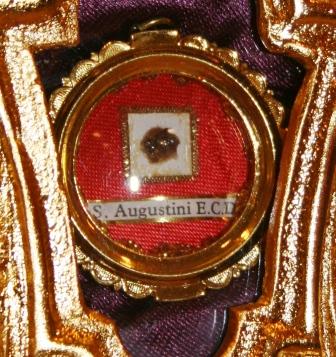

Relic of St Augustine


Now if this applies to our relationships with other people, how much the more should it apply to our relationship with God and with the friends and family of the God who created us, sustains us and wishes us to be happy with Him in the next life.

No-one asks why a man keeps a memento of his late wife, whom he so much loved, on his desk. Why then should they ask why he also keeps a memento of God, whom he also loves.

No-one would ask him why he does not keep bodily fluids because the obvious answer is that it is not fitting. The less corruptible a relic the better it reminds us of the timelessness of our love.

Likewise with the humanity of God and the mutual love of God and man. In the case of God the Son, the Second Person of the Trinity, JESUS CHRIST, there can be no relics of the body simply because His whole body went up to heaven at the Ascension and did not decay.

We, therefore, venerate His Sacred Heart, as a symbol of His love for us, which is now in heaven.

The same applies to the Blessed Virgin Mary, His mother and our Queen and Mother for His sake. She was assumed body and soul into heaven at her Assumption because she was without sin, even Original Sin. Thus we venerate her Immaculate Heart which is in heaven.

With the saints we know that their bodies lie corrupted in the earth (with the exception of Enoch, "who walked with God and was seen no more because God took him" [Gen 5:24], and Elias who went up to heaven in a fiery chariot [4 Kings 11], both of whom are said to return at the end of time to convert mankind [Malachi 4:5 and other texts]).


The Prophet Elias (Elijah) rising to heaven in a fiery chariot as the Prophet Eliseus (Elisha), his successor, looks on in awe crying out "My father! My father! The chariot of Israel and the driver thereof!"[4 Kings 11]


We keep mementos of the saints out of love for them and also as a reminder to ourselves that their love and our love is eternal and will not be lost and that, in token thereof, even their bodies will rise on the last day and be resurrected like the body of Christ. It is a symbol of the conquest of death by love.

It is also natural to man because we naturally keep mementos of loved ones. But that is already a pre-figurement of the fact that loves survives death and is eternal and never lost. Every man or woman who has lost a loved one instinctively feels this. The Church teaches that this instinct is profoundly right.

My correspondent asks a few other questions. The answers follow from what I have already said.

Does God ignore the people venerating the fake/inaccurate relics?

God ignores no-one, least of all when we make mistakes. Why, then, would He ignore us when we make a mistake about a relic? The virtue is in the veneration, prayer and love. Why would God - or anyone - ignore that? God judges the heart not the origins of a piece of wood or cloth or metal.

Just as a husband keeps a memento of his wife as a reminder of her, and not of the actual memento, so with God. If the memento of his wife turns out to be actually a memento of someone else that may be a bit embarrassing for the husband but it does not mean he had less devotion for his late wife, does it?

Or do the people venerating the real ones just get a bonus?

Love is not to be measured in terms of "bonuses" like shares on the Stock Exchange or the Dow Jones Average.

God measures man by how much he loves for "charity shall cover the multitude of sins" [1 Peter 4].

I don't doubt the existence of a prepuce or circumcision-I just can't imagine someone sane not only keeping a foreskin but keeping it long enough and trying to get other people to touch it.

Unfitting mementos are plainly not what relics are for.

Circumcision was, for the Jews, what baptism is for us. It was (and is) the rite of initiation for a Jew. Not all cultures are as squeamish as modern American culture can sometimes be.

However, I tend to agree that christening mugs and baptismal gowns are more fitting mementos than severed pieces of flesh and for the reasons I have already said.

The more corruptible the relic, the less fitting it is to be a memento since, for obvious reasons, it will corrupt and disintegrate all the quicker and so is a less fitting symbol of the eternity of love and charity.

A lasting memento is much better as a remembrance of that which lasts longest of all, namely love.

I guess it's no more foolish than the Buddha Tooth temples or the mob scene at Ayatollah Khomeini's funeral.

Buddha tooth temples, perhaps, but not mob scenes.

They must be amongst the most corruptible of things. They come, they agitate, like some unstable chemical compound, they are often filled with hate, they often do terrible damage and then they quickly fade away like a wisp of smoke.

A mob is hardly an appropriate memento of the longevity of love.

Relics are a form of devotion that is natural to man. Just as we keep sporting relics, familial relics, relics from our past days, as a student, in the Army, of various jobs done and so on, so, too, we keep relics of a religious nature.

It is simply natural.

Moreover, it is hallowed by sacred tradition and all of the Holy Fathers of the Faith promoted the keeping of sacred relics.


The Shroud of Turin: a relic of the burial shroud of our Lord miraculously imprinted with the Holy Face


...

Sunday, 21 June 2009

The Feast of the Sacred Heart

This Feast says it all really.

In the eleventh and twelfth centuries a special devotion to the Sacred Heart was particularly cultivated. It was taken up particularly by St Bruno and the Carthusians.

The Cistercians also were much devoted to the heart of Jesus, particularly St Bernard himself.

St Gertrude the Great and St Mechtilde were also great promoters of the devotion as also the learned the author of the "Vitis mystica", thought to be St Bonaventure.

From the thirteenth to the sixteenth centuries, the devotion was everywhere practised by individuals and by different religious congregations, such as the Franciscans and the Dominicans.

It was established as a devotion with prayers already formulated and special exercises, found in the writings of Lanspergius (d. 1539) of the Carthusians of Cologne, Louis of Blois (Blosius, 1566), a Benedictine and Abbot of Liessies in Hainaut, John of Avila (d. 1569) and St Francis de Sales, the latter belonging to the seventeenth century.


St Gertrude the Great, Visionary-Apostle of the Sacred Heart


The image of the Sacred Heart of Jesus was everywhere in evidence, largely due to the Franciscan devotion to the Five Wounds and to the habit formed by the Jesuits of placing the image on their title-page of their books and the walls of their churches.

The Jesuits subsequently became the great defenders of the devotion to the Sacred Heart and were opposed by the mean-minded, narrow, puritanical but revolutionary Jansenists who mockingly called the devotees of the Sacred Heart by the name of Cordicoles or heart-worshippers.

Jansenists, like Bishop Scipione de' Ricci of Pistoia-Prato in Tuscany, later openly embraced the principles of the French Revolution whilst those Catholics who fought against the Revolution frequently adopted the Sacred Heart as their symbol.


The heresiarch Jansenist, Bishop Scipione de' Ricci, the Bishop of Pistoia-Prato


Ricci worked in conjunction with Prince Kaunitz, the Freemasonic Chancellor of State (Prime Minister) of the Holy Roman Empire, who had consolidated himself in the government of the Empire under Empress Maria Theresa, and later under the liberal Modernist heterodox Catholic, Emperor Joseph II.

Joseph's younger brother, Grand Duke Peter Leopold of Tuscany, later himself Emperor for 2 years, was also a willing aider and abetter of Ricci's schemes.

Ricci held a famous Synod at Pistoia in which, with the support of the Grand Duke, he tried to impose, experimentally, an early form of liberal Modernist Catholicism upon people and clergy in his diocese. The people rose up, locked his Synod members in the Seminary and would not let them out until they had rescinded all the Modernist decrees, even taking off roof-tiles to get them to hurry the rescissions!

Few foresaw that the foolish experiments of the Jansenists and liberal Modernists would lead to them, the Empire and the Grand Duchy being altogether swept away by the tide of revolutionary hatred and violence.

Some Jansenists, after the Terror, returned to the Faith but by then the damage was done.

Ricci did not return until 1805, after he had seen the arrest of Pope Pius VII by Napoleon Bonaparte who compelled him to come to Paris and there to preside at the coronation of the destroyer of Christendom. It finally dawned on Ricci that his experiments had not had a good result.

Heterodox Habsburg: HIRH Grand Duke Peter Leopold of Tuscany was that rare thing, an heterodox Habsburg. He supported Ricci's ill-fated schemes and so prepared the way for his own family's later fall.


The faithless disloyalty of these Jansenists, Febronianists, Gallicanists and other liberal Catholics who had lapsed from the Faith, wrought appalling damage to Christendom and eventually led to the complete overthrow of Christendom.

Conversely, the Sacred Heart symbol became one of the great symbols of the defence of the Faith during the French revolutionary period and was used by the many Catholics who rose up against the usurping secularists and revolutionaries, not least in the Vendée region of Western France.

The enemies of the Sacred Heart of Jesus had become, wittingly or not, the prime tools of Satan. That is their legacy - fittingly so, since it is Satan who is primarily opposed to the love of God which is so much a part of the devotion to the Sacred Heart.


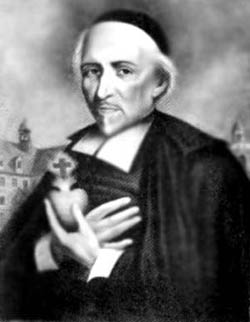
St John Eudes, Apostle of the Sacred Heart of Jesus


St John Eudes (1602-1680) publicly and enthusiastically promoted the devotion and gave it an Office and established a feast for it. St John Eudes was also the apostle of the Immaculate Heart of Mary.

On 31 August 1670, the first feast of the Sacred Heart was celebrated in the Grand Seminary of Rennes in Brittany. Coutances followed suit on 20 October, a day with which the Eudist feast was from then on to be connected.

The feast soon spread to other dioceses, and the devotion was likewise adopted in various religious communities. It gradually came into contact with the devotion begun at Paray-le-monial resulting in a fusion of the two.


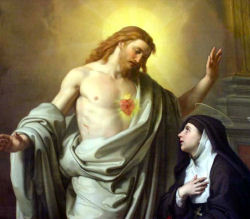
Our Lord shows His Sacred Heart to St Margaret Mary Alacoque


Eventually the devotion was hallowed by private revelation with the now famous revelations to St Margaret Mary Alacoque in the Visitation convent in Paray-le-monial.

Thereafter the devotion was taken by her confessor and spiritual director, St Claude de la Colombiere SJ, to England where, as chaplain to the English Queen, Mary of Modena, he was able to promote the devotion.


St Claude de la Colombiere SJ, confessor of both St Margaret Mary Alacoque and HRH Queen Mary of England, wife of King James II and VII. He was a great promoter of the Sacred Heart devotion.


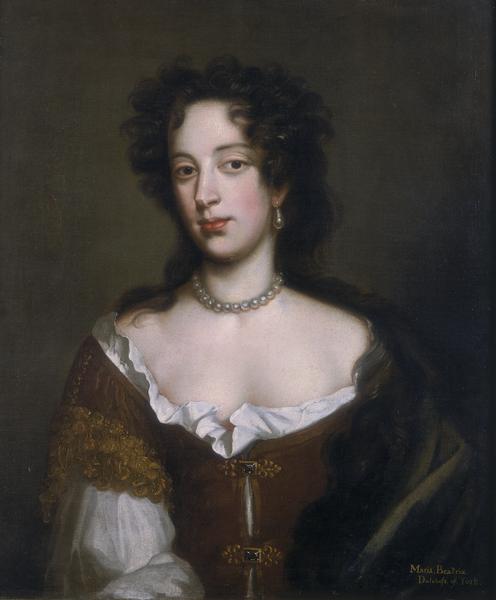
In 1676 he had been sent to England as preacher to Mary of Modena, Duchess of York, afterwards Queen and wife to King James II and VII, the true Stuart monarch of England, Scotland, Ireland and France.

It is fitting that Mary came from Modena which is not far north of that later centre of Jansenism, Pistoia.

St Claude lived the life of a Religious even in the Court of St. James and was as active a missionary in England as he had been in France. Although encountering many difficulties, he was able to guide Saint Margaret Mary by letter.


HRH Princess Mary of Modena-Este, Duchess of York as wife to the future King James II and VII and thus, later, Queen of England. Her confessor was St Claude de la Colombiere SJ whom she helped to spread the devotion to the Sacred Heart of Jesus in England


Now the Feast is a great one and has an Octave. An external solemnity is also permitted to be celebrated on the Sunday during the Octave.


St Gaius Cassius Longinus,
the Roman soldier who opened the side of our Lord with a spear but later converted to Christianity


"Unus militum lancea latus ejus aperuit, et continuo exivit sanguis et aqua".

"One of the soldiers with a spear opened His side and immediately there came out blood and water".

[John, 19:34. Communio, Feast of the Sacred Heart]


Wednesday, 17 June 2009

God bless America for its greatest sons...

In case anyone thinks that ALL Yankees are myopic and prejudiced Americanists, the truth is that they are not.

Most Americans are, I believe, far more reasonable than that.

And all Americans have reason to be very proud of an extraordinary legacy.

I am proud of my true-blue American uncles and of the fact that most members of my wider clan live in the USA.

Here's a post dedicated to Good Yankees - indeed some really great ones to whom we in Europe owe a very great deal.

Pretty near top of the tree must be GI Joe, the archetypal US infantryman who gave up his farm or post office or teamster job to join the Army, cross the Atlantic, train in a foreign country and then risk his neck a hundred times over.

Let's just start with something like D-Day or, in particular, Omaha Beach where the enemy fire was murderous, the cliffs too high to climb quickly and the air cover and naval gunfire support hampered by bad weather conditions.

The result was a lot of GIs killed and injured helping to save Europe from a madman and his mad secular, atheist ideology.

Let us not forget how Winston Churchill described what we were fighting:

"What General Weygand called the Battle of France is over. I expect that the Battle of Britain is about to begin. Upon this battle depends the survival of Christian civilization. Upon it depends our own British life, and the long continuity of our institutions and our Empire. The whole fury and might of the enemy must very soon be turned on us. Hitler knows that he will have to break us in this Island or lose the war. If we can stand up to him, all Europe may be free and the life of the world may move forward into broad, sunlit uplands. But if we fail, then the whole world, including the United States, including all that we have known and cared for, will sink into the abyss of a new Dark Age made more sinister, and perhaps more protracted, by the lights of perverted science..."

The GIs knew that's what they were fighting against and they were willing to risk their lives to do it even if some must have suspected that the same sort of perverted science would once again rear its ugly head in the latter half of the 20th and the beginning of the 21st century. They measured this all up and decided it was worth the fight.

Who can forget those incredible scenes so well captured in the memorable opening sequences of the Hollywood film Saving Private Ryan - some just too harrowing to replay.


As President Ronald Reagan rightly said, when challenged about the continuing presence of American bases on European soil, American military forces are in Europe to help defend Europe not, like some foreigners on European soil, to conquer and oppress it.

Then he said this: America does not claim any part of European soil...except, perhaps, those parts where American soldiers, who died fighting to save Europe from tyranny, are buried.


President Ronald Reagan memorably said that America claimed no part of Europe except, perhaps, the land where her sons, who had died defending Europe, were buried.

Indeed.

We, in Europe, must ever thank God for the sacrifice of those gallant and heroic men.

...

Reprise on Just War and the American Revolution

I received quite a post-bag on this one.

Let me look at some of the questions raised.

Pedes Christi wrote:

”My question is, can such a government be considered legitimate? And if not, what is one justified in doing about it? I am not suggesting violent revolution (given your just war theory above), but how does one otherwise deal with such tyranny? I pray for the conversion of my country, but what else? With this I wrestle”.

I think you are right to wrestle with this issue. See what you think of my comments below.

Mark asks:

”Surely St. Thomas would not say that a private citizen should bear ‘any’ level of injustice imposed upon him, correct? To use an example from modernity, would a private citizen in say, the Soviet Union, China, Cuba or North Korea be justified in rebelling against the dictatorship?”.

He later asks:

”1. What relevance is it to the question of Just War when the subject is a private (Catholic) citizen rebelling against a non-Catholic government? Does it matter what form the government is (monarchy, democracy, communist, tyrant), or whether it is oppressive towards Catholicism, or Christianity in general? At what point does a secular government, tyrant or otherwise, become so oppressive to a Catholic society as to merit rebellion? I have in mind your response on 10 June at 14:51 and your comment s regarding the alleged Freemasonic affiliations of the European Prime Ministers.

2. In your reply to Ollie you offered that his view was that of a ‘tiny minority’; I wonder what relevance does this have? Did you mean that in terms of having any bearing on a contemporary public that it is not relevant because it is impractical, or because it was not widely held at the time, or only that it is so obscure as to be discarded for purposes of discussion?

3. As you have explained your understanding of the application of Just War principles to this particular conflict, I wonder whether you believe the Crusades to have been just? What about the First War of Independence by the Scots?

4. In your reply to Dion, you asked a (rhetorical?) question as to how he would conclude as to the guilt of a Mohammedan claiming justice as the motivation for a act which resulted in the death of innocents; I wonder if by this you mean to imply that combatants whose actions result in the death of other combatants in wars which you believe to have been unjust are guilty of murder? Or does the responsibility for the justice of the war rest solely on the civil authorities to whom God has granted this responsibility? Is his culpability greater because the innocents were his targets, as opposed to a combatant who knows there will be innocent lives loss by his actions but which are otherwise unintended?

5. I am curious if you know of any declarations since 1789 by Roman Pontiffs declaring a major conflict to have been unjust.”


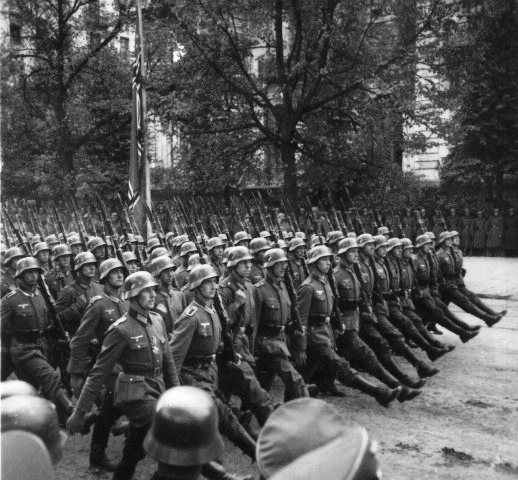
Was the German invasion of Poland just? Pomerania and Silesia were both originally German and had been seized after World War I. But the German government had pledged not to invade and, moreover, its ideology was then Nazi, a grossly heretical creed.


Let me essay an answer to these.

1. The principles of a just war are matters of Natural Law and, as such, apply to all men, not just Catholics. A private citizen, Catholic or otherwise, may not, according to those principles, rebel against properly constituted authority. It matters not what form the government takes, although it may be relevant that the government is oppressing Christianity, which is a true religion, rather than a false religion. However, that does not confer upon the private citizen the right to revolt against properly constituted government. Thus, at no point does a secular government, tyrant or otherwise, become so oppressive to a Catholic society as to merit rebellion, if it is a properly constituted government. Private citizens did not have the right to rebel against the Freemasonic European Prime Ministers, for instance, if they were properly constituted. There may be some residual or other powers of the Pope, however, to depose Catholic sovereigns but it would first have to be convincingly demonstrated that they derived their authority from the Pope. In general, according to Dante and St Thomas, Catholic monarchs derived their authority direct from God and not the Pope, although that varies. For instance, the Pope had the right to refuse to accept the Prince-electors nominee for Roman Emperor.

2. In my reply to Ollie I meant that his view is so obscure as to be discarded for purposes of discussion.

3. Not all of the Crusades were unjust – although they were not always justly conducted – because the Holy Land belonged to Christendom and the Eastern Empire in particular and it was a war of restoration and defence, expressly sanctioned by the Church as restorative and defensive against the ever-encroaching advance of Islam. I am not sure about the First War of Independence by the Scots. I would need to study the causes in more detail. Does anyone else have a view on it?

4. In my reply to Dion, I did not mean that combatants whose actions result in the death of other combatants in wars which are unjust are necessarily guilty of murder, although their leaders might be depending upon the usual criteria of intentionality. It is a standard application of the principle of “double effect” that a combatant who knows there will be innocent lives loss by his actions but which are otherwise unintended Is not guilty of moral crime. The culpability of the terrorist who deliberately targets the innocent is plainly evident. None of this was my primary point which was that no man can plead his disagreement with the Natural Law as an excuse for his crimes because every man has the Natural Law “written in his heart” and so cannot claim ignorance of it or exemption from it. If he could then Al Capone could say that he was innocent of murder because he did not believe that killing those who got in his way was murder.

5. There have been plenty of papal condemnations of conflicts as unjust since 1789. Pope Pius VI and Pius VII both declared the French Revolutionary wars unjust as well as the Bonapartist wars. Leo XII also did so and Gregory XVI declared the Italian revolutions unjust as did Bl Pius IX. He also condemned the Irish rebellions and excommunicated the Fenians on 12 January 1870. Of course, he also did the same to the Italian rebels. The Polish rebels were also – very significantly since they were rebelling against an heretic Tsar – condemned. The First World War was variously condemned and so were the Fascist and Nazi wars. The Spanish rebels were condemned (as were some actions by the Nationalists), Paul VI condemned the anti-terrorist war against ETA and John Paul II condemned the British invasion of the Falkland Islands, albeit not formally (and, in my view, on questionable grounds) as well as the Iraq war.


St Thomas Aquinas, leading theologian of just war principles


St. Thomas would not say that a private citizen should bear ‘any’ level of injustice imposed upon him, however bad, because he expressly allows the principle of self-defence. One may defend oneself, one’s family and others, together with property. If this requires what may become a war against the government then that is justified on the principle of “double effect” provided that there is no intention to overthrow the government or to prosecute a war against it.

If, however, the government was never a legitimate one then a war might be prosecuted against it (subject to all the usual just war criteria) in order to restore the legitimate government.

This was the purpose behind the Jacobite and Carlist wars and – arguably – the US War between the States. The South were seeking to restore the original Constitution as against the effectively new and unauthorised Constitution imposed by Lincoln and the Northern Yankees.

The governments of the Soviet Union, China, Cuba and North Korea were all illegitimate governments imposed by revolution and force of arms against legitimate governments. So long as they continued to be illegitimate in that sense it would be open to anyone (subject to all the other just war criteria) to rise up against them to restore the true and legitimate government (if there was one).


"Manifest Destiny" was just a re-run of the old Puritan and Cromwellian cry that the Protestant white man was pre-destined by an apparently arbitrary God to rule over all other men as a "chosen people" of Biblical stature who would be enriched in a new republic designed chiefly for their benefit. It is, of course, unbiblical nonsense.


I agree that “Manifest Destiny” is really an outgrowth of the theology of certain Protestant groups (often Calvinists) who beleive in the “God is on our (America's) side” school of thinking and I agree that this theology – like that of the Cromwellian Puritans and the Afrikaner Boer Vortrekker people – tends to give the impression of a status of “chosen people” based upon the nation of Israel as a chosen people.

That is one of the reasons why I am opposed to such Americanist Yankee nonsense. It does no good to America nor to the rest of the world.

But you cannot persuade Americanists of this view. They simply stick their fingers in their ears and shout pro-Americanist slogans.

...

Waterloo Day - 18 June

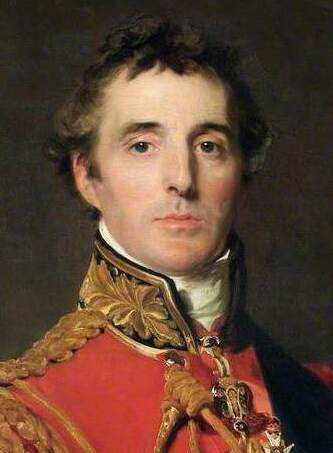
The Duke of Wellington on the field of Waterloo

The day of deliverance for Europe from the materialist, secularist tyranny of Bonaparte was 18 June 1815.

The day was nearly won by Bonaparte so that Wellington called the battle a "damn close-run thing".

The French cavalry, led by Marshal Ney, charged in a mass but were successfully received by the British Infantry squares and foundered, leaving Bonaparte with a badly-mauled cavalry.


Later, however, Boney rallied his troops, sent in the Imperial guard and was on the point of winning the whole battle.

Then Prince Blucher and his Prussian army arrived in the nick of time and rolled up his flank.


Field Marshal the Duke of Wellington - "Arthur" or "Old Nosey" as the British troops called him


In fact, the battle was won because there was another uprising in the Vendée by the Catholic and Royalist peasantry and their nobility. Bonaparte had to detach 2 Divisions to deal with the uprising - the most recent of many since the start of the Revolution - because he knew what valiant and tenancious fighters these Vendeans were.

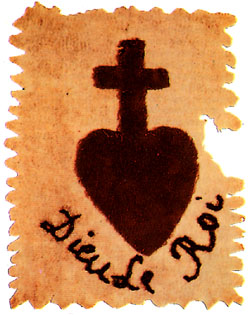
The Vendeans fought under the banner of the Sacred Heart of Jesus and that of the Bourbons and they represented the true Catholic heart of France having been prepared for their great struggle for the Faith by none other than St Louis-Marie Grignon de Montfort, the great missionary saint of the previous century.

The war in Vendée was at its most intense from 1793 to 1799 when, after the most savage reprisals and what Reynald Secher has not hesitated to call a "Franco-French genocide", the newly appointed Consul, Napoleon Bonaparte, agreed to restore to them their religious practice and to exempt them from the revolutionary militia - two of their primary aims (the third being to restore the King).


The 21-year-old Henri, Marquis de Larochejacquelein, leading the Vendeans from the front

The war later broke out again, especially in 1813, 1814 and 1815. During the Hundred Days in 1815, the population of Vendée remained loyal to King Louis XVIII, forcing Bonaparte – who was short of troops to fight the Waterloo Campaign – to send a force of 10,000 (according to other sources 20,000) under the command of Jean Maximilien Lamarque to pacify the region.

Without these troops Bonaparte lost the Battle of Waterloo and went permananetly into exile until his death on the island of St Helena.


The symbol of the Vendean Catholic Royalists - the Sacred Heart of Jesus surmounted by a Cross with the motto: "God - the King".

The following video selection tells the story of the earlier Vendean uprisings and the grotesque genocide practised by the revolutionaries against their own countrymen and women.


...

Wednesday, 10 June 2009

WHITE ROSE DAY

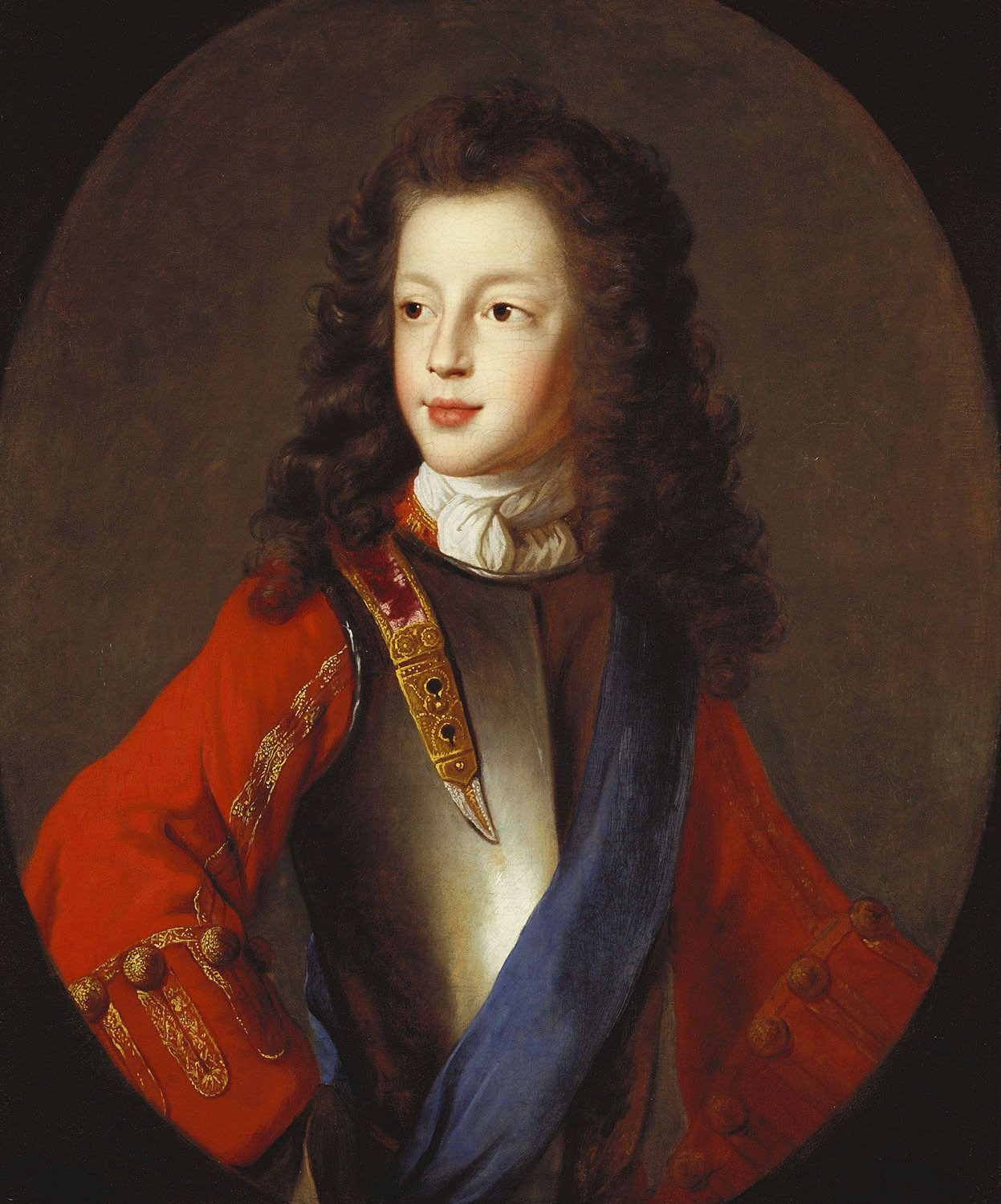
Today is White Rose Day, the day when Prince James, Prince of Wales (James Francis Edward Stuart; "The Old Pretender" or "The Old Chevalier") was born in 1688, thus occasioning the English Whigs to begin to plot against his father, King James II and VII, our last Catholic King, so as to exclude from the throne all Catholic monarchs.

King James III and VIII, de jure King, died on 1 January 1766 and, as the son of the deposed King James II and VII, rightfully claimed the English, Scottish and Irish thrones (as James III of England and Ireland and James VIII of Scotland) from the death of his father in 1701, when he was proclaimed king of England, Scotland and Ireland by his cousin Louis XIV of France. Following his death in 1766 he was succeeded by his son Prince Charles Edward Stuart ("Bonnie Prince Charlie") in the Jacobite Succession.

The White Rose or White Cockade is the symbol of Catholic monarchy all over Europe.

The motto of the family was (in Old French) Aymez Loyaute - "Love Loyalty"- a fitting motto if ever there was one!

God save the House of Stuart!

King James III of England and Ireland and VIII of Scotland - the legitimate Catholic King when he was a young prince.


The Arms of the House of Stuart


...

Two nations divided by a common language...

I am reliably informed by some of my American friends that there is a difference in meaning, in our respective countries, in the use of the word "ass".

I have used the Oxford English Dictionary meaning which defines the term in the following manner:

Ass

(noun) 1 a donkey or similar horse-like animal with long ears and a braying call. 2 (informal) a foolish or stupid person.

Apparently, this is not the common meaning in America where it refers to that part of the anatomy upon which one sits. British people use a different expression.

Thus to refer to a "dumb ass" is not, as in Britain, to refer to a "foolish or stupid person" likened to a dumb donkey but, rather, in America, is cruder and ruder.

I hope this clarifies matters for those who may have misunderstood.

There may be some truth in the old adage that we are two nations divided by a common language.

PS. Moreover, it is not much of an insult in English (e.g. "Oh, you are such an ass, Charles!") since donkeys may be dumb and stubborn but they are still likeable and friendly. Moreover, they were chosen by God who rode into Jerusalem on one. You will notice that donkeys all have the Sign of the Cross upon their backs (see picture). All in all, then, not too bad as insults go...and rather different from the American meaning!

...