Tuesday, 29 July 2008

The Good Yankee: St Elizabeth Ann Seton

Saint Elizabeth Ann Seton was born into a prominent “Brahmin” family in America – that is to say, one of the long-standing, well-established and wealthy families of the United States of America which formed a new home-grown American aristocracy.

Saint Elizabeth came from the Bayley family of New York City, a family of prominent Episcopalian Protestants.

She was married to a wealthy ship-owner, William Magee Seton, at the age of 19 and had 5 children, 2 sons and 3 daughters. William suffered the loss of numerous ships and his fortunes went into a reverse and he was forced to go into bankruptcy. This affected his health and he and his family travelled to Italy in the hope that he might recuperate there.

William did not improve and sadly died whilst he, Elizabeth and the family were in Italy.

Elizabeth was left alone and was taken in, with the children, by a local Catholic family who looked after them and cared for them.

During that time she was much influenced by, and learned much about, the Catholic faith. So much was she affected by what she learned and experienced of the faith that Elizabeth became a Catholic herself, 2 years later on 14 March 1805.


This cost her the support of her family and friends who, having the strong prejudices against the Catholic Church so typical of many American Protestants of the time, in effect, shunned her for her courageous decision. She was left to her own devices and therefore had now to support herself despite the fact that her parents were very wealthy.

She therefore started a school in Baltimore, Maryland. Her school struggled along for a time but eventually failed due to the anti-Catholic bigotry and prejudice then prevailing in the country.

This failure was followed by several difficult years of penury and hardship. This did not defeat her spirit but rather strengthened all the more her heroic resolve to dedicate herself to God and mankind and she responded to the challenge of such difficulties by deciding to start a new religious community in Emmitsburg, Maryland, dedicated to the care of the children of the poor.

As part of her new commitment St Elizabeth founded the first free school in the United States to educate young girls to live by the great religious values and truths.

She named her new community the Sisters of Charity of St Joseph and it enures to this day with some 6 independent communities stemming from these humble beginnings.

This new life brought St Elizabeth Ann even more crosses to bear and she had, like many a religious foundress, much to suffer by way of misunderstanding from friends and enemies alike, from personal hostilities and from other such hardships and trials. To cap it all she lost 2 of her daughters as well as other relatives and even 2 sisters in her community.

Eventually, after many hardships bravely and nobly borne, she herself succumbed to tuberculosis and she died at the age of 46, mourned, loved and admired, a truly great lady and a great American.

Her remains are entombed in the Basilica that bears her name: the Basilica of the National Shrine of Saint Elizabeth Ann Seton.


She was declared “venerable” on 18 December 1959 and beatified by Pope John XXIII on 17 March 1963. She was canonized by Pope Paul VI on 14 September, the Feast of the Triumph of the Holy Cross, 1975.

The Feast Day of Saint Elizabeth Ann Seton is 4 January.

“We must pray literally without ceasing—without ceasing—in every occurrence and employment of our lives . . . that prayer of the heart which is independent of place or situation, or which is rather a habit of lifting up the heart to God as in a constant communication with Him.”
[Saint Elizabeth Ann Seton]


St Elizabeth Ann Seton, pray for us!


...

Saturday, 26 July 2008

And now for the good Americans... let's start with the Saint Patrick Battalion

Not all Americans are dumb ass Yankees - far from it.

The problem is that so few Americans these days seem to know much more than the received version of history that so many bloggistes keep churning out.

One correspondent has reminded me of the great history of those Americans who strongly objected to the rape of Mexico by US forces.

The Saint Patrick's Battalion (Batallón de San Patricio) was a unit of several hundred Irish, Germans, Swiss, Scots and other Roman Catholics of European descent, whose consciences were gravely offended by the Yankee attempts to annex Spanish America and so left the US Army and fought as part of the Mexican Army against the United States in the Mexican-American War of 1846 to 1848.

Ordinarily, this would not be a course open to a Catholic since it would involve repudiating one’s oath of loyalty to one’s own country.

However, necessity argued for a defence of the states subjected to Yankee aggression and these men were among the few who were able to take steps to prevent it. Even the usual option of simply resigning was not enough since they were faced with a people who needed immediate aid against the oppressive invader.

The great majority of these men were, in any case, recent immigrants from northeastern US ports, escaping extremely poor economic conditions in Ireland, which at the time was being grossly ill-treated by deliberately wicked British economic and military policies resulting in the starving and oppressing of the Catholic Irish.


The flag of the San Patricios


The famine in Ireland was taking place at this time and so resulted in many Irishmen having to leave their native land to flee to America for food and shelter. They were often recruited directly into military service at the ports or, worse, were conscripted on their way south by General Zachary Taylor with fair promises of reward that were often dishonoured.

Many such conscripts were forbidden the free practice of the Catholic religion by the many anti-Catholic officers in the US Army. They also witnessed the conduct of US troops following battle victories with horror and disgust.

They also shared a great sympathy for the Mexicans who were also usually Catholics (although their leaders were usually anti-Catholic Freemasons like their US counter-parts, ironically).

Indeed, as with the Wild Geese of Ireland who served in European Catholic armies, there were many Irishmen who served in the Catholic armies of Latin America.

Captain John Riley, Irish-born and a former NCO in the British Army, had joined the Army in Michigan from but went over to the Mexicans at, appropriately, the town of Matamoros (which means “Moor-slayer”, a title of St James the Greater in Spain. He fought at the Battle of Monterrey in 1846 commanding an Artillery battery.


Scenes of battle for the San Patricios


As so often, these Irishmen distinguished themselves as brave and resourceful soldiers. Doubtless their erstwhile Yankee commanders said, as did King George II at Fontenoy exactly 100 years earlier, “what cursed laws deprived me of such soldiers!”.

The US army's conduct at the previous battle, which had included firing on civilians taking refuge in Catholic churches, resulted in more desertions from the US army.

San Patricios captured by the Americans were, of course, treated with all the usual savagery that one has long since come to expect from Protestants and anti-Catholics. A stooge, show trial was set up with no defence lawyers and no transcripts of the trials were made (err… small matter of the US Constitution being over-ridden yet again by these hypocritical Yankee manslaughterers).

Several were even shot who never even joined the Mexican army! But – hey! – they were anti-Yankee so what does it matter?

Guantanamo Bay, anyone?

Most of the captured San Patricios were hanged or shot.

Some 9,000 US soldiers deserted during the Mexican-American War but only the San Patricios were punished in this way.

Why?

Usual reason: they were Catholic.

Yankee dumb ass anti-Catholicism strikes yet again!

According to several sources, those who had left military service before the official declaration of war on Mexico (Riley among them) were sentenced to:

“receive 50 lashes on their bare backs, to be branded with the letter "D" for deserter, and to wear iron yokes around their necks for the duration of the war”

Mass hangings took place at San Angel and Chapultepec.

That odious bully, General Winfield Scott, ordered 30 San Patricios to be executed in full view of the two armies as they fought the Battle of Chapultepec, at the precise moment that the flag of the US replaced the flag of Mexico on the citadel.

By way of example of what these odious Yankee screwballs were like, several sources evidence that this order was executed by the coarse, Yankee heretic and murderer, Colonel William Harney, who already had a very poor disciplinary record and was later court-martialled at least twice.

This brutish rogue ordered Francis O'Connor hanged though he had lost both legs. When informed, the thuggish Harney replied:

“Bring the damn son of a bitch out! My order was to hang 30 and by God I shall do it!”.

Mass hanging of captured San Patricios by the US army


See what lovely people those Mex-basher Yankees were?

Whatever happened to that much-vaunted piece of hypocrisy about ending all “cruel and unusual punishments”?

The celebration days for the San Patricios are 12 September (yes, really! Day after 9/11 and the same day as the victorious Battle of Vienna against the Turks), the anniversary of the executions, and of course St Patrick’s Day. They are remembered in Mexico by the naming of schools and streets and even churches and the battalion’s name is written in gold letters in the Mexican Chamber of Deputies.

Viva los San Patricios!

...

Friday, 25 July 2008

Crass remark of the day from.......Mr Anonymous!

It's simple and direct - so I just had to share it with you.

Stand by, folks! Here it comes:


"If we had annexed all of Mexico then we would have no illegal immigration problem."


Yep.

There it is.

And who was the hero who gave us this bit of wisdom?

Well, he or she is not lacking in courage, this Agamemnon of the Americas.

He or she is so willing to stand up and be counted as to sign off as "Anonymous".

Who says that unthinking racism is dead in America?

Go, Mr Anonymous!

...

Post scriptum: Karen go blah...

She's a sucker for punishment - she's back for more!

Our Karen - she of the "Gem of the Ocean" - has come back with some overpoweringly brilliant arguments in favour of her position and in defence of the rapacious Yankees who stripped half of Mexico bare.

Let me share them with you.

They are pretty much unassailable and are a rare demonstration of the extent and depth of the modern American education system.

Moreover, they clearly reflect a well-rounded and deeply-read understanding of Catholicism in all its aspects.

For refinement, insight, subtlety, deftness and wit they can hardly be beaten.

And, of course, above all, they cite so many powerful and persuasive sources and provide so many carefully thought out and reasoned arguments that they cannot be gainsaid.

And the lucidity, the logic! It is surely infallible!

Stand aside Cicero, Seneca, Homer, Dante, Chaucer and Shakespeare, not to mention Hawthorne, Twain and Henry James - here comes Karen, whose "Gems of the Ocean" we are all privileged to share.

Stand back in awe, wonder and amazement, folks and hear what wise profundity Karen has to offer us:


"Tell me, is it the Napoleon complex, or just the inadequate penis Freudian coming out in you that you hate Americans so much? I've seen your ilk since my first grand tour, and you're not even remotely up to the frothing Frenchmen who loath us for saving their asses from the Nazis."


Such mellifluous prose, such elegance, such - how shall I say? - ineluctable logic and inspired poesy!

And here's more:


"Whatever dude. Who has time to wade through your BS?"


There is much more in similar vein - intellectual genius supported by so many learned references and scholarly detail.

Enough said.

This sheer brilliance speaks for itself.

The future of America is secure with so much wit and wisdom at its disposal!

...

Wednesday, 23 July 2008

How the Yanks grabbed half of Mexico

The Treaty of Guadalupe Hidalgo (Tratado de Guadalupe Hidalgo) was the peace treaty almost entirely dictated by the United States to the interim government of a Mexico militarily occupied by US forces following the end of the illegal and entirely aggressive Mexican-American War (1846–1848).

The Mexican–American War was an armed military conflict between the United States and Mexico from 1846 to 1848 in the wake of the 1845 U.S. annexation of Texas. Mexico did not recognize the secession and subsequent military victory by Texas in 1836, and considered Texas a rebel province.

The United States was animated by a popular belief in its own "Manifest Destiny" and the opportunity to gain territory for the expansion of slavery.

The most important consequence of the war for the United States was the Mexican Cession, in which the Mexican territories of Alta California and Santa Fé de Nuevo México were ceded to the United States under the terms of the Treaty of Guadalupe Hidalgo with enormous loss of territory to Mexico and huge gains to a rapacious, grasping, greedy and aggressive American government.

And what was this “Manifest Destiny”?

That’s right, folks!

The very thing that my previous posts were describing and criticizing!


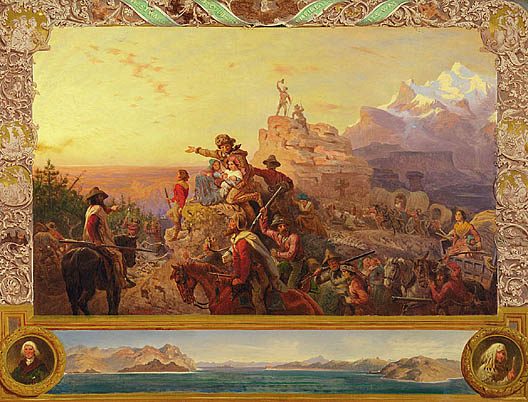
A highly fanciful allegory of the "Manifest Destiny" of the United States conquering the West and laying telegraph wiring. The reality was often enough merely naked aggression.


Manifest Destiny was the belief that the United States was destined to expand from the Atlantic seaboard to the Pacific Ocean. It was the belief that westward expansion was “obviously” right and was the “destiny” of the United States. It was the bastard offspring of that other similar doctrine, the so-called Monroe doctrine.

It was an astonishingly arrogant doctrine.

But it was what many Yankees believed in.

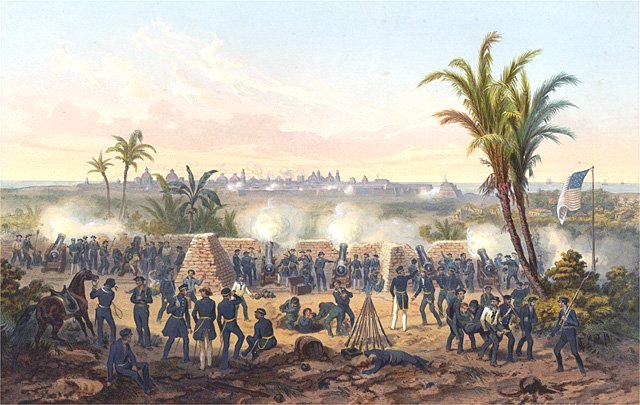
The Battle of Vera Cruz - an episode from the Mexican-American war


The term was first used primarily by Jacksonian Democrats (well, surprise, surprise!!) in the 1840s to promote the annexation of much of Oregon, Texas and much of what was then Mexico.

Even today some Americans still naively believe that it is their country’s job to tell other countries how to run themselves and blockade, or even invade, them if they don’t agree.

In short, exactly the attitude I was criticizing in my posts.

The Guadalupe treaty provided for the ensured safety of pre-existing property rights of Mexican citizens in the transferred territories, which the United States government later all too often dishonoured, just as it had failed to honour its treaty obligations to the native American Indians.

Texas had been annexed by infiltrating Americans into the country as false Catholics and then – when there were enough of them – declaring independence for Texas and asking the US to “protect” the infiltrated American false Catholics (who thereafter quickly reverted to their former heathenism or Protestantism).

After this, President Polk then provoked Mexico into further war so that he could annex the remaining northern parts of Mexico. Polk, a believer in “manifest destiny” and yet another Yankee Freemason and enemy of the Catholic Church, declared a war on 13 May 1845.

Mexico’s subsequent defeat left them with little choice but to accept the United States’ demands, or risk total annexation of Mexico.

The treaty was signed by Nicholas Trist on behalf of the United States on 2 February 1848 just as US troops under the command of General Winfield Scott were occupying Mexico City.


The troops of Gen Winfield Scott occupying Mexico City to force the Mexicans to surrender to unjustified Yankee demands for huge portions of their land and territory


This was the clearest possible example of Yankee bullying, greed, annexation and grand theft of other people’s territory.

And afterwards the US government reneged on parts of the treaty which was supposed to protect the inhabitants of the new territory.

Another fanciful allegory of the belief that civilisation moves westward and so it was the destiny of the USA to kick the Indians and the Spanish off their land illegally, violently and aggressively


Border disputes continued; the United States’s desire to expand its territory continued unabated leading to the equally controversial Gadsden Purchase in 1854.

Land grant claims still persist to this day.

But all too many Yankees simply do not know this - or a great deal else about their own country's history.

...

Some Yankee mothers do have 'em...

It was inevitable that some dumb-bunny would emerge to share their bigotry with us.

Step forward Karen H, aka "Gem of the Ocean".

She has bought the whole, received, Yankee history of "How the West was won" - hook, line and sinker.

And she does not scruple to spew forth racism despite her supposedly being a Catholic.

I'd like to have shared her post with you...

...but it was so crass that I wanted to spare your blushes and her the ignominy.

I suppose one must make allowances for the apparent fact that, according to US government surveys, 58% of people leaving High School in the USA never again read a book.

Karen's blog describes her as a "Right minded woman on the left coast. Catholic. Conservative. All American. Who could ask for anything more?"

Well, Karen, one could ask for quite a lot more, actually.

Racism does not become a Catholic, let alone a Conservative Catholic. Neither does ignorance and neither does crass rudeness and bigotry.

Let's check out the ignorance.

Dear Karen indignantly thinks that I have never heard of the Treaty of Guadalupe Hidalgo and, in high dudgeon, claims that this is how the West was won: the Mexicans ceded all of alta California.

Passing over the fact that my post nowhere denies the existence of the treaty, let us just remember a thing or two about this "great" treaty.

I set it all out in my next post.

Karen's next claim is even more laughable. She claims - again indignantly - that President Abraham Lincoln returned the Catholic missions to the Catholic Church after they had been - so she claims - plundered by the Mexicans.

Here are the facts.

Mexico, constantly infiltrated by pro-Yankee agitators and fifth columnists but also by its own home-grown Freemasons or Spanish ones imported from Europe, suffered numerous revolutions which, despite the Catholicism of the ordinary people, eventually succeeded in eradicating Catholic government from Mexico. The US government constantly supported the anti-Catholic forces with money and arms - hence their repeated success.

The wars and revolutions that Mexico endured cost the country dear. This, and the anti-clericalism of the government, led to the decline of the Spanish missions and they fell into ruin, anti-Catholic Yankees being well content to let the Papist missions fall into disuse.

This was in the 1840s.

By the 1860s most of the missions were in ruins or nearly so. There was thus but little to give back to the Catholic Church and Lincoln's supposed generosity in so doing was very small beer - a cheap gesture indeed.

Catholics must be very careful not to put the myths about their own country above truth, faith and charity.

But Karen seems to think it was all down to some innate defect in the Mexican race.

Not quite, Karen, I'm afraid.

...

Sunday, 13 July 2008

Ramona: a love story of Spanish and Catholic California

Ramona, written by Helen Hunt Jackson in 1884, is the story of a part-Scottish and part-Native American orphan girl growing up under the influence of the Spanish-Mexican missionaries but suffering later from the rapacity, brutality, rapine and murder of the Yankee Americans as they sought to win the West by force and oppression.

Helen Hunt Jackson was the daughter of a Minister and Professor of Classics at Amherst College in Massachusetts. She married an Army Captain who later died at war and she later married a wealthy banker.

The novel was hugely popular, despite its portrayal of the evils of Yankee exploitation. The novel’s impact was great and, once the railroads came, many tourists came looking to see the evidences of the old Mexican ranchero life that still remained from the days of the Spanish Empire.

The story takes place after the American war of annexation of theft in Mexico and is set in Southern California.

Jackson's novel is set in Southern California, shortly after the Mexican-American War. It is about a part-Scottish and part-Indian orphan girl, Ramona is an orphan raised by the sister of his deceased foster mother, Señora Gonzaga Moreno. Señora Moreno detests the rapacious and uncouth Americans whom she is now bound to recognize as her new rulers who have seized most of her lands. But she prefers her own child to Ramona.


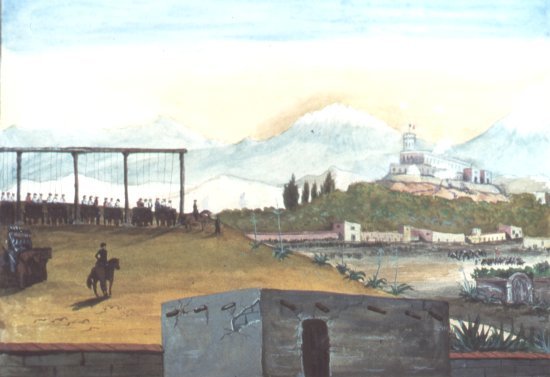
The peace and tranquillity of the Missions before the arrival of the rapacious Yankee


Ramona falls in love with a young Indian shepherd, Alessandro, who is also the son of the Chief of the tribe, Pablo Assis but Señora Moreno will not hear of it so Ramona and Alessandra elope. They live lives of hardship and are, with the new daughter, run off their lands several times by rapacious, greedy, brutal Yankee American freebooters.

Alessandro is driven out of his wits by the unpunished lawlessness of the brutal Yankees and after they are forced into the San Bernadino mountains, Alessandro goes into town and rides off on the horse of one of the Yankee exploiters. The Yankee follows him and shoots him out of hand, knowing that he will not be punished by his fellow Yankees.

This was a fine example of how the West was made “wild” not by the Indians or the Spanish but by the damnable greed and licentiousness of the Yankee land-grabbers.

Fortunately for Ramona, the son of Señora Moreno, Felipe, who long ago fell in love with Ramona, finds her and they are married and go to settle in Mexico.


Helen Hunt Jackson


The novel was written after the appearance of a report, A Century of Dishonor, on the exploitation of American Indians.

Some critics have suggested that the novel romanticized the life round the Spanish missions of the Franciscans, the freedom enjoyed by the native Indians, the dignity of the Spanish señoritas and caballeros, ladies and knights, and of the peons or peasants.


Catholic Mexican gentleman or caballero


However, her account was true. The Franciscans maintained a regime of liberty, peace and religion amongst the Indians with only a handful of Mexican soldiers and there were always many more mission stations than presidios or forts.


Subsequent Yankees have – with low cunning and foul, detestable hypocrisy – sought to pretend that they were bringing civilization to the Indians and were sweeping away the darkness of Romish superstition by defeating the Spanish. They even pretended that they were bringing the Yankee work ethic of “self reliance”.


Yankee cattle-thieves doing their dirty work which they called "rustling" - they had no time for the Christian nobility of the Mexican missionaries and people


This was a convenient lie designed to do no more than cloak the naked greed of the Yankee exploiters. The missionaries treated the native Indians as men like themselves and with dignity. The Yankee exploiters did the opposite.

In fact, the story of the Spanish missions in California is even more romantic, beautiful and holy than the novel itself tells.


It speaks volumes that black-hearted, bigoted and narrow-minded men of low morals and lower culture should seek to pour scorn and lies upon a story of great courage and beauty, whether it be the fiction of Ramona or the beautifully noble reality of the Hispanic missions in California.

But, then, the Devil is always eager to vilify the beautiful things of God.


Our Lady of California, pray for us!
...