Thursday, 24 February 2011

The Penal Laws in England and Ireland

By a series of statutes, successive sovereigns and Parliaments from Elizabeth I to George III, sought to prevent the practice of the Catholic Faith in England.

Catholics lost not only freedom of worship, but civil rights as well; their estates, property, and lives were at the mercy of any informer.

The Penal Laws began with the two Statutes of Supremacy and Uniformity by which Queen Elizabeth I, in 1559, initiated her religious settlement; and her legislation falls into three divisions:

• 1558-70 when the Government trusted to the policy of enforcing conformity by fines and deprivations - Acts of Supremacy and Uniformity (1 Eliz. 1 and 2) and the amending statute (5 Eliz. c. 1); by the Act of Supremacy all who maintained the spiritual or ecclesiastical authority of any foreign prelate, especially the Pope, were to forfeit all goods and chattels and all benefices for the first offence, or if below £20, to be imprisoned for one year; for a second offence, they were liable to the forfeitures of Praemunire, that is, exclusion from the sovereign's protection, forfeiture of all lands and goods, and arrest to answer to the Sovereign and Council and, for the third offence, to the penalties of high treason i.e. the barbaric savagery of hanging, drawing and quartering, corruption of blood by which heirs became incapable of inheriting honours and offices, and all property was forfeit;

• 1570-80 from the date of the excommunication of Queen Elizabeth by Pope St Pius V to the time when the Government tightened the persecution of seminary priests and Jesuits;

• from 1580 to the end of the reign.

The penalty for women was to be burned at the stake.

Yes, really. In Britain.

Don't let anyone tell you that Protestantism got rid of the practice. It was, unfortunately, practised all over Europe.

At least 32 women were thus burned at the stake in England alone between 1735 and 1789. Women supposed to be witches were also burned in many Protestant countries - America included.

The burning of women was not abolished until the Treason Act 1790 in Great Britain and by the Treason by Women Act (Ireland) 1796 in Ireland.

Burning came into law in England in 1401 and was used against the Lollards. It was repealed in 1553 but re-introduced by King Henry VIII. The early Church Fathers had expressly taught against the practice but this was, it seems, ignored.

Execution for treason was not abolished until 1973 and that Act was amended by the Crime and Disorder Act 1998 when the death penalty was abolished and replaced with imprisonment at the discretion of the court, up to life imprisonment.

The first Penal statutes were made stricter by the Amending Act (5 Eliz. c.1) which declared that to maintain the authority of the Pope in any way was punishable by penalties of Praemunire for the first offence and of high treason, without corruption of blood, for the second.


Queen Elizabeth I,
the bastard daughter of King Henry VIII with no right to the throne, she had Catholics tortured and murdered for fear that they would denounce her right to the throne


All who refused the Oath of Supremacy, i.e. an oath swearing that the Queen was the Supreme Governor of the Christian Church, were subjected to the like penalties. The Act of Uniformity, which made the use of the Anglican Book of Common Prayer compulsory for all, punished all clerics who used any other service by deprivation and imprisonment, and everyone who refused to attend the Anglican service by a large fine for each omission.

Some hypocrites even dared to call this totalitarian code of blood by the name of “toleration” and “liberty”.

Coming to the legislation of the second period, there were two Acts directed against the Bull of Excommunication:

13 Eliz. c. 1, which, among other enactments, made it high treason to affirm that the Queen ought not to enjoy the Crown, or to declare her heterodox or schismatic, and

13 Eliz. c. 2, which made it high treason to put into effect any papal Bull of absolution, to absolve or reconcile any person to the Catholic Church, or to be so absolved or reconciled, or to procure or publish any papal Bull or writing whatsoever.

The penalties of Praemunire were enacted against all who brought into England or who gave to others Agnus Dei or articles blessed by the Pope or by any one through faculties from him.

A third act, 13 Eliz. c. 3, which was designed to stop Catholics from taking refuge abroad, declared that any subject departing the realm without the queen's licence, and not returning within six months, and should forfeit the profits of his lands during life and all his goods and chattels.

The third and most severe group of statutes begins with the "Act to retain the Queen's Majesty's subjects in their obedience" (23 Eliz. c. 1), passed in 1581.

This made it high treason to reconcile anyone or to be reconciled to "the Romish religion", prohibited Mass under penalty of a fine of two hundred marks, a simply enormous sum in those days, and imprisonment for one year for the celebrant, and a fine of one hundred marks and the same imprisonment for those who heard the Mass.

This act also increased the penalty for not attending the Anglican service to the sum of twenty pounds a month, or imprisonment till the fine be paid, or till the offender began to attend the Anglican services.

A further penalty of ten pounds a month was inflicted on anyone keeping a schoolmaster who did not attend the Anglican services. The schoolmaster himself was to be imprisoned for one year.

The climax of Elizabeth's persecution was reached in 1585 by the "Act against Jesuits, Seminary priests and other such like disobedient persons" (27 Eliz. c. 2).

This statute, under which most of the English martyrs suffered, made it high treason for any Jesuit or any seminary priest simply to be in England at all, and felony for anyone to harbour or relieve them.


St Edmund Campion SJ, scholar, poet, priest and martyr.
Jesuits were, for their intelligence and loyalty, among the most savagely persecuted of all Catholics


The penalties of Praemunire were imposed on all who sent assistance to the seminaries abroad, and a fine of 100 pounds for each offence on those who sent their children overseas without the royal licence.

The last of Elizabeth's laws was the "Act for the better discovery of wicked and seditious persons terming themselves Catholics, but being rebellious and traitorous subjects" (35 Eliz. c. 2). Its effect was to prohibit all recusants from removing more than five miles from their place of abode, and to order all persons suspected of being Jesuits or seminary priests, and not answering satisfactorily, to be imprisoned till they did so.

The hopes of the Catholics on the accession of James I were soon dispelled, and during his reign (1603-25) five very oppressive measures were added to the statute-book. In the first year of his reign there was passed the "Act for the due execution of the statute against Jesuits, seminary priests, etc." (1 Jac. I, iv) by which all Elizabeth's statutes were confirmed with additional aggravations.

The carefully arranged "discovery" of the Gunpowder Plot in 1605 was followed by two statutes of particularly savage character. This plot was almost certainly a set up arranged by Lord Burghley so as to set up Catholics as stool pigeons.


The Gunpowder Plot was almost certainly a put up job arranged by Lord Burghley to set up and defame Catholics, Certainly all the Catholic clergy warned straitly against it in confession and spiritual counsel


These were "An Act for the better discovering and repressing of Popish Recusants" (3 Jac. I, iv) and "An Act to prevent and avoid dangers which may grow by Popish Recusants" (3. Jac. 1, v).

The first of these two unjust, grossly intolerant and oppressive laws enacted that all convicted recusants should communicate once a year in the Anglican church under penalties of 20 pounds for the first omission, 40 pounds for the second, and 60 pounds for the third.

Moreover the King was to be allowed to refuse the penalty of 20 pounds per month for non-attendance at the Anglican Church, and to take in its place all the personal property and two-thirds of the real property of the offender.

But the main point of this Act was the new and even more oppressive Oath of Allegiance which it prescribed.

Yet all who refused it were to be subjected to the penalties of Praemunire, except married women, who were to be imprisoned in the common jail. Finally, every householder of whatever religion was liable to a fine of 10 pounds a month for each guest or servant who failed to attend the Anglican Church.

The second Act was even worse, and the Catholic historian Tierney justly says of it that it "exceeded in cruelty all that had hitherto been devised for the oppression of the devoted Catholics".


The Penal Laws against Roman Catholics in Britain are among the most comprehensively savage and oppressive of laws ever put together by a government against a minority religion. They are a disgrace to the name of English law, to Englishmen generally and to the nation as a whole. Americans who think they are any better are fooling themselves. The same laws applied in America!


It prohibited recusants from remaining within ten miles of the city of London, a provision which it was impossible to carry out; or to remove more than five miles from their place of residence till they had obtained licence from four magistrates and the bishop of the diocese or lieutenant of the county.

They were disabled from practising as lawyers, physicians, apothecaries (i.e. doctors); from holding office in any court or corporation; from holding commissions in the army or navy, or any office of emolument under the State; from discharging the duties of executors, administrators, or guardians.

Any married woman who had not received the sacrament in the Anglican Church for a year before her husband's death forfeited two-thirds of her dowry, two-thirds of her jointure, and was debarred from acting as executrix to her husband or claiming any part of his goods.

Husbands and wives, if married otherwise than by an Anglican minister in an Anglican church, were each deprived of all interest in the lands or property of the other. They were fined 100 pounds for omitting to have each of their children baptised by an Anglican minister within a month of birth.

All Catholics going or being sent beyond the seas without a special licence from the King or Privy Council were incapable of benefiting by gift, descent, or devise, till they returned and took the Oath of Allegiance; and in the meantime the property was to be held by the nearest Anglican heir.

And, lastly, every convicted recusant was excommunicated from the Established Church, with the result that they were debarred from maintaining or defending any personal action or suit in the civil courts. Their houses were liable to be searched at any time, their arms to be seized, and any books or furniture which were deemed superstitious to be destroyed.

The two remaining statutes of James I were "An Act to cause persons to be naturalized or restored in blood to conform and take the oath of allegiance and supremacy" (7 Jac. 1, ii) and "An Act for the reformation of married recusant women, and administration of the oath of allegiance to all civil, military, ecclesiastical and professional persons" (7 Jac. I, vi). The chief effect of this latter act was to cause the oath to be offered to all persons over eighteen, and to empower the committal to prison of any recusant married woman, unless her husband paid 10 pounds a month for her liberty.

During the reign of Charles I, the only penal statute was a short "Act to restrain the passing or sending of any to be Popishly bred beyond the Seas" (3 Car. 1, iii), which re-enacted the provisions in 3 Jac. 1, c. 5, adding that offenders should be disabled from prosecuting any legal actions in law or in equity; from acting as guardian, executor, or administrator; receiving any legacy or deed of gift, or bearing any office within the realm. Moreover, such offender was to forfeit all his lands and personal property.
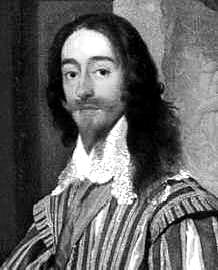

King Charles I
married to a Catholic, sought to temper the Penal Laws but was forced by Parliament to do otherwise. In the end, he suffered a martyr's death himself at the hands of a savagely Protestant Parliament.


After the Restoration in 1660, an attempt was made by Charles II, not unmindful of the sacrifices Catholics had made in the Stuart cause, to obtain a repeal of the Penal Laws, and a committee of the House of Lords was appointed to examine and report on the question. The matter, however, was allowed to drop; and in the following year both Houses of Parliament joined in petitioning the King to issue a proclamation against the Catholics.

Further efforts on the part of the King came to nothing, and matters remained on the same footing till the latter part of his reign, when new statutes of a harassing nature were passed.

With the exception of the Corporation Act (13 Car. II, St. 2, c. 1) which was not aimed against Catholics directly, but which provided that no person could hold any municipal office without taking the Oaths of Allegiance and Supremacy and receiving the Sacrament in the Anglican Church, no new measures were introduced till 1673, when Parliament passed the Test Act (25 Car. II, ii). This required all officers, civil and military, to take the same Oaths and to make a Declaration against Transubstantiation.

Five years later another Act was passed (30 Car. II, St. 2), which excluded all Catholics from sitting or voting in Parliament, by requiring every member of either House to take the two oaths and to make the Declaration against Popery which, for a Catholic, was highly blasphemous.

From this statute, which was entitled "An Act for the more effectual preserving the King's person and government, by disabling Papists from sitting in either House of Parliament", a special exception was made in favour of the Duke of York, afterwards King James II, who was himself a Catholic.

With the Revolution of 1688 began a whole new era of persecution.


The Dutch Prince of Orange
illegally invaded Britain with the help of English traitors and so became King William III with the aim of excluding Catholics from the throne and persecuting and oppressing Catholics all the more so that Anglicans enriched by the spoliation of the monasteries might not be called to account. William had no children, is thought to have been homosexual and died out riding when his horse stumbled over a mole hill. Ever after Jacobite have saluted the mole as "the little gentleman in black velvet".


The "Act for further preventing the growth of Popery" (11 & 12 Gul. III, 4), passed in 1699, introduced a fresh hardship into the lives of the Roman Catholic clergy by offering a reward of 100 pounds for the apprehension of any priest, with the result that Catholics were placed at the mercy of common informers who harassed them for the sake of gain, even when the Government would have left them in peace.

It was further enacted that any Roman Catholic bishop or priest exercising episcopal or sacerdotal functions, or any Roman Catholic keeping a school, should be imprisoned for life; that any Catholic over eighteen not taking the Oaths of Supremacy and Allegiance, or making the Declaration against Popery, should be incapable of inheriting or purchasing any lands; and any lands devised by will to a Catholic who refused to take the oaths should pass to the next of kin who happened to be an Anglican.

A reward of 100 pounds was also offered for the conviction of any Catholic sending children to be educated abroad. The cruel operation of this Act, which made itself felt throughout the ensuing century, was extended by a measure passed under Queen Anne (12 Anne, St. 2, c. 14), though Catholics were not generally molested during her reign.

The last penal statutes to be enacted were those of George I.


Prince George of Hanover
was invited by Parliament to become king, after Queen Anne died, because he was the nearest Protestant relative. Fully 57 other people had a better claim to the throne than he but they were all Roman Catholics. George arrived at Dover with a mistress on each arm and, when he was booed, called out in bad English with a thick German accent "my people, I have come for your goods". A wag in the crowd replied "Aye, and our chattels, too!". George I imprisoned his innocent wife in a German castle for over 30 years. He was the first of a line of Hanoverian rotters.


By 1 Geo., 1, St. 2, c. 13, the Hanoverian Succession Oaths were to be taken by all Catholics to whom they were tendered, under penalty of all the forfeitures to which "popish recusant convicts" were liable.

Not surprisingly, all over Britain people were ready to rise up against the oppressive government that cruelly persecuted the innocent with these odious laws. So began the series of Jacobite risings aimed at restoring the Stuart dynasty which had been excluded from the throne for no other reason than that, since King James II, the heirs-apparent were Roman Catholics.

The Stuart or Jacobite rising of 1715 was followed by another Act (1 Geo. 1, St.2., c.50) appointing commissioners to inquire into the estates of popish recusants with a view to confiscating two-thirds of each estate.

The scope of "An Act to oblige papists to register their names and real estates" (I. Geo. I. St. 2. c. 55) is sufficiently indicated by its title.

It added to the expense of all transactions in land, the more galling as Catholics were doubly taxed under the annual land-tax acts, e.g. by also 4 Geo. III, c. 60.

In 1722 was passed "An Act for granting an aid to his Majesty by levying a Tax upon Papists" (9 Geo. I, 18), by which the sum of one hundred thousand pounds was wrung from the already impoverished and oppressed Catholics.

Happily, throughout the reign of George II (1727-60) there were no further additions to the penal code and under his successor, George III, (1760-1820), the work of repeal was at last commenced.

Yet, even the foregoing does not enumerate all the Penal Laws against Roman Catholics.

The task of repeal was a long, slow, gradual, and complicated one, the chief measures of relief being three: The first Catholic Relief Act of 1778, which enabled Catholics to inherit and purchase land and repealed the Act of William III, rewarding the conviction of priests; the second Relief Act of 1791, which relieved all Catholics who took the oath therein prescribed from the operation of the Penal Code, and, finally, the Catholic Emancipation Act of 1829 which removed the last of the Penal Acts.

The only disqualifications against Catholics which appear to be still in force are those which prohibit the sovereign from being or marrying a Catholic, or any Catholic subject from holding the offices of Lord Chancellor, Prime Minister or Lord Lieutenant of Ireland or, until the recent appointment, of being British Ambassador to the Holy See.

For this reason, two sons of HRH the Duke of Kent are excluded from succession to the throne, that is, the Earl of St Andrews, who married a Roman Catholic, Sylvana Tomaselli, and Lord Nicholas Windsor who became a Roman Catholic and married Princess Paola Doimi de Lupis de Frankopan, of the former Croatian royal family, in the Vatican City State, the first British royal ever so to do.


Lord and Lady Nicholas Windsor and son.
Lord Nicholas is the son of the Duke of Kent and converted to Catholicism and Lady Nicholas, born Princess
Paola Doimi de Lupis de Frankopan, descends from Croatian royalty and Italian nobility.


Their mother, HRH the Duchess of Kent also became a Roman Catholic in 1994. Edward Windsor, Lord Downpatrick, son to the Earl of St Andrews, when he succeeds, will be the first Catholic Duke of Kent since the Reformation. Interestingly, the current Duke is the Grand Master of the English Freemasons, so their family is, from one point of view, a fascinating example of modern ecumenism and religious toleration.


O holy martyrs of England, Scotland, Wales and Ireland, pray for us!


...

Sunday, 20 February 2011

Motu Proprio under threat! Sign the Petition!

There are ugly rumours doing the rounds that there is to be a "clarification" of the Motu Proprio Summorum Pontificum.

The position is very confusing and unclear.

The time has come for action.

May I urge you all to sign the petition posted by the New Liturgical Movement blog?

Here is the introduction to the petition:

"This appeal came out of information coming from a variety of sources, suggesting that the forthcoming Instruction on Summorum Pontificum may contain restrictive elements (or, at very least, elements that could be interpreted restrictively) thereby having the adverse effect of limiting the motu proprio Summorum Pontificum in some manner – or at least making this more possible.

Obviously, we do not presume to know what the text may say. However, in checking in with a variety of our own sources, we have confirmed that there is a very real and substantive reason for some concern here. Substantial enough that a joint, multi-blog, international appeal has been launched: http://www.motuproprioappeal.com/

The appeal does not presume to know or state what the actual contents of this proposed instruction are, however, in the light of the aforementioned reports, and given credible confirmations that there is reason for concern, it simply wishes to calmly and respectfully share our concern with the Holy Father about this potentiality, asking that, whatever is finally released, that the integrity of the letter and the spirit of the
motu proprio Summorum Pontificum be preserved.

If, in the end , there is nothing to any of this, then we shall all be very thankful indeed. But if there is substance to this, then at least our concern will have been respectfully voiced to our pastors and to our beloved Holy Father.

Who should then sign this? Everyone who is concerned with liturgical patrimony and mutual enrichment. Whether you are attached to the Ordinary Form and see a reform of the reform, a re-enchantment, as your primary liturgical focus, or the
usus antiquior, the other Western liturgical rites/uses, or even are an Eastern Christian, I believe we all have something potentially at stake here, either in practice, in effect, or in principle at very least."

Well said!

Please, therefore - sign the petition now!

Thank you and God bless you all!


God protect our Pope!

...

Revolution is not the answer in the Arab world or anywhere...

No folks - revolution is not the answer.

So pray for the Arab world that is now under threat from revolutionaries.

Has anyone else noticed how the Kings have been restrained but the republics, with notable exceptions, have not?

Thus the King of Bahrain has withdrawn the police and the army but Colonel Qaddafi has already started massacring people in Libya.

And there are still some deluded people in the West who actually think this is all just part of a movement for democracy in the Middle East.

Time to wake up.

Sunday, 13 February 2011

Revolution: the voice of the people or just manipulation by agitators?

Following the nearly three weeks of protests in Egypt, and the departure of President Hosni Mubarak, the Egyptian army council has dissolved parliament and suspended the constitution.

What does it portend?

Freedom and democracy?

Or something sinister?

The scene of the demonstrations, Tahrir Square in Cairo, is still filled with crowds and attempts by the army and police to move demonstrators has met with opposition.

Apparently, the "revolution" is continuing, at least in the minds of some demonstrators.

Some news reports have quoted demonstrators saying that this is a movement of the people without leaders and without the need for leaders.

Only a fool would believe such a thing.

There are leaders - of that one may be certain - even if they are hidden. Indeed, protest "leaders" are already planning to set up a "monitoring council" which clearly shows that there is, indeed, a leadership. But who are they?

The military government has promised to abide by all Egypt’s international treaties until parliamentary elections take place in six months time.

Extraordinarily, Switzerland has frozen assets belonging to President Mubarak and Britain and America are being urged to do the same.

The chutzpah and sheer arrogance of US President Barack Obama has been quite incredible. Considering the Democrat Party's claim to be the party of self-determination, independence and "freedom", it is frankly little short of astonishing that Obama thinks he has the right to demand that President Mubarak leave office.

Back off Obama - it's not your country!


Is this the new "Obama girl"?


Needless to say Tony Blair and those of his ilk are also claiming that the army take-over is a good thing.

In fact, the suspension of the Constitution and Parliament looks like a revolution.

What next?

The Muslim Brotherhood will not be happy with the kind of Western democracy that the media think is coming and anything less than democracy may well mean that the demonstrators are back but this time they may have to face the police and the military.

As with most revolutions, the revolutionaries now think they have the sole right to choose the rulers and therein lies the danger.

Extremists can exploit the divisions and the next stage may well be instability.

Remember what happened to Iran when the Shah fell.

Israel and other nearby nations are understandably fearful of developments.

The sad truth is that, often enough, it takes a strong leader to keep some Islamic nations stable and peaceful.

But Obama need not care - he is thousands of miles away from the danger zone!

And oh how quickly he forgets how he so often used to advance the hand of warm friendship to President Mubarak.

Now his tune seems to be: "Forget it, Hosni, you're yesterday's man and I'm Barack Obama who always backs the latest fashion!"


Presidents Obama and Mubarak warmly shake hands in former days before Obama had yet to turn a cat in the pan and dump his old friend.


...

Thursday, 10 February 2011

The glory of God is living man - not veganism

The leaf-eaters are back!

The latest says this:

"Aren't humans amazing? They kill wildlife - birds, deer, all kinds of cats, coyotes, beavers, groundhogs, mice and foxes by the million in order to protect their domestic animals and their feed.

Then they kill domestic animals by the billion and eat them. This in turn kills people by the million, because eating all those animals leads to degenerative - and fatal - health conditions like heart disease, stroke, kidney disease, and cancer.

So then humans spend billions of dollars torturing and killing millions more animals to look for cures for these diseases.

Elsewhere, millions of other human beings are being killed by hunger and malnutrition because food they could eat is being used to fatten domestic animals.

Meanwhile, few people recognize the absurdity of humans, who kill so easily and violently, and then call for Peace on Earth".


He's quoting (apparently) from the "Revised Preface to Old MacDonald's Factory Farm" by C. David Coates, so he says.

And - you guessed it - of course he, she or it is a vegan.


Mr Shark will insist on eating meat but no vegan or animal libbers ever campaigned against his cruelty. Why not - if animals are equal to humans?


Let's analyse, shall we?

They kill wildlife - birds, deer, all kinds of cats, coyotes, beavers, groundhogs, mice and foxes by the million in order to protect their domestic animals and their feed.

Nope.

They kill birds, deer and other animals to eat.

They kill coyotes and wild cats to protect other humans, particularly children.

They kill rats, foxes, mice and other vermin to prevent the spread of disease.

Wrong, Mr Vegan!

Then they kill domestic animals by the billion and eat them.

Nope.

You can count on the toes of one hand the number of people who freely choose to kill and eat their own domestic cats and dogs.

Wrong, Mr Vegan!

Who eats domestic dogs? No-one, of course, unless they are literally starving and probably not even then. Wake up, Mr Vegan!


This in turn kills people by the million, because eating all those animals leads to degenerative - and fatal - health conditions like heart disease, stroke, kidney disease, and cancer.

Nope.

Eating animals that you hunt and kill is healthy and avoids those diseases.

It is eating the factory-farmed poisonous garbage that fast food and factory producers spew out onto the market that kills humans.

But Mr Vegan is too busy denying nature to worry about that.

Wrong, again, Mr Vegan!

So then humans spend billions of dollars torturing and killing millions more animals to look for cures for these diseases.

Nope.

The science industry pretends to do that but actually it wastes most of its time pursuing ridiculous schemes simply in order to preserve jobs.

But Mr Vegan is too busy denying nature to worry about that.

Wrong, again, Mr Vegan!

Elsewhere, millions of other human beings are being killed by hunger and malnutrition because food they could eat is being used to fatten domestic animals.

Nope.

There is more food available now than ever before and enough to keep feeding the whole world over and over. It does not reach the starving or poor because of selfish and corrupt political regimes, not because of meat-eaters.

But Mr Vegan is too busy denying nature to worry about that.

Wrong, again, Mr Vegan!

Meanwhile, few people recognize the absurdity of humans, who kill so easily and violently, and then call for Peace on Earth.

Nope.

The real absurdity is represented by those human beings who refuse to address the real issues and instead go down the blind alley of pretending that meat-eating is unnatural when most of the animal kingdom does precisely that.

Do vegans campaign against animals who eat meat?

No.

Yet, they think animals are the equal of humans.

Well, then?

Go tell those meat-eating animals to stop at once!

Then there are those animal lib terrorists who set fire to laboratories or put poison in products in order to kill human beings.

It is they who “kill so violently and easily and then call for peace on earth”.

Animal libbers claim to be for peace and against violence but will hypocritically put poison in products and set fire to laboratories.


Fortunately not too many people take these hypocrites at all seriously.

God gave us nature to use and enjoy for our own benefit. We should use it wisely and sustainably but that does not mean we should not use it.

Every animal uses nature for sustenance and enjoyment.

Human beings, however, have the greater right because humans are not merely animals. They are rational beings created in the image of God.

Animals do not have rational souls. Where are the animal writings, works of art, poetry and literature, science and scholarship? Where are the animal works of architecture? Where are the animal space programmes? Where are the animal works of mercy and charity? Where are the animal governments, laws and constitutions?


What animal can compose music, let alone music of the sublime quality of Allegri's
Miserere?

None?

Too all but an animal libber, it is perfectly clear that humans are vastly superior to animals in every way.

Animals have their place but man is far higher and created in the image of the Divine Creator.

Man also has free will so man can do evil. Then he falls far below any animal and becomes more like a devil. But that is the consequence of having free will.

Animal libbers would have us all behave like animals but, in so doing, we would all become more like devils, not animals.

Hitler, let us not forget, was an animal libber.

If man chooses good then he becomes more and more himself and more and more the image of He who made him.

Thus, then, says St Irenaeus:

"the glory of God is living man”


St Irenaeus, pray for us!


...

Saturday, 22 January 2011

Showing Christ to the Gentiles: the Season of the Epiphany


The Epiphany


of the Lord

to the Gentiles

on the same day as later occurred

the Baptism of the Lord

and

the miracle of wine at the wedding feast in Cana of Galilee


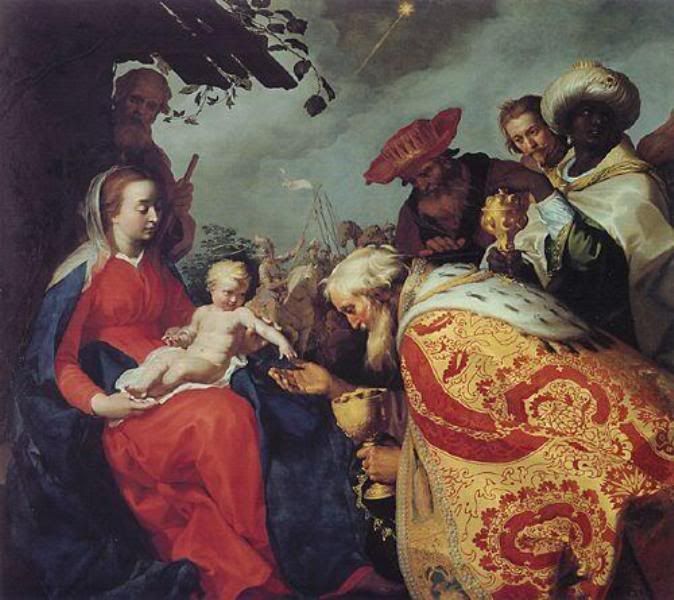
Whom Kings adore...

"When Jesus therefore was born in Bethlehem of Juda, in the days of king Herod, behold, there came wise men from the East to Jerusalem, saying: where is he that is born king of the Jews? For we have seen his star in the East, and are come to adore him. And king Herod hearing this, was troubled, and all Jerusalem with him. And assembling together all the chief priests and the scribes of the people, he inquired of them where Christ should be born. But they said to him: In Bethlehem of Juda. For so it is written by the prophet: and thou Bethlehem the land of Juda art not the least among the princes of Juda: for out of thee shall come forth the captain that shall rule my people Israel.

Then Herod, privately calling the wise men learned diligently of them the time of the star which appeared to them; and sending them into Bethlehem, said: go and diligently inquire after the child, and when you have found him, bring me word again, that I also may come and adore him. Who having heard the king, went their way; and behold the star which they had seen in the East, went before them, until it came and stood over where the child was. And seeing the star they rejoiced with exceeding great joy. And entering into the house, they found the child with Mary his mother, and falling down they adored him: and opening their treasures, they offered him gifts; gold, frankincense, and myrrh. And having received an answer in sleep that they should not return to Herod, they went back another way into their country."

[Matt 2:12 - Gospel for the Mass of the Epiphany]


The shrine of the Three Kings at Cologne Cathedral


The Shrine of the Three Kings in Cologne Cathedral contains their relics brought from Milan by ship to the City of Cologne on the order of the Holy Roman Emperor, Frederick Barbarossa, in 1164 as a gift to the Prince-Elector Archbishop, Rainald of Dassel.

This gave rise to the English Carol "I Saw Three Ships Come Sailing in".

The relics had first been taken from Constantinople to Milan in 344 by Bishop Eustorgius of Milan.

Around 1199, the Roman Emperor Otto IV gave three golden crowns made for the three wise men as a present to the church of Cologne, the city where, the previous year, he had been elected King of the Romans and Emperor-elect by the Prince-Electors of the Empire (he later gained the support of all the imperial princes at Frankfurt in 1208).

An inscription reads:

Otto rex coloniensis curiam celebrans tres coronas de auro capitibus trium magorum imposuit.

Otto the King, the court of Cologne celebrating, gave three golden crowns for the heads of the three Magi.

Emperor Otto IV was the only member of the Welf dynasty to be elected Holy Roman Emperor and, being the son of Matilda Plantagenet (married to Henry the Lion, Duke of Bavaria), he was allied to England in the Franco-English wars. He was also the personal preference of Pope Innocent III, who crowned him Roman Emperor at Rome in 1209, although they later fell out over the issue of the imperial rights in Italy.

Because of the importance of the shrine and the cathedral for the later development of the city, the Coat of Arms of Cologne still shows these three crowns symbolizing the Three Kings.

Construction of the present Cologne Cathedral was begun in 1248 to house these important relics. The cathedral took 632 years to complete and is now the largest Gothic church in northern Europe.

On July 20th, 1864, the shrine was opened, and the remains of the three Kings and the coins of Philipp von Heinsberg, Archbishop of Cologne, were discovered.

An eyewitness report reads:

“In a special compartment of the shrine now there showed - along with remains of ancient old rotten or moulded bandages, most likely byssus, besides pieces of aromatic resins and similar substances - numerous bones of three persons, which under the guidance of several present experts could be assembled into nearly complete bodies: the one in his early youth, the second in his early manhood, the third was rather aged. Two coins, bracteates made of silver and only one side striken, were adjoined; one, provably from the days of Philipp von Heinsberg, displayed a church, the other showed a cross, accompanied by the sword of jurisdiction, and the crozier on either side.”

The bones were wrapped in white silk and returned to the shrine where they remain to this day to be venerated by all the Faithful.

By long tradition, on the Feast of the Epiphany – called Dreikoenigsfest (the Feast of the Three Kings) in the lands of the old Holy Roman Empire – the Rector of the Parish (or in his absence, the father of each family) visits each house with a cross-bearer, 2 acolytes and 3 children dressed as the kings, one bearing a censer with lighted incense. At each house a little ceremony takes place, the house is blessed with Epiphany water, and over the door lintel of the house the following is inscribed with blessed chalk:

20 + C + M + B + 11

In my house we always perform this traditional ceremony.

This symbolises the present year and the blessing of the three Magi, Caspar, Melchior and Balthazar, upon each home.

The symbols remain all year or until the weather has washed them away.

Blessed Caspar, Melchior and Balthazar, wise men and kings from the East, pray for us!


+


The Journey of the Magi

by T S Eliot


A cold coming we had of it,
Just the worst time of the year
For a journey, and such a long journey:
The ways deep and the weather sharp,
The very dead of winter.
And the camels galled, sore-footed, refractory,
Lying down in the melting snow.
There were times when we regretted
The summer palaces on slopes, the terraces,
And the silken girls bringing sherbet.
Then the camel men cursing and grumbling
And running away, and wanting their liquor and women,
And the night-fires going out, and the lack of shelters,
And the cities dirty and the towns unfriendly
And the villages dirty and charging high prices:
A hard time we had of it.
At the end we preferred to travel all night,
Sleeping in snatches,
With the voices singing in our ears, saying
That this was all folly.

Then at dawn we came down to a temperate valley,
Wet, below the snow line, smelling of vegetation;
With a running stream and a water mill beating the darkness,
And three trees on the low sky,
And an old white horse galloped away in the meadow.
Then we came to a tavern with vine-leaves over the lintel,
Six hands at an open door dicing for pieces of silver,
And feet kicking the empty wineskins.
But there was no information, and so we continued
And arrived at evening, not a moment too soon
Finding the place; it was (you may say) satisfactory.

All this was a long time ago, I remember,
And I would do it again, but set down
This set down
This: were we led all that way for
Birth or Death? There was a Birth, certainly,
We had evidence and no doubt. I had seen birth and death,
But had thought they were different; this Birth was
Hard and bitter agony for us, like Death, our death.
We returned to our places, these Kingdoms,
But no longer at ease here, in the old dispensation,
With an alien people clutching their gods.
I should be glad of another death.


+ + +

"three trees on the low sky... I should be glad of another death."


...

The Nativity of Christ: Christmastide does not end until Candlemas, 2nd February


O most Holy Night...

...all the earth being at peace...


Anton Raphael Mengs. Adoration of the Shepherds.


"And Joseph also went up from Galilee out of the city of Nazareth, into Judaea to the city of David, which is called Bethlehem, because he was of the house and family of David, to be enrolled with Mary, his espoused wife, who was with child. And it came to pass, that when they were there, her days were accomplished that she should be delivered. And she brought forth her firstborn Son and wrapped Him in swaddling clothes, and laid Him in a manger, because there was no room in the Inn. And there were in the same country shepherds watching and keeping the night watches over their flock. And behold an Angel of the Lord stood by them and the brightness of God shone round about them, and they feared with a great fear. And the Angel said to them 'Fear not; for behold I bring you tidings of great joy that shall be to all people. For this day is born to you a Saviour who is Christ the Lord, in the city of David. And this shall be a sign unto you: you shall find the Infant wrapped in swaddling clothes and laid in a manger'. And suddenly there was with the Angel a multitude of the heavenly host, praising God and saying 'Glory to God in the highest and on earth peace to men of good will.' "

[Luke 2:4-14]
[The Gospel of the Nativity of Our Lord, the first Mass of Christmas at midnight]


OCTAVO KALENDAS JANUARII
The Eighth Day before the Calends of January, being
CHRISTMAS DAY


In the 5199th year of the creation of the world, from the time when God in the beginning created the heavens and the earth;

the 2957th year after the flood;

the 2015th year from the birth of Abraham;

the 1510th year from Moses, and the giving forth of the people of Israel from Egypt;

the 1032nd year from the anointing of King David;

in the 65th week according to the prophesy of Daniel;

in the 194th Olympiad;

the 752nd year from the foundation of the City of Rome;

the 42nd year of the rule of Octavian Augustus,

all the earth being at peace,

JESUS CHRIST

the eternal God,
and Son of the eternal Father,
desirous to sanctify the world by His most merciful coming,
being conceived by the Holy Spirit,
nine months after His conception
was born in Bethlehem of Judaea,
MADE MAN OF THE VIRGIN MARY.

THE NATIVITY OF OUR LORD JESUS CHRIST ACCORDING TO THE FLESH

[From the Martyrology of Christmas Day
sung at the old Office of Prime in Cathedral Chapters and Monasteries of the Latin rite of the Roman Catholic Church, to an ancient chant by a dignitary in Choir recalling the Septuagint chronology. All others in Choir remain standing throughout until the lector comes to the word "Bethlehem" at which all bend the knee unto the ending.]


O Emmanuel,
Rex noster et legifer noster, expectatio Gentium, et Salvator earum: veni ad salvandum nos, Domine Deus noster.

O Emmanuel,
our King and Lawgiver, the desire of the nations and the Saviour thereof, come to save us, O Lord our God.

[Isaias 7:14,33,22]
[The 7th of the Great 'O Antiphons' of Advent, sung at Vespers in the Roman rite for the last 7 days of Advent]


Puer natus est nobis,
et filius datus est nobis, cujus imperium super humerum ejus et vocabitur nomen ejus, magni consilii Angelus.

Unto us a child is born,
a Son is given, and the government shall be upon His shoulder and His name shall be called Wonderful Counsellor"

[Isaias 9:6]
[Introit of the third Mass of Christmas, during the daytime]


Happy Christmas to all!


...