Thursday, 23 October 2008

St Hubert against the vegetarian Nazis

St Hubert, pray for us!


Notoriously, the odious totalitarian oppressor, heretic and mass-murderer, Adolf Hitler, was not only a vegetarian but also a teetotaller and a non-smoker.

Here is an extract from the Neugeist/Die Weisse Fahne, the German magazine of the New Thought Movement:

"Do you know that your Führer is a vegetarian, and that he does not eat meat because of his general attitude toward life and his love for the world of animals? Do you know that your Führer is an exemplary friend of animals, and even as a chancellor, he is not separated from the animals he has kept for years?...The Führer is an ardent opponent of any torture of animals, in particular vivisection, and has declared to terminate those conditions...thus fulfilling his role as the saviour of animals, from continuous and nameless torments and pain".

(Source: Wuttke-Groneberg, W. 1980. Medizin im Nationalsozialismus. Tübingen: Schwabische Verlaggesellschaft).

But he had no compunction about causing humans pain, death and terrible suffering!

Hitler disapproved of cosmetics since they contained animal by-products. He frequently teased his mistress Eva Braun about her habit of wearing makeup. In his post-war reminiscence The Enigma of Hitler, Belgian SS General, and friend of Hitler, Léon Degrelle wrote:

"He could not bear to eat meat, because it meant the death of a living creature. He refused to have so much as a rabbit or a trout sacrificed to provide his food. He would allow only eggs on his table, because egg-laying meant that the hen had been spared rather than killed."

(Sources: Hitler, Adolf. 2000. Hitler's Table Talk: 1941-1944. Enigma Books; Wilson, Bee. "Mein Diat - Adolf Hitler's diet", New Statesman. 9 Oct 1988).

He had no such tenderness of conscience over the killing of millions of souls whom he well knew were "living creatures"!
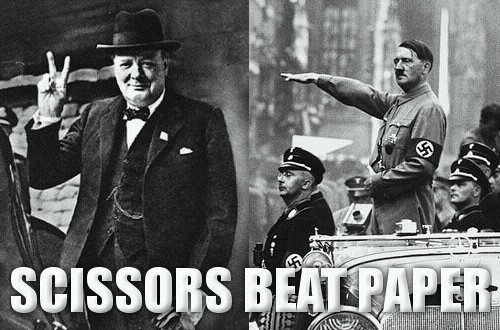

Fun-loving, game-eating, whisky-drinking, cigar-smoking, hunt-loving, aristocratic conservative defeats odious, teetotalling, non-smoking, vegetarian, anti-hunting, Socialist fanatic!


Hitler was, notoriously, a teetotaller, non-smoking, vegetarian, Socialist fanatic.

He also hated his native Austria-Hungary and its aristocracy and ruling Habsburg dynasty as is evident from this infamous book, Mein Kampf, in which he writes:


"Did we not know, even as little boys, that this Austrian state had and could have no love for us Germans?

Our historical knowledge of the works of the House of Habsburg was reinforced by our daily experience. In the north and south the poison of foreign nations gnawed at the body of our nationality, and even Vienna was visibly becoming more and more of an un-German city...

In the course of this book I shall have occasion to take up this problem at length. Here it suffices to state that even in my earliest youth I came to the basic insight which never left me, but Only became more profound:

That Germanism could be safeguarded only by the destruction of Austria, and, furthermore, that national sentiment is in no sense Identical with dynastic patriotism; that above all the House of Habsburg was destined to be the misfortune of the German nation."


So much for the Pan-Germanist, Socialist, vegetarian, non-smoking, teetotalling, anti-Habsburg, racist, murderer Adolf Hitler. See what a danger such fanatics are?

He also hated, in equal measure, both hunting and the aristocrats who had, traditionally, engaged in the chase. He called the aristocrats, the "Purple International" and designated them an enemy of the Nazi state.


The Archduke Franz Ferdinand, here with his daughter, was a devout Catholic, humane and wise leader, and was fond of the chase


HIRH the Archduke Franz Ferdinand of Austria-Este was possessed of a just, humane and civilised mind, was a good father and husband, and a wise ruler who intended to bring in a Federal constitution for the people of Austria-Hungary when he became Emperor but he was assassinated, togther with his pregnant wife, Archduchess Sophie, by a Serbian fanatic who thought his Socialist nationalist ideas more important than human life.

The Archduke was fond of the chase and a great hunter, as well as a devout and faithful Catholic.

The fanatics who sought his life were also responsible for the greatest mass slaughter of human life in history until that time - the First World War.


Hunt game, not humans!


...

Hunt game, not humans - free hunting, stop aborting!


The Feast of St Hubert is on 3 November.

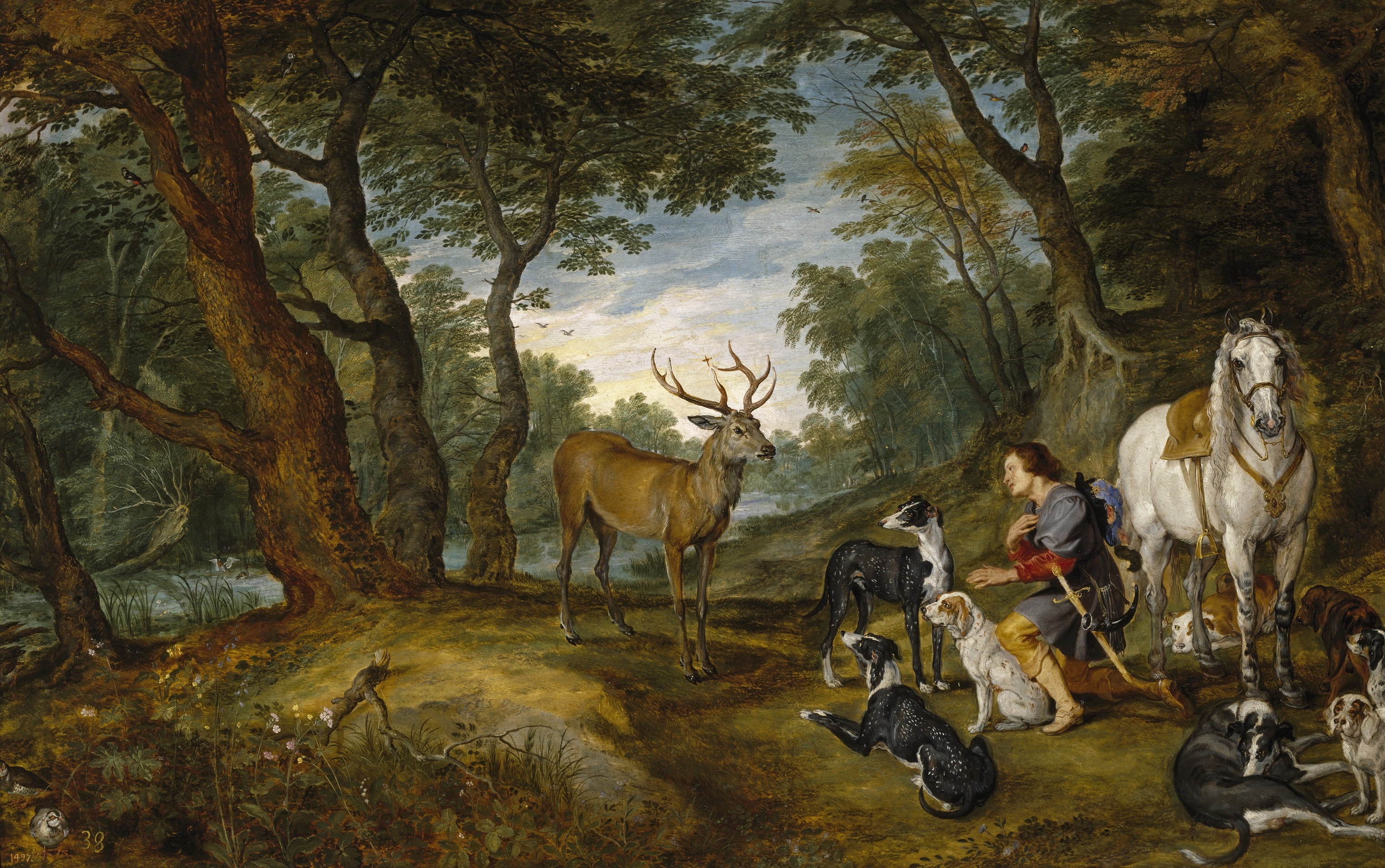
Above is the famous painting by Brueghel the Elder and Peter Paul Rubens called The Vision of St Hubert.

Hubert was the eldest son and apparent heir of Bertrand, Duke of Aquitaine, and was born and lived during the reign of the Merovingian kings of France.
As a youth, Hubert was sent to the Neustrian court of Theuderic III at Paris, where his charm and agreeable address led to his investment with the dignity of "count of the palace". Like all nobles of the time, Hubert was a greater hunter and fond of the chase.

Meanwhile, the tyrannical conduct of Ebroin, mayor of the Neustrian palace, caused a general emigration of the nobles and others to the court of Austrasia at Metz.

Hubert soon followed them and was warmly welcomed by Pippin of Heristal, mayor of the palace, who created him almost immediately grand-master of the household.

About this time (682) Hubert married Floribanne, daughter of Dagobert, Count of Leuven, a great and suitable match. Their son Floribert would later become Bishop of Liège.

Unfortunately, his wife died giving birth to their son, and Hubert retreated from the court, withdrew into the forested Ardennes, and gave himself up entirely to hunting.


Woodcock shooting


On Good Friday morning, when the faithful were crowding the churches, Hubert sallied forth to the chase. As he was pursuing a magnificent stag or hart, the animal turned and he was astounded at perceiving a crucifix standing between its antlers, while he heard a voice saying: "Hubert, unless thou turnest to the Lord, and leadest an holy life, thou shalt quickly go down into hell". Hubert dismounted, prostrated himself and said, "Lord, what wouldst Thou have me do?" He received the answer, "Go and seek Lambert, and he will instruct you". Hubert set out immediately for Maastricht, for there Lambert was bishop. Saint Lambert received Hubert kindly, and became his spiritual director. Hubert now renounced all his very considerable honours, and gave up his birthright to the Aquitaine to his younger brother Odo, whom he made guardian of his infant son, Floribert.


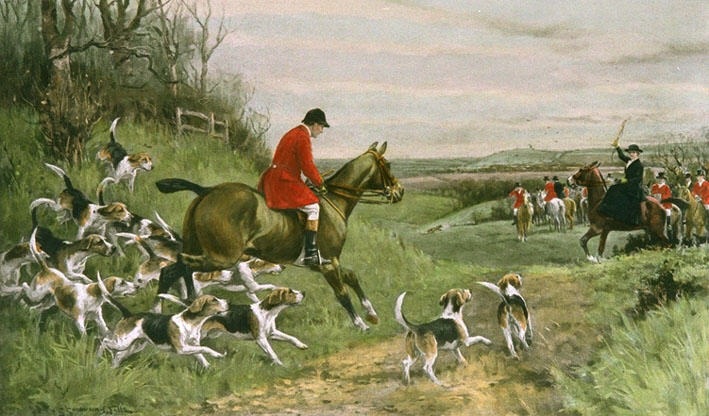
Fox-hounds on the scent


Having distributed all his personal wealth among the poor, he studied for the priesthood, was soon ordained, and shortly afterwards became one of St. Lambert's chief associates in the administration of his diocese. By the advice of St. Lambert, Hubert made a pilgrimage to Rome in 708, but during his absence, Lambert was assassinated by the followers of Pippin. According to the hagiographies of Hubert, this act was simultaneously revealed to the pope in a vision, together with an injunction to appoint Hubert Bishop of Maastricht.

He distributed his episcopal revenues among the poor, was diligent in fasting and prayer, and became famous for his eloquence in the pulpit. In 720, in obedience to a vision, Hubert translated St. Lambert's remains from Maastrict to Liège with great pomp and ceremonial, several neighboring bishops assisting. A basilica for the relics was built upon the site of Lambert's martyrdom, and was made a cathedral the following year, the see being removed from Maastricht to Liège, then only a small village. This laid the foundation of the future greatness of Liège, of which Saint Lambert is honoured as patron, and Saint Hubert as founder and first bishop.

St Hubert actively evangelised among the pagans in the extensive Ardennes forests and in Toxandria, a district stretching from near Tongeren to the confluence of the Waal and the Rhine.


The story of St Eustace is similar.

Prior to his conversion to Christianity, he was a Roman general named Placidus, who served the Emperor Trajan.

While hunting a stag in Tivoli near Rome, Placidus saw a vision of Jesus between the stag's antlers. He was immediately converted, had himself and his family baptized, and changed his name to Eustace (meaning "good fortune" or "fruitful").

A series of calamities followed to test his faith: his wealth was stolen; his servants died of a plague; when the family took a sea voyage, the ship's captain kidnapped Eustace's wife; and as Eustace crossed a river with his two sons, the children were taken away by a wolf and a lion. Like Job, Eustace lamented but did not lose his faith.

He was then quickly restored to his former prestige and reunited with his family; but when he demonstrated his new faith by refusing to make a pagan sacrifice, the emperor, Hadrian, condemned Eustace, his wife, and his sons to be roasted to death inside a bronze statue of a bull or an ox, in the year AD 118.

Both saints are the patrons of hunting.

Some say that their story tells against hunting for that they gave up the chase. Closer analysis reveals a more subtle moral. St Hubert was out hunting on Good Friday instead of repairing to Church. That was impious and a danger to his soul. He had, in effect, abandoned devotion to his faith following his wife's death. God called him back and to a bishopric, since this was what was necessary to his salvation and was his true calling. He now had to "hunt" for souls.


When the hunt was over...


It is an interesting twist of human nature and history that opposition to hunting and belief that animals should be given quasi-human rights is a common harbinger of oppressive totalitarian and heterodox views.

So, in our time, many who oppose hunting animals, even for food, happily support abortion, embryo-experiments and the "hunting" of humans to use in scientific research and "search and destroy" operations against the defenceless child in the womb.

Professor Peter Singer, Australian-born Princeton University philosopher, believes that animals should have rights likes humans and that new-born human babies should not have rights until they are "wanted" or "initiated". For him, man is but one form of animal and no more.


St Hubert and St Eustace, pray for us!


...

Saturday, 18 October 2008

The holy Peace Emperor: Feast Day of the Blessed Emperor Charles of Austria on 21 October

The Feast Day of His Imperial Majesty, the Blessed Emperor Charles I of Austria is on Tuesday 21 October 2008.

This is the day of his marriage to HRH Princess Zita of Bourbon-Parma, and was, for that reason, chosen by Pope John Paul II at the beatification.

This saintly exemplar of Christian virtue, chivalry, devotion and holiness was the last Hapsburg Emperor, the successor of the Holy Roman Emperor who was the first knight and lay leader of all Christendom for 1,000 years with the solemn blessing of the Supreme Pontiff and Holy Church.

He was the first political leader in Europe to introduce a Ministry of Social Assistance for the relief of the poor and unemployed. He based this directly upon the teachings of Pope Leo XII in his Encyclical, Rerum Novarum, on the condition of the working classes.

He died in 1922 at the early age of 34, in absolute poverty with his wife, Her Imperial Majesty Empress Zita, and 7 children, exiled from their homeland to the island of Madeira. Madeira Island has constant sunshine on the coast but up the mountain, where the imperial family lived, was often shrouded in close, dense, mist straight off the Atlantic which was unhealthy for the sick

The exiled Emperor wanted to get toys for presents for his children but, having no money, he always had to walk down the mountain to Funchal and there barter away a few items in exchange for others.

Walking back he caught a chill which later developed into double pneumonia. The doctor was called and the Empress Zita's worst fears were realised. The Emperor Charles, the exiled ruler of the great Catholic Empire, was dying, although still a young man.

He died with the Holy Name of Jesus on his lips.


The Blessed Emperor Charles upon his death bed


So poor were the family that the Empress Zita had to ask a peasant whom the Emperor had given some clothes, to return them so that the Blessed Emperor could have some clothes to be decently buried in.

Everything had been taken from the imperial family and from the Blessed Emperor. All had been relinquished. He died with nothing left but himself to take to his Creatorand his family to be left in the hands of God.

50 years later in 1972, his grave was opened and his body found to be incorrupt. The Emperor's youngest son, the Archduke Rudolf of Austria, witnessed this and saw his own father incorrupt.

Who can imagine what it must be like to see one's own father incorrupt?

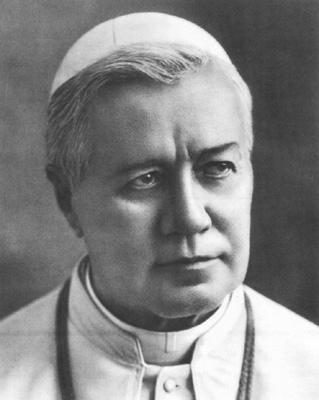
His Holiness, Pope St Pius X, had granted a private audience to Karl’s fiancée, HRH Princess Zita of Bourbon-Parma, a short time before their wedding, and the saintly Pope had prophesied that he would one day become Emperor. Zita corrected the Pope reminding him that Charles was only 2nd in line after HIRH the Archduke Franz Ferdinand.

Nevertheless, the holy Pope insisted that it would be so and told her that when he was Emperor they must both work zealously for peace. Thus St Pius X also indirectly predicted the First World War.

Then this great Pope told her a remarkable thing. He told her to rejoice “because he saw Charles to be Heaven’s reward to Austria for all her faithfulness to Pope and Church.”


The Blessed Emperor Charles on his wedding day in 1911


The devotion of the Blessed Emperor is clearly demonstrated in the acta of the Beatification process. The following excerpt from The Religious Life of Emperor Karl: A Study of the Documents for the Beatification Process by Giovanna Brizi, gives a very edifying summary:

"He drew the strength to endure all of these trials from incessant prayer and continual communion with God, which he fostered by daily participation in Holy Mass, Eucharistic worship, and adoration of the Most Sacred Heart of Jesus. He went to confession every eight days and took the observance of Sundays and Lent very seriously. He loved the Psalms, two of which he prayed daily, the “Miserere” and Psalm 90. (62)

He was especially devoted to the Mother of God and frequently prayed the rosary, a devotion he also practised with his family. He reverently wore the scapular according to the tradition of the confraternity to which he belonged, and in which he also enrolled all of his children. In honour of the Virgin, the children were given the middle name of Maria, and up to the age of three were only permitted to wear clothes in the colours of the Madonna to whom they had been dedicated. (63)

He also attached a medal of the Mother of God to his children’s cradle. (64)

He often meditated on the Stations of the Cross in the house chapel, alone. (65)

Before making any important decision the Servant of God would withdraw to the chapel by himself to weigh his decision before the Sanctum Sanctorum and to 'pray about it', as he used to say. (66)

He also deeply adored the Holy Spirit. During the peace negotiations he prayed the Veni Creator daily after Holy Mass. And after the peace accord he decided to keep up this beautiful habit, since he was convinced that the world needed enlightenment from above more than ever. (67)

On 2 October 1918, at his son Otto’s First Communion he dedicated his entire family to the Most Sacred Heart of Jesus, and included all nations of the monarchy in this act. The prayer of consecration to the Sacred Heart of Jesus was prayed in the family chapel on every first Friday of the month, and the litany and the Little Office of the Sacred Heart of Jesus were among his favourite prayers. (68)

Corpus Christi Day was strictly observed every year, which is why Bishop Fischer-Colbry also called him 'the Eucharistic Emperor'. (69)

He also especially revered St Michael the Archangel, whom he declared patron saint of his imperial army. His children were taught to pray to their guardian angels daily. He much revered St. Joseph, as well, which is why 'Joseph' was added to his children’s middle name of 'Maria'.

He fervently supported the cause of Father (now Blessed) Marco d’Aviano’s beatification; and he honoured Brother Konrad of Parzham who had already been canonized at this time, carrying a relic of this saint with him up until his fatal sickness. The canonized parish priest Maaß von Fließ in the Tyrol and, naturally, the various patron saints of his multiple countries and St Charles Borromeo were also objects of his special devotion. (70)

He never began any meal without saying grace, and wherever he was he prayed the Angelus at noon.

He valued indulgences and strove to obtain them. For example, he fervently and joyfully obtained the Porziuncula Indulgence at Santa Maria degli Angeli at Assisi, year after year. He also highly revered his Cross for a Happy Death, to which a Plenary Indulgence for the Hour of Death had been granted and which he always carried on himself. (71)"

________________________________________
References:
62 Summ. test., p. 567, § 748, Empress Zita.
63 Summ. test., p. 148, § 226; Anna Francesca Maria Lamich.
64 Summ. test., p. 214, Archduchess Elisabeth Charlotte.
65 Summ. test., p. 511, ad 41, Baron Karl Werkmann von Hohensalzburg.
66 Summ. test., p. 558, § 740, Empress Zita.
67 Summ. test., p. 555, Empress Zita.
68 Summ. test., p. 556, Empress Zita.
69 Summ. test., p. 556, Empress Zita.
70 Summ. test., pp. 566-567, Empress Zita
71 Summ. test., p. 579, § 49.


The Blessed Emperor Charles on the day of his coronation in Hungary,
as King Charles IV of Hungary


A few days after his coronation, Karl automatically became commander-in-chief of all his armed forces. In this capacity, too, he frequently visited the front, advancing all the way to the foremost lines and participating in many battles, where he exhibited exemplary courage and calm in the midst of exploding enemy artillery fire. The sight of the gruesome slaughter, however, brought him into sharp conflict with moral and religious principles that were so deeply engrained in him. A few hours after the eleventh battle at the Isonzo River, court photographer Schuhmann saw him crying at the sight of charred and disfigured corpses. He heard him say, “No one can justify this before God. I will put an end to it as soon as possible”.

As Emperor he had a growing conviction that he had to take all possible diplomatic routes to achieve peace; he thought so despite his German allies who accused him of cowardice because they knew only one kind of peace, “victorious peace.”

In the meantime, he made use of all his powers to at least reduce the cruelty of the war; he firmly opposed the use of poisonous gas on the eastern front; he was immovable in his decision not to shell Italian towns; he fought against the use of submarines which were to attack enemy towns along the Adriatic coast, especially Venice, and later brought Americans into the war; and all this despite the mockery, fury and accusations coming from his German ally. To him, the civilian population was absolutely inviolable.


The Blessed Emperor Charles decorates soldiers at the front.
He had ever the keenest concern for the care of the ordinary soldier.


At the same time he took up with great fervour Fr Wilhelm Schmidt’s idea to establish “soldiers’ homes” at all fronts, in order to keep the troops’ morale high. Everyone was to have access to them, should be at home, be able to find distractions from war, and buy affordable treats. Unobjectionable newspapers and magazines, books and games were to be found there as well. Thus, the soldiers were to be kept from spending their time with less uplifting distractions, which would be detrimental to them physically and spiritually.

General Bardoff for instance felt compelled to challenge the Emperor’s sweeping measures against “immoral practices” (i.e. brothels) in the armed forces, because the high-ranking officers thought them to “make sense from a hygienic perspective”. The Emperor personally saw to the distribution of rosaries among the soldiers and issued a rescript calling for Holy Mass and sermons to be said in the soldiers’ quarters not just on Sundays and Holidays, but also every day of the week.

As far as possible he strove to improve and make more humane the lot of prisoners of war; he participated in initiatives between Austria-Hungary, Russia and Italy to exchange prisoners. He personally verified that prisoners were treated well in the camps, supported those returning to their homes as best he could, and opposed the repression of remnant populations in enemy territory.

The fiercest opposition arose to his outlawing of duelling, evidently a very widespread custom that proved difficult to root out. He was warned that his reputation with the Army would suffer if he banned it but ban it the Blessed Emperor did for, as he said, duelling is a sin and condemned by the Church.

He expressed horror at the German plan to send Lenin by train from Zurich to start revolution in Russia and opposed it, with immense foresight, telling the Germans that revolution did not confine itself to national borders and was a bacillus that would affect the world, not just Russia. The Germans pressed ahead so Charles forbade any such train to pass through any of the imperial lands.


The Blessed Emperor hears Mass (in the old Roman rite)
before attempting to regain his throne in Hungary in 1919


His people called him the “Peace Emperor” for his efforts to obtain peace which were cruelly rebuffed by the Entente leaders, almost all secularist anti-Catholics and Freemasons, like France’s Alexandre Ribot, Italy’s Baron Sydney Sonnino and Britain’s David Lloyd-George.

These wicked old men refused to listen to the compassionate charity and mercy of the 29-year old “Peace Emperor” in 1916 and so ensured that millions would die in the slaughter of Passchendaele and the trenches, and Communism would be victorious in Russia and, later, Nazism in Germany.


O Servant of God, Emperor Charles, pray for the Christian West,
- the evening land upon which the Sun sets!


...

"I saw the lady!": the saints that God loves best - the simple, the humble and the devout

When Our Lady is asked by God to appear to men it is usually to the simplest and to those who are often thought of by others as stupid, clumsy and unimportant.

One such was St Marie-Bernarde Soubirous, usually known as St Bernadette.

Saint Bernadette was born 7 January 1844, a miller's daughter from the town of Lourdes in the foothills of the Pyrenees.

From 11 February to 16 July 1858, she reported 18 apparitions of "a lady".

She was the daughter of François Soubirous and his wife Louise (née Castérot), a laundress and was the eldest of five children who survived infancy. Bernadette was a sickly child; she had cholera in infancy and suffered most of her life from asthma.

Hard times had fallen on France which was under the rule of the unbeliever, revolutionary and thrower of bombs at the Pope (in his youth) Emperor Napoleon III Bonaparte.

Secularism had taken over France and the result was extreme poverty for many of the poor.

The Soubirous family were an example and the family lived in extreme poverty. Neighbours, however, reported that the family lived in unusual harmony, relying on their religious devotion. They lived in a tiny room shared between a whole family.

On 11 February 1858, Bernadette, then aged 14, was out gathering firewood and bones with her sister and a friend at the grotto of Massabielle outside Lourdes, when she had the first of 18 visions of what she termed "a small young lady" (uo petito damizelo) standing in a niche in the rock. Her sister and her friend stated that they had seen nothing. On her next visit, she said that the "beautiful lady" asked her to return to the grotto every day for fifteen days.


At first her mother had forbidden her from going but Bernadette persuaded her mother to allow her to go. The apparition did not identify herself until the seventeenth vision, although the townspeople who believed she was telling the truth assumed she saw the Virgin Mary.

Bernadette never claimed it to be the Blessed Virgin, calling what she saw simply Aquerò ("that thing"), in Gascon Occitan, the patois of that part of France which is, even today, spoken by many.

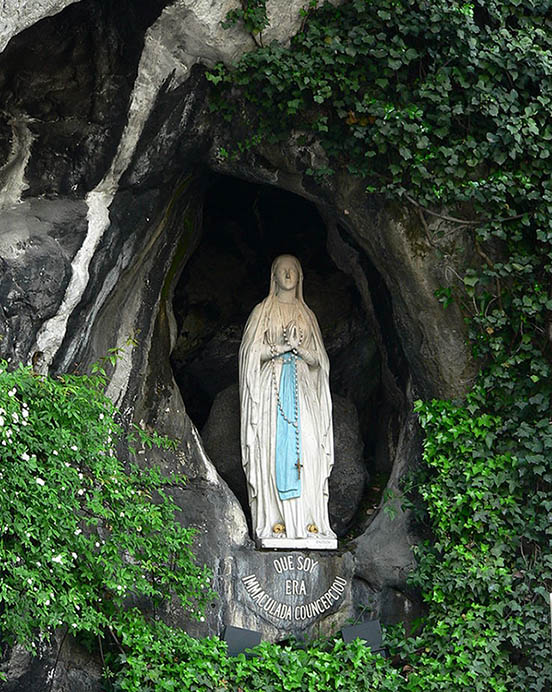
Bernadette described the lady as wearing a white veil, a blue girdle and had a golden rose on each foot and held a rosary of pearls.

Bernadette's story caused a sensation with the townspeople, who were divided in their opinions on whether or not Bernadette was telling the truth.

At the thirteenth of the apparitions on 2 March, Bernadette told her family that the lady had said "Please go to the priests and tell them that a chapel is to be built here. Let processions come hither".

Accompanied by two of her aunts, Bernadette duly went to parish priest Curé Dominique Peyramale with the request. He had little belief in claims of visions and miracles and told Bernadette that the lady must identify herself.


Curé Dominique Peyramale, the Dean and Parish Priest of Lourdes


As Bernadette later reported to her family and to church and civil investigators, at the ninth visitation the lady told Bernadette to drink from the spring that flowed under the rock, and eat the plants that grew freely there.

Although there was no known spring, and the ground was muddy, Bernadette did as she was told by first digging a muddy patch with her bare hands and then attempting to drink the brackish drops. She tried three times, failing each time. On the fourth try, the droplets were clearer and she drank them. She then ate some of the plants.

When finally she turned to the crowd, her face was smeared with mud and no spring had been revealed. Understandably, this caused much scepticism among onlookers who shouted, "She's a fraud!" or "She's insane!" while embarrassed relatives wiped the adolescent's face clean with a handkerchief. In the next few days, however, a spring began to flow from the muddy patch first dug by Bernadette. Some devout people followed her example by drinking and washing in the water, which was soon reported to have healing properties.

In the 150 years since Bernadette dug up the spring, 67 cures have been "verified" by the Lourdes Medical Bureau as "inexplicable", but only after extremely rigorous scientific and medical examinations failed to find any other explanation.


Even the Empress Eugenie, devout Catholic wife to the unbelieving Emperor Napoleon III,
sent for a bottle of the Lourdes water to help heal her own child


According to Bernadette's account, during one visitation she again asked the lady her name but the lady just smiled back. She repeated the question three more times and finally heard the lady say, in Occitan, "I am the Immaculate Conception" (Que soi era immaculada concepcion).

Four years earlier, Blessed Pope Pius IX had promulgated the doctrine of the Immaculate Conception; that, alone of all human beings who have ever lived (save for Jesus, Adam, and Eve), the Virgin Mary was conceived without the stain of Original Sin.

This was not a phrase that Bernadette or her family had heard and, plainly, she could not have invented it.


The Basilica of Our Lady of Lourdes


Eventually, as visitors to Lourdes know well, churches and chapels were built and eventually a large Basilica which is visited by 5,000,000 pilgrims every year.

This year is the 150th anniversary of the apparitions at Lourdes.


The statue of our Lady of Lourdes at the grotto at Massabielle, today


Bernadette eventually joined the Sisters of Charity of Nevers convent moving into their motherhouse at Nevers at the age of 22. She spent the rest of her brief life there, working as an assistant in the infirmary and later as a sacristan, creating beautiful embroidery for altar cloths and vestments.

She eventually died of her long-term illness at the age of 35 on 16 April 1879.

On 8 December 1933 she was canonized as a saint and her Feast Day is celebrated on 16 April. The Feast of Our Lady of Lourdes was instituted by the Church.

2009 has been declared "The Year of Bernadette".

Bishop Gauthey of Nevers and the Church exhumed the body of Bernadette Soubirous on 22 September 1909 in the presence of representatives appointed by the postulators of the cause, two doctors, and a sister of the community. They found that although the crucifix in her hand and the rosary had both oxidized, her body was incorrupt and preserved entirely from decomposition.

The Church exhumed the corpse a second time on 3 April 1919. The body was still preserved, however her face was slightly discoloured possibly due to the washing process (by the sisters) of the first exhumation.


The incorrupt body of St Bernadette of Lourdes at the Convent of Charity, Nevers


In 1925, the church exhumed the body for a third time. Relics were taken which were sent to Rome. The remains were then placed in a gold and crystal reliquary in the Chapel of Saint Bernadette at the mother house in Nevers. The site is visited by many pilgrims and the body of Saint Bernadette to this day remains intact despite being nearly one hundred and thirty years old.

It is one of the most perfect examples of incorruption of any saint.

These are the saints that God loves most – the simple, the humble, the devout – those that others think are stupid, clumsy, unimportant. God knows better. The ways of God are not those of men.


"I am the Immaculate Conception"


St Bernadette, pray for us!

Our Lady of Lourdes, the Immaculate Conception, pray for us!


...

Thursday, 9 October 2008

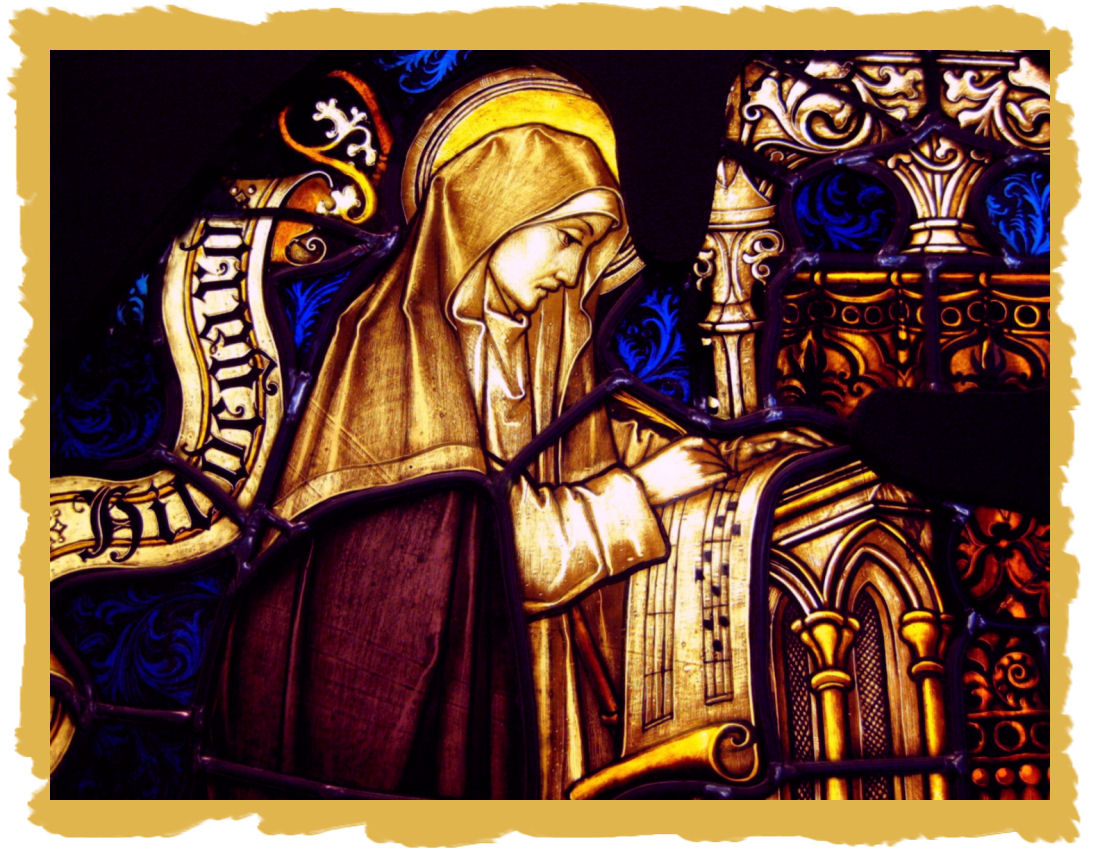
8 October: St Bridget of Sweden, great saint and patroness of chivalry

St Bridget (sometimes called Birgitta) - Feast day 8 October - was born about the year 1303 (by tradition on 14 June) in Upland, the chief province of Sweden, where her father, Birger Persson, Lord of Finsta, was governor and "law-speaker".

Her mother, Lady Ingeborg of Finsta, was a daughter of the governor of East Gotland.

When only seven Bridget had a vision in which our Lady placed a crown on her head, and when ten, after a sermon on the Passion, she saw in a dream Christ wounded and bleeding.

These two experiences seem to have been the formative ones of her life.

Her mother died in 1314, and she lived with an aunt until, in 1316, obediently but against her inclination, she married Ulf Gudmarsson, Lord of Närke.

They had four boys and four girls.

Two of the boys died young. Karl, the eldest, was worldly but devoted to our Lady. Birger, the second, though married, later became his mother's companion and brought her body home to Sweden from Rome to be buried. Three of the girls married: Merita and Cecilia staying in Swedish society, while Catherine lost her husband and lived with her mother. The fourth, Ingebord, became a Cistercian.

Twenty-eight years after their marriage, Lord Ulf died and Bridget went to live the penitential life she longed for near the Cistercian monastery at Alvastra. While there, she planned the Rule and Office of the Order she was called to found but which she never saw in existence. After two years, in 1344, she went to Rome, where she died on 23 July 1373. Her canonization took place only eighteen years later, on 7 October 1391 (later the Feast Day of the Holy Rosary, following the Battle of Lepanto).

St. Bridget had the gift of prophecy and worked many marvellous cures. Once widowed, she lived an ascetic life, eating very little, sleeping short hours, and praying continually. She followed a strict rule and practised every possible kind of charitable work, even reducing herself to begging.

She received constant inspirations which were either taken down by her chaplain and put into Latin, thus becoming known as her Revelations, or took the form of letters to the succeeding popes, cardinals, and secular rulers of the day, telling them of their wickedness and how to reform their lives.

Both in Sweden and in Rome she was either hated violently or loved as a saint. "Strong and full of courage", she was "homely and kind and had a laughing face".

She founded the Order of the Saviour or the Bridgettines at Vadstena in Sweden, which was richly endowed by King Magnus Eriksson of Sweden and his Queen.


Vadstena Abbey, founded by St Bridget of Sweden, stands to this day


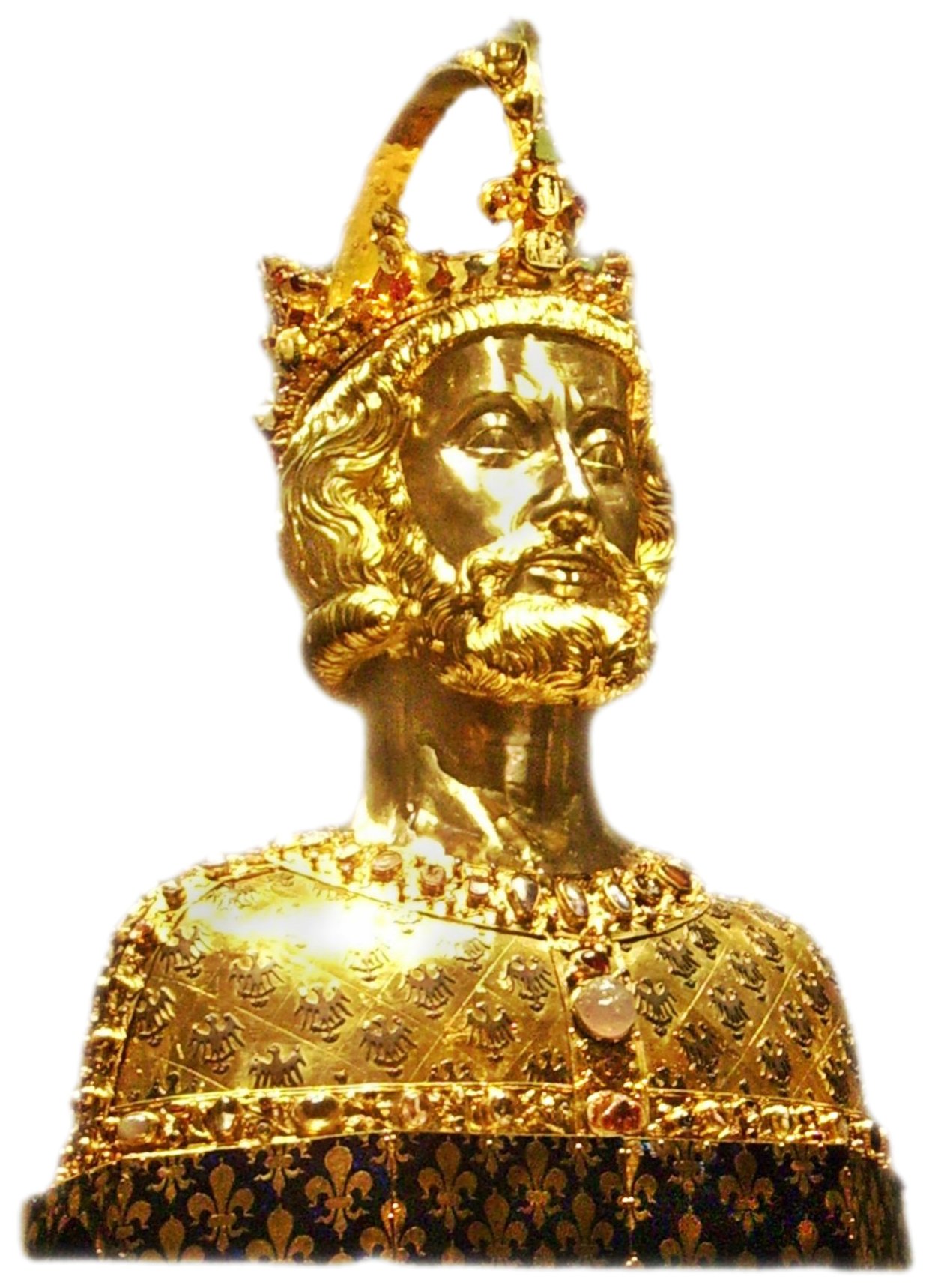
King Magnus had been named at birth after Carolus Magnus i.e. Charlemagne the Emperor.

The Order really started after St. Bridget's death but with her daughter, St. Catherine of Sweden, as first Abbess of Vadstena.

About 1350 she went to Rome, partly to obtain from the pope the authorisation of the new order, and partly in pursuance of her self-imposed mission to elevate the moral tone of the age.


Bridgettine sisters wear a very distinctive habit and wimple with a cross over the head


She also set herself the task of persuading the Pope to return to Rome from Avignon, a task later completed by St Catherine of Siena.

She also composed a Rosary-chaplet of 69 Aves in honour of the number of years of our Lady's life, with 7 Paternosters and 7 Credos in honour of her joys and sorrows.

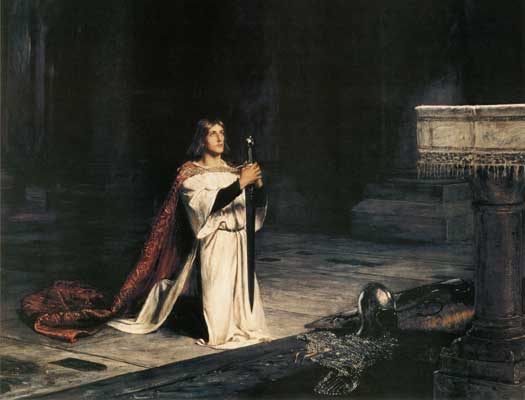
St Bridget received great revelations concerning chivalry and the great virtue of the knights that fought for Christ and Christendom. Our Lord appeared to her and said in one of her visions, taking care to emphasise what He said to her, this:

"A knight who keeps the laws of his order is exceedingly dear to me. For if it is hard for a monk to wear his heavy habit, it is harder still for a knight to wear his heavy armour".

These were the very words of our Lord to St Bridget.


The Vigil of a knight.
St Bridget had visions from our Lord extolling Christian chivalry and the virtue of Knighthood


It was not until 1370 that Pope Urban V confirmed the rule of her order, but meanwhile Bridget had made herself universally beloved in Rome by her kindness and good works. Save for occasional pilgrimages, including one to Jerusalem in 1373, she remained in Rome until her death on 23 July 1373. She was originally buried at San Lorenzo in Panisperna before being moved to Sweden. She was canonized in 1391 by Pope Boniface IX (also confirmed by the Council of Constance in 1415).

In 1999, Pope John Paul II chose St Bridget of Sweden as Europe's co-patroness, along with St Catherine of Siena and St Teresa Benedicta of the Cross.


St Bridget of Sweden, pray for us!


...

7 October: Feast of the Most Holy Rosary, weapon of prayer

The Feast of our Lady of the Most Holy Rosary is a title of the Blessed Virgin Mary as the Queen of the Holy Rosary, the chaplet of prayer beads that are used to invoke the Virgin to aid us whilst meditating upon scenes in the life of her Son, JESUS CHRIST.

The Rosary developed out of the habit of lay brothers, who did the manual work and did not have time to pray the whole Monastic Office, of praying Paternosters and Ave Marias in monasteries. This habit then passed to the devout laity.

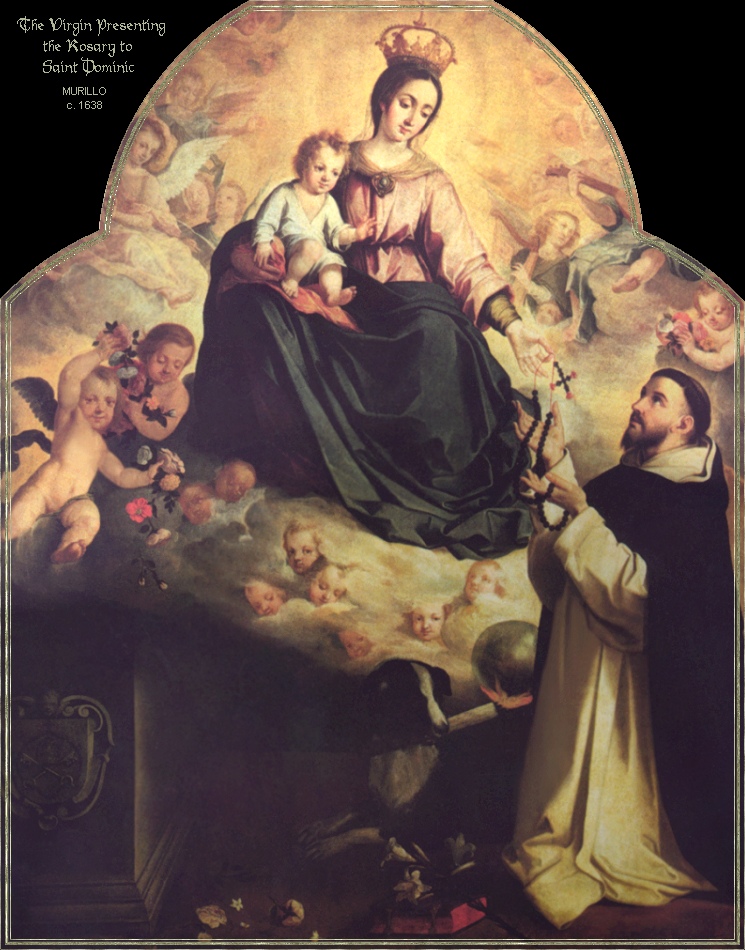
In 1208 our Lady appeared to St Dominic in the Church of Prouille, France, and gave him a chaplet of beads representing roses commending to him the devotion which had spread among the Faithful of saying Paters and Aves whilst meditating upon the life of Christ.

St Dominic then gave the Rosary to all his Friars Preachers to use in their efforts to convert the heterodox Cathars in Southern France and to call upon our Lady to assist the soldiers of Count Simon de Montfort, 5th Earl of Leicester, father of the founder of the later English Parliament, to defend Christendom from the attacks by the armies of the heterodox Cathars and Albigensians.


St Dominic receives the Holy Rosary from our Lady


On 12 September 1213, whilst St Dominic and his brethren were praying in the Church at Muret in the South of France, Count Simon and 700 knights charged out of the town to meet an invading army of 50,000 marauding heterodox Albigensians who were set upon capturing the whose of Southern France for the Albigensian heresy.

The Albigensians were a type of Manichee and they believed in euthanasia, abortion and sodomy and opposed marriage and child-birth because they believed that all material things were evil and created by an evil force. They had one Sacrament which was called the consolamentum and consisted in euthanasia by either starvation or suffocation. They had murdered Catholic missionaries sent to preach to them and murdered bishops, priests and the Papal legate who was sent to negotiate with them.

Count Simon and his knights straight into the middle of their ranks and slew their leader King Pedro of Aragon, much to the chagrin of Count Simon who wanted to defeat him but not slay him. At this the Albigensian horde fell into disarray and were routed. Our Lady, Count Simon de Montfort and the Rosary saved the day.

Ever after, the Rosary became a great weapon of prayer against evil, and especially in time of battle.

In thanks for the victory of the Battle of Muret, Count Simon built the first shrine dedicated to Our Lady of Victory.

The Rosary was prayed in 1529 at the Siege of Vienna and a great victory won under Count Nicholas von Salm against the Ottoman Turks and their Sultan Suleiman the Magnificent.

In 1571 Pope St Pius V instituted the Feast of Our Lady of Victory as an annual feast to commemorate the victory of Lepanto, off the Greek coast, the huge naval battle won by the Christian navies against the navy of the invading Muslim Turkish hosts. The Turkish navies were many times larger than the Christian navies and had been bent upon conquering the whole of Christendom and enslaving all Christians.


Allegory of the Battle of Lepanto with our Lady and the saints interceding


The victory was attributed to our Lady, as a rosary procession took place on that day in St. Peter's Square in Rome for the success of the forces of the Holy League to hold back the Muslim forces from over-running Western Europe.

In 1573, Pope Gregory XIII changed the title of this feast-day to the Feast of the Holy Rosary. This feast was extended by Pope Clement XII to the whole of the Latin Rite, inserting it into the Roman Calendar in 1716, and assigning it to the first Sunday in October.


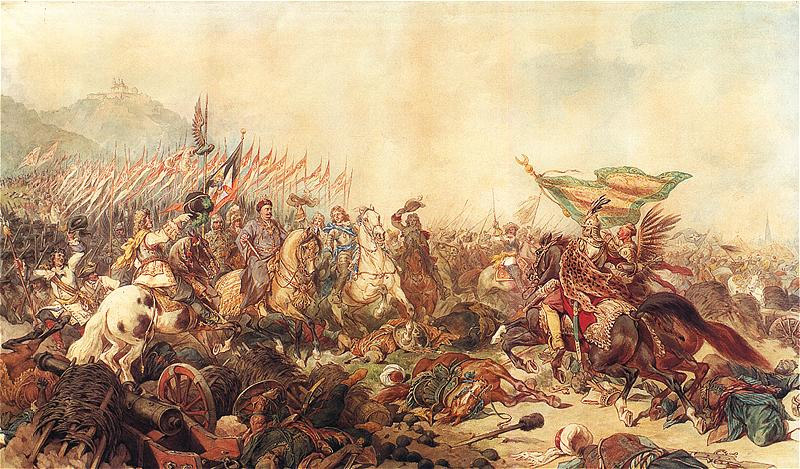
King Jan Sobieski and his army at the Battle of Vienna, 12 September 1683


On 12 September (that date again!) 1683, King Jan Sobieski, appointed commander by Roman Emperor Leopold I, and his Polish Hussars, inflicted a massive defeat upon the Turkish hosts in the Battle of Vienna. Again a Rosary campaign had preceded his victory.

Venerable Pope Innocent XI instituted the Feast of the Holy Name of Mary on 12 September to mark the victory obtained by praying to our Lady.


Kara Mustapha Pasha, the commander of the Turkish host, was unfairly executed by his own king, Sultan Mehmed II, after losing the Battle of Vienna


Pope St Pius X changed the date to 7 October in 1913, being the actual date of the great victory at Lepanto.

In 1969, Pope Paul VI changed the name of the feast to Our Lady of the Rosary.


Our Lady of the Most Holy Rosary, pray for us!


...

Saturday, 4 October 2008

The Sacred Military Constantinian Order of St George: investitures of new knights in Britain

This week will see investitures of new knights in the Sacred Military Constantinian Order of St George in the UK.

They take place at Brompton Oratory in London.

The investees include His Serene Highness Albert II, the Prince of Thurn und Taxis, Sir Nicholas Mander, Bart, Mark Watson-Gandy of Myrton, Baron of Myrton, and Rafe Heydel-Mankoo Esq.

The insignia of the Order, as in the gold star of a Knight of Justice (left), include the Chi-Rho symbol of the ancient Labarum, the first two letters in Greek of Christos (Christ), together with the Alpha and Omega, the first and last letters of the Greek alphabet, indicating that Christ is first and last.

Outside this are the letters IHSV representing In Hoc Signo Vinces, the Latin transliteration of the Greek words en touta nika (meaning "in this (sign) conquer") seen in the sky by the Emperor Constantine just before his victory at the Battle of the Milvian Bridge which gave him the Roman Empire and allowed him, later, to make Christianity the official religion of the Empire.

St George the Martyr, pray for us!


The Sacred Military Constantinian Order of Saint George was incorporated as a Religious Order of the Roman Catholic Church hereditary in the House of Farnese and its Bourbon heirs dating from the transfer to Francesco Farnese, Duke of Parma and Piacenza, in 1698.

In 1731 the Grand Magistery was inherited by HRH the Infante Don Carlos de Borbon y Farnese (from 1759-88, King Charles III of Spain), eldest son of King Philip V of Spain and Elisabeth of Parma, who also inherited the duchies of Parma and Piacenza from the Farnese.


Francesco Farnese, Duke of Parma


Statutes of the Order dating from the sixteenth century show that rules were confirmed and amended by the Byzantine Emperors Isaac Angelus and Michael Paleologus and the aim of the imperial founders was to revive the Guard of 50 Knights that escorted the Labarum, the Chi-rho emblazoned banner of the Emperor Constantine I.

The Constantinian Order subsequently received confirmation as a Religious-Military Order from the Holy See and, together with the Order of Malta, is the only international Catholic Order which has maintained this status unchanged to the present day.

The Order is regulated as a subject of canon law, and the succession to the Grand Magistery is governed first by the statutes of 1705, approved by Papal Brief in 1706 and the Bull Militantis Ecclesiae of 1718, and then confirmed in the statutes of 1922 approved by Papal Placet (these statutes have again been modified in 1934, 1943, 1987 and 2004).


King Charles VII of Naples (III of Spain) abdicating the throne of Naples to Ferdinand VII


In 1910 Pope St Pius X appointed the first of three successive Cardinal Protectors and, in 1913, approved a series of privileges for the chaplains of the Order. In 1915 Pope Benedict XV dedicated the Constantinian Chapel in the Basilica of Santa Croce al Flaminio, which had been built with donations from the knights, who included Monsignor Eugenio Pacelli, later Pope Pius XII. In 1916 the Pope restored the Church of Saint Anthony Abbot to the Order. In 1919 new statutes received Papal approval and Cardinal Ranuzzi de' Bianchi was appointed Cardinal Protector.

The Grand Master of the Order is HRH the Infante Don Carlos, Duke of Calabria, first cousin to HM the King of Spain.


The Grand Master of the Order,
HRH the Infante Don Carlos, Duke of Calabria,
first cousin to HM the King of Spain


St George the Martyr, pray for us!
Emperor Constantine I, pray for us!
Empress St Helena, foundress of the True Cross, pray for us!


...