Monday, 14 January 2008

Jefferson Davis: answering the sceptics

I am still getting posts from sceptics who are (all innocently in most cases) still so badly infected with modernist historical piffle and secular fundamentalist propaganda that they just cannot bring themselves to believe that Jeff Davis wore Catholic devotional symbols about his person.

One good-natured soul writes thus:

"I would REALLY love to believe all of this, really I would... But do you have a citation for

'Davis always wore a St. Benedict Medal and a Miraculous Medal as well as a French scapular. Someone had also given him the brown scapular of the Discalced Carmelites. All of these he wore in prison and preserved to the end of his life.'

I wear all of those as well... would love to believe he did too, but... I am not sure I believe this one."

I answer him/her thus:

"Worry no more.

You may believe it all!

There are a number of sources but this one is good:

Jefferson Davis: the Unconquerable Heart (1999) by Felicity Allen (Blue and Grey Series).

At page 440, she writes this:

'Davis wore round his neck at that very moment, besides his St Benedict medal the one already known as 'Miraculous', struck just 33 years before, from the vision of a French Sister of Charity, still living, who would one day be known as St Catherine Laboure.

Nor were these all: thin woven laces over his shoulders held on his breast and back the little cloth panels of a French scapular. Both these distinctly Roman Catholic channels of blessing had been sent to him by the Sisters of Charity who had cared for his family in Savannah.'

Believe and be no more unbelieving, O ye of little faith!

I realise that it is hard for us moderns to get our heads round the fact that the secular, liberal, anti-Christian view of history is false but you really must try and overcome the Secular Fundamentalist mumbo-jumbo that the media, the chattering classes and the more worldly of your teachers and professors have tried to hoodwink you with!

Real history and the truth is much more interesting, fascinating, inspiring and fulfilling.

FREE YOUR MIND!

REJECT SECULAR FUNDAMENTALIST CLAPTRAP NOW!

And enjoy the book, too!"

Yes, folks, Jeff Davis really did wear them!


...

Wednesday, 9 January 2008

Who is Yeshua Moshiach?

Well, apparently these people know:

http://www.ark-of-salvation.org/jesus_christ_2003.htm

But - absurdly - they don't know why He is usually called

JESUS CHRIST


Here is what their web-site says about the Holy Name:

"Although this name is not at all difficult for English speakers to pronounce, the King James translators of the Bible chose to take his name from the Greek New Testament, in which book he was called Iesous. This name, for reasons which are not entirely clear, became Jesus in England."

Not clear?

What poppycock!

The reasons are entirely clear. The language of the Christian Church became Latin after the Roman Empire became Christian.

Any simpleton knows this, surely?

And the Latin for Yeshua or Iesous is Jesus.


The Anointed Saviour - Yeshua Moshiach

The English equivalent is Joshua. So if they want an English translation they should call our Lord by the name of Joshua Christ.

But they don't.

They call Him Jesus Christ just as we do in the Roman Catholic Church.

Yet another example of the simple truth that Christianity is Roman and Catholic, that the Roman Catholic Church gave to the whole world the first message of Christianity and that is why the Latin version of our Lord's name is the name that is universally used.

The name, as I said in my last post, means

SAVIOUR, ANOINTED OF THE LORD


Yeshua means "saviour" and Moshiach means "Anointed of the Lord" which is often rendered "Messiah" or "Messias".

In Greek, the language of the Septuagint and the New Testament, it is Iesous Christos and in Latin, the language of the Roman Empire and of the Church, it is JESUS CHRISTUS.

The word "Chrism" has the same root since the Oil of Chrism is used for anointing.

How, therefore, can these people say that the Holy Name of Jesus is used in England for "reasons which are not clear"?

There are none so blind as those who will not see...


...

Tuesday, 8 January 2008

The gifts of the Kings and the blessing of the sons of Israel

I have been asked what is the value of the gifts of the 3 Kings.

Their monetary value is of little significance although we know that they were "costly".

Were they sold or used? We do not know for certain.

In those days, the Jews were allowed, by concession only due to their avarice according to Moses, to "fenerate" (i.e. lend at interest) to non-Jews since the prohibition was, they said, only against fenerating to one's brethren.

Christianity said that all men are brothers and so we may not fenerate to any man.


According to the visions of Blessed Anna Catherine Emmerich, recently beatified by Pope John Paul II in 2004, the gifts were costly and were taken from the cave at Bethlehem by the family of the Blessed Virgin under the supervision of St Anne, the mother of the Virgin.


They were taken back to Nazareth and kept there until the Holy Family returned from Egypt.

There is a tradition that the Myrrh was carefully preserved against the day of our Lord's entombment when the women disciples recovered it from the Blessed Virgin to anoint the body of Christ.

The real significance of the gifts is that they represent the 3 aspects of our Lord's ministry and the 3 roles of a Christian, in imitation, namely:

(1) Gold - for a king;

(2) Incense - for a priest;

(3) Myrrh - for a holy death, the symbol of the prophetic role.

These are our 3 roles, Kingly, Priestly and Prophetic of which the Prophetic is the greatest since Joseph, the son of Jacob/Israel, received the double portion that would normally go to the eldest son, Reuben, who was disinherited, even though Jacob was the youngest son. See Gen 49 and the blessing by Israel of his sons and the apportionment of their inheritance.

The next 2 sons, after Reuben and Simeon, were Levi and Judah and they fulfilled the priestly and kingly roles respectively.

The sons of Levi, despite being deprived by Jacob of their inheritance because of Levi's savagery against the Sichemites, were to be the clergy of Israel.

The sons of Judah were the royal princes of Israel.

They retained the royal sceptre until the coming of Christ, according to Jacob's prophecy written at Gen 49:10 thus:

"The sceptre shall not be taken from Judah, nor a ruler from his thigh, until He come that is to be sent, and He shall be the expectation of the nations."

This is yet another proof that the Messias has come since the sceptre was, indeed, taken from Judah and from the whole of Israel shortly before the birth of Christ when Pompey the Great took Jerusalem, subdued the Jews, profaned the Temple and Holy of Holies and abducted Aristobulus the High Priest.

Thereafter Cassius despoiled the Temple and further subdued the Jews.

At this time the Jews are the Church since the Messias is yet to come. After He comes, He teaches His people the fulfulment of the Law and the Prophets, namely Catholic Christianity which is, for all time, the true religion of God, of His prophets, priests and kings, as taught by His son, Yeshua, the Aramiac word for "Saviour" or "Salvation" which was rendered into Greek as Iesous, and in Latin as Jesus. It is the same name as Joshua.

The name Jesus Christ means "Anointed Saviour" and the word "Messias" or "Messiah" from the Hebrew/Aramaic Mashiach means "the Anointed of the Lord".

Thus the Messias or Messiah and Jesus Christ are one and the same person, namely God, Adonai, Elohim, the 2nd Person of the Holy Trinity and the Saviour of the Jews, of the Gentiles and of the world and all mankind.

To modern Jews, of course, this is blasphemy but to Christians it is the sacred truth. Nevertheless, although we strongly disagree with the modern Jews on this central point, we should continue to respect them and their traditions to the extent that they are a reminder to us of the ancient traditions upon which the true Church of God is built, that is, the Law and Prophets of the Old Testament and all the great prophecies of the coming of the Messias.

After the death and Resurrection of our Lord, Jerusalem was sacked and the Temple destroyed utterly by the Roman Emperor and Caesar Augustus, Titus Flavius Vespasianus, known to history as Titus, the son of the Emperor Vespasian.


Francesco Hayez. Destruction of the Temple of Jerusalem. 1867.

Israel blessed his youngest son with the double portion that is normally given only to the eldest son. Joseph was the specially chosen, the type of the Prophets and of the blessed, though he was the youngest.

God inspired Israel so to act in order to show that the Prophetic role is the greatest role, greater than the Kingly or the Priestly because it is the role of teacher by example which pleases God the best.

This should provide an antidote to the pride of kings and priests who, through history, constantly challenge each other's superiority when they should both bow low before the exemplars of the greatest of the roles, namely the Prophetic role.

The greatest exemplar of the Prophetic role is the Blessed Virgin Mary, the very greatest of the seed of Adam, of the daughters of Israel and Jerusalem and the Queen of all the Prophets, Priests and Kings.

The Blessed Virgin Mary, the greatest of all the daughters of Israel and the Queen of all Prophets


All Christians are called to all 3 roles but especially the Prophetic role.

As Kings (and Queens) we rule in our homes and in any position of authority, paternal or maternal especially, to which we are called.

As Priests we are called to pray and to sacrifice.

As Prophets we are called to witness to the Faith, to make ourselves and others holy by our example and good counsel.

The blessing of Israel upon Joseph is itself highly prophetic (Gen 49:26):

"The blessings of thy father are strengthened with the blessings of his fathers, until the desire of the everlasting hills should come; may they be upon the head of Joseph, and upon the crown of the Nazarite among his brethren"

It would take another whole post just to unpack this verse alone!

The successor of the last of the Kings of Judah was, in fact, St Joseph, the foster-father of our Lord. He, too, succeeds to the double blessing of his namesake, Joseph, the son of Israel, and it is his privilege and duty to guard and nurture that "Desire of the everlasting hills" of which Israel speaks, namely the Messias Himself, Jesus Christ. Thus our Lord is, in material historical fact, as well as spiritually, King of Israel, Judah and the Jews.

He is really and truly the "King of the Jews".

These are but some of the many meanings associated with the gifts of the Magi.

...

Monday, 7 January 2008

Feast of the Kings: "the kings of Arabia and Saba shall bring gifts"

The Epiphany
of the Lord
to the Gentiles

on the same day as
the Baptism of the Lord
and
the miracle of wine at the wedding feast in Cana of Galilee


Bartolomeo Esteban Murillo. The Adoration of the Magi. 1655-60.


"When Jesus therefore was born in Bethlehem of Juda, in the days of king Herod, behold, there came wise men from the East to Jerusalem, saying: where is he that is born king of the Jews? For we have seen his star in the East, and are come to adore him. And king Herod hearing this, was troubled, and all Jerusalem with him. And assembling together all the chief priests and the scribes of the people, he inquired of them where Christ should be born. But they said to him: In Bethlehem of Juda. For so it is written by the prophet: and thou Bethlehem the land of Juda art not the least among the princes of Juda: for out of thee shall come forth the captain that shall rule my people Israel.

Then Herod, privately calling the wise men learned diligently of them the time of the star which appeared to them; and sending them into Bethlehem, said: go and diligently inquire after the child, and when you have found him, bring me word again, that I also may come and adore him. Who having heard the king, went their way; and behold the star which they had seen in the East, went before them, until it came and stood over where the child was. And seeing the star they rejoiced with exceeding great joy. And entering into the house, they found the child with Mary his mother, and falling down they adored him: and opening their treasures, they offered him gifts; gold, frankincense, and myrrh. And having received an answer in sleep that they should not return to Herod, they went back another way into their country."

[Matt 2:12 - Gospel for the Mass of the Epiphany]


The shrine of the Three Kings at Cologne Cathedral

The Shrine of the Three Kings in Cologne Cathedral contains their relics brought from Milan by ship to the City of Cologne on the order of the Holy Roman Emperor, Frederick Barbarossa, in 1164 as a gift to the Prince-Elector Archbishop, Rainald of Dassel.

This gave rise to the English Carol "I Saw Three Ships Come Sailing in".

The relics had first been taken from Constantinople to Milan in 344 by Bishop Eustorgius of Milan.

Around 1199, the Roman Emperor Otto IV gave three golden crowns made for the three wise men as a present to the church of Cologne, the city where, the previous year, he had been elected King of the Romans and Emperor-elect by the Prince-Electors of the Empire (he later gained the support of all the imperial princes at Frankfurt in 1208).

An inscription reads:

Otto rex coloniensis curiam celebrans tres coronas de auro capitibus trium magorum imposuit.

Emperor Otto IV was the only member of the Welf dynasty to be elected Holy Roman Emperor and, being the son of Matilda Plantagenet (married to Henry the Lion, Duke of Bavaria), he was allied to England in the Franco-English wars. He was also the personal preference of Pope Innocent III, who crowned him Roman Emperor at Rome in 1209, although they later fell out over the issue of the imperial rights in Italy.

Because of the importance of the shrine and the cathedral for the later development of the city, the Coat of Arms of Cologne still shows these three crowns symbolizing the Three Kings.

Construction of the present Cologne Cathedral was begun in 1248 to house these important relics. The cathedral took 632 years to complete and is now the largest Gothic church in northern Europe.

On July 20th, 1864, the shrine was opened, and remains of the three Kings and the coins of Philip I, Archbishop of Cologne, were discovered.

An eyewitness report reads:

“In a special compartment of the shrine now there showed - along with remains of ancient old rotten or moulded bandages, most likely byssus, besides pieces of aromatic resins and similar substances - numerous bones of three persons, which under the guidance of several present experts could be assembled into nearly complete bodies: the one in his early youth, the second in his early manhood, the third was rather aged. Two coins, bracteates made of silver and only one side striken, were adjoined; one, provably from the days of Philipp von Heinsberg, displayed a church, the other showed a cross, accompanied by the sword of jurisdiction, and the crozier on either side.”

The bones were wrapped in white silk and returned to the shrine where they remain to this day to be venerated by all the Faithful.

By long tradition, on the Feast of the Epiphany – called Dreikoenigsfest (the Feast of the Three Kings) in the lands of the old Holy Roman Empire – the Rector of the Parish (or in his absence, the father of each family) visits each house with a cross-bearer, 2 acolytes and 3 children dressed as the kings, one bearing a censer with lighted incense. At each house a little ceremony takes place, the house is blessed with Epiphany water, and over the door lintel of the house the following is inscribed with blessed chalk:


20 + C + M + B + 08


In my house we always perform this traditional ceremony.

This symbolises the present year and the blessing of the 3 Magi, Caspar, Melchior and Balthazar, upon each home.

The symbols remain all year or until the weather has washed them away.

Blessed Caspar, Melchior and Balthazar, wise men and kings from the East, pray for us!


+


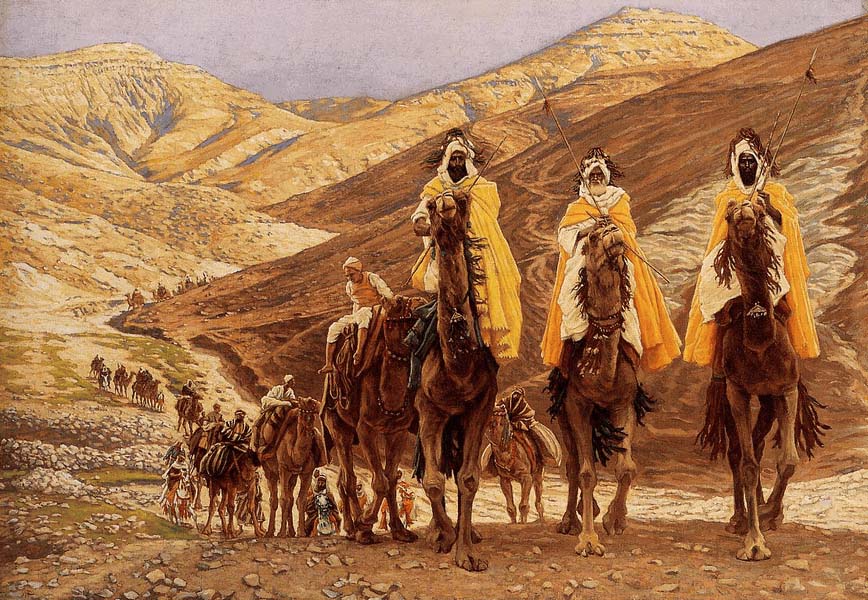
The Journey of the Magi

by T S Eliot


A cold coming we had of it,
Just the worst time of the year
For a journey, and such a long journey:
The ways deep and the weather sharp,
The very dead of winter.
And the camels galled, sore-footed, refractory,
Lying down in the melting snow.
There were times when we regretted
The summer palaces on slopes, the terraces,
And the silken girls bringing sherbet.
Then the camel men cursing and grumbling
And running away, and wanting their liquor and women,
And the night-fires going out, and the lack of shelters,
And the cities dirty and the towns unfriendly
And the villages dirty and charging high prices:
A hard time we had of it.
At the end we preferred to travel all night,
Sleeping in snatches,
With the voices singing in our ears, saying
That this was all folly.

Then at dawn we came down to a temperate valley,
Wet, below the snow line, smelling of vegetation;
With a running stream and a water mill beating the darkness,
And three trees on the low sky,
And an old white horse galloped away in the meadow.
Then we came to a tavern with vine-leaves over the lintel,
Six hands at an open door dicing for pieces of silver,
And feet kicking the empty wineskins.
But there was no information, and so we continued
And arrived at evening, not a moment too soon
Finding the place; it was (you may say) satisfactory.

All this was a long time ago, I remember,
And I would do it again, but set down
This set down
This: were we led all that way for
Birth or Death? There was a Birth, certainly,
We had evidence and no doubt. I had seen birth and death,
But had thought they were different; this Birth was
Hard and bitter agony for us, like Death, our death.
We returned to our places, these Kingdoms,
But no longer at ease here, in the old dispensation,
With an alien people clutching their gods.
I should be glad of another death.


+ + +

"three trees on the low sky... I should be glad of another death."

...

Monday, 24 December 2007

O most Holy Night...

O most Holy Night, all the earth being at peace...


Correggio. Madonna and child (Holy Night). 1520.


"And Joseph also went up from Galilee out of the city of Nazareth, into Judaea to the city of David, which is called Bethlehem, because he was of the house and family of David, to be enrolled with Mary, his espoused wife, who was with child. And it came to pass, that when they were there, her days were accomplished that she should be delivered. And she brought forth her firstborn Son and wrapped Him in swaddling clothes, and laid Him in a manger, because there was no room in the Inn. And there were in the same country shepherds watching and keeping the night watches over their flock. And behold an Angel of the Lord stood by them and the brightness of God shone round about them, and they feared with a great fear. And the Angel said to them 'Fear not; for behold I bring you tidings of great joy that shall be to all people. For this day is born to you a Saviour who is Christ the Lord, in the city of David. And this shall be a sign unto you: you shall find the Infant wrapped in swaddling clothes and laid in a manger'. And suddenly there was with the Angel a multitude of the heavenly host, praising God and saying 'Glory to God in the highest and on earth peace to men of good will.' "

[Luke 2:4-14]
[The Gospel of the Nativity of Our Lord, the first Mass of Christmas at midnight]


OCTAVO KALENDAS JANUARII
The Eighth Day before the Calends of January, being
CHRISTMAS DAY


In the 5199th year of the creation of the world, from the time when God in the beginning created the heavens and the earth;

the 2957th year after the flood;

the 2015th year from the birth of Abraham;

the 1510th year from Moses, and the giving forth of the people of Israel from Egypt;

the 1032nd year from the anointing of King David;

in the 65th week according to the prophesy of Daniel;

in the 194th Olympiad;

the 752nd year from the foundation of the City of Rome;

the 42nd year of the rule of Octavian Augustus,

all the earth being at peace,

JESUS CHRIST

the eternal God,
and Son of the eternal Father,
desirous to sanctify the world by His most merciful coming,
being conceived by the Holy Spirit,
nine months after His conception
was born in Bethlehem of Judaea,
MADE MAN OF THE VIRGIN MARY.

THE NATIVITY OF OUR LORD JESUS CHRIST ACCORDING TO THE FLESH

[From the Martyrology of Christmas Day
sung at the old Office of Prime in Cathedral Chapters and Monasteries of the Latin rite of the Roman Catholic Church, to an ancient chant by a dignitary in Choir recalling the Septuagint chronology. All others in Choir remain standing throughout until the lector comes to the word "Bethlehem" at which all bend the knee unto the ending.]


O Emmanuel,
Rex noster et legifer noster, expectatio Gentium, et Salvator earum: veni ad salvandum nos, Domine Deus noster.

O Emmanuel,
our King and Lawgiver, the desire of the nations and the Saviour thereof, come to save us, O Lord our God.

[Isaias 7:14,33,22]
[The 7th of the Great 'O Antiphons' of Advent, sung at Vespers in the Roman rite for the last 7 days of Advent]


Puer natus est nobis,
et filius datus est nobis, cujus imperium super humerum ejus et vocabitur nomen ejus, magni consilii Angelus.

Unto us a child is born,
a Son is given, and the government shall be upon His shoulder and His name shall be called Wonderful Counsellor"

[Isaias 9:6]
[Introit of the third Mass of Christmas, during the daytime]


Happy Christmas to all!


...

Friday, 21 December 2007

What is a good man like?

What is a good man like?

It is not really fashionable to speak of this today. Men, particularly white European men, are, in today's supposedly "anti-sexist", "anti-discriminatory" world, so often disregarded and too often considered to be the suitable butt of rather unpleasant Feminist jokes and insults. That this is, in itself, "sexist" and "discriminatory" is either not realised or just ignored.

Of course, women are interested in men but not always the good men. They are all too often more interested in the fashion icon, the pop star, the actor or the popular hero. In so wasting their time, they often miss the good man, the one who would make them the best sort of husband and so they end up with someone rather less good for a husband. In far too many cases, divorce follows.

They may then, all too often, blame the entire male sex and jump to the false conclusion that there are, in fact, no good men.

The media - especially the advertising media - all too frequently mocks the good man, the loyal and faithful husband and the gentle, loving father. He is too often presented as pedestrian or foolish or "uncool" (that most fatuous of descriptions!).

So, what is the good man like?

Well, we have the model of our Lord and the saints, particularly St Joseph, the Prince of Juda who humbly worked as a tradesman and carpenter. These are our best models, of course, but sometimes they can seem too remote.

Perhaps it is good to look around us, among our friends and family, for good people. If we look we shall see them.

But good men are often overlooked and not seen. Why is that? Well, perhaps it is because they are less obtrusive and do not press themselves upon others so much and so are not so readily seen. They are often not the centre of attention because they dislike that. They are not part of the glittering, glamorous, worldly beau monde. They are not the pop star or actor of the moment, nor the popularist politician who features in all the papers or the multi-millionaire who is feted by the media.

Personally, for men, I think a particularly fine example is that portrayed in the film Dr Zhivago by Sir Ralph Richardson - himself, in real life, an excellent Catholic gentleman, by the way, and a traditional Catholic at that.

He plays the wonderful character of Zhivago's father-in-law, Alexandr Alexandrovich Gromeko.

He is, in the film, a composite character combining two characters from the book but I particularly like the way he is portrayed in the film by Sir Ralph. It was an inspired choice by David Lean. Sir Ralph, in real life the quintessential English Catholic gentleman, is the perfect choice for this character.

He is a constant presence but never obtrusive. He is father to Tonya, Zhivago's wife.

Both book and film concentrate upon the famous poet, Yury Andreyevich Zhivago, and his affair with Larissa Feodorovna Antipova, a central figure, Lara, played by Julie Christie, as they are both caught up in the drama and terror of the Russian Revolution.

But whilst we have some sympathy with both these central characters we cannot, of course, approve their affair. We think of poor Tonya and little Sasha and his unborn sister. We might even think of her loving father, Alexandr Alexandrovich, except that he does not obtrude upon us. Why? Because he is the model of a good man and a good father. He provides the safe and reliable background upon which his wife, family, son-in-law and grand-children can depend.

Sir Ralph Richardson as Alexandr Alexandrovich Gromekin in the David Lean film of Dr Zhivago

His first care is his wife and family. He is a devout Christian, is patriotic and is patient and long-suffering. He is a loving and indulgent father and a safe and reliable husband. He has impeccable manners and is kind to all. In Gromeko's case, he is also a gentleman and something of a scholar.

When the film begins we see him burying little Yury's mother, his wife's good friend, and taking little Yury into the family as if he was his own son. He follows the coffin of his wife's good friend, praying with the priests, removes his hat and crosses himself as the prayers are said and does his best to comfort the women and children. He is on good terms with the priest and is known and respected by his neighbours.

He is well-to-do, has a big house in Moscow and an estate beyond the Urals.

Zhivago watches as Tonya lights a candle on the tree at a Christmas party before the Revolution but, unknown to all, Lara (left) is preparing to shoot the exploitative Viktor Komorovsky who has abused her

When the revolution comes, his world is turned upside down. Zhivago goes to the front as an Army doctor, and Alexandr Alexandrovich, his wife and daughter and grand-child are forced to occupy a small part of his house which is seized by the Bolshevik government, and they have to take orders from a pair of brazen liars and thugs who are the Political Commissars that now occupy the best parts of his house.

The Bolshevik Army on the march in Moscow


They live in great poverty, scrimping for food, lacking fuel to heat even their small part of the house. His beloved wife grows ill and dies and he is left alone with his daughter and grand-child. He bears his grave misfortunes with Christian fortitude.

When the war ends, Zhivago comes home. He is feted by his family and his wife cooks up the best of their carefully preserved rations for him. Ever solicitous for the comfort of others, Alexandr Alexandrovich asks "How was it?". "Excellent!" says Yury. "Say something to her, won't you?" says his father-in-law, ever anxious that his daughter's special efforts for her husband will be noticed and thanked by him.

The gentlemanly Alexandr Alexandrovich (right) is ever-solicitous for the welfare of his family

When they are able, they escape from Moscow to the Gromeko estate near Yuryatin beyond the Urals, miles away, so that they can hide from the Communists who are determined to slaughter Christian gentlefolk like them.

Gromeko and his family, having been used to comfort and wealth, are penniless and in mortal danger. They must queue and sleep on the platform at Moscow station and then take a filthy cattle truck full of starving peasants, brutalised prisoners, sick and even mad people, on the long, long journey to get to Yuryatin.

At Varykino, their estate has been impounded by the local Soviet and they must make do with a ruined cottage to house themselves.

A touching scene is enacted at Yuryatin station when they arrive. The new station master is the Gromekos' old servant, Petya. Upon seeing Gromeko he cries "Is it really you, Alexandr Alexandrovich?", who replies in fatherly tones, "Yes, it's me, Petya" and Petya runs to kiss his hand in the old way calling him "your Honour". "Now, now, Petya", he says, "That's all done with, you know" seeking to forestall any possible problems that might arise from the old pre-revolutionary and very Christian relationship of master and servant.

But the old retainer will not have it, so fondly does he remember his old master and so favourably does he compare the old Christian gentleman with the foul, new, Bolshevik masters who are burning, murdering and ripping up the whole country. He quickly takes up his former role as a servant of the family and drives them in the horse and carriage to Varykino and settles them into the cottage. It is almost like those old, happy times before the Revolution!

One day, Petya brings some supplies from Yuryatin but his master sees that his mind is saddened. "What is it, Petya?" he kindly asks and Petya gives him a newpaper he has managed to find.

The Tsar has been murdered, together with all his family.

Tsar Nicholas II and his family who were mercilessly murdered by the Boshevik Communists


"Oh, that's a savage deed!" groans the old man putting his hand to his eyes and then cries out in compassion "Oh, what's it for? What's it for?".

The old master and the old servant, both deeply Christian, share the same sadness for the destruction of the old world, the savage murder of innocents and the horror of the new world that has engulfed them all. They are both good, compassionate, Christian men.

Throughout, the family is penniless and scratch and scrimp just to live but the old man continues to do his best to dress as a gentleman ought, though everything he possesses is threadbare and worn and almost falling apart - his old grey Homburg hat, his tattered Inverness cape, his threadbare suit.

Yet through all the horror and penury, he even manages to keep his sense of humour and, when they are still in Moscow, he tells Yury, jokingly and with mock triumph, to watch as he smokes the last half of the last cigar in all of Moscow.

This good old man also greatly loves his daughter who is also a wonderfully good person.
Zhivago, too, loves his wife but, in the chaos of the times, he sees, again, Larissa Feodorovna Antipova in Yuryatin and falls in love with her. He later tries to break off from her, especially as Tonya is pregnant with their second child, but on his way home, lost in thought and heart-break, he is captured by Red partisans and forced to become their Army doctor.

Varykino beyond the Urals, in mid-winter

Tonya and her father have no idea what has happened to Yury. Disaster has struck. After this, in the film, we do not see them again.

We learn later that they went to Yuryatin in search of Zhivago and were led to the house of Lara Antipova after which they understand that part of the story, doubtless to their intense sadness. But the good Tonya leaves a touching letter for her husband hoping that he might one day be able to re-join them if he is still alive.

Later still, we learn that they returned to Moscow but that they were later exiled by the government as being hated bourgeois in touch with "White" or monarchist emigres. They are sent into exile and go to Paris, happy merely to have escaped being shot.

We also learn that they have been in touch with expatriate Russian monarchists with the aim of enlisting their aid to try to help get Yury out of Russia.

But it comes to nothing and they never see Yury again - as happened to so many Russian emigre families.

What sadness must have engulfed those unhappy families, so brutalised and buffeted by those evil times!

We can readily imagine how the old man will have done his best to comfort his beloved daughter and to help and protect his grand-children since he is now the nearest male relative able so to do.

Cheated of all his wealth and estates, ill-used by the Bolsheviks, deprived of his wife and then, later, his son-in-law, exiled with his daughter and grand-children to a foreign city and forced to make ends meet as best he can, this gallant old gentleman does his best to rise to the occasion, retaining his honour, his dignity, his faith and even his sense of humour, putting always before himself his daughter and grand-children whom he loves with all the love that a good man can muster.

This, I suggest, is an accurate portrait of what a truly good man is like.

God grant us all the grace to conduct and bear ourselves in the same way!


...

O DAYSPRING, BRIGHTNESS OF ETERNAL LIGHT! - the "O" Antiphons of Advent

O ORIENS, splendor lucis aeternae et sol iustitiae: vei, et illumina sedentes in tenebris et umbra.

O Dayspring! Brightness of eternal Light and Sun of Justice: come and enlighten them that sit in darkness and in the shadow of death.


~~~~~ " ~~~~~

This is the 5th of the 7 great "O" Antiphons of Advent that are sung at Vespers up until Christmas Eve.

These are beautiful prayers that tell of the coming of our God in the flesh using the words of the Old Testament that predict the coming of the Messias.

There are 7 of them. 7 is a sacred number - 7 days of the week, 7 Sacraments, 7 deadly sins and contrary virtues, 7 ages of man, 7 ranks of Holy Orders (Priest, Deacon, Subdeacon, Acolyte, Lector, Exorcist and Porter), 7 ranks of the Christian nobility, 7 diurnal hours of the Divine Office (Lauds, Prime, Terce, Sext, None, Vespers and Compline - Matins being the Night Office) and so on. 7 is the Biblical number of perfection whereas 6 is the number of sin.
The 7 "O" Antiphons are a most wonderful and ancient way to usher the Christian people into the Holy Presence that comes to us in the depth of the night on Christmas Eve as a tiny babe.
What a glorious way for God to come into the world - a tiny baby in a stable-cave, with his holy parents and surrounded by animals and simple, adoring shepherds!

Who but God could think of such a marvellously beautiful way to come down from on high to visit His people!


Anton Raphael Mengs. The Adoration of the Shepherds.

NOLITE timere: quinta enim die veniet ad vos Dominus noster!

FEAR not: on the fifth day our Lord shall come to you!

[Antiphon of 21 December, 5 days before Christmas]

...